Posted on

Friday Poem – ‘Borderland’, Christopher Meredith

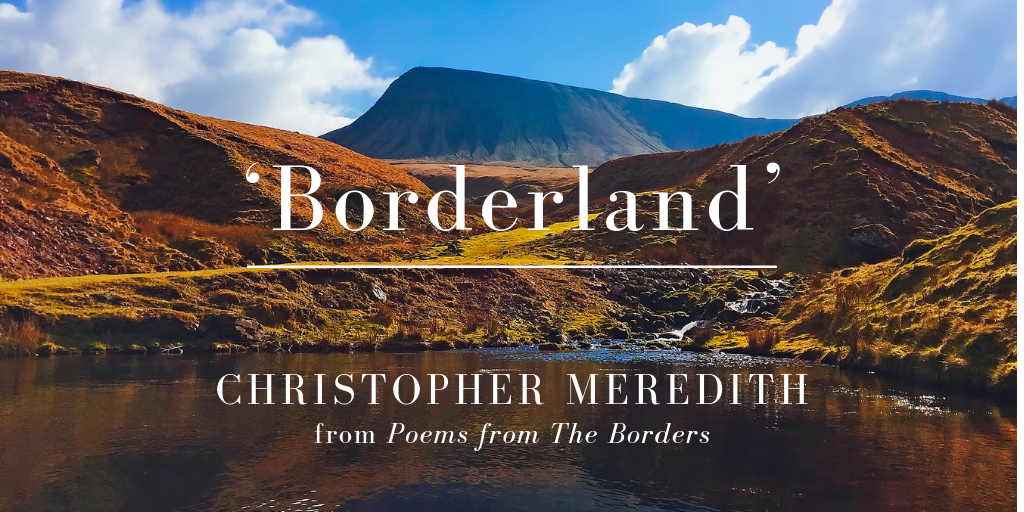
Our Friday Poem this week is ‘Borderland’ by Christopher Meredith.

Poems from The Borders is part of Seren’s pamphlet series celebrating the spirit of place. Featured poems range from “the spine of the A470”, through Monmouthshire, over the dramatic Brecon Beacons, and also through the Black Mountains towards Hay-on-Wye, towns in Herefordshire and Radnorshire and along rivers, the Wye and Severn.


Poems from The Borders is available from the Seren website: £5.00

Create your free Seren account and enjoy 20% off every book you buy from us.

Posted on

Friday Poem – ‘Easter Sunday, Table Mountain’, Graham Mort

With today being celebrated as Good Friday, and the start of the long weekend, we felt our Friday Poem for this week ought to fit the Easter theme. Today we bring you ‘Easter Sunday, Table Mountain’ by Graham Mort, found in his collection Black Shiver Moss.  

Happy Easter!

Graham Mort writes beautifully about North Yorkshire, but the poems in his tenth collection, Black Shiver Moss, include pieces about landscapes and peoples as distant as South Africa and as close as Europe. New places are made intimate and familiar by Mort’s vivid descriptions and evocations. Here is a traveller who has taken his destinations to heart, reproducing their weathers and textures with a startling exactitude and intensity. A poet who loves nature, particularly in the liminal states of dawn and dusk, Mort move us beyond the visible, towards spiritual and philosophical concerns.


Black Shiver Moss is available from the Seren website: £9.99

Create your free Seren account and enjoy 20% off every book you buy from us.


Posted on

Friday Poem – ‘Tenby Shores’, David Foster-Morgan

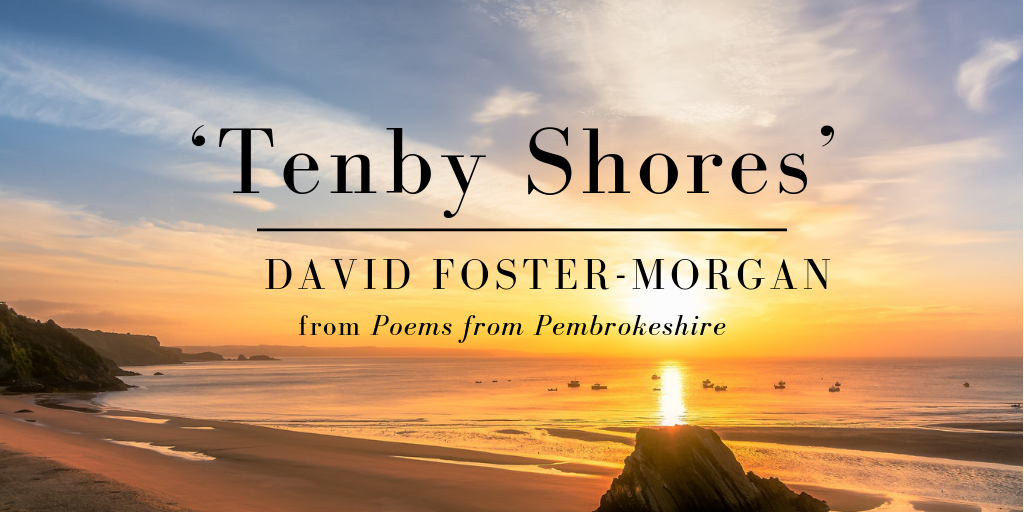
Our Friday Poem this week is ‘Tenby Shores’ by David Foster-Morgan.

Poems from Pembrokeshire is part of Seren’s pamphlet series celebrating the spirit of place. An area of supreme but also disquieting beauty, Pembrokeshire has been the home to saints and pirates, the cradle of Tudor Kings and subject to oil spills and annual invasions of summer visitors. The undeniable loveliness of its off-shore islands: Ramsey, Grassholm, and Caldey, contrasts with the often harsh life of settlers, of monks and sea-fishing folk of the past, such as the stoic ‘Boatmen’ of Tenby.


Poems from Pembrokeshire is available from the Seren website: £5.00

Create your free Seren account and enjoy 20% off every book you buy from us.


Posted on

Veganuary: Tips & vegan recipes from Sarah Philpott

Veganuary Sarah Philpott vegan

Forget the January blues – in recent years this cold and gloomy month has instead brought cooking inspiration and healthy eating ideas as ‘Veganuary’ has taken off.

What is Veganuary? Whether you’re new to the vegan diet or you’ve dabbled before, the idea is to cut out meat and dairy throughout January – and if you find you like it, then continue for as long as you’d like! To help kickstart your vegan journey, vegan cook Sarah Philpott, author of The Occasional Vegan, has some tips, tricks and recipes:

Sarah Philpott The Occasional VeganGetting started
Eating and cooking as a vegan might seem like a minefield but it’s simple once you know
how. Despite what your mother says, you’d be surprised by how little protein you actually
need and it can be found in a number of vegetables, beans and pulses. The same goes for iron, calcium and healthy fats.

Where to shop & what to buy – Can eating vegan be budget-friendly?
You might think that veganism is only for well-off lefties but it’s not a middle-class fad; it’s actually really accessible for those of us on a tight budget. Seasonal fruit and vegetables are cheap and plentiful, and beans, pulses, rice and other grains cost pennies. Meals like chilli, dhal and curry are tasty tummy fillers which, armed with a well-stocked cupboard, will cost you next nothing to make. You can buy big bags and tins of pulses for next to nothing from supermarkets and international stores, and pound or bargain shops often sell quinoa, nuts, seeds and dried fruit at a fraction of the price you’d pay elsewhere. Most supermarkets sell everything from plant milk to vegan cheese, as well as a variety of ready meals, and if you fancy a treat, there are plenty available, including vegan Magnums and Ben and Jerry’s. Most restaurants now offer a vegan menu and you can even enjoy a vegan sausage roll at Greggs.

Get started – try these vegan recipes!


The healthy meal:
Beat the Blues Salad
This vibrant and filling salad pairs smoky tofu with beetroot, orange and salty black olives.

Video credit: Manon Houston

Read the full recipe


The mid-week treat:
‘KFC’ – Kentucky Fried Cauliflower
This spiced, fried cauliflower tastes amazing and is surprisingly easy to make.

Video credit: Manon Houston

Read the full recipe


The decadent dessert:
Vegan Chocolate Mousse
This gorgeously light and creamy mousse has just four ingredients and comes together as if by magic.

Video credit: Manon Houston

Read the full recipe


We hope you feel inspired and ready to begin your voyage into veganism. Hungry for more great recipes? Get your copy of The Occasional Vegan from our website: £12.99

Create your free Seren account and enjoy 20% off every book you buy direct from us.


Posted on

Gen: An Interview with Jonathan Edwards

Jonathan Edwards Gen interview

Jonathan Edwards GenJonathan Edwards’ debut collection, My Family and Other Superheroes, was a triumph: shortlisted for the Fenton Aldeburgh First Collection Prize and winner of the Costa Poetry Award 2014.
Jonathan now returns with his wonderful second collection, Gen. How did the writing process differ this time, and what can we expect to see in the new poems? In this interview, we find out more about Jonathan and his new work.


How did the process of writing Gen differ from putting together your debut collection, My Family and Other Superheroes?
I think, like most people’s second collections, it was swifter, and I had more of a sense of what I was doing. I grew up at a time when the struggles of bands like The La’s to produce a follow-up to successful work were legendary, and the voice of those experiences sits on your shoulder. I wanted to maintain in this collection the strengths of the first book, writing about famous people and their interactions with the ordinary, focusing on Kurt Cobain’s mythical visit to the Newport nightclub TJs, or the impact on a young boy of watching the disgraced Olympic sprinter Ben Johnson racing in 1988. I also wanted to continue looking at a Valleys village life in surreal ways, constructing narratives about a village which is inundated by tourists, and another where a street is locked down for a day, and the residents decide to spend the time having a massive party. It was also important, though, to reach out in new directions. One of these was about incorporating other voices in the book. The collection includes a range of monologues, working with the voices of lions and servants, trees and cities, and I wanted to work with real voices too, interviewing some of the figures at the heart of the Welsh historical events which feature in the poems. I was also interested in echoing the collection’s central interest, of being young, through a wide range of experiences, looking at my own youth and the youth of my parents, but also considering youth through a range of events in Welsh history. What was it like for my grandfather to be young at the turn of the twentieth century in Newport? What was it like to be a child at Capel Celyn?

Gen includes poems that provide glimpses into pin-prick moments from the distant and not-so-distant past – for instance, ‘Servant Minding a Seat for his Master Before a Performance of The Rivals, Covent Garden Theatre, 1775’, and ‘Welsh Flag on the Wall of Richard Burton’s Dressing Room, Broadway, 1983’ – told from the perspective of the flag.  Is it more challenging getting into the head of an inanimate flag than, say, a family member?
Writing more monologues was one difference with this collection – I see the book as a boxful of voices you can open, and they all come out, some shouting in your face, some whispering in your ear, some sulking or stuttering, some jibber-jabbering on. I’d been lucky enough to be asked to teach a number of workshops, to all sorts of different groups, since the publication of the first book, and writing monologues is a great workshop activity – I use the great Carol Ann Duffy poem, ‘A Week as my Home Town’ as a way into writing about place. So it became inevitable that I would want to push my usual concerns – class, Wales, animals – through monologue. I say ‘would want to’ but this isn’t quite right. The truth is that the voices of these poems wrote them for me, and I sat there like a sort of court reporter or secretary, trying to keep up. Monologue is great for a writer because it allows you to go into other worlds and see and feel other things, all while sitting at a desk, clutching a pen. It can take you much farther than Easyjet, and it’s cheaper. You can open your eyes as a lion, see your reflection on the inside of the glass of your zoo enclosure, feel your lion-breath against the glass. Or you can rub your eyes again and open them in the eighteenth century, smell the stink of the streets, hear the bloke next to you, gossiping about your master, spot someone in a doorway over there, looking furtive, saying your name. Or you can wake up and be a whole city, think everything you think, explore all your nooks and crannies, your hilltops and waterways, feel how you feel for your rush-hour commuters and your lost-hearted rough sleepers. It’s magic that poems can do this. Charles Bukowski used to talk about writing a poem having to compete with a night out at the movies as an alternative form of entertainment for the writer. Monologue, and the promise of finding out in intimate and fascinating ways about completely alien experiences, is one way of getting yourself onto a chair to write.

Family is once again a central theme, and the small and unnoticed actions of family members often overshadow larger, less personal histories – for instance, the image of your grandfather tying people’s shoelaces together in ‘Harry Houdini on Newport Bridge, May 1905’. It’s obvious you take great joy in recounting these anecdotes – who can you thank for this interest in family history, and will we be hearing more wild tales of the Edwardses in future collections?
As with everything in life, really, I thank my mother and father for the existence of these poems. Also the South Wales Argus: the stories it features always have a decent chance of making it into my poems, and I would politely thank its writers and editors to remember this, when writing up their copy. My family has always been interested in its own history, partly because our history is so mysterious and obscure – World War One, for example, and the way my family seemed to roll down this valley, generation by generation, until I emerged, at the bottom, blinking, headachey and literate. In a framed black-and-white photo on the mantelpiece, my grandfather is the image of me, Brylcreem’d and watch-chained, blinking out of a black-and-white photo, yet I never met him. What was it like to wake up and be him? What were the smells and tragedies of his life? Writing about him can help bridge the gap between what I share deeply with him and what I know nothing of.

In terms of more tales of the Edwardses, they’re always on the go. Sinéad Morrissey’s On Balance is a magisterial, holy collection for me, and I especially love the ‘Collier’ sequence, about her grandfather. My maternal grandfather was a will-o-the-wisp character, all pinstripe suits and Woodbines, a rickety, backfiring Volkswagen Beetle and a grin from here to the end of the street. His experience, my nan’s experience, is something I want to shout and sing about – I don’t know what writing is for, really, if it isn’t to re-discover and celebrate their Workingmen’s Club and bay-windowed, permed or eye-sparkling lives.

How do you think your poetic style has evolved since the publication of the first book?
I often say, jokingly, at readings, that my poetry shows enormous evolution between books one and two: the first collection is made up of poems about my family, which often focus on famous people, while my second collection is made up of poems about famous people, which often focus on family. One thing I wanted to do in this collection was explore more fully the ground I’d sketched out in the first book, to approach those themes from different directions and travel into them farther. In my first collection, I was interested in the history of Wales, writing about Chartism and the North Wales village of Capel Celyn, drowned in the 1960s in order to create a water source for Liverpool. Capel Celyn is a resonant, echoing subject in all sorts of ways – the human experience of losing your home, the relationships which people would have sustained and developed, as well as the political implications of this episode, and the way it drove Devolution. Additionally, as someone who lives in a tight-knit village community, my heart is in this place and in its loss. One thing I was keen to do, then, was to get the voices and the real experience of Capel Celyn into the writing. It turned out that David Walters, who was arrested for one of the first attacks on the dam site at Tryweryn, is from just up the road from me in Bargoed, and I am really grateful to him for the interview which resulted in the ‘Cofiwch Dryweryn’ sequence. Equally, these poems are indebted to a number of important books which serve this subject, including Einion Thomas’s Capel Celyn: Ten Years of Destruction and Owain Williams’s first-person account, ­­­­­Tryweryn: A Nation Awakes. The poems in Gen which mourn this experience are a baby step towards the book of poems which is needed on this subject.

Your poetry displays a deep and constant affection for the Welsh landscape and experiences of your youth – even down to the mess and madness of an illicit party: ‘there / was chaos, carnage, every pot plant / an ashtray, every ashtray a sick bag.’ (‘House Party at Tanya’s, 1995’). Your poems certainly aren’t rose-tinted, and yet they hold onto a sense of celebration. Do you hope readers will share that sense of fondness and familiarity?
One of the reasons I write is that it makes time travel possible. Once I get the notebook and the biro up to 88mph, I can get there. Time is clearly a concern across both collections, and I love that I can step into a room, scribble a line, and be in another time. Some of these are times before I was born – I like hanging out with my parents in the years before I knew them, and seeing what they were like, or spending time in a poem with a grandfather I never met. I love that poetry can be a way of talking to people who aren’t there anymore, because they aren’t themselves any more, and some of these people are past selves. Either poetry is a loudspeaker shouting across time, or else it’s a box you put yearning in to store under the stairs. Like lots of people, I guess, I know exactly the second of my life I would go back to if I could, and what I would do differently. The poems in this collection about house parties and school days, my father crashing a car in 1965, my mother cutting her arm in 1955, my uncle smoking a pipe in 1986 – it’s all a way, I suspect, of addressing that.

Anyone lucky enough to have seen you perform will know that you are as entertaining in person as you are through your poems. What events and projects do you have lined up?
From now until August, I seem to be reading everywhere that will have me, and several places that won’t, from Cardiff to Cork, from Merthyr to Mitcheldean. This is one of the best things about poetry – hitting the road and seeing what happens to you, meeting the artists, the enthusiasts, the personalities who keep poetry going up and down the country. This time round, it will be about re-connecting with people who are now friends, and I love that poetry has made that happen. As my sinister mega-global marketing campaign has it, all events will be advertised on the Seren website. I love teaching poetry and working with other writers to help them develop, and am really excited about my upcoming courses for The Poetry School and Tŷ Newydd. This month, the Poetry Society will be launching a film of a poem I wrote in celebration of the Monmouth and Brecon canal, made by Chris Morris of Falmouth University. I’m really proud of this work and really excited about the opportunity to sing for a place that has always been really important to me, a place I splashed and grew up in. There are some other exciting things coming up which I’m not allowed to talk about yet and other crazier, wilder projects, including zoo animals and Valleys school children, installations and chaos, I hope can happen, if I can talk the right people into it. Most important will be finding the time to scribble new poems. Whatever else the future holds, whether it’s time travel or history, voices or narrative, I very much hope there’s a lot more writing to be done.


Local to Cardiff? Catch Jonathan at the Seren Cornerstone Poetry Festival – he will be in conversation with Christopher Meredith and Archbishop George Stack in the ‘Afternoon Tea: Generations’ event, 9 February. Tickets include a generous selection of cakes, pastries and sandwiches. Book now.


Gen is available from the Seren website: £9.99

Enjoy 20% off every book you buy from us when you create your free Seren account.


Posted on

Peter Jones: on editing my father’s letters

Peter Jones Dear Mona Letters

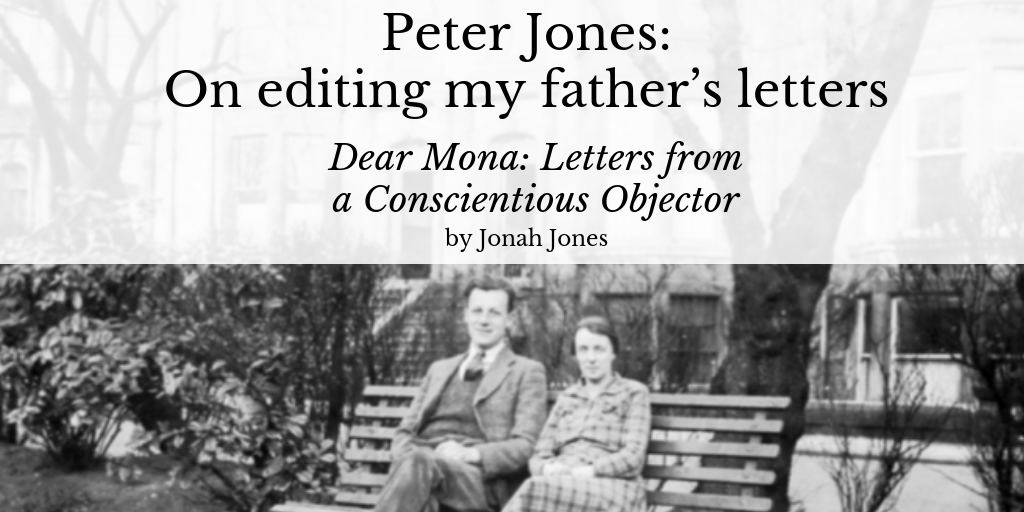
In Dear Mona: Letters from a Conscientious Objector, we are given a window into the life of Jonah Jones through private letters to his close friend and mentor, Mona Lovell. We see his character evolve as he nurtures his love of art and sculpture, and finds new ways to express his creativity.

A pacifist, Jones at first declined to enlist when war broke out, but later served as a non-arms bearing medic in the Second World War. His letters give an emotional insight into the prejudices he faced and the reality of his wartime experiences. Peter Jones, Jonah’s son, has edited this fascinating book and here gives insight into the difficult process of bringing its intimate contents to print.


Deciding to publish my father’s letters to Mona was both an easy step and one of the hardest things I have had to do.

Easy because of the quality of the writing and the interest the material holds. There is a clear narrative arc to the letters as the intense relationship between Len Jones (as my father Jonah was then known) and his friend and mentor Mona Lovell develops, and he simultaneously stumbles towards his vocation in art. This makes them a very satisfying read, and gives the whole a novelistic quality. Along the way we get fascinating insights into the life of a conscientious objector in the Second World War, vivid descriptions of action after Len joins the 6th Airborne Division as a non-combatant medic, and powerful accounts of the tension in British Mandate Palestine in the run-up to the birth of the State of Israel.

Len Jones, 1945
Len Jones, 1945
‘…there is no hysteria – only a desperate apathy & an anxious searching for belongings as they come from their cellars or from a few miles back. Once in the back area again they begin to smile even, as the war moves on & they feel safe again – but many have lost what can never be replaced…’

All of this compelled publication. Yet at the same time I wavered, for my father was a very private man in some ways, and I knew he would not have been glad to see these letters released to the world. They cover a time when he was mainly unhappy, a time he preferred to forget. And of course, fundamental to my whole dilemma, was his relationship with Mona – she was in love with him, he looked on her as a soul-mate whom he valued dearly as a friend but could not love in the way she wished. It was extremely hard to lay all this open before a reading public.

Len Mona
Len and Mona relax in the park

So the question arose: could I make the insightful, non-personal material available without publishing the deeply personal side of the letters? Yes, but this would run the risk of creating a narrative without a narrative, for Len’s relationship with Mona (and, to a lesser but still important extent with the poet James Kirkup) is the spine of the whole story. Most crucial, cutting out the personal would diminish Mona to little more than a sounding board for Len’s thoughts and experiences. This would be a grave injustice, for it is clear how vital she was in Len’s transition from his constricted working class roots to the man who could express himself through art. Too often women have been relegated to the shadows of history; Mona did not deserve this fate.

Dear Mona
Mona Lovell, 1935

So, with qualms, I decided to lay out the whole story. It reveals so much: how life was for conscientious objectors in the Second World War (we have heard a lot about their brave predecessors in the Great War, but much less of Len’s generation), the widespread frustration people suffered due to their lives being suspended by the war, the congenial debating society that was Carmel College in Haifa, where servicemen and women did university-style courses prior to demobilization. Some of the issues touched on in Len’s letters seem remarkably topical, especially the Arab-Israeli conflict and anti-semitism (whether among forestry workers in Yorkshire or British officials), and homosexuality, on which he evolved from unthinking revulsion to deep compassion. These letters are compelling; the world should see them.

Peter Jones.

Posted on

An interview with Christopher Meredith

Christopher Meredith interview

Brief Lives Christopher MeredithChristopher Meredith is an award-winning author of fiction and poetry. He has published four novels, three full poetry collections, and several shorter works. He is also the subject of a new Writers of Wales critical study, written by Diana Wallace.
Meredith’s new book, Brief Lives, is his first venture into short story writing – and its release comes thirty years after his groundbreaking debut novel, Shifts.

In this interview, Rosie Johns asks Chris about creative inspiration, the impact of personal experience, and the challenge of playing with tone and style in the short story form.

In the acknowledgements, you mention that you felt Brief Lives is an unoriginal title; what about it was so important to the collection that you decided to keep it anyway?
It’s not that I feel the title’s unoriginal – it is. Apart from the famous John Aubrey book from the 17th century at least one novel, other story collections, various book series and radio series have used this title. It was simply my working title as the book evolved, and it grew to fit. Ultimately the publisher registered the ISBN under this title without checking with me and there we were. In some ways that was a relief as it was probably the right title all along, and the subtitle six fictions does a bit of extra work.
Calling this book Brief Lives was a bit like a composer calling a piece Nocturne or Study or Caprice. It draws on a myth kitty of shared knowledge and expectations and suggests both form and theme. But the two words are very charged. As used originally for Aubrey’s short biographical notes on real people, the word ‘brief’ implies that the writing is not the whole story. In its origins, ‘brief’ can mean a summary, or better a compression. In one story, ‘Progress’, the young man standing on a bridge actually uses the word ‘summaries’ to describe, euphemistically, a blaze of powerful memory that’s just run through his head. While a summary can sound like an arid thing, it can also suggest; its compression can expand in the mind after the reading. A few reviewers have commented on the intensity of this book which perhaps is an effect of those compressions opening in the mind.
So it’s the writing that’s ‘brief’, but of course there’s the thought that life itself is brief too, and the fact of mortality haunts this book. Every story touches on death in some way. The powerful conflation of art and reality in that double meaning partly explains why the title has such a draw.

The story ‘Opening Time’ features in two very different books: Snaring Heaven and now Brief Lives. What drives your certainty that it belongs in both, despite their differences?
Snaring Heaven is a collection of poems. There are echoes and connections between that story at the end of the collection and other poems in that book and also its title; exactly the same thing happens in different terms in Brief Lives. There it gathers many of the elements and effects of the previous stories and goes beyond their various realisms. Readers can compare the two books and decide for themselves.

Does writing about Wales in English differ from writing about it in Welsh? And if so, how?
I’ve written little in Welsh and in all my writing I hardly ever write about Wales. It’s not a subject but often, perhaps always, part of the context. The one difference I can think of is that when writing in Welsh that context is manifest. Of Wales, not about.

How much of your own experience is reflected in the three stories that take place in Wales, and how is this influenced by the connection between place and memory, as demonstrated in ‘The Enthusiast’? And in stories with less explicit locations, how else do your experiences inform the narrative?Everything you write has to come from somewhere in your own experience, even if that experience is sometimes reading, research, dreams, stuff overheard, something glimpsed, stuff at second or third hand, etc., and all of that’s then transformed in the imagination and the process of writing. In that sense, everything in the book comes from that slippery thing ‘experience’, and I don’t see the value in looking for differences in how that plays in relation to ‘place’. The mediation of that stuff into the final story can be immensely complex and obscure. I’ve never waded into a cold river to rescue a child as happens in the supposedly realistic and located ‘The Enthusiast’, but it became useful for the story to imagine how that would feel. On the other hand, in ‘Haptivox’, one of the strangest and least ‘realistic’ stories, though I’ve never magically changed sex, as happens there, I have noticed a bird looking like a comma hanging on a sawn branch, and I’ve swum in ocean so clear that you can see the sea bed vividly even at quite great depths. Anyway, the story you write doesn’t care about you or your experience. It just has to work.

‘Haptivox’ certainly stands out with its more ambiguous sense of place, and the science fiction elements. How did this change of tone affect your portrayal of individuals and their internal lives?
I think there are shades of ambiguity in relation to both place and genre. Formally, ‘Haptivox’ is similar to the opening story ‘Averted Vision’ in that it’s broadly third person, inhabits two points of view, and is divided into short sections. The two stories, I hope, share an unreal and intense quality. The exact setting for ‘Averted Vision’ is never made completely explicit. I hope it’s more vivid for that; there are clues and it’s roughly guessable. A date and place are given away only in the cover blurb in fact, not in the story. For the characters, the nightmare time at sea feels dis-located in time and space, unreal, and the word ‘real’ plays a key and dark part in the story. Fewer suggestions for location are needed for ‘Haptivox’ to work. But the potential of short fiction to reach for the simultaneously emblematic and, I hope, psychologically rich and convincing is at work in both, perhaps all, the stories, but in nuanced ways. The two overwrought young soldiers in ‘Averted Vision’ are named because they’re both male and I need to distinguish between them. The man and woman in ‘Haptivox’ are unnamed because ‘he’ and ‘she’ can do all the work. But at the same time that works in an emblematic way with the fact that story is partly to do with maleness and femaleness. In that sense ‘Haptivox’ moves towards the more manifestly general. But in every story I think I found myself looking into brief, often small moments in lives and at the interplay between moment and memory in isolated people to gain vistas into vast and perhaps shared spaces.


Brief Lives is available from the Seren website: £9.99

Create your free Seren account and enjoy 20% off every book you buy from us.


Posted on

An interview with Cardiff author & legend, Peter Finch

Interview Cardiff Peter Finch

The Eisteddfod will soon be in full swing in Cardiff’s beautiful Bay area. We can’t wait to welcome you to Wales’ capital city – and to introduce you to our resident Cardiff expert, Peter Finch, who will be signing copies of his new book on the Welsh Books Council stand (84) on Wednesday 8 August, 1:00pm.

As you prepare for the marvellous week ahead, we thought you might enjoy learning a little more about the Welsh capital – so here is our interview with Peter Finch, who – as ever – is full of fascinating insight into his home city.

Peter Finch

Peter, you have been writing about Cardiff for quite some time now, with the first ‘Real Cardiff’ book having appeared in 2004. What do you perceive as the most radical change Cardiff has undergone in the last decade?
Changes to Cardiff seem to work in twenty year cycles rather than decades.  We didn’t have the Bay nor the Barrage, the Millennium Centre not the Senedd in 1980 but by 2000 we did.  In 2000 and other than right on campus there was barely a purpose-built student let available anywhere in the city.  Today they are everywhere, gargantuan, gleaming, glowing, growing, rocketing up in every district from right next door to the old Gaiety Cinema on City Road to the city’s highest of new high rises, the Bridge Street Exchange, at the bottom of Charles Street.  In the pipeline are plans for more.  Purpose Built Student Accommodation (PBSA) erected against a background of weak planning control and easy to manage building regulation they are the cash cows of property developers everywhere.   Put them up and then apply for change of use.  The cityscape will never be the same again.  In 2000 we had a green belt running right round the city.  Today that belt has shifted to become instead a green wedge, a green splash, a green smear.  In its place are the city’s new districts.  Plas Dwr, Churchlands and all the others. Cardiff expands. And expands. And expands.

The ‘culinary odyssey of City Road’ is marvellously well documented in Real Cardiff: The Flourishing City. For hungry Eisteddfod-goers, where would you recommend trying first?
.CN, the internet suffix for China, is the name of the city’s best Chinese eatery by far.  Here you can get top end Sichuan king prawn in chilli and pepper sauce, healthy option Kung Po chicken, and north east China salad in a style you’ll find hard to beat anywhere else in the city.  Failing that and for kebab fans Al Wali’s Omani Restaurant half way down and hiding behind a bus stop is pretty decent.  For Omani read Persian or Iranian or Egyptian, or Middle Eastern.  City Road is a feast from one end to the other offering meals at price points everyone can reach.

If you could be transported to any period of Cardiff’s history, which would you choose?
I think I’d want to see the heroic period of Cardiff’s industrial expansion in action first hand.  That would mean arriving in 1861 at the Royal Arcade and finding the very first Cardiff Free Library on the first floor.  Out the back they’d have a time machine, naturally, so having got here I could then get back.  I’d use it to slide back a further few years to 1849 to see Brunel move the Taff in order to build Cardiff General Rail Station for his South Wales broad gauge railway.  I’d spot a few numbers and then rush forward to 1886 to visit the brand new Coal Exchange, have a drink in the just opened Grand Hotel on the new Westgate Street, buy some cockles at the brand new indoor market and finally climb up the shiny new statue of John Bachelor to top his head with a road mender’s lamp, traffic cones not yet having been invented.   This was the period that made Cardiff, when the population boomed and when modern invention and business innovation flooded the place.  That flourishing must have been simply thrilling to watch.

Psychogeography is a particularly inventive way of mapping a place – how did you first become interested in it?
The Situationists who flourished between the fifties and the seventies were international social revolutionaries and avant garde artists.  I was running the journal second aeon at the time, a Welsh-based home for a world of avant garde poetry, so naturally I took note.  These people interested me.  They were an onward growth of the Dadaists and the Surrealists and seemed to me to be right at the cutting edge.  One of their members was Guy Debord ­– the man who invented psychogeography, the exploration of mainly urban environments for what they were rather than where they led.  The sense of place became more important than the place itself.  Why not view a city as an entity rather than a destination?  This was something I needed to try for myself.

Peter Finch Real Cardiff Flourishing CityWhat did you find most challenging in your process of writing Real Cardiff: The Flourishing City?
In writing these books you don’t sit about waiting for inspiration to strike, no hoping for those rays of Blakean stuff to come pouring down through the air and infest your work.  None of that.  This is work..  I need to immerse myself in my subject. Research it, walk through it, think about, talk about, listen to it, feel it.  I make notes.  Constantly.  I record things on the camera, take snaps, use the phone.  I check out the maps.  I check out the old ones and then the new ones.  I check  just how the used to spell the name of the place I am interested in.  Why was Rumney called Rompney? Why was Cardiff called Kairdiv?

I accumulate what I need to say and then find a way of starting out and saying it.  The starting is so important.  Get that right and the rest will flow. I work hard walking and thinking, note book always with me, and into it I make notes of how my start might go.  The walking helps the flow.  I ignore passers-by, I ignore interrupters, I am working so this poor and rude behaviour is entirely reasonable.

It’s also true that you then need to check and then check again.  I reread and redraft.  I get help from others to check too and I listen to what they say.  I recheck my spellings.  I look at what others have said and I try not to repeat them.  I acknowledge them if I do.

What’s the most challenging?  Transcribing interviews.  Getting that right.  And remembering to ask the right questions in the first place.  I always double check with my interviewees.  I let the subject see what I intend including and ask them if they are happy.  If they aren’t or I’ve got it wrong somehow then I put it right.

And finally, in the closing pages of The Flourishing City, you wonder about Cardiff ‘how it could be’, and tell us, ‘Cities are never finished’. Is it also true, then, that you’ll never be finished exploring this city of yours?
I think that once a city gets above a certain size there will always be new things to discover about it.  Not only is Cardiff big enough to keep me permanently involved but it is also changing constantly, often at a bewildering rate.  No matter which part of it I find myself in there are always new things to look at, new roads to walk down, new paths to follow and new routes to create.  Tracking the lost can be just as thrilling as delighting in the newly discovered.  The moment I finish a volume of Real Cardiff something new or different or previously unseen appears.  Buildings get built.  Buildings get torn down.  Populations flourish.  Roads and walkways bend and turn offering new and different vistas.  This capital of ours is a great Welsh place, far more involving than most people think. Try it. Just arrive and open your eyes. Real Cardiff: The Flourishing City will give you a few hints.


Real Cardiff: The Flourishing City is available from the Seren website: £9.99

Join our free Book Club for 20% off every book you buy from us.


Posted on

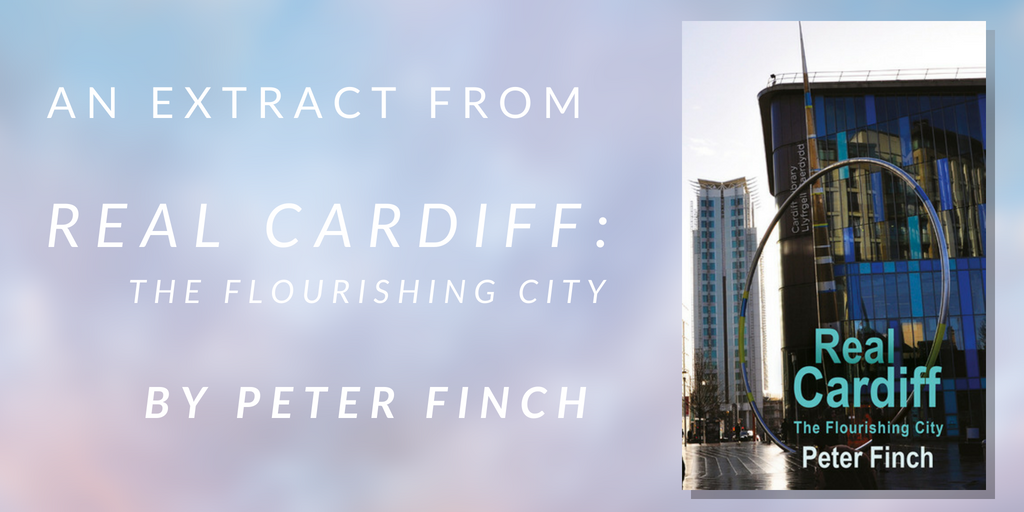
An extract from Real Cardiff: The Flourishing City, by Peter Finch

Real Cardiff Peter Finch extract

Though certain parts may be seeing rain this weekend, the warm weather continues – and what better time than summer to explore all the UK has to offer?

Peter Finch Real Cardiff Flourishing CityOur Real Series – a collection of intimate and entertaining guide books written by local writers – offers an insider’s view of the places it celebrates. The most recent addition to the series is Real Cardiff: The Flourishing City by Cardiff author and legend Peter Finch. So whether you’re an armchair traveller, or someone looking forward to a trip to the Welsh Capital sometime soon, we hope you enjoy this glimpse into the history of Cardiff – specifically, the area in which famous children’s author Roald Dahl grew up.

The whole of the Real Series – and all our other Seren books – are 50% off until midnight, Sunday 29 July, on the Seren website.


ROALD DAHL’S CARDIFF NORTH LEY

I catch the train at Cardiff Central. This is the City Line which began in the city’s north east and now, after looping in a great U through the city’s heart is about to head north again. I’m in the two-car Sprinter and I’m standing. Every single seat is occupied by pupils from Bishop of Llandaff High School. Kids, bags, blazers, headphones, chewing.
The windows stream as the train steams. Around us is railway land, an industrial cityscape full of rail sheds, engine bays, carriage washeries, repair shops and assembled new track in stacks like a giant train set. This south west of the city on view from the tracks is the capital with its guard down. Backs of mosques, tottering streets, unkempt gardens, the yards of Brains brewery, warehouses stacked with building materials, and even more open and right now empty rail beds. It reminds me of London, how the land looks as you reach Paddington or Waterloo.
But it doesn’t last. After the carriages have disgorged a hundred uniformed school kids at Fairwater, the cuttings emerge, wooded banks and scrub masking the housing above. It’s leafy suburbia giving an impression of empty countryside. A green west Cardiff, a place that doesn’t change.
It’s freezing. This is January. The train has reached Radyr where it will rest a while before returning the way it came. I’m off, up the footbridge steps, plastered thickly with Network Rail road salt. No one but no one will slip and sue here. In a previous, smaller, steam-filled incarnation, the Radyr train would have served Roald Dahl’s father, Harald, who did a daily commute in to what was then called Bute Road Station. His ghost is there on the platform now, eye glasses, three-piece suit, white starched collar. He looks like a disapproving headmaster. His railway season ticket was found inside his expensive leather wallet when he died in 1920. That was on April the 11th. The ticket was valid until the 23rd.
Like most in Cardiff at this time Harald’s business was coal. With his partner Ludvig Aadnesen he had established a business as a colliery agent and provider of all that ships docking in the world’s leading coal port would need. Provisions, ropes, oil for their lamps, food. The profits flowed.
In 1917 Harald had bought Tŷ Mynydd (Mountain House), set on rising ground a mile north of the Radyr rail station. As befits the successful businessman Harald was, here was life on a grand scale. 150 acres of land, outbuildings, cottages, a piggery, lawns, formal flower borders, terraces, its own electricity generator and an enormous Victorian house.
In photographs it looks like part of Hogwarts. It had multiple chimney stacks, mock Tudor gables, a tiled roof larger than most churches’ and greenhouses to the side to rival those of Dyffryn House, to the west of Cardiff. This is the place Roald, the great author, remembers with nostalgia, recalling the fields full of shire horses and dairy cows. There are photographs of him as a four-year-old out on the lawns and terraces, in the fields among the sheaves of corn, sitting on the wall of the piggery and of the house itself, which is resplendently decorated with both the Union Jack and the Norwegian Flag. No Welsh dragon in sight.
Like Cefn Onn, Tŷ Mynydd also had railway connections. The house had been built in 1883 by George Fisher, Director of the Taff Vale Railway. When he died in 1891 the property passed to his son, H. Oakden Fisher, Chair of both the TVR and the Cardiff Gaslight and Coke Company Ltd, although his real interest lay with the military. He was Lieutenant Colonel of the Glamorgan Volunteer Artillery. Harald bought the estate in 1918. When he died in 1920, his second wife, Sofie Magdalene, moved to smaller premises back in Llandaff. Tŷ Mynydd then became the property of the architect Sir Beddoe Rees, MP and for a brief time in the 1930s was turned into St Maur’s College, a small private boarding school for girls.
In 1967 the house and most if its outbuildings were demolished. This was the first full-blooded rush at clearance following the war. Cardiff was expanding. Property developers had no interest in the preservation of inefficient, draughty piles such as Tŷ Mynydd. On its lands a whole housing estate could be build. It had to come down.
I take the road up out of the station’s gully. Already the old shunting yards and waste ground lining the river have been populated with high density brick town housing. There’s little public space. Most structures are distinct from each other, laid at angles as if thrown there like dice. Room for breath is restricted and corners are rounded. Access is on turning roads named after De Clare, Norman Lord of the City, Aradur Hen, an ancient local croft that gave us the name Radyr, and Goetre Fawr, the farm that once worked these lands. Behind the aptly named Junction Terrace is a field replete with three grazing llamas, tall-necked beasts which, despite the ll of their name, are about as common in Wales as kangaroos. Food To Go which has signs offering coffee and warmth is closed. I head up along rising Heol Isaf in the direction of the Village of Fire.
In 1841 the ten cottages of Pentre Poeth (Warm Village) were all that existed of what is now Morganstown, upper Radyr – that part of Cardiff north of the M4’s périphérique grip. This is where the workforce of the developing fire-filled ironworks at Pentyrch lived, an element of Cardiff’s lost industrial heritage. Heol Isaf was and still is the main road to Tŷ Mynydd. It’s no distance to cover. In my ears I’ve got Emmylou playing through the buds. 1970s country, when what she sang was the edge. Alabama down home. Dahl wouldn’t have stood for this. He preferred Beethoven.
The Tŷ Mynydd estate has been built on; the fields are gone. The line of the original entrance path running up from Tŷ Mynydd Lodge has been preserved in the rising bends of MaesYr Awel. The detached late-sixties houses along it turn eventually to a U-shaped cluster of apartment blocks. Cwrt Tŷ Mynydd is the appropriately named first; after that the developer gave up and resorted to names with a strong English resonance – Norfolk Court, York Court, Windsor. It’s a marketing thing. Here, near the eastern edge of Wales, where the language thins, the Anglo norm dominates.
Beyond the apartment courts, circled like a residential wagon train, there’s a copse, ancient pine trees, all that remains of what once was here. For the Dahls of the nineteen teens this would all now be virtually unrecognisable. A local walking his young daughter to the primary school at the former estate’s southern end tells me, yes, he knows about Dahl and the great house. He points me back towards the still extant Tŷ Mynydd Lodge which faces Heol Isaf. And there it is, the gatehouse preserved, doing time now as an up-market B&B. The Llandaff Society have installed a celebratory plaque above the front door. Over the years since Roald would have known it the building has been much extended. But there’s enough original left for the Dahlian spirit to soar. I can see him outside, short pants, laced leather shoes, hat, overcoat with enormous buttons. Mama holding his hand.


Real Cardiff: The Flourishing City is currently half price on the Seren website: £9.99 £4.99

Thinking of visiting cities elsewhere in the UK? Find the perfect insider’s guidebook to enrich your trip:

Poet Ian Spring overlays the current map of Glasgow with the map of his memory and experience.
‘Bard of Barnsley’ Ian McMillan delves into the past of the area of South Yorkshire in which he was born and still lives.
Poet Chris McCabe looks at the art, attractions and ‘oozy’ docklands history of this slice of London.
Novelist Clare Dudman explores her richly historic city as you won’t find it in other guidebooks.


See the full list of Real books on the Seren website: all half price until midnight, Sunday 29 July!

Posted on

An extract from The Wellspring by Barney Norris

Barney Norris The Wellspring extract

‘A rare duet, in which father and son rediscover a whole world through the redeeming power of art.’
– Declan Kiberd

Barney Norris The WellspringIn The Wellspringacclaimed novelist and dramatist Barney Norris conducts a conversation with his even more acclaimed father, the pianist and composer David Owen Norris, on creativity, cultural identity, and how the two intertwine.

In this free extract, the conversation between father and son turns towards David’s career as a pianist: how it began; the impact of failures and accolades; the strangely altering milestone of 30.

This extract begins on page 87 of The Wellspring.

Playing

BN: I’ve titled this second sequence ‘Playing’. Ostensibly, what I hope to cover here is the bulk of your professional life – your work as a performer. But I have it in my mind as well that what we’re circling is one person’s route into a life, into living well, and I want to draw attention to that as we begin. This book will take the same path everyone does as they find their way into the world – first we listen, then we simulate, then we live. In some lives, I don’t think the path is as easy to trace. Not everyone has a vocation. Not everyone’s entire life can be expressed as the development of a single project. Of course, your life isn’t adequately summarised if we turn it into a single developing theme, either. If we were to exhaustively catalogue everything you’ve ever done, a meaning would emerge that was too diffuse and complex to express – or you might end up with a catalogue of infinite drift, I don’t know how open you are to the idea that lives have inherent meanings at all, or whether it’s fairer to say all narratives are superimposed. But the opportunity we have here is that it’s in the nature of an artist’s career, where the life feeds the work and the enthusiasms are buried deep in childhood and the work is all-consuming, that a narrative can be constructed more easily than is usually the case that expresses something like a linear development through life. So when looking at an artist’s life, you can say things about the way all people move through time more easily than you can with some other careers. The milestones are easier to make out. So for the purposes of this book we’ll read your performing career as a second stage in a development that leads, eventually, to the writing of music. Not an adequate summation, but perhaps it’s an interesting one, you see the two as connected?

DON: It was the break-down of my early composing career that led directly to my performing career. I’ve already hinted that my composing didn’t go down too well in 1970s Oxford, though come to think, I left with a composition scholarship to the Academy. But the contemptuous reaction to my B. Mus exercise a year later – ‘This fugue subject implies harmony’ was one criticism I still recall with some puzzlement – and the prevailing narrow taste in ‘modern music’ funding circles, led me to concentrate on something I did to everyone’s satisfaction, namely, play the piano. Young performers play a wide range of music, partly because they know they need a wide range of experience, and partly for frank commercial reasons, and so I formed hands-on opinions of the work of still-living composers like Tippett & Britten & Messiaen, and I gave innumerable premieres of works by composers now forgotten.

BN: It’s a very interesting environment, the generation of contemporaries one works with at the beginning, before it’s clear who’s really going to make it. I’ve been going through that myself for the last few years – it’s still a bit too soon to tell which of my generation of theatremakers will one day be filed under that ‘now forgotten’. Because there’s no precise formula for identifying the ones who’ll last, is there. It’s not only talent, it’s not only prevalent fashions in funding circles, it’s not only luck, it’s not only hard work, it’s not only whether you choose to have a family, or where you’re from, or who you know; it’s not even whether you’re someone that anyone likes. It’s terrifying, because of course, after the first six months when a few people who thought they were serious wake up and back out, anyone who’s tilting at the windmill of the arts can’t imagine doing anything else, and doesn’t have a back-up plan, even though some will end up needing one. The arts are so hard to break into, you’d never do it if you were capable of doing anything else. But it’s also a very wonderful moment, because, in a Schrodinger sort of way, you live suspended in this moment where anything might be possible for you and your friends – even if in actual fact, when you get to the end, you will look back and find that it wasn’t.

DON: ‘Now forgotten’ sounds callous, doesn’t it? I meant it more as a merciful imprecision. Your list of things that need to slot into place is pretty scary – and very carefully ordered! Academy Professors, as I discovered when I became one, all agreed that we should exert ourselves to the utmost to put students off, because only the students that can’t be put off stand the slightest chance in the business. Good as far as it goes, but things change, become less narrow – good changes as well as bad changes. Some of the less positive changes at institutions of higher education are down to money, which has all sorts of repercussions – not all new courses fill purely educational needs. Then, if half the population is going to university, degrees will need to change, not necessarily for the worse: but we need to make sure that the former methods of study, where they were valuable, can be continued – which has emphatically not happened in secondary school music.

But there are positive changes too. I’m thinking especially of social change. What’s often called dumbing-down (something I’ve hinted at in the previous paragraph) can also be seen as a welcome acceptance that art need not always be on the verge of unintelligibility to be worthy – which is why my music can reach listeners now, though it was so out of tune with the seventies. Another helpful social development is a public acceptance of the portfolio career. We can take real advantage of the new opportunities the twenty-first century has brought us, the communications revolution. I wonder if I could have created a taste for my sort of music back in the seventies, if we’d had the Internet. But it lumbers up too late, like Chesterfield coming to the assistance of Dr. Johnson. Still, it gives us new ways to reach audiences, if only we had time to develop them.

BN: You told me once that the thing to watch for was what happened when everyone turned thirty – it was around then that things started shaking out. Having turned thirty not so long ago, I can increasingly attest to the truth of this. Did that advice come from personal experience?

DON: Observation rather than experience, luckily. There were so many schemes and scholarships that you could compete for till you were thirty. After that, you were on your own, and many winners didn’t make the change into actually earning a living. It’s an age that concentrates the mind in many ways. Clocks are ticking, clocks of self-esteem as well as of biology. Is it still too late to become a bank manager? we used to ask ourselves back in the day, in blissful ignorance, probably, of how difficult it is to be a bank manager.


The Wellspring is available on the Seren website: £12.99

Join our free Book Club for 20% off every book you buy from us.