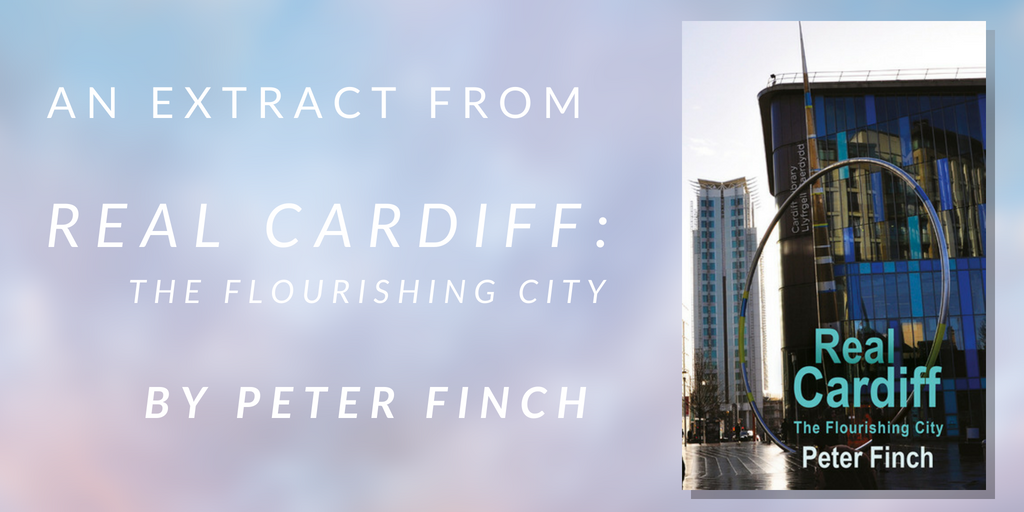
The Eisteddfod will soon be in full swing in Cardiff’s beautiful Bay area. We can’t wait to welcome you to Wales’ capital city – and to introduce you to our resident Cardiff expert, Peter Finch, who will be signing copies of his new book on the Welsh Books Council stand (84) on Wednesday 8 August, 1:00pm.
As you prepare for the marvellous week ahead, we thought you might enjoy learning a little more about the Welsh capital – so here is our interview with Peter Finch, who – as ever – is full of fascinating insight into his home city.

Peter, you have been writing about Cardiff for quite some time now, with the first ‘Real Cardiff’ book having appeared in 2004. What do you perceive as the most radical change Cardiff has undergone in the last decade?
Changes to Cardiff seem to work in twenty year cycles rather than decades. We didn’t have the Bay nor the Barrage, the Millennium Centre not the Senedd in 1980 but by 2000 we did. In 2000 and other than right on campus there was barely a purpose-built student let available anywhere in the city. Today they are everywhere, gargantuan, gleaming, glowing, growing, rocketing up in every district from right next door to the old Gaiety Cinema on City Road to the city’s highest of new high rises, the Bridge Street Exchange, at the bottom of Charles Street. In the pipeline are plans for more. Purpose Built Student Accommodation (PBSA) erected against a background of weak planning control and easy to manage building regulation they are the cash cows of property developers everywhere. Put them up and then apply for change of use. The cityscape will never be the same again. In 2000 we had a green belt running right round the city. Today that belt has shifted to become instead a green wedge, a green splash, a green smear. In its place are the city’s new districts. Plas Dwr, Churchlands and all the others. Cardiff expands. And expands. And expands.
The ‘culinary odyssey of City Road’ is marvellously well documented in Real Cardiff: The Flourishing City. For hungry Eisteddfod-goers, where would you recommend trying first?
.CN, the internet suffix for China, is the name of the city’s best Chinese eatery by far. Here you can get top end Sichuan king prawn in chilli and pepper sauce, healthy option Kung Po chicken, and north east China salad in a style you’ll find hard to beat anywhere else in the city. Failing that and for kebab fans Al Wali’s Omani Restaurant half way down and hiding behind a bus stop is pretty decent. For Omani read Persian or Iranian or Egyptian, or Middle Eastern. City Road is a feast from one end to the other offering meals at price points everyone can reach.
If you could be transported to any period of Cardiff’s history, which would you choose?
I think I’d want to see the heroic period of Cardiff’s industrial expansion in action first hand. That would mean arriving in 1861 at the Royal Arcade and finding the very first Cardiff Free Library on the first floor. Out the back they’d have a time machine, naturally, so having got here I could then get back. I’d use it to slide back a further few years to 1849 to see Brunel move the Taff in order to build Cardiff General Rail Station for his South Wales broad gauge railway. I’d spot a few numbers and then rush forward to 1886 to visit the brand new Coal Exchange, have a drink in the just opened Grand Hotel on the new Westgate Street, buy some cockles at the brand new indoor market and finally climb up the shiny new statue of John Bachelor to top his head with a road mender’s lamp, traffic cones not yet having been invented. This was the period that made Cardiff, when the population boomed and when modern invention and business innovation flooded the place. That flourishing must have been simply thrilling to watch.
Psychogeography is a particularly inventive way of mapping a place – how did you first become interested in it?
The Situationists who flourished between the fifties and the seventies were international social revolutionaries and avant garde artists. I was running the journal second aeon at the time, a Welsh-based home for a world of avant garde poetry, so naturally I took note. These people interested me. They were an onward growth of the Dadaists and the Surrealists and seemed to me to be right at the cutting edge. One of their members was Guy Debord – the man who invented psychogeography, the exploration of mainly urban environments for what they were rather than where they led. The sense of place became more important than the place itself. Why not view a city as an entity rather than a destination? This was something I needed to try for myself.
 What did you find most challenging in your process of writing Real Cardiff: The Flourishing City?
In writing these books you don’t sit about waiting for inspiration to strike, no hoping for those rays of Blakean stuff to come pouring down through the air and infest your work. None of that. This is work.. I need to immerse myself in my subject. Research it, walk through it, think about, talk about, listen to it, feel it. I make notes. Constantly. I record things on the camera, take snaps, use the phone. I check out the maps. I check out the old ones and then the new ones. I check just how the used to spell the name of the place I am interested in. Why was Rumney called Rompney? Why was Cardiff called Kairdiv?
I accumulate what I need to say and then find a way of starting out and saying it. The starting is so important. Get that right and the rest will flow. I work hard walking and thinking, note book always with me, and into it I make notes of how my start might go. The walking helps the flow. I ignore passers-by, I ignore interrupters, I am working so this poor and rude behaviour is entirely reasonable.
It’s also true that you then need to check and then check again. I reread and redraft. I get help from others to check too and I listen to what they say. I recheck my spellings. I look at what others have said and I try not to repeat them. I acknowledge them if I do.
What’s the most challenging? Transcribing interviews. Getting that right. And remembering to ask the right questions in the first place. I always double check with my interviewees. I let the subject see what I intend including and ask them if they are happy. If they aren’t or I’ve got it wrong somehow then I put it right.
And finally, in the closing pages of The Flourishing City, you wonder about Cardiff ‘how it could be’, and tell us, ‘Cities are never finished’. Is it also true, then, that you’ll never be finished exploring this city of yours?
I think that once a city gets above a certain size there will always be new things to discover about it. Not only is Cardiff big enough to keep me permanently involved but it is also changing constantly, often at a bewildering rate. No matter which part of it I find myself in there are always new things to look at, new roads to walk down, new paths to follow and new routes to create. Tracking the lost can be just as thrilling as delighting in the newly discovered. The moment I finish a volume of Real Cardiff something new or different or previously unseen appears. Buildings get built. Buildings get torn down. Populations flourish. Roads and walkways bend and turn offering new and different vistas. This capital of ours is a great Welsh place, far more involving than most people think. Try it. Just arrive and open your eyes. Real Cardiff: The Flourishing City will give you a few hints.
Real Cardiff: The Flourishing City is available from the Seren website: £9.99
Join our free Book Club for 20% off every book you buy from us.