
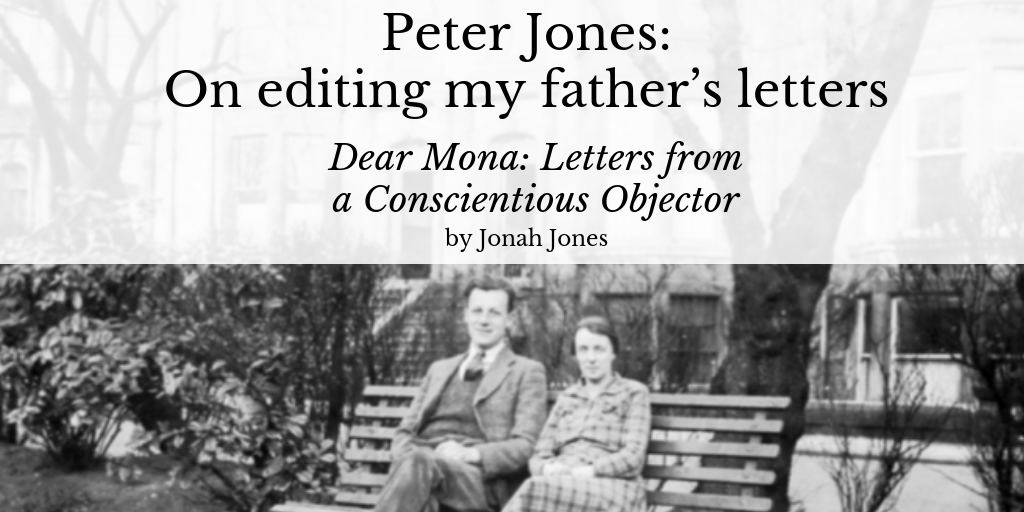
In Dear Mona: Letters from a Conscientious Objector, we are given a window into the life of Jonah Jones through private letters to his close friend and mentor, Mona Lovell. We see his character evolve as he nurtures his love of art and sculpture, and finds new ways to express his creativity.
A pacifist, Jones at first declined to enlist when war broke out, but later served as a non-arms bearing medic in the Second World War. His letters give an emotional insight into the prejudices he faced and the reality of his wartime experiences. Peter Jones, Jonah’s son, has edited this fascinating book and here gives insight into the difficult process of bringing its intimate contents to print.
Deciding to publish my father’s letters to Mona was both an easy step and one of the hardest things I have had to do.
Easy because of the quality of the writing and the interest the material holds. There is a clear narrative arc to the letters as the intense relationship between Len Jones (as my father Jonah was then known) and his friend and mentor Mona Lovell develops, and he simultaneously stumbles towards his vocation in art. This makes them a very satisfying read, and gives the whole a novelistic quality. Along the way we get fascinating insights into the life of a conscientious objector in the Second World War, vivid descriptions of action after Len joins the 6th Airborne Division as a non-combatant medic, and powerful accounts of the tension in British Mandate Palestine in the run-up to the birth of the State of Israel.

‘…there is no hysteria – only a desperate apathy & an anxious searching for belongings as they come from their cellars or from a few miles back. Once in the back area again they begin to smile even, as the war moves on & they feel safe again – but many have lost what can never be replaced…’
All of this compelled publication. Yet at the same time I wavered, for my father was a very private man in some ways, and I knew he would not have been glad to see these letters released to the world. They cover a time when he was mainly unhappy, a time he preferred to forget. And of course, fundamental to my whole dilemma, was his relationship with Mona – she was in love with him, he looked on her as a soul-mate whom he valued dearly as a friend but could not love in the way she wished. It was extremely hard to lay all this open before a reading public.

So the question arose: could I make the insightful, non-personal material available without publishing the deeply personal side of the letters? Yes, but this would run the risk of creating a narrative without a narrative, for Len’s relationship with Mona (and, to a lesser but still important extent with the poet James Kirkup) is the spine of the whole story. Most crucial, cutting out the personal would diminish Mona to little more than a sounding board for Len’s thoughts and experiences. This would be a grave injustice, for it is clear how vital she was in Len’s transition from his constricted working class roots to the man who could express himself through art. Too often women have been relegated to the shadows of history; Mona did not deserve this fate.

So, with qualms, I decided to lay out the whole story. It reveals so much: how life was for conscientious objectors in the Second World War (we have heard a lot about their brave predecessors in the Great War, but much less of Len’s generation), the widespread frustration people suffered due to their lives being suspended by the war, the congenial debating society that was Carmel College in Haifa, where servicemen and women did university-style courses prior to demobilization. Some of the issues touched on in Len’s letters seem remarkably topical, especially the Arab-Israeli conflict and anti-semitism (whether among forestry workers in Yorkshire or British officials), and homosexuality, on which he evolved from unthinking revulsion to deep compassion. These letters are compelling; the world should see them.
Peter Jones.


