Posted on

Queer’s the Word: Readings for LGBT+ History Month

Daryl Leeworthy, author of A Little Gay History of Wales and Elaine Morgan: A Life Behind the Screen, shares some of the top books you should be reading this LGBT+ History Month.

Since the removal of Section 28 from the statute book in 2003, Britain’s queer communities have come together each February to celebrate a history which was for so long hidden in plain sight. Each year, LGBT+ History Month has a theme: in 2021 it is ‘Body, Mind, Spirit’. Anyone who has watched Russell T. Davies’s masterpiece, It’s A Sin, will know just how much each of those elements can be affected by absorbing oneself in aspects of the queer past and present. The books I have chosen for this short article penned as a contribution to LGBT+ History Month, each represent a different side of life.

Let’s start with the master historian, Jeffrey Weeks, who was born in the Rhondda in 1945, and his landmark book, Coming Out. First published by Quartet in 1977, and released in a new edition in 2016, Coming Out brings Britain’s queer history to life. It is radical. It is rooted in the ideas of gay liberation – about which more in a moment – and in the left-wing politics of the 1970s. But it is not an artifact of an earlier time, so much as an endlessly absorbing and fascinating excavation of a past richly experienced but all-too-easily cloaked in the horror of criminal codes and lavender scares. Weeks’s great triumph is to bring queer history back down to street level. In his long career, Weeks went on to write about Edward Carpenter, theories of sexuality, and the triumph of the queer civil rights movement through signature legislation such as same-sex marriage. This spring he turns his attention to his Welsh roots in a masterful memoir, Between Worlds.

To understand the Gay Liberation Front itself, there is no better work than Lisa Power’s No Bath But Plenty Of Bubbles, an oral history of the movement in London, which was originally published in 1995 by Cassell. Long out of print and difficult to get hold of, it has recently been re-released as an e-book to mark GLF’s fiftieth anniversary. By the time the book appeared in the mid-1990s, the world had changed completely from that envisaged by the GLF activists twenty years before – but rarely for the better. The age of consent, set at 21 since 1967, fell to eighteen in 1994 but the opportunity to bring about equality at 16 was narrowly missed. Section 28 was on the statute book and ruining the lives of a generation of queer children (me included). HIV/AIDS wreaked havoc all over the world, amongst queer and non-queer communities alike. Lisa Power wrote a book of history, then, but one designed as a kick into gear, a serious attempt to recover something of the spirit and purpose of the Gay Liberation Front and to make the world better for everyone. Twenty five years later, we know it succeeded.

After a year living with the COVID-19 pandemic, many of us are feeling an enormous strain and frustration. We have come to think of the virus as a once in a century event – it is not. But that tells us something about how societies remember and how we as individuals remember, too. Studies have shown that the descendants of those most directly impacted by traumatic events carry with them a genetic memory – an imprint of that harm which cannot be got rid of. It is especially apparent amongst Holocaust survivors and their children and grandchildren. For queer people, especially, it is also true of HIV/AIDS, the other great global pandemic of the past fifty years. To understand the interplay between trauma and memory, there is no better novel than Rebecca Makkai’s The Great Believers. Published in 2018, it focuses on Chicago and brings to life a community which was forced to adapt and compelled to live with death and danger, day after day. But it is a universal story, one which can – and in its comparison with COVID-19 does – affect us all.

But what of Wales? When I wrote A Little Gay History of Wales a few years ago, I had a delightful afternoon reading Sion Eirian’s 1979 novel, Bob yn y Ddinas. It’s not really a queer novel except for a passage where the title character, Bob, goes into the Duke Of Wellington pub in central Cardiff and encounters a neighbourhood drag queen who buys a drink for everyone in the snug, but not him. He was outside the community. This was truth, not fiction. For a period in the late-1970s, the Duke of Wellington joined its neighbour the King’s Cross and the nearby Golden Cross and Bristol Hotel as part of the small gay scene of those years. This was Real Cardiff, as Peter Finch would describe it, tough and grimy and poor; the place as it was before the corporate towers arrived and the rents shot up.

My last choice takes me back to the Rhondda and to another queer emigré who made his way to London: the novelist Rhys Davies. In his lifetime, Rhys Davies never openly acknowledged his homosexuality. Privately, and to his friends, and partners, it was a different story. He cruised guardsmen on the streets of interwar London; he cruised men in the various European cities in which he lived; he was in Germany like Christopher Isherwood and saw the rise of the Nazis; he wrote very queer novels which take little decoding for modern readers; and became close friends and a beneficiary of the noted American lesbians Gertrude Stein and Alice Toklas. Alas, much of the writer’s work is now out of print but his memoir, Print of a Hare’s Foot, first published in 1969, appears as a Seren Classic. More so than Mike Stephens’s prize-winning biography, which doesn’t really get to the heart of its subject’s sexuality, I’m afraid, Print of a Hare’s Foot is the best place to start with a writer who is to Wales what Oscar Wilde is to Ireland.

Daryl Leeworthy is the Rhys Davies Research Fellow at Swansea University. He is the author of A Little Gay History of Wales (2019) and of Elaine Morgan: A Life Behind the Screen, which is out now with Seren.

Elaine Morgan: A Life Behind the Screen is available on the Seren website: £9.99

A Little Gay History of Wales is published by University of Wales Press: £11.99

Consider supporting independent bookshops with a purchase via bookshop.org.
Posted on

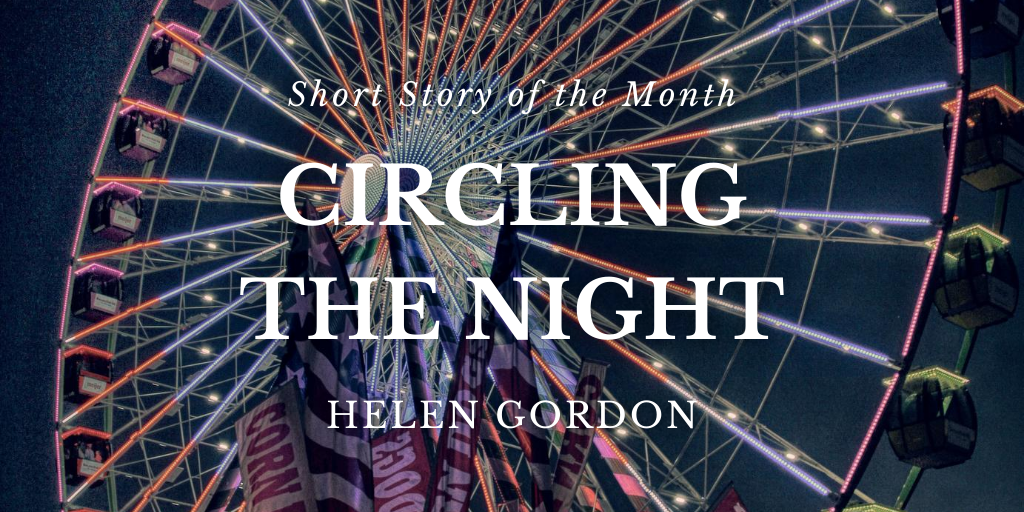
Short Story of the Month – ‘Circling the Night’ by Helen Gordon

Our new short story of the month is ‘Circling the Night’ by Helen Gordon.

“You look pretty,” Gemma says, accusatorially. “You’re going to pull tonight.”

For Leila and her friends a night at the fair is full of opportunities that only the heady world of teenage relationships, fancy dress and friendship can provide. 

Helen Gordon‘s short fiction has won the Cambrensis Short Story Competition, been shortlisted for the Real Writers Short Story Awards and longlisted for both the Bridport Prize and the Fish International Short Story Prize. Her non-fiction has been published in The Big Issue and The Church Times as well as in local lifestyle magazines. She currently lives in Shropshire, where she brings up her two boys and works as a freelance journalist.

This is an excerpt, read the full story for FREE on the Seren website here.

Circling the Night

Leila makes her father drop her by the bridge, where they can hear the muffled boom of the fairground shaking through the dusk.

“You look beautiful,” he tells her as she slides out of the car and fluffs her skirts back into a bell.

“Go!” she hisses. But he doesn’t. He watches her tug at the ringlets she’s spent the whole afternoon curling, fiddle with the silk daisies in their midst. And he’s still watching as she picks her way down the alley, turns the corner and lets the fairground take her.

It’s a scratchy excuse for a fairground; a few spidery rides cornered into the tiny car-park that can barely contain them. It’s a sideshow to the pub-spilled streets, thick with messy delight; a gathering-ground for teens too old for costume competitions but too young to squeeze up against heaving bars in the hope of getting a pint.

Leila’s shoes – her mother’s old tap shoes that she found crushed at the base of the dressing-up trunk – tap across the pitted tarmac towards the waltzer, where Gemma and Lizzie are waiting.

Gemma has added a short chequered tie to her school uniform, pulled a flimsy police hat firmly over her curls and rolled her skirt so short that the gusset of her fishnet tights is showing. She has a thick truncheon in one hand and a bottle of 20/20 in the other, and both of them look dangerous.

She puts the bottle down on the bottom step of the waltzer to take in the pink ribbons curling through the net of Leila’s skirt, the pinafore frills of her top, the improbable white of her tights.

“What the fuck are you? Little Bo Peep?”

“A clockwork doll” Leila says, turning to show the gold-sprayed cardboard key sticking sideways out of her back and then completing the circuit self-consciously, fingers splayed, just as she had for the camera at home.

“You look pretty,” Gemma says, accusatorily. “You’re going to pull tonight.”

It’s a promise and a threat, and Leila’s heart leaps and cramps, leaps and cramps until it merges with the disco beat pounding through her veins.

Lizzie, in a pink fur-trimmed cowboy hat and thigh-high leather boots that go no way towards closing the gap on her skirt, takes a deep swig of the 20/20 and thrusts the lurid green liquid in Leila’s direction. She’s got a psychedelic rock dummy strung round her neck and she sucks on it provocatively, her eyes fixed on the bare chest of the boy spinning the cars of the waltzer.

Leila drinks, breathes through the syrupy burn, and looks out across the night. The fairground’s already busy. Clumps of oddly dressed youths cluster together letting the disco beat thump them into a state of excitement. She scans them, endlessly, her heart twitching in hope and fear, but she can’t see Rhys Davis amongst them.

“Come on then, who d’ya fancy?” says Gemma, curving her back against the waltzer railings and puffing out her chest. “Oh don’t be a stuck up bitch. Come on.”

She thrusts the half-empty bottle into Leila’s face, watches her swig, then pushes it back until it re-connects with her lips.

“It’s not fucking cough mixture” she says, “Drink!”

“Right then,” she repeats, when Leila’s swallowed to her satisfaction “Tell us who you fancy.”

“I don’t-“

“Come on. It’s Rob Thomas isn’t it?”

“No-” she says far too quickly, because a year ago it had been, and the thought of Gemma knowing makes something delicate crunch inside her, like a ladybird under a boot.

“It is!”

“No, it’s not. It’s not. ”

Shame’s burning through the pink circles she’s painted so carefully onto her cheeks and Gemma’s watching it cat-like, her claws twitching in anticipation of the kill.

“Honestly. Not Rob Thomas. Someone else.”

Gemma eyes the bait coolly, waits for it to turn its pale belly towards her.

“Go on then…”

“It’s Rhys Davis,” breathes Leila and even the words have a music to them, a soft rustle of pleasure that whispers somewhere in the tissue of her skirt and lingers like a sigh, cooling the burning circles of her cheeks. Rhys Davis. Rhys Davis. Rhys Davis.

Gemma curls her lip in revulsion.

“What d‘you fancy that lanky dick for? He’s rank. Anyway he’s been getting off with my cousin.”

Gemma’s cousins are many and nameless and Leila knows better than to mess with the suggestion of one. She reaches instead for the booze and holds the fiery green liquid in her mouth until it dissolves the surface of her teeth, burns away the horror crawling at the base of her belly.

“Alright alchy!” says Gemma, snatching the bottle back and taking a long answering swig of her own. “It’s not just for you, you know.”

Leila hardly notices. Because there, at the far end of the car park, is the silhouette she’s been looking for all night, and a tight spiral of joy is corseting her lungs, making it difficult to breathe. Rhys Davis: in khaki shorts and a cork-dangled hat, with two white streaks of sunblock slanting each side of his perfectly crooked nose, is walking across the car park.

Finish reading ‘Circling the Night’ on the Seren website here.

Posted on

An Interview with Euron Griffith

When he smiled it really did feel as if the chilly Caernarfonshire wind had stopped for a few seconds and as if the place had suddenly got warmer.

When Miriam fell in love with Padraig life seemed simple. But soon she discovered that love is a treacherous business. Everything changed when she met Daniel. She was taken down an unexpected path which would dictate and dominate the rest of her life.
Spanning three generations of a North Wales family in a Welsh-speaking community, Miriam, Daniel and Me is an absorbing and compelling story of family discord, political turmoil, poetry, jealousy…and football.

Miriam, Daniel and Me is the first novel in English by Welsh author Euron Griffith. In this interview, Euron tells us what inspired the novel and discusses what its like to bring a book out during a global pandemic. Scroll to the bottom to see the details of the virtual launch taking place this Thursday (30th July).

What was the inspiration behind Miriam, Daniel and Me?

Believe it or not, initially this was going to be a book about my lifelong obsession with the Beatles – a kind of ‘music memoir’ of how the band’s music reflected incidents in my own life. This seemed to make some kind of sense since I’d already written a short story collection called The Beatles in Tonypandy (which was a satirical fantasy on what ‘happened’ when the band moved to South Wales and took up pigeon fancying in 1967!) and so I wanted to write about them in a more personal and less surreal way. It soon became clear to me, however, that I was becoming more interested in the context of the piece – that is, my own experiences of my upbringing and my family history – than I was in the Fab Four’s peripheral and distant part in it. I found that the concept was becoming laboured and that I wasn’t making it come alive for myself and, therefore, it probably wasn’t going to work for anyone reading it. So the Beatles were soon rejected in a cruel, Decca-like fashion!

There were parts of my family history that I only had a vague knowledge of – my paternal grandfather for instance, whom I had never met because he died before I was born. I remember my granny and my dad telling me the story of how he had died suddenly in his chair after returning from the quarry one night but that was all I knew. I filled in the blanks myself – guessing here and there as to how things might have happened. The same was true of my mum. She had fallen in love with an Irishman before she met my dad but I didn’t know the whole story. As a kid I recall my maternal grandad showing me little bits of electrical handiwork this Irishman had constructed – little light switches etc. – so I knew he’d been an electrician and I’d seen photos of him so I knew he had red hair…but nothing much else. Only tantalizing fragments.

Once I’d stumbled across a photo of my mum walking down a street with him and, on the back, someone had written ‘Dublin’. She must have really loved him to go there for a visit. Especially in those days when travel wasn’t such a common thing. So here I did the same as I did with the story of my paternal grandad – I just tried to fill in the gaps. To make sense of it all. It soon grew into something of an obsession and, slowly, I saw that there was a novel brewing here. I weaved in my dad’s experiences as a poet and a goalie – how he had been invited for a trial with a big club once (in real life it was Bolton Wanderers but I changed it to Preston North End in this book…not entirely sure why to be honest!). Now, as I stand back and look at the finished piece, I can see that the overarching theme seems to be the notion of chance, often driven by love or passion, and of how it can affect the course of our lives.

The story is told through the eyes of multiple characters, particularly by three generations of Miriam and Daniel’s family. How is this inter-generational perspective important to the story?

The flippant answer would be that I get bored quite easily and I like to allow myself to dive into different characters and styles of narrative. But there is a more stylistic reason for it too. I love the way classic Victorian fiction such as Wuthering Heights and The Woman in White utilize a playful and effective way of presenting events through different viewpoints. I was also influenced in this by the films of Kurosawa and Quentin Tarantino. I was keen to hurl the reader back and forth without always giving an initial indication of when something was happening in ‘linear’ time because I thought it would heighten the dramatic effect. I suppose a simple example of this would be the rat poison incident (no spoilers!). The novel began with Miriam and Daniel’s story but, around this, there gradually grew the context of their lives- what happened before and what happened after (with the unnamed son). I played with time more outrageously in my last Welsh language novel Tri Deg Tri about a hitman where chapters were numbered in relation to the sequence of the central character’s ‘kills’ rather than to chronology. So I have form! Some readers found it puzzling but more, so I’m told, found it exhilarating!

My other challenge here – admittedly rather grand and insurmountable – was to try to write a kind of Welsh ‘bildungsroman’ – the story of a family and personal development featuring several characters. I was introduced to Buddenbrooks as a student and Thomas Mann’s masterpiece has stayed with me over the years. It certainly influenced me more strongly as this novel developed and the overall shape became clearer. Needless to say I could never come close to such a perfect piece of art but it gave me something to aim for! Aim high. Always aim high…

You build a clear picture of village life in 1950s and 60s Gwynedd by bringing in other members of the community and the events affecting their lives, namely the investiture of Prince Charles. Why was it important to you to bring this to life in Miriam, Daniel and Me?

It was a matter of context. Of filling in the canvas and making the whole world more real and multi-layered. I am a keen painter and there is a clear link, I reckon, between visual art and writing. Paul Klee once said that he liked ‘taking a line for a walk’ and that’s how writing begins for me. A line followed by another and, gradually (if you’re lucky), a world forms – a picture. Then it’s a matter of filling in the details. Picasso once said that the most difficult part of any painting was knowing when to stop. He was obviously right (when was Picasso wrong about anything??). In my own case I only recognise when to stop when it comes to re-writing. The first draft is always a sketch. I really don’t think you know what the book is until you’ve stepped back and studied the overall shape and pattern. It needs time. Re-writes. This novel went through at least three major re-writes! Curiously perhaps, this novel was also mainly written in London so there was an extra layer of distance there. James Joyce once said that he had to move to Zurich to write about Dublin. He wasn’t wrong about much either…

The book is coming out in very different circumstances to those any of us could have imagined but the BBC reported last week that Brits have been buying more books during lockdown. What makes Miriam, Daniel and Me a good lockdown read? What do you hope readers will take away from reading it?

Books and records are an obsession for me and if people are reading more and listening to more music then, in my world, that’s a good thing. Online trading is obviously booming in both these markets but I do worry about the wider context of physical retail – not only from the perspective of people’s livelihoods but also from a rather more selfish one. I really find wandering through shops and cities soothing and exciting so, in lockdown, I miss the bustle of the high street – the sights and sounds. When I was in London I would often hop on a bus in the afternoons and go to the middle of Piccadilly Circus and then wander around Soho just to soak up the atmosphere and work out things in my head to do with this novel and with other matters. I’m hopeful that things will return to normal soon.

In terms of what people will take away from this book there is the obvious factor of enjoyment of course but one of the reasons I wrote this book in English was because I don’t think north Wales and the ‘north Welsh experience’ has been explored as often in English language fiction as its southern counterpart. Most people when they think of Wales think rugby and the valleys but this is not strictly accurate. Rugby meant nothing to me when I was growing up and still doesn’t. Indeed, I vividly remember our PE teacher damning it as ‘a game for fat boys who are too slow for football’! My world when growing up was formed by television, football and pop music – the Monkees, The Man from UNCLE, Leeds United, Thunderbirds and Monty Python. Not by chapel or the Eisteddfod or Gareth Edwards. I never ‘got’ Shirley Bassey or Max Boyce and there were no coal mines in my part of Wales. I’m not entirely sure what ‘Wales’ is. My guess is that there are at least twenty versions of it and I didn’t think the story of mine had been told.

We’re hosting an online launch for the book later this week. What can attendees expect at the event?

Well Jon Gower is a perceptive reader and I’m intrigued to know what he thinks of the novel. He always has an interesting perspective on things. I’m thrilled that Rakie Ayola has agreed to read a few passages from the novel. She is such a brilliant actor. Hopefully the conversation and the readings will stimulate all the many thousands tuning in via Zoom to buy the novel and send it to the top of the Sunday Times best seller chart…

Finally, a question lots of writers have probably been asked recently, but have you found lockdown a particularly creative time? Is there anything you’re currently working on?

Writing never stops for me. After finishing this novel I immediately returned to a manuscript I started ten years ago and have been working on intermittently since then. I finally finished it just before last Christmas. It’s a peculiar, surreal ‘historical’ novel based on the adventures of a gentleman traveller. Influenced by ‘Don Quixote’ and more modern pieces such as ‘Life of Pi’ it features a man mistaken for Jesus, a three-legged cat, a serial killer and cannibalism. So it couldn’t be more different to Miriam, Daniel and Me! It’s called The Confession of Hilary Durwood. Since lockdown I’ve started another novel. I was up to 40,000 words before realising that it wasn’t much good so I scrapped it and started again. It’s much better now.

Before Covid struck I played regularly in my band Six Sided Men but, naturally, all that is on hold now. But I’ve been writing tons of songs and recording them myself on my little portastudio (driving my wife mad in the process as we have inadequate soundproofing!). I’m currently recording some Christmas songs I’ve written and will include these on a CD for friends when the season for merriment arrives…

I’ve also been painting and drawing. So yes. A worrying time in many ways. But I can’t say it’s been entirely unproductive…


Miriam, Daniel and Me is available now from Seren: £9.99

Join us for the virtual book launch – Thursday 30th July, 7:30pm. Euron will be in conversation with Jon Gower and actress Rackie Ayola will be reading excerpts from the book. Email [email protected] for the link. Full details here.

Create your free Seren account and enjoy 20% off every book you buy from us.

Posted on

Short Story of the Month – ‘Scream, Scream’ by Glenda Beagan

Our new Short Story of the Month is ‘Scream, Scream’ by Glenda Beagan which features in The Green Bridge: Stories from Wales.

The Green Bridge is an entertaining anthology of classic stories from twentieth century Wales. From Dylan Thomas to Ifan Pughe, the familiar to the revived, from the rural west of Caradoc Evans to the industrial south of Gwyn Thomas, the politics of Emyr Humphreys to the relationships of Dorothy Edwards, all Wales and all human life is here.


This is an excerpt, read the full story for FREE on the Seren website here.

Scream, Scream

It is quiet on the ward. There are only three bed patients. Nurse

Sandra looks at her watch. It is so still. There is the faint hum of a

mechanical mower on lawns far away, that is all. No birds are singing.

Mrs Jessop is snoring quietly. She’s had a bad night. It is on the

report.

Linda is about to make her move. Nurse Sandra senses it. She

smooths her apron, flicks through a magazine with studied

carelessness watching sideways through her hair as Linda shifts her

slow carcase off the bed. Even now as those bare arms emerge Nurse

Sandra has to steel herself. She looks up, clenched. Sioned, the

anorexic girl in the top bed is semaphoring wildly. Linda begins.

“Is my heart still beating?”

“Yes, Linda.” Nurse Sandra sighs, tries to smile. How well she

knows this never ending litany.

“Are you sure?”

“Yes.”

“Can you hear it?”

“Not from here I can’t, no.”

“Come and listen.”

“Again, Linda?”

“Yes. I think it’s stopped.”

“No luv, silly. Course it hasn’t stopped. You wouldn’t be sitting

up talking to me if it had stopped, would you?”

“No.”

“There you are then.”

Now the familiar pause.

“Is my baby dead?”

This was the bit she dreaded. Day after day, hour after hour, the

same question. And still she dreaded it.

“It’s a long time ago now, Linda.”

“How long?”

“Two years.”

“I killed my baby didn’t I?”

“No, you didn’t kill your baby. You know you didn’t.”

“Heroin killed my baby.”

“Yes.”

“Not me.”

“No.”

“But I did really. I know I did.”

Nurse Sandra gulps. Linda never wants platitudes. Sometimes

she’ll accept them. Mostly she won’t.

Nurse Sandra still finds she winces inside at the sight of those

arms: the half healed scars she’d cleaned of pus months before are

still lurid among the tattoos, the roses, crowns and mermaids, the

names JIMMY and MOTHER, the waste, the pointlessness. Linda is

dying, her liver, which is all of twenty three years old, is ready to

pack up on her. She has respiratory problems. Her legs are hideously

ulcerated. She has come here to die because there is nowhere else for

her to go.

“Have you got a fag?”

“I don’t smoke, Linda.”

“Mrs Jessop smokes.”

“Mrs Jessop is asleep.”

“When she wakes up?”

“You can ask her when she wakes up.”

“Will she give me a fag?”

“She usually does, doesn’t she?”

“She always does.”

A giggle. The ghost of a giggle.

“She always gives me a fag to make me go away.”

Linda is not averse to exploiting the unnerving effect she has on

people, and Mrs Jessop is easily unnerved. So is Sioned. Linda

changes tack. She knows the answer before she asks the question but

she wants a reaction. She wants to see those dark eyes close, that pale

skull shake its negative.

“You don’t smoke, do you Sioned?”

Sioned is pretending not to be here. She does it well. She is now

so thin she hardly makes a ripple under the blankets. She is

disappearing. Tonic insulin seems not to have had the desired effect.

She is seventeen, always tiny, admittedly, but now she weighs just

four stone.

Mrs Jessop sputters into consciousness. Stretches, yawns, sits bolt

upright.

“Oh.”

“Good morning Mrs Jessop. For this relief much thanks.”

Nurse Sandra walks up to the bed.

“How are we this morning?”

Mrs Jessop can’t remember how she is. Bleary still from night

sedation, she blinks, owl-like, registers Linda’s looming presence and

makes an instinctive move for her handbag, proffering the packet.

Linda beams.

“Ta, Mrs Jessop. You’re alright, you are. You’ll be going home

soon.”

She slouches off to the top of the ward again.

“If you’re going to smoke you go to the sitting room, Linda.”

“Aw, just this once, Sandra.”

“Sitting room.”

“Can I go in the wheelchair, then?”

“You know I can’t push you. I can’t leave the ward.”

“There’s only Mrs Jessop and Sioned, Sandra. Nothing’s going to

happen while you push me that little way. It’s not far.”

“If you want to smoke you go to the sitting room and if you want

to go to the sitting room you have to walk.”

“You’re a tight bitch, Sandra.”

“Yeah, I’m a real hard case.”

“Can I have a light, Mrs Jessop?”

“Not on the ward, Linda.”

“I wasn’t talking to you. I was talking to Mrs Jessop.”

There is an edge in Linda’s voice but she no longer has the energy

to put that edge into action. Nurse Sandra gives her a look. Now it’s

a battle of wills and Sandra will win because she has the will to win

and Linda has not. The girl’s efforts have already exhausted her. She

wants her cigarette but she does not want to haul herself down the

corridor to smoke it. In the end the cigarette wins. It always does.

She starts to move down the ward again, painfully slowly for Sandra’s

benefit, holding on to the beds.

“Can I borrow your lighter, Mrs Jessop?”

“Get a light from someone down there.”

“There won’t be anyone down there. They’ve gone to OT.”

“Get a light from Sister Annie, then.”

“Where?”

“In the office.”

“Is that where she is?”

“Yes.”

“Are you sure? Is she on her own?”

“It’s not time for the doctors to make their round yet, Linda if

that’s what you’re worried about.”

“Is Dr Patel on today?”

“I don’t know.”

“She’s on holiday,” says Mrs Jessop.

“Is she? How do you know?”

“She told me.”

Linda looks sulky. She likes to think she has a special relationship

with Dr Patel, that she is her confidante. To compensate for not

having received this piece of information she makes an extravagant

balletic swoop towards Mrs Jessop, hands moulded into a parodic

impression of an Indian dancer’s.

“She’s promised me one of her old saris, Dr Patel has. She said I

could have one. She likes me.”

“You’ve been pestering her again, haven’t you?” Nurse Sandra

cuts in, wishing Linda would really get off the ward and go for her

smoke. Linda glowers.

“I like Dr Patel. She’s alright.”

In a moment of rare humour Mrs Jessop chuckles to herself.

“She’ll be going home soon.”

Nurse Sandra smiles. “She’s got a long way to go.”

Just then the scream.

A vehicle must have drawn up, but they didn’t hear it. The front

doors have opened and the scream has come in, has forced itself in,

breaking through their innocuous recitative. This is the aria, a full

blooded aria.

Continue reading ‘Scream, Scream’ on the Seren website here.


Posted on

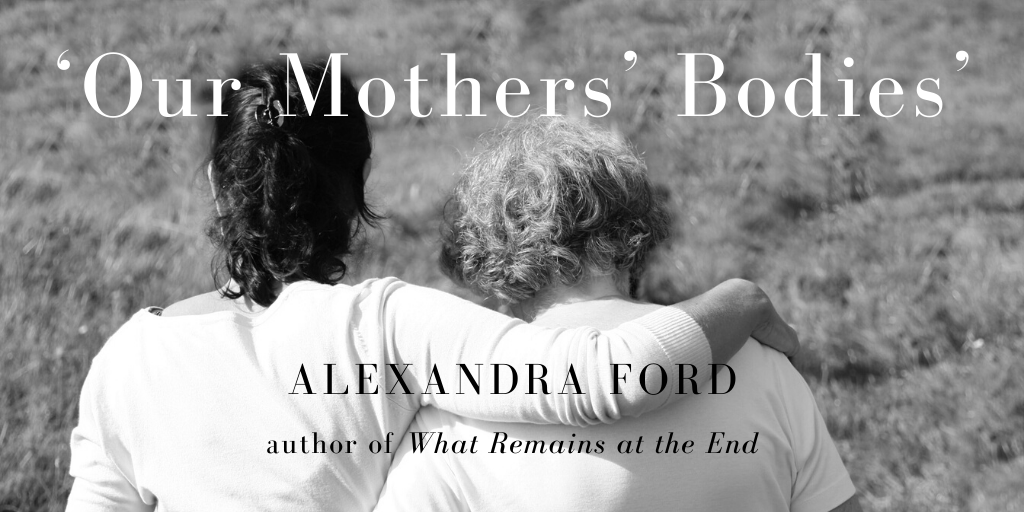
Friday Poem – ‘Our Mothers’ Bodies’ by Alexandra Ford

This week’s Friday Poem is ‘Our Mothers’ Bodies’ by Alexandra Ford. Alexandra’s debut novel What Remains at the End was published last month.

In the aftermath of World War II, hundreds of thousands of Yugoslavia’s ethnic Germans, the Danube Swabians, were expelled by Tito’s Partisan regime. A further sixty-thousand were killed. Seventy years later Marie Kholer travels to Europe to learn the truth about her grandparents’ flight to America. A story of war and suffering, of loss and the search for connection and identity, it is an intriguing debut novel from Alexandra Ford.


What Remains at the End is available on the Seren website: £9.99

Create your free Seren account and enjoy 20% off every book you buy from us.

Don’t miss the launch of What Remains at the End, taking place on Saturday 23rd November at the The Hurst, The John Osbourne Arvon Centre. There will be books, wine and cake! See the full details here

Posted on

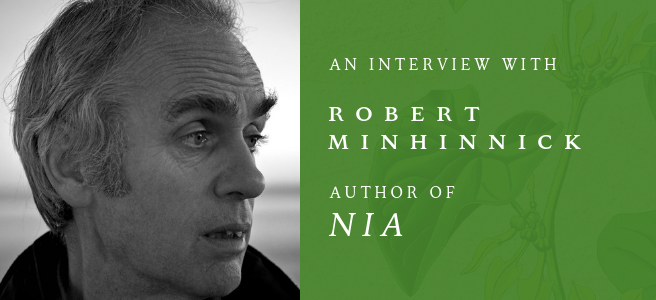
An Interview with Robert Minhinnick

Robert Minhinnick is one of Wales’ (some would say Britain’s) most eminent writers. Next month we publish his latest novel Nia, the third book in his coastal trilogy all set in the same fictional resort. Ahead of its publication on the 1st October, Robert talks to us about the novel’s themes, its characters and what inspires him.


In Nia, dreams, memory and time all flow into one, leaving the reader to decide for themselves what is real and what is in Nia’s imagination. What about this structure draws you to it when writing and how is it important to the development of your characters?

Frankly, ‘madness’ is a big part of my life, and how it is socially perceived. Schizophrenia continues to play a role in my family, via my mother and her sister, aged 93 and 91. During World War II, my father contracted malaria, in Burma. The result was periodic delirium. My writing tries to explore ‘madness’ and delirium, and relate them to memory and dreams and the very act of writing ‘fiction’.

Throughout the book you touch on themes of the environment and climate change. Do you think it is important that authors use their voice to highlight issues to their audiences, and why in particular are they important to you?

You’re interviewing someone who is co-founder of Friends of the Earth Cymru, in 1984, and the charity ‘Sustainable Wales’, ongoing.

This is your third novel set in the same fictional community, each with interlinking characters but separate, stand-alone stories. How have the community and its inhabitants changed over the course of the series? Will we see any more writing set in the same place?

The fairground is a constant theme. It’s a powerful metaphor, a constant source of drama. I can see it from my attic. I like the idea of a particular family or community being examined.  After all, staying/belonging are familiar themes in fiction.

Nia is a book dominated by sunshine, even drought. Limestone Man experienced a suffocating sea-fret. The town’s economic circumstances always play a part, as does its history, and they are very much based on Porthcawl where I live. The street names, for instance, are the names of ships wrecked off the Porthcawl coast.

You take Porthcawl and the Merthyr Mawr dunes as the inspiration for your fictional town. Why did you choose to reimagine that place?

I write about where I live. I decided long ago that I should celebrate Porthcawl and the areas between the mouths of the rivers Ogwr and Cynffig. My writing is one way of achieving this. In Nia, I also celebrate my time in Saskatchewan, and my brief periods in Kerala and Amsterdam. Writing about different places can create an interesting friction – a little like icebergs grinding against each other in the South Saskatchewan river.

Some may say that the structure of Nia is reminiscent of that of prose poetry. How does your long career as a poet influence your prose style?

Originally, Nia possessed chapter names. I dispensed with these at a late stage, as I felt they directed the reader too forcibly. One of my friends is disappointed by the first two novels in that there seems no real ‘resolution’. Of course, I tell him, even death does not resolve matters…

How has your fiction style developed over the course of writing this series? Did the process of writing Nia differ from that of your previous novels? 

I’m older. But still wishing to learn. The character of Nia is developed because some years ago the former fiction editor at Seren, Penny Thomas, told me I should strengthen my female characters.

Nia is obsessed with words. What is your relationship with them?

Well, obsessional might be the correct description.

Another blurred boundary between time and place, comes about through the travel stories vividly recounted by Nia’s friends throughout the book. In what way is the theme of travel important to the book, and to Nia’s story in particular?

I wanted to write about Saskatchewan. There are poems actually written there incorporated into the text of Nia. Also memories of visiting Auschwitz, Amsterdam, Kerala and New York. But the editing process removed many references…

Nia’s perception of her life seems unstable throughout: she constantly questions her own sanity and her role as a mother. These kinds of traits can be seen in the lead characters of your other two novels as well. What draws you to this type of character as a narrator?

All my narrators are ‘unreliable’, and plagued by self-doubt, dreams and delusion. That’s why memory blends into delirium. The fairground is an excellent means of depicting this. I look at the eyes of my grandchildren as they encounter the funfair, or ‘the shows’ as we used to call it, and wonder what they see…

At the heart of Nia’s story, is her dream expedition with her friends into the unexplored caves beneath the dunes. Why did you choose to centre the action of your book on a caving expedition, and what is the significance of the trip to Nia?

It’s a fictional expedition, but Nia doesn’t dream it. Yet she experiences many other dreams in this novel about the dunes, their history, flora and fauna.  ‘The Shwyl’ caves are based on ‘the Schwyll’ cave system, which provided fresh water for the Bridgend area (including the Seren office) until recently, using ‘the Great Spring of Glamorgan’, which emerges in Ewenni.

Thus, it’s a real place, little known yet fascinating. Perhaps Nia feels intimidated by the travel stories of Isaac Pretty and Skye, and it’s her way of competing with two seemingly powerful personalities, who have returned to her community.

Nia will be available on the Seren website from the 1st October 2019. Pre-order your copy now. 

Robert Minhinnick’s ‘Sea Holly’ series is a set of three novels that follow generations of one family – the Vines – and a cast of characters brought up in the same location, which is dominated by the sea, wild duneland, and a funfair. 
Posted on

Short Story | ‘Transit of Moira’ – Maria Donovan

With the 50th anniversary of the moon landings taking place this week, we thought it pertinent that we share some moon-themed writing from our authors. ‘Transit of Moira’ comes from Maria Donovan’s collection of short stories Pumping Up Napoleon.

In Pumping Up Napoleon, Maria Donovan takes us on a bizarre, funny and often touching tour of death and laughter, love and space travel. Her light, humorous touch allows darker strands to surface repeatedly – dislocated, lonely lives, out of sync with their surroundings are set alongside human oddity and tenderness. These understated, well-crafted stories constantly surprise and engage, producing a fine, enjoyable and thought-provoking collection.


Transit of Moira

At ten-past-midnight by the Tokyo clock, Gavin started floating down the service corridor. Most of the passengers were Japanese and would be strapped to their bunks by now; the only people he expected to be awake were a contingent from the West Country of England, playing endless games of gin rummy in the recreation pod. It seemed like a safe time to go clean the glass in the Bubble Observatory.

He was therefore intensely annoyed to catch sight of a pair of beige open-toed sandals of the kind old ladies wear – the ones with the patterns of little holes punched in the leather – floating ahead of him, kicking a little up and down as if their owner thought she was swimming. Further up were light-brown nylons, the flapping edges of a petticoat and an orange-and-yellow flower-print dress – an ensemble Gavin mentally labelled ‘hideous’. She wasn’t supposed to be in here. This corridor was for crew only. She wasn’t even suitably dressed for zero gravity! Gavin didn’t say anything as he hauled past her, just turned and glared.

She was a silver-haired old lady with a determined but contented look on her face and all she did was nod and smile at him, which annoyed Gavin even more. When he got to the Bubble Observatory, well ahead of her, he thought about bolting the door behind him, but it was against regulations. Suppose she couldn’t manage to get back the way she’d come? He couldn’t really leave her floating there all night, like some over-fed, expiring goldfish.

Gavin rose to the top of the Bubble and began wiping the glass with his specially-impregnated rags; gone were the days when he could dream of space travel scented by leather seats and mood perfume. As usual, the glass was covered in finger marks and, as usual, Gavin wondered why people couldn’t just hold on to the handles that were put there for the purpose. How many more times would he have to wipe the breath and snot and sweat of the world’s most boring passengers off this glass before he could retire? He could count the days, but unfortunately there were still three-thousand-and-twenty-four to go (Gavin was younger than he looked). By then, as he well knew, if he spent all his time in weightlessness, his wasted body would be useless back on Earth. He’d be condemned to spend the rest of his years in space or on the Moon, breathing canned air. But what did it matter? Wherever he went, he was sure to end up surrounded by scuffed plastic.

Earth; people always said the same things about it: ‘It’s so beautiful; it’s so blue; it looks just like a marble’. When he looked down at it, he always reminded himself that, though it did look peaceful from up here, really it was as busy as hell and full of tortures. You knew that once you stepped off the ferry you’d be put in line, processed, stamped, herded, sent here and there, told where you could stop and where you couldn’t. He was glad to be up here, on the out-trip, going lunar.

‘I always said I’d see the Moon before I die.’ The voice at Gavin’s elbow startled him.

She bobbed gently, using, he noted at once, the appropriate handles. This ought to have soothed him, but the fact that she was smiling, evidently quite at peace with herself and the Universe, irritated Gavin so much he broke the company code and retorted: ‘It’s not all it’s cracked up to be, you know.’

‘No?’ she said. ‘It looks good from here.’

They were long past the Neutral Point and accelerating towards the Moon, though you couldn’t tell how fast the ship was going. Behind them the Earth had dwindled to a bright blue disk; the lunar sphere hung before them, pockmarked, shadowed and mysteriously empty, apart from the sprinkle of red and white lights on the Sea of Tranquillity. Stubbornly, Gavin persisted. ‘Neil Armstrong’s footprint,’ he said. ‘I ask you. How does anybody know for sure that’s Neil Armstrong’s footprint?’

‘Have you seen it?’ said the old lady. ‘I’m Moira, by the way.’

Gavin didn’t give his name and he even put his hand over his name badge, as if he were putting hand on heart. He said, ‘I’ve never seen it and I don’t want to. You might as well look at my footprint in the dust.’

‘You’re probably right,’ said Moira. ‘Or mine. Perhaps I’d like to see mine.’

‘The Moon is full of footprints. It’s not like you think it’s going to be.’

‘How do you know what I think?’ said Moira, her head on one side as if she really did have a mild interest in his answer.

‘You’ll see. It’s all canned music and souvenirs. You can’t just wander about. They make you see things whether you want to or not.’

‘Is that so bad?’ said Moira. ‘It is for some people,’ muttered Gavin sulkily. ‘Anyway, I got cleaning to do. And,’ he added as a clincher, ‘I’m not supposed to talk to you passengers.’

Without asking, she took a cloth from his pack and began making circular motions on the glass. ‘Look at that,’ said Moira. ‘My face among the stars.’ When she said it, Gavin looked at his own reflection, something he usually avoided doing as much as possible. He was wearing the expression of a man with a bitter taste in his mouth.

Moira didn’t speak again for some time. She rubbed at the glass with her borrowed cloth and looked at the lights in the dark. ‘Have you ever seen a shooting star?’ she said.

Gavin couldn’t resist scoffing: ‘Not up here,’ he said. ‘And not down there.’ He pointed at the Moon. ‘No atmosphere!’ In the weak lunar orbit things either disappeared off into space or kept going round and round, eventually falling onto the surface, where they stayed, because no one would go and pick them up.

He remembered his first trip, leaving home, when it had all seemed like a big adventure, as well as something to do until a better job came along. How he’d loved to see those bright streaks of burning rubbish flare and fizzle out as they tried to touch the Earth. But now, he knew it was just another kind of pollution. Soon the rest of the Solar System would be polluted too, and eventually the Galaxy and then the Universe…

A flash of diamond-bright sparks flew past the window, ice crystals catching the light of the sun. ‘Oh!’ exclaimed Moira. ‘How lovely!’

‘Urine,’ said Gavin. ‘It’s the voiding hour.’

‘Isn’t it marvellous,’ said Moira, shaking her head, ‘how even your own waste products can look wonderful in space?’

Gavin couldn’t bear it; he gritted his teeth and rubbed harder, as if he might rub out the stars, while Moira made dreamy circles with her cloth. ‘I’ve always wanted to be an astronaut,’ she said.

‘It’s nothing special,’ said Gavin. ‘These days everyone’s an astronaut.’


Moira was in the Observatory often after that, or bouncing off the walls of the service corridor, poking into spaces no passenger should know about. Though Gavin saw her, he always hid until she’d gone away. So he couldn’t tell the Captain anything much about her when she went missing.

They had docked in the orbit of the Moon by then, and the passengers had all disembarked. Moira’s absence wasn’t noticed until the whole contingent went through immigration and the numbers didn’t add up. A search was made of the area, all the restrooms were checked, and every cupboard in the transit shuttle was opened. There was no sign of Moira.

Gavin and the rest of the ferry crew were put on alert and ordered to check every locked and unlocked space on board the ship and every item of inventory for clues. Then Gavin was summoned to the Captain’s quarters. ‘You were seen talking to her in the Observatory,’ he said. ‘We have it on visual. What were you talking about?’

‘Nothing much,’ said Gavin.

‘What we’re after,’ said the Captain, ‘is some clue as to her state of mind. We’re not trying to apportion blame.’

Not yet, thought Gavin. Blame will surely follow.

‘How did she seem to you?’ said the Captain. Gavin tried to remember. She had smiled a lot – and she said she wanted to see the Moon before she died.

‘Captain!’ A voice in the air interrupted Gavin’s thoughts before he uttered them. ‘One of our space suits is missing.’

At first no one believed an old lady like that would know how to operate an airlock or even want to try. The space suit was fitted with a standard locator device, but it had been turned off. There was a whisper among the crew that murder had been done, and some of them looked sideways at Gavin. He didn’t mind: it would encourage them to leave him alone.

Then the visuals for that area were checked again and the whole crew saw Moira standing in the airlock and waving goodbye. She even blew a kiss as she stepped out backwards into space.


That night, with a full set of new passengers safely on board, the story was officially put to rest. It seemed Moira had no relatives on Earth to inform and so the Captain would be spared the difficulty of writing any letters of regret.

Half-past-one by the Tokyo clock. The ferry left the Moon’s orbit and Gavin went back to polishing the Bubble Observatory. It was quiet; just how he liked it. But the smell of the cleaning rags caught the back of his throat. Angrily, he rubbed harder.

Then his heart lurched as a star-shaped object crossed the face of the Moon. He knew at once what it must be: Moira in her white suit, spreading her arms and legs to the Sun.

Pressing his fingers to the glass, Gavin saw himself – a ghastly open-mouthed reflection superimposed on the face of the receding Moon – and it scared him. But what made him truly uneasy was the suspicion that, if he had been able to get up close, he would have seen that Moira was still smiling.


Pumping Up Napoleon is available on the Seren website: £6.99


Maria Donovan is a native of Dorset and has strong connections with Wales and Holland. Past career choices include training as a nurse in the Netherlands, busking with music and fire around Europe and nine years as a lecturer in Creative Writing at the University of Glamorgan. Her fiction is often offbeat, exploring uneasy relationships, mind and body: ‛My Own CVA’ was a prizewinner in a competition run by The Lancet; and ‘My Cousin’s Breasts’ was shortlisted for the Fish Short Story Prize. Her flash fiction story ‘Chess’ won the Dorset Award in the Bridport Prize 2015.

Maria’s debut novel The Chicken Soup Murder  was published in 2017 and was shortlisted for the Rubery Book Award, fiction category.

The Chicken Soup Murder is available on the Seren website: £9.99


Create your free Seren account and enjoy 20% off every book you buy from us.

Posted on

Maria Donovan; Long-lists, first lines and ‘The Chicken Soup Murder’

41POingnfmL._SX322_BO1,204,203,200_We’re incredibly pleased to hear that Maria Donovan has been long-listed for the Hall & Woodhouse DLF Local Writing Prize for her book The Chicken Soup Murder. It’s a huge achievement considering this year the DLF received over 70 entries, and we’re all crossing our fingers for the next round!
You can purchase a copy of Donovan’s thrilling and genre-transcendent debut novel here: The Chicken Soup Murder

Donovan has been busy lately, and has recently been interviewed by novelist Shauna Gilligan for her Writer’s Chat Series. To read the two discussing breaking down genres, developing complex and sympathetic characters and to hear about Donovan’s upcoming plans, follow the link here: Donovan’s Interview


Posted on

Jayne Joso on Child Characters and her New Book; ‘From Seven to the Sea’

Jayne Joso author of My Falling Down House

Author Jayne Joso has recently been interviewed about how she creates compelling child characters. Her latest book, From Seven to the Sea, features a complex and beautifully written portrait of a seven-year-old girl, Esther.From Seven to the Sea

Children are amazing, they are so complicated and, at the same time, simple and straightforward in many ways, but what they lack is the vocabulary to describe their lives, particularly their feelings, and so it is easy for these feelings, their inner lives, to be overlooked.

You can read Joso’s full and insightful interview here: http://www.skylightrain.com/how-to-create-compelling-child…/

And purchase the wonderful From Seven to the Sea here:  https://www.serenbooks.com/productdisplay/seven-sea

Later this month, Joso will also be discussing her new novel alongside Deborah Kay Davies, hosted by Dylan Moore, at the Hay Festival 2019. The event, taking place on Wednesday, 29th May, 2.30pm at the Compass Studio is entitled Fiction: Freedoms.

Find out more and book your tickets here: https://hayfestival.com/p-15412-jayne-joso-and-deborah-kay-…

Joso will also be bringing her book to the Chapter Arts Centre, Cardiff, in July; details to follow, so watch this space…

Posted on

An interview with Christopher Meredith

Christopher Meredith interview

Brief Lives Christopher MeredithChristopher Meredith is an award-winning author of fiction and poetry. He has published four novels, three full poetry collections, and several shorter works. He is also the subject of a new Writers of Wales critical study, written by Diana Wallace.
Meredith’s new book, Brief Lives, is his first venture into short story writing – and its release comes thirty years after his groundbreaking debut novel, Shifts.

In this interview, Rosie Johns asks Chris about creative inspiration, the impact of personal experience, and the challenge of playing with tone and style in the short story form.

In the acknowledgements, you mention that you felt Brief Lives is an unoriginal title; what about it was so important to the collection that you decided to keep it anyway?
It’s not that I feel the title’s unoriginal – it is. Apart from the famous John Aubrey book from the 17th century at least one novel, other story collections, various book series and radio series have used this title. It was simply my working title as the book evolved, and it grew to fit. Ultimately the publisher registered the ISBN under this title without checking with me and there we were. In some ways that was a relief as it was probably the right title all along, and the subtitle six fictions does a bit of extra work.
Calling this book Brief Lives was a bit like a composer calling a piece Nocturne or Study or Caprice. It draws on a myth kitty of shared knowledge and expectations and suggests both form and theme. But the two words are very charged. As used originally for Aubrey’s short biographical notes on real people, the word ‘brief’ implies that the writing is not the whole story. In its origins, ‘brief’ can mean a summary, or better a compression. In one story, ‘Progress’, the young man standing on a bridge actually uses the word ‘summaries’ to describe, euphemistically, a blaze of powerful memory that’s just run through his head. While a summary can sound like an arid thing, it can also suggest; its compression can expand in the mind after the reading. A few reviewers have commented on the intensity of this book which perhaps is an effect of those compressions opening in the mind.
So it’s the writing that’s ‘brief’, but of course there’s the thought that life itself is brief too, and the fact of mortality haunts this book. Every story touches on death in some way. The powerful conflation of art and reality in that double meaning partly explains why the title has such a draw.

The story ‘Opening Time’ features in two very different books: Snaring Heaven and now Brief Lives. What drives your certainty that it belongs in both, despite their differences?
Snaring Heaven is a collection of poems. There are echoes and connections between that story at the end of the collection and other poems in that book and also its title; exactly the same thing happens in different terms in Brief Lives. There it gathers many of the elements and effects of the previous stories and goes beyond their various realisms. Readers can compare the two books and decide for themselves.

Does writing about Wales in English differ from writing about it in Welsh? And if so, how?
I’ve written little in Welsh and in all my writing I hardly ever write about Wales. It’s not a subject but often, perhaps always, part of the context. The one difference I can think of is that when writing in Welsh that context is manifest. Of Wales, not about.

How much of your own experience is reflected in the three stories that take place in Wales, and how is this influenced by the connection between place and memory, as demonstrated in ‘The Enthusiast’? And in stories with less explicit locations, how else do your experiences inform the narrative?Everything you write has to come from somewhere in your own experience, even if that experience is sometimes reading, research, dreams, stuff overheard, something glimpsed, stuff at second or third hand, etc., and all of that’s then transformed in the imagination and the process of writing. In that sense, everything in the book comes from that slippery thing ‘experience’, and I don’t see the value in looking for differences in how that plays in relation to ‘place’. The mediation of that stuff into the final story can be immensely complex and obscure. I’ve never waded into a cold river to rescue a child as happens in the supposedly realistic and located ‘The Enthusiast’, but it became useful for the story to imagine how that would feel. On the other hand, in ‘Haptivox’, one of the strangest and least ‘realistic’ stories, though I’ve never magically changed sex, as happens there, I have noticed a bird looking like a comma hanging on a sawn branch, and I’ve swum in ocean so clear that you can see the sea bed vividly even at quite great depths. Anyway, the story you write doesn’t care about you or your experience. It just has to work.

‘Haptivox’ certainly stands out with its more ambiguous sense of place, and the science fiction elements. How did this change of tone affect your portrayal of individuals and their internal lives?
I think there are shades of ambiguity in relation to both place and genre. Formally, ‘Haptivox’ is similar to the opening story ‘Averted Vision’ in that it’s broadly third person, inhabits two points of view, and is divided into short sections. The two stories, I hope, share an unreal and intense quality. The exact setting for ‘Averted Vision’ is never made completely explicit. I hope it’s more vivid for that; there are clues and it’s roughly guessable. A date and place are given away only in the cover blurb in fact, not in the story. For the characters, the nightmare time at sea feels dis-located in time and space, unreal, and the word ‘real’ plays a key and dark part in the story. Fewer suggestions for location are needed for ‘Haptivox’ to work. But the potential of short fiction to reach for the simultaneously emblematic and, I hope, psychologically rich and convincing is at work in both, perhaps all, the stories, but in nuanced ways. The two overwrought young soldiers in ‘Averted Vision’ are named because they’re both male and I need to distinguish between them. The man and woman in ‘Haptivox’ are unnamed because ‘he’ and ‘she’ can do all the work. But at the same time that works in an emblematic way with the fact that story is partly to do with maleness and femaleness. In that sense ‘Haptivox’ moves towards the more manifestly general. But in every story I think I found myself looking into brief, often small moments in lives and at the interplay between moment and memory in isolated people to gain vistas into vast and perhaps shared spaces.


Brief Lives is available from the Seren website: £9.99

Create your free Seren account and enjoy 20% off every book you buy from us.