Posted on

‘No Far Shore’: An Interview with Anne-Marie Fyfe

No Far Shore  by Anne-Marie Fyfe is no ordinary exploration of coastlines. She combines travel writing, history, memoir and poetry in an intriguing meditation on the sea, the land, and the maps, lighthouses, islands, north, journeys and other things which mark them. In the process, she also looks at the work of a number of writers for whom the coast has been influential including Elizabeth Bishop, Herman Melville and Virginia Wolf.

In this interview she tells us more about why she moved away from poetry in this exploration and how the book developed during her journey.

You write that the collection takes ‘no settled form’, and it is written in a mixture of poetry, prose and music. How do you think this enriched the story you were telling?

It wasn’t so much a means of enriching the story, as recognising that unsettledness of form – like the unpredictability of coastal seas – was a way of exploring the story in all its depths. Having published  five collections of often strange & slightly surreal poetry, I’d let much remain beneath the surface. It isn’t just that poetry allows one to avoid explaining – it had also allowed me to avoid exploring. Since I’ve been teaching poetry & creative non-fiction in the US, I’ve been struck by how much hybridity of form, mixing traditions, crossing boundaries, offers certain writers not just a new aesthetic, but precise metaphors for subject matter. And it seemed that, for me, setting out into new forms paralleled setting out into the unknown waters of a deeper narrative.

What commonalities would you say that the writer and sea fearer share? Why do you think literature has such an enduring romantic association with the sea?

I’m not sure it’s specific to writers. So many creatives, whatever their artform, music, film-making, painting, etc, feel the need to grapple with the sea. We have to face its threats & dangers if our options aren’t to narrow down into one safe piece of dry land; & its vastness, its distant horizons have always been somehow magnetic. My puzzle wasn’t just why so many writers are drawn to the sea, or why I’m particularly drawn to those writers, but why so many sea-farers & those who spent childhoods by the sea, went on to become writers.

In the collection, you discuss the idea of ‘journeying map-less’, arriving somewhere without expectation. How much direction would you say you have when you begin writing?

I can answer that with Bob Dylan’s line about No Direction Home, or TS Eliot’s idea that all our exploring will lead us back to where we started and that we’ll know the place for the first time. I guess the book was always going to come full circle, back to Cushendall (where I grew up) after the actual journey (Felixstowe, Orkney, Barra, Hook, Swansea, Martha’s Vineyard, North Haven, Maine, Nova Scotia & on to Cape Breton), after the literary journey, exploring coastal writers’ lives. And, of course, after the emotional journey into my own & my own people’s sea-girt pasts. But I didn’t set out knowing what I would find in terms of ‘understanding’ other writers’ passions, or knowing how my family’s story would fall into place.

No Far Shore is filled with meditations on horizons and edges, which seem symbolic of knowledge and certainty. How do you explain both the thrill and fear that seem embedded in self-discovery?

It’s knowledge & un-certainty really: we know when we’re leaving behind the familiar & trying to map the unknown. The two defining edges are the near edge, shoreline/tideline/coastline, between known & unknown, & the illusory far edge. The horizon appears geometrically straight but actually curves horizontally, as well as falling away from us into the distance & off the edge of the known world. So there is No Far Shore in one sense.  And when I lead workshops entitled Edge of the Depths as I’ve done all along the coastlines I’ve travelled, I’m thinking of both near & far ‘edges’.

As for ‘self-discovery’, in a sense that Joseph Conrad would recognise as clearly as TS Eliot, all voyages are self-discovery &, as with any other journey, excitement & dread are involved.

In some senses it’s been the opposite of write about what you know. It’s rather write because you don’t know! The act of bringing together memory, myth, fact, history, poetic fragments, snatched thoughts, conversations, the act of writing it, is less about retelling & more about exploring.

No Far Shore is peppered with references to mythology. In what ways do you think the sea/or a sea-faring journey reflects aspects of human identity? What can we learn about ourselves from looking to the land and seascapes around us?

In a way all our sources, literary, cultural, historical, local, & family, are what shapes us growing up. So Treasure Island & Greek myth &, say, news reports of a local shipwreck in the years before I was born, stories from local fishermen, conversations on a family car journey, all have equal status: what they all do evidence, though, is the looming presence, since the earliest times, of the sea in our geographic & psychological mindscapes. What we learn from those stories, & from simply gazing at oceans & horizons, is more complex than simply longing, aspiration or awe. Which is what the journey & the book taught me, & is the book’s hesitant conclusion.

You cite Elizabeth Bishop’s value of ‘aloneness’ and write of your own desire to discover that ‘other self, deep down’. How do you think the figurative journey through poetry and the physical journey across the sea, differ in unearthing the ‘other self’? How would you define the ‘other self’?

I’d long cherished Bishop’s ‘aloneness’ remarks as touching on something both positive & negative in my own feelings about coasts, isolation & home. Finding or not finding a ‘far shore’, finding the ‘other self’, is simply the long journey towards understanding oneself: an understanding that I’m sure, for some, could be found simply by reading, writing, & contemplating. But for me that understanding required the physical journey, going back to coasts, headlands & harbours, gazing at islands & lighthouses & horizons that Bishop, Woolf, MacNeice, Melville, Tove Jansson & so many more had gazed upon: the difference between ‘research’ at one’s writing-desk & an actual ‘quest’, an ‘odyssey’ perhaps.

You talk about the ‘lure’ and ‘lore of islands’, that ‘Island is illusion’. How influential is the concept of intangibility over your poetry and prose?

On islands/isolation, of course, I’m playing with words & concepts, & while the idea of the desert island in children’s literature always fascinated me, islands can be isolated from the world & yet be some of the most closely-knit, supportive places to live. Like Barra in the Outer Hebrides where my McNeil family originated. Like North Haven in Maine, where I found one of Elizabeth Bishop’s holiday homes: it’s an island outsiders love for its remoteness, its escape from the busy world (unlike, say, fashionable Martha’s Vineyard & Nantucket) and that year-rounders, conversely, love for its close community & family ties.

I’ve lived happily with intangibility & a certain evasiveness in poetry that’s never seemed difficult, just a little strange, perhaps, oblique or mysterious. But this new strategy of combining, around each coastal theme, poetry fragments, observations, reflection, memories, facts & – as you’ve mentioned – myth, creates much more tangibility. It’s an approach that allows the reader many different ways of joining me on the journey.

What was your favourite place to visit during the travels that inspired this collection?

Difficult to weigh up, favourite-wise, the tranquility of blue harbours at Loch Eireboll, Fresgoe in Caithness, Fethard in County Wexford, or Lubec on the US/Canada border, against the magic of a moon-silvered midnight in the Western Isles. But the most important times for me were the nights spent in Elizabeth Bishop’s childhood home in Nova Scotia, which were pivotal in my thinking not just about her life, but about my mother’s, and my own.

Although the text predominately explores themes of isolation and solitude, it also demonstrates remarkable ties of connection between literature, people, home and place. Would you say we can only understand our ‘aloneness’ by understanding the ways in which we are connected to others?

The ’story’, the exploration, unfolds to show that a desire for solitude can arise from the need, not to imagine an elsewhere, or a future, but for sufficient remoteness from the world to allow us to recapture, momentarily, a vanished past, to spend time in the imagination with people who mattered to us and whose memory is often lost in the noise & busyness of the world. Oddly that desire to be alone with one’s reflections isn’t inconsistent with the desire, as a writer, to share one’s solitary, personal reflections with the wider world in poetry, novels, or books like this.

You end the collection with a coastal soundscape, which among many things, consists of Morse code and music. What inspired you to end the collection this way? How do the visual and audible aids capture what you were trying to convey in a way that poetry and prose alone could not?

Having set out with a sense that many different literary & oral forms of communication have a place in understanding what makes us who we are, I was also aware that – although Yeats says words alone are certain good – there were other forms of communication jostling for attention throughout the essays/chapters: sea sounds, wireless experiments, songs my mother sang, radio waves, lighthouse signals, Mayday messages, a ringing telephone, even car headlights on a coast road… all part of a visual & aural picture that would bring together the various strands, the interwoven stories, the literal & metaphorical journeys.

No Far Shore: Charting Unknown Waters is available on the Seren website: £9.99

Create your free Seren account and enjoy 20% off every book you buy from us.

Posted on

Seren Gift Guide: Give the Perfect Gift this Christmas

We all have them. That one person in the family who is impossible to buy presents for. They’re very particular so food or alcohol is out of the question and you bought them novelty socks last year so what are you going to do? Buy them a book of course!

Here at Seren we’ve got books to suit everyone: fiction addicts, nature lovers, poetry fanatics, art & photography connoisseurs, history buffs, current affairs enthusiasts, fans of biography & memoir – the list goes on. Here are a selection of our top suggestions for those difficult to buy for family members to help you give the perfect gift this Christmas.


Books for Fiction Addicts

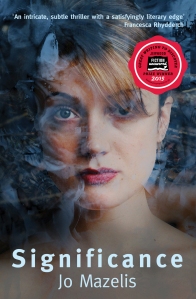
Significance by Jo Mazelis £9.99 

significanceLucy Swann is trying on a new life. She’s cut and dyed her hair and bought new clothes, but only gets as far as a small town in northern France when her flight is violently cut short. When Inspector Vivier and his assistant Sabine Pelat begin their investigation the chance encounters of her last days take on a new significance. Lucy’s death, like a stone thrown into a pool, sends out far-reaching ripples, altering the lives of people who never knew her as well as those of her loved ones back home.

Sugar Hall by Tiffany Murray: £8.99 

Sugar Hall Tiffany MurrayEaster 1955 and Britain waits for a hanging. Dieter Sugar finds a strange boy in the red gardens at crumbling Sugar Hall – a boy unlike any he’s ever seen. As Dieter’s mother, Lilia, scrapes the mould and moths from the walls of the great house, she knows there are pasts that cannot be so easily removed. Sugar Hall has a history, buried, but not forgotten. Based on the stories of the slave boy that surround Littledean Hall in the Forest of Dean, this is a superbly chilling ghost story from Tiffany Murray.

Brief Lives by Christopher Meredith £9.99 

Brief Lives Christopher MeredithFrom the nightmarish first story set in the South China Sea in 1946 to the final piece, set nowhere at the end of time, Brief Lives demonstrates in a short compass a huge range in technique and milieu and a unity of theme and sensibility. It opens naturalistically but is distinctly non-realist by the close. We meet an ex-collier in 1950 anguishing over whether to return to the pit, a young mother in the early 1960s quietly shepherding those around her through a bleak Christmas day, an industrial chemist in this century plunged into vortices of memories that cause him to question his grasp of the world, and more.

New Stories From The Mabinogion – The Complete Box Set (Unsigned): £80 

In New Stories from the Mabinogion ten great authors take the Celtic myth cycle as a starting point to give us masterly re-workings with a modern twist in a series both various and wonderful. In these retellings of medieval stories from Celtic mythology and Arthurian Britain, we reach the orbit of Mars, the Tower of London and the edges of India, travel in time to WW2 and forward to the near future, see Iraq in drug-addled dreams, and view Wales aslant, from its countryside to its council estates. Each author makes the story entirely their own, creating fresh, contemporary novellas while keeping the old tales at the heart of the new.


Books for Home Birds

The Seren Real Series: £9.99

First started by Peter Finch with Real Cardiff and now containing over 20 volumes, the Seren Real Series is a collection of psychogeographic guides that take a closer look at beloved towns and cities from all over the UK. Always insightful and full of interesting observations, made personal by each author’s connection to the place, these books discover the essence of what makes our towns and cities tick.


The Living Wells of Wales by Phil Cope: £20.00 

Author and photographer Phil Cope takes us on a journey through the sacred wells of Wales, from the Anglesey to the Gwent. On his way he discovers wells in city centres and, quite literally, in the middle of nowhere – on mountainsides, in deserted valleys, on the coast, in sea caves. They include healing wells, cursing wells, and wells named for saints, Satan, witches, angels, fairies, friars, nuns, hermits, murderers and hangmen. Packed with colour photographs, including some of long-forgotten wells now rediscovered, The Living Wells of Wales is the new definitive volume on a subject gaining a new popularity.

Walking Cardiff by Peter Finch and John Briggs: £14.99 

Join Peter Finch and John Briggs on twenty walks around Cardiff, the bustling capital of Wales. Together they visit the new and the ancient, the difficult, the undiscovered, the lesser-known, the artistic, the entertaining, the quirky and the unexpected. They criss-cross the city, informing, discovering, exploring, and enduring, reviving old routes as they go.Their journeys encompass the city’s history, and record daily life on its streets, in its parks and its famous and not so famous, buildings.


Books for History Buffs

Conflict, War and Revolution: My Life by Alessandra Kozlowska: £12.99 

Discovered by the author’s grandson, and written originally in Italian, Conflict, War and Revolution: My Life is the memoir of Baroness Alessandra Koslowska (1892-1975) and is a vivid depiction of her life from childhood to the end of the Second World War. In essence it is the story of her struggle to keep her family together through the huge and sometimes deadly social and political changes of early twentieth century Europe including the survival of two revolutions in Russia and the subsequent civil war, her travels in central Europe during World War One, her life in Italy during the inter-war years, and her internment there, which was almost terminated by German forces.

Forbidden Lives by Norena Shopland: £12.99 

Norena Shopland Forbidden LivesForbidden Lives is a fascinating collection of portraits and discussions that aims to populate LGBT gaps in the history of Wales, a much neglected part of Welsh heritage. In it Norena Shopland reviews the reasons for this neglect while outlining the activity behind the recent growth of the LGBT profile here. She also surveys LGBT people and their activity as far back as Giraldus Cambrensis’ Journey Through Wales in the twelfth century where he reports on ‘bearded women’ and other hermaphrodites. Other subjects include Edward II and Hugh DeSpenser, seventeenth century poet Katherine Philips, the Ladies of Llangollen, Henry Paget, artists Gwen John and Cedric Morris, and actor Cliff Gordon.

Caradoc Evans: The Devil in Eden by John Harris: £19.99 

Caradoc Evans Devil in Eden John HarrisIn Caradoc Evans: The Devil in Eden John Harris has written the definitive biography of Welsh author Caradoc Evans. He investigates what lay behind his writing, and its impact on Wales and beyond. Evans is revealed as a polemicist on issues like the rights of workers, the conduct of the Great War, and the status of women. A leading London journalist, Evans had a popular weekly column in which he responded to readers’ views in trenchant fashion. As Harris argues, challenging convention was his life’s work. Extensively researched and brilliantly written, it is a revelatory and necessary insight into the man, his country and his times.


Books for Nature Lovers

Wild Places UK: UK’s Top 40 Nature Sites by Iolo Williams: £19.99 

In 2016 television naturalist Iolo Williams brought us the definitive guide to the top nature sites in Wales. Now he returns with a guide to his top 40 sites in the UK. From Hermaness on Shetland to the London Wetland Centre, from Dungeness in Kent to Loch Neagh, Williams criss-crosses the country. Lavishly illustrated, author and book aim to introduce a new audience to the delights of the UK, be they armchair naturalists or, more importantly, visitors to the forty sites Williams has selected.

Waterfalls of Stars by Rosanne Alexander: £12.99 

Waterfalls of Stars Rosanne AlexanderWhen Rosanne Alexander’s boyfriend Mike was offered the job of warden of Skomer Island, they had just ten days to leave college, marry (a condition of employment) and gather their belongings and provisions for the trip to the island. With great sensitivity, and humour, Rosanne Alexander relates their experiences, including her observations of the island’s wildlife and landscape. With her lyrical evocation of the natural world and its enthusiastic and resourceful approach to the problems of island life, Waterfalls of Stars will inspire and entertain anyone who has felt the need for escape.

Once by Andrew McNeillie: £9.99 

Once is the journey from boyhood to the threshold of manhood of poet Andrew McNeillie. From an aeroplane crossing north Wales the middle-aged writer looks down on the countryside of his childhood and recalls an almost fabulous world now lost to him. Ordinary daily life and education in Llandudno shortly after the war are set against an extraordinary life lived close to nature in some of the wilder parts of Snowdonia. Continually crossing the border between town and country, a fly-fisherman by the age of ten, McNeillie relives his life in nature during a period of increasing urbanisation.


Books for Poetry Fanatics

Erato by Deryn Rees-Jones: £9.99 

Named after the Greek muse of lyric poetry, Erato combines documentary-style prose narratives with the passionate lyric poetry for which Rees-Jones is renowned. Here, however, as she experiments with form, particularly the sonnet, Rees-Jones asks questions about the value of the poet and poetry itself.  Erato’s themes are manifold but particularly focus on personal loss, desire and recovery, in the context of a world in which wars and displacement of people has become a terrifying norm.
Shortlisted for the T.S. Eliot Prize.

Gen by Jonathan Edwards: £9.99 

Jonathan Edwards GenGen is a book of lions and rock stars, street parties and servants, postmen and voices. In the opening sequence’s exploration of youth and young manhood, the author sets his own Valleys upbringing against the ’50s youth of his parents and the experience of a range of pop culture icons, including Kurt Cobain and Harry Houdini. Other poems place a Valleys village and the characters who live in it alongside explorations of Welsh history and prehistory, and the collection concludes with a selection of sometimes witty, sometimes heartfelt love poems.

Regional Poetry Pamphlets: £5.00

Our new series of poetry pamphlets celebrates the beauty, history and lively everyday goings-on in four areas of Wales: Pembrokeshire, Snowdonia, the Borders, and the capital city of Cardiff. Each pamphlet comes with an envelope and a postcard – the perfect stocking filler for your loved ones this Christmas.


Twelve Poems for Christmas: £5 

This sparkling selection of Christmas poems is the perfect stocking filler for any poetry addict. These are poems full of feeling that resist cliché, that touch on classic ‘Christmas’ themes, but bring them to life from fresh perspectives. The pamphlet opens with Pippa Little’s lyrical and tender poem, ‘St. Leonore and the Robin’, and features poems both humorous and contemplative. Small enough to send with (or instead of) a card, this is the perfect festive treat for your loved ones.


Books for Cooks

The Occasional Vegan by Sarah Philpott: £12.99 

The Occasional Vegan Sarah PhilpottThe Occasional Vegan is a collection of 70 simple, affordable and delicious recipes, suitable for newcomers and long-time vegans alike, that will keep you well-fed and healthy. Author Sarah Philpott’s recipes are accompanied by the story of her own journey to becoming a vegan, exploring the ethical and lifestyle arguments for a plant-based diet.  Food lover Philpott shows that embracing veganism certainly doesn’t need to break the bank. Her recipes are homely and easily cooked, suitable for old and young, gourmet cooks and the kitchen novice.


Books for Music Lovers

Just Help Yourself by Vernon Hopkins: £9.99 

Just Help Yourself Vernon Hopkins1960. Britain stood at the cusp of new times. In Pontypridd, sixteen-year-old Vernon Hopkins had just found a new singer for his band: a local boy who would come to be known as Tom Jones. Just Help Yourself tells the full story of The Senators – soon to become The Squires – and their lead singer Tom Jones. Vernon Hopkins’ authentic narrative is a revealing look at the highs and lows of the music business, and of London in the allegedly Swinging Sixties. Full of gritty detail about life in Pontypridd, and with great insight into the music business, it is a cautionary tale of ambition and success. Illustrated with previously unseen photographs from the author’s archive.

The Roots of Rock, from Cardiff to Mississippi and Back by Peter Finch: £9.99 

The Roots of Rock, from Cardiff to Mississippi and BackPeter Finch follows the trail of twentieth century popular music from a 1950s valve radio playing in a suburban Cardiff terrace to the reality of the music among the bars of Ireland, the skyscrapers of New York, the plains of Tennessee, the flatlands of Mississippi and the mountains of North Carolina. The Roots of Rock mixes musical autobiography with an exploration of the physical places from which this music comes. It is a demonstration of the power of music to create a world for the listener that is simultaneously of and beyond the place in which it is heard. It also considers how music has changed during this time, from the culture-shaping (revolutionising) 50s and 60s to the present day.


Books for Horizon Gazers

No Far Shore: Charting Unknown Waters by Anne-Marie Fyfe: £9.99 

No Far Shore is no ordinary exploration of coastlines. Anne-Marie Fyfe combines travel writing, history, memoir and poetry in an intriguing meditation on the sea, that explores the unsettledness of living on the boundary between two elements. She explores countless coastlines, her own family history and the works of a number of writers for whom the coast has been influential along the way.


Losing Israel by Jasmine Donahaye: £12.99 

In 2007, in a chance conversation with her mother, a kibbutznik, Jasmine Donahaye stumbled upon the collusion of her family in the displacement of Palestinians in 1948. She set out to learn the story of what happened, and discovered an earlier and rarely discussed piece of history during the British Mandate in Palestine. Losing Israel is a moving and honest account which spans travel writing, nature writing and memoir. Through the author’s personal situation it explores the powerful and competing attachments that people feel about their country and its history, by attempting to understand and reconcile her conflicted attachments, rooted in her family story – and in a love of Israel’s birds.

The Road to Zagora by Richard Collins: £9.99 

When Richard Collins was diagnosed with a progressive incurable disease in 2006 he decided to see as much of the world as he could while his condition allowed. The result is The Road to Zagora, a singular travel book which takes in India, Nepal, Turkey, Morocco, Peru, Equador and Wales. With ‘Mr Parkinson’, as Collins refers to his condition, by their side, he and his partner Flic decide to continue to travel ‘close to the land’ post diagnosis, leaving the tourist trails and visiting places of extremes: the Himalayas, rainforests, deserts. The story of their travels is collected here in a memorable journey around the world, and the self.


Books for Fans of Biography and Memoir

The Longest Farewell by Nula Suchet: £12.99 

When Nula’s husband James, an Irish documentary filmmaker, becomes forgetful they put it down to the stress of his work. But his behaviour becomes more erratic, and he is eventually diagnosed as suffering from Pick’s Disease, an early onset and aggressive form of dementia. The Longest Farewell is the true story of Nula’s fight with her husband’s disease, and how this terrible time held a happy ending.


Tide-Race by Brenda Chamberlain: £9.99 

Tide-Race is a remarkable account of life on Bardsey (known as Ynys Enlli to Welsh speakers), a remote and mysterious island off the coast of North Wales. Brenda Chamberlain lived on the island from 1947 to 1961, during the last days of its hardy community. The combination of Bardsey, ancient site of Christian pilgrimage, wild and dangerous landscape, and Brenda Chamberlain, Royal Academy trained artist, results in a classic book, vividly illustrated by the author’s line drawings.

Jim Neat: The Case of a Remarkable Man Down on his Luck by Mary J. Oliver: £9.99 

Jim Neat is a remarkable evocation of the seemingly fractured life of Mary J. Oliver’s father. Tinged with the tragedy of his partner’s death and an orphaned daughter, it ranges across the history of 20th century England and Canada. Using the few documents of Jim’s life and a combination of poetry and prose, Oliver adopts a legal structure, making ‘the case’ for the worth of his life. The result is a fascinating and engaging book unlike any other memoir.


Books for Art Connoisseurs

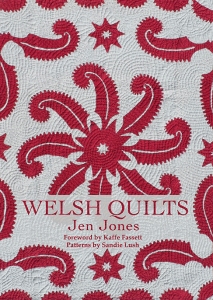
Welsh Quilts by Jen Jones: £12.99 

Welsh Quilts Jen JonesWelsh Quilts is an authoritative guide to the history and art of the quilt in Wales. It is the result of expert author Jen Jones’ researches into the subject and her desire to revive what had been a gloriously high-quality craft. Illustrated with beautiful images of the bold designs and intricate stitching of the quilts in her own collection, Welsh Quilts is the essential book on the subject, whether you are a quilter yourself, or simply interested in quilting heritage.

Jonah Jones: An Artist’s Life by Peter Jones: £14.99 

Sculptor, painter, letter cutter, stained glass artist, novelist, academic and administrator; Jonah Jones (1919-2004) was a twentieth century renaissance man. His son Peter looks back on his life, from growing up in a mining family in Newcastle, through his experiences in a non-combatant role in the Medical Corps during the Second World War, to the people and places that fired his passion to become an artist. Jonah Jones: An Artist’s Life is a considered look at the life of one of Wales’ most successful artists.

Try the Wilderness First : Eric Gill and David Jones at Capel-y-Ffin by Jonathan Miles: £12.99 

Try the Wilderness First is the only study devoted to controversial artist Eric Gill’s artistic and religious community in the Black Mountains of Wales during the 1920s, told through the character and work of Gill himself and David Jones, two of Britain’s most significant twentieth century artists. In it, Jonathan Miles explores the influences of place, culture and religion on artistic practice and investigates the effect of the Black Mountains and of Gill’s community on the work of these two important British artists, both at the time and in the future.

Books for Photographers

Living in Wales by David Hurn: £25.00 

Living in Wales is an album of one hundred and one duotone portraits of people who, in the words of David Hurn ‘have enriched my life and that of Wales.’ It is a roster of the famous and distinguished in the fields of science, business, the arts, sport, the law, health, media, politics and religion. Beautifully composed, and shot with David’s characteristic flair for detail, the photographs linger on the physicality of the person, a telling prop pushing the image towards the possibility of narrative. Here is a photographer on inspirational form.

Taken in Time by John Briggs: £14.95 

Photographer John Briggs continues his project to document change in the Cardiff docklands, revisiting the sites and people memorably recorded in Before the Deluge. In the last thirty years landmark buildings have been demolished, docks filled in, the barrage built, maritime businesses closed, and streets disappeared. In their place, a huge redevelopment scheme, gentrification, and tourism. With characteristic honesty and an eye for compelling detail, John Briggs brings these changes to a wider audience in this not to be missed book.


Still not found what you’re looking for? Browse our website for more inspiration.

Create your free Seren account and enjoy 20% off every book you buy from us.
Posted on

January Sale: 50% off our books this week

January Sale Half Price books

Kick off 2019 with some literary loveliness and take advantage of our January sale – all our published books are half price for one week only.

January sale half price books


The sale ends midnight, Sunday 20 January. So which books can you steal away for half the price? Well – practically all of them! The sale includes all our published poetry, fiction and non-fiction books (only excluding forthcoming titles). With so much on offer, we thought you might enjoy some highlights…


Best for…
Late night reading:
Paul Deaton A Watchful Astronomy£9.99  £4.99
Paul Deaton’s PBS Recommended debut, A Watchful Astronomy, is gloriously dark and atmospheric. The poet’s father stalks the poems like a ‘wounded bear’ as weathers and seasons are conjured onto the page: icy blasts of weather, frosts, and inky skies full of stars.
‘Each poem in this collection is like a little torchlight’
– Jen Cambell


Best for…
Transporting you to another time:
Simple Scale David Llewellyn£9.99  £4.99
David Llewellyn’s gripping new novel, A Simple Scale, moves in narratives of love, death, deceit, Classical music and government oppression. Prepare to be transported to Soviet Russia, McCarthyite Hollywood and post-9/11 New York as a determined young PA tries to piece together the fragments of history.


Best for…
Cheering up a dull day:
Jonathan Edwards Gen
£9.99  £4.99
Gen 
is the wonderful follow-up to Jonathan Edwards’ Costa Award-winning debut, My Family and Other Superheroes. It’s a book of wonder, nostalgia and music where poems are as likely to be voiced by a family member as by a lion, or a flag on the wall of Richard Burton’s dressing room. Gen is a celebration of everything that matters to Edwards – Wales, family, animals, history.


Best for…
Intellectual reading:
Caradoc Evans Devil in Eden John Harris£19.99  £9.99
Challenging convention was Caradoc Evans’ life’s work. A controversial figure in Welsh literature, Evans’ books were publicly burned in the streets of Cardiff, yet praised across the border. But what lay behind his writing? John Harris’ biography is the first of its kind and a marvel – extensively researched and brilliantly written.


Best for…
Glimpsing into history:
Dear Mona Jonah Jones
£19.99  £9.99
Dear Mona collects together the private letters of Jonah Jones, sent during and after World War Two to his mentor and friend, Mona Lovell. Their tumultuous relationship informed the evolution of Jonah’s character. We see this in his intimate and emotional letters as he describes work as a conscientious objector, his time on the Home Front as a non-arms bearing medic, and his artistic progression.


Best for…
Armchair travelling:
Richard Gwyn Stowaway£9.99  £4.99
In Stowaway, Richard Gwyn navigates the rich history and landscapes of the Mediterranean. The central character, an anti-Ulysses figure, seems to transcend time, and acts as the witness to major events: from the fall of Byzantium to the Syrian civil war. This is a richly imagined and thrillingly inventive new collection.


Best for…
Daytime entertainment:
Just Help Yourself Vernon HopkinsIt was 1960 when teenaged Vernon Hopkins recruited a new kid to his band. They didn’t know it yet, but this boy from Pontypridd would grow up to become Tom Jones. Just Help Yourself is the gritty, honest story of the band’s journey towards superstardom – from tiny gigs in South Wales to record deals in London – and then the inevitable bust up. It’s a wild ride that you might find hard to put down.


We hope you find a bookshelf full of hidden gems before the sale ends. Have a browse and see what catches your eye before the offer ends (midnight, Sunday 20 January).


Posted on

Veganuary: Tips & vegan recipes from Sarah Philpott

Veganuary Sarah Philpott vegan

Forget the January blues – in recent years this cold and gloomy month has instead brought cooking inspiration and healthy eating ideas as ‘Veganuary’ has taken off.

What is Veganuary? Whether you’re new to the vegan diet or you’ve dabbled before, the idea is to cut out meat and dairy throughout January – and if you find you like it, then continue for as long as you’d like! To help kickstart your vegan journey, vegan cook Sarah Philpott, author of The Occasional Vegan, has some tips, tricks and recipes:

Sarah Philpott The Occasional VeganGetting started
Eating and cooking as a vegan might seem like a minefield but it’s simple once you know
how. Despite what your mother says, you’d be surprised by how little protein you actually
need and it can be found in a number of vegetables, beans and pulses. The same goes for iron, calcium and healthy fats.

Where to shop & what to buy – Can eating vegan be budget-friendly?
You might think that veganism is only for well-off lefties but it’s not a middle-class fad; it’s actually really accessible for those of us on a tight budget. Seasonal fruit and vegetables are cheap and plentiful, and beans, pulses, rice and other grains cost pennies. Meals like chilli, dhal and curry are tasty tummy fillers which, armed with a well-stocked cupboard, will cost you next nothing to make. You can buy big bags and tins of pulses for next to nothing from supermarkets and international stores, and pound or bargain shops often sell quinoa, nuts, seeds and dried fruit at a fraction of the price you’d pay elsewhere. Most supermarkets sell everything from plant milk to vegan cheese, as well as a variety of ready meals, and if you fancy a treat, there are plenty available, including vegan Magnums and Ben and Jerry’s. Most restaurants now offer a vegan menu and you can even enjoy a vegan sausage roll at Greggs.

Get started – try these vegan recipes!


The healthy meal:
Beat the Blues Salad
This vibrant and filling salad pairs smoky tofu with beetroot, orange and salty black olives.

Video credit: Manon Houston

Read the full recipe


The mid-week treat:
‘KFC’ – Kentucky Fried Cauliflower
This spiced, fried cauliflower tastes amazing and is surprisingly easy to make.

Video credit: Manon Houston

Read the full recipe


The decadent dessert:
Vegan Chocolate Mousse
This gorgeously light and creamy mousse has just four ingredients and comes together as if by magic.

Video credit: Manon Houston

Read the full recipe


We hope you feel inspired and ready to begin your voyage into veganism. Hungry for more great recipes? Get your copy of The Occasional Vegan from our website: £12.99

Create your free Seren account and enjoy 20% off every book you buy direct from us.


Posted on

100 Years On: Newport RFC and the Great War

Armistice Newport RFC

Today, November 11th 2018, marks the centenary of the Armistice and the ending of the Great War. In commemoration, author and historian Mike Rees looks at the sacrifices made by rugby players from his home town of Newport, revealing details about their sporting and personal lives, as well as their brave and tragic last stands.

Rees is the author of Men Who Played the Game, which explores the development and importance of sport in Britain and the Empire leading up to the outbreak of the First World War, and the part played by sportsmen in the conflict.


The Great War was conducted on a scale hitherto unknown and its consequences remain with us to this day. Such were the losses, over 750,000 in Britain alone, that the idea of a ‘lost generation’ is firmly established in the collective memory. The existence of war graves, carefully maintained by the Commonwealth War Graves Commission, throughout Western Europe and beyond serve as a reminder of the sacrifices made in this cataclysmic war. Memorials to the missing, their bodies never found, both move and shock us when we visit Thiepval on the Somme, with 73,367 names and the Menin Gate in Ypres with 54,896. Given the scale of these losses it is clear that communities throughout Britain were affected. As we now reach the centenary of the Armistice that brought to an end this dreadful conflict, it is an appropriate time to see just how those badly those communities were affected. Here I will look at the wartime stories from one community in particular  – rugby players from my home city, Newport.

Newport Athletic Club has always remembered its war dead. The memorial gates at Rodney Parade contain the names of 86 members of the club who lost their lives in the Great War, among them 6 rugby internationals who represented Wales in what was to become their national sport. Playing in the late nineteenth and early twentieth century these men, to a greater or lesser extent, played a significant role in the evolution of the game in Wales. More importantly, they made the greatest sacrifice of all after the First World War erupted.

Richard Garnons Williams

The first of these men, Richard Garnons Williams, holds a special place in Welsh rugby history as a member of the first ever Wales XV to play international rugby. This historic event took place on 19th February 1881 at Blackheath and Wales were soundly beaten. Garnons Williams, a Newport forward, never played for Wales again.

Born in Llowes, Radnorshire in 1856, one of ten children, Garnons was educated at Magdalen College School, Oxford before studying at Trinity College, Cambridge. From here he progressed to the Royal Military College, Sandhurst and, on completion forged a successful military career with the Royal Fusiliers (City of London Regiment). This was followed by service with the South Wales Borderers (1st Brecknockshire Volunteer Battalion) where he reached the rank of lieutenant colonel. Garnons retired from regular service in 1892, although he did continue to serve in a voluntary capacity until 1906. This determination to follow a military career undoubtedly curtailed his rugby career, details of which are somewhat sketchy. We do know, however, that he played for Cambridge University, Brecon and Newport, from where he won his solitary cap.

On the outbreak of war in 1914 Garnons, by now aged 58, re-joined the British Army and returned to the Royal Fusiliers, the 12th Battalion. He was killed on 27th September 1915 leading his battalion at Loos when he was shot in the head following an attack on German trenches. The battalion had become exposed on each flank and Garnons had just given the order to retreat. He is remembered on the Loos Memorial.

Garnons, at 59, was the eldest of the 13 Welsh internationals to make the ultimate sacrifice in The Great War. He left a wife, Alice Jessie and a daughter, Barbara, who also served in France and lost her husband on the Western Front in 1917. A brother, Mark Penry, died when the HMS Hampshire was sunk by a mine in 1916.


Louis Augustus “Lou” Phillips (1900)

Our second Newport international was one of the cities’ greatest all round sportsmen, the Wales half back, Louis Phillips. Lou was born in Stow Hill in 1878 and was later a resident of Gold Tops, a prosperous residential area in the town. He made his mark as a swimmer, cricketer and international standard water polo player but it is as a rugby player that he is best remembered. A product of Monmouth Boys Grammar School, he won 4 caps and played half back, partnering club mate Llewellyn Lloyd in the Triple Crown winning team of 1900, the year that heralded the beginning of Wales first ‘golden era’.  Lou looked set for a long and distinguished run in this emerging Welsh team but a serious knee injury sustained playing against Scotland in 1901 brought his brief rugby career to a premature close. A qualified architect by profession, Lou continued to display his sporting ability by becoming an international golfer and twice Welsh Amateur Golf Champion.

On the outbreak of war Lou joined the 20th (Service) Battalion Royal Fusiliers where, after first refusing a commission, he served as a sergeant. On the night of 14th March 1916, while out with a wiring party near Cambrin, France, Lou was fatally shot in the chest. The loss of this immensely talented 38 year old was keenly felt in the sporting circles of South Wales.


Pritchard in Newport jersey

Probably the best known rugby international to lose his life in the war was Charles Meyrick Pritchard. Charlie was born in September 1882 in Newport and attended Newport Intermediate School and Long Ashton School, Bristol before taking his place in the family wine and spirit business. A well-built, thirteen and a half stone backrow forward, Charlie made his Newport debut in January 1902. By the following year Charlie was a travelling reserve with the Wales team and in 1904 he won the first of his 14 caps in the game against Ireland. In December 1905 Charlie had his finest rugby moment when he was the stand out player in the Welsh victory over the All Blacks. Known for his all-round skills, it was his deadly tackling that drew praise in this momentous victory. Fellow Newport hero, George Travers said that Charlie “knocked ‘em down like ninepins”. Following this historic achievement, Charlie went on to represent Wales until 1910, although he did miss a number of matches through injury, and was part of the Grand Slam winning side of 1908. He also captained his club between 1906 and 1909.

When war broke out, Charlie was quick to enlist and joined the South Wales Borderers as a temporary Second Lieutenant. By October 1915 Charlie was a captain in the 12th Battalion and arrived on the Western Front in time for the Somme offensive of July 1916. He was quickly into the action and wrote home detailing some of his experiences. Tragically, on the night of 12th/13th August Charlie was instructed to lead a raiding party on German trenches. Despite fighting bravely in a successful raid, Charlie suffered serious injuries and was taken to No 1 Casualty Clearing Station. After being reassured that his men “had got the Hun”, Charlie replied with his last known words, “Well I have done my bit”. Charlie, a resident of Llwynderi Road, Newport, was buried in Choeques Military Cemetery and left a grieving widow and two young children. This legendry Newport rugby player and war hero was 34 years old.


Johnnie Williams in Cardiff jersey

Johnnie Williams was the most capped Welsh rugby international to die in the Great War and, until 1976, jointly held the record for the most tries scored by a Welsh player. Born in Whitchurch, Cardiff in 1882 and a product of Cowbridge Grammar School, Johnnie spent the majority of his career playing for his home club. However he began his career at Newport where he played between 1899 and 1903, scoring 19 tries and a dropped goal in 50 appearances for the club. In 1906 he broke into a strong Wales team to play the touring Springboks. Although this match was lost Johnnie only experienced defeat once more in 17 matches in a Welsh shirt. Noted for his swerve and sidestep, this pacey winger played in 3 Grand Slam winning teams and captained his country against France in 1911. Johnnie also toured with the British Isles team to Australia and New Zealand where he played in 2 of the 3 tests and was the second top scorer with 12 tries on the tour.

When the war began, Johnnie left his job as a partner in a coal exporters based in the Cardiff Coal Exchange to join the 16th Battalion of the Royal Welch Regiment. By now a captain, Johnnie led his men in the attack on Mametz Wood, part of the Somme offensive. After ‘going over the top’ on 7th July, Johnnie was severely injured which resulted in the amputation of his left leg. Despite being able to write to his wife Mabel following his injury, thirty-four-year-old Johnnie died of his wounds on 12th July. He was buried at Corbie Communal Cemetery.


Phil Waller
Phil Waller with the British Isles team in 1910

Phil Waller was born in Bath in 1889 and educated at Carmarthen Intermediate School but it is as a Newport Rugby Union international that he is best remembered. On leaving school, Phil was apprenticed as an engineer to the Alexander Dock Railway Company and, by 1907, he was a regular member of the Newport pack, specializing in the line out and the loose. A year later 19 year old Phil was in the Wales team that defeated the touring Australians 9-6 and kept his place for the 1909 Five Nations tournament. All four matches were won ensuring that Phil became one of the few players to have defeated a southern hemisphere country and win a Grand Slam in the same season. The following season Phil played in the victory over France but lost his place for the first visit to Twickenham.

Although he never played for Wales again, Phil was selected for the British Lions tour to South Africa where he played in all 3 tests. Taken with the country, Phil stayed in South Africa playing rugby and working in Johannesburg as an engineer. In August 1915 Phil enlisted as a gunner with the 71st Siege Battery SA Heavy Artillery and saw action at Ypres, the Somme, Arras and Cambrai. About to go on leave, driving to the nearest rail link, he and a colleague were killed by stray shellfire. Phil’s colleague was the son of South African statesman, Sir Percy Fitzpatrick, the man who initially proposed the observation of the two minutes silence on Armistice Day. Phil Waller, buried in Red Cross Corner Cemetery, Beugny, near Arras, was 28 years old.


Billy Geen, photographed 1914-1915

Billy Geen was, like fellow war casualty and Newport rugby international Lou Phillips, a resident of Gold Tops in Newport. Born in 1891, this nephew of Frank Purdon who had won four caps in the 1880’s, was educated at Haileybury College in Hertfordshire and then Oxford University. A fine cricketer who represented Monmouthshire in the Minor Counties Championship, Billy made his name as an extremely talented rugby three-quarter and won three ‘Blues’ playing on the wing outside the great England captain, Ronnie Poulton-Palmer. In his first Varsity match Billy scored three tries in a famous Oxford victory.

Billy played his club rugby for Newport and was a member of the team that defeated the 1912 South Africans 9-3 in front of a crowd of over 18,000 at Rodney Parade. Selection for Wales against the same opposition followed and, despite a controversial defeat, Billy kept his place against England. He also played against Ireland that year, this time in the centre, but lost his place through injury.

With the outbreak of war Billy joined the 60th King’s Royal Rifle Corps and quickly became a Second Lieutenant in the 9th Battalion. He saw action in the Second Battle of Ypres and was tragically killed at Hooge on 31st July 1915. Billy was last seen leading his men in hand to hand fighting, one of 17 officers and 333 other ranks of this battalion killed in the exchange. This ‘dazzling left wing’ with ‘dancing footwork’ was one of 740 boys from Haileybury College to be killed in the war. Billy’s body was never found and he is remembered as one of the 54,896 names on the Menin Gate. He was 24 years old.


Perhaps, of all the Newport internationals killed in the Great War, it is the death of Billy Geen, a young man in the prime of his rugby career that best represents the loss to Welsh rugby. However, at this time it is only right to remember all thirteen Wales rugby internationals lost in this dradful conflict as well as countless other rugby players throughout the land. Heroes every one.


Find out more about the sportsmen who fought in the Great War in Men Who Played the Game.

Posted on

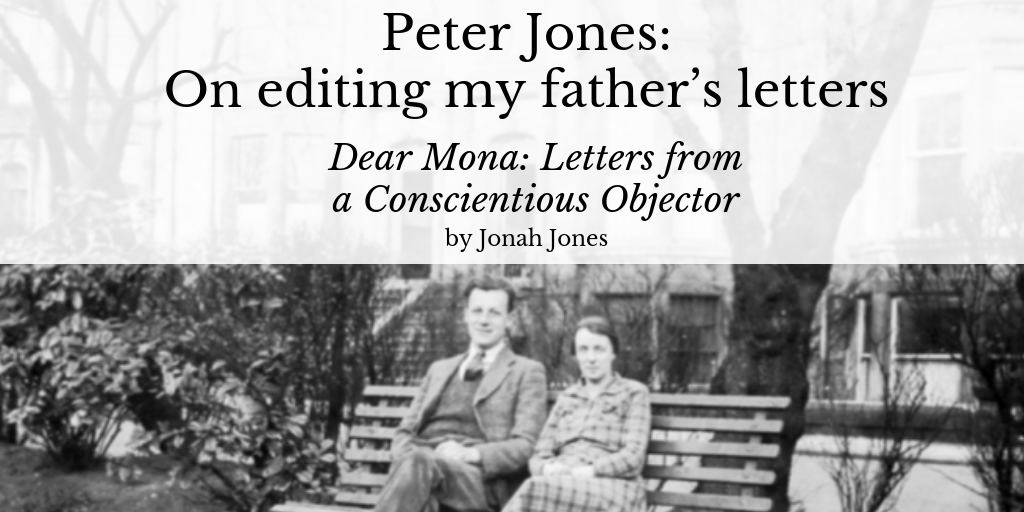
Peter Jones: on editing my father’s letters

Peter Jones Dear Mona Letters

In Dear Mona: Letters from a Conscientious Objector, we are given a window into the life of Jonah Jones through private letters to his close friend and mentor, Mona Lovell. We see his character evolve as he nurtures his love of art and sculpture, and finds new ways to express his creativity.

A pacifist, Jones at first declined to enlist when war broke out, but later served as a non-arms bearing medic in the Second World War. His letters give an emotional insight into the prejudices he faced and the reality of his wartime experiences. Peter Jones, Jonah’s son, has edited this fascinating book and here gives insight into the difficult process of bringing its intimate contents to print.


Deciding to publish my father’s letters to Mona was both an easy step and one of the hardest things I have had to do.

Easy because of the quality of the writing and the interest the material holds. There is a clear narrative arc to the letters as the intense relationship between Len Jones (as my father Jonah was then known) and his friend and mentor Mona Lovell develops, and he simultaneously stumbles towards his vocation in art. This makes them a very satisfying read, and gives the whole a novelistic quality. Along the way we get fascinating insights into the life of a conscientious objector in the Second World War, vivid descriptions of action after Len joins the 6th Airborne Division as a non-combatant medic, and powerful accounts of the tension in British Mandate Palestine in the run-up to the birth of the State of Israel.

Len Jones, 1945
Len Jones, 1945
‘…there is no hysteria – only a desperate apathy & an anxious searching for belongings as they come from their cellars or from a few miles back. Once in the back area again they begin to smile even, as the war moves on & they feel safe again – but many have lost what can never be replaced…’

All of this compelled publication. Yet at the same time I wavered, for my father was a very private man in some ways, and I knew he would not have been glad to see these letters released to the world. They cover a time when he was mainly unhappy, a time he preferred to forget. And of course, fundamental to my whole dilemma, was his relationship with Mona – she was in love with him, he looked on her as a soul-mate whom he valued dearly as a friend but could not love in the way she wished. It was extremely hard to lay all this open before a reading public.

Len Mona
Len and Mona relax in the park

So the question arose: could I make the insightful, non-personal material available without publishing the deeply personal side of the letters? Yes, but this would run the risk of creating a narrative without a narrative, for Len’s relationship with Mona (and, to a lesser but still important extent with the poet James Kirkup) is the spine of the whole story. Most crucial, cutting out the personal would diminish Mona to little more than a sounding board for Len’s thoughts and experiences. This would be a grave injustice, for it is clear how vital she was in Len’s transition from his constricted working class roots to the man who could express himself through art. Too often women have been relegated to the shadows of history; Mona did not deserve this fate.

Dear Mona
Mona Lovell, 1935

So, with qualms, I decided to lay out the whole story. It reveals so much: how life was for conscientious objectors in the Second World War (we have heard a lot about their brave predecessors in the Great War, but much less of Len’s generation), the widespread frustration people suffered due to their lives being suspended by the war, the congenial debating society that was Carmel College in Haifa, where servicemen and women did university-style courses prior to demobilization. Some of the issues touched on in Len’s letters seem remarkably topical, especially the Arab-Israeli conflict and anti-semitism (whether among forestry workers in Yorkshire or British officials), and homosexuality, on which he evolved from unthinking revulsion to deep compassion. These letters are compelling; the world should see them.

Peter Jones.

Posted on

Chocolate Mousse – a recipe from The Occasional Vegan

chocolate mousse occasional vegan

This weekend you’ll find Sarah Philpott at the Cardiff Book Festival chatting to fellow vegan cook Gaz Oakley. While you wait for the event, why not whip up some of Sarah’s delicious chocolate mousse? Believe it or not, this recipe uses chickpea water in place of cream – and miraculously you can hardly tell the difference.

Tip: I find that cheap supermarket dark or plain chocolate works well here as it’s usually higher in sugar.’ – Sarah

Chocolate Mousse

vegan chocolate mousse

If you fancy a sweet treat or if you’re cooking for friends and need a quick dessert, you can make this quickly and leave it to set in the fridge while you’re eating dinner. The surprise ingredient here is chickpea water, also known as aquafaba. It might sound crazy but it acts in the same way as egg whites and gives you a light and fluffy mousse. You really should give this a try because it’s truly delicious.


Ingredients

– 150g dark chocolate
– A dash of plant milk
– 120ml chickpea water
– 1 tsp vanilla extract
– A pinch of sea salt (optional)

Directions

Carefully place a heatproof bowl over a pan of boiling water and add the chocolate and plant milk and stir gently until melted. Remove the bowl from the pan and set aside to cool slightly. If you have a microwave, heat the bowl on a medium power at 60-second intervals until melted.

Pour the chickpea water (one can should give you about 120ml water and you save the chickpeas for cooking something else) into a large bowl and whisk vigorously for 15 minutes, or until you have stiff peaks.This requires a strong wrist although you can use an electric whisk if you have one.To check if you have said stiff peaks, tilt the bowl slightly – if the water runs down the edge, you need to whisk more.When stiff, fold in the chocolate mixture then add the vanilla extract and the salt and stir well.

Pour into glasses or ramekins and leave in the fridge to set for at least an hour.

The Occasional Vegan Sarah Philpott

The Occasional Vegan is available from the Seren website: £12.99

Create your free Seren account and enjoy 20% off every book you buy direct from us.


Posted on

An interview with Cardiff author & legend, Peter Finch

Interview Cardiff Peter Finch

The Eisteddfod will soon be in full swing in Cardiff’s beautiful Bay area. We can’t wait to welcome you to Wales’ capital city – and to introduce you to our resident Cardiff expert, Peter Finch, who will be signing copies of his new book on the Welsh Books Council stand (84) on Wednesday 8 August, 1:00pm.

As you prepare for the marvellous week ahead, we thought you might enjoy learning a little more about the Welsh capital – so here is our interview with Peter Finch, who – as ever – is full of fascinating insight into his home city.

Peter Finch

Peter, you have been writing about Cardiff for quite some time now, with the first ‘Real Cardiff’ book having appeared in 2004. What do you perceive as the most radical change Cardiff has undergone in the last decade?
Changes to Cardiff seem to work in twenty year cycles rather than decades.  We didn’t have the Bay nor the Barrage, the Millennium Centre not the Senedd in 1980 but by 2000 we did.  In 2000 and other than right on campus there was barely a purpose-built student let available anywhere in the city.  Today they are everywhere, gargantuan, gleaming, glowing, growing, rocketing up in every district from right next door to the old Gaiety Cinema on City Road to the city’s highest of new high rises, the Bridge Street Exchange, at the bottom of Charles Street.  In the pipeline are plans for more.  Purpose Built Student Accommodation (PBSA) erected against a background of weak planning control and easy to manage building regulation they are the cash cows of property developers everywhere.   Put them up and then apply for change of use.  The cityscape will never be the same again.  In 2000 we had a green belt running right round the city.  Today that belt has shifted to become instead a green wedge, a green splash, a green smear.  In its place are the city’s new districts.  Plas Dwr, Churchlands and all the others. Cardiff expands. And expands. And expands.

The ‘culinary odyssey of City Road’ is marvellously well documented in Real Cardiff: The Flourishing City. For hungry Eisteddfod-goers, where would you recommend trying first?
.CN, the internet suffix for China, is the name of the city’s best Chinese eatery by far.  Here you can get top end Sichuan king prawn in chilli and pepper sauce, healthy option Kung Po chicken, and north east China salad in a style you’ll find hard to beat anywhere else in the city.  Failing that and for kebab fans Al Wali’s Omani Restaurant half way down and hiding behind a bus stop is pretty decent.  For Omani read Persian or Iranian or Egyptian, or Middle Eastern.  City Road is a feast from one end to the other offering meals at price points everyone can reach.

If you could be transported to any period of Cardiff’s history, which would you choose?
I think I’d want to see the heroic period of Cardiff’s industrial expansion in action first hand.  That would mean arriving in 1861 at the Royal Arcade and finding the very first Cardiff Free Library on the first floor.  Out the back they’d have a time machine, naturally, so having got here I could then get back.  I’d use it to slide back a further few years to 1849 to see Brunel move the Taff in order to build Cardiff General Rail Station for his South Wales broad gauge railway.  I’d spot a few numbers and then rush forward to 1886 to visit the brand new Coal Exchange, have a drink in the just opened Grand Hotel on the new Westgate Street, buy some cockles at the brand new indoor market and finally climb up the shiny new statue of John Bachelor to top his head with a road mender’s lamp, traffic cones not yet having been invented.   This was the period that made Cardiff, when the population boomed and when modern invention and business innovation flooded the place.  That flourishing must have been simply thrilling to watch.

Psychogeography is a particularly inventive way of mapping a place – how did you first become interested in it?
The Situationists who flourished between the fifties and the seventies were international social revolutionaries and avant garde artists.  I was running the journal second aeon at the time, a Welsh-based home for a world of avant garde poetry, so naturally I took note.  These people interested me.  They were an onward growth of the Dadaists and the Surrealists and seemed to me to be right at the cutting edge.  One of their members was Guy Debord ­– the man who invented psychogeography, the exploration of mainly urban environments for what they were rather than where they led.  The sense of place became more important than the place itself.  Why not view a city as an entity rather than a destination?  This was something I needed to try for myself.

Peter Finch Real Cardiff Flourishing CityWhat did you find most challenging in your process of writing Real Cardiff: The Flourishing City?
In writing these books you don’t sit about waiting for inspiration to strike, no hoping for those rays of Blakean stuff to come pouring down through the air and infest your work.  None of that.  This is work..  I need to immerse myself in my subject. Research it, walk through it, think about, talk about, listen to it, feel it.  I make notes.  Constantly.  I record things on the camera, take snaps, use the phone.  I check out the maps.  I check out the old ones and then the new ones.  I check  just how the used to spell the name of the place I am interested in.  Why was Rumney called Rompney? Why was Cardiff called Kairdiv?

I accumulate what I need to say and then find a way of starting out and saying it.  The starting is so important.  Get that right and the rest will flow. I work hard walking and thinking, note book always with me, and into it I make notes of how my start might go.  The walking helps the flow.  I ignore passers-by, I ignore interrupters, I am working so this poor and rude behaviour is entirely reasonable.

It’s also true that you then need to check and then check again.  I reread and redraft.  I get help from others to check too and I listen to what they say.  I recheck my spellings.  I look at what others have said and I try not to repeat them.  I acknowledge them if I do.

What’s the most challenging?  Transcribing interviews.  Getting that right.  And remembering to ask the right questions in the first place.  I always double check with my interviewees.  I let the subject see what I intend including and ask them if they are happy.  If they aren’t or I’ve got it wrong somehow then I put it right.

And finally, in the closing pages of The Flourishing City, you wonder about Cardiff ‘how it could be’, and tell us, ‘Cities are never finished’. Is it also true, then, that you’ll never be finished exploring this city of yours?
I think that once a city gets above a certain size there will always be new things to discover about it.  Not only is Cardiff big enough to keep me permanently involved but it is also changing constantly, often at a bewildering rate.  No matter which part of it I find myself in there are always new things to look at, new roads to walk down, new paths to follow and new routes to create.  Tracking the lost can be just as thrilling as delighting in the newly discovered.  The moment I finish a volume of Real Cardiff something new or different or previously unseen appears.  Buildings get built.  Buildings get torn down.  Populations flourish.  Roads and walkways bend and turn offering new and different vistas.  This capital of ours is a great Welsh place, far more involving than most people think. Try it. Just arrive and open your eyes. Real Cardiff: The Flourishing City will give you a few hints.


Real Cardiff: The Flourishing City is available from the Seren website: £9.99

Join our free Book Club for 20% off every book you buy from us.


Posted on

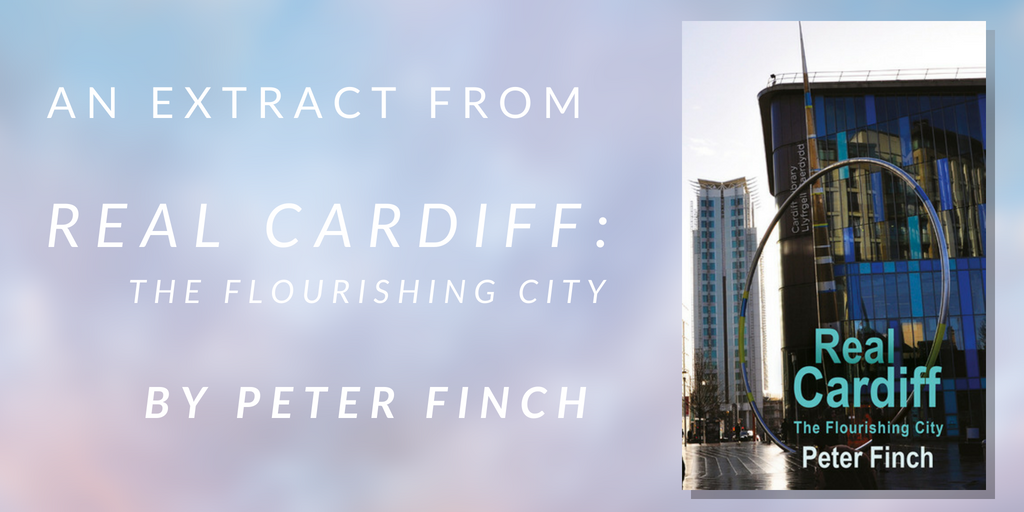
An extract from Real Cardiff: The Flourishing City, by Peter Finch

Real Cardiff Peter Finch extract

Though certain parts may be seeing rain this weekend, the warm weather continues – and what better time than summer to explore all the UK has to offer?

Peter Finch Real Cardiff Flourishing CityOur Real Series – a collection of intimate and entertaining guide books written by local writers – offers an insider’s view of the places it celebrates. The most recent addition to the series is Real Cardiff: The Flourishing City by Cardiff author and legend Peter Finch. So whether you’re an armchair traveller, or someone looking forward to a trip to the Welsh Capital sometime soon, we hope you enjoy this glimpse into the history of Cardiff – specifically, the area in which famous children’s author Roald Dahl grew up.

The whole of the Real Series – and all our other Seren books – are 50% off until midnight, Sunday 29 July, on the Seren website.


ROALD DAHL’S CARDIFF NORTH LEY

I catch the train at Cardiff Central. This is the City Line which began in the city’s north east and now, after looping in a great U through the city’s heart is about to head north again. I’m in the two-car Sprinter and I’m standing. Every single seat is occupied by pupils from Bishop of Llandaff High School. Kids, bags, blazers, headphones, chewing.
The windows stream as the train steams. Around us is railway land, an industrial cityscape full of rail sheds, engine bays, carriage washeries, repair shops and assembled new track in stacks like a giant train set. This south west of the city on view from the tracks is the capital with its guard down. Backs of mosques, tottering streets, unkempt gardens, the yards of Brains brewery, warehouses stacked with building materials, and even more open and right now empty rail beds. It reminds me of London, how the land looks as you reach Paddington or Waterloo.
But it doesn’t last. After the carriages have disgorged a hundred uniformed school kids at Fairwater, the cuttings emerge, wooded banks and scrub masking the housing above. It’s leafy suburbia giving an impression of empty countryside. A green west Cardiff, a place that doesn’t change.
It’s freezing. This is January. The train has reached Radyr where it will rest a while before returning the way it came. I’m off, up the footbridge steps, plastered thickly with Network Rail road salt. No one but no one will slip and sue here. In a previous, smaller, steam-filled incarnation, the Radyr train would have served Roald Dahl’s father, Harald, who did a daily commute in to what was then called Bute Road Station. His ghost is there on the platform now, eye glasses, three-piece suit, white starched collar. He looks like a disapproving headmaster. His railway season ticket was found inside his expensive leather wallet when he died in 1920. That was on April the 11th. The ticket was valid until the 23rd.
Like most in Cardiff at this time Harald’s business was coal. With his partner Ludvig Aadnesen he had established a business as a colliery agent and provider of all that ships docking in the world’s leading coal port would need. Provisions, ropes, oil for their lamps, food. The profits flowed.
In 1917 Harald had bought Tŷ Mynydd (Mountain House), set on rising ground a mile north of the Radyr rail station. As befits the successful businessman Harald was, here was life on a grand scale. 150 acres of land, outbuildings, cottages, a piggery, lawns, formal flower borders, terraces, its own electricity generator and an enormous Victorian house.
In photographs it looks like part of Hogwarts. It had multiple chimney stacks, mock Tudor gables, a tiled roof larger than most churches’ and greenhouses to the side to rival those of Dyffryn House, to the west of Cardiff. This is the place Roald, the great author, remembers with nostalgia, recalling the fields full of shire horses and dairy cows. There are photographs of him as a four-year-old out on the lawns and terraces, in the fields among the sheaves of corn, sitting on the wall of the piggery and of the house itself, which is resplendently decorated with both the Union Jack and the Norwegian Flag. No Welsh dragon in sight.
Like Cefn Onn, Tŷ Mynydd also had railway connections. The house had been built in 1883 by George Fisher, Director of the Taff Vale Railway. When he died in 1891 the property passed to his son, H. Oakden Fisher, Chair of both the TVR and the Cardiff Gaslight and Coke Company Ltd, although his real interest lay with the military. He was Lieutenant Colonel of the Glamorgan Volunteer Artillery. Harald bought the estate in 1918. When he died in 1920, his second wife, Sofie Magdalene, moved to smaller premises back in Llandaff. Tŷ Mynydd then became the property of the architect Sir Beddoe Rees, MP and for a brief time in the 1930s was turned into St Maur’s College, a small private boarding school for girls.
In 1967 the house and most if its outbuildings were demolished. This was the first full-blooded rush at clearance following the war. Cardiff was expanding. Property developers had no interest in the preservation of inefficient, draughty piles such as Tŷ Mynydd. On its lands a whole housing estate could be build. It had to come down.
I take the road up out of the station’s gully. Already the old shunting yards and waste ground lining the river have been populated with high density brick town housing. There’s little public space. Most structures are distinct from each other, laid at angles as if thrown there like dice. Room for breath is restricted and corners are rounded. Access is on turning roads named after De Clare, Norman Lord of the City, Aradur Hen, an ancient local croft that gave us the name Radyr, and Goetre Fawr, the farm that once worked these lands. Behind the aptly named Junction Terrace is a field replete with three grazing llamas, tall-necked beasts which, despite the ll of their name, are about as common in Wales as kangaroos. Food To Go which has signs offering coffee and warmth is closed. I head up along rising Heol Isaf in the direction of the Village of Fire.
In 1841 the ten cottages of Pentre Poeth (Warm Village) were all that existed of what is now Morganstown, upper Radyr – that part of Cardiff north of the M4’s périphérique grip. This is where the workforce of the developing fire-filled ironworks at Pentyrch lived, an element of Cardiff’s lost industrial heritage. Heol Isaf was and still is the main road to Tŷ Mynydd. It’s no distance to cover. In my ears I’ve got Emmylou playing through the buds. 1970s country, when what she sang was the edge. Alabama down home. Dahl wouldn’t have stood for this. He preferred Beethoven.
The Tŷ Mynydd estate has been built on; the fields are gone. The line of the original entrance path running up from Tŷ Mynydd Lodge has been preserved in the rising bends of MaesYr Awel. The detached late-sixties houses along it turn eventually to a U-shaped cluster of apartment blocks. Cwrt Tŷ Mynydd is the appropriately named first; after that the developer gave up and resorted to names with a strong English resonance – Norfolk Court, York Court, Windsor. It’s a marketing thing. Here, near the eastern edge of Wales, where the language thins, the Anglo norm dominates.
Beyond the apartment courts, circled like a residential wagon train, there’s a copse, ancient pine trees, all that remains of what once was here. For the Dahls of the nineteen teens this would all now be virtually unrecognisable. A local walking his young daughter to the primary school at the former estate’s southern end tells me, yes, he knows about Dahl and the great house. He points me back towards the still extant Tŷ Mynydd Lodge which faces Heol Isaf. And there it is, the gatehouse preserved, doing time now as an up-market B&B. The Llandaff Society have installed a celebratory plaque above the front door. Over the years since Roald would have known it the building has been much extended. But there’s enough original left for the Dahlian spirit to soar. I can see him outside, short pants, laced leather shoes, hat, overcoat with enormous buttons. Mama holding his hand.


Real Cardiff: The Flourishing City is currently half price on the Seren website: £9.99 £4.99

Thinking of visiting cities elsewhere in the UK? Find the perfect insider’s guidebook to enrich your trip:

Poet Ian Spring overlays the current map of Glasgow with the map of his memory and experience.
‘Bard of Barnsley’ Ian McMillan delves into the past of the area of South Yorkshire in which he was born and still lives.
Poet Chris McCabe looks at the art, attractions and ‘oozy’ docklands history of this slice of London.
Novelist Clare Dudman explores her richly historic city as you won’t find it in other guidebooks.


See the full list of Real books on the Seren website: all half price until midnight, Sunday 29 July!

Posted on

Summer Sale: a whole week of half price books

Seren Summer Sale Half Price books

The sun is shining, school’s out for the summer, and – what’s this? All our books are half price!

Half price summer sale
Fiction, non-fiction and poetry – and this is just a tiny portion of it…

Whether you’re looking for some poetry to dip into, or an immersive holiday read – we’ve got you covered. We’ve even picked out a few highlights below…

Best for…
Holiday reading:
Maria Donovan The Chicken Soup Murder£9.99 £4.99
A dear elderly neighbour has died under suspicious circumstances and the only one searching for justice is eleven-year-old Michael. No-one believes his cries of ‘murder’, so how will he prove his version of events? This is a truly touching coming-of-age story with an addictive mystery at its heart.


Best for…
Dipping into in moments of peace:
£9.99 £4.99
Elizabeth Parker’s debut book of poems is delicate, precise, and utterly captivating. From flowing rivers to the Forest of Dean, let yourself be lured into landscapes both captivating and strangely unfamiliar.


Best for…
Armchair reading:
£12.99 £6.49
For at least the last 1,500 years, Capel-y-Ffin has been a spiritual retreat: a beautiful, lonely, timeless place where people have gathered to escape from the outside world. And so it was for artists Eric Gill and David Jones: with fascinating insight, Jonathan Miles explores their years spent in this Welsh wilderness, and its promise of religious and artistic evolution.


Best for…
Livening up a long journey:
Christopher Meredith Brief Lives£9.99 £4.99
Whether reading on a stuffy train, whilst waiting at the airport or, perhaps, somewhere more peaceful, these six masterful short stories will transport you: to the South China Sea in 1946 to a nameless place at the end of time, and many others in-between. Christopher Meredith is a writer at the height of his powers – these beautifully crafted stories are all the proof you need.


Best for…
Broadening the mind:
Barney Norris The Wellspring£12.99 £6.49
Acclaimed novelist and playwright Barney Norris ponders cultural identity and the nature of creativity in these conversations with his father, David Owen Norris – ‘quite possibly the most interesting pianist in the world’ (Toronto Globe and Mail). This is a deeply personal, entertaining and at times provocative study of how people and societies find their voice.


Best for…
Keeping you up past bedtime:
Ross Cogan Bragr£9.99 £4.99
Norse gods tumble out of Ross Cogan’s new collection, intermingling with the environmental concerns so pressing in the modern day, and eulogies for vanishing wildlife. The pitch-perfect re-tellings of creation myths and bloodthirsty battles will hold you spellbound until the last page.


Our Summer Sale lasts for one week only – so treat yourself and have a browse before midnight on Sunday, 29 July! Who knows what gems you’ll find…

50% discount subject to availability. Excludes forthcoming titles.