Posted on

An Interview with Polly Atkin

Interview with Polly Atkin

From nature, to places we call home and poetic inspiration – today we talk to Polly Atkin about her debut collection, Basic Nest Architecture.
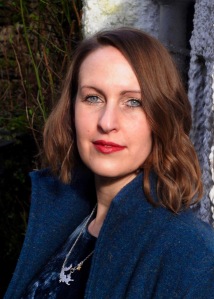
Polly Atkin interviewPolly Atkin lives in Cumbria. Her debut poetry pamphlet bone song (Clitheroe: Aussteiger, 2008) was shortlisted for the Michael Marks Award, 2009. Her second poetry pamphlet Shadow Dispatches (Seren, 2013) won the Mslexia Pamphlet Prize, 2012. In 2014 an extract from her first collection, Basic Nest Architecture, was awarded New Writing North’s Andrew Waterhouse Prize for ‘reflect[ing] a strong sense of place or the natural environment’. Polly has taught English and Creative Writing at Lancaster University and the Universities of Strathclyde and Cumbria.


Basic Nest Architecture Polly AtkinIn Basic Nest Architecture, the contrast between city and country, natural and unnatural, is at the forefront of many of the poems – did this theme emerge organically through the process of your writing, or was there a conscious fascination with the urban & rural you sought to explore from the outset?
I think the poems try to trouble the idea of these binaries – I’m not a fan of binaries generally; they always over-simplify – and especially the way people use terms like ‘natural’ or ‘unnatural’ or ‘rural’ or ‘urban’ to certain ends. The natural/unnatural dichotomy in particular is something that really bothers me. Natural to whom, or what? Unnatural how, and in what context?

There’s a very practical movement behind the appearance of some of those concerns in the poems – in 2006 I moved to Lancashire, and then to the Lake District – after seven years living in East London. People often think of the Lake District as a kind of little wilderness, but it’s actually one of the most populated national parks, with over 40, 000 people living within its boundaries. It contains towns and villages and a vast array of different kinds of managed lands, yet we are constantly encouraged to see it as wild and empty ‘Nature’, including by the Lake District National Park Authority themselves. People have a tendency to associate the rural with the past, and the urban with the future or with modernity. This association is as ancient as cities themselves, and hard to challenge. I don’t know what the best answers to our current environmental crises are, but re-examining some assumptions about how we live, and what we live with, seems pretty central to me. I’ve been doing that in a very small way in my own life, and I hope the poems are doing that too.

Which do you find a better source of poetic inspiration – the natural world or the urban one? Do you think your poetic style has shifted as you’ve moved from city to country?
I would never say one or other was more ‘inspirational’. A poet I respect a lot said to me a while ago ‘you’ve found your place’, and I think that’s the key, for me at least. I loved living in London whilst I was there, but when I left, it was coming out of a long fever or something. I had never loved a place I lived in before Grasmere, only the things a place provided for me, and the ways it allowed me to live. Really loving the place I woke up in every day was a radical difference for me.

As for style … I’m very much of the mind that it is important to keep learning and developing and changing, as a person, as an artist. What influences that change and growth can be many things, from what you read, to social and political changes, to changes in your environment. If I’m still writing the same way in ten years time that I am now, I’ll have to have a serious word with myself, if someone else doesn’t get there first.

In ‘Buzz Pollination’ we see a bee attempting to take pollen from a woman’s bracelet: ‘tricked by the blossom/ of my bracelet’s fat fake pearls, their delicious/ lustre’. The pearls are pretty yet useless – would you say this is indicative of the human preoccupation with aesthetics?
Partly … people can get very focused on the external without considering usefulness, and yes, that might suggest a preoccupation with aesthetics over function. But I wouldn’t say beauty didn’t have a purpose. Going back to the first question, those beads are something inorganic that is mistaken as organic. It’s not the fact that they’re not ‘natural’ that’s the problem, or that they’re fake pearls and not flowers, but that they’re in the wrong place. The bee needs flowers, and the flowers need the bee. But from my very selfish human perspective, the bee’s inappropriate attraction to my bracelet made me feel like the bee and I had some kind of connection. I liked it; liked the fact it kept coming back to me, as though that made me special, even though I knew on a larger scale that meant both the end of the bee, and the end of pollination. So maybe it’s really about human selfishness, and prioritising the human experience over the needs of the non-human.

Several of the poems seem to express the view that urbanization is destroying the natural world in the name of progress, particularly in the poem ‘The New Path’. Do you think that more should be done to protect British wildlife? Do you hope that your poetry inspires its readers to be more active in protecting it?
That’s a big ask for a poem, isn’t it? The most I can hope for is that some of these poem might make some readers question some of the ways they respond to the things around them, including, but by no means limited to, animals. There are a lot of debates about what animals should or should not be protected. I’m very aware of my status in Cumbria as an off-comer – an incomer, raised in an urban environment – exactly the kind of person who would sentimentalise foxes or badgers, and prioritise of the aesthetics of the landscape over practical concerns. ‘The New Path’ is literally about a new path, which seemed grotesque in its insistence on ease of movement, and in its inappropriateness in the landscape. But, like the road in the epigraph, ‘we take it nonetheless’. Why? Because it’s easier. If it allows access to someone who was unable to use the more aesthetically pleasing old path, maybe it’s not the new path that’s unreasonable.

Some of the poems capture the unease and discomfort at not feeling at home in either your location or your mind – for example ‘Dreams’ and ‘Colony Collapse Disorder.’ Did you find it difficult to write about such personal feelings, particularly when writing about your illness, or was this cathartic?
I wouldn’t say it was either particularly difficult or particularly cathartic, no more so than writing anything. Chronic illness, pain, and all the strange and marvellous things that come with them, are facts of my life. I write about them in the same way as I write about anything. Another way of looking at it is that all my writing is filtered through my mind and my body, my experience of the world, so I am always writing through those things, through personal and bodily feelings, whether they are the subject of the poem or not. Everything is both personal and totally impersonal in a poem. Once you write about it, it is outside you. It no longer belongs to you. I do joke a lot about ‘the Plath consolation’, that idea of ‘grit into art’, but it’s a very troubled concept, particularly where Disability is concerned. I recently heard David Constantine answer a similar question, and he said (in my poor paraphrase) that writing can’t be redemptive, or consolatory, that it can’t change the facts of real life, but that what it does instead is imagine different ways of being, different human possibilities. I thought that was very beautiful.

Lastly, what can we look forward to next? Are you working on any other exciting projects, or appearing at any events soon?
I’m working on new poems, but I’m not quite sure how they’ll come together yet. I’ve been working on a sequence about experiences of venesection (taking blood) as a treatment for Haemochromatosis, which will be included in a Wellcome Trust funded project called Books of Blood. Two of the poems from this sequence are going to be published in an anthology, Gush (Fronetac House, 2018), ed. by Rosanna Deerchild, Ariel Gordon and Tanis McDonald. I’ve got some other possible projects lining up but I can’t talk about them yet!

I’m lucky to have quite a few readings and events over the next few months including:

  • Guest Poet at The Garsdale Retreat, ‘Writing The Land: Crafting Poems from Inspired Communion’, Sedbergh, Wednesday August 23rd 2017.
  • Reading for Caught by The River at The Good Life Experience, Hawarden Estate, Flintshire, Saturday September 16th, 2017.
  • ‘Northern Poets’ event at Durham Book Festival, Saturday October 14th.
  • Reading with Elizabeth Jane Burnett at Kendal Mountain Festival, Brewery Arts Centre, Kendal, Saturday November 18th, 2017.

I put new events up on my website, so keep an eye on https://pollyatkin.com/events/ if you’re interested.


Basic Nest Architecture is available on our website: £9.99

Join our free, no obligation Book Club for 20% off every time you shop with us.
 

Posted on

Legend of the Month: Iolo Williams

Legend of the Month Iolo Williams

Each month we are celebrating one fantastic Seren author in honour of Wales’ Year of Legends. This month the spotlight falls on Iolo Williams.

Wild Places – Iolo Williams gIolo Williams has just returned to our TV screens with Trefi Gwyllt Iolo on S4C and BBC’s Springwatch, where in Episode 8 he goes head to head with Martin Hughes-Games, pitting two iconic birds (the barn owl and the kestrel) against each other in a challenge to see which is the ultimate hunter. So what better time to have this nature expert as our Legend of the Month?

Previously Iolo has worked as the presenter of seventeen TV shows, in two languages; he is also an author, and a public lecturer. With a degree in Ecology, he has worked in farming, timber and for the RSPB in the field, and as a regional co-ordinator. Williams is the author of five books in Welsh and two in English: Llyfr Adar, Llyfr Natur, Blwyddyn Fan Hyn a Fan Draw, Cynefin Glan Y Môr, Blwyddyn Iolo, Wild about the Wild, and most recently, Wild Places: Wales’ Top 40 Nature Sites (Seren, 2016).

Wild Places is an ode to the beauty and significance of Wales’ nature places and features forty of Iolo’s favourites, scattered all around the country. From mountains to meadows, coastal sites to towering cliffs, his list takes in all the best of what Wales has to offer, and reveals how to get the most out of each site – where to spot dolphins and salmon, where hares box and otters swim, where to see Wales’ great variety of hawks and other birds of prey.
Wild Places is available from our website: £19.99 (20% off when you join our Book Club).

Meet Iolo at our Secrets of Skomer Island event at the Teifi Marshes Centre, where he will join former Skomer warden and author, Rosanne Alexander, to talk about the island’s important landscape and wildlife.  Tickets are limited, so book now to avoid disappointment:
£5 from The Wildlife Trust website
(all ticket proceeds go to the Trust)

Rosanne Alexander Iolo Williams Skomer event


Find a great selection of books by our other legendary writers on the Year of Legends page.


Save

Posted on

Legend of the Month: Robert Graves

Robert Graves Legend of the Month

Each month we are celebrating one fantastic Seren author in honour of Wales’ Year of Legends. This month the spotlight falls on Robert Graves.

Robert Graves began publishing poetry after the outbreak of the First World War, for which he enlisted in 1914 as a junior officer in the Royal Welch Fusiliers. Robert Graves War Poems Charles MundyeHe was one of the first to write realistic poems about the experience of fighting on the frontline. His first volume, Over the Brazier, was published in 1916, and by 1917 he had produced two further collections of war poetry whilst still on active service. Over the Brazier and Fairies and Fusiliers earned for Graves the reputation of an accomplished war poet.
You can find all Graves’ war poetry in recently published Robert Graves: War Poems (Seren, 2016).

During his lifetime Graves published more than 140 books, including fifty-five collections of poetry (he reworked his Collected Poems repeatedly during his career), fifteen novels, ten translations, and forty works of non-fiction, autobiography, and literary essays. His best known works are his memoir of World War One, Goodbye to All That, The White Goddess, and the novels I, Claudius and Claudius the Great.

Here is Graves’ poem, ‘Hate Not, Fear Not’, from his previously unpublished collection The Patchwork Flag (1918) which, almost a century after composition, has now been brought into print as part of Robert Graves: War Poems.


Robert Graves Hate Not, Fear Not


Robert Graves: War Poems is available from our website: £19.99

Find a great selection of books by our other legendary writers on the Year of Legends page.

And don’t forget to sign up to our free, no-purchase-necessary Book Club for 20% off every book you buy from us.


Save

Posted on

Legend of the Month: Ruth Bidgood

Legend of the Month Ruth Bidgood

Each month we are shining the spotlight on one fantastic Seren author in honour of Wales’ Year of Legends. Our selection for April is the poet Ruth Bidgood.

Ruth Bidgood turns 95 this year, and her poetry career spans over five decades. She was born in Blaendulais, near Neath, educated at Oxford, and worked as a coder in Alexandria, Egypt in World War Two. She has lived in mid-Wales since the mid-sixties.

Legend of the Month Ruth Bidgood

She has published fourteen books of poetry, including The Fluent Moment (Seren, 1996), Singing to Wolves (Seren, 2000), and her New and Selected Poems (Seren, 2004). Her twelfth collection, Time Being (Seren, 2009), won the Roland Mathias Prize and was a Poetry Book Society Recommendation. Her most recent collection is Land Music (Cinnamon, 2016). As well as poetry, she has written a prose book about Wales, Parishes of the Buzzard (Goldleaf, 2000), and published many articles in country historical journals.

Matthew Jarvis writes of Bidgood’s achievement: ‘The heart of Ruth Bidgood’s poetry is her varied and intertwined rendition of the mid-Wales area that she has made her home… Artistically, what she has achieved in such material is nothing less than a mid Wales epic.’

Here is ‘Legacy’, from New and Selected Poems, which featured as our Poem of the Month in the April edition of Seren News:

Ruth Bidgood 'Legacy' New and Selected Poems


Find more of Ruth Bidgood’s poetry on the Year of Legends page, alongside books by March’s featured author, Dannie Abse.


Save

Posted on

Author Appearances at the Seren Christmas Pop-Up Shop

chapter pop-up shop author appearances

The Seren pop-up bookshop is returning to Chapter, Cardiff, for its third year. You’ll find us in Chapter’s entrance hall, Friday 9th to Monday 12th December.

Come and have a browse of our books, take advantage of free Christmas gift wrapping, and chat with Seren staff about publishing, writing, reading – and your love of books. We look forward to seeing you!

When: 9-12 December, 10am–8pm
Where: Chapter Arts Centre, 40 Market Road, Cardiff, CF5 1QE

Seren authors will also be stopping by, so why not come along and grab a special signed Christmas gift or two?

author-appearances-chapter-pop-up-16


Peter Finch will be joining us on Saturday. A poet, author and critic, Peter is author of the hugely popular Real Cardiff trilogy, and series editor for the Real Series. He has published numerous poetry collections, including perennial bestseller Zen Cymru, and his Selected Later Poems. His latest book, The Roots of Rock, from Cardiff to Mississippi and Back, explores the evolution of rock and popular music, and is the perfect gift for the music lover in your life.

David Foster-Morgan will be coming to the pop-up shop on Sunday. David has been widely published in a number of journals including Poetry Wales, Envoi, Smiths Knoll and The Interpreter’s House, and was recently shortlisted in the Times Literary Supplement Poetry Competition. Masculine Happiness is his innovative debut collection, and signed copies will be available if you come along at 12.


We look forward to seeing you at the Seren Christmas pop-up shop!


Posted on

NaNoWriMo: How to write a novel – advice from Seren novelists

how to write a novel advice from Seren novelists

It’s November and that means NaNoWriMo (National Novel Writing Month) has begun. If you’re not familiar with it, NaNoWriMo is a worldwide writing challenge, where participants have one month (1st–30th November) to write a 50,000 word novel.

Are you taking on the challenge? Perhaps you’re in need of a little motivation? Or maybe your novel has been in the works for a while now, and you need some guidance to get it finished? Whatever the case, Seren novelists are here to help.

Take a look below for some novel writing tips from the experts. Whether your novel takes a month or a year, we know you can do it.

Bethany W Pope author of Masque1. Start by letting your mind wander where it will. Taking long walks helps. Don’t ever say ‘no’ to an idea, however ridiculous or obscene it seems at first. Every idea is a seed; it’s best to let it grow. (Bethany W. Pope, author of Masque)


Jayne Joso author of My Falling Down House2. Don’t begin until the ideas preoccupy your thoughts, until you have read and researched to a point of exhaustion, until your mind is full of the world of the book, and the characters inhabit it freely. Things will change and move, grow, and diminish, and some will brutally be cut, but if you begin with a world that you can see, characters that you are beginning to know, then, when you settle down in the quiet to write, the world of your novel will begin to emerge as though by itself. Research more as you go, as you need to; sleep well, exercise and eat well, and always have something else to read. Stay with the world of your book in your mind, and switch off when you need to, sleep some more, run or swim some more. Then write and write, with fight, with joy. (Jayne Joso, author of My Falling Down House)

Bethany W Pope author of Masque3. Eventually you’ll spot your characters. Once you’ve seen them, the best way to capture what they’re like on the page is by inhabiting them, mentally. Use the actor’s method. Wear the skin of the role that you’re playing; write as if you are them and the writing will breathe. This is easier than you might think — after all, you are them, really; or they are aspects of you. Even the bad guys. Especially the bad guys. They’re parts of your psyche that you never let out. (Bethany W. Pope, author of Masque)

Jo Mazelis author of Significance4. There are two ways to approach a novel: some writers plot the whole work in advance, others begin with a vague idea, character or situation, then plunge in allowing organic development to occur. Neither is right or wrong, but there are certain advantages to both, every writer will discover along the way which works best for them. (Jo Mazelis, author of Significance)

Bethany W Pope author of Masque5. When it comes to the actual writing, do it wherever you can. By this, I mean that you should write wherever you can actually produce work. My top two choices are at the gym (I think best whilst moving — the stepper is my friend) and while sitting in my (empty) bathtub with a budgie on my head. There is no ‘should’ when it comes to writing. If it works for you, do it and give no thought to what other people think about it. You have to if you want to finish the job at hand. Once the story starts coming it will continue to come. If you love it, you will finish it. That which we cannot live without is that which we love. (Bethany W. Pope, author of Masque)

Jayne Joso author of My Falling Down House6. Drink whiskey, drink tea. Plan, don’t plan. Write. Tear it up. Start again, as you like… but finally, remember, there ain’t no way round but through, so just write the darn thing! (Jayne Joso, author of My Falling Down House)


Bethany W Pope author of Masque7. Do not worry about proofreading or editing until after the first draft is finished. Get it out, as fast as possible, even if it’s rough. It’s much, much easier to edit a finished manuscript than a few measly pages. But once it’s out of your head, for the love of God, go over it with a fine-toothed comb. Remove all the nits and every last tangle before sending it out to meet the world. It’s your child, after all. It deserves a clean face. (Bethany W. Pope, author of Masque)


We hope these helpful tips from our talented authors give you the push you need to get that novel finished – however long it takes.

‘I love deadlines. I like the whooshing sound they make as they fly by.’
– Douglas Adams


Save

Posted on

An Interview with Caroline Smith

An interview with Caroline Smith The Immigration Handbook

Today we are joined by Caroline Smith, whose new poetry collection The Immigration Handbook weaves together stories of hope, frustration and pain, drawn from Smith’s experience as an Immigration Caseworker.

CarolineSmith CropCaroline Smith was born in Ilford and grew up in Hertfordshire. She originally trained as a sculptor at Goldsmith’s College. Her first publication was a 30-page narrative poem, ‘Edith’. Smith’s first full collection, The Thistles of the Hesperides (Flambard), is about the community of West Pilton in Scotland where Caroline lived in the 1980s when it was one of the most deprived housing estates in Europe. Using imagery and structure from Greek mythology, and direct stories from observed lives, the poet weaves a dense and dramatic tension between the harshness of reality and the lyricism of myth. Published widely in journals like Poetry Wales, Poetry Review, Staple, Orbis and Stand, she has twice won prizes in the Troubadour Poetry Competition.  Smith has had work set to music, broadcast on the BBC and is also the author of a musical play, The Bedseller’s Tale, that was performed at the Edinburgh Festival Fringe.  She lives in London with her family.
 The Immigration Handbook Caroline SmithYour new poetry collection, The Immigration Handbook, brings to life the stories from migrants and refugees that you hear every day in your work as an Immigration Caseworker. What made you choose to transcribe these deeply affecting stories, and was the process cathartic?

Writing thousands of letters to the Home Office over the years, I think about language, what turns a letter into a poem, the different functions of language and how by changing the angle or perspective on a subject you can show it afresh. My book is another way of contributing to the immigration debate, but it is primarily a book of poetry. It’s the stuff of my life so it’s what I make art out of.

When I was younger I couldn’t decide if I wanted to be a priest or a sculptor – so I campaigned for women’s equality and ended up as a poet! But in a sense these twin strands have come together in my poetry; my interest in social justice and my training as a sculptor who needs always to recreate the world in a different way.

I’ve never found writing cathartic. When I am most upset about something I want it to stop, I don’t write my way out of it. I see my work as an Immigration Caseworker and my poetry as separate. I get angry and try to change the system, but for poetry I need distance and reflection and I enjoy the creative process; the juxtaposition of odd fragments, creating something new, although I suppose it is cathartic in a Nietzschean way….. ‘Every art and every philosophy may be regarded as a healing… in that respect maybe.

Your poems are often (unsurprisingly) rather bleak, as they describe characters who have lost hope, who feel abused by the system, who don’t know where to turn. Do you hope the collection inspires people to see beyond the statistics and recognise the humanity of those seeking citizenship?

Yes that is exactly what I am hoping people will find in my poems – despite the bleakness, a celebration of humanity. My poetry contributes to the immigration debate; not by putting forward a set of arguments like I do in my letters to the Home Office, but by showing the humanity of people trapped in the system. Not every asylum seeker or refugee is a hero or angel. I have painted people as they are – with both frailties and resilience. We all have the same longings and desires to make something of our lives, it’s just that the people I see in our immigration surgery have a much tougher journey than most of us have ever had to bear.

You have a knack for finding humour in surprising places, for instance in your poem ‘Judgements’, which cleverly and comically portrays the bureaucracy behind judgements made on applications:

“… if the appellant claimed
that relevant matters did not happen I should not
exclude the possibility that they did not happen
(although believing that they probably did)”

Is humour an important part of poetry writing for you? And does it follow you into the workplace, and other aspects of your life?

Tragedy and comedy sit very close to each other. I’ve received so many misspelt letters…’I have been arrested by six uninformed guards’…with wormiest regards’‘I love your cuntry’!

Satire and the use of comedy is important in art. Slapstick and the absurd sharpen the truth of a situation. The most wildly improbable stories, can actually accentuate pathos and provide a break in the bleakness. Humour is also a great tool for showing up the absurdity and dysfunctionality of the Home Office which cruelly traps people without status and documents for years. It is the startling and unbelievable that is often true; whereas the predictable stories are most likely to be fabricated.

The Immigration Handbook was written over a number of years. Were these poems always destined to be released as a collection, or did the idea to publish these stories together come much later?

I always intended them to be a sequence of poems on the subject. I remember the night I started writing this collection. I filled a book with scrawling notes of incidents, characters and injustices. But it is one thing to have an idea for a poem, but then you have to wait for all the elements to come together and it often ends up going off in a completely different direction. Because I have so many stories fermenting in my head, unexpected elements mesh together.

Both my previous collections included sequences of poems. I’ve never been interested in writing a novel, but I love the opportunities presented by writing a number of individual poems that can work together and spark off each other to come at an idea from different angles and perspectives. Although I don’t write formally, the form of the poems are critical to me. I used to approach a sculpture from all angles as once.  I would use different materials and found objects set against each other to break up the surface, juxtaposing different textures. And I think I do the same with poems using different intensities; some highly worked, some quick ‘line drawings’, some found reports. The difference today is that I’m carrying my studio of scraps and fragments and found objects around in my head!

And finally, tell us about your plans for the future- where will we see your name next, and are there any festival or events appearances you can tell us about?

I had a great time reading at the Ledbury Festival earlier this summer and my book launch at the Nehru Centre in London was just fantastic – courtesy of the Indian High Commissioner! I have a whole series of readings lined up for the autumn in Cardiff, London, Aberystwyth and I’m doing a couple of Festivals in Bristol and Chorleywood as well as a special event with Waterstones in Berkhamsted for National Poetry Day.

I am really enjoying giving readings and talking about my book but already the restlessness to create and my dissatisfaction with the world as it is, is pushing me back to my writing desk. When I have lots of ideas in my head I find it distracting to read. Now The Immigration Handbook is out I’m reading as much as I can, going to lots of poetry events and every play that I can get tickets for.

17th September: Free Verse, The London Poetry Book Fair.
3
rd October: Poetry Can Festival, Bristol.
6
th October: National Poetry Day, Waterstones Berkhamsted, Herts.
15
th October: Chorleywood LitFest, 12 noon The Junction, Chorleywood, Herts.
18
th October: Lumen Poetry Series, 19:00 Tavistock Place, London.
26
th October: Aberystwyth University, English & Creative Writing Society.
27
th October: Waterstones Aberystwyth.
30th October: Cardiff Book Festival.
24
th November: 19:30 Waterstones Piccadilly.

The Immigration Handbook is available on our website. Buy your copy now: £9.99
Claim 20% off when you become a Seren Book Club member

Save

Posted on

Aspie-Chromatics | Carol Rumens on Asberger’s, ASC and Poetry

aspie-chromatics carol rumens asberger's syndrome poetry

Carol Rumens is the author of sixteen collections of poems, as well as occasional fiction, drama and translation. Here she talks about Asperger’s Syndrome and Autistic Spectrum Condition (ASC), the misunderstandings and mysteries still surrounding these conditions, and how her awareness of Asperger’s Syndrome has affected her understanding of her own creative process.

Aspie –  someone with Asperger’s Syndrome

Chromaticsthe study of colour

When my grandson was diagnosed with autism it was as if a stone had been hurled into a quiet pool. The ripples spread through his immediate family, particularly affecting my two daughters (one being his mother) and myself. We re-evaluated our lives from a dizzy perspective. Autistic spectrum condition is a genetic condition. It’s a doubtful gift passed from generation to generation. A lot of us were implicated!

At first I was very uncomfortable with the idea that I had Asperger’s Syndrome. I’d always considered myself eccentric. My self-esteem relied on a sense, since earliest childhood, that I was creative, one of those people who could paint, draw, play music and write, even if they weren’t always very good at thinking straight or mixing with the other kids. I was an introvert – fine. So were a lot of intelligent people. I didn’t need close friends: I needed a room of my own, plus a typewriter. So what?

Perhaps being an Aspie made me less guilty of the wrongs I’d done to others in my life, but, equally, I was less responsible for the good. The best of my ‘good’ self – my poetry – was just a symptom, an expression of pathology.

I began the “On the Spectrum” sequence partly to express that grief. But I soon struck notes of defiance and humour. I remembered strange, disconcerting experiences I’d had as a child, and I measured them against some of the diagnostic criteria of Asperger’s Syndrome. Some were in tune with the criteria. But others weren’t.

I will have more questions in future: I haven’t finished telling the story. For instance, it’s said that Aspies lack empathy, and that we misunderstand metaphor. I wonder where this leaves the Aspergers poets – or indeed the women with Aspergers.

Sensory over-stimulation is one of the affects of Autistic Spectrum Condition: there’s neurological and experiential evidence. But wouldn’t that susceptibility be more likely to increase empathy? Perhaps autistic people, especially women (the gender which is socially conditioned for empathy) have an excess rather than a lack of response to others, but deny it because it feels chaotic and scary? An inability to grasp metaphor might be the result of a similar subconscious defence-mechanism –because metaphor is also sensuously stimulating, and therefore potentially disruptive.

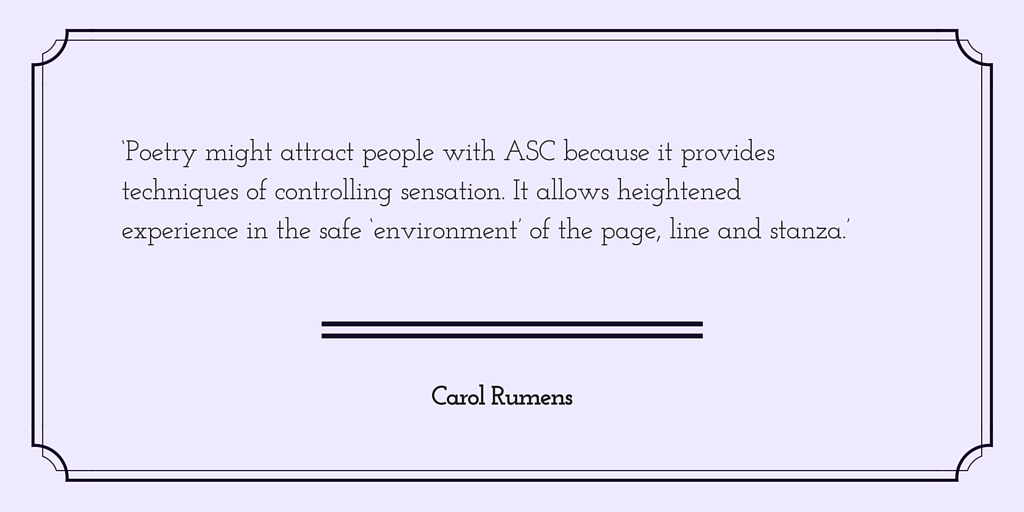
Poetry might attract people with ASC because it provides techniques of controlling sensation. It allows heightened experience in the safe ‘environment’ of the page, line and stanza. It foregrounds pattern-making. It allows repeated patterns to be safely interrupted. I realise now that, whatever the genetic ‘prompt’ towards an activity for an individual, it doesn’t invalidate the activity. Being an Aspie poet doesn’t damage the poetry, but the pride.

And so, having overcome my pride and prejudice, a faintly crusading element entered my attitude to autism. The condition needs a lot more fresh thinking. I’m not generally someone who wants poetry to earn its bread as a foot-soldier in the army of good causes. But I want to speak for a greater understanding of autism, and I choose to do it through the medium I’m best able to employ. Rather than use poetry as propaganda, I would simply ask it to report back sometimes from the field, like a travel correspondent in the complex, many-coloured terrain of a newly discovered country.

What I’d like to do now, besides filing more dispatches, is to edit an anthology of poems by autistic poets. Certain poets have already ‘come out’ and I suspect there are potentially many more. Autism is a richer, wider, more polychromatic spectrum than so far defined. In fact, to know autism would be to know consciousness, which would be to see God. I don’t think anyone can, but I hope we can build some better microscopes.


Animal People Carol RumensCarol Rumens’ latest collection, Animal People, is available on the Seren website. The striking final sequence, ‘On the Spectrum’, focuses particularly on Asperger’s Syndrome and how it may be experienced by young women, as well as exploring some of the effects of Autistic Spectrum Condition (ASC).

Buy your copy now: £9.99
Claim 20% off when you become a Book Club Member


Save

Save

Posted on

An extract from Boy Running | Wales Book of the Year shortlist

extract from Boy Running Wales Book of the Year

The winners of the Poetry, Non-Fiction and Fiction Categories, and the overall Wales Book of the Year Winner, will be announced in just two weeks. Seren have two titles in the running for the awards, and before we find out the results, we thought you might enjoy reading an extract from each of our nominated books. Look below and you’ll find an extract from Boy Running by Paul Henry (shortlisted for the Open University in Wales Creative Non-Fiction Award).

Studio Flat

Socks hang like bats from a skylight.
They may be dry in time for the moon.
The camp site owner’s water-feature
drains more blood from the sun.

Cars queue for the narrow bridge.
Birds catch their pulses and fly.
I am suddenly old. What’s an attic
but a bungalow in the sky.

And where are you, my sons?
I heard your voices in the bells
of snowdrops pulled by the wind.
These tulips have lost their smell.

Perhaps I could tell you, one day
where the snowdrops went, why old men
dry their socks on the moon, and what
darkened the skylight, just then.


Ring

I can’t get the ring out of my finger.
How long till it disappears
this ghost ring, twenty years deep?
I’m branded. Is it the same with you?
Your fingers were slenderer than mine.


We hope you enjoyed reading this free extract from Boy Running by Paul Henry. Keep an eye on the Seren blog, as we will be announcing the Wales Book of the Year Awards results in just over two weeks time.

About Boy Running:
Paul Henry has gained a reputation as one of of the best poets in the UK. Boy Running is his beautiful sixth collection and the first to follow  The Brittle Sea: New and Selected PoemsAlso a singer-songwriter, Henry is known for his precise lyricism, intimate tone and a cast of characters inspired (like Dylan Thomas) by his childhood by the sea in Aberystwyth, West Wales.

Posted on

Sacrifices made a century ago: Welsh rugby heroes on the Somme

Sacrifices made a century ago welsh rugby heroes on the Somme

The coming months will see the commemoration of one of the most notorious battles in history. The Battle of the Somme, fought between July 1st and November 18th 1916, has left an indelible mark on the history of the twentieth century and, for Britain in particular, it symbolises the horrors of modern warfare.

One hundred and forty one days of horror. The casualties are well documented: the first day alone saw 57,470 British casualties, 19,240 of whom were killed. The second day, with 30,000 British casualties, was not much better. Add to that the French and German losses and you have total losses of dead and injured easily exceeding 1,000,000.

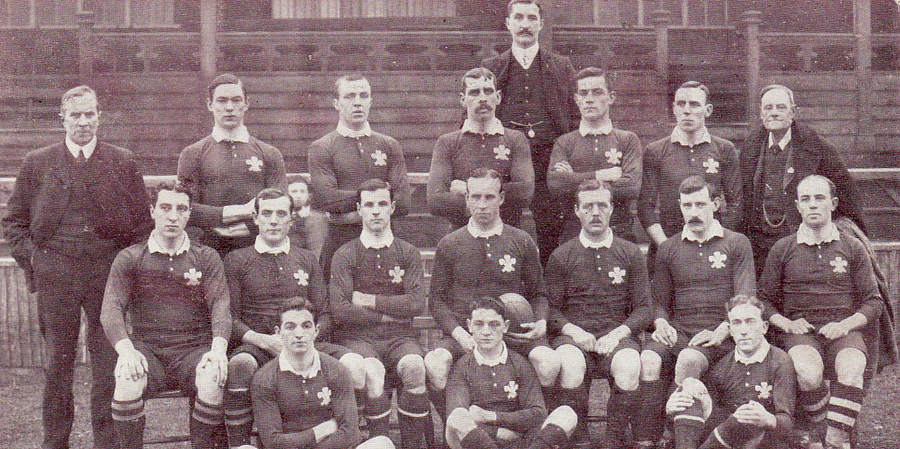
It was inevitable that many British sportsmen would be among the dead. Heart of Midlothian, Scotland’s table topping football team, lost 3 players on the first day while English cricket saw 3 notable all-rounders, Booth, Jeeves and Burns make the ultimate sacrifice. Welsh goalkeeper Leigh Roose, English footballers Evelyn Lintott and Donald Bell VC and England rugby captain Lance Slocock met the same fate. But what of Welsh rugby? What sacrifices were made by this small nation, a nation which was just at the close of its first rugby ‘Golden Era’? The answer is stark. The total number of Welsh rugby internationals to die as a result of the Great War was 13, 14 if one includes ‘Hop’ Maddock who died in December 1921 as a result of illness which had its roots in the battlefields of the Somme. No less than 5 of these unlucky and brave young men met their death on the Somme.

Charles Meyrick Pritchard

The first to appear in Mike Rees’ book, Men Who Played the Game: Sportsmen who gave their life in the Great War, is a true man of Newport, Charles Meyrick Pritchard. Charlie was the son of John Pritchard, a founder member of the Newport Rugby Club and part of a family that ran a wine and spirit business. Following an education at Newport Intermediate School and Long Ashton, Bristol, Charlie joined Newport RFC and by 1904 this twenty two year old, thirteen stone, six foot tall version of the modern backrow forward was in the Welsh team. A year later he was taking his place on the field to decide the unofficial championship of the world. The New Zealand All Blacks arrived in Cardiff unbeaten to be challenged by a strong Welsh team and Charlie was to play a huge part in what many regard as the most important match in rugby history. Wales deservedly won a thrilling, controversial match 3-0 but, although it was Teddy Morgan who scored the try, Charlie was the inspiration. Fellow players had no doubt in telling anybody who was not too excited to listen that Charlie had played a key role, “knocking ‘em down like ninepins” according to George Travers, a fellow hero and club colleague. Others talked of his willingness to be in the thick of the fight, disrupting the hitherto invincible All Blacks with his devastating tackling. Following this victory Charlie’s fame was assured but his career didn’t end there. In 1906 he was made captain of Newport, a position that he held for 3 years. On the international field he won a further 10 caps, (14 in all), a figure that would have been higher but for injury. He played in the championship winning Wales team of 1906 and in the first Grand Slam success in 1908. After missing out on a second Grand Slam in 1909, Charlie played his last game for Wales in 1910.

With the outbreak of war Charlie was quick to enlist. He joined the South Wales Borderers as a temporary Second Lieutenant in May 1915, was promoted to lieutenant at the end of July and was made a captain in the 12th Battalion the following October. Following a period of training, Charlie arrived on the Western Front in June 1916 in time for the Somme offensive and was quickly into the action. He and his men had been forced to take cover in the long grass from their own bombs and struggled to avoid the German searchlights. On the night of 12th/13th August Charlie was instructed to lead a raiding party on the German trenches with a view to taking as many prisoners as possible. He led his men into the trenches showing exceptional bravery in the process and, despite being wounded in the wrist, continued to encourage and lead his men in what was to prove to be a successful raid. He took one of the enemy prisoner but was wounded once again, taken back to the British front line and then to No1 Casualty Clearing Station shortly before dawn on the wet morning of August 13th. Here his concern for the success of the raid and his devotion to duty came to the fore asking, “Have they got the Hun?” “Yes” he was told, “Well I have done my bit,” Charlie replied, the last words that he was known to speak. He died, without ever leaving the Clearing Station, on August 14th 1916.

His commanding officer, Lieutenant Colonel Alexander, wrote to the family describing Charlie as being “as brave as a lion” and talking about how his death had “cast a gloom” over the whole Battalion. Others spoke of the deep affection in which he was held, the fine example that he set as to what a sportsman should be and his “private tenderness” who was “loved by all who came into contact with him”. Attempts to grant him the Distinguished Order failed, as only living soldiers were eligible, although he was given a Mention in Dispatches. Charlie was buried in Choeques Military Cemetery, one of 86 members of Newport Athletic Club who lost their lives in The Great War and remembered on the Memorial Gates at Rodney Parade. The thirty two year old left in Llwynderi Road, Newport, a grieving widow with two young children and the legacy of a true Welsh rugby hero.

John Lewis Williams
John Lewis Williams

A second significant Welsh rugby player with Newport connections had already died on the Somme. John Lewis Williams is quite properly remembered as a prolific wing for both Cardiff and Wales, the most capped Welsh international to die in the conflict. However Johnnie Williams began his career at Newport in 1899 after leaving Cowbridge Grammar School. Born in Whitchurch in March 1882, Johnnie had an illustrious rugby career. After winning his first cap against the 1906 Springboks he went on to score a record seventeen tries in seventeen internationals, a record that was later equalled by Ken Jones and beaten by both Gerald Davies and Gareth Edwards in 1976. Illustrious company indeed! Noted for his swerve and sidestep, Johnnie was an integral part of three Wales Grand Slam winning teams in 1908, 1909 and 1911, one of the handful of Welsh players to achieve such a feat. Unsurprisingly, Johnnie also toured with the British Isles team which visited Australia and New Zealand in the summer of 1908 where he played in two of the three tests, scoring twelve tries on the trip. While making the long sea journey to the Southern Hemisphere, Johnnie earned himself a supplement to his two shillings a day out of pocket expenses by writing articles for the South Wales Daily News and the South Wales Echo. A well-educated man who earned his living as a principal clerk in a coal exporters based in Cardiff Coal Exchange, Johnnie was given the captaincy of his country for the game against France in Paris in 1911 due to his ability to speak French at the post match dinner. A couple of weeks later he played his seventeenth and final match for Wales in the victory over Ireland. His record was impressive with only two defeats in his Wales international career.

On the outbreak of war Johnnie joined the 16th Battalion of the Royal Welch Regiment and was, by July 1916, in the thick of the action on the Somme, in particular at Mametz Wood, a place synonymous with the Welsh losses in the Great War. The action which took place at Mametz between 7th and 12th July 1916 saw the 16th Royal Welch and the 11th South Wales Borderers suffer the most appalling losses. Johnnie went over the top on 7th July but heavy machine gun fire cut them down. Johnnie was severely wounded and his left leg was amputated. Infection set in and, although he was able to write to his wife Mabel that he was in good spirits, Johnnie died of wounds on 12th July. He was one of 190 officers and 3,803 other ranks who were casualties at Mametz. He had fought in distinguished company – the poets Siegfried Sassoon, Robert Graves and David Jones as well as the writers Frank Richards and Llewellyn Wyn Griffith all fought at Mametz but, unlike Johnnie, they survived to commit their experiences to paper. Johnnie was not so lucky. He left his wife of a mere eighteen months a widow in their Penarth home. His reputation as one of the great Welsh wings, however, remains firmly intact.

Dick Thomas
Dick Thomas

Alongside Johnnie, another Welsh international rugby player also made the supreme sacrifice. Born in Ferndale in October 1883, Dick Thomas had spent his early years working underground as a collier before joining the police force based in Mountain Ash. Dick, by now playing for Mountain Ash after short spells with Penygraig and Cardiff, had made his debut for Wales in the same game as Johnnie made his international bow. Although on the losing side against South Africa, Dick went on to win three more caps and contributed to victories in each of the 1908 and 1909 Grand Slam seasons. Only illness prevented him from winning more caps and possibly becoming a regular in the Welsh pack of this ‘Golden Era’. Dick was known as a tough uncompromising forward, who was also a Glamorgan Police heavyweight boxing champion. Never one to shirk a challenge, he went over the top on 7th July. His body was never found and he is remembered on the Thiepval Memorial, one of the 72,195 names on that ‘memorial to the missing’.

David ‘Dai’ Watts
David ‘Dai’ Watts

Dick Thomas is not the only Welsh international named on the Thiepval Memorial. One week after Dick was lost and just three days after Johnnie Williams succumbed to his wounds, Dai Watts, a tough forward born in Maesteg in March 1886, was killed in action at Bazentin Ridge on 14th July. After a career spent playing for smaller valley clubs, Dai joined his hometown club, Maesteg where he became the first player from this club to be capped. Following impressive games for the Glamorgan League and then Glamorgan County, Dai was picked for the first international of 1914 against England. Wales lost this game 10-9, a match they should have won due to the supremacy of their forwards. England went on to win the Grand Slam under the captaincy of Ronnie Poulton, the glamorous young England centre who was killed in 1915, while the Welsh pack remained unchanged for their three subsequent victories and cement their reputation as ‘The Terrible Eight’. A long rugby career at international level appeared to be Dai’s destiny.

It was not to be. In the autumn of 1914 Dai joined the 7th (Service) Battalion, The King’s (Shropshire Light Infantry). In July 1916 they were involved in the Battle of Bazentin Bridge. At 3.25am on 14th July the KSLI were ordered to attack. Confronted by uncut wire they became easy targets and Dai was one of the 171 who lost their lives in this attack. There are no records of how this toughest of forwards met his end, only that his body was never recovered and that he left a widow and two children.

The third and final Welsh international named on the Thiepval Memorial is a player of a very different type to the tough, uncompromising miners, the forwards Dick Thomas and Dai Watts. Horace Wyndham Thomas was an outside half educated at Monmouth School and Cambridge University where he was a choral scholar. Born in Pentyrch near Cardiff in 1890, he originally attended Bridgend Grammar School before winning a scholarship at Monmouth. Both at Monmouth and Cambridge Wyndham excelled in a range of sports. Injury and choral duties prevented him gaining his ‘Blue’ but he finally achieved this in 1912 when he played his part in a Cambridge victory.  Four days later this brilliant and elusive outside half made his debut for Wales in the match against the Springboks, a game which he nearly won for Wales with a late drop goal attempt which sailed narrowly wide. Many who saw this effort were adamant that the ball had actually gone through the posts and that Wales were ‘robbed’. He kept his place for the game against England a few weeks later but, although he played in this match, Wyndham had been offered a job with a firm of shipping agents in Calcutta. Immediately after the game Wyndham sailed to India to fulfil a five year contract, a huge loss to Welsh rugby. It was expected that Wyndham would be the Welsh outside half for years to come.

When war broke out Wyndham resigned his job and headed home to join the 14th (Reserve) Rifle Brigade. In August he was to be found on the Somme and on 3rd September he was attempting to capture trenches above the Ancre. The assault resulted in over 400 casualties, one of whom was Second Lieutenant Horace Wyndham Thomas. His body was never found and his name joined those fellow players on the Thiepval Memorial. Of all the Welsh internationals killed in the Great War perhaps Wyndham Thomas was the player whose potential was greatest and unfulfilled. Lost to rugby far too soon, Wyndham, with all his brilliance and talent, perfectly represents the sacrifices made by that generation of rugby players one hundred years ago.

Men_Who_Played_the_GamergbThe stories of these players, (with the exception of Dai Watts), are included in Men Who Played the Game. Mike Rees has included the contributions of sportsmen in The Great War from all corners of Britain and the wider Empire but, during this summer of 2016, none of the stories have greater significance than those of the Welsh rugby heroes on the Somme. It is fitting that we now remember their sacrifice made a century ago.

Save

Save

Save