Posted on

Richard Collins: My Experience of Parkinson’s Disease

Set aside thirty minutes to watch author Richard Collins’ honest, moving and sometimes humorous video about his experience of suffering from Parkinson’s disease. About the video, he says: ‘I hope that it will give people a better understanding of this entertaining illness.’

Collins’ diagnosis in 2006 led to some years of extensive travelling, in the Himalayas, the Andes, the Middle East and North Africa, which he recorded in The Road to Zagora (Seren, 2015), a wonderful combination of travel and memoir. But a decade later Richard’s situation has worsened and he has moved from writing to making this video in which horizons have closed in and he has become more reliant on himself, and others. This is a revealing glimpse into a world we seldom see in person. You’ll learn about Mr Parkinson (as Collins calls his condition), about Richard’s enduring left-fielded take on life and, quite possibly, a little about yourself.


The Road to ZagoraYou can buy The Road to Zagora from our website. Sign up to the Seren Book Club for 20% off.

Posted on

Remembering Leigh Roose – ‘The Prince of Goalkeepers’

Remembering Leigh Roose

It’s Euro 2016 and Wales is in the finals! Historian Mike Rees looks back into Wales’ sporting history to remember goalkeeping legend Leigh Roose, who found glory on the football field and died a hundred years ago, at the Somme.

Mike Rees’  book Men who Played the Game looks at the development and importance of sport in Britain and the Empire leading up to the outbreak of the First World War, and the part played by sportsmen in the conflict.

On the eve of Wales’s participation in the finals of a major international football tournament for the first time since 1958, it is likely many of you may be reflecting on past glories achieved by Welshmen on the football field.
You might well consider the achievements of Wales first ‘football superstar’ Billy Meredith, talisman of both Manchester City and Manchester United in the early years of the twentieth century or the ‘Gentle Giant’ that was John Charles, revered from Swansea to Turin where he won multiple league championships and cups as the focal point of a brilliant Juventus team. More likely, you’ll consider the incomparable Ryan Giggs, with his sack full of medals, or the striking prowess of Ian Rush or Mark Hughes. But as Gareth Bale, the latest Welsh superstar, graces the football stadiums of France this summer how many will remember Leigh Roose, the first renowned Wales goalkeeper and predecessor of Jack Kelsey in 1958 or Neville Southall in the 1980’s and ‘90’s? As we move towards the centenary of Roose’s demise on the battlefields of the Somme, perhaps it is time to ensure that a new generation is made aware of the exploits of this remarkable Welshman.

Remembering Leigh RooseThe process of remembering Leigh Roose has already begun. Pupils from Wrexham are creating a collage with a particular focus on his part in the first international match to be caught on film, the game between Wales and Ireland at the Racecourse, Wrexham on 2nd April 1906. This will be displayed in Eagles Meadow shopping centre, Wrexham and bring his name to many for the first time – recognition that is long overdue.

Leigh Richmond Roose was born at Holt, near Wrexham on 26th November 1877, the son of a Presbyterian minister, the fourth of five boys. Despite losing his mother to cancer at the age of four, he had a comfortable middle class upbringing which led to him gaining a degree in Bacteriology from UCW Aberystwyth in 1899. Leigh enjoyed his time at ‘Aber’, particularly his experience of playing for the town football team in his favourite position, that of goalkeeper. So successful was he that in February 1900 he was chosen to play for Wales in the match against Ireland, the first of his 24 caps. A host of professional clubs sought his signature but by now Leigh was working in King’s College, London, fully intending to pursue a medical career. In the summer of 1901, however, he relented and signed for Stoke.

It was not long before this six foot, thirteen stone athlete made his mark. He became known for his reckless bravery, total dominance of his penalty area, his startling reflexes and resulting shot-stopping. Playing often as a modern day sweeper, Leigh left the confines of his area to start attacks, carrying the ball to the half way line, as he was permitted to do. So effective was this tactic that in 1912 the laws were changed in order to prevent goalkeepers handling the ball outside the penalty area. Leigh was also prepared to impose himself in other ways. It was not uncommon for him to be involved in the occasional scuffle or dispute with authority, sometimes over his travel expenses, on other occasions, disputes with the opposition. Leigh was also an entertainer – his gymnastic ability used to swing from the crossbar when things were quiet at his end of the pitch. Crowds loved him, even more so when Wales won their first Home International championship in 1907. Although top league and cup medals eluded him, Leigh was always challenging for honours at Everton from 1904 and later at Sunderland. He became one of the country’s best known footballers whose lifestyle as an eligible young man in Savile Row suits predates David Beckham by ninety years. His affair with the ‘Queen of the Music Hall’, Marie Lloyd would delight the tabloids of the 21st century. However nothing lasts for ever and, following a spell as player coach at Arsenal, Leigh retired to his medical commitments and the after dinner circuit in 1912.

When war broke out Leigh joined the Royal Army Medical Corps and was quickly despatched to the Dardanelles where he served in Gallipoli. Here he worked in hospitals treating hundreds of serviceman injured in that futile encounter. However Leigh wanted to see the action for himself and, following his return to London, he joined the 9th Battalion of the Royal Fusiliers. His wish for action was soon granted. Leigh was awarded the Military Medal after he had taken part in the capture of Ration Trench near Dainville and the subsequent resistance to the German counter-attack. In October 1916 Leigh was once again in action. The 9th Royal Fusiliers advanced on the Albert-Bapaume Road and this led to the capture of Le Sars but the cost was disastrous. Three hundred and thirty two officers and private soldiers were killed or injured in the action. Leigh was seen running across No Man’s Land firing his gun with no concern for his own safety. He was last seen lying in a crater, probably already dead. Leigh’s body was never discovered and he is remembered, his name engraved and incorrectly spelt, on the Thiepval Memorial to the missing. Thirty eight year old Leigh is one of the 72,000 names remembered on that most impressive of memorials.

Leigh’s death was keenly felt by all who knew him. Mike Rees, in his recent book Men Who Played the Game, quotes the Athletic Times which described him as “dexterous though daring, valiant though volatile”. But Rees also concludes that this is only part of the story and that Leigh Roose, along with Billy Meredith, did more to put Welsh football on the map than any other player. That, coupled with his ability to entertain thousands of spectators, demands that he be remembered as a sportsman of real significance, one who died as bravely as he played. During this summer of exciting Welsh football, a century after Leigh made the ultimate sacrifice, he deserves to be remembered.


Posted on

St Ives Residential Course 2017

Kim Moore David Tait poetry course 2017

Kim Moore: St Ives Residential Poetry Course 2017

“After a sell-out course in 2016 in St Ives, I’m really pleased to announce that I’ll be co-tutoring another residential poetry course at Treloyhan Manor Hotel in St Ives, from the 20th-26th February 2017.  I’m very excited to announce that my co-tutor this year will be the fabulous poet David Tait.…”

Find out more about the St Ives poetry course on Kim Moore’s blog.


Source: St Ives Residential Course 2017

Posted on

Ritual, 1969 | An interview with Jo Mazelis

Ritual, 1969 Jo Mazelis interview

Our Marketing Officer Rosie Johns talks to Jo Mazelis about her new short story collection, Ritual, 1969, which is newly available.

Have you got a burning question of your own you would like to ask Jo? Or would you like your copy of Ritual, 1969 signed? If so, come to John Smith’s bookshop, Swansea, this Thursday for the book launch. This event is free to attend, all are welcome, and refreshments will be provided. Find more details here.

Ritual, 1969 by Jo Mazelis

What are little girls made of? What will they become? Will they run away to the circus or become dressmakers, teachers or servants? From the playground to adulthood the path is beset with misunderstandings, missed dates and hidden traps for the unwary.
This darkly gothic collection of stories explores the unsettling borderland between reality and the supernatural. Ranging from early twentieth-century France to 1960s South Wales and contemporary Europe, Jo Mazelis’ singular vision and poetic language creates characters caught up in events and feelings they do not fully understand or control, giving the book its uncanny focus. Not all is as it seems in a world where first impressions may only conceal disguises and false trails – and there’s no going back.
A thrilling third collection from the author of Jerwood Award winning novel Significance.

Your novel Significance was set in France while many of the stories in Ritual, 1969 are located in Wales. As a Welsh writer, do you see any importance in the issues of place and identity?

I think with Significance it had to be set abroad because I wanted to explore ideas about escape and rebirth as a starting point. The same novel could, I suppose, have been set in a small coastal town in Wales, but it just wouldn’t have been the same – I mean in the sense of my imaginative process. It had to be in an unfamiliar territory, yet one that is perceived as innocent and safe.

The stories in Ritual, 1969 weren’t planned or written as a collection – therefore the fact that so many are set in Wales is probably due to my thinking and experiences over the last twelve years or so. This also raises the question of whether Welsh writers should only write about Wales and the Welsh. The MA I did many years ago was ‘Writing the Celtic Archipelago’ and involved a sort of comparative study of the 20th century literature of small nations; from Wales to Éire, Northern Ireland and Scotland. In one tutorial I raised the issue of Muriel Spark as she wasn’t included in the course and was firmly told that she was not a Scottish writer. The argument was that she didn’t write about Scotland or live there, which I have always found rather puzzling. Then very recently I read Ian Rankin’s introduction to Spark’s novel Symposium and his first words were, ‘Muriel Spark was the greatest Scottish novelist of modern times’.  He goes on to say that although she lived abroad, ‘her roots are evident in everything she wrote.’ Aside from feeling vindicated after almost twenty years, I think his words make clear something I have always believed, namely that my roots inform everything I write.

The period when these stories were written also coincides with my travelling all over Wales for a variety of reasons, so the landscape figures directly as a place of reality and imagination. I also made a sort of conscious effort to travel imaginatively through time, so that the stories are set in different periods as well as different locations.

Ritual, 1969 contains stories that are often given hauntingly uncertain endings. What made you choose to give the reader so much room for interpretation?
The writer Paul Auster said, ‘The one thing I do in all my books is to leave enough room in the prose for the reader to inhabit it’. I suppose I must do the same but unconsciously. Saying that it seems almost deliberately vague or evasive to attribute any aspect of writing to the unconscious because it suggests that what the writer is producing is a stream of consciousness or work that is unmediated or without art or craft, but this is my experience.

When I write I don’t think about any potential or ideal reader and very often I have no idea where a story is going. It is a process of discovery for me as much as for the reader. When I first began seriously writing stories in 1987 I had not studied literature or creative writing beyond GCSE as I had gone to Art College not university. I had however read a great deal, but I think because I was essentially self-taught, I tended to doubt myself and worried that ‘real’ writers would not work in the same way as me. ‘Real’ writers would have the whole thing mapped out and they wouldn’t rely on intuition or the unconscious. I later read something John Fowles said about his novel The French Lieutenant’s Woman; how he had a recurring image during the autumn of 1966 of ‘A woman [who] stands at the end of a deserted quay and stares out to sea’ and he explained that he wrote the book to discover her story. It was this and other things a broad range of writers said which made me realise I was not unique in my approach and that was reassuring.

It has often been my experience that I don’t notice the underlying themes of my stories until after publication. It is only then that my later university education in literature seems to kick in and I can begin to analyse my work more like an academic. I realise that very often my fiction can be read on two levels, one which is simply the plot and characters, and the other which is connected to philosophy, politics, myth and culture. So the story ‘A Bird Becomes a Stone’ could be read as a crime mystery. Actually it’s a story whose title I changed several times and the other titles were far more prosaic. At the point I changed the title for the third or fourth time I thought I was being almost flippantly artful, but later I realised that the new title with a living thing, a bird, changing into a dead thing, a stone actually was the key to the story’s meaning. This was not just in the sense that something dies, but it also speaks to the whole process of art – a bird carved out of a stone, or a film of a bird or a poem will outlive the bird itself. Does this mean that a carved representation is somehow more important than the living creature?

A similar question is evident below the surface in ‘The Flower Maker’ a story set during a period of war and turmoil concerning a displaced woman who makes and sells artificial flowers from scraps of silk and satin in order to survive. Art and what should be sacrificed for it emerges in story after story, whether it is poetry or circus performance or film or photography or novels. If the endings to my stories are enigmatic then perhaps it’s because I can’t and won’t answer that question.

There are many female characters who seem to be struggling for survival and against alienation throughout the collection. Did the diversity of female characters and experiences in these stories appear with a conscious plan in mind?
As with my other collections of short fiction, these stories were written over a fairly long period of time – some were created as far back as 2003, others as late as December 2015, so there was no guiding principle as such, no sense of any relationship between them in terms of a book. Penny Thomas, my editor at Seren was really helpful in selecting these from the rather larger group of stories I presented her with, thus helping the book to become a cohesive whole. I think the effect of this is that the stories speak to one another; though clearly I was also at different times experimenting with the idea of linked stories.

If these stories have a common theme then I think it might be that they expose gender as an artificial construct, so much so that it almost seems as if all of the female characters are ‘performing femininity’ rather that behaving naturally or instinctively. In this sense there is once again a dichotomy between the false and the real, the surface and what lies beneath; between art and nature, dreams and reality.

In my earlier short story collections Diving Girls and Circle Games there were far more stories about men and their particular perspectives  –  I was interested in ideas about patriarchy and men’s internalised view of their ‘natural’ superiority, so these characters were often white, middle-class Englishmen. Of course you can’t generalise about anyone on account of their gender, race, class or religion, and it was fairly hard to get inside the head of some of these male characters, especially at moments when they were acting badly, then performing mental tricks of self-justification, but these stories were an important aspect of my feminism because they interrogated power itself at a micro-level. Having said that I also wanted to interrogate or dispel some myths, for example those to do with a relationship between a lecturer and a student (who is over the age of eighteen) as I felt that such a relationship would not be simply about a predator and his victim. It seemed important that the female character has to have some degree of free will, that she is responsible for her own choices.  Just as he is.

I suppose in some ways I am exploring the limits of knowledge and how none of us can really understand how it feels to be someone else, or why people do the things they do whether for good or ill. In the story ‘Word Made Flesh’ which was commissioned by Wales Arts Review, a young Irish woman is never listened to. Because no one knows her tragic story she grows increasingly lonely and alienated and cannot sleep at night – so in this story it’s a case of important knowledge not withheld but ignored.

These themes about knowledge also appear in the stories about teenage girls and children, recurring again and again in different guises, whether it is a poem that never gets discussed, or the secrets and/or fantasies of many of the characters. It could be argued that a lot of these characters are trying to live their lives according to the wrong script – which is the case in ‘Whose Story Is This Anyway’ and ‘The Murder Stone’. One of the questions I am asking is, why are people so deceived and so enduringly self-deceiving? Why do so many women feel so self-conscious about their imperfections, so eager to construct their image based on artificial and/or idealised figures whether these are dolls or glamorous female celebrities?

The two epigraphs at the start of the book by William Blake and Mary Wollstonecraft are there as lodestones to the stories’ meaning, but were added long after most of the stories were written.  One addresses the issue of corrupted beauty and nature, the other the issue of truth with particular regard to education and these themes are revisited in many of the stories.

Which character was the hardest to bring to life, and why?
Characters either come to life or they don’t. I tend not to think of them as separate entities from the story itself – they are woven in, creating a tapestry, rather than appliquéd on. Or perhaps instead of using a metaphor which employs a traditionally female art form I might say that the idea for a story appears in my mind like a block of marble. I chip away at it to reveal the figures and the narrative that is locked in the stone.

I wish I could give a simple answer to this question but after writing fiction for so long I have acquired something I learned about via Flannery O’Connor, namely ‘the habit of art’. I began to read the stories of Flannery O’Connor in 1975, then in 1988, when I began to steadfastly write, I bought ‘Mystery and Manners: Occasional Prose’ which is a collection of her non-fiction work. O’Connor has been a huge and enduring influence on my short stories making me wonder some time ago if the notion of Southern Gothic couldn’t be extended to absorb Southern Welsh Gothic. Strangely, many years ago I bought a rare hardcover 1st edition of a Flannery O’Connor novel for 50p. I was exceedingly poor for many years, in debt and fear and worry constantly which is a miserable way to live. Then in an idle moment I looked up the value of this particular O’Connor novel and found it was worth a lot of money – I had a brief and dizzy moment of thinking that Flannery had saved me, that this was fate that it was her book not any other. There was only one problem, the copy I possessed had no dust jacket and this meant it was virtually worthless. So if there is a lesson to be learned from that it is that an author’s worth is in their words, not in any abstract artefact. Though the story might have had a more rewarding and uncanny ending had I sold the book for thousands.

To return to the question, I think if a character fails to come to life then the story is a failure and I abandon it. I’ve got a lot of abandoned stories; some might be worthy of resuscitation, others are beyond hope. I think the cause of the half-written stories is usually lack of time – I find I can’t begin a story then pick up the thread weeks later, the original impulse or train of thought has gone. Sometimes a story will just emerge fully formed and my pen can barely keep pace with my mind – but that is a fairly rare occurrence and it hasn’t happened for a couple of years.

One of the recurring themes in this collection seems to be the idea that the journey towards womanhood is fractured and complicated. Where did your focus on this theme stem from?
This is complicated – in part it was due to the fact I was researching the late sixties and early seventies for another novel. This research was focused on the general history of the period but also specifically Swansea where I grew up. I have also been working on several autobiographical pieces for years now, though nothing so organised as a full length book, though I did at one point think about putting all of these together and calling it ‘Experiments in Autobiography: a Sampler’. One of these memoir pieces was published in New Welsh Review in 2015 as ‘The Girl in Red Boots’ – other pieces have appeared in non-fiction anthologies published by Honno, Parthian and Pandora, and in the online journal, Wales Arts Review.

One of these pieces was about an unforgettable and terrible event that occurred in the early seventies. This was brought vividly back to life in 2003 when the identity of a serial killer who murdered three girls in the Swansea area was discovered using DNA. I had been at the same nightclub on the same Saturday as the murdered girls. My friend and I were a similar age; we were probably dressed in similar clothes, may have danced next to those girls. I always think it could have been me and my friend – we were just lucky, unlike them.

Because of this autobiographical writing I was thinking very deeply about the 60s and 70s time the news broke about Jimmy Savile and his crimes. I think it is almost impossible to make people understand how very different things were up until the 1990s. Indeed it was hard for me to remember or perhaps trust my memory about the period: during my research I found that news stories in the local and national papers that were quite mind-boggling; there was a man who had battered his wife to death who was given a suspended sentence from a sympathetic judge because it was said the woman nagged him, while a young man was sent to prison for two years for possession of a very trifling amount of cannabis, and in a report about a school teacher having a relationship with one of his pupils the girl was referred to as a ‘Lolita’, the implication being that this teenager had tempted a ‘good and respectable family man’.

The other source for a lot of the 1969 stories were several books by Peter and Iona Opie which confirmed everything I remembered about The Levitation Game but also rhymes and games I had forgotten. From them I found the quite remarkable fact that The Levitation Game was first recorded in the seventeenth century. These games, and the lore of the playground, were passed on through generations of children, were not part of the taught curriculum and are for the most part left behind in childhood. I think, though it’s hard to be certain, that finally, under pressure from health and safety, television, smart phones and the greatly curtailed freedom of children to ‘go out and play’ they are now disappearing.

I think as a woman it is easier for me to understand how female lives can be fragmented, but that doesn’t mean that men’s aren’t also – or at least some men’s. I certainly found my early life to be difficult, both at home, at school and at Art College aged eighteen – the last of these was probably the worst but perhaps only because everything that happened before came to a head at that point. So at nineteen, after one year of college, my education stopped and I worked for years and years in a variety of low paid jobs as a waitress, chambermaid, shop assistant, barmaid and library assistant. I had no sense of any future, hardly any useful qualifications, no A levels, no confidence, seemingly no hope. I had also lived through a variety of personal tragedies, terrible experiences and other disturbing and often inexplicable events. So the idea of a fragmented life is very familiar to me.

You can purchase your copy of Ritual, 1969 direct from our website, or get your copy at the John Smith’s launch event, 21 April, 12:00-2:00pm.


Posted on

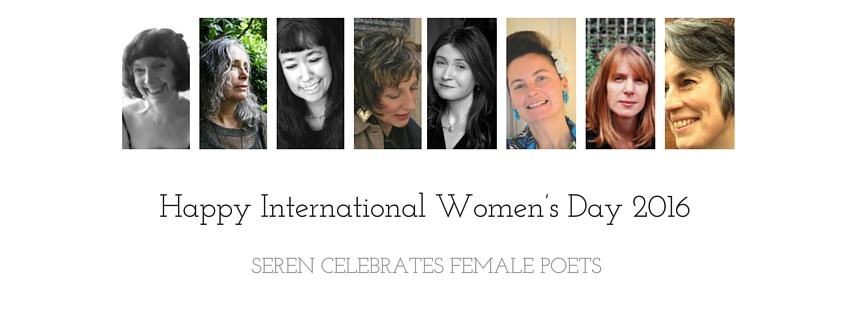
International Women’s Day: celebrating Seren’s female poets

International Women’s Day 2016 has arrived. We celebrate this year by highlighting just a few of the talented women we’ve been fortunate enough to publish. There will always be more names to mention and more works to appreciate, and you can find countless gorgeous books written by women on our website. But none-the-less, we hope you enjoy hearing about just a few of the Seren women writers and their achievements.

In this blog post, the first of two, we focus on the Seren female poets. Poetry Editor Amy Wack has been with us at Seren for over twenty years, publishing countless collections by women. The gender balance of most UK publishers favours men but in our case, with Amy at the helm, the balance is far more even.

Amy: Seren has a very good record for promoting, and bringing forth women writers and we owe this both to the Seren Board, and the forward-looking people at the Welsh Books Council, as well as the skill of my co-commissioner: Fiction Editor at Seren, Penny Thomas.

women's work 2016Women’s Work, edited by Eva Salzman and Amy Wack
March 2016, £14.99
Featuring over 100 poets, Women’s Work: Women Poets Writing in English, has been re-printed.  The 2016 edition features a revised introduction and updated author biographies.
Women’s Work contains classic poems by famous poets as well as lesser-known works. Editor Eva Salzman has provided an opening essay that artfully picks apart the statistics involving women’s work in anthologies and points out, with her characteristically vigorous wit,  just who gets to choose the canon, and why. Along with co-Editor Amy Wack (Seren poetry editor), they’ve both ranged broadly over the English-speaking world, and aimed to represent women of colour as well as those from the more esoteric wings of the style spectrum.

Poets published by Seren included in Women’s Work:

Kate Bingham
Jean Earle
Carrie Etter
Catherine Fisher
Hilary Menos
Deryn Rees-Jones
Vuylwa Carlin
Pascale Petit
Carolyn Jess-Cooke
Anne-Marie Fyfe
Kathryn Gray
Siobhan Campbell
Kathryn Maris
Anne Cluysenaar
Hilary Llewellyn-Williams
Tamar Yoseloff
Kathryn Simmonds
Zoe Skoulding
Christine Evans
Sarah Corbett
Carol Rumens

The Art of Falling Kim Moore Tamar_quicksand cover the man at the corner table rosie shepperd playing house katherine stansfield


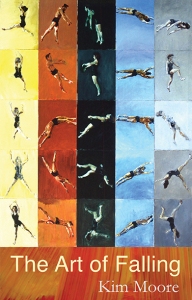
Collections published in the last few years include Kim Moore’s critically acclaimed debut The Art of Falling, Tamar Yoseloff’s A Formula for Night: New and Selected Poems, Rosie Shepperd’s The Man at the Corner Table, and Katherine Stansfield’s debut, Playing House.

Elterwater Rain Crowd Sensations Judy BrownA Boat Called Annalise


Hot off the press, we have Crowd Sensations by Judy Brown, which is a Poetry Book Society Recommendation, and Lynne Hjelmgaard’s A Boat Called Annalise, which recalls a journey the author took with her late husband on a sailboat, to the Caribbean and back.

The-Dogs-That-Chase-Bicycle-Wheels-rgbthe way the crocodile taught meanimal people


You can look forward to many more collections by female poets, and on the horizon we have Mslexia Poetry Pamphlet Competition winner The Dogs that Chase Bicycle Wheels by Ilse Pedler (available to pre-order), Katrina Naomi’s hard-hitting The Way the Crocodile Taught Me (April), and Animal People by Carol Rumens (April).

Posted on

Short Story of the Month | ‘Like Lizards Ride Water’ by Maggie Harris

Welcome to the return of Seren’s short story of the month after a summer break. This September we bring you a new story ‘Like Lizards Ride Water’ by Maggie Harris.

maggie new photoMaggie was born in Guyana and now lives in Wales, performing her work frequently with Cardigan’s Cellar Bards. A poet, prose writer and memoirist, she won the Guyana Prize for Literature for her first collection, Limbolands, 2000, and was Regional Winner of The Commonwealth Short Story Prize, 2014. Her latest collection of poetry is Sixty Years of Loving, (Cane Arrow Press), and short stories, In Margate by Lunchtime, (Cultured Llama Press).

‘Like Lizards Ride Water’ is the story of one man’s flight from his own war-torn country towards the apparent safety of Europe.


Like Lizards Ride Water

There was a moment when the men were assaulting the girls that Isxaaq almost intervened. His fists were clenched and he had almost risen to his feet. It was the old man who stopped him. He had put out his hand and stilled him. Isxaaq felt his wrist being pinned to the ground.

Afterwards, he was angry with himself, and angry with the man who had prevented him from rising; prevented him from defending the honour of the girls, who all night were staggering out from the back of the truck in tears.  Isxaaq wanted to believe that if one of his sisters had been amongst them, that someone would have stood up for her. After all they were not prisoners. They were not here by force. They had paid their way. They had each one of them made sacrifices to be here. Isxaaq thought of his father’s pinched face, his mother’s tears; uncles and aunts selling cattle, mortgaging their houses, trading labour, time, and honour to raise the cost of Isxaaq’s journey. ‘Walk good, my son’.

When, in the morning, they had been herded into new trucks, amid dry laugher from men who casually leaned their rifles over their shoulders, Isxaaq had no doubt that anyone who had attempted to stop them would have been shot. As the engines started, bodies bumped against each other, and Isxaaq found himself locking eyes momentarily with the old man. He didn’t know what he was doing here. Almost everyone else was young.

Isxaaq had walked one hundred miles. He had walked through the desert at night, slept in the shade of rocks. Sometimes he thought he saw others walking too, either before him, or behind him, but he could never trust his eyes. ‘Trust no-one’ was the last thing his father had said. When he got to the meeting point, others bled out of the hazy morning, young men and girls, eyeing each other warily.

They sat and waited outside the village with no name. In the distance goats bleated and villagers stumbled out of half-built houses. The morning had brought camels and trucks stirring up clouds of dust. When the truck pulled up and two men jumped out, Isxaaq was surprised to see that they carried guns. Fear rose in his heart then and he wanted to turn back. Was it really so bad, the life he was leaving? Then the faces of his lost friends appeared before him: their battered faces and broken knees, their disappearances.  He stood in the shade of the truck as the men walked between them, taking the parcels of money produced from the folds of their clothing. Sacrificial bundles. Bundles born of blood and tears, dust and hope. They shouted hurry up, get in the back! This was not what he had expected, this intimidation. He had expected it would be like riding on a bus. He pushed to the back of his mind the boy who had returned with his mind half-gone, telling tales of deception and robbery, of being abandoned in the desert. He stood wavering between a past and a future that seemed to offer equal despair. Then the face of his mother and the caress of her hand on his face seven nights ago: ‘Be brave my son, Abu crossed safely. So will you.’

 —

He had climbed up into that first truck with the memory of her words, taking comfort from the fact that his cousin had already done this journey, two years ago. Had crossed into Europe; sent money now for his family. Isxaaq held his chin up. He met the eyes of one of the girls, her head wrapped in a scarf decorated with lizards. She glanced away.

They had travelled for days; over unmade roads, which jerked the bones of their bodies, snapped them against each other like sticks. They reached into the small parcels they carried for snacks – biscuits, bread. Shared a diminishing flagon of water. They stopped at night to relieve themselves. First men, then women, by the side of the road. Isxaaq had felt discomfort relieving himself in proximity to women. The women grouped around each other for protection. The laughter of the men in charge unnerved him.

Other times they slowed to a stop; heard voices. Sat stiff with fear. They did not breathe. Isxaaq had no idea where they were but he knew there were checkpoints. He relaxed when he heard laughter. Sometimes he slid the tarpaulin apart. A flash of daylight cut into his eyes. The shapes of men interrupted his blindness. Guns. Forearms. Money. He breathed slowly and let the tarpaulin fall.

The roar of traffic woke him from a distracted sleep. They were on a highway. Isxaaq was ashamed to find his head had drooped onto the shoulders of the old man. The man had looked at him kindly, his eyes saying all that needed to be said. Heat was an unwanted passenger between them; the smell of sweat and body odour composting through underarms and clothing, settling in nostrils, on tongues. Car horns and the roaring of engines accompanied the loud beating of Isxaaq’s heart.

They stopped sometime in the middle of the day. The men banged on the side of the truck, shouting words that Isxaaq did not recognise. The tarpaulin was raised then, and the group looked out onto a crossroads. The countryside was bleached earth; crops had not grown here for a long time. Mountains undulated in the distance. The men shouted again, waving their rifles, and the group scrambled to their feet, their limbs slow to obey. They dropped one by one onto an unmade road.

They waited in the shade of an acacia tree, its canopy filtering the harsh sun. There was no breeze. Nothing but a lizard stirred. Isxaaq didn’t know what they were waiting for. The men had produced a plastic container of water and this they passed lip to lip, not caring that the water was as warm as the sweat on their skin.  There was no food.

Out of the rippling wave of heat on the highway a vehicle approached. Two vehicles. Four by fours. They came to stop by the acacia tree. Four men jumped out. They too

held guns. Isxaaq could not stop the fear that rolled over him again and again. He watched the men closely. They stood together, sharing the bundles of money out between them. Isxaaq thought of his sister’s bondage to the merchant in his village. Three years of unpaid labour, so that he, Isxaaq, could be where he was right now. What was to stop these men turning their guns on each and every one of them, and disposing of their bodies in this scant countryside? The image of the mad boy, the one who had returned, came into his mind. He tried to quell his panic through reason. Why would they want to stop this lucrative trade? Word would soon get out. He preferred to think of Abu, the money he sent.

The men were clapping each other on their shoulders now. The first group looked back and gave a wave, a mock salute. They climbed into the truck and headed back the way they had come.

The new men approached them, counting them, and running their eyes over the women. One of them spoke, a mix of English, Italian and dialect.

‘I trust you have been well treated,’ he said. ‘We have a long journey ahead, some four days before we reach the sea. Here, we have food, eat and relax. We leave when it is dark.’

But they didn’t leave when it was dark. When it was dark, they told them that the money they paid was not enough for this dangerous journey. They said they themselves would be in trouble if they were caught. They said that others were more ruthless and would hold them whilst they sent messages to their family for more money. But, not them, they did not have time to spare. That’s when they had looked at the women. They told them they were fortunate that being women, they were able to get everyone out of this predicament.

The women had begun to scream and shout, rising to their feet and gathering more closely to each other. That is when one of the men raised his gun and shot it into the acacia tree. A branch splintered and hung, its shadow bleeding on the earth.

The man’s quiet voice warned them that no-one was going to be harmed. This was just a business arrangement.

Isxaaq and the men were told to sit beneath the tree and relax.  The women sat apart from them, their heads in their palms, their cries rising like the remembered cries of birds. But there were no birds here, only the staggered passage of moonlight through the leaves.  Isxaaq took himself back home in his mind, whilst the women were taken one by one into the back of the trucks.

It was dawn before they left. Split between the new vehicles, again under cover. The road rolled away beneath the wheels, beneath their bodies once again in enforced intimacy, the aroma of skin and fear, and now shame. They did not speak.

The smell of the sea came to them at night, long before they arrived. It was cooler, sending a breeze to greet them, rinse them, cleanse them. The cries of seabirds too, entered the world they shared beneath the tarpaulin, like messengers. But when they clambered down, they didn’t see the port they had imagined, bristling with ships. Isxaaq did not know what he had imagined. But what he saw was the mouth of a muddy river and some sort of craft that did not resemble anything like a ship. What he also saw was a moving body that reminded him of termites. As he approached he saw that it was people. He and the other men turned and raised their voices to those who had brought them here. All their voices rose as if in unison, their fists too. But the men turned the trucks around and drove away.

Isxaaq tried to stay as close to the edge of the craft as possible. He refused to be pressed towards the centre. One of the girls who had travelled with him was close by. He recognised the headscarf she wore. He wished she had sat somewhere else. There was barely enough room for anyone to sit side by side.

He could not forget he had not tried to save her.

As they moved out to sea, he began to dream of the life he would live. He knew there would be difficulties. They were heading for the Italian coast. He did not know what would become of them there. He did not want to live there. His cousin Abu had made it to England. That’s where he wanted to go. He tried to relax and imagine a life there. He was good with motorbikes. Maybe he could learn to be a mechanic. He imagined his meeting with Abu. He had memorised his mobile number. That was the first thing he would say, when they questioned him. ‘I have a cousin, Abu, in London, here is his telephone number.’ He knew Abu would back him up; tell the stories of kidnap and torture.

He must have been smiling to himself, as the girl said: ‘Are you happy we are almost there?’

He turned to look at her, his shame returning. She had such large eyes. Beautiful and brown. They did not rebuke him. Next to her, a woman was attempting to hold on to her baby who wanted to crawl, who lifted his arms and stretched his body out in rigid protest. All around him were women and children, young men. He wondered what happened to the old man who had almost certainly saved his life. What was he doing, making this journey anyway? Did he not have children to look after him? Isxaaq looked at the baby and smiled. He would like to have a child like that someday. When he had reached London, become a mechanic, had somewhere nice to live. Someone started to sing a song. It was not one he knew. But it had a lulling quality that led him again to think of his mother and his childhood, just yesterday, close to her knees as she baked injera on the open stove.

He never knew if the wind had turned, or if the engine for some reason had stopped. He never knew if water had rushed in all of a sudden or whether the weight of them all had started the procedure which informed his brain that the sea suddenly appeared to be leaning dangerously above them. The whole crowd of passengers whom he had only just been looking at, the mothers and babies, young men with their hopeful grins and leather jackets that gave them some assurance, the crawling, fretful baby, his exasperated mother – they all of a sudden changed direction, some sailing right over his head. All of a sudden bodies were plummeting into each other with force, knees and elbows and foreheads cracking together with the finality of bone, clothing becoming heavy with water, flesh an upturned cart of market produce in a sudden up-pour of rain.

Isxaaq was lifted away in a large wave of water. He felt himself risen up and then dropped down in turn. Water filled his ears and eyes, his mouth. He tried to beat at the water with his hands.

He did not know how to swim; there were no rivers back home. But his fingers were strong and found something to hang onto. Some fragment of wood and iron wrenched from the craft. But more and more fingers were rising up from the water like fish: Isxaaq fought to keep his grip as others scrambled for a hold, pushing his hand away, coiling with slippery determination around a loin of timber. The waves slapped against all their faces with insistent anger. All around him cries rose like seabirds circling. A child’s body floated past, held up by a buoyant plastic diaper.

Lizards were dancing on the water. He was becoming delusional. He was watching his mother pound maize, watching a lizard just an inch away from him on the wall. So still. Basking in the sun, raising one leg and then the other. But these were swimming, they were rising up and down on the water. The girl’s head broke the surface; her hand reaching out to join the fists that had already formed there, cupped tight; fighting for space alongside Isxaaq’s. He could feel her legs touch his under the water, frantic. Her large eyes filled her face as she recognised him. He felt her hand slip then, lose her grip on the makeshift raft that was holding its own against the battering waves.

With a certainty that had not been present at any time since he had begun his journey, at any time through all the plans of the past two years, through the farewells, his mother’s tears, the acknowledgement of debts and futures, through these weeks of driving closer to hope, through the tension of that night at the crossroads: a certainty arose that made him grasp her hand and pin it beneath his.

He could feel himself losing the sensation of his fingers, the oiled slipperiness that was greasing his body, greasing all their bodies. His fingers slipping. Oil from the boat. The girl’s scarf came in his vision again, like a flag, almost jolly as it surfed the surges of water, lifting a little with the wind. Isxaaq let go his right hand and grabbed it, with some effort wrapping it round and round the wrist of the girl on to the makeshift raft, bracing his body, using his teeth to knot it securely. His heart was lightening, the fear that had accompanied him disappearing. He managed to say to her, ‘Hold on’, watched the ‘o’ of her mouth mirror the roundness of her eyes  before he slipped away, her gaze holding his, absolving him, lifting the terror away from him, lighting his journey downwards.


Afternote

‘I wrote this story last year, moved by the drownings that began to occur in the Mediterranean. The numbers overwhelmed me, and I wanted to focus on an individual journey, and explore what it might be like for someone to move from hope for a better life to get caught up in such a terrible experience. I did some research on the migrants, where they came from, and why, and was appalled to find out how big a scale the exodus was approaching, and how trafficking had suddenly, it seemed, become big business, aided by politics, extremism and corruption.
Since I wrote this story, the problems as we know have grown much much worse, nevertheless I believe that empathy with the individual is something we must never lose sight of.’

Maggie Harris

Posted on

An Interview with Damian Walford Davies

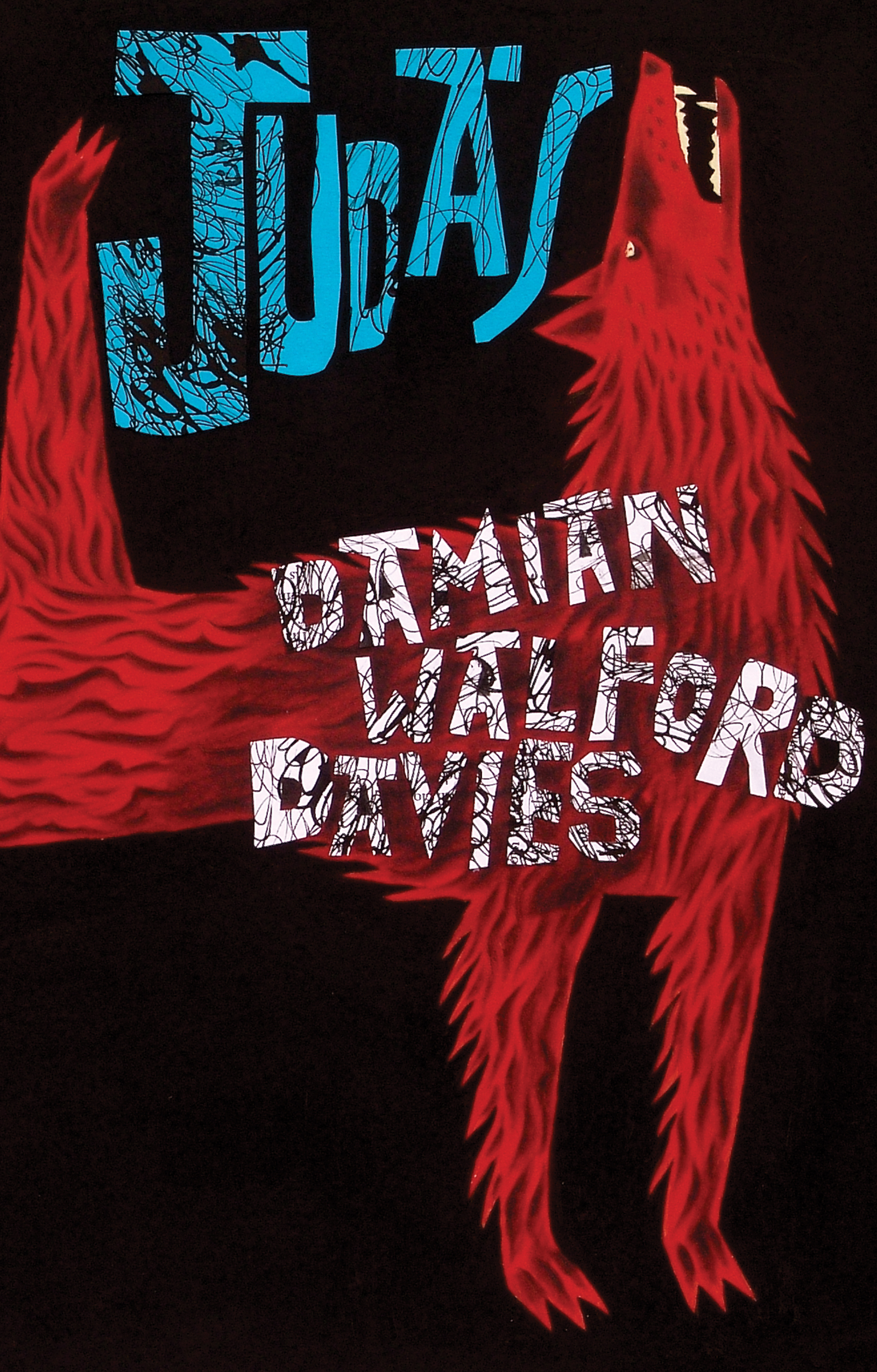
Today we’re chatting to poet Damian Walford Davies about his latest collection, Judas, which you can pre-order from our website here.

Damian is a poet, writer and librettist. He is the author of three Seren collections – Suit of Lights (2009), Witch (2012) and Judas (2015), together with the pamphlet Alabaster Girls (Rack Press, 2015) and the co-written volume, Whiteout (Parthian, 2006). He is Head of the School of English, Communication & Philosophy at Cardiff University, where he specialises in Romanticism, the two literatures of Wales, and Creative Writing.

Had you always wanted to write about Judas, whether it was Judas the man or Judas the metaphor, or did the poems in this collection quietly creep up on you?

Judas creeps up on you, certainly. I’ve always found him (or ‘it’ – Judas is a phenomenon, a problem, a crux (‘cross’), a paradox, a sore point) compelling. (The same with Lazarus, by the way, but that’s another, if related, story . . .) He is contradictorily represented in the canonical gospels, and that’s before we come to the second-century AD gnostic Gospel of Judas, where he is Christ’s confidant. There are a myriad of historical, theological, political and psychological arguments as to why Judas did what he did (if he did). To accept the historicity of Judas – which many scholars of first-century Palestine and early Christianity do not – means recognising him as an elusive figure. He is a no-man as well as a knot of contradictory representations, built up over twenty ideological centuries. (See Susan Gubar’s excellent 2009 biography of Judas.) This is the guy with the dark halo.

What is it you enjoy most about exploring history through poetry?

I like to write against big accepted narratives, intervene in them at personal, psychological levels, offer case studies of emotional quandaries, reveal terror on local, personal scales. I use the dramatic monologue for this, aiming for an imaginative inhabitation of voice and situation, aware at the same time that ventriloquising others has an ethics attached. This is Judas’s speaking platform, throughout. My previous Seren collection, Witch, did similar things, exploring how a witch is ‘made’ in the tense atmosphere of 1640s Suffolk. In Judas, I’m constantly negotiating suggestive gaps in the canonical gospel accounts. One has to be nuanced here, as well as bold. I made the decision from the outset to play with timescales, and so Judas is encountered during the week after the crucifixion, wandering through first-century Jerusalem one minute, but then clocking two women air kissing in the contemporary city’s Sheraton Hotel the next. Judas quotes Bob Dylan. Time is spliced; the Arab-Israeli conflict is as real to him as the Roman occupation. He is disturbed by a history that hasn’t yet happened. So I enjoy querying dogmatic versions of history, indulging in counterfactuals (which is more than a parlour game – it’s a way of changing the future). History always happens somewhere, and (like religion) is in many aspects terrifying. All this is not to say that the collection is iconoclastic, or without belief/faith, or blandly ‘materialist’. Quite the opposite. Multiple ironies mean that there are no final, fixed positions in this collection.

Throughout the collection you play around with many biblical images, such as the ‘thorns’ in ‘Annunciation 1’ and the ‘silver coins’ in ‘Denominations’. I imagine it would be difficult to write a poetry collection titled Judas without them! But did you ever worry about finding a new way to use imagery that has been around for centuries?

I saw it as an opportunity – to inflect, defamiliarise, and recontextualise these ‘core’ images. Judas is a collection in which all these images exist (I hope) in a complex, kinetic, shifting relationship. Did I worry about this? All the time. Poets must always be on edge, edgy. Poetry is about edgework. Judas is published at a time of political-religious crisis and horror. The collection is a reflection on fundamentalism, belief, faith, history, knowing, unknowing, violence, intolerance and human beings as agents and casualties of history. And (of course) beauty, friendship, love, worlds of spice.

You paint a very vivid picture of Jerusalem throughout the collection, picking out places like Yad Vashem in ‘In Vino’ and Ben Yehuda Street in ‘Siloam Pool’. Was giving your poems a specific setting important to you while writing the collection?

It was crucial. I was lucky enough to be able to visit Jerusalem in April 2012, and parts of the volume were written there in a hostel room under the muezzin’s recorded call to prayer and on the hostel’s roof, from which I could see the Al-Aqsa mosque to the east, the Church of the Holy Sepulchre to the west, and a sea of satellite dishes in between. And so the journeys that the shattered Judas takes through the old city are the ones I myself took through the narrow streets – full of managed but mangy colonies of cats – and souqs, around the Baths of Bethesda (a place of deep peace), down to the Garden of Gethsemane (from which I phoned my 93-year-old grandmother, who quite understandably asked ‘How big is it?’), back up to the ‘tufted wall’ of the Temple and through the four quarters of the divided (and machine-gun-patrolled) town. Judas is a map. Gethsemane, by the way, is tiny.

What, if anything, have you learned about Judas and the idea of evil through writing this collection?

He wants answers as much as we do. He’s still waiting.

Pre-order Judas from Seren’s website.

Posted on

Friday Poem – The Sound of a Diamond Planet

Short Days Log Shadows Sheenagh Pugh

The Sound of a Diamond Planet comes from Sheenagh Pugh’s collection Short Days, Long Shadows, published in 2014.

In this, her twelfth collection, noted poet Sheenagh Pugh steps into a new, northern landscape, the Shetland Islands, with poems steeped in the wilder weathers and views of rugged coastlines, sweeping sea-vistas and the hardy historical characters who have inhabited these lands. There is a lovely pared-down spareness, and elegiac formality to poems like ‘Travelling with Ashes’, ‘Staying’, and ‘Trondheim: January’ where the inhabitants appear lost in a ‘strange pink daylight’, and in ‘Gardening’ where ‘White stones are shaped like hearts’. The author’s characteristic dry humour emerges elsewhere as in ‘Extremeophiles’, a paean to bacteria – ‘chancers’ who live without sun. A poet who considers ‘too accessible’ to be the best sort of compliment, Sheenagh Pugh’s work has as much to offer the general reader as it does the specialist, who will admire her artful use of traditional forms.

Sheenagh will be reading at the Stanza Festival on the 5th March. For more information check out our website!

The Sound of a Diamond Planet

I seem to be surrounded
by things not quite there,

like the fieldmice munching
unseen inside my walls,

the spit of sand
uncovered at low tide,

the slick rock waiting to be
a waterfall again.

A planet, they say,
made all of diamond

resonates in its orbit,
light years beyond

human hearing, its brittle sound
broadcast in space.

Order Short Days, Long Shadows from Seren’s website.

Posted on

Jonathan Edwards in India

My Family and Other Superheroes author Jonathan Edwards is behind today’s post after taking part in the ‘Walking Cities’ exchange. Part of the Dylan Thomas centenary celebrations and organised by the British Council, ‘Walking Cities’ pairs up UK and international writers, providing them with the opportunity to tour each other’s home cities through the eyes of their local host.

Earlier this month Tishani Doshi, author of the Mabinogion retelling Fountainville inspired by India’s own mythological landscape, showed Jonathan around Kolkata.

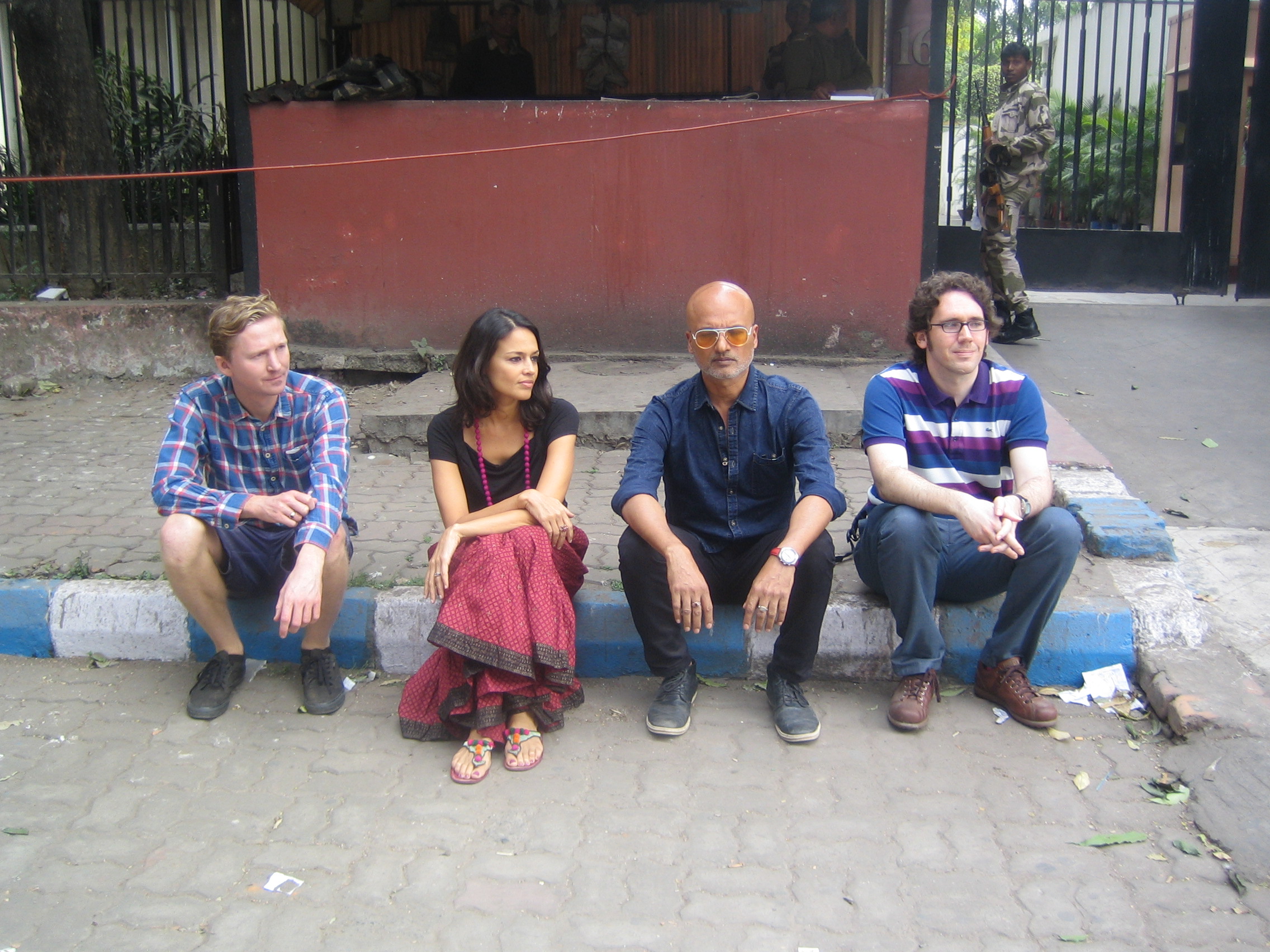
‘Now through your head there speed the words Hold on.’ As those words, the final line of a short poem about Kolkata I’d been working on since arriving in the great city, came out of my mouth, I looked in front of me at my audience. During the past year, I’d read poems at Sheep Festivals and school assemblies, in attics of restaurants and back rooms of pubs, with gangster rappers and Morris dancers, but none of that prepared me for the scene in front of me. I was reading poems to one poet from Swansea and two from India and behind them, a crowd of grinning and pointing residents of Kolkata had gathered. A rickshaw driver had stopped to take me in. Two Indian schoolboys giggled with eachIMG_3182 other. Behind them, the city’s distinctive yellow Ambassador taxis sped past. On the other side of the road, a man sat on the pavement gutting fish for sale, as murky water gurgled past his feet towards the drain. The next stall over was crammed with the most vibrantly coloured flowers I’d seen in my life. This was Kolkata.

The poem I was reading was the culmination of a film I was making with my exchange partners, Joe Dunthorne, Tishani Doshi and Jeet Thayil. Loosely inspired by Richard Linklater’s Slacker, our plan was to shoot, in one take, a series of conversations as we walked down Chitpur Road in north Kolkata. Joe Dunthorne would tell an anecdote about the time a local tried to pick him up by telling him he looIMG_3117ked like Princess Diana. Tishani Doshi would reflect on the quieter spaces of the city, its parks, its rivers. Jeet Thayil would grab hold of unsuspecting locals and shout haiku at them. The relay baton for this series of conversations would be a stool, passed from hand to hand, which would also be the platform from which I would deliver my embryonic poem.

As the content of these coIMG_3167nversations will tell you, Kolkata is a city of incredible variety and vibrancy. It is rich in history: we managed to find in the Park Street Cemetery the tomb of one of Charles Dickens’s sons, which was impressive yet surprisingly ramshackle. We went on a boat on the Hooghly river, fishingboat-bobbing our Welsh and Indian selves and chatting about our shared poetic concerns on a break from the madness of the city. We found a shared love of the sestina and wrote one collaboratively for Dylan Thomas, whose centenary celebrations the trip was part of. And we read together at the Kolkata Book Fair, the tents, stewards and professionalism of which reminded us of Hay-on-Wye, but with roughly, it seemed, a hundred times as many people. It was awesome to read poems like ‘Anatomy’ and ‘View of Valleys High Street through a Café Window’ in that setting.

One thing I struggled wIMG_3179ith during the trip, and continue to do so now I’m back and trying to develop my jottings into full poems, was how to write about this amazing city. Do I have any right to? My writing is so geographically rooted in Wales and in a set of experiences which are my own. How do I write about a completely different culture and way of living? The best I’ve come up with so far is to adapt the sort of descriptive, documentary, writing-in-situ style of a number of poems in my first collection to this completely new subject matter. To paraphrase something Jeet said, if you were simply to fIMG_3180ix a camera to the front of a taxi and record a drive through the streets of Kolkata, you’d have a truly astonishing film. The poems I’m working on out of the experience, including ‘Kolkata Street Scene’ with which I’ll end this blog, and which I read for the film, are attempts to replicate something like that.

Before I finish, though, I just want to take a moment to thank my collaborators – or co-conspirators – on this project. Joe, Tishani and Jeet are amazing writers and people who it was a joy to be with. Discovering the shared ground in our writing and also enjoying our differences, discussing process and the things we’re grappIMG_3172ling with, was an amazing experience. In May we’ll do the whole thing again in Swansea, culminating in an event at the South Bank Centre in London which will also involve Rhian Edwards and a number of other Welsh, Scottish and Indian writers. I’m already looking forward to it. In the meantime, I can’t wait to see the final cut of that film. A boy from Crosskeys standing on a stool in the middle of the street in Kolkata and shouting his loony poem at the colour, the dust, the grins. Yes, yes, grandchildren, I remember. That fella just by there look – that was me.

Kolkata Street Scene

There on the pavement, men in broken-down
patio chairs fiercely discuss
what’s for lunch and a dog has given up
on consciousness. A bus comes tooting at itself
to get out of the way and, in top floor flats, men take up
sniper positions. A flower stall guy names the price
for colour, as a passerby
spits his clear spit onto the street.
Here comes a girl on a motorbike, plaited ponytail
growing from her helmet like a towrope.
Now through your head there speed the words Hold on.

Posted on

Friday Poem – The Voice in which my Mother Read to Me

This cover shows a colourful painting of a school boy stomping with excitement viewed as if looking from the ground. The text reads: My Family and Other Superheroes, Jonathan Edwards.

The Friday poem is back f0r 2015 and we’re kicking off with The Voice in Which my Mother Read to Me from Jonathan Edwards’ Costa Poetry Award Winning collection My Family and Other Superheroes.

The Voice in which my Mother Read to Me

isn’t her good morning, good afternoon, good night voice,
her karaoke as she dusts, make furniture polite voice,
her saved for neighbours’ babies and cooing our dog’s name voice.

It isn’t her best china, not too forward, not too shy voice,
or her dinner’s ready, your room looks like a sty voice,
or her whisper in my ear as she adjusts my tie voice.

It’s not her roll in, Friday night, Lucy in the Sky voice,
her Sunday morning, smartest frock, twinkle-in-the-eye voice,
that passing gossip of the vicar with the Communion wine voice.

It’s not her ‘Gateau – no, ice cream – no… I can’t make the choice’ voice.
It’s not her decades late, fourth change, ‘Is this skirt smart enough?’ voice.
It’s not her caught me with the girl from number twenty-one voice.

That voice which she reserved for twelve-foot grannies, Deep South hobos,
that sleepy, secret staircase, selfish giants, Lilliput voice.
That tripping over, ‘Boy, why is your house so full of books?’ voice.

[soundcloud url=”https://api.soundcloud.com/tracks/183594834″]

My Family and Other Superheroes is available from the Seren website. Save 20% when you join our online book club.