Every year, we observe two minutes silence at 11am, on the 11th day of the 11th month to mark the moment The Armistice began in 1918. Today, as we once again take time to remember the sacrifices made by servicemen and women in the armed forces, we’re sharing some of the commemorative titles we’ve published during the last 40 years. Lest we forget.
Men Who Played The Game by Mike Rees
The Great War and the resulting unimaginable loss of life had a profound effect on servicemen and those at home, perhaps never more so than in the case of sportsmen, who fought ‘battles’ on the pitch or in the ring according to rules devised for fair play. Men Who Played the Game by historian Mike Rees explores the development and importance of sport in Britain and the Empire leading up to the outbreak of the First World War, and the part played by sportsmen in the conflict. The book opens with revealing chapters on how various sports – the fans, the governing bodies and the sportsmen themselves – reacted to the outbreak of war. This book is an invaluable guide to the relationship of sport and war, to the state of sporting Britain, and a moving testimony to the fate of so many sportsmen.
Robert Graves: War Poems draws together all of Robert Graves’s poems about the Great War. It consists of his first two major published volumes: Over the Brazier (1916) and Fairies and Fusiliers (1917) as well as the previously unpublished 1918 manuscript, ‘The Patchwork Flag’. Critical and contextual introductions by editor Charles Mundye provide biographical and historical context, locating and ranking Graves amongst the other soldier poets of the First World War: Sassoon, Owen, Thomas, Rosenberg et al.
Alun Lewis (1915-1944) was the most prominent writer of World War Two, in poetry and short fiction. He was born in the industrial valleys of south Wales and grew up during the deep poverty of the Depression. Set against this background and war, Alun, Gweno & Freda is an account of Lewis’s life and his writing, through the particular prism of his relationships with his wife, Gweno, and with Freda Aykroyd, an expatriate in India whose house provided respite for British officers on leave. The book argues that Lewis’s charged relationships with these two women were the key to both his writing and his mental health. It also explores the circumstances surrounding Lewis’ death by a single shot from his own gun and contributes to the ongoing debate about whether this was an accident or suicide.
And You, Helen by Deryn Rees-Jones and Charlotte Hodes
This specially commissioned collaboration between poet Deryn Rees-Jones and artist Charlotte Hodes explores the life of Helen Thomas, wife of the poet Edward Thomas who was killed at the battle of Arras in 1917. Rees-Jones’s sequence takes Thomas’s only poem addressed directly to his wife, ‘And you, Helen’ as its starting point, and imagines Helen after Edward’s death. Complemented by a meditative essay on the complexities of the relationship between the poet and his family, and on war, grief, marriage and bereavement more generally, this is a critical exploration through a personal lens.
This scholarly volume offers insight into the highly influential writer and poet Edward Thomas, through his correspondence with Walter de la Mare: 318 letters from between 1906 and 1917.Poet to Poet offers a moving epistolary account of the developing personal and poetic relationship of both poets, with biographical revelations, and increased understanding of their influence on each other and key points relating to their poetic processes.
The coming months will see the commemoration of one of the most notorious battles in history. The Battle of the Somme, fought between July 1st and November 18th 1916, has left an indelible mark on the history of the twentieth century and, for Britain in particular, it symbolises the horrors of modern warfare.
One hundred and forty one days of horror. The casualties are well documented: the first day alone saw 57,470 British casualties, 19,240 of whom were killed. The second day, with 30,000 British casualties, was not much better. Add to that the French and German losses and you have total losses of dead and injured easily exceeding 1,000,000.
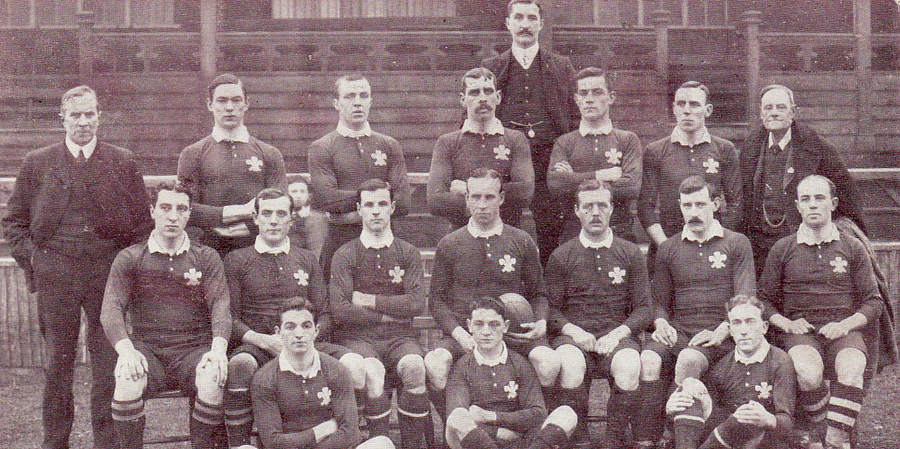
It was inevitable that many British sportsmen would be among the dead. Heart of Midlothian, Scotland’s table topping football team, lost 3 players on the first day while English cricket saw 3 notable all-rounders, Booth, Jeeves and Burns make the ultimate sacrifice. Welsh goalkeeper Leigh Roose, English footballers Evelyn Lintott and Donald Bell VC and England rugby captain Lance Slocock met the same fate. But what of Welsh rugby? What sacrifices were made by this small nation, a nation which was just at the close of its first rugby ‘Golden Era’? The answer is stark. The total number of Welsh rugby internationals to die as a result of the Great War was 13, 14 if one includes ‘Hop’ Maddock who died in December 1921 as a result of illness which had its roots in the battlefields of the Somme. No less than 5 of these unlucky and brave young men met their death on the Somme.
Charles Meyrick Pritchard
The first to appear in Mike Rees’ book, Men Who Played the Game: Sportsmen who gave their life in the Great War, is a true man of Newport, Charles Meyrick Pritchard. Charlie was the son of John Pritchard, a founder member of the Newport Rugby Club and part of a family that ran a wine and spirit business. Following an education at Newport Intermediate School and Long Ashton, Bristol, Charlie joined Newport RFC and by 1904 this twenty two year old, thirteen stone, six foot tall version of the modern backrow forward was in the Welsh team. A year later he was taking his place on the field to decide the unofficial championship of the world. The New Zealand All Blacks arrived in Cardiff unbeaten to be challenged by a strong Welsh team and Charlie was to play a huge part in what many regard as the most important match in rugby history. Wales deservedly won a thrilling, controversial match 3-0 but, although it was Teddy Morgan who scored the try, Charlie was the inspiration. Fellow players had no doubt in telling anybody who was not too excited to listen that Charlie had played a key role, “knocking ‘em down like ninepins” according to George Travers, a fellow hero and club colleague. Others talked of his willingness to be in the thick of the fight, disrupting the hitherto invincible All Blacks with his devastating tackling. Following this victory Charlie’s fame was assured but his career didn’t end there. In 1906 he was made captain of Newport, a position that he held for 3 years. On the international field he won a further 10 caps, (14 in all), a figure that would have been higher but for injury. He played in the championship winning Wales team of 1906 and in the first Grand Slam success in 1908. After missing out on a second Grand Slam in 1909, Charlie played his last game for Wales in 1910.
With the outbreak of war Charlie was quick to enlist. He joined the South Wales Borderers as a temporary Second Lieutenant in May 1915, was promoted to lieutenant at the end of July and was made a captain in the 12th Battalion the following October. Following a period of training, Charlie arrived on the Western Front in June 1916 in time for the Somme offensive and was quickly into the action. He and his men had been forced to take cover in the long grass from their own bombs and struggled to avoid the German searchlights. On the night of 12th/13th August Charlie was instructed to lead a raiding party on the German trenches with a view to taking as many prisoners as possible. He led his men into the trenches showing exceptional bravery in the process and, despite being wounded in the wrist, continued to encourage and lead his men in what was to prove to be a successful raid. He took one of the enemy prisoner but was wounded once again, taken back to the British front line and then to No1 Casualty Clearing Station shortly before dawn on the wet morning of August 13th. Here his concern for the success of the raid and his devotion to duty came to the fore asking, “Have they got the Hun?” “Yes” he was told, “Well I have done my bit,” Charlie replied, the last words that he was known to speak. He died, without ever leaving the Clearing Station, on August 14th 1916.
His commanding officer, Lieutenant Colonel Alexander, wrote to the family describing Charlie as being “as brave as a lion” and talking about how his death had “cast a gloom” over the whole Battalion. Others spoke of the deep affection in which he was held, the fine example that he set as to what a sportsman should be and his “private tenderness” who was “loved by all who came into contact with him”. Attempts to grant him the Distinguished Order failed, as only living soldiers were eligible, although he was given a Mention in Dispatches. Charlie was buried in Choeques Military Cemetery, one of 86 members of Newport Athletic Club who lost their lives in The Great War and remembered on the Memorial Gates at Rodney Parade. The thirty two year old left in Llwynderi Road, Newport, a grieving widow with two young children and the legacy of a true Welsh rugby hero.
John Lewis Williams
A second significant Welsh rugby player with Newport connections had already died on the Somme. John Lewis Williams is quite properly remembered as a prolific wing for both Cardiff and Wales, the most capped Welsh international to die in the conflict. However Johnnie Williams began his career at Newport in 1899 after leaving Cowbridge Grammar School. Born in Whitchurch in March 1882, Johnnie had an illustrious rugby career. After winning his first cap against the 1906 Springboks he went on to score a record seventeen tries in seventeen internationals, a record that was later equalled by Ken Jones and beaten by both Gerald Davies and Gareth Edwards in 1976. Illustrious company indeed! Noted for his swerve and sidestep, Johnnie was an integral part of three Wales Grand Slam winning teams in 1908, 1909 and 1911, one of the handful of Welsh players to achieve such a feat. Unsurprisingly, Johnnie also toured with the British Isles team which visited Australia and New Zealand in the summer of 1908 where he played in two of the three tests, scoring twelve tries on the trip. While making the long sea journey to the Southern Hemisphere, Johnnie earned himself a supplement to his two shillings a day out of pocket expenses by writing articles for the South Wales Daily News and the South Wales Echo. A well-educated man who earned his living as a principal clerk in a coal exporters based in Cardiff Coal Exchange, Johnnie was given the captaincy of his country for the game against France in Paris in 1911 due to his ability to speak French at the post match dinner. A couple of weeks later he played his seventeenth and final match for Wales in the victory over Ireland. His record was impressive with only two defeats in his Wales international career.
On the outbreak of war Johnnie joined the 16th Battalion of the Royal Welch Regiment and was, by July 1916, in the thick of the action on the Somme, in particular at Mametz Wood, a place synonymous with the Welsh losses in the Great War. The action which took place at Mametz between 7th and 12th July 1916 saw the 16th Royal Welch and the 11th South Wales Borderers suffer the most appalling losses. Johnnie went over the top on 7th July but heavy machine gun fire cut them down. Johnnie was severely wounded and his left leg was amputated. Infection set in and, although he was able to write to his wife Mabel that he was in good spirits, Johnnie died of wounds on 12th July. He was one of 190 officers and 3,803 other ranks who were casualties at Mametz. He had fought in distinguished company – the poets Siegfried Sassoon, Robert Graves and David Jones as well as the writers Frank Richards and Llewellyn Wyn Griffith all fought at Mametz but, unlike Johnnie, they survived to commit their experiences to paper. Johnnie was not so lucky. He left his wife of a mere eighteen months a widow in their Penarth home. His reputation as one of the great Welsh wings, however, remains firmly intact.
Dick Thomas
Alongside Johnnie, another Welsh international rugby player also made the supreme sacrifice. Born in Ferndale in October 1883, Dick Thomas had spent his early years working underground as a collier before joining the police force based in Mountain Ash. Dick, by now playing for Mountain Ash after short spells with Penygraig and Cardiff, had made his debut for Wales in the same game as Johnnie made his international bow. Although on the losing side against South Africa, Dick went on to win three more caps and contributed to victories in each of the 1908 and 1909 Grand Slam seasons. Only illness prevented him from winning more caps and possibly becoming a regular in the Welsh pack of this ‘Golden Era’. Dick was known as a tough uncompromising forward, who was also a Glamorgan Police heavyweight boxing champion. Never one to shirk a challenge, he went over the top on 7th July. His body was never found and he is remembered on the Thiepval Memorial, one of the 72,195 names on that ‘memorial to the missing’.
David ‘Dai’ Watts
Dick Thomas is not the only Welsh international named on the Thiepval Memorial. One week after Dick was lost and just three days after Johnnie Williams succumbed to his wounds, Dai Watts, a tough forward born in Maesteg in March 1886, was killed in action at Bazentin Ridge on 14th July. After a career spent playing for smaller valley clubs, Dai joined his hometown club, Maesteg where he became the first player from this club to be capped. Following impressive games for the Glamorgan League and then Glamorgan County, Dai was picked for the first international of 1914 against England. Wales lost this game 10-9, a match they should have won due to the supremacy of their forwards. England went on to win the Grand Slam under the captaincy of Ronnie Poulton, the glamorous young England centre who was killed in 1915, while the Welsh pack remained unchanged for their three subsequent victories and cement their reputation as ‘The Terrible Eight’. A long rugby career at international level appeared to be Dai’s destiny.
It was not to be. In the autumn of 1914 Dai joined the 7th (Service) Battalion, The King’s (Shropshire Light Infantry). In July 1916 they were involved in the Battle of Bazentin Bridge. At 3.25am on 14th July the KSLI were ordered to attack. Confronted by uncut wire they became easy targets and Dai was one of the 171 who lost their lives in this attack. There are no records of how this toughest of forwards met his end, only that his body was never recovered and that he left a widow and two children.
The third and final Welsh international named on the Thiepval Memorial is a player of a very different type to the tough, uncompromising miners, the forwards Dick Thomas and Dai Watts. Horace Wyndham Thomas was an outside half educated at Monmouth School and Cambridge University where he was a choral scholar. Born in Pentyrch near Cardiff in 1890, he originally attended Bridgend Grammar School before winning a scholarship at Monmouth. Both at Monmouth and Cambridge Wyndham excelled in a range of sports. Injury and choral duties prevented him gaining his ‘Blue’ but he finally achieved this in 1912 when he played his part in a Cambridge victory. Four days later this brilliant and elusive outside half made his debut for Wales in the match against the Springboks, a game which he nearly won for Wales with a late drop goal attempt which sailed narrowly wide. Many who saw this effort were adamant that the ball had actually gone through the posts and that Wales were ‘robbed’. He kept his place for the game against England a few weeks later but, although he played in this match, Wyndham had been offered a job with a firm of shipping agents in Calcutta. Immediately after the game Wyndham sailed to India to fulfil a five year contract, a huge loss to Welsh rugby. It was expected that Wyndham would be the Welsh outside half for years to come.
When war broke out Wyndham resigned his job and headed home to join the 14th (Reserve) Rifle Brigade. In August he was to be found on the Somme and on 3rd September he was attempting to capture trenches above the Ancre. The assault resulted in over 400 casualties, one of whom was Second Lieutenant Horace Wyndham Thomas. His body was never found and his name joined those fellow players on the Thiepval Memorial. Of all the Welsh internationals killed in the Great War perhaps Wyndham Thomas was the player whose potential was greatest and unfulfilled. Lost to rugby far too soon, Wyndham, with all his brilliance and talent, perfectly represents the sacrifices made by that generation of rugby players one hundred years ago.
The stories of these players, (with the exception of Dai Watts), are included in Men Who Played the Game. Mike Rees has included the contributions of sportsmen in The Great War from all corners of Britain and the wider Empire but, during this summer of 2016, none of the stories have greater significance than those of the Welsh rugby heroes on the Somme. It is fitting that we now remember their sacrifice made a century ago.
It’s Euro 2016 and Wales is in the finals! Historian Mike Rees looks back into Wales’ sporting history to remember goalkeeping legend Leigh Roose, who found glory on the football field and died a hundred years ago, at the Somme.
Mike Rees’ book Men who Played the Gamelooks at the development and importance of sport in Britain and the Empire leading up to the outbreak of the First World War, and the part played by sportsmen in the conflict.
On the eve of Wales’s participation in the finals of a major international football tournament for the first time since 1958, it is likely many of you may be reflecting on past glories achieved by Welshmen on the football field.
You might well consider the achievements of Wales first ‘football superstar’ Billy Meredith, talisman of both Manchester City and Manchester United in the early years of the twentieth century or the ‘Gentle Giant’ that was John Charles, revered from Swansea to Turin where he won multiple league championships and cups as the focal point of a brilliant Juventus team. More likely, you’ll consider the incomparable Ryan Giggs, with his sack full of medals, or the striking prowess of Ian Rush or Mark Hughes. But as Gareth Bale, the latest Welsh superstar, graces the football stadiums of France this summer how many will remember Leigh Roose, the first renowned Wales goalkeeper and predecessor of Jack Kelsey in 1958 or Neville Southall in the 1980’s and ‘90’s? As we move towards the centenary of Roose’s demise on the battlefields of the Somme, perhaps it is time to ensure that a new generation is made aware of the exploits of this remarkable Welshman.
The process of remembering Leigh Roose has already begun. Pupils from Wrexham are creating a collage with a particular focus on his part in the first international match to be caught on film, the game between Wales and Ireland at the Racecourse, Wrexham on 2nd April 1906. This will be displayed in Eagles Meadow shopping centre, Wrexham and bring his name to many for the first time – recognition that is long overdue.
Leigh Richmond Roose was born at Holt, near Wrexham on 26th November 1877, the son of a Presbyterian minister, the fourth of five boys. Despite losing his mother to cancer at the age of four, he had a comfortable middle class upbringing which led to him gaining a degree in Bacteriology from UCW Aberystwyth in 1899. Leigh enjoyed his time at ‘Aber’, particularly his experience of playing for the town football team in his favourite position, that of goalkeeper. So successful was he that in February 1900 he was chosen to play for Wales in the match against Ireland, the first of his 24 caps. A host of professional clubs sought his signature but by now Leigh was working in King’s College, London, fully intending to pursue a medical career. In the summer of 1901, however, he relented and signed for Stoke.
It was not long before this six foot, thirteen stone athlete made his mark. He became known for his reckless bravery, total dominance of his penalty area, his startling reflexes and resulting shot-stopping. Playing often as a modern day sweeper, Leigh left the confines of his area to start attacks, carrying the ball to the half way line, as he was permitted to do. So effective was this tactic that in 1912 the laws were changed in order to prevent goalkeepers handling the ball outside the penalty area. Leigh was also prepared to impose himself in other ways. It was not uncommon for him to be involved in the occasional scuffle or dispute with authority, sometimes over his travel expenses, on other occasions, disputes with the opposition. Leigh was also an entertainer – his gymnastic ability used to swing from the crossbar when things were quiet at his end of the pitch. Crowds loved him, even more so when Wales won their first Home International championship in 1907. Although top league and cup medals eluded him, Leigh was always challenging for honours at Everton from 1904 and later at Sunderland. He became one of the country’s best known footballers whose lifestyle as an eligible young man in Savile Row suits predates David Beckham by ninety years. His affair with the ‘Queen of the Music Hall’, Marie Lloyd would delight the tabloids of the 21st century. However nothing lasts for ever and, following a spell as player coach at Arsenal, Leigh retired to his medical commitments and the after dinner circuit in 1912.
When war broke out Leigh joined the Royal Army Medical Corps and was quickly despatched to the Dardanelles where he served in Gallipoli. Here he worked in hospitals treating hundreds of serviceman injured in that futile encounter. However Leigh wanted to see the action for himself and, following his return to London, he joined the 9th Battalion of the Royal Fusiliers. His wish for action was soon granted. Leigh was awarded the Military Medal after he had taken part in the capture of Ration Trench near Dainville and the subsequent resistance to the German counter-attack. In October 1916 Leigh was once again in action. The 9th Royal Fusiliers advanced on the Albert-Bapaume Road and this led to the capture of Le Sars but the cost was disastrous. Three hundred and thirty two officers and private soldiers were killed or injured in the action. Leigh was seen running across No Man’s Land firing his gun with no concern for his own safety. He was last seen lying in a crater, probably already dead. Leigh’s body was never discovered and he is remembered, his name engraved and incorrectly spelt, on the Thiepval Memorial to the missing. Thirty eight year old Leigh is one of the 72,000 names remembered on that most impressive of memorials.
Leigh’s death was keenly felt by all who knew him. Mike Rees, in his recent book Men Who Played the Game, quotes the Athletic Times which described him as “dexterous though daring, valiant though volatile”. But Rees also concludes that this is only part of the story and that Leigh Roose, along with Billy Meredith, did more to put Welsh football on the map than any other player. That, coupled with his ability to entertain thousands of spectators, demands that he be remembered as a sportsman of real significance, one who died as bravely as he played. During this summer of exciting Welsh football, a century after Leigh made the ultimate sacrifice, he deserves to be remembered.
Christmas is on its way, and we have some recommendations for you whether you’re looking for a present for someone else, or you’re looking for something to ask Santa for this Christmas!
For Thriller Lovers:
If you or someone you know loves a good crime story, why not try Jo Mazelis’ Jerwood Fiction Uncovered Prize-winning Significance, or Anne Lauppe-Dunbar’s debut Dark Mermaids?
For Historical Fiction Lovers:
Francesca Rhydderch’s debut, The Rice Paper Diaries, which won the 2014 Wales Book of the Year Award and Tiffany Murray’s chilling Sugar Hall are perfect for readers who like their stories old school. So old school they’re practically history.
For Sci-Fi/Fantasy Lovers:
If you’re after something weird and wonderful for you or a friend this festive season, then you can’t go wrong with one of our New Stories from The Mabinogion; The Meat Tree is a brilliantly bizarre sci-fi retelling of the Blodeuwedd myth, perfect for readers who love stories that are literally out of this world. But if you’re after something a little closer to home, why not pick up a copy of Mary-Ann Constantine’s fable-esque debut, Star-Shot? This novel is a real treat for readers who are familiar with Cardiff.
For Short Story Lovers:
For lovers of the oft forgotten art form that is the short story, why not pick up New Welsh Short Stories, an anthology featuring a wide range of Welsh authors from Carys Davies to Jo Mazelis, or Graham Mort’s latest collection, Terroir. These two look quite charming together, so if I were you I’d get both.
For Non-Fiction Lovers:
Jasmine Donahaye’s memoir, Losing Israel, has been stunning readers since its publication earlier this year; part memoir, part travel writing, part nature writing, it’s the perfect gift for any non-fiction connoisseur. Mike Rees’ Men Who Played the Game is the ideal book for any sports fan, and as we commemorate one hundred years since the First World War there’s no better time to read it than right now.
For Poetry Lovers:
Here at Seren we’d be nothing without our poetry, so why not pick up a copy of Kim Moore’s hugely popular debut collection, The Art of Falling, or Jonathan Edwards’ Costa Award-winning debut collection, My Family and Other Superheroes – we promise they won’t disappoint you! Or if someone you know likes to keep on top of the latest poetry, a subscription to Poetry Wales magazine would make for a fine Christmas present, if you ask me. And I suppose you must be asking me if you’re reading this…
You can find all these books and more on our website, so treat the readers you know to some well-chosen words this Christmas!
November will always be a month in which we remember the sacrifices of our ancestors, those who fought, and those who died doing so. 2015 marks not only 70 years since the end of the Second World War, but also the birth of the Welsh war writer, Alun Lewis, whose centenary we have been celebrating throughout the year.
One of the most important things we can do is to ensure we never forget the fighting that both horrified and defined the 20th century, and so, as we thank both the fallen and those who made it home, we hope you’ll take a moment to peruse some of war-themed titles, and help us to honour Remembrance Day in the best way we know how.
This anthology contains writing by many of the greatest authors of Wales. From Wilfred Owen and David Jones, Dylan Thomas and Dannie Abse to Christopher Meredith and Gillian Clarke, it spans a century which saw both the barbarism of mechanised warfare and the development of mass communication, mass literacy and a flourishing of creative endeavour.
After the First Death draws on the experience of those who have faced death on the battlefield, and on others who have sought to put into words the complex philosophical, political and emotional responses that military action demands. Including poetry, extracts from fiction, memoirs, letters and biography, the book moves from World War One via the ideological battleground of the 1930s into the Second World War, then through the Cold War, Vietnam, the Falklands and the Gulf wars.
The Great War marked a profound change in attitudes to war and the conduct of it. Six million men from the British Isles served in it, 720,000 (12%) were killed. Junior offices had a 20% survival rate; up to 80% of a battalion could be lost. Battle had changed from engagement by professionals to wholesale, mechanized slaughter. The effect on servicemen and those at home was profound, perhaps never more so than in the case of sportsmen, who fought ‘battles’ on the pitch or in the ring according to rules devised for fair play.
Men Who Played the Game explores the development and importance of sport in Britain and the Empire leading up to the outbreak of the First World War, and the part played by sportsmen in the conflict. The book opens with revealing chapters of how various sports – the fans, the governing bodies and the sportsmen themselves – reacted to the outbreak of war.
The bulk of the book tells the stories of individuals and groups of sportsmen, combining accounts of their pre-war sporting success and their military experience. It covers several sports – rugby, football, cricket, athletics, tennis, boxing; social hierarchy – ‘gentlemen’ and ‘players’; several nationalities – English, Welsh, Scottish, Irish, Australian, New Zealanders; and several theatres of war – Western Front, Gallipoli, Africa, the Middle East. Here are stories about the famous Hearts football team, soccer stars Leigh Rhoose, Jimmy Speirs and the first mixed race footballer Walter Tull. Rugby Union is represented by All Black captain Dave Gallagher, British Lion David Bedell-Sivright and a swathe of England captains; cricket by the fate of the Kent County side and Booth, Jeeves and Burns: three all-rounders killed on the Somme.
Historian Mike Rees has written an invaluable guide to the relationship of sport and war, to the state of sporting Britain, and a moving testimony to the fate of so many sportsmen.
Alun Lewis (1915-1944), the remarkable poet and story writer, died, aged 28, in Burma during the Second World War. Some critics see him as the last of the great Romantic poets, a twentieth century Keats. Others view him as the bridge between pre-war poets like Auden and Yeats to post-war poets such as Hughes and Gunn. He was born and raised in Depression-struck south Wales and, following degrees in history at Aberystwyth and Manchester, became a teacher there. Early in 1940, despite his pacifist inclinations he enlisted and, after long periods of training, joined the war in India.
Becoming a soldier galvanised Lewis’s writing. By 1944 he had written two collections of poems and one of short stories, all published to considerable acclaim. Firmly established with Keith Douglas as the leading writer of the Second World War, Lewis’s death in an accident while on active service was huge loss to English literature. This Collected Poems comprises a body of work which has endured and which transcends the label ‘war poetry’; it is complete in itself and full of promise of greater things.
Siân James brings her customary narrative flair and ear for dialogue to this beautifully-observed novel of love, scandal and grief set in wartime rural Wales.
For three years, young teacher Rhian Evans has lived a life of isolation in her small village, patiently awaiting the return of her soldier-husband, Huw. While Rhian struggles to stay true to her strict Chapel upbringing, her carefree lodger Ilona Hughes apparently has no such concerns, seeming to live life as she pleases.
As Rhian’s loneliness grows, Ilona’s influence leads her friend to confront the conflicting passions at work within her. Faced with the interests of art-teacher Gwynn Morgan (a married man with whom Rhian fell in love before meeting her husband) she finds herself questioning the morals imposed upon her by her upbringing, and eventually even her love for her absent husband. Soon, Rhian’s revived affections for Gwynn overpower both her loyalty to Huw and the disapproval of certain members of the community, leading the couple to embark on a passionate affair, just as Gwynn himself is called-up to fight.
But Rhian’s sadness at his departure is nothing compared to her devastation when she learns of his death only a few weeks later; wracked by grief, loneliness and guilt, she endeavours to make peace with her community, and particularly with Gwynn Morgan’s urbane French widow.
Perceptive, funny and moving, Love & War is a poignant and beautifully-plotted portrait of one rural community during the Second World War.
Ellen Davis was born in 1929 in the small German village of Hoof. Her Jewish family had lived there since 1760 but its peaceful existence was shattered when Hitler came to power and German Jews were persecuted.
Ellen’s autobiography tells the harrowing story of her childhood struggle to protect her younger brothers and sisters from the terrors of life in Nazi Germany and her escape to Swansea via the Kindertransport.
This is also the moving story of Ellen’s life in Britain, the difficulties of her first marriage and her love for her own Welsh children as she finds happiness in a new relationship. Meanwhile she continues to search for her German family and relatives in Australia, Israel and the US – a search which ends finally, heart-rendingly, in Riga in Latvia. Ellen Davis tells her story simply and honestly. In recent years she has given many interviews about her life and spoken about it especially to young people.