Posted on

Books to celebrate Earth Day 2022

We’re celebrating Earth Day 2022 with a list of books that address the natural world, the climate emergency and nature in all its glory.

100 Poems to Save the Earth – Zoë Brigley and Kristian Evans

100 Poems to Save the Earth. Edited by Zoe Brigley and Kristian Evans

100 Poems to Save the Earth invites us to fine-tune our senses, to listen to the world around us, pay attention to what we have been missing. The defining crisis of our time is revealed to be fundamentally a crisis of perception. For too long, the earth has been exploited. With its incisive Foreword, this landmark anthology is a call to action to fight the threat facing the only planet we have. 

Wild Places UK:UK’s Top 40 Nature Sites – Iolo Williams

Iolo Williams Wild Places UK UK's Top 40 Nature Sites

In Wild Places UK television naturalist Iolo Williams picks his favourite forty wildlife sites from the many nature reserves around the country. As this informative and lavishly illustrated book demonstrates, all forty places are packed with the widest variety of trees, plants, birds, animals and insects. Williams draws on his enormous knowledge to guide readers and visitors to the natural delights of each site. Wild Places will show them rarities like the osprey, where to find almost six hundred different species of moths, or an incredible 51 species of caddis fly. Readers will discover where to find birds, both rare and in huge numbers, where hares box and otters swim, where to spot dolphins and salmon, and where to see whales and sharks.

We Have To Leave the Earth – Carolyn Jess-Cooke

We Have to Leave the Earth Carolyn Jess-Cooke. Fierce and very beautiful - Jen Hadfield

Carolyn Jess-Cooke’s new poetry collection is both keenly political and deeply personal. The opening poem ‘now’ features a seemingly peaceful domestic scene of a family lounging at home as the starting point for meditation on history, time, mortality and the fate of the planet: I think of what tomorrow asks and what is yet/ to be done and undone, how many nows make up a life/ and what is living. There are hints of a struggle with depression stemming from a difficult childhood, inspiring Jess-Cooke to express her experiences with her child and their autism diagnosis.

Blood Rain – André Mangeot

Blood Rain Andre Mangeot A thought-provoking book for turbulent times - Matthew Caley

Resonant, complex, rich in heft and texture, these are mature poems that grapple with serious themes. André Mangeot’s Blood Rain opens with a deeply personal love poem (“Remember, too, our secret pool?”) that also introduces the natural world and it’s endangerment – one of several key themes in a book that addresses some of the most troubling man-made issues now facing us all.  The second poem, ‘Bellwether’, reflects this: a subtle socio-political piece, a warning in a time of populism and radicalisation. This breadth of awareness and range is part of the collection’s appeal, giving the poems an urgent topicality and depth.

Much With Body – Polly Atkin

Much With Body Polly Atkin This is series play indeed – Vahni Capildeo Poetry Book Society Recommendation

Much With Body is the startlingly original second collection by poet Polly Atkin. The beauty of the Lake District is both balm and mirror, refracting pain and also soothing it with distraction: unusual descriptions of frogs, birds, a great stag that ‘you will not see’. Much of the landscape is lakescape, giving the book a watery feel, the author’s wild swimming being just one kind of immersion. There is also a distinct link with the past in a central section of found poems taken from transcripts of the journals of Dorothy Wordsworth, from a period late in her life when she was often ill. In common with the works of the Wordsworths, these poems share a quality of the metaphysical sublime. Their reverence for the natural world is an uneasy awe, contingent upon knowledge of our fragility and mortality.

Waterfalls Of Stars – Roseanne Alexander

Rosanne Alexander Waterfalls of Stars My ten years on the island of Skomer

When Rosanne Alexander’s boyfriend Mike was offered the job of warden of Skomer, a small uninhabited island off the south west tip of Wales, they had just ten days to leave college, marry (a condition of employment) and gather their belongings and provisions for the trip to the island. This was the first of many challenges Rosanne and Mike faced during their ten years on the nature reserve, from coping with periods of isolation when they were the island’s only inhabitants, to dwindling food supplies during the winter when rough weather made provisioning from the mainland impossible. Thrown on their own resources they had also to deal with catastrophes like the devastation of the island’s seal colony following an oil spill.

The Shaking City – Cath Drake

The Shaking City Cath Drake A guide to staying clear-eyed, combative and caring in unsettled times. – Philip Gross

The shaking city of Australian poet Cath Drake’s debut poetry collection is a metaphor for the swiftly changing precarity of modern life within the looming climate and ecological emergency, and the unease of the narrator who is far from home. Tall tales combine with a conversational style, playful humour and a lyrical assurance.​ The poet is able to work a wide set of diverse spells upon the reader through her adept use of tone, technique, plot and form.

Nia – Robert Minhinnick

Nia A Novel Robert Minhinnick

Nia Vine is about to fulfil her dream of exploring an unmapped cave system. With her will go two friends who were brought up in the same seaside town.  These companions are international travellers, but Nia, who has recently become a mother, feels her experience insignificant compared with that of her friends. While the three explore, Nia finds herself obsessed by a series of dreams that finally lead to a shocking revelation. Page-turningly evocative, immersive and compelling, Robert Minhinnick has written a novel in which realism and poetry collide and mingle.

Dark Land, Dark Skies – Martin Griffiths

Dark Land, Dark Skies The Mabinogion in the Night Sky Martin Griffiths

In Dark Land, Dark Skies, astronomer Martin Griffiths subverts conventional astronomical thought by eschewing the classical naming of constellations and investigating Welsh and Celtic naming. Ancient peoples around the world placed their own myths and legends in the heavens, though these have tended to become lost behind the dominant use of classical cultural stories to name stars. In many cases it is a result of a literary culture displacing an oral culture.

Find these titles and many more on the Seren website serenbooks.com.

Create your free Seren account and enjoy 20% off every book you buy from us.
Posted on

Extract from ‘The Owl House’ by Daniel Butler

If you’re still looking for a last minute gift, you can’t go wrong with Daniel Butler’s new book The Owl House. This pastoral exploration of mid-Wales is beautifully observed, full of evocative observations that can only have been lived to have been accrued. Here is a wintry extract from the chapter ‘Weather’.

Daniel Butler has lived in the Cambrian Mountains near Rhayader for twenty-five years, absorbing the world around him and charting its changes slow and rapid. His passion for the natural world was compounded when two wild birds, barn owls, nested at his farm. Through charting his relationship with the birds, he embarks on a pastoral exploration of his locale, rich as it is in wildlife of all kinds. His new book The Owl House is a rich and vivid portrait of one of the most remote and sparsely populated areas of Britain, broad in its horizons yet full of fascinating detail. The perfect gift for any lover of the natural world and mid-Wales.

Winter bird activity is not just about survival. I used to think the breeding season was a spring phenomenon, but for many creatures the concept seems to lurk as a constant background urge.

Even in the depths of winter there are signs of what’s to come. Mistle thrushes start to gang up towards the end of August in family groups which later join together to form small flocks. They give off their instantly recognisable football rattle calls as they bounce through the air above the fields, but by the end of the year these groups have disbanded. Instead of looking for the security of a flock to evade predators, the males are beginning to get a head start on next year’s breeding season. They do this by searching for a berry-laden food source. Indeed, the bird’s name comes from its fondness for mistletoe, that strange shrub, a living green sphere that hangs in bunches from the apparently lifeless limbs of oaks and apple trees. A glance at its fleshy white berries and strange green leaves and it isn’t difficult to see why the druids apparently venerated it as a sign of life in the depths of winter. The oak or crab apple host would be no more than a black skeleton, yet its passenger would appear the embodiment of life. Mistletoe is rare in Radnorshire, although it is common enough a few miles away in the acres of Herefordshire cider orchards.

My mistle thrushes are drawn mainly by the lure of another tree beloved by pagans and one which is, if anything, even more associated with Christmas. There is a particularly splendid and always well-endowed holly halfway down the lane. The berries grow slowly all autumn, green and hard and invisible among the glossy spiked leaves until they burst into view by turning red seemingly overnight.

By the time I go to collect a few decorative sprigs in early December, there will already be a resident mistle thrush. His favourite perch is near the crown to gain a good vantage point. He sits here like a miser crouched over his hoard, jealously watching for thieves or rivals which may try to steal his crown. At my approach he flies off giving his characteristic rattling calls of alarm towards the row of neighbouring pines. He perches there and with binoculars I can just make him out staring warily at me, filled with terrors that his jewelled kingdom might be raided in his absence.

He is not always in the holly, however, sometimes he is lurking among the ‘sallies’ (goat willows) that straggle along the banks of the nearby stream. This probably indicates the proximity of a sparrowhawk or goshawk, and he’s waiting for the danger to pass. Normally he’s a pugnacious fellow, fiercely defending his scarlet treasure from a host of increasingly hungry thieves. His greatest ire is reserved for sexual rivals, but he will defend his prize from smaller redwings and fieldfares, doves and even wood pigeons. He does this by intimidation rather than actual violence, flying at them only to veer off at the last second. At stake is not just a precious food supply at the leanest time of year, but the implications this has for the breeding season ahead. The fatter and fitter he is at winter’s end, the better his chances of attracting the best mate, for any bird that can finish the lean months in good condition is clearly a good breeding prospect. So he spends the winter fighting for food and sex.

By Christmas tawny owls are also beginning to stake out breeding territories, hooting out their instantly recognisable ‘toowhit, too-woo’ calls and at about the same point the garden robins become increasingly evident. The clichéd seasonal card image of a robin on a snow-covered spade handle as a representation of the season of goodwill and peace couldn’t be further from the truth. These are testosterone-pumped pugilists, determined to fight all rivals. At first they are driven by the need to protect their food supplies and territories and will pick fights with any other robin – even potential future mates. Once, after a heavy snow fall, I was looking at the crowds of finches, tits and nuthatches hanging on the feeders outside the kitchen window when my eye was caught by flying puffs of snow on the back lawn. Two robins were scrapping in the soft powder, bouncing into view as they pecked and kicked in fury, only to sink almost out of sight whenever they paused. No sooner had the last tiny crystals fallen back, however, than the furious tussle would resume.

The Owl House is available on the Seren website £12.99 or can be found in bookshops nationwide. Find your nearest independent bookshop using the Books Council of Wales or Bookseller Association shop finders.

Create your free Seren account and enjoy 20% off every book you buy from us.

Posted on

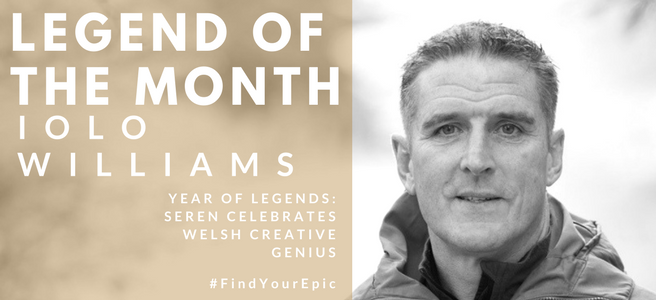
Legend of the Month: Iolo Williams

Legend of the Month Iolo Williams

Each month we are celebrating one fantastic Seren author in honour of Wales’ Year of Legends. This month the spotlight falls on Iolo Williams.

Wild Places – Iolo Williams gIolo Williams has just returned to our TV screens with Trefi Gwyllt Iolo on S4C and BBC’s Springwatch, where in Episode 8 he goes head to head with Martin Hughes-Games, pitting two iconic birds (the barn owl and the kestrel) against each other in a challenge to see which is the ultimate hunter. So what better time to have this nature expert as our Legend of the Month?

Previously Iolo has worked as the presenter of seventeen TV shows, in two languages; he is also an author, and a public lecturer. With a degree in Ecology, he has worked in farming, timber and for the RSPB in the field, and as a regional co-ordinator. Williams is the author of five books in Welsh and two in English: Llyfr Adar, Llyfr Natur, Blwyddyn Fan Hyn a Fan Draw, Cynefin Glan Y Môr, Blwyddyn Iolo, Wild about the Wild, and most recently, Wild Places: Wales’ Top 40 Nature Sites (Seren, 2016).

Wild Places is an ode to the beauty and significance of Wales’ nature places and features forty of Iolo’s favourites, scattered all around the country. From mountains to meadows, coastal sites to towering cliffs, his list takes in all the best of what Wales has to offer, and reveals how to get the most out of each site – where to spot dolphins and salmon, where hares box and otters swim, where to see Wales’ great variety of hawks and other birds of prey.
Wild Places is available from our website: £19.99 (20% off when you join our Book Club).

Meet Iolo at our Secrets of Skomer Island event at the Teifi Marshes Centre, where he will join former Skomer warden and author, Rosanne Alexander, to talk about the island’s important landscape and wildlife.  Tickets are limited, so book now to avoid disappointment:
£5 from The Wildlife Trust website
(all ticket proceeds go to the Trust)

Rosanne Alexander Iolo Williams Skomer event


Find a great selection of books by our other legendary writers on the Year of Legends page.


Save