Posted on

Friday Poem – Snow

This week’s poem is by the National Poet of Wales, Gillian Clarke, and is taken from the Seren anthology, Christmas in Wales. If you order two books from our website you’ll get a copy of Christmas in Wales for free! Offer ends Midnight, 24th December.

Celebrate Christmas the Welsh way in the company of some of the country’s leading writers, past and present. Christmas mass, the nativity play, turkey and plum pudding, the Mari Lwyd, presents, the weather, the shopping and post-festive blues are among the many subjects drawn from stories, poems, diaries and letters. Wartime Christmases in Swansea and the Rhondda – and home thoughts from India and Italy – pantomime characters, Christmas cards and New Year Resolutions; R.S. Thomas, Dylan Thomas, Dannie Abse, Gillian Clarke, Catherine Fisher, Bruce Chatwin, Sian James, Kate Roberts and Leslie Norris, Christmas in Wales has all the ingredients for the complete experience of the season of celebration.

Snow

The dreamed Christmas,
flakes shaken out of silences so far
and starry we can’t sleep for listening
for papery rustles out there in the night
and wake to find our ceiling glimmering,
the day a psaltery of light.

So we’re out over the snow fields
before it’s all seen off with a salt-lick
of Atlantic air, then home at dusk, snow-blind
from following chains of fox and crow and hare,
to a fire, a roasting bird, a ringing phone,
and voices wondering where we are.

A day foretold by images
of glassy pond, peasant and snowy roof
over the holy child iconed in gold.
Or women shawled against the goosedown air
pleading with soldiers at a shifting frontier
in the snows of television,

while in the secret dark a fresh snow falls
filling our tracks with stars.

Order Christmas in Wales from our website.

Posted on

Santa Baby, Slip a Story Under the Tree

Christmas is on its way, and we have some recommendations for you whether you’re looking for a present for someone else, or you’re looking for something to ask Santa for this Christmas!

santagif

For Thriller Lovers:

ttt

If you or someone you know loves a good crime story, why not try Jo Mazelis’ Jerwood Fiction Uncovered Prize-winning Significance, or Anne Lauppe-Dunbar’s debut Dark Mermaids?

For Historical Fiction Lovers:

ttt (1)

Francesca Rhydderch’s debut, The Rice Paper Diaries, which won the 2014 Wales Book of the Year Award and Tiffany Murray’s chilling Sugar Hall are perfect for readers who like their stories old school. So old school they’re practically history.

For Sci-Fi/Fantasy Lovers:

ttt (4)

If you’re after something weird and wonderful for you or a friend this festive season, then you can’t go wrong with one of our New Stories from The Mabinogion; The Meat Tree is a brilliantly bizarre sci-fi retelling of the Blodeuwedd myth, perfect for readers who love stories that are literally out of this world. But if you’re after something a little closer to home, why not pick up a copy of Mary-Ann Constantine’s fable-esque debut, Star-Shot? This novel is a real treat for readers who are familiar with Cardiff.

For Short Story Lovers:

ttt (4)

For lovers of the oft forgotten art form that is the short story, why not pick up New Welsh Short Stories, an anthology featuring a wide range of Welsh authors from Carys Davies to Jo Mazelis, or Graham Mort’s latest collection, Terroir. These two look quite charming together, so if I were you I’d get both.

eldoradogif

For Non-Fiction Lovers:

ttt (3)

Jasmine Donahaye’s memoir, Losing Israel, has been stunning readers since its publication earlier this year; part memoir, part travel writing, part nature writing, it’s the perfect gift for any non-fiction connoisseur. Mike Rees’ Men Who Played the Game is the ideal book for any sports fan, and as we commemorate one hundred years since the First World War there’s no better time to read it than right now.

For Poetry Lovers:

ttt (5)

Here at Seren we’d be nothing without our poetry, so why not pick up a copy of Kim Moore’s hugely popular debut collection, The Art of Falling, or Jonathan Edwards’ Costa Award-winning debut collection, My Family and Other Superheroes – we promise they won’t disappoint you! Or if someone you know likes to keep on top of the latest poetry, a subscription to Poetry Wales magazine would make for a fine Christmas present, if you ask me. And I suppose you must be asking me if you’re reading this…

You can find all these books and more on our website, so treat the readers you know to some well-chosen words this Christmas!

homealone


Posted on

Friday Poem – For Christmas

This week’s poem is from Christine Evans’ 2007 Wales Book of the Year shortlisted collection, Growth Rings, published in 2006.

This collection from Christine Evans follows well-received Selected Poems.  Hers is a sensitive and persuasive voice, highly attuned to the vagries of the seasons, to the landscapes and inhabitants of the beautiful Llyn Peninsula in North Wales where the author has made her home.

As well as vibrant short lyrics on everything from ‘Bluebells in Nanhoron’ to jets flying over Wales, there are a series of tender elegiac pieces on relatives, meditations on the last moments of Shelley and the fates of the Brontes, and a number of poems featuring the mysterious Island of Bardsey.

For Christmas

Hubble shows us this:
the star factory in Sagittarius
where time’s a flying strand
looping from a furnace

where, out of the flux, out of the fire,
a boilover of hydrogen and sulphur,
cobalt and vermilion
from the radiant debris,

a scatter of new stars
streams out, seeds of light.
Pinpricks in our darkness:
guides as good as any for the journey.

Order Growth Rings from our website.


Posted on

Friday Poem – The Snow Dome

This week’s poem is from Paul Henry’s fifth collection, Ingrid’s Husband, first published in 2007.

Here is a book of ghosts, from the mysterious traveller in the title poem who, mistaken for another man, starts to crave his new alter ego, to the first person of ‘Between Two Bridges’, Henry’s long poem on Newport, who follows his teenage ghost across the city for a night:

He pulls away. The wind puts its lips to an arcade.
A seagull on a barber’s pole waits to open its blades.

How the living haunt themselves is the concern of Ingrid’s Husband, and the author discovers his spirits through an imagery of absences: a child’s signature in the dust of an old guitar; the stone plinth where a cafe once stood; a white balloon drifting down a shopping arcade; a chateau, still furnished with belongings of its vanished owner…. Love continues to underscore the commonplace in Paul Henry’s fifth collection and this lyric poet’s distinctive voice continues to haunt its readers.

The Snow Dome

First sun, then snow … my father floats up the lane
in white jeans, a white rose in his claw.
He cuts a Lear-like figure, drifting alone
through the sun and snow.

Wherever you mother goes, I follow
he mutters, brushing the icing from her stone,
its doorstep to a colder house. It snows

and shines about the ornamental scene.
We can’t see for the petals of the rose.
He says she kissed his bald head in the lane,
first with sun, then snow.

Order Ingrid’s Husband from our website.

Posted on

Friday Poem – A small domestic scene

This week’s poem is from Ivy Alvarez’s collection, Disturbance, published in 2013.

Disturbance is a novel in verse by Ivy Alvarez that chronicles a multiple homicide, a tragic case of domestic violence, where a family was gunned down by the husband and father. 

The book features poems in a kaleidoscope of voices from all the characters involved. We first meet the family itself and witness how the father’s controlling attitude gradually escalates into violence. Then we get the aftermath: the authorities, police and neighbours, who all might have helped to prevent this tragedy. This is a very dark book, but a courageous one, ultimately about evil and its presence in our everyday lives. The fact that this family was relatively well-to-do, seemingly prosperous and well-connected, adds another layer of intrigue and mystery. There is some graphic violence, but the emphasis is on the characters and their motivations.

A small domestic scene

‘Blood comes out in cold water,’
he said to me,
almost tenderly,
from the doorway,
as I held the icepack to my cheek,
looked at my blouse in the mirror,
fingered the stains.

Order Disturbance from our website.

Posted on

Help the Homeless: A Charity Evening with Rosie Shepperd

Rosie Shepperd is teaming up with Waterstones Guildford to present a charity launch of her debut collection, The Man at the Corner Table.

Join Rosie and the Waterstones team at 18:30 on Monday 7th December for a sophisticated evening that will include wine, canapés, and a talk from Rosie about her dazzling collection. The event itself is free, but any who wish to attend are encouraged to make a donation, however large or small, to the Number Five Project, a Guildford-based homeless shelter.

Number Five offers short-term emergency accommodation for homeless men and women over the age of 18; they provide a hot meal, a hot shower, a bed for the night and breakfast the next morning, as well as 1-2-1 key-worker support to all residents.

For those of us lucky enough to have never been homeless, we can’t possibly imagine just how awful homelessness is. People who are homeless are in danger of being attacked, abused or stigmatised, and as the weather gets colder, many homeless people will not survive the winter.

So if you can, attend the launch and make a donation – if you can’t make a donation, why not spread the word? You could make a difference!


Posted on

Friday Poem – Mermaid

This week’s poem is from Simon Mundy’s fourth collection, More for Helen of Troy, first published in 2012.

More for Helen of Troy, Simon Mundy’s new collection of poems from Seren, is suffused with the atmosphere of the landscapes that inspire him, the lush countryside of Powys, and a number of islands all over the world:Genada, Jamaica, Shetland, Italy. It is also deeply involved with many questions of desire: for the ideal of a beautiful woman, as ‘Mermaid’; for the hope of a good state, as in ‘The New Senedd, Cardiff’ for the vision of a pristine country and seaside, as in ‘Radnor Songs’ and ‘Aspects of Sea’. The tension between all these ideals, between lofty aims and inevitable disappointments, come together in the main title sequence, where an entire society must scheme and suffer for the allure of Helen. Helen is also emblematic: both a legendary figure and a imago for women from all times: pursued, desired, lonely, restless, she haunts the imagination of the poet. Sometimes keenly satirical, as in ‘Society Haiku’, and often poignantly lyrical as in ‘Translated Daughter’, these poems are both pointed and enjoyable. 

Mermaid

This rock, this divan of stone
Is too jagged for your tail, tearing
Young scales, the salt of sea and tears
Searing raw skin as you preen and comb,
Holding the pose for shipsful of men
Who pass in the morning.
What else can you do?
Hide in the cold northern waters that sparkle
On the surface but hold poisons that pock
Your fins with dirty sores.
Or you could hitch on board those ships,
Shed the tail, rejoice in legs and bush,
Bask on the warm sands of love
Before the mortal tides creep in
Across the disappointing strand.
No. Keep amphibious. Immortal
Beauty is worth a little weeping.

Order More for Helen of Troy from our website.

Posted on

Friday Poem – Masculine Happiness

This week’s poem is from David Foster-Morgan’s debut collection, Masculine Happiness, which was released this week!

Masculine Happiness is the provocative debut poetry collection by David Foster-Morgan. Born and based in Wales, Foster-Morgan has long been a presence in the poetry world, having had poems published widely in magazines and with appearances at workshops, festivals, and events including ‘slams’ where his quiet style and obvious integrity frequently beat louder and less subtle voices to a prize. His debut collection, some years in the making, is inspired in part by his reading of American literature: the conversational tone of Frank O’Hara (‘F’OH’) and the long-lined garrulity of Allen Ginsberg, (‘Allen Ginsberg returns to Llantony Priory’) as well as the models of masculinity handed out to us by Hollywood characters like John Wayne (‘Masculine Happiness’). His ambivalence toward the idea of the ‘hero’ and his observation of the fate of those who have been lauded, like the conflicted protagonist of ‘The City Legend’, is a fruitful area for exposition.

This is also a writer who casts a cold eye on the natural world, at one point lauding a landscape and the next, mourning its depredation. In the poem ‘Meeting my Eagle’ the narrator comments: ‘Polar magnets, our feel for each other is/strongest at the point of turning away.’  The poet observes, interacts and resists the urge to rhapsodise. The author’s philosophical education informs his frequent changes of character and point of view. This erasure of ego is characteristic. We also see into the minds of people like the ‘Machine Gun Killer’, made frightening due to the author eschewing gory melodrama in favour of cool accuracy. We are poised with this professional killer, ‘behind the muzzle’s flare, breathing the pepper exhaust, transported on the recoil’s shudder.’

There is also a considerable amount of humour here, along with astute satire and insightful character poems.

Foster-Morgan’s work repays the careful attention of thoughtful readers.

Masculine Happiness

John Wayne is warm, tired and had
just the right number of drinks. Firelight
and the stars of Arizona surround his bed:
a saddle blanket rolled out in the desert night.

News headlines of a foreign war: the reporter’s
hair and blue eyes match her checked scarf;
and a voice behind me starts: who’s having her,
insulted when I won’t laugh as he starts to laugh.

On another channel Bob Mitchum’s an old sea captain:
safe on land while his son’s submarine is overdue;
drinking cognac from a dark bottle, he finishes it all,
and floats into the sleep of drunk and drowned men.
Sick the next morning, his steps slow and unsure,
like a shipwrecked sailor exploring a new shore.

Order Masculine Happiness from our website.

Posted on

Friday Poem – Witch

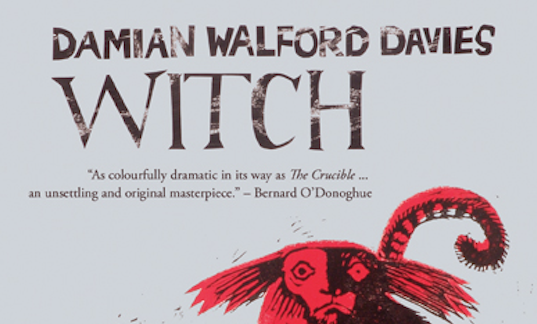
Witch by Damian Walford Davies

This week’s poem is a section from Damian Walford Davies’ second collection Witch, just in time for Halloween!

With the narrative pull of a novel and the vibrancy of a play for voices, Damian Walford Davies’ Witch offers a thrilling portrait of a Suffolk village in the throes of the witchcraft hunts of the mid-seventeenth century. The poems in this collection are dark spells, compact and moving: seven sections, each of seven poems, each of seven couplets, are delivered by those most closely involved in the ‘making’ of a witch. The speakers – from Thomas Love the priest, the villagers who slowly succumb to suspicion and counter-accusation, the ‘discoverer of witches’ Francis Hurst, and the ‘witch’ herself – authentically conjure a war-torn society in which religious paranoia amplifies local grievances to fever pitch. Witch is a damning parable that chimes with the terror and anxieties of our own haunted age.

An extract from Witch

She was threshing out
a prayer from deep inside

her chained throat’s
gabble. The air was dizzy

with her dirt. Which art,
she kept repeating,

which art in, as if the once
lithe tongue were damned

to dwell on it. Hustling
clouds let sunlight flush

in pools; she sprang
and chased it, thwacking,

thwacking back again
along her jangling leash.

Did they expect she’d
partner them in one

last meek pavane?
She scratched and bit,

lapsed sullen. At the gate
they bound her wrists

until the knot was
knuckled like a fist

and dragged her bucking
in the dirt. I followed

in her rut and fierce
curlicues, like the carving

of the vine stock’s sudden
flourish into grapes.

Shouldered like a sheaf,
bare hockshins shocking

white, she felt the press
of bodies pitching up

against the pikes. Each
rung made her trussed

bulk skip. He botched
the roping-up, the halter

like a bridle round her
mouth. She turned to him

with squally eyes. Her feet
on his, he held her like

a husband by the waist,
and let her go.

Order Witch from our website.

Posted on

Friday Poem – The Witch Bag

This week’s poem comes from Sarah Corbett’s second collection, The Witch Bag, published in 2002.

“Poetry as white-knuckle ride” is how Poetry Wales described Sarah Corbett’s debut, The Red Wardrobe. Her eagerly-awaited second collection, The Witch Bag, is as powerful as its predecessor, and is sure to cement Corbett’s reputation as one of the rising stars of British poetry. The title poem evokes a spellbinder who is both “weightless, thin as pond moss” and “blacker than the pond’s belly.” ’The Kitchen God’ is a series of erotic love sonnets; ’My Son the Horse’ is part of an astonishing group of poems about the birth of a son; ’Czech Pieces’ records vivid impressions of Eastern Europe; the final section focuses on the death of a father. This poet, in sensuous and evocative language, conjures intimate worlds; her subjects are often fearlessly personal: birth, death, and love in all its manifestations.

The Witch Bag

Remember me. I am the woman
who shook her fisted nipples
at the moon,
bearing down the dark streets
that could not take her.

My face broke in two
as I ate its bright cheek,
my hands sudden as marshlight
held before me
into the dark nights that followed.

I am the woman who flew
not only in her dreams,
but remembered the spell as she woke
and hunted sighs like ticks,
dipping and turning as she went.

That woman, weightless thing,
thin as pond moss,
blacker than the pond’s black belly.
She hooks its clammy limbs around her own
and sucks the water into herself.

That woman, without a world,
who goes hopping with one boot
between twilights,
a bagful of grave treasures
lost and lost again –

mask of hair, milk tooth,
heel-bone, blood-purse, name.

Order The Witch Bag from our website.