Posted on

Friday Poem – The Formula for Night

Tamar Yoseloff A Formula for Night

This week’s poem comes from Tamar Yoseloff’s latest collection, A Formula for Night: New and Selected Poems.

Tamar Yoseloff is a poet whose career has been profoundly influenced by the visual arts. A Formula for Night: New and Selected Poems is the eagerly awaited summation of her work, encompassing selections from four published print volumes: Sweetheart, Barnard’s Star, Fetch and The City with Horns (now mostly out of print); and poems from her collaborations with artists: Formerly, Marks and Desire Paths. The book also includes a generous selection of beautiful new poems. The title poem is based upon an installation by Welsh artist Cerith Wyn Evans. An image from his work, a light sculpture, is used for the cover of the book. 

The poet’s first collection, Sweetheart, was a PBS Special Commendation and the winner of the Jerwood/Aldeburgh First Collection Prize. She was the recipient of an Arts Council New Writing award which helped her complete her second manuscript, later published as Barnard’s Star. Of her collaborations, Marks was published as a limited-edition artist’s book and pamphlet by Pratt Contemporary Art in 2007. Desire Paths was a limited-edition portfolio produced by Galerie Hein Elferink in the Netherlands. Both books feature work by artist Linda Karshan.

More recently, Formerly, a chapbook of poems based on forgotten London locations, with accompanying photographs by Vici MacDonald, was the debut publication of their co-founded imprint, Hercules Editions. Formerly was shortlisted for the Ted Hughes Award in 2012.  Exhibitions of the poems and photographs have appeared in two venues in London: the Poetry Society’s Poetry Café and the Saison Poetry Library at the Southbank.

The new poems are often artful explorations of paradox: death/birth, dark/light, clarity/mystery. In the ‘Swimmer of Lethe’  the protagonist says: ‘I’ve mastered surface/ here everything is under.’ Atmospheres are conjured, surfaces interrogated and humans are often found woefully or wonderfully implicated in their settings in unexpected ways. A misunderstood creature, the ‘Muntjac’, is seen with tender clarity ‘Now white with May/tar and fern on his delicate hooves…’. The poet’s vocabulary is spiky, sometimes ferociously so. Sex is another paradox, its violence at times palpable: from ‘Pictures of Spring’:  ‘I bend and break, bend/ and break, contort my limbs/ into these lovelocked shapes.’  ‘Hospital Time’: ‘collapses, folds the days into sterile gauze,/
a thousand different words for hurt’ beautifully evokes the estranging, atmosphere of a hospital but slowly evolves to become a moving elegy to the poet’s mother. 

The Formula for Night

It’s getting late. Light
floods the public bar,
you’re the final one to leave.
The mirror’s silver eye
gives you back yourself, precise.
You’ve lived your life through
glass, you miss the brush

of skin, someone whispering
your name.You hear it now,
a calling on the wind, insistent,
a small but steady flame.
You carry in your bones a gasp
of summer heat, the formula
for night.You arrive at the end-

of-pier reveal – the heart-stop hour,
when this world briefly yields
to the next: a door that creaks
an inch or two to catch
a blinding beam. You want
to understand what can’t
be seen, the fact behind

the trick, the wires hidden
from your view, the blue breath
that powers the machine.
Raise your eyes to read the stars –
streetlight’s glare has cast them
dark; once-bright bulbs,
trembling elements crack

and fizzle as they die. Their light
is obsolete. But close
your eyes, and still you find
gold impressed beneath
your lids, a moment lived.
And when you open them again,
darkness is what’s left.

Order A Formula for Night: New and Selected Poems from our website.
Posted on

Friday Poem – The Death of Doc Emmett Brown in Back to the Future

my family and other superheroes

This week’s poem comes from Jonathan Edwards’ Costa Award-winning debut collection, My Family and Other Superheroes.

My Family and Other Superheroes introduces a vibrant and unique new voice from Wales. The superheroes in question are a motley crew. Evel Knievel, Sophia Loren, Ian Rush, Marty McFly, a bicycling nun and a recalcitrant hippo – all leap from these pages and jostle for position, alongside valleys mams, dads and bamps, described with great warmth. Other poems focus on the crammed terraces and abandoned high streets where a working-class and Welsh nationalist politics is hammered out. This is a post-industrial valleys upbringing re-imagined through the prism of pop culture and surrealism. If the author’s subjects have something in common with RS Thomas, or even Terry Street-era Douglas Dunn, his technique and approach owe at least as much to contemporary American poets like James Tate and David Wojahn.

The Death of Doc Emmett Brown in Back to the Future

I sit here in the darkness with my father,
slurping Pepsi, passing popcorn round.
The Libyans come fast around the corner,

pump Doc Brown with automatic fire.
My feet are dangling, inches from the ground.
I sit here in the darkness with my father,

as Marty hits 88 miles an hour,
goes back to ’55, to warn Doc Brown.
The Libyans come fast around the corner,

pump Doc Brown with automatic fire:
he gets up, dusts his bulletproof vest down.
I sit here in the darkness with my father,

who starts to gently snore. Now time goes quicker:
the cinema’s knocked down, moved out of town;
the Libyans come fast around the corner

on DVD. My boy asks for Transformers
instead as, from the wall, his bamp looks down.
I sit here in the darkness with my father.
The Libyans come fast around the corner. 

Order My Family and Other Superheroes from our website.

Posted on

Friday Poem – The Snake House

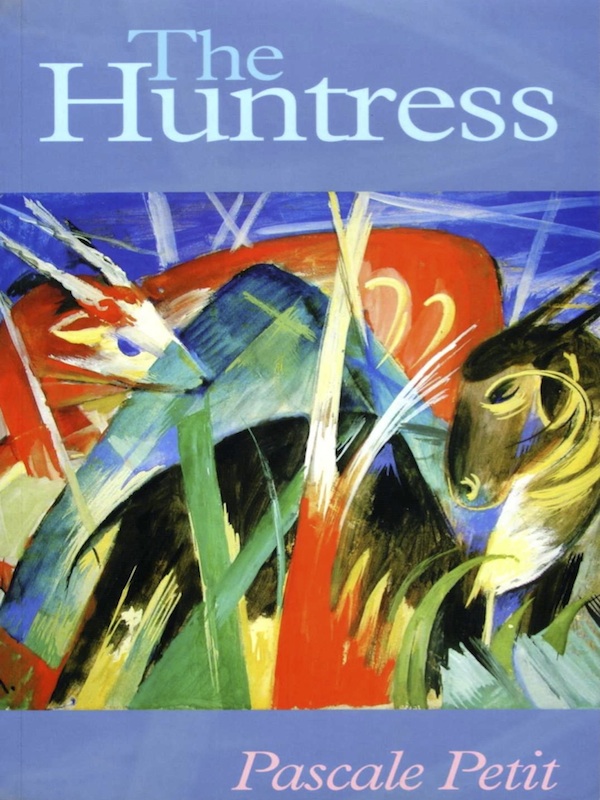
This week’s poem comes from Pascale Petit’s third collection, The Huntress, published in 2005.

In Pascale Petit’s highly-charged third collection, a daughter is haunted by her mentally ill mother, and a painful childhood is re-imagined through a series of remarkable and passionate transformations. The feared mother is a rattlesnake, an Aztec goddess, a Tibetan singing bowl, a stalagmite, a praying mantis, a ghost orchid. These culminate in a long central poem where the daughter escapes her huntress as a cosmic stag. Underlying these poems is an intense mystical vision that lifts the dark material of the subject matter above the merely personal. 

The Snake House

It’s time to go up to your front door, Mother,
and ring the rattling buzzer of a bell,
the door with two curved fangs.
I go in, into the muscular throat of the hall,
down the tunnel that’s closing now
to a pinpoint of light.
I’m in the swallowing living-room,
washing it for you, half-alive,
like a man preparing for the rain-dance
in the dry arroyo. He reaches
into the pit and washes the snakes
so that later when he dances with the ‘little mothers’
in his mouth, they won’t bite.
I’m a child playing in the pen
with my pet rattlers,
giving them bread and milk.
As long as I’m unscared
they won’t strike. And you’re saying,
“Only a girl-child can do this”.
My cheeks are almost seamless now,
countless grafts hide the necrosis.

Order The Huntress from our website.

Posted on

Friday Poem – Requiem for a Requiem Shark

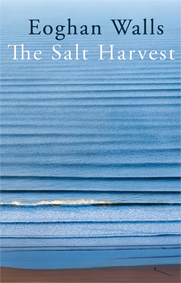
This week’s poem is from Eoghan Walls’ debut collection, The Salt Harvest, shortlisted for the 2012 DLR Strong Award.

Dark and evocative, these poems involve rich, multi-layered descriptions of the natural world, and cast a sardonic and tender eye on the human condition. All the climates of his native Ireland inspire both the muscular imagery and the complex forms of work such as ‘Star of the Sea’, ‘Cockles’ and the title poem; each line has been ‘packed with ore’. Also apparent is an ambivalent, often deeply ironic attitude towards a culture once steeped in religion, as in ‘Myrrh’ and ‘Confessions to the Southwest’. Threads of humour run throughout, an imaginative playfulness evident in ‘Martin Healey’s War on God and Ireland’, ‘Frog’ and ‘Star Matter’.

Requiem for a Requiem Shark

The necropsy left no doubt; this was a miracle of death.
Unpeeled from her womb lay the body of the christpup,

teeth crusting out its mouth, with a dorsel fin the breadth
of a thumbnail, tipped in black. The finprint of its makeup,

said Dr. Chapman, proved the non-existence of a father.
Angelsharks burrowed deeper into the ocean bottom.

There was no rising afterwards. Lights above the water
were only torches held by men from the aquarium.

Order The Salt Harvest from our website.

Posted on

Friday Poem – How I Abandoned My Body To His Keeping

The Art of Falling Kim Moore

This week’s poem is from Kim Moore’s debut collection, The Art of Falling, released earlier this year.

Kim Moore, in her lively debut poetry collection, The Art of Falling, sets out her stall in the opening poems, firmly in the North amongst ‘My People’: “who swear without knowing they are swearing… scaffolders and plasterers and shoemakers and carers…”. ‘A Psalm for the Scaffolders’ is a hymn for her father’s profession.

The title poem riffs on the many sorts of falling “so close to failing or to falter or to fill”. The poet’s voice is direct, rhythmic, compelling. These are poems that confront the reader, steeped in realism, they are not designed to soothe or beguile. They are not designed with careful overlays of irony and although frequently clever, they are not pretentious but vigorously alive and often quite funny. In the first section there is: a visit to a Hartley street spiritualist, a train trip from Barrow to Sheffield, a Tuesday at Wetherspoons.

The author’s experience as a peripatetic brass teacher sparks several poems. The lives of others also feature throughout, including a quietly devastating central sequence, ‘How I Abandoned My Body To His Keeping’: is the story of a woman embroiled in a relationship marked by coercion and violence. These are close-to-the-bone pieces, harrowing and exact.

The final section includes beautifully imagined character portraits of John Lennon and Wallace Hartley (the violinist on the Titanic), as well as Jazz trumpeter Chet Baker and the poet Shelley and other poems on: suffragettes, a tattoo inspired by Virginia Woolf’s A Room of One’s Own, and a poetic letter addressed to a ‘Dear Mr Gove’.

How I Abandoned My Body To His Keeping

What happened sits in my heart like a stone.
You told me I’d be writing about it
all my life, when I asked
how to stop saying these things to the moon.
I told you how writing it makes the dark
lift and then settle again like a flock of birds.

You said that thinking of the past like birds
who circle each year will make the stone
in my chest heavy, that the dark
that settles inside me will pass. You say it
is over, you say that even the moon
can’t know all of what happened, that to ask

to forget is to miss the point. I should ask
to remember. I should open myself to the birds
who sing for their lives. I should tell the moon
how his skin was like smoke, his hand a stone
that fell from a great height. It
was not what I deserved. The year was dark

because he was there and my eyes were dark
and I fell to not speaking. If I asked
him to leave he would smile. Nothing in it
was sacred. And I didn’t look up. The birds
could have fallen from the sky like stones
and I wouldn’t have noticed. The moon

was there that night in the snow. The moon
was waiting the day the dark
crept into my mouth and left me stone
silent, stone dumb, when all I could ask
was for him to stop, please stop. The birds
fled to the trees and stayed there. It

wasn’t their fault. It was nobody’s fault. It
happened because I was still. The moon
sung something he couldn’t hear. The bird
in my heart silent for a year in the dark.
This is the way it is now, asking
for nothing but to forget his name, a stone

that I carry. It cools in my mouth in the dark
and the moon sails on overhead. You ask
about birds, but all I can talk of is stones.

Order The Art of Falling from our website.

Posted on

Friday Poem – Sound Archive

Sound Archive

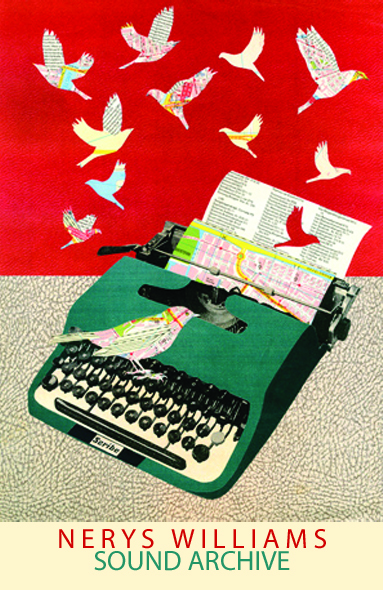
This week’s poem is from Nerys Williams’ debut collection, Sound Archive, which won the 2012 DLR Strong Award.

Sound Archive is the strikingly original first collection of poems from Nerys Williams. Using formal strategies similar to modernist painting: abstraction, dislocation, surrealist juxtaposition, the poet conjures a complex music, intriguing narratives, and poems full of atmosphere that query identity, gender, and the dream of art as a vehicle for emotion and meaning. There is a playful lightness of touch and tone and for every serious inquisition like ‘An Anatomy of Arguments’ or ‘Conversations with Cocteau’, there is a poem that will muse on ‘Canter’s Starstruck Diner, L.A.’ or on the ‘artifacts’ left by Marilyn Monroe, in ‘Marilyn’s Auction House’. Williams confronts our preconceptions about what it might mean to be a woman writing against the background of two formidable traditions: that of Welsh-speaking Wales and of English literature. A thoughtful, subtle and fascinating first collection.

Sound Archive
for Cliff Anderson

It takes patience this piecing
of noise in an archive for voices.

Chronicled on my silver-silicon
a focus of of gravity gone, scene unset.

Tempos in the unthreading
of flight beating.

Misremembered movement
the voice still says:

Do not package me
as an afterthought or a bulletin.

Though I have never been to Spain
I understand attachment theory
and have been told of thanatology.

Raise your glass to this last flourish
as I switch from Andante to Largo

I toast Dubrovnik, Elvis and Chopin
free the slaves of my imagination.

I will wear boaters in the rain
and fill one room with flowers.

I will raise hell in remaining chapels
never searching for injunctions nor pardons.

I will be the sage on the hill
filling in for memorial towers.

I will finish that string quartet
begun at twenty-five.

I will flirt with the ladies at the till
and get my groceries free.

I will smoke over the baby grand
turning to my right for a tumbler of gin.

I will mark a map of all colours felt
frame them into a continent.

There will be methods to my madness
which I will name kinetic imbalance.

On this day
thought is blown over the wall
over trees to the road,

jazzed up and jiving
a bouquet of spectral dandelions
for you to hold.

Order Sound Archive from our website.

Posted on

Friday Poem – About my Daughter

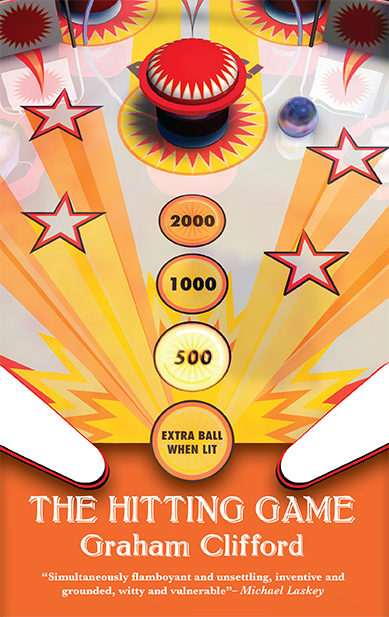
This week’s poem is from Graham Clifford’s debut collection, The Hitting Game, published in 2014.

The Hitting Game is the first collection of poems by the London-based poet Graham Clifford. The vibrancy of the poet’s voice and the immediacy of his claims  upon our attention are clear.

Characters first appear as ‘you’ in ‘Obvious Constellations’, ‘Amazing’ and ‘Trying’, as if we’ve arrived in the middle of a conversation. Incidents are approached from disarmingly intimate and also entertainingly oblique angles, as in ‘Shorn’. These are urban poems where nature appears like a strange intrusion: a flock of swallows ‘flick about dusk like black flames’. There is also a gentleness and empathy, particularly in regards to children, as in ‘About my Daughter’ where the word ‘echoes: ‘the er-ing sound of doubt/mixed with ought.’ There is humour and pathos as in the poem about a chimp and her keeper.

These are poems full of unexpected dramas and fresh enchantments, they provoke as well as delight.

About my Daughter

How right the word seems,
so drawn out,
the er?-ing sound of doubt
abutting ought.

I stand in the dark
taking heat from you
spasming to slip my grip
full of voodoo, my daughter
a little scarecrow stuffed with eels
curling and flipping to get away.

Used light from cars
queasily slides across the wall,
shards and slices identically rearrange
with such recurring precision –
this long trapezoid, that misty rhombus
locked into the same move as tomorrow,
then its tomorrow.
A deadlocked endgame.

Doubt: ought; her. Daughter.
At last loose in my arms,
I lay you as if broken
into sleep’s black mouth.

Order The Hitting Game from our website.

Posted on

Friday Poem – A Horse in the Dark

This week’s poem is from Meirion Jordan’s debut collection, Moonrise, published in 2008.

Finely held moods and moments resonate throughout this unusually accomplished first book. The rich, complex history of Wales often crops up in expected, as in the post industrial imagery of ‘A Camera at Senghenydd Pit’, and then, in often unexpected contexts: ‘The New World’ is a vision, a cross between ‘Under Milk Wood’ and an early J.G. Ballard novel, of post-global warming Wales, with a polyglot population: “Ronaldinho Davies/wowing the crowds at the Millennium Stadium” and swamped by tropical vegetation: “cobalt lizards and coral snakes/swallowing the cottages an Llandinam/ the mahoganies uprooting Carno’s hearths”.Another apocalyptic scenario prevails in ‘Pirate Music’ where a typical weekend in the binge-drinking culture unravels vividly as one of Dante’s circles of Hell.

Such inversions of myth are rife in this book. There is a freshness with which classical motifs echo in thoroughly modern contexts. A girl on a motorbike: “you fly your hair like a flag” is a glimpse of a goddess at speed. ‘The Head of an Athlete in an Ionian shipwreck’ is the past as ghost: “his smile as white as alum”. What starts as portraiture sometimes veers off in darkly mysterious incantatory digressions as in ‘The Magdalen College Chef’ whose “souffles bloom from a dipped fork./Upstairs his ragouts seethe under the grins of dons and demons”.

There are also clever, out and out satires like ‘The Nuclear Disaster Appreciation Society’ where “We love to watch/the palm trees beating in the thorium breeze…” and ‘Blockbuster Season’ where the protagonist is bizarrely ensared by the cliché plots and B-list actors of the cinema “Darth Vader using my Ford Fiesta to escape from Colditz…”. The plot twists and clever inversions available in these poems often recall science fiction writers like Philip K. Dick. Engaging, musically deft, an intelligence that wears its learning lightly, this is a sparkling debut from one of the most promising young poets Wales has seen in some time.

A Horse in the Dark

Quiet, quiet; do not dream
it is the owl parting fronds
of starlight, the water
muttering in abandoned mines.

It is the stillness falling
and pooling, drop
after drop

it is the clouds spooling past on wires.

Soon you will hear oaks
pushing their mouths to the soil’s tap,
the rushes drinking
far down the hill.

The lidless quartz blinks
at the snap of a twig’s shadow;

a nothing so breathless.
It champs at a giant sky.

Order Moonrise from our website.

Posted on

Friday Poem – South Shore House, Long Island

the man at the corner table rosie shepperd

This week’s poem is from Rosie Shepperd’s debut collection, The Man at the Corner Table.

The Man at the Corner Table crackles with the unexpected. The voice is one of urban sophistication; a merciless charm that teases and tempts us with sensual evocations of food and place. The reader is surprised with tastes, scents, colours and textures. There is a winning insistence on detail offered with an irony that blends into satire.

The poems adopt a deadly seriousness to the business of comedy.  In‘It isn’t just the under-floor heating that makes me lie down in the kitchen’, the poem explores the ineffable by sending it up in a domestic setting that subverts as it disconcerts.

The gorgeous place settings of these poems are not just carefully delineated backdrops. They toy with our interpretations of ‘at table’. As in a Dutch master ‘tablescape’, they become symbolic of our relation to ourselves, to others and the world.

These poems are exquisite meals, to be devoured amidst surprising intimacies, like the search for solace that is edging towards something more in ‘Balthazar Bakery, Spring Street, NY. Others explore troubling scenarios of grief and loss, such as the heartbreak in ‘You all have lied…’. Sometimes the poems appear like postcards from beautifully observed moments of exile, as in ‘Chorinho’ – where the author is hounded and haunted by unease. As in Elizabeth Bishop’s ‘Questions of Travel’ there is artfulness in this unease, and an obligation to close observation that resolutely refuses to moralize.

South Shore House, Long Island

Now the man who does the garden
has stopped gardening. Each Thursday he drifts
through the hothouse, composting silence.
His cash-in-hand drips home to Peru to feed
his sister and her children, Ana and round Amparo.
The youngest lives in an iron bed
on the longest, thinnest tubercular ward.
He will see them next year and waits without complaint,
sleeping his lunch hour in the coolness of the arbor
while the filthy cleaner flicks about your desk.
There’ll be ash under your chair and white musk
between the cushions. She checks empty
drawers and drops damp family secrets.
I pick them off and forget them.

The foxes are back tonight
savaging the trash, nosing the scent of bones.
Perhaps the ribcage of a roast.
Egg boxes, sticky with protein.
They find nothing, but I hear
their icy sex and cannot shake them.
One is injured; his eye reflects
a single bulb from the not quite busted light.
Rime hangs on his breath.
Lightly, he lifts a front leg. Up.
Slowly down. Up. I watch the dark space
between us, feel the fog
settle back. We are again separate.
I am not afraid of being alone.
I am alone because I am not afraid.

Order The Man at the Corner Table from our website.

Posted on

Friday Poem – The woman in the sun, a letter

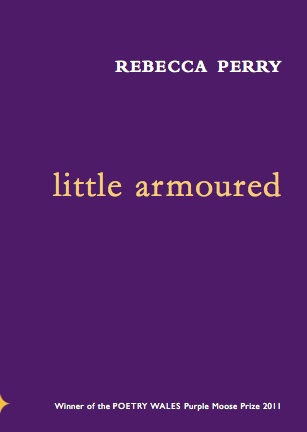
This week’s poem is from Rebecca Perry’s collection little armoured, winner of the 2011 Poetry Wales Purple Moose Prize.

little armoured is a brilliant book, which emits light and heat like the electric heater one of its poems describes as

a humming like a bee in the corner
of the room, its orangeness
brighter than your eyes expect.

Its miniatures and transforming images sometimes recall Elizabeth Bishop, its tonally various sequences Paul Muldoon, but this is a young poet who already discovered her own voice in these exact and tender, smart and moving poems.“

– John McAuliffe

The woman in the sun, a letter

I want my feet to tingle with cold again.
I want to be cold with you.
I want you to put your hands between my thighs in bed,
and I would clench them tight for you,
like daisies in a flower press.
I want to press my nipples onto your shoulder blades,
and leave tiny licks of saliva on your back, cold as skis.

I am full of tears.
All day they roll out of my eyes
and fizz to nothing by my feet.
They splash my breasts and for a second it is dark there,
then no. I am dry. I am a pillar of salt.

My body is warmed from the inside out.
My stomach is molten inside my body,
my lungs bubble from the heat of it,
my heart in your hand would be like
taking a potato straight from the oven,
my bones are the wood of a campfire,
my skin is bed sheets slept in for a day and night.

Order little armoured from our website.