Posted on

Friday Poem — Making Love

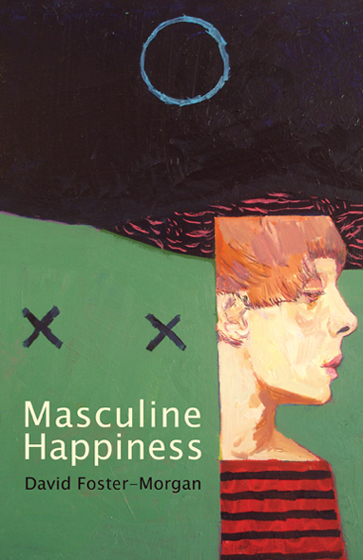
Masculine happiness

This week’s poem is from Cardiff-based David Foster-Morgan’s provocative debut, Masculine Happiness. The collection is half price until midnight, Sunday 10th January. You can find the book here.

Born and based in Wales, Foster-Morgan has long been a presence in the poetry world, having had poems published widely in magazines and with appearances at workshops, festivals, and events including ‘slams’ where his quiet style and obvious integrity frequently beat louder and less subtle voices to a prize. His debut collection, some years in the making, is inspired in part by his reading of American literature: the conversational tone of Frank O’Hara (‘F’OH’) and the long-lined garrulity of Allen Ginsberg, (‘Allen Ginsberg returns to Llantony Priory’) as well as the models of masculinity handed out to us by Hollywood characters like John Wayne (‘Masculine Happiness’). His ambivalence toward the idea of the ‘hero’ and his observation of the fate of those who have been lauded, like the conflicted protagonist of ‘The City Legend’, is a fruitful area for exposition.

Making Love

I think that we were meant to…
Is it treat as if we were nations
or better meet as friends.
To have no buts
and simply wait ’til fate instructs.
Fate though never interrupts.
Oh: sighs, eyes, easy, thighs.

Oh: find, kind, miss, bliss.

In exquisite orbit on your…
Is it rim
or better promise held within.
Both pleasure and pain
in equal measure, at once the same.
With no words the meaning plain.
Oh: insane, flame, be, flee.

Oh: quest, rest, crux, stuck.

You are…
Is it everything I lack
or better welcome heart and hurry back.
Your soft magnetic air sublime,
wraps me in an ecstasy so kind.
That is I like your style.
Oh: start, apart, qualm, charm.

Oh: light, flight, sun, undone.

I fear you sense my…
Is it following cloud
or better stubborn doubt.
It is a flinching habit to say no
and pinch new love before it can grow.
Give no the elbow.
Oh: aloud, shroud, spite, blight.

Oh: cruel, duel, bequeathed, heed.

Banish fear with…
Is it yes
nothing better than yes.
Defeat strange love with a yes,
fate and doubt distress with a yes.
I would really like you to say yes.
Oh: finesse, mistress, conquest, bless.

Oh: fair, dare, rare, flare.

I watch your hair…
Is it coil like a snake
or better hang at your nape.
High on oblivion’s plain,
a wordless freedom we will claim.
Enjoy the moment, don’t explain.
Oh: arms, charms, find, unconfined
Oh: sublime, entwine, sun, outdone.
Oh: me, thee, we.

Masculine_happiness_72dpirgb
Order David Foster-Morgan’s Masculine Happiness from our website (half-price until midnight, Sunday 10th January).
Posted on

Friday Poem – The Red Aeroplane

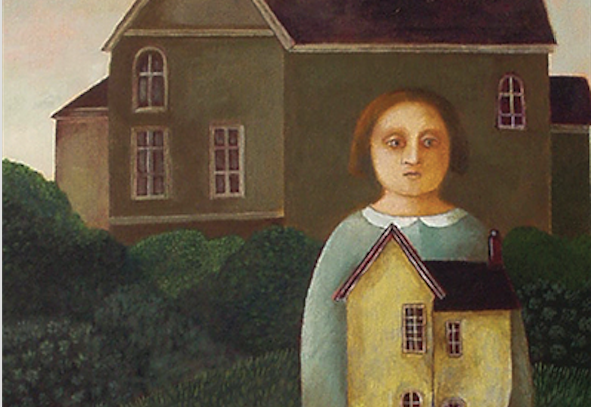
house of small absences

Our first Friday Poem of 2016 is from Anne-Marie Fyfe’s new collection, House of Small Absences. We hope you enjoy it, and happy New Year!

Anne-Marie Fyfe’s poems have long dwelt on the role that the spaces we inhabit, the places in which we find security, play in our lives: House of Small Absences is an observation window into strange, unsettling spaces—a deserted stage-set, our own personalised ‘museum’, a Piedmont albergo, underground cities, Midtown roof-gardens, convent orchards, houseboats, a foldaway circus, a Romanian sleeper-carriage—the familiar rendered uncanny through the distorting lenses of distance and life’s exigencies, its inevitable lettings-go…

The book opens with ‘The Red Aeroplane’ where witnessing an apparent plane crash sparks a vertiginous sequence of image and memory. We will follow the author in exploring not just specific places and memories but the ‘exponential function of tangents’, all that is implied and suggested.

The Red Aeroplane

From the oratory window I witness
mid-air doom, a slew of concentric
swirls, a trail of forge-sparks,
and that’s it. A vermilion two-seater
stagger-wing loops earthbound,
so much depending upon centrifugal
drive. Slivers of toughened glass
spangle the outer stone sill,
the vacant co-pilot seat
is plummeted deep in rosebed mulch.

I question now if the red bi-plane
ever was, the way sureties tilt
and untangle from any one freezeframe
to its sequel. Maybe I was glimpsing
that two-seater red pedal car
– injection-moulded plastic –
collected one Christmas Eve night
for a fevered child? Or conflating
the replica cherry-red sixty-three
we’d toyed with, tinkered with, briefly
on a tinsmith’s covered stall
that drenched Saturday?
What can’t be
cast in any doubt is the wreckage,
a fragmentary scattering,
the mangledness on the far side
of glass. And how a Galway blue
skyscape proves ineluctably
the exponential function of tangents.

Order Anne-Marie Fyfe’s House of Small Absences from our website.

Posted on

Friday Poem – In Hospital: Poona

This week’s poem is from Alun Lewis: Collected Poems, edited by Cary Archard, to celebrate Lewis’s centenary earlier this week. Lewis was one of the most compelling writers of the Second World War, whose premature death in 1944 – when he was only 28 – was a grave loss to Britain’s literature community.

For more information about Lewis, check out his website and find out everything you need to know about the continuing centenary celebrations on Twitter.

In Hospital: Poona

Last night I did not fight for sleep
But lay awake from midnight while the world
Turned its slow features to the moving deep
Of darkness, till I knew that you were furled,

Beloved, in the same dark watch as I.
And sixty degrees of longitude beside
Vanished as though a swan in ecstasy
Had spanned the distance from your sleeping side.

And like to swan or moon the whole of Wales
Glided within the parish of my care:
I saw the green tide leap on Cardigan,
Your red yacht riding like a legend there,
And the great mountains, Dafydd and Llewelyn,
Plynlimmon, Cader Idris and Eryri
Threshing the darkness back from head and fin,
And also the small nameless mining valley

Whose slopes are scratched with streets and
sprawling graves
Dark in the lap of firwoods and great boulders
Where you lay waiting, listening to the waves-
My hot hands touched your white despondent shoulders

– And then ten thousand miles of daylight grew
Between us, and I heard the wild daws crake
In India’s starving throat; whereat I knew
That Time upon the heart can break
But love survives the venom of the snake.

Order Alun Lewis: Collected Poems from our website.

Posted on

Friday Poem – The Love Songs of Davy Blackrock

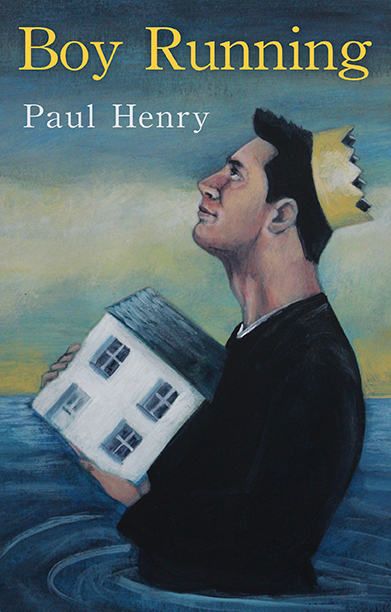
Boy Running, Paul Henry

Today’s poem is from Paul Henry’s latest collection, Boy Running, published last month.

Paul Henry has gained a reputation as one of of the best poets in the UK. Boy Running is his beautiful sixth collection and the first to follow ‘The Brittle Sea: New and Selected Poems’. We begin in a ‘Studio Flat’. Cut adrift by marital break-up, the poet must sort through the emotional fallout and the various ‘chattels’ left behind; a sea of characteristic props: tables, lamps, metronomes, pianos, guitars. The poet’s sons are at the heart of this section where pathos is balanced by humour amidst the characters of a small country town.

A second section moves to the Welsh coastal town of Henry’s childhood, Aberystywth, opening with a long poem, ‘Kicking the Stone’ set in the summer of 1969. Also in this section are some familiar characters from earlier poems such as Brown Helen and Catrin Sands.

In the final sequence we meet ‘Davy Blackrock’: washed-up songwriter and modern day alter ego of Dafydd y Garreg Wen (David of the White Rock), alias David Owen (1720-1749), the blind, 18th century harpist and composer who fell asleep on a hill and dreamt the famous song which bears his name. In contrast to David of the White Rock, Davy Blackrock, ‘star of an ashen town’, drags his guitar from street to hotel to bedsit, an unsettled ghost who dreams of the perfect song.

The Love Songs of Davy Blackrock

  “The songs I had are withered
   Or vanished clean,
   Yet there are bright tracks
   Where I have been,”

                         Ivor Gurney – ‘The Songs I Had’

Few remembered them
but by the end
it was enough
that they’d brought love,
some good friends.
What was ambition
after all but the drum
of rain on a glass room,
a distraction from the moon?

He’d sit late for hours, Davy
in those final days,
inventing new chords
in his conservatory,
oblivious to the news,
worrying less about words
than the melody,
trusting his ear,
not counting the bars

and, between downpours
keeping one eye on the stars.

Paul will be launching Boy Running on 27th March at the bear in Crickhowell. Find out more or book tickets here.

Order Boy Running from our website.

Posted on

Friday Poem – A Birthmother’s Catechism

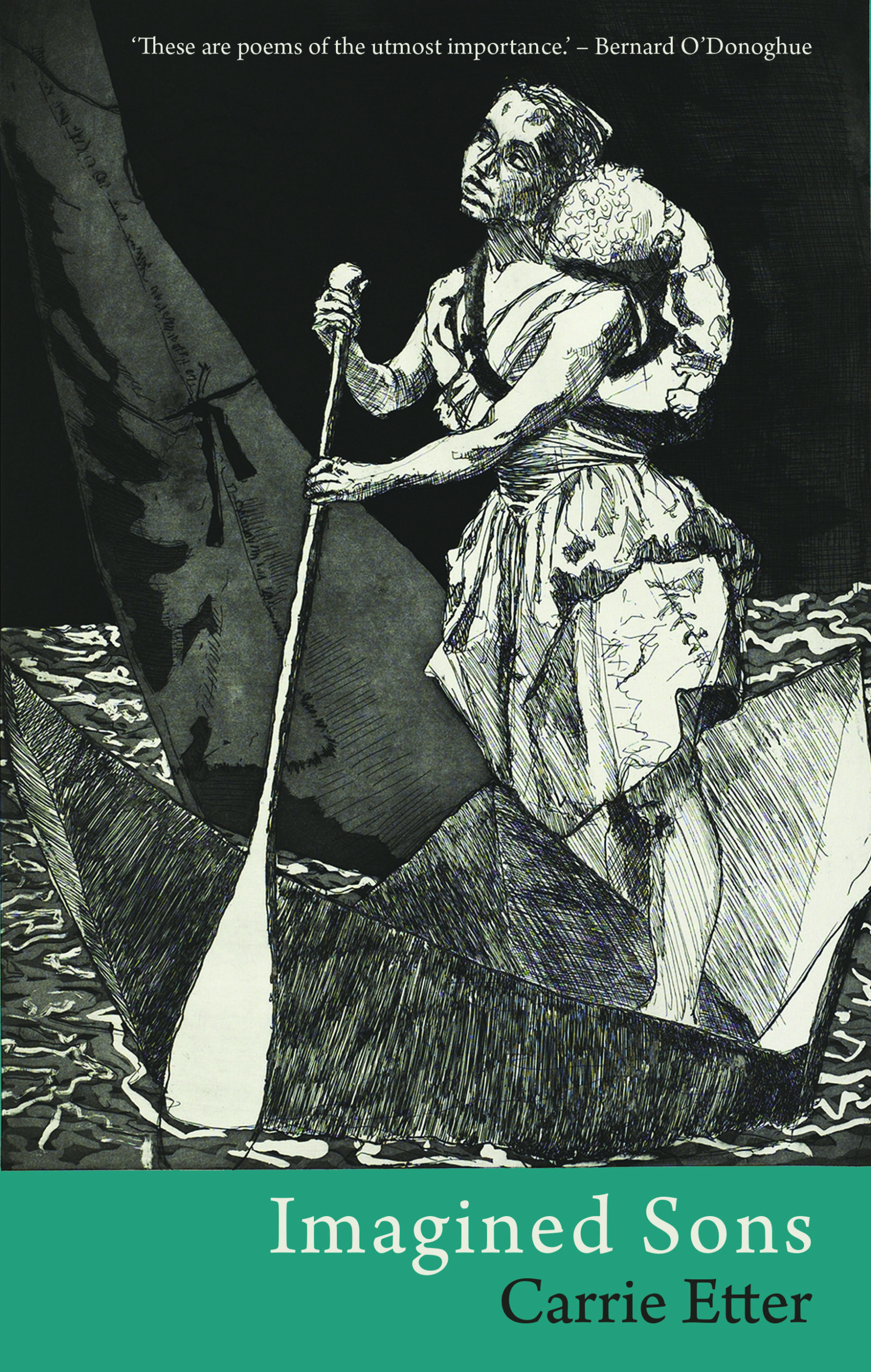
This week’s poem is from Carrie Etter’s Imagined Sons, first published in 2014, which has been shortlisted for the 2014 Ted Hughes Award for New Work in Poetry.

In Imagined Sons  Carrie Etter has written a book of vivid, heartbreaking poems on the experience of giving up a child for adoption. A prize-winning author, lecturer, critic and popular blogger, Etter imagines the possible destinies for the child and presents us with various scenarios from the tragic to the absurd. That the child’s birthday is also Sept. 11th adds a layer of irony and pathos, ‘What is the anniversary of loss?’ – asks the narrator in one of the ‘Birthmother’s Catechism’ poems. A pamphlet containing some of these poems was a Poetry Book Society Choice.

A Birthmother’s Catechism

How did you let him go?

With black ink and legalese

How did you let him go?

It’d be another year before I could vote

How did you let him go?

With altruism, tears, and self-loathing

How did you let him go?

A nurse brought pills for drying up breast milk

How did you let him go?

Who hangs a birdhouse from a sapling?

Order a copy of Imagined Sons from our website.

Posted on

An Interview with Damian Walford Davies

Today we’re chatting to poet Damian Walford Davies about his latest collection, Judas, which you can pre-order from our website here.

Damian is a poet, writer and librettist. He is the author of three Seren collections – Suit of Lights (2009), Witch (2012) and Judas (2015), together with the pamphlet Alabaster Girls (Rack Press, 2015) and the co-written volume, Whiteout (Parthian, 2006). He is Head of the School of English, Communication & Philosophy at Cardiff University, where he specialises in Romanticism, the two literatures of Wales, and Creative Writing.

Had you always wanted to write about Judas, whether it was Judas the man or Judas the metaphor, or did the poems in this collection quietly creep up on you?

Judas creeps up on you, certainly. I’ve always found him (or ‘it’ – Judas is a phenomenon, a problem, a crux (‘cross’), a paradox, a sore point) compelling. (The same with Lazarus, by the way, but that’s another, if related, story . . .) He is contradictorily represented in the canonical gospels, and that’s before we come to the second-century AD gnostic Gospel of Judas, where he is Christ’s confidant. There are a myriad of historical, theological, political and psychological arguments as to why Judas did what he did (if he did). To accept the historicity of Judas – which many scholars of first-century Palestine and early Christianity do not – means recognising him as an elusive figure. He is a no-man as well as a knot of contradictory representations, built up over twenty ideological centuries. (See Susan Gubar’s excellent 2009 biography of Judas.) This is the guy with the dark halo.

What is it you enjoy most about exploring history through poetry?

I like to write against big accepted narratives, intervene in them at personal, psychological levels, offer case studies of emotional quandaries, reveal terror on local, personal scales. I use the dramatic monologue for this, aiming for an imaginative inhabitation of voice and situation, aware at the same time that ventriloquising others has an ethics attached. This is Judas’s speaking platform, throughout. My previous Seren collection, Witch, did similar things, exploring how a witch is ‘made’ in the tense atmosphere of 1640s Suffolk. In Judas, I’m constantly negotiating suggestive gaps in the canonical gospel accounts. One has to be nuanced here, as well as bold. I made the decision from the outset to play with timescales, and so Judas is encountered during the week after the crucifixion, wandering through first-century Jerusalem one minute, but then clocking two women air kissing in the contemporary city’s Sheraton Hotel the next. Judas quotes Bob Dylan. Time is spliced; the Arab-Israeli conflict is as real to him as the Roman occupation. He is disturbed by a history that hasn’t yet happened. So I enjoy querying dogmatic versions of history, indulging in counterfactuals (which is more than a parlour game – it’s a way of changing the future). History always happens somewhere, and (like religion) is in many aspects terrifying. All this is not to say that the collection is iconoclastic, or without belief/faith, or blandly ‘materialist’. Quite the opposite. Multiple ironies mean that there are no final, fixed positions in this collection.

Throughout the collection you play around with many biblical images, such as the ‘thorns’ in ‘Annunciation 1’ and the ‘silver coins’ in ‘Denominations’. I imagine it would be difficult to write a poetry collection titled Judas without them! But did you ever worry about finding a new way to use imagery that has been around for centuries?

I saw it as an opportunity – to inflect, defamiliarise, and recontextualise these ‘core’ images. Judas is a collection in which all these images exist (I hope) in a complex, kinetic, shifting relationship. Did I worry about this? All the time. Poets must always be on edge, edgy. Poetry is about edgework. Judas is published at a time of political-religious crisis and horror. The collection is a reflection on fundamentalism, belief, faith, history, knowing, unknowing, violence, intolerance and human beings as agents and casualties of history. And (of course) beauty, friendship, love, worlds of spice.

You paint a very vivid picture of Jerusalem throughout the collection, picking out places like Yad Vashem in ‘In Vino’ and Ben Yehuda Street in ‘Siloam Pool’. Was giving your poems a specific setting important to you while writing the collection?

It was crucial. I was lucky enough to be able to visit Jerusalem in April 2012, and parts of the volume were written there in a hostel room under the muezzin’s recorded call to prayer and on the hostel’s roof, from which I could see the Al-Aqsa mosque to the east, the Church of the Holy Sepulchre to the west, and a sea of satellite dishes in between. And so the journeys that the shattered Judas takes through the old city are the ones I myself took through the narrow streets – full of managed but mangy colonies of cats – and souqs, around the Baths of Bethesda (a place of deep peace), down to the Garden of Gethsemane (from which I phoned my 93-year-old grandmother, who quite understandably asked ‘How big is it?’), back up to the ‘tufted wall’ of the Temple and through the four quarters of the divided (and machine-gun-patrolled) town. Judas is a map. Gethsemane, by the way, is tiny.

What, if anything, have you learned about Judas and the idea of evil through writing this collection?

He wants answers as much as we do. He’s still waiting.

Pre-order Judas from Seren’s website.

Posted on

Friday Poem – The Sound of a Diamond Planet

Short Days Log Shadows Sheenagh Pugh

The Sound of a Diamond Planet comes from Sheenagh Pugh’s collection Short Days, Long Shadows, published in 2014.

In this, her twelfth collection, noted poet Sheenagh Pugh steps into a new, northern landscape, the Shetland Islands, with poems steeped in the wilder weathers and views of rugged coastlines, sweeping sea-vistas and the hardy historical characters who have inhabited these lands. There is a lovely pared-down spareness, and elegiac formality to poems like ‘Travelling with Ashes’, ‘Staying’, and ‘Trondheim: January’ where the inhabitants appear lost in a ‘strange pink daylight’, and in ‘Gardening’ where ‘White stones are shaped like hearts’. The author’s characteristic dry humour emerges elsewhere as in ‘Extremeophiles’, a paean to bacteria – ‘chancers’ who live without sun. A poet who considers ‘too accessible’ to be the best sort of compliment, Sheenagh Pugh’s work has as much to offer the general reader as it does the specialist, who will admire her artful use of traditional forms.

Sheenagh will be reading at the Stanza Festival on the 5th March. For more information check out our website!

The Sound of a Diamond Planet

I seem to be surrounded
by things not quite there,

like the fieldmice munching
unseen inside my walls,

the spit of sand
uncovered at low tide,

the slick rock waiting to be
a waterfall again.

A planet, they say,
made all of diamond

resonates in its orbit,
light years beyond

human hearing, its brittle sound
broadcast in space.

Order Short Days, Long Shadows from Seren’s website.

Posted on

Forthcoming Title: ‘Writing King Kong’

To be released on 20th June 2011.

Writing King Kong explores the way we write the world, and reinvent it both for our own development and delusion. From an elliptical self-help manual to a telephone party line where we become ‘an accidental spy’ on another life, from the ambivalent comfort of a drunken night singing hymns to the elusive proximity of family trees, the recipe for summer pudding as elegy for a lost friend or a mantra of engineering facts (‘six million hand-driven rivets’) about Sydney Harbour Bridge to comfort a dying father.  Along with King Kong, Anton Chekhov, Marilyn Monroe and Shakespeare’s comic lovers, the likes of Gershwin, Robinson Crusoe, Ulysses, Fred and Ginger also find their way into this eclectic, multi-voiced collection.  At the heart of the book is a sequence of poems inspired by the writer’s travels in South America, conjuring both the exactitude of place and the strange unreality of journeying.

“His poems can remind us how complex a business it is to recall and rebuild a world, and how the act of doing so comes bundled with its own sense of loss” – Paul Farley, Poery London

Posted on

Join Our Online Book Club

Join our Online Book Club to get 20% off every book you buy from us.

It takes seconds to sign up to the Seren online book club – you will enjoy 20% off every puchase made.

You will be kept up-to-date with forthcoming titles, news and events. Be the first to know when a new title has just been released, see exclusive videos of Seren authors reading from their books and enjoy special offers which are available to our online Book Club Members only.

We want to contact people interested in Seren, its list, authors, events and news. And even the multinational publishers can’t rely on the usual media for this information so we want to open our own channel of communication.

Members help us understand our readers (ensuring we can continue to publish the books you enjoy), and help us make a better website. We know readers of Seren titles will be literate, informed and interested in a variety of styles and subjects. Our ambition is to make this site a prime port of call for all those interested in the goings-on in the (independent) publishing sector and beyond. We need feedback from visitors and recognise the value of their comments as a resource to make the site relevant and attractive.

We hope you’ll enjoy your membership, remember to log in as a member as soon as you enter the site

Click the link below to edit your account and sign up to become a full member of the Seren Book Club.

Sign up to the Book Club now!

Posted on

‘The Ivy Hides the Fig-ripe Duchess’

Seren is pleased to announce the newest poetry collection by Welsh writer Ellie Evans is released on 13th June 2011, head to the Seren website to get your copy today!

The Ivy Hides the Fig-ripe Duchess is an exhilarating first collection of poems from Ellie Evans. Using a surrealist palette of imagery and a tightly focused idiom, the author takes us on strange journeys:to the post-apocalyptic world of the title poem, or into a skewed 18th century Venice in ‘The Zograscope’. These strange worlds are always to the purpose, they are, as Marianne Moore famously said of poetry ‘imaginary gardens with real toads in them.’ We obliquely unearth childhood trauma, fraught or intense relationships and also a singular (and perhaps also Welsh?) delight in rebellion, and in escape through the imagination. Poems like ‘Picnic with Earthquakes’ and ‘Jekyl Island, Georgia’ deftly align exotic locales (Eastern Europe, South East Asia, Greece and the USA,) with intimate states of mind. A fascination with art and history emerge in: ‘A Brief History of Topiary’ and ‘Two Monologues from The Odyssey’. There is also a palpable delight in technique: you will find a sonnet, a villanelle, triolets and a concise free verse where she employs rhyme, half-rhyme, and subtle alliteration.

Seren will keep you posted on reviews and comments on Evans’s poetry collection.

To find out more about Seren and Ellie Evans search our blog or go to our website http://www.serenbooks.com/