Posted on

Friday Poem – ‘Case History’ by Dannie Abse

Black and white photo of a stethoscope laying beside a pile of old books.

This week’s Friday Poem is ‘Case History’ by Dannie Abse from his collection Welsh Retrospective. Friday 22nd September marks Abse’s centenary. Join us at Carnegie House in Bridgend for a special event celebrating his life and work.

Case History
‘Most Welshmen are worthless,
an inferior breed, doctor.’
He did not know I was Welsh.
Then he praised the architects
of the German death-camps –
did not know I was a Jew.
He called liberals, ‘White blacks’,
and continued to invent curses.
When I palpated his liver
I felt the soft liver of Goering;
when I lifted my stethoscope
I heard the heartbeats of Himmler;
when I read his encephalograph
I thought, ‘Sieg heil, mein Führer.’
In the clinic’s dispensary
red berry of black bryony,
cowbane, deadly nightshade, deathcap.
Yet I prescribed for him
as if he were my brother.
Later that night I must have slept
on my arm: momentarily
my right hand lost its cunning.
Dannie Abse Remembered: Centenary Celebration. From 7pm Friday 22nd September 2023. Carnegie House, 14 Wnydham Street, Bridgend, CF31 1EF. £5.50 general admission. £3.50 concessions.
Posted on

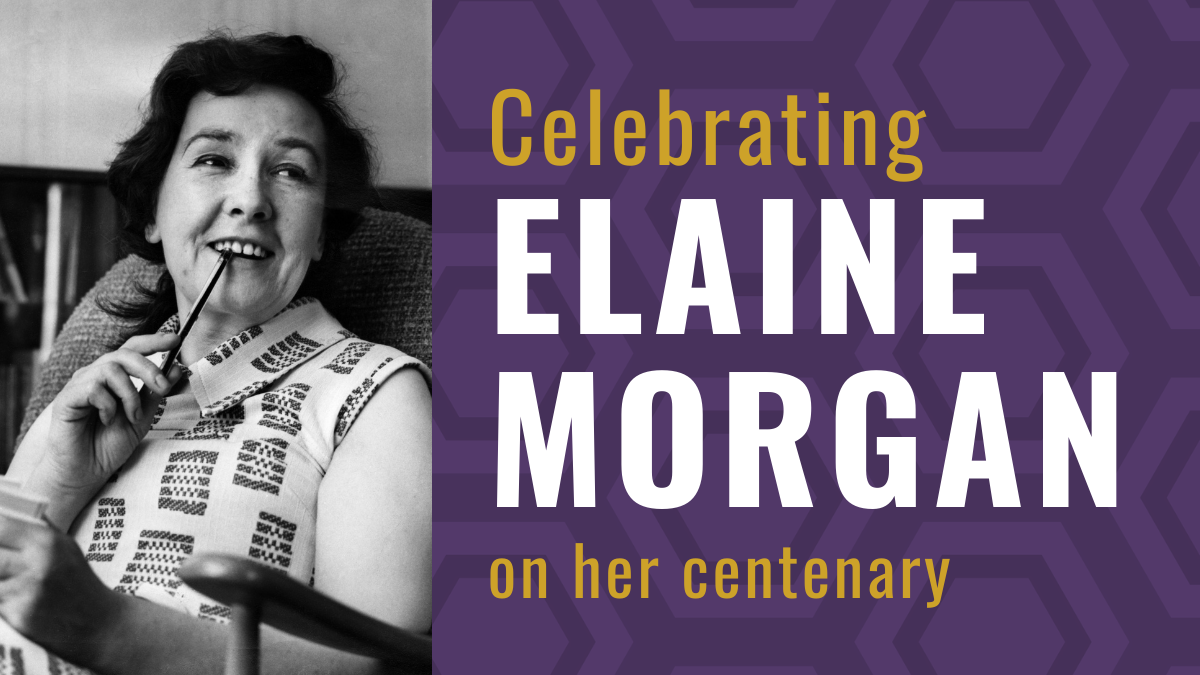
Celebrating Elaine Morgan on her centenary

Elaine Morgan (1920 – 2013) was a pioneer. Born into a working-class family, she was the first person from her school in Pontypridd to go to Oxford University. She went on to pursue multiple careers, first as an award-winning TV writer, then anthropologist, whilst maintaining a role in political activism throughout her life. Daryl Leeworthy, author of Elaine Morgan: A Life Behind the Screen, introduces us to this extraordinary writer on the eve of her centenary.

This informative biography restores Elaine Morgan’s reputation and establishes her significant place in writing from Wales. Richly detailed it is essential in understanding the life and work of this important writer.

“A scintillating new biographical study, impressively researched and elegantly written.” – Dai Smith

“Thanks to this book… many more can take inspiration from Elaine Morgan and a legacy that spans both arts and science. In this, her centenary year, there can be no more fitting tribute.” – Carolyn Hitt

Elaine Morgan has always been a hero of mine.

I suppose I first heard her name when I was in secondary school – we went to the same one. To me it was Coedylan Comprehensive, to her Pontypridd Intermediate School for Girls; these days Pontypridd High. One of my teachers, whose own life had been so influenced by Elaine’s iconic feminist book, Descent of Woman (1972), pointed out to me that being someone from ‘our town’ studying at Oxford not only brings great opportunities but also sets you on a path set down by one of Wales’s truly great writers. A national treasure.

Elaine Morgan at matriculation, autumn 1939 – front row, second from left.
By Kind Permission of The Principal and Fellows of Lady Margaret Hall, Oxford.

That idea of Elaine has stuck with me over the years. When I set out to research Elaine Morgan: A Life Behind The Screen, I knew that I wanted to look more carefully at her screenwriting and her contribution to our collective sense of the valleys and their people – those aspects of her career now very much overshadowed by the aquatic ape theory and Elaine’s undoubted contributions to popular anthropology. How, I wondered, did Elaine get her break at the BBC; how did she fit into an overwhelmingly masculine world; and how did she reach the top all from a desk in South Wales – a feat that seems so impossible nowadays.

Seeking the answers to those questions took me to the BBC’s written archives near Reading, a marvellous building with truly wonderful staff, where you half expect George Smiley to wander through the corridors. Out of Elaine’s voluminous files came letters sent back and forth to producers like Donald Wilson, Michael Barry, Sydney Newman, and Verity Lambert. The Doctor Who fan in me got very excited when I saw their names! Writers such as Gwyn Thomas and Dennis Potter were mentioned with casual ease. And there were occasional tête-a-tête when Elaine felt she was being undervalued – and underpaid – because she was a woman. The writer who emerged from those files was strong-willed, determined, and keen to learn. She was every bit the feminist my teachers had told me about.

The greatest finds in those files related to Elaine’s debut serial – now lost from the television archives – A Matter of Degree. First broadcast on the BBC in 1960, it told the story of the Powell sisters, and their experiences of South Wales and Oxford. Like the producers who brought it to the screen, I could not help but read an autobiographical presentation of Elaine’s life. She had always maintained that she loved Oxford, but here was the clash of cultures so familiar to me and to many others who have gone up from the valleys to those dreaming spires. Here was a kind of sequel to Emlyn Williams’s famous play The Corn Is Green (1938) but which anticipated the famous television serials of Oxbridge life, Brideshead Revisited (1981) and Porterhouse Blue (1987), decades before they were aired. This was Elaine Morgan, then, the television pioneer.

There was, I discovered, another side to Elaine, too – her politics. She grew up in a household which read the Labour-supporting Daily Herald and her own political activity took her to the pinnacle of student activism whilst she was at Oxford and into circles which included Clement Attlee and Roy Jenkins. Then she worked for the Workers’ Educational Association, just like Gwyn Thomas and Raymond Williams. As a young mother, she kept up her public activism and at one point taught for the Extra Mural Department of Manchester University. She helped to set up the United Nations Association in Burnley and led the town’s first celebrations of International Women’s Day. She even joined the Communist Party, although later returned to the Labour fold. Her radicalism had its fullest expression in a passionate belief in nuclear disarmament, in combatting climate change and humanity’s exhaustion of the planet’s natural resources, and in the campaign to ensure the survival and vibrant future of the Welsh language.

But, of course, if we are to remember one thing about Elaine Morgan on this, her centenary, it is her contribution to the women’s movement and to the self-belief that all women, regardless of their origins, can reach the top. Though she is not traditionally remembered as a historian, her television work, her radio broadcasting, her teaching, and her activism, all contributed to the active recovery of women’s collective, historical experience. In those decades of the twentieth century when Welsh women were absent from parliament, from leadership roles, from the apex of public life, Elaine Morgan stood out. She understood this and made the most of her remarkable influence.

In many respects, Elaine Morgan was the embodiment of what I like to think of as the ‘South Walian Dream’. She took the opportunities afforded her by an education which lasted for as long as she wished, but never forgot her origins. Never lost sight of the fact that she had grown up in a small terraced house in Hopkinstown. Never lost her ear for the rhythm of the valleys and their people. Alongside Gwyn Thomas, she helped to define what Wales meant for television and radio audiences all over the world. Whether as the pensioner, the playwright, the protester, the poet’s muse, or the student politician, Elaine Morgan was determined to say to her own community, to her own people, first and foremost, it does not have to be this way.

Daryl Leeworthy

Elaine Morgan: A Life Behind the Screen is available on the Seren website: £9.99

Join us for the virtual launch of this important new biography on Wednesday 11 November at 7pm. Author Daryl Leeworthy will be in conversation with Carolyn Hitt. Register for FREE via Eventbrite https://www.eventbrite.co.uk/e/125898462691.

Posted on

Friday Poem – In Hospital: Poona

This week’s poem is from Alun Lewis: Collected Poems, edited by Cary Archard, to celebrate Lewis’s centenary earlier this week. Lewis was one of the most compelling writers of the Second World War, whose premature death in 1944 – when he was only 28 – was a grave loss to Britain’s literature community.

For more information about Lewis, check out his website and find out everything you need to know about the continuing centenary celebrations on Twitter.

In Hospital: Poona

Last night I did not fight for sleep
But lay awake from midnight while the world
Turned its slow features to the moving deep
Of darkness, till I knew that you were furled,

Beloved, in the same dark watch as I.
And sixty degrees of longitude beside
Vanished as though a swan in ecstasy
Had spanned the distance from your sleeping side.

And like to swan or moon the whole of Wales
Glided within the parish of my care:
I saw the green tide leap on Cardigan,
Your red yacht riding like a legend there,
And the great mountains, Dafydd and Llewelyn,
Plynlimmon, Cader Idris and Eryri
Threshing the darkness back from head and fin,
And also the small nameless mining valley

Whose slopes are scratched with streets and
sprawling graves
Dark in the lap of firwoods and great boulders
Where you lay waiting, listening to the waves-
My hot hands touched your white despondent shoulders

– And then ten thousand miles of daylight grew
Between us, and I heard the wild daws crake
In India’s starving throat; whereat I knew
That Time upon the heart can break
But love survives the venom of the snake.

Order Alun Lewis: Collected Poems from our website.

Posted on

The Centenary of Alun Lewis

100 years ago today, the 1st July 1915, Alun Lewis was born. No one could have known then that he would grow into one of the most remarkable writers of the Second World War, nor that he would die under tragic circumstances at just 28 years old.

Though short, Lewis’s life was tumultuous; he was a talented academic, a gifted writer, a depressive personality, and a pacifist by nature who was faced with a war against fascism. And yet despite all that there aren’t many outside of Wales who’ve even heard his name.

At Seren, that’s something we’ve been trying to change this year.

So if you’d like to celebrate the centenary of this outstanding writer, come and join us in Aberdare today for a whole array of celebrations including the unveiling of a Royal Welsh Regiment blue plaque, re-dedications of the Lewis Bronze in Aberdare Library, an address by National Poet Gillian Clarke, and a reading of Lewis’s poetry by Brigadier Philip Napier as well as contributions from local schools.

Join us at 10:30am at Glynhafod Junior School from where the celebrations will begin, and help us to mark this occasion and remember one of the greatest writers Wales has ever produced.

Order Alun Lewis’s work from our website.