Posted on

Reading for Remembrance – Armistice Day 2021

Every year, we observe two minutes silence at 11am, on the 11th day of the 11th month to mark the moment The Armistice began in 1918. Today, as we once again take time to remember the sacrifices made by servicemen and women in the armed forces, we’re sharing some of the commemorative titles we’ve published during the last 40 years. Lest we forget.

Men Who Played The Game by Mike Rees

Men Who Played the Game

The Great War and the resulting unimaginable loss of life had a profound effect on servicemen and those at home, perhaps never more so than in the case of sportsmen, who fought ‘battles’ on the pitch or in the ring according to rules devised for fair play. Men Who Played the Game by historian Mike Rees explores the development and importance of sport in Britain and the Empire leading up to the outbreak of the First World War, and the part played by sportsmen in the conflict. The book opens with revealing chapters on how various sports – the fans, the governing bodies and the sportsmen themselves – reacted to the outbreak of war. This book is an invaluable guide to the relationship of sport and war, to the state of sporting Britain, and a moving testimony to the fate of so many sportsmen.

Robert Graves: War Poems edited by Charles Mundye

Robert Graves War Poems Charles Mundye

Robert Graves: War Poems draws together all of Robert Graves’s poems about the Great War. It consists of his first two major published volumes: Over the Brazier (1916) and Fairies and Fusiliers (1917) as well as the previously unpublished 1918 manuscript, ‘The Patchwork Flag’. Critical and contextual introductions by editor Charles Mundye provide biographical and historical context, locating and ranking Graves amongst the other soldier poets of the First World War: Sassoon, Owen, Thomas, Rosenberg et al. 

Alun, Gweno & Freda by John Pikoulis

Alun, Gweno & Freda by John Pikoulis

Alun Lewis (1915-1944) was the most prominent writer of World War Two, in poetry and short fiction.  He was born in the industrial valleys of south Wales and grew up during the deep poverty of the Depression. Set against this background and war, Alun, Gweno & Freda is an account of Lewis’s life and his writing, through the particular prism of his relationships with his wife, Gweno, and with Freda Aykroyd, an expatriate in India whose house provided respite for British officers on leave. The book argues that Lewis’s charged relationships with these two women were the key to both his writing and his mental health. It also explores the circumstances surrounding Lewis’ death by a single shot from his own gun and contributes to the ongoing debate about whether this was an accident or suicide.

And You, Helen by Deryn Rees-Jones and Charlotte Hodes

This specially commissioned collaboration between poet Deryn Rees-Jones and artist Charlotte Hodes explores the life of Helen Thomas, wife of the poet Edward Thomas who was killed at the battle of Arras in 1917. Rees-Jones’s sequence takes Thomas’s only poem addressed directly to his wife, ‘And you, Helen’ as its starting point, and imagines Helen after Edward’s death. Complemented by a meditative essay on the complexities of the relationship between the poet and his family, and on war, grief, marriage and bereavement more generally, this is a critical exploration through a personal lens.

Poet to Poet edited by Judy Kendall

This scholarly volume offers insight into the highly influential writer and poet Edward Thomas, through his correspondence with Walter de la Mare: 318 letters from between 1906 and 1917. Poet to Poet offers a moving epistolary account of the developing personal and poetic relationship of both poets, with biographical revelations, and increased understanding of their influence on each other and key points relating to their poetic processes.

Create your free Seren account and enjoy 20% off every book you buy from us.
Posted on

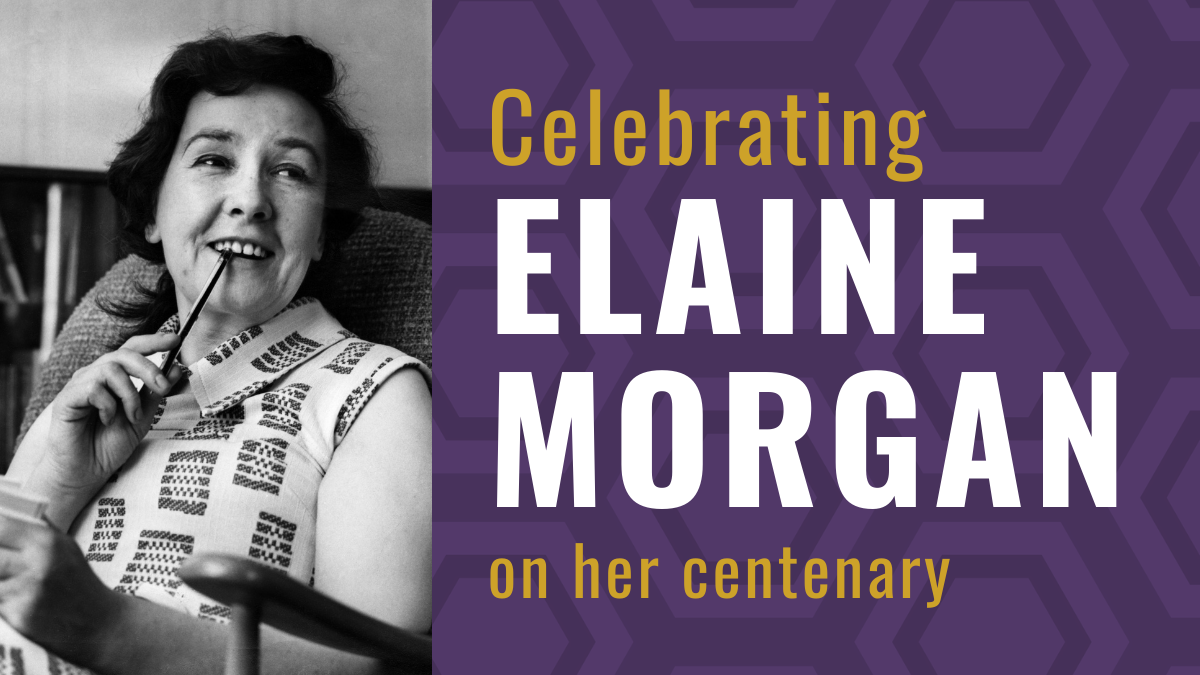
Celebrating Elaine Morgan on her centenary

Elaine Morgan (1920 – 2013) was a pioneer. Born into a working-class family, she was the first person from her school in Pontypridd to go to Oxford University. She went on to pursue multiple careers, first as an award-winning TV writer, then anthropologist, whilst maintaining a role in political activism throughout her life. Daryl Leeworthy, author of Elaine Morgan: A Life Behind the Screen, introduces us to this extraordinary writer on the eve of her centenary.

This informative biography restores Elaine Morgan’s reputation and establishes her significant place in writing from Wales. Richly detailed it is essential in understanding the life and work of this important writer.

“A scintillating new biographical study, impressively researched and elegantly written.” – Dai Smith

“Thanks to this book… many more can take inspiration from Elaine Morgan and a legacy that spans both arts and science. In this, her centenary year, there can be no more fitting tribute.” – Carolyn Hitt

Elaine Morgan has always been a hero of mine.

I suppose I first heard her name when I was in secondary school – we went to the same one. To me it was Coedylan Comprehensive, to her Pontypridd Intermediate School for Girls; these days Pontypridd High. One of my teachers, whose own life had been so influenced by Elaine’s iconic feminist book, Descent of Woman (1972), pointed out to me that being someone from ‘our town’ studying at Oxford not only brings great opportunities but also sets you on a path set down by one of Wales’s truly great writers. A national treasure.

Elaine Morgan at matriculation, autumn 1939 – front row, second from left.
By Kind Permission of The Principal and Fellows of Lady Margaret Hall, Oxford.

That idea of Elaine has stuck with me over the years. When I set out to research Elaine Morgan: A Life Behind The Screen, I knew that I wanted to look more carefully at her screenwriting and her contribution to our collective sense of the valleys and their people – those aspects of her career now very much overshadowed by the aquatic ape theory and Elaine’s undoubted contributions to popular anthropology. How, I wondered, did Elaine get her break at the BBC; how did she fit into an overwhelmingly masculine world; and how did she reach the top all from a desk in South Wales – a feat that seems so impossible nowadays.

Seeking the answers to those questions took me to the BBC’s written archives near Reading, a marvellous building with truly wonderful staff, where you half expect George Smiley to wander through the corridors. Out of Elaine’s voluminous files came letters sent back and forth to producers like Donald Wilson, Michael Barry, Sydney Newman, and Verity Lambert. The Doctor Who fan in me got very excited when I saw their names! Writers such as Gwyn Thomas and Dennis Potter were mentioned with casual ease. And there were occasional tête-a-tête when Elaine felt she was being undervalued – and underpaid – because she was a woman. The writer who emerged from those files was strong-willed, determined, and keen to learn. She was every bit the feminist my teachers had told me about.

The greatest finds in those files related to Elaine’s debut serial – now lost from the television archives – A Matter of Degree. First broadcast on the BBC in 1960, it told the story of the Powell sisters, and their experiences of South Wales and Oxford. Like the producers who brought it to the screen, I could not help but read an autobiographical presentation of Elaine’s life. She had always maintained that she loved Oxford, but here was the clash of cultures so familiar to me and to many others who have gone up from the valleys to those dreaming spires. Here was a kind of sequel to Emlyn Williams’s famous play The Corn Is Green (1938) but which anticipated the famous television serials of Oxbridge life, Brideshead Revisited (1981) and Porterhouse Blue (1987), decades before they were aired. This was Elaine Morgan, then, the television pioneer.

There was, I discovered, another side to Elaine, too – her politics. She grew up in a household which read the Labour-supporting Daily Herald and her own political activity took her to the pinnacle of student activism whilst she was at Oxford and into circles which included Clement Attlee and Roy Jenkins. Then she worked for the Workers’ Educational Association, just like Gwyn Thomas and Raymond Williams. As a young mother, she kept up her public activism and at one point taught for the Extra Mural Department of Manchester University. She helped to set up the United Nations Association in Burnley and led the town’s first celebrations of International Women’s Day. She even joined the Communist Party, although later returned to the Labour fold. Her radicalism had its fullest expression in a passionate belief in nuclear disarmament, in combatting climate change and humanity’s exhaustion of the planet’s natural resources, and in the campaign to ensure the survival and vibrant future of the Welsh language.

But, of course, if we are to remember one thing about Elaine Morgan on this, her centenary, it is her contribution to the women’s movement and to the self-belief that all women, regardless of their origins, can reach the top. Though she is not traditionally remembered as a historian, her television work, her radio broadcasting, her teaching, and her activism, all contributed to the active recovery of women’s collective, historical experience. In those decades of the twentieth century when Welsh women were absent from parliament, from leadership roles, from the apex of public life, Elaine Morgan stood out. She understood this and made the most of her remarkable influence.

In many respects, Elaine Morgan was the embodiment of what I like to think of as the ‘South Walian Dream’. She took the opportunities afforded her by an education which lasted for as long as she wished, but never forgot her origins. Never lost sight of the fact that she had grown up in a small terraced house in Hopkinstown. Never lost her ear for the rhythm of the valleys and their people. Alongside Gwyn Thomas, she helped to define what Wales meant for television and radio audiences all over the world. Whether as the pensioner, the playwright, the protester, the poet’s muse, or the student politician, Elaine Morgan was determined to say to her own community, to her own people, first and foremost, it does not have to be this way.

Daryl Leeworthy

Elaine Morgan: A Life Behind the Screen is available on the Seren website: £9.99

Join us for the virtual launch of this important new biography on Wednesday 11 November at 7pm. Author Daryl Leeworthy will be in conversation with Carolyn Hitt. Register for FREE via Eventbrite https://www.eventbrite.co.uk/e/125898462691.

Posted on

Legend of the Month: Gwyneth Lewis

Legend of the Month Gwyneth Lewis

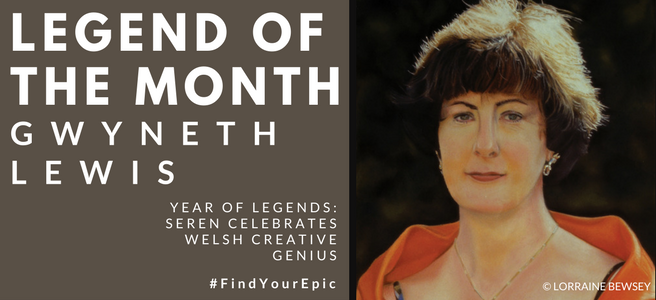
Each month we are celebrating one fantastic Seren author in honour of Wales’ Year of Legends. This month the spotlight has fallen on Wales’ first ever National Poet, Gwyneth Lewis, shown here in brilliant pastel by artist Lorraine Bewsey, from her series Poet Portraits.

Gwyneth Lewis has published nine books of poetry in Welsh and English, and wrote the six-foot-high words on the front of Cardiff’s iconic Wales Millennium Centre, rumoured to be the largest poem in the world.

Gwyneth is also an award-winning writer of non-fiction and screenplays. Gwyneth’s first non-fiction book, Sunbathing in the Rain: A Cheerful Book about Depression (2002) was shortlisted for the Mind Book of the Year, and her first television screenplay, Y Streic a Fi (‘The Strike and Me’), commissioned by S4C, won the 2015 BAFTA Wales for Best Drama. Gwyneth is also a writer of fiction: The Meat Tree, a space-age re-imagining of the tale of Blodeuwedd, is part of Seren’s New Stories from the Mabinogion series. Her light-hearted novella, Advantages of the Older Man, explores the strange case of a Swansea woman who is apparently possessed by the ghost of Dylan Thomas.

Gwyneth is a librettist and dramatist and has written two chamber operas for children and an oratorio, all commissioned and performed by Welsh National Opera. She is a Fellow of the Royal Society of Literature, a member of the Welsh Academi and a NESTA Fellow. In 2010 she was given a Society of Authors Cholmondeley Award recognizing a body of work and achievement of distinction.


Please enjoy this extract from The Meat Tree – a dangerous tale of desire, DNA, incest and flowers:

1

Technical Preparation

Synapse Log 28 Jan 2210, 09:00

Inspector of Wrecks
Is that working now, I wonder? I hate these thought recorders. They’re good in very confined spaces, where you don’t want to overhear the idiotic things your colleagues say to their families back on Mars, but I think they’re overrated. The trick is to keep the unconscious out of it as much as possible and pretend that you’re talking to yourself.
Now, I think it’s settling down. Right. Well, we’re just about approaching the Mars Outer Satellite Orbit. Not seeing too much debris around at the moment, they must have had a clean up fairly recently. Last time I was here, you could hardly move for junk. We’ve glimpsed the ship in the distance, and should arrive later this afternoon.
The new girl’s feeling sick but won’t admit it. She thinks I don’t know that she threw up in the heads, but you can’t hide any smells in a spacecraft. If Nona doesn’t stop vomiting, I’ll have to make her take the drugs. Her eyes are red alraedy, she’s dehydrated. I can’t have her out of action, we’re too close to the target vessel. Typical, getting lumbered with a student on my last mission.
Befrore anything starts happening, I’m going to get my expenses software set up…

Apprentice
So Campion’s telling me how he does his mileage first ‘and all else follows’ and I’m about to throw up all over him, but I manage to swallow it. Ironic. My whole life to get to Mars orbit, and now I’m here I feel too awful to take it in.
I did get to look out of a porthole as we passed close to home. Saw a dust storm in Thaumasia, thousands of miles wide. It looked like miso soup when you stir it up. Made me nauseous all over again. So I stopped looking. You wouldn’t believe how hard it is to catch floating vomit in a paper bag.
We’re not one day in and I’m already tired of hearing about the Department of Wrecks in the Good Old Days. When flotsam came in from as far as the Sculptor galaxy or the Microscopium Void. When he had a full team and they got to work on really interesting cultures. Not like this speck from God knows where, just me and him – the one man in the service who has absolutely no imagination.
Oh, I think he wants to do a quick equipment check.

Joint Thought Channel 28 Jan 2210, 09:02

Inspector of Wrecks
This is so that we can talk to each other on the vessel without disturbing any of the artifacts. Sometimes alien communication can be diffused by the human voice, so we’ll keep to Joint Thought mode until we know more about what’s going on.

Apprentice
You mean like a mind-meld? God! I didn’t mean to say that.

Inspector of Wrecks
The whole trick of this channel is to avoid personal static. Keep it professional.

Apprentice
Sorry. Of course.

Inspector of Wrecks
It’s a knack. Not a silent version of speaking out loud, but it’s a way of sharing two sets of sense impressions from slightly different angles. It doubles the amount of data we can record. But you’ll have to learn to make a very precise form of running commentary. It’s not your uncensored thoughts, but it’s not formal reporting either. Try doing it on me for a second.

Apprentice
He looks much taller than he did on Mars. And skinnier.

Inspector of Wrecks
That’s close, but you can do better. It’s a question of what’s appropriate. Give me some sensory data, because that’s often much more valuable than your opinions. We Won’t know what we’re seeing, but we need to record the effect its having on us. Try again.

Apprentice
The smell of his soap makes me sick to my stomach, I can’t get away from it.

Inspector of Wrecks
That’s much, much better. Relevant stuff. A little personal, perhaps, but that’s good. We’ll be getting all the objective data from the robots we send in before us.
Again.

Apprentice
His comb-over looks like the tendrils of a plant in zero gravity.

Inspector of Wrecks
That’s it, you’re getting it. And don’t worry, you can’t offend me. What I’m looking for is information. Record it, even if it doesn’t seem important at the time. I’m particularly interested in alien emotio-translation technology, we have a lot to learn in that area. This technique is going to be especially important if we have to go into Virtual Reality.

Apprentice
The sleep of leaves!

Inspector of Wrecks
All right! That’s it! That will do for now. Oh, and I’ll change the soap. Didn’t realise it was a problem. You should have said.


The Meat Tree is available from the Seren website: £7.99


Save

Save

Posted on

Top of the Non-Fiction: what to buy in the half price sale

Top of the Non Fiction Seren half price sale

There’s still time to take advantage of our big January sale – which ends midnight, Friday 13th (not such an unlucky day, after all!)
All our books are half price, and that includes a gloriously diverse range of non-fiction: everything from biography to art, history to criticism. Here we pick a few of our favourites.

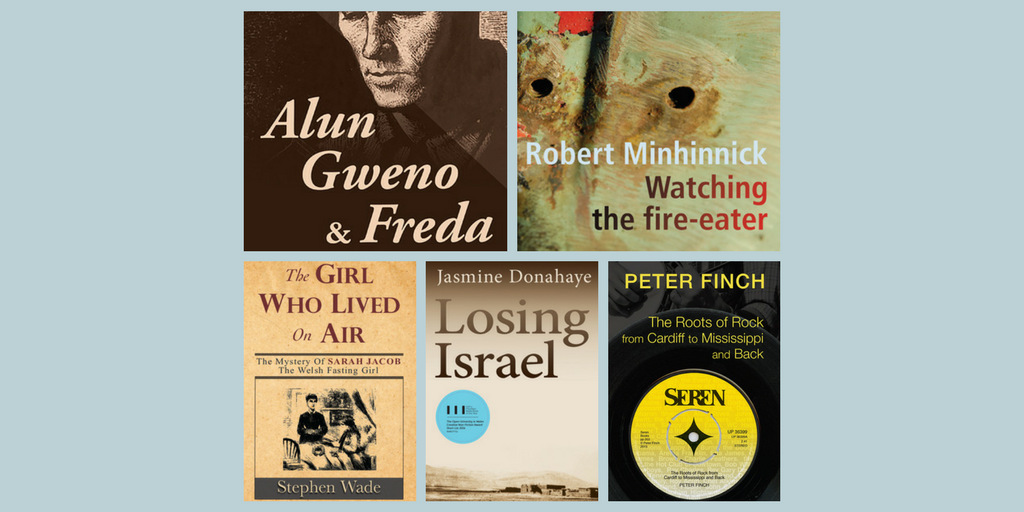
The Girl who Lived on Air by Stephen Wade examines the strange story of The Girl Who Lived on AirSarah Jacob, ‘the Welsh fasting girl’. Though not the first anorexic, she was arguably the first to cause a national furore, and was made to be the centre of a lucrative and also media-hungry ‘spin’ on the nineteenth century nexus of knowledge between science and superstition, folk-belief and religious asceticism. Stephen Wade covers new ground in examining the medical issues surrounding the case, the legal complexities, the prison life of Sarah’s parents, and the significance of folklore and superstition.
Alun Lewis biographer John Pikoulis covers new ground in Alun, Gweno & Alun, Gweno & Freda by John PikoulisFreda, which examines Lewis’ life and writing through the particular prism of his relationships with his wife, Gweno, and Freda Aykroyd, an ex-patriot in India whose house provided respite for British officers on leave. The book argues that Lewis’s charged relationships with these two women were the key to both his writing and his mental health, and goes on to explore the circumstances surrounding Lewis’ sudden death, and weigh into the ongoing debate over whether it was accidental, or suicide.
Losing Israel by Jasmine Donahaye is more than biography. This moving and honest losing_israelrgbwelsh-book-of-the-yearmemoir, which won the Wales Book of the Year, Non-Fiction Category (2016), recounts the author’s struggles with identity and history after she stumbles upon the collusion of her family in the displacement of Palestinians in 1948. Biography, travel writing and birdwatching are all weaved together in this fascinating re-evaluation of memory, family and cultural identity.
Robert Minhinnick’s Watching the Fire Eater, newly back in stock, takes us Watching the Fire Eater Robert Minhinnickfrom Copacabana to urban Yorkshire, from New Mexico to a Welsh funfair, from The Netherlands to the Clare coast. Minhinnick’s essays cover a variety of subjects – sunbathing, third world poverty, the demise of Margaret Thatcher, to name a few – but at the core this is a vivid series of attempts to strip away the exhausted mythologies of the writer’s own country and the increasingly-packaged places he visits.
The Roots of Rock, from Cardiff to Mississippi and Back is Peter Finch’s The Roots of Rock, from Cardiff to Mississippi and Backserenade to rock and popular music, and an infectiously nostalgic trip from the 1950s onwards that is guaranteed to enthrall music lovers. From an old valve radio playing in the Cardiff suburbs in the ’50s to live music today in America and beyond, Peter Finch tours countries and decades to illustrate how rock and pop has evolved, giving us sharp-eyed accounts of gigs from Champion Jack Dupree to the Garth Mountain Boys, visits to musical shrines and theme parks – Dollywood, Grand Ole Opry, Graceland, Stax – and music, lots and lots of music.


See our full Non-Fiction list on the Seren website, and hurry – sale ends midnight, Friday 13 January.

Save

Posted on

Seren Advent Calendar: 24 days of offers

Seren Advent Calendar 24 days of offers

Here’s a special Seren advent calendar– instead of chocolate, you’ll find 24 fantastic book offers to enjoy.

Each day in December we’ll reveal a different book, available half price for one day only. We’ll have a range of poetry, fiction, biography, art, photography and Welsh interest titles included, so there are sure to be surprises to delight everyone.

We’ll be updating this blog post every day with the latest offer, so keep your eyes peeled!

1st December: 50% off Wales’ Best One Hundred Churches
2nd December: 50% off Masque
3rd December: 50% off Leslie Norris: The Complete Poems
4th December: 50% off Star-Shot
5th December: 50% off Losing Israel
6th December: 50% off Significance
7th December: 50% off A Formula for Night: New and Selected Poems
8th December: 50% off Writing the Picture
9th December: 50% off The Immigration Handbook
10th December: 50% off American Sycamore
11th December: 50% off The Road to Zagora
12th December: 50% off House of Small Absences
13th December: 50% off Borderlands
14th December: 50% off Limestone Man
15th December: 50% off A Boat Called Annalise
16th December: 50% off The Harp in Wales
17th December: 50% off Morlais
18th December: 50% off Newspaper Taxis: Poetry After The Beatles
19th December: 50% off Men Who Played the Game
20th December: 50% off
Swimming on Dry Land
21st December: 50% off Playing House
22nd December: 50% off The Rivalry of Flowers

23rd December: 50% off the New Stories from the Mabinogion complete signed box setNew Stories from The Mabinogion box set
£100
   £50
In New Stories from the Mabinogion ten great authors have taken the Celtic myth cycle as a starting point to give us masterly re-workings with a modern twist in a series both various and wonderful. This box set contains all ten contemporary tales, signed by the authors – Owen Sheers, Gwyneth Lewis, Horatio Clare, Cynan Jones, Niall Griffiths, Russell Celyn Jones, Tishani Doshi, Fflur Dafydd, Lloyd Jones and Trezza Azzopardi.


Each offer ends at midnight on the specified day.


Save

Save

Save

Save

Save

Save

Save

Save

Save

Save

Save

Posted on

Barry Plummer (ed)

Barry Plummer is an independent researcher of Welsh art. He was awarded a doctorate in 2006 from the University of Wales for his thesis on the life and work of Evan Walters.He has a degree in Visual Art and studied the history of art as a post- graduate at the Courtauld Institute. Between 1999 and 2010 he lectured on Art History at Trinity College, Carmarthen, University of Wales, Swansea and Swansea Metropolitan University.

Books by Barry Plummer
Evan Walters: Moments of Vision

Posted on

Robert Seatter

After studying English at Oxford University, Robert Seatter worked variously as an EFL teacher in Italy and France, an actor, a journalist, in publishing and broadcasting. He lives in London where he now works for the BBC. His poetry has been widely published, has won numerous awards and has been featured on radio, television and London buses.

Books by Robert Seatter
On the Beach with Chet Bake

Travelling to the Fish Orchards

Writing King Kong


Posted on

Join Our Online Book Club

Join our Online Book Club to get 20% off every book you buy from us.
It takes seconds to sign up to the Seren online book club – you will enjoy 20% off every puchase made.

You will be kept up-to-date with forthcoming titles, news and events. Be the first to know when a new title has just been released, see exclusive videos of Seren authors reading from their books and enjoy special offers which are available to our online Book Club Members only.

We want to contact people interested in Seren, its list, authors, events and news. And even the multinational publishers can’t rely on the usual media for this information so we want to open our own channel of communication.

Members help us understand our readers (ensuring we can continue to publish the books you enjoy), and help us make a better website. We know readers of Seren titles will be literate, informed and interested in a variety of styles and subjects. Our ambition is to make this site a prime port of call for all those interested in the goings-on in the (independent) publishing sector and beyond. We need feedback from visitors and recognise the value of their comments as a resource to make the site relevant and attractive.

We hope you’ll enjoy your membership, remember to log in as a member as soon as you enter the site

Click the link below to edit your account and sign up to become a full member of the Seren Book Club.

Sign up to the Book Club now!

Posted on

Patrick McGuinness

Patrick McGuinness is a Professor of French and Comparative Literature at Oxford University and a Fellow of St Anne’s College where he has taught since 1998. He lives in North West Wales. His poetry is published by Carcanet and he has won an Eric Gregory Award, the American Poetry Foundations Levinson Prize in 2003 and the Poetry Business Prize in 2006. He frequently writes and presents for radio, eg “A Short History of Stupidity” and “The Art of Laziness” for R3 and Night Waves and Women’s Hour on poetry, French culture and his own work as a poet and translator. His translation of Mallarme’s For Anatole’s Tomb, 2004 was the Poetry Book Society’s Translation Choice. His other books include studies of theatre, French culture and literature. Patrick is a frequent contributor to TLS, and TLRB and reads and speaks at literary festivals in UK , US, Canada , France , Czech Republic , Austria and Italy .

Books by Patrick McGuinness
The Last Hundred Days