Posted on

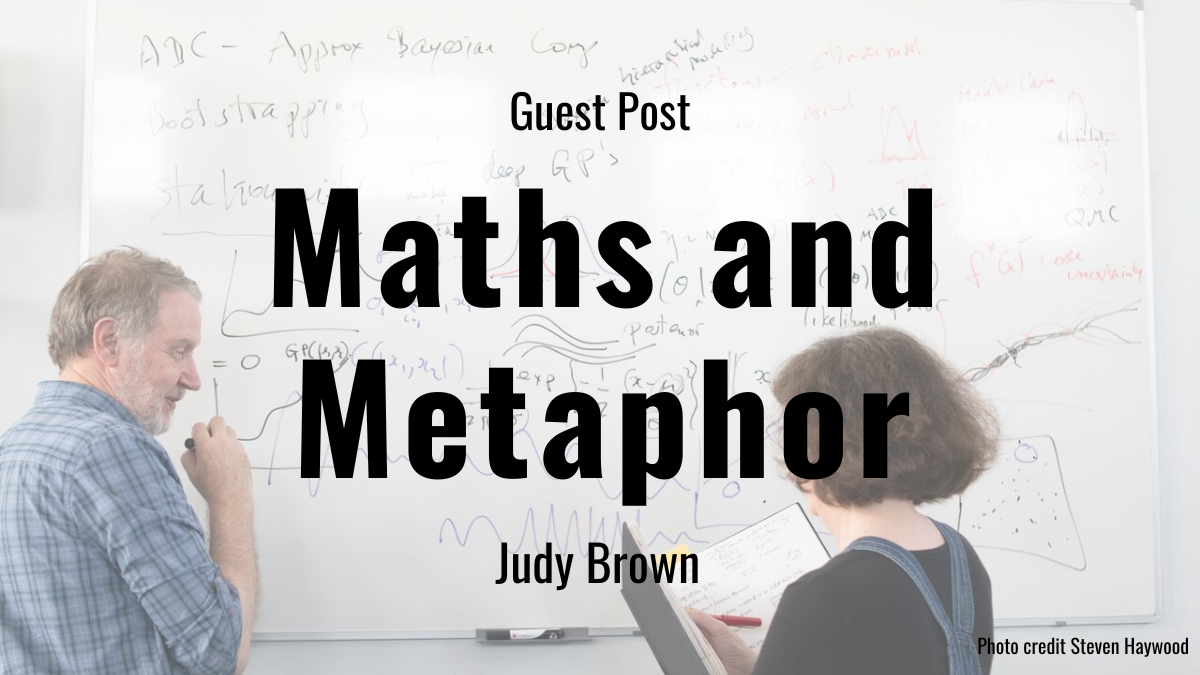
Guest post: Maths and Metaphor – Judy Brown

Judy Brown’s new collection Lairs was partly born out of a residency Exeter University’s Institute of Data Science and Artificial Intelligence. In this guest post she discusses the experience and how maths and poetry have more in common than you might think.

This cover shows a sci-fi inspired collage of a girl sitting in a field at dusk looking towards a black, star filled orb in the distance. Red mountains rise up behind it beneath a purple sky. The text reads: Lairs, Judy Brown.

Lairs brings together something primal and secret – the lair as haven for a wild or feral animal – with the poem framed as a mathematical equation. In these terms, the ‘lair’ is a kind of nest, a beautiful accumulation of dense detail. The poems are introspective, by turns mocking, fearful and analytical. Judy Brown’s use of language is innovative, while maintaining moments of vulnerability and moving self-awareness. In these exquisite poems, the lair is both the community at large and a dark and intricate interior space where something wild still survives.

Maths and Metaphor

Before this summer, if someone had told me maths could be as much fun as writing poems, it wouldn’t have been a long chat. Professor Beth Wingate, mathematician and poet, did say as much to me in July but by then it was too late: it had become obvious. Residencies teach you things – often not what you expected.

This was a summer of empty campus lawns, rain, whiteboards crammed with notation, hours spent looking up half-heard maths phrases on Wikipedia, metaphors I splashed everywhere and tried to hold onto to avoid panic, attempts not to look stupid, looking stupid despite everyone saying, kindly, ‘There are no stupid questions.’ And lots of questions, lists of them collected amongst my drawings and notes in a big A3 sketchbook – a necessary navigation aid in this slightly frightening, very exhilarating experience. This sort of messy process is how I write anyway, I just hadn’t ever been quite so at sea. 

Stacks of sketch books from Judy's residency. The pages are filled with notes, pictures and bright sketches.
Judy Brown’s residency sketchbooks

To backtrack a little: Arts and Culture University of Exeter has a programme that matches creative practitioners with research academics. The area under consideration can be quite sharply defined, the methodology and the outcome full of openness. I’d been attracted by the measured strangeness in the language used by Professor Peter Challenor, a statistician whose work involves producing approximations of what complex mathematical models (of the human heart, the ocean, the climate) would be likely to predict across a wide range of situations, together with exact assessments of how much you can rely on those predictions. The models themselves are often too expensive and slow to be run as many times as you’d like – just like the planet and the human body – so the techniques used by Peter’s team in the Institute of Data Science and Artificial Intelligence are of critical value, but also a little magical, seeming to create bricks out of straw. 

Peter had said in his brief ‘There is always a discrepancy,’ but I had no idea how many sorts of discrepancy existed. The team’s specialisation is called uncertainty quantification – and when didn’t a poet love a paradox?

I was lucky. Peter turned out to be interested in everything, a member of the Poetry Book Society, and an eloquent explainer who could shift in and out of maths notation and take up my hesitant and extravagant metaphors to talk to me in a language I knew. 

Judy Brown takes notes in her sketch book whilst Peter Challenor maps out an equation on a large whiteboard.
Judy Brown and Professor Peter Challenor. Photo credit: Steven Haywood

I had five weeks of great conversations – about writing on proper blackboards, machine learning, the problems of multidimensionality, different types of probability, heart surgery, whether a mathematical model is a metaphor, the importance of pattern and of deviations from it.  We talked about Jack Underwood’s essay ‘On Poetry and Uncertain Subjects’ (The Poetry Society) – how our kind of uncertainty made poems hospitable, how unacknowledged uncertainty for Peter made things dangerous.

I only have a maths GSCE but I wasn’t too worried. I quite like feeling a subject is full of things I don’t know and knew that the not-knowing would itself generate ideas that would lead to poems. In the end I felt I’d been allowed to walk further into another world than I anticipated, with tiny, occasional flavours of what it might be like to know how to move in those regions as of right. As with poetry, it turns out that even small amounts of maths are worth having.

I knew that metaphor is what I think with, and where many of my poems originate – it’s central, not decorative. The fact that I couldn’t think anything without it was demonstrated very clearly over these weeks when I kept asking ‘What is it like in there?’, ‘What kind of creature is it?’ That was our difference, maybe – the poet’s obsession with specificity where a small precise detail stands in for a big abstract thing. Or maybe it’s not so different, I still don’t know.

The experience also underlined the importance of play for writing, and for problem-solving. At school I always wanted a structure to put what I learned in – that’s often what a teacher gives you – a particular shaped bucket, and you fill it. Here I had no time to get even a small bucket; there were only the structures I already had – metaphor, language, question, answer, and sometimes just the process of sitting and drawing.

Close up picture of notes from one of Judy's sketchbooks. The word language stands out in bold black letters.
Close up of one of Judy’s sketchbooks

This was semi-feral learning in the sense that when people told me about their work I was able to choose the questions and Peter’s team worked to give me answers that might make sense in the language of the asking. I also tried to learn as much of their talk as I could – even a few equations. It felt amazing for someone middle-aged to be learning in this essentially childlike way, like a car wash for the brain. It felt just like writing.

I’ve written quite a few poems from this – now on the Arts and Culture website and in issue 2 of Finished Creatures magazine, and migrating into the manuscript of my next collection Lairs. I have lots more drafts and ideas. While the maths is not always apparent, I couldn’t have written them without that huge new space in my head. I’m slowly reading a book about calculus and watching the odd MIT lecture or Isaac Newton Institute seminar on probability or uncertainty quantification. It still feels flukey, strange, to be treasured.

Judy Brown

Read Judy’s maths-inspired poem ‘Some Security Questions’ on the Exter Arts and Culture website.

‘Uncertain Rigours’, a short film by Steve Haywood about the residency, can be viewed on the Exter University Arts and Culture website.

This article was first published by The Poetry Society in their Winter 2019 edition of Poetry News.

Lairs is available on the Seren website: £9.99

Create your free Seren account and enjoy 20% off every book you buy direct from us.

Posted on

Guest Post: COP26 – Kristian Evans on poetry & the climate crisis

Today’s guest post is by Kristian Evans, co-editor of the landmark anthology 100 Poems to Save the Earth – vital reading as world leaders meet in Glasgow for COP26.

100 Poems to Save the Earth edited by Zoë Brigley and Kristian Evans

Our climate is on the brink of catastrophic change. 100 Poems to Save the Earth invites us to fine-tune our senses, to listen to the world around us, pay attention to what we have been missing. The defining crisis of our time is revealed to be fundamentally a crisis of perception. For too long, the earth has been exploited. With its incisive Foreword from editors Zoë Brigley and Kristian Evans, this landmark anthology is a call to action to fight the threat facing the only planet we have. 

Leaders from the world’s governments and businesses are currently meeting in Glasgow for the UN Climate Change Conference (COP26). Delegates are attempting to create a roadmap towards a zero-carbon future, to find ways to prevent the earth from warming by more than 1.5C, and to explore other technological and financial options to help us mitigate climate change.

Considering the results of previous conferences, we can be forgiven for feeling less than optimistic about this one. Surely here are the same old people, using the same old tools, trying to make the problem conform to the same old solutions they have found for it.

Einstein famously said “no problem can be solved by the same consciousness that created it. We need to see the world anew.”

So how does our culture see the world today? What does ‘nature’ mean to those of us in the West? What does our way of life tell us about our unconscious beliefs and attitudes to it? What might ‘seeing the world anew’ mean?

empty your paradise onto a desk:
your white sands, green hills and fresh fish.
Shine the lamp on it like the fresh hope
of morning, and keep staring at it till you sleep.

From ‘A Portable Paradise’ by Roger Robinson – 100 Poems to Save the Earth

Since the Enlightenment, it has become the custom to see nature as a machine, something inert, a predictable resource, perfectly intelligible to reason. Animals are considered to be little more than complicated robots – it’s ok to test cosmetics, drugs and ammunition on them. Nature can be dominated, controlled and tamed. There is nothing truly strange or mysterious out there, certainly no ghost haunting the moving the parts.

We find these beliefs reflected in our perception of human life: consciousness is only a brain process, life has no intrinsic meaning and ends completely in death. We don’t have souls and should find fulfilment in material things, tools and toys that will, we are promised, get bigger and better year after year. Get it while you can and drink it dry, because time is running out and soon you will be gone.

At least, that’s how it used to be. That was the dream. Poets were never quite convinced by it and climate change and the ecological crisis are now ringing a very loud alarm. Blake railed against the oppression of a rationalising utilitarian mind he saw embodied in ‘the dark Satanic mills’. The Romantics, foreshadowing Freud, found plenty of evidence that the Enlightenment had a concealed dark side, that it was haunted and shaped by the superstitions it thought it had banished.

Illustration of ‘The Ancient Mariner’ by artist David Jones

Coleridge’s ‘The Rime of the Ancient Mariner’ is now often read as an ecological fable, a warning of the consequences of adopting a violent, domineering attitude to nature. Most of us will have seen images of dead Albatross chicks, their stomachs stuffed full of the bits of plastic they’ve been fed by the parent bird, the shiny junk plucked from the waves, fragments of the rubbish with which we fill our own lives. We’re all the Mariner now, it seems; every one of us has killed the Albatross.

Yet at the end of his terrifying hallucinatory voyage to the edges of the world, to the edges of himself, the Mariner does “see the world anew.” He is reconciled to a vision of nature as a complex web of relationships, beautiful and strange, everything intertwined with everything else.

Albatros chick

What if we were no longer separated and isolated, disconnected from nature and each other? We too might see a world transformed. What was once viewed as a collection of dead, inert or robotic objects, might now be experienced as a community of vibrantly alive subjects, multi-faceted aspects of a cosmos full of meaning, intelligence and imagination not confined to humans, but distributed throughout everything.

When we were editing 100 Poems to Save the Earth thoughts such as these were never far from our minds. Poets have always kept an ear open to communication from the earth, imagining what the birds and fish and fungi, the oceans and forests might say. It’s not hard to hear them. They are only saying what our own souls are saying after all. Stop. Change. Please listen.

It is as if there were some irresistible force
blowing us over into a strange new century
that billows beyond us, between our thin heart-beats.

From ‘Climate’ by George Szirtes – 100 Poems to Save the Earth

It’s time also to listen to those of us beyond the West, especially indigenous peoples, who are often on the front line of climate change and habitat and biodiversity loss, and who still hold a vision of the possibility of a meaningful existence with an intelligent world. As Ozawa Bineshi Albert of Climate Justice Alliance says, “Solutions to the climate crisis must come from those communities most directly impacted. At COP26, the orientation of the international community must come from them, not economists, corporations and politicians who created the problems in the first place. Solutions can’t be about us without us.”

The ecological crisis is transforming us, forcing us to reassess the relationship between mind and nature, forcing us to revise our cultural assumptions and beliefs about who we are, where we are going and what we want to become. COP26 might attempt technological solutions and new finance initiatives. It might be an exercise in perception management that enables business as usual. A new dark age might be closer than we realise.

Whatever happens, if we don’t jettison the old mechanistic worldview and learn to see the world anew as alive and intelligent, we will remain stuck in the old ways of thinking that got us into this crisis in the first place.

Kristian Evans

100 Poems to Save the Earth is available on the Seren website: £12.99

Create your free Seren account and enjoy 20% off every book you buy from us.

David Baker reads ‘Pastoral’ from 100 Poems to Save the Earth

Posted on

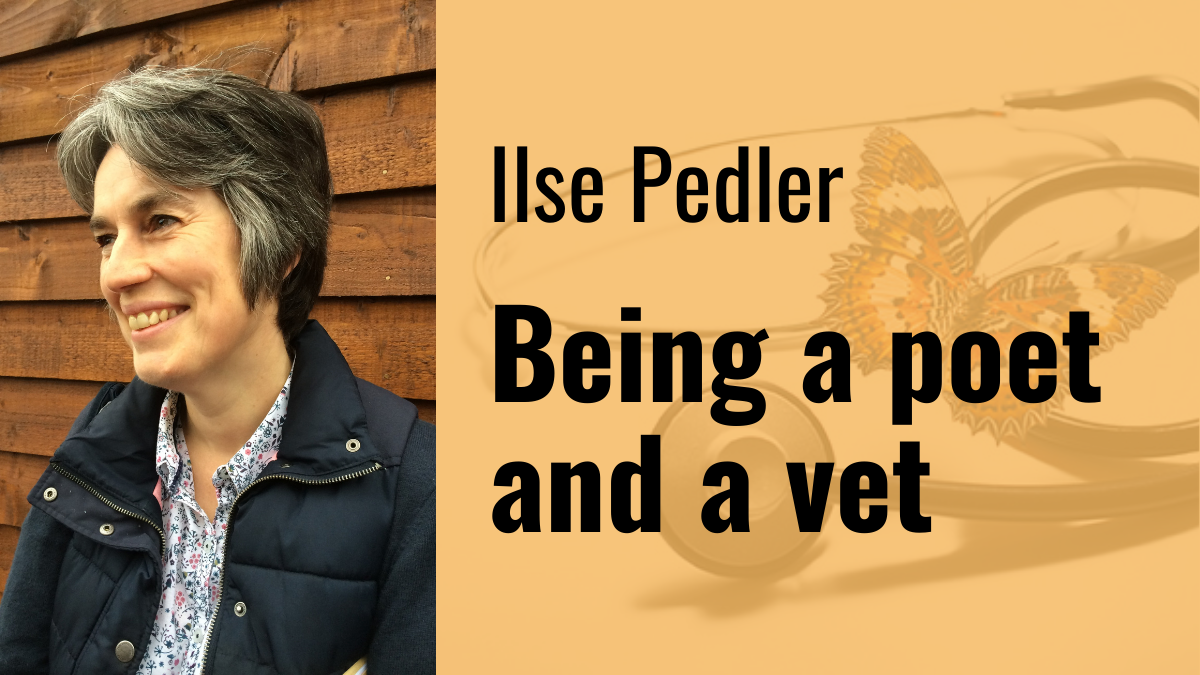
Ilse Pedler: Being a Poet and a Vet

This week we publish Ilse Pedler’s debut collection Auscultation. In this post she reflects on finding time to write around her career as a vet and how this inspires her poetry.

The cover of Auscultation shows a stethoscope against a white background with an orange and brown butterfly resting on the chord. Beneath the image is an orange box with the title and author name.

Auscultation means listening and specifically, in medicine, listening to sounds that come from the body’s internal organs. If listening is a central theme of this collection, it is also about being heard. Ilse Pedler is poet of breadth and depth. There are poems about waiting rooms and surgical instruments, about crisis calls, about overhearing farmers and pet owners and colleagues. There are poems about surviving a stern childhood and a heartbreaking sequence about being a stepmother. This is a compelling set of poems from a striking new voice.

“Unique and utterly original.” – Kim Moore

How do you juggle writing poetry with a demanding career, particularly a career like veterinary medicine? Being a vet is not so much a job as a way of life. You come to live to the rhythms of animals, their needs take priority over your own. Work becomes a river; fluid, broken over rocks, never ceasing.

I’ve always written but during university and early years in practice, life as a vet was so all-consuming, poetry was squeezed to the very periphery. Slowly though, it began to filter back, sometimes it was people’s stories, sometimes it was the relationship between an animal and its owner. I started to feel the need to write down what I was experiencing. I also became frustrated at how little time I had to devote to poetry, until I went to a reading by Dennis O’Driscoll who worked full time through all his career. His comment on the dilemma of work and poetry was ‘Just write’. This became my mantra in the following years and I found myself jotting down fragments and ideas in between seeing clients or after I had finished an operation and on more than one occasion, I pulled over into a layby on the way back from a visit to write a few lines.

At first, I was hesitant about sharing my poems. I thought, because I hadn’t studied English or had a background in the arts, my work probably wasn’t up to much. It wasn’t until I went on a poetry course and another participant said, ‘isn’t it wonderful, you have a second language.’ I realised that being a vet may actually have its advantages.

As a vet I had a rich variety of experiences and emotions to draw on. I’ve seen cases of cruelty and neglect but also moments of extreme tenderness and dedication, I’ve known people go without food so they can afford medication for their pets and I’ve known people whose only reason for getting up in the morning is their animals. The consulting room is a privileged place and consulting effectively is an art as well as a science. The ability to draw out the back story and to get to the heart of the matter is a skill that is learnt over time. Farms are also unique; they are places of rough practicality and particular language; there is a bluntness there but also a gentleness.

We vets spend a lot of our time reading and writing clinical notes. They are our observations of patients and although factual, these notes are far from ‘clinical’, they are a record of what we’ve seen, felt, heard or smelt. Medical language is full of colour and dimension, it is muscular and vital. We observe our patients closely and we record what we feel about them. I found not only did I did have a whole other language to draw on but I had a scientist’s eye for detail and precision.

I feel so incredibly privileged to be a vet; animals have an honesty and in the case of animals like horses and cattle, a majesty too. They love and trust unconditionally and I am constantly inspired by them. If I can capture any of this in my poems, I will feel I have truly become a poet.

Ilse Pedler

Ilse Pedler’s debut collection Auscultation is available on the Seren website: £9.99

Create your free Seren account and enjoy 20% off every book you buy from us.

Posted on

Friday Poem(s) – 3 Poems for International Women’s Day

International Women's Day poems

For our celebration of International Women’s Day, we’ve selected not one Friday Poem but three – each offering a different perspective, and each representing a different stage in a woman’s life.


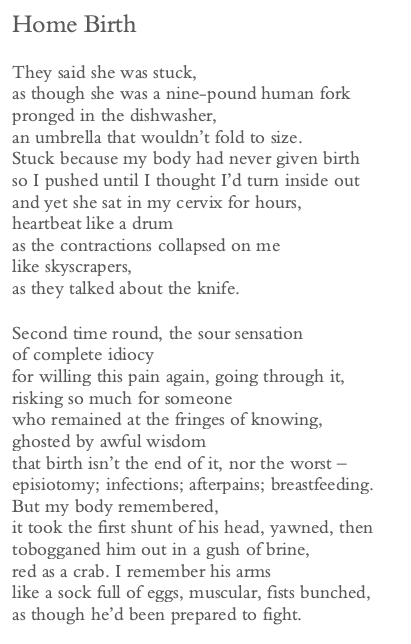
‘Home Birth’ by Carolyn Jess-Cooke, from Boom!
Through vivid, painful and powerful imagery, Jess-Cooke relives the intensely physical and emotional act of labour.

Carolyn Jess-Cooke Home Birth


Boom! Carolyn Jess-Cooke

Boom!
Carolyn Jess-Cooke
£9.99
Buy Now


‘The Girls on the Train’ by Katherine Stansfield, from Playing House
The joy of youth is a catalyst for the speaker mourning the loss of her ‘early velour glory’ in this short, powerful poem, which causes us to question our aversion to ageing.

Katherine Stansfield Girls on the Train


playing house katherine stansfield

Playing House
Katherine Stansfield
£9.99
Buy Now


‘I start to understand yellow’ by Rosie Shepperd, from
The Man at the Corner Table

Violence and isolation are overcome as the quiet power of female unity gathers strength in the textures, flavours and colours of nineteenth century Mauritius.

Rosie Shepperd I start to understand yellow


the man at the corner table rosie shepperd

The Man at the Corner Table
Rosie Shepperd
£9.99
Buy Now


Happy International Women’s Day. We hope these poems nourish and delight, and if you’d like to discover more of our women writers, have a browse on our website.


Posted on

An Interview with Kim Moore

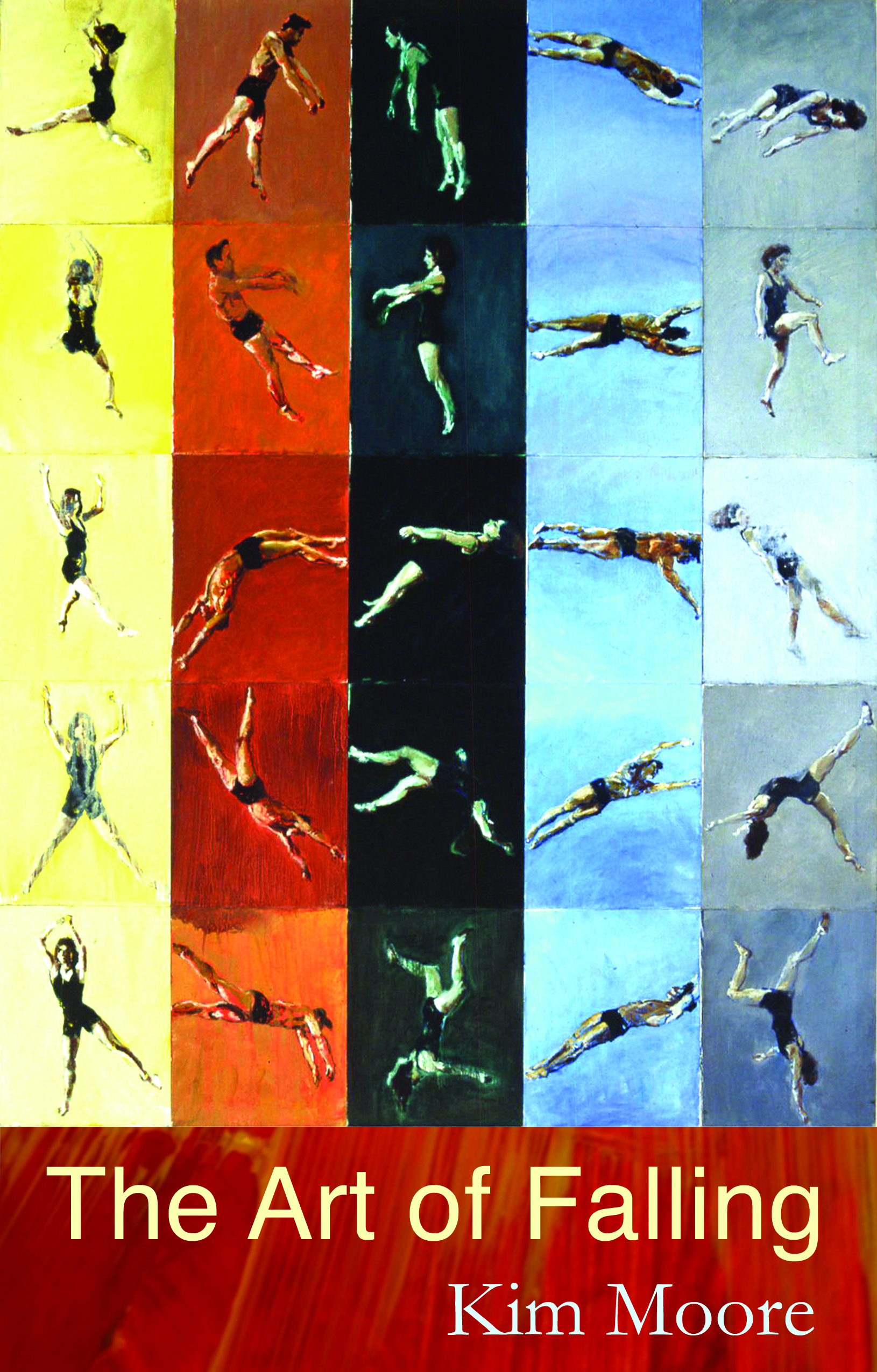
Today we’re talking to poet Kim Moore about her debut collection, The Art of Falling, which you can order from our website here.

Kim Moore lives in Barrow, Cumbria. She has an MA from Manchester Metropolitan University. Her poems have been published in the TLS, Poetry Review, Poetry London, and elsewhere. She regularly appears at festivals and events, her prize-winning pamphlet, If We Could Speak Like Wolves (Smith-Doorstop) was chosen as an Independent Book of the Year in 2012 and was shortlisted for other prizes. Moore won an Eric Gregory Award in 2011 and the Geoffrey Dearmer Prize in 2010. In 2014 she won a Northern Promise award. She writes a thoughtful blog and has a wide social media following. The Art of Falling (Seren 2015) is her debut collection.

Has the idea of falling, be it literally or metaphorically, always fascinated you, or did you find yourself writing about the many ways in which we fall purely for this collection?

The short answer is no, not consciously, but unconsciously. I think the concept of falling must have been something that has always been in the background. My father is a scaffolder and has had two serious falls – once when my twin sister and I were born and then again when I was twenty-one when he fell thirty feet from scaffolding and was lucky to survive. However, I didn’t realise I was writing about falling a lot until I wrote the title poem of the collection – and I only wrote that because David Tait, a good friend and wonderful poet set me a challenge to write a poem about falling. We used to take it in turns to do this – to set each other challenges – I didn’t even think at the time to ask him why, or what type of falling he meant. I actually forgot all about it and didn’t write the poem until six months later but looking back, the seed was definitely planted in that moment. Once I’d written the poem I realised that there were lots of poems about different types of falling throughout the collection – the book was maybe three quarters done by this point, so maybe I was just being very slow on the uptake.

In poems such as ‘My People’ and ‘A Psalm for the Scaffolders’ there’s a real sense of proud, working-class history. Is it fair to say you have a fondness for writing about the ‘every day’ hero?

‘My People’ is one of the poems I feel most guilty about writing because as well as hopefully communicating my pride, love and admiration for the people and background I came from, I’m being quite critical as well. It was an exhilarating poem to write, but it was also quite nerve-wracking. My people are ‘the type of people who would argue with their teacher if the child has detention’. Now I’m a teacher so I see it from both sides, of course. I actually wrote it when my husband started tracing his family tree and got quite far back and I realised I couldn’t. The poem was a way of finding out who my people were.

As for ‘A Psalm for the Scaffolders’ I definitely have a fondness for writing about my poor old dad! I think he likes it though – and to me it is really interesting because his life and the way he has worked, doing the same job since he left school is a way of working that is dying out, I think. I have a lot of admiration for that, for the physical hard graft of doing the same job for forty odd years.

I couldn’t help noticing the recurring animal imagery throughout The Art of Falling. There are plenty of wolves amongst your poems – ‘And the Soul’; ‘If We Could Speak Like Wolves’; ‘How Wolves Change Rivers’ – and also the incredibly powerful poems ‘The Language of Insects’ and ‘When I Was a Thing with Feathers’. In what way do animals help you to explore human nature through your writing?

I have never managed to answer this question about what the wolves mean in my poems, so I will skip over that one. Part of me also wants to duck out of answering it – I don’t really want to know. I like that they wander in and out of my poems when they feel like it though.

Halfway through writing the sequence which makes up the central sequence of this book, I got lost. I couldn’t find a way of saying what I wanted to say. I didn’t want to write a narrative sequence, with a beginning, a middle and an end. I started reading Ovid’s Metamorphoses and that is when everything shifted for me and I was able to carry on writing. The poems have a lot of animals in them, but perhaps more importantly, they have a lot of transformation in them, which was a way I found of writing about violence and the loss of not just identity, but of speech.

You play the trumpet, so I imagine there must be many musicians you admire. What is it about John Lennon and Wallace Hartley that made you want to write about them in particular?

It is actually obsessive people in general that I like writing about – and most musicians are obsessive – you have to be to practice enough to be good.

I actually wrote the John Lennon poem to take part in a competition to write a poem about John Lennon. It is what I call a research poem – I went to the library and read as many books about John Lennon as I could find and then wrote the poem, putting together the things that I read that interested me.

As for Wallace Hartley, I was helping to put together a project as part of my work as a music teacher. I read that he was found with his violin still with him and it was this that made me want to write something about him.

Congratulations on the publication of your debut collection! What are your future plans for your writing?

Thank you! My future plans are pretty simple – just to keep writing, and to always read more than I write. In September, I’ll only be working 2 days as a music teacher so this will hopefully give me a little bit more time. I haven’t written for the last six months – basically since I handed in the final proofs of the book, and then I’ve just started writing again last week, strangely coinciding with the book being delivered. I’ve started writing a few poems about scaffolding and a few poems about running which is my new obsession at the minute so I’m planning on carrying on with those.

Order The Art of Falling from our website.

Posted on

Friday Poem – The Love Songs of Davy Blackrock

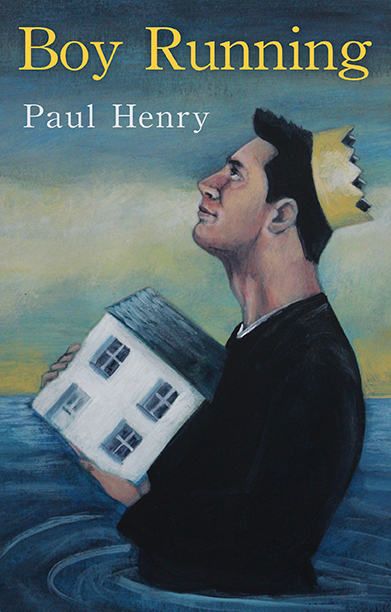
Boy Running, Paul Henry

Today’s poem is from Paul Henry’s latest collection, Boy Running, published last month.

Paul Henry has gained a reputation as one of of the best poets in the UK. Boy Running is his beautiful sixth collection and the first to follow ‘The Brittle Sea: New and Selected Poems’. We begin in a ‘Studio Flat’. Cut adrift by marital break-up, the poet must sort through the emotional fallout and the various ‘chattels’ left behind; a sea of characteristic props: tables, lamps, metronomes, pianos, guitars. The poet’s sons are at the heart of this section where pathos is balanced by humour amidst the characters of a small country town.

A second section moves to the Welsh coastal town of Henry’s childhood, Aberystywth, opening with a long poem, ‘Kicking the Stone’ set in the summer of 1969. Also in this section are some familiar characters from earlier poems such as Brown Helen and Catrin Sands.

In the final sequence we meet ‘Davy Blackrock’: washed-up songwriter and modern day alter ego of Dafydd y Garreg Wen (David of the White Rock), alias David Owen (1720-1749), the blind, 18th century harpist and composer who fell asleep on a hill and dreamt the famous song which bears his name. In contrast to David of the White Rock, Davy Blackrock, ‘star of an ashen town’, drags his guitar from street to hotel to bedsit, an unsettled ghost who dreams of the perfect song.

The Love Songs of Davy Blackrock

  “The songs I had are withered
   Or vanished clean,
   Yet there are bright tracks
   Where I have been,”

                         Ivor Gurney – ‘The Songs I Had’

Few remembered them
but by the end
it was enough
that they’d brought love,
some good friends.
What was ambition
after all but the drum
of rain on a glass room,
a distraction from the moon?

He’d sit late for hours, Davy
in those final days,
inventing new chords
in his conservatory,
oblivious to the news,
worrying less about words
than the melody,
trusting his ear,
not counting the bars

and, between downpours
keeping one eye on the stars.

Paul will be launching Boy Running on 27th March at the bear in Crickhowell. Find out more or book tickets here.

Order Boy Running from our website.