Posted on

Queer’s the Word: Readings for LGBT+ History Month

Daryl Leeworthy, author of A Little Gay History of Wales and Elaine Morgan: A Life Behind the Screen, shares some of the top books you should be reading this LGBT+ History Month.

Since the removal of Section 28 from the statute book in 2003, Britain’s queer communities have come together each February to celebrate a history which was for so long hidden in plain sight. Each year, LGBT+ History Month has a theme: in 2021 it is ‘Body, Mind, Spirit’. Anyone who has watched Russell T. Davies’s masterpiece, It’s A Sin, will know just how much each of those elements can be affected by absorbing oneself in aspects of the queer past and present. The books I have chosen for this short article penned as a contribution to LGBT+ History Month, each represent a different side of life.

Let’s start with the master historian, Jeffrey Weeks, who was born in the Rhondda in 1945, and his landmark book, Coming Out. First published by Quartet in 1977, and released in a new edition in 2016, Coming Out brings Britain’s queer history to life. It is radical. It is rooted in the ideas of gay liberation – about which more in a moment – and in the left-wing politics of the 1970s. But it is not an artifact of an earlier time, so much as an endlessly absorbing and fascinating excavation of a past richly experienced but all-too-easily cloaked in the horror of criminal codes and lavender scares. Weeks’s great triumph is to bring queer history back down to street level. In his long career, Weeks went on to write about Edward Carpenter, theories of sexuality, and the triumph of the queer civil rights movement through signature legislation such as same-sex marriage. This spring he turns his attention to his Welsh roots in a masterful memoir, Between Worlds.

To understand the Gay Liberation Front itself, there is no better work than Lisa Power’s No Bath But Plenty Of Bubbles, an oral history of the movement in London, which was originally published in 1995 by Cassell. Long out of print and difficult to get hold of, it has recently been re-released as an e-book to mark GLF’s fiftieth anniversary. By the time the book appeared in the mid-1990s, the world had changed completely from that envisaged by the GLF activists twenty years before – but rarely for the better. The age of consent, set at 21 since 1967, fell to eighteen in 1994 but the opportunity to bring about equality at 16 was narrowly missed. Section 28 was on the statute book and ruining the lives of a generation of queer children (me included). HIV/AIDS wreaked havoc all over the world, amongst queer and non-queer communities alike. Lisa Power wrote a book of history, then, but one designed as a kick into gear, a serious attempt to recover something of the spirit and purpose of the Gay Liberation Front and to make the world better for everyone. Twenty five years later, we know it succeeded.

After a year living with the COVID-19 pandemic, many of us are feeling an enormous strain and frustration. We have come to think of the virus as a once in a century event – it is not. But that tells us something about how societies remember and how we as individuals remember, too. Studies have shown that the descendants of those most directly impacted by traumatic events carry with them a genetic memory – an imprint of that harm which cannot be got rid of. It is especially apparent amongst Holocaust survivors and their children and grandchildren. For queer people, especially, it is also true of HIV/AIDS, the other great global pandemic of the past fifty years. To understand the interplay between trauma and memory, there is no better novel than Rebecca Makkai’s The Great Believers. Published in 2018, it focuses on Chicago and brings to life a community which was forced to adapt and compelled to live with death and danger, day after day. But it is a universal story, one which can – and in its comparison with COVID-19 does – affect us all.

But what of Wales? When I wrote A Little Gay History of Wales a few years ago, I had a delightful afternoon reading Sion Eirian’s 1979 novel, Bob yn y Ddinas. It’s not really a queer novel except for a passage where the title character, Bob, goes into the Duke Of Wellington pub in central Cardiff and encounters a neighbourhood drag queen who buys a drink for everyone in the snug, but not him. He was outside the community. This was truth, not fiction. For a period in the late-1970s, the Duke of Wellington joined its neighbour the King’s Cross and the nearby Golden Cross and Bristol Hotel as part of the small gay scene of those years. This was Real Cardiff, as Peter Finch would describe it, tough and grimy and poor; the place as it was before the corporate towers arrived and the rents shot up.

My last choice takes me back to the Rhondda and to another queer emigré who made his way to London: the novelist Rhys Davies. In his lifetime, Rhys Davies never openly acknowledged his homosexuality. Privately, and to his friends, and partners, it was a different story. He cruised guardsmen on the streets of interwar London; he cruised men in the various European cities in which he lived; he was in Germany like Christopher Isherwood and saw the rise of the Nazis; he wrote very queer novels which take little decoding for modern readers; and became close friends and a beneficiary of the noted American lesbians Gertrude Stein and Alice Toklas. Alas, much of the writer’s work is now out of print but his memoir, Print of a Hare’s Foot, first published in 1969, appears as a Seren Classic. More so than Mike Stephens’s prize-winning biography, which doesn’t really get to the heart of its subject’s sexuality, I’m afraid, Print of a Hare’s Foot is the best place to start with a writer who is to Wales what Oscar Wilde is to Ireland.

Daryl Leeworthy is the Rhys Davies Research Fellow at Swansea University. He is the author of A Little Gay History of Wales (2019) and of Elaine Morgan: A Life Behind the Screen, which is out now with Seren.

Elaine Morgan: A Life Behind the Screen is available on the Seren website: £9.99

A Little Gay History of Wales is published by University of Wales Press: £11.99

Consider supporting independent bookshops with a purchase via bookshop.org.
Posted on

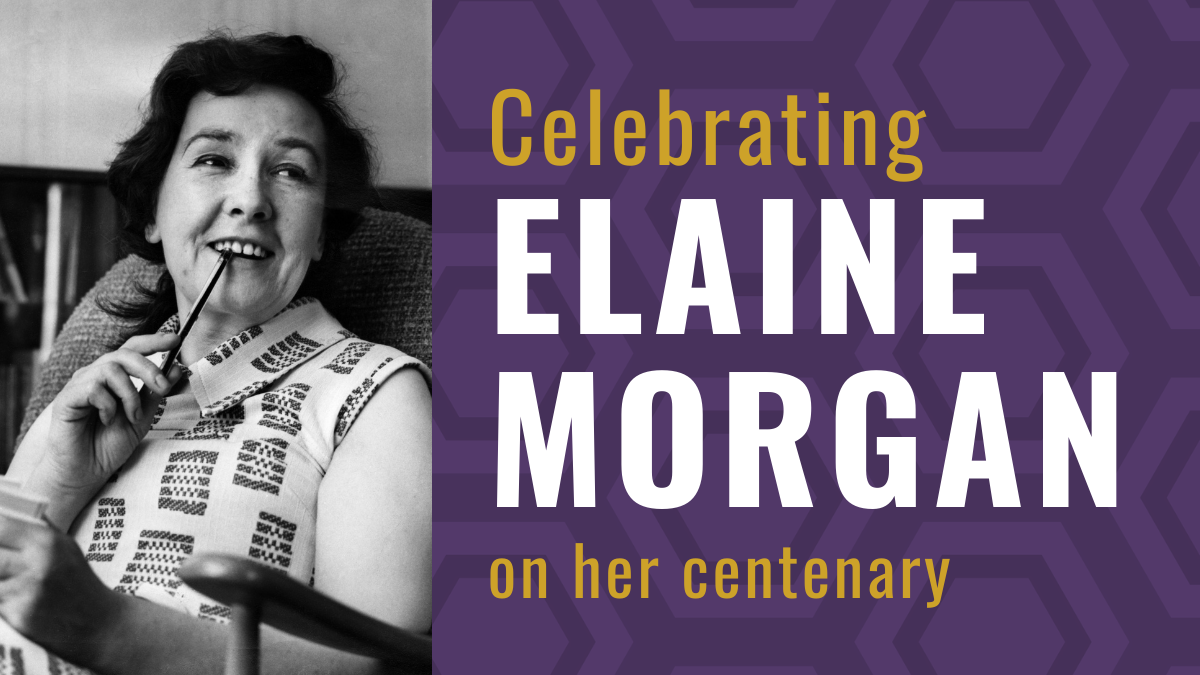
Celebrating Elaine Morgan on her centenary

Elaine Morgan (1920 – 2013) was a pioneer. Born into a working-class family, she was the first person from her school in Pontypridd to go to Oxford University. She went on to pursue multiple careers, first as an award-winning TV writer, then anthropologist, whilst maintaining a role in political activism throughout her life. Daryl Leeworthy, author of Elaine Morgan: A Life Behind the Screen, introduces us to this extraordinary writer on the eve of her centenary.

This informative biography restores Elaine Morgan’s reputation and establishes her significant place in writing from Wales. Richly detailed it is essential in understanding the life and work of this important writer.

“A scintillating new biographical study, impressively researched and elegantly written.” – Dai Smith

“Thanks to this book… many more can take inspiration from Elaine Morgan and a legacy that spans both arts and science. In this, her centenary year, there can be no more fitting tribute.” – Carolyn Hitt

Elaine Morgan has always been a hero of mine.

I suppose I first heard her name when I was in secondary school – we went to the same one. To me it was Coedylan Comprehensive, to her Pontypridd Intermediate School for Girls; these days Pontypridd High. One of my teachers, whose own life had been so influenced by Elaine’s iconic feminist book, Descent of Woman (1972), pointed out to me that being someone from ‘our town’ studying at Oxford not only brings great opportunities but also sets you on a path set down by one of Wales’s truly great writers. A national treasure.

Elaine Morgan at matriculation, autumn 1939 – front row, second from left.
By Kind Permission of The Principal and Fellows of Lady Margaret Hall, Oxford.

That idea of Elaine has stuck with me over the years. When I set out to research Elaine Morgan: A Life Behind The Screen, I knew that I wanted to look more carefully at her screenwriting and her contribution to our collective sense of the valleys and their people – those aspects of her career now very much overshadowed by the aquatic ape theory and Elaine’s undoubted contributions to popular anthropology. How, I wondered, did Elaine get her break at the BBC; how did she fit into an overwhelmingly masculine world; and how did she reach the top all from a desk in South Wales – a feat that seems so impossible nowadays.

Seeking the answers to those questions took me to the BBC’s written archives near Reading, a marvellous building with truly wonderful staff, where you half expect George Smiley to wander through the corridors. Out of Elaine’s voluminous files came letters sent back and forth to producers like Donald Wilson, Michael Barry, Sydney Newman, and Verity Lambert. The Doctor Who fan in me got very excited when I saw their names! Writers such as Gwyn Thomas and Dennis Potter were mentioned with casual ease. And there were occasional tête-a-tête when Elaine felt she was being undervalued – and underpaid – because she was a woman. The writer who emerged from those files was strong-willed, determined, and keen to learn. She was every bit the feminist my teachers had told me about.

The greatest finds in those files related to Elaine’s debut serial – now lost from the television archives – A Matter of Degree. First broadcast on the BBC in 1960, it told the story of the Powell sisters, and their experiences of South Wales and Oxford. Like the producers who brought it to the screen, I could not help but read an autobiographical presentation of Elaine’s life. She had always maintained that she loved Oxford, but here was the clash of cultures so familiar to me and to many others who have gone up from the valleys to those dreaming spires. Here was a kind of sequel to Emlyn Williams’s famous play The Corn Is Green (1938) but which anticipated the famous television serials of Oxbridge life, Brideshead Revisited (1981) and Porterhouse Blue (1987), decades before they were aired. This was Elaine Morgan, then, the television pioneer.

There was, I discovered, another side to Elaine, too – her politics. She grew up in a household which read the Labour-supporting Daily Herald and her own political activity took her to the pinnacle of student activism whilst she was at Oxford and into circles which included Clement Attlee and Roy Jenkins. Then she worked for the Workers’ Educational Association, just like Gwyn Thomas and Raymond Williams. As a young mother, she kept up her public activism and at one point taught for the Extra Mural Department of Manchester University. She helped to set up the United Nations Association in Burnley and led the town’s first celebrations of International Women’s Day. She even joined the Communist Party, although later returned to the Labour fold. Her radicalism had its fullest expression in a passionate belief in nuclear disarmament, in combatting climate change and humanity’s exhaustion of the planet’s natural resources, and in the campaign to ensure the survival and vibrant future of the Welsh language.

But, of course, if we are to remember one thing about Elaine Morgan on this, her centenary, it is her contribution to the women’s movement and to the self-belief that all women, regardless of their origins, can reach the top. Though she is not traditionally remembered as a historian, her television work, her radio broadcasting, her teaching, and her activism, all contributed to the active recovery of women’s collective, historical experience. In those decades of the twentieth century when Welsh women were absent from parliament, from leadership roles, from the apex of public life, Elaine Morgan stood out. She understood this and made the most of her remarkable influence.

In many respects, Elaine Morgan was the embodiment of what I like to think of as the ‘South Walian Dream’. She took the opportunities afforded her by an education which lasted for as long as she wished, but never forgot her origins. Never lost sight of the fact that she had grown up in a small terraced house in Hopkinstown. Never lost her ear for the rhythm of the valleys and their people. Alongside Gwyn Thomas, she helped to define what Wales meant for television and radio audiences all over the world. Whether as the pensioner, the playwright, the protester, the poet’s muse, or the student politician, Elaine Morgan was determined to say to her own community, to her own people, first and foremost, it does not have to be this way.

Daryl Leeworthy

Elaine Morgan: A Life Behind the Screen is available on the Seren website: £9.99

Join us for the virtual launch of this important new biography on Wednesday 11 November at 7pm. Author Daryl Leeworthy will be in conversation with Carolyn Hitt. Register for FREE via Eventbrite https://www.eventbrite.co.uk/e/125898462691.