This week’s Friday Poem is ‘On Allt yr Esgair’ by Christopher Meredith from his newly published poetry collection Still. In a unique publishing event, Still is published simultaneously with Christopher’s tragicomic short novel Please. Both are available on our website now.
Christopher Meredith’s new poetry collection Still, uses the title word as a fulcrum to balance various paradoxical concerns: stillness and motion, memory and forgetting, sanity and madness, survival and extinction. Lively and thought-provoking, this is a beautifully crafted, humane and intelligent collection.
“Lyrical, always surprising, Meredith ‘fixes stillness’ in absences here. His perfect ear tunes in so precisely – especially to the natural world, it’s ‘edge of sense’ – we are left haunted á la Frost, by a deep lonliness in the human condition.” – Paul Henry
Don’t miss the launch of both books at the Seren Cardiff Poetry Festival from 12pm on Sunday 18 April. Register for free via the festival website here. You only need to register ONCE for access to the entire four-day weekend.
This week we have two Friday Poems from TROEON : TURNINGS, the new bilingual collaboration between poets Philip Gross and Cyril Jones and artist Valerie Coffin Price. ‘Penny’ by Philip Gross and ‘Glasffrwd’ by Cyril Jones.
To turn, to dig, to plough, to upset, to translate… Bend, lap, journey, time… The Welsh word troeon unfolds meaning after meaning. In TROEON : TURNINGS, two poets confident in their own traditions meet in the hinterland between translation and collaboration – Cyril Jones from the disciplines of Welsh cynghanedd, Philip Gross from the restless variety of English verse.
This International Women’s Day we’re showcasing books written by or about inspiring women. Find many more on our website.
With over 250 contributors, this generous selection of poetry by women with an emphasis on twentieth-century poetry in English features poets from the USA, Canada, England, Ireland, Scotland, Wales, Australia, and New Zealand. Arranged by thematic chapters that touch on various aspects of modern life, this anthology aims to be a touchstone of women’s thoughts and experiences; to be entertaining and relevant as well as inclusive and representative of some of the best poetry published now.
Wild Persistence by Katrina Naomi is a confident and persuasive collection of poems. Written following her move from London to Cornwall, it considers distance and closeness, and questions how to live. She dissects ‘dualism’ and arrival, sex and dance, a trip to Japan. The collection also includes a moving sequence of poems about the aftermath of an attempted rape.
The Estate Agent’s Daughteris the eagerly awaited follow up to Rhian Edwards’s Wales Book of the Year winning debut collection Clueless Dogs. Acute and wryly observed, the poems step forth with a confident tone, touching on the personal and the public, encapsulating a woman’s tribulations in the twenty-first century.
This informative biography restores Elaine Morgan’s reputation and establishes her significant place in writing from Wales. It outlines her early days living only just above the poverty line in the Rhondda, before reading English Literature at Oxford, and examines her careers as an award-winning television writer and visionary anthropologist. Richly detailed it is essential in understanding the life and work of this important writer.
By turns laugh out loud funny and deeply sad, The Amazingly Astonishing Story is a frank and surprising look into a child’s tumultuous mind, a classic story of a working-class girl growing up in the 60s. Her Catholic upbringing, a father torn between daughter and new wife, her irreverent imagination and determination to enjoy life, mean this really is an amazing story (including meeting the Beatles).
When Nula’s husband James, an Irish documentary filmmaker, becomes forgetful they put it down to the stress of his work. But his behaviour becomes more erratic, and he is eventually diagnosed as suffering from Pick’s Disease, an early onset and aggressive form of dementia. The Longest Farewell is the true story of Nula’s fight with her husband’s disease, and how this terrible time held a happy ending.
A city burns in a crisis − because the status quo has collapsed and change must come. Every value, relationship and belief is shaken and the future is uncertain. In the twenty-six stories in A City Burning, set in Wales, Northern Ireland and Italy, children and adults face, in the flames of personal tragedy, moments of potential transformation. On the threshold of their futures each must make a choice: how to live in this new ‘now’.
In the aftermath of World War II, hundreds of thousands of Yugoslavia’s ethnic Germans, the Danube Swabians, were expelled by Tito’s Partisan regime. A further sixty thousand were killed. Seventy years later, Marie Kohler’s marriage is falling apart. She’s seeing someone new, an enigmatic man named David, who takes her to the former Yugoslavia to find the truth behind her grandparents’ flight to America. Ford has written a moving narrative of emigration and identity, realpolitik and relationships, and asks what happens when the truth is unspoken.
Princess Adélaïde, daughter of Louis XV, is at odds with the etiquette of the French court. Adélaïde envies her brother, is bored with her sister and, when Madame de Pompadour, a bourgeoise, comes to court as her father’s mistress, she is smitten, with dangerous results. Adélaïde pushes against the confines of the court, blind to the difference between a mistress and princess, with tragic results. Forty-four years later, under the looming shadow of the revolution, what has happened to the hopes of a young girl and the doomed regime in which she grew up?
This week’s Friday Poem is ‘Green Ink’ by Abeer Ameer from her debut collection Inhale/Exile.
Abeer Ameer writes of her forebears in her first collection, Inhale/Exile. Dedicated to the “holders of these stories”, the book begins with a poem about a storyteller on a rooftop in Najaf, Iraq, follows tales of courage and survival, and ends with a woman cooking food for neighbours on the anniversary of her son’s death.
“…these poems remind us that even in the darkest times, there is light, and there is love.” – Katherine Stansfield
This week’s Friday Poem is ‘Fixative’ by Rosalind Hudis from her new collection Restorations which was published earlier this week.
Inspired by the art restorer’s keen eye and by a vivid empathy for people and events, Restorations, is a journey through memory. Suffused with colour, inspired by thoughts of people and places, by artefacts and how the passage of time shifts perspectives and erodes surfaces, these poems are beautifully complex explorations, full of curiosity and the adventure of seeing and listening.
“If a poem is like a picture, these are history paintings, rich in human detail and many-layered in their brushwork.” – Matthew Francis
If you’re still looking for a last minute gift, you can’t go wrong with Daniel Butler’s new book The Owl House. This pastoral exploration of mid-Wales is beautifully observed, full of evocative observations that can only have been lived to have been accrued. Here is a wintry extract from the chapter ‘Weather’.
Daniel Butler has lived in the Cambrian Mountains near Rhayader for twenty-five years, absorbing the world around him and charting its changes slow and rapid. His passion for the natural world was compounded when two wild birds, barn owls, nested at his farm. Through charting his relationship with the birds, he embarks on a pastoral exploration of his locale, rich as it is in wildlife of all kinds. His new book The Owl Houseis a rich and vivid portrait of one of the most remote and sparsely populated areas of Britain, broad in its horizons yet full of fascinating detail. The perfect gift for any lover of the natural world and mid-Wales.
…
Winter bird activity is not just about survival. I used to think the breeding season was a spring phenomenon, but for many creatures the concept seems to lurk as a constant background urge.
Even in the depths of winter there are signs of what’s to come. Mistle thrushes start to gang up towards the end of August in family groups which later join together to form small flocks. They give off their instantly recognisable football rattle calls as they bounce through the air above the fields, but by the end of the year these groups have disbanded. Instead of looking for the security of a flock to evade predators, the males are beginning to get a head start on next year’s breeding season. They do this by searching for a berry-laden food source. Indeed, the bird’s name comes from its fondness for mistletoe, that strange shrub, a living green sphere that hangs in bunches from the apparently lifeless limbs of oaks and apple trees. A glance at its fleshy white berries and strange green leaves and it isn’t difficult to see why the druids apparently venerated it as a sign of life in the depths of winter. The oak or crab apple host would be no more than a black skeleton, yet its passenger would appear the embodiment of life. Mistletoe is rare in Radnorshire, although it is common enough a few miles away in the acres of Herefordshire cider orchards.
My mistle thrushes are drawn mainly by the lure of another tree beloved by pagans and one which is, if anything, even more associated with Christmas. There is a particularly splendid and always well-endowed holly halfway down the lane. The berries grow slowly all autumn, green and hard and invisible among the glossy spiked leaves until they burst into view by turning red seemingly overnight.
By the time I go to collect a few decorative sprigs in early December, there will already be a resident mistle thrush. His favourite perch is near the crown to gain a good vantage point. He sits here like a miser crouched over his hoard, jealously watching for thieves or rivals which may try to steal his crown. At my approach he flies off giving his characteristic rattling calls of alarm towards the row of neighbouring pines. He perches there and with binoculars I can just make him out staring warily at me, filled with terrors that his jewelled kingdom might be raided in his absence.
He is not always in the holly, however, sometimes he is lurking among the ‘sallies’ (goat willows) that straggle along the banks of the nearby stream. This probably indicates the proximity of a sparrowhawk or goshawk, and he’s waiting for the danger to pass. Normally he’s a pugnacious fellow, fiercely defending his scarlet treasure from a host of increasingly hungry thieves. His greatest ire is reserved for sexual rivals, but he will defend his prize from smaller redwings and fieldfares, doves and even wood pigeons. He does this by intimidation rather than actual violence, flying at them only to veer off at the last second. At stake is not just a precious food supply at the leanest time of year, but the implications this has for the breeding season ahead. The fatter and fitter he is at winter’s end, the better his chances of attracting the best mate, for any bird that can finish the lean months in good condition is clearly a good breeding prospect. So he spends the winter fighting for food and sex.
By Christmas tawny owls are also beginning to stake out breeding territories, hooting out their instantly recognisable ‘toowhit, too-woo’ calls and at about the same point the garden robins become increasingly evident. The clichéd seasonal card image of a robin on a snow-covered spade handle as a representation of the season of goodwill and peace couldn’t be further from the truth. These are testosterone-pumped pugilists, determined to fight all rivals. At first they are driven by the need to protect their food supplies and territories and will pick fights with any other robin – even potential future mates. Once, after a heavy snow fall, I was looking at the crowds of finches, tits and nuthatches hanging on the feeders outside the kitchen window when my eye was caught by flying puffs of snow on the back lawn. Two robins were scrapping in the soft powder, bouncing into view as they pecked and kicked in fury, only to sink almost out of sight whenever they paused. No sooner had the last tiny crystals fallen back, however, than the furious tussle would resume.
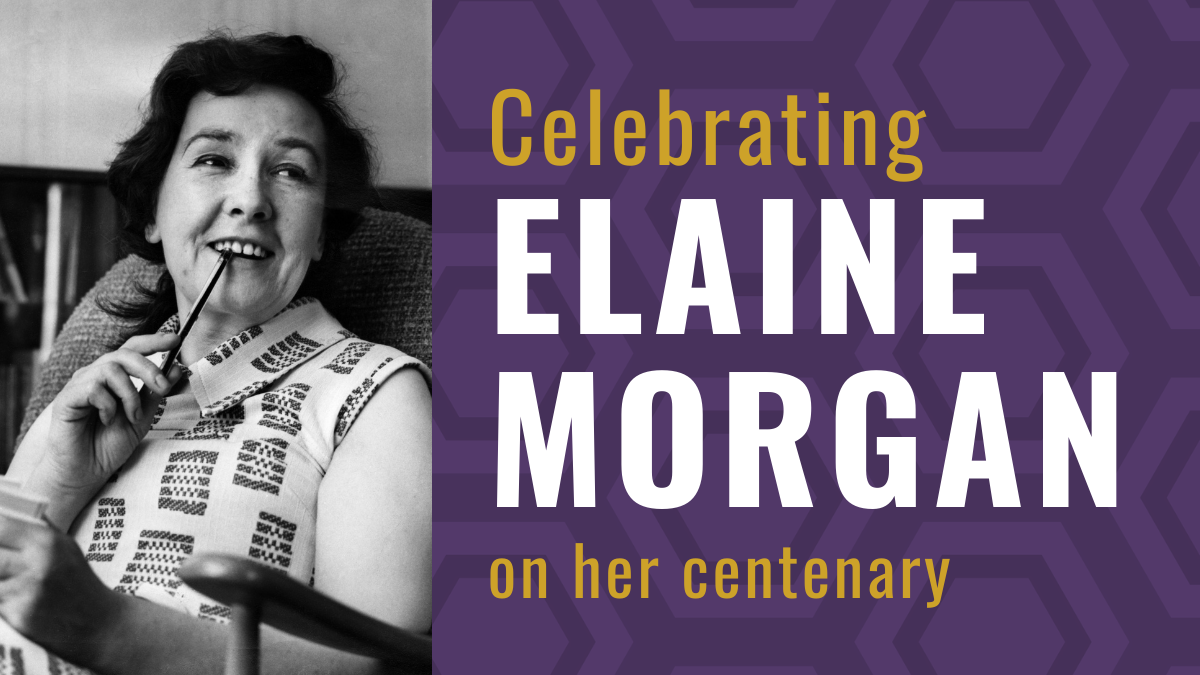
Elaine Morgan (1920 – 2013) was a pioneer. Born into a working-class family, she was the first person from her school in Pontypridd to go to Oxford University. She went on to pursue multiple careers, first as an award-winning TV writer, then anthropologist, whilst maintaining a role in political activism throughout her life. Daryl Leeworthy, author of Elaine Morgan: A Life Behind the Screen, introduces us to this extraordinary writer on the eve of her centenary.
This informative biography restores Elaine Morgan’s reputation and establishes her significant place in writing from Wales. Richly detailed it is essential in understanding the life and work of this important writer.
“A scintillating new biographical study, impressively researched and elegantly written.” – Dai Smith
“Thanks to this book… many more can take inspiration from Elaine Morgan and a legacy that spans both arts and science. In this, her centenary year, there can be no more fitting tribute.” – Carolyn Hitt
Elaine Morgan has always been a hero of mine.
I suppose I first heard her name when I was in secondary school – we went to the same one. To me it was Coedylan Comprehensive, to her Pontypridd Intermediate School for Girls; these days Pontypridd High. One of my teachers, whose own life had been so influenced by Elaine’s iconic feminist book, Descent of Woman (1972), pointed out to me that being someone from ‘our town’ studying at Oxford not only brings great opportunities but also sets you on a path set down by one of Wales’s truly great writers. A national treasure.
Elaine Morgan at matriculation, autumn 1939 – front row, second from left. By Kind Permission of The Principal and Fellows of Lady Margaret Hall, Oxford.
That idea of Elaine has stuck with me over the years. When I set out to research Elaine Morgan: A Life Behind The Screen, I knew that I wanted to look more carefully at her screenwriting and her contribution to our collective sense of the valleys and their people – those aspects of her career now very much overshadowed by the aquatic ape theory and Elaine’s undoubted contributions to popular anthropology. How, I wondered, did Elaine get her break at the BBC; how did she fit into an overwhelmingly masculine world; and how did she reach the top all from a desk in South Wales – a feat that seems so impossible nowadays.
Seeking the answers to those questions took me to the BBC’s written archives near Reading, a marvellous building with truly wonderful staff, where you half expect George Smiley to wander through the corridors. Out of Elaine’s voluminous files came letters sent back and forth to producers like Donald Wilson, Michael Barry, Sydney Newman, and Verity Lambert. The Doctor Who fan in me got very excited when I saw their names! Writers such as Gwyn Thomas and Dennis Potter were mentioned with casual ease. And there were occasional tête-a-tête when Elaine felt she was being undervalued – and underpaid – because she was a woman. The writer who emerged from those files was strong-willed, determined, and keen to learn. She was every bit the feminist my teachers had told me about.
The greatest finds in those files related to Elaine’s debut serial – now lost from the television archives – A Matter of Degree. First broadcast on the BBC in 1960, it told the story of the Powell sisters, and their experiences of South Wales and Oxford. Like the producers who brought it to the screen, I could not help but read an autobiographical presentation of Elaine’s life. She had always maintained that she loved Oxford, but here was the clash of cultures so familiar to me and to many others who have gone up from the valleys to those dreaming spires. Here was a kind of sequel to Emlyn Williams’s famous play The Corn Is Green (1938) but which anticipated the famous television serials of Oxbridge life, Brideshead Revisited (1981) and Porterhouse Blue (1987), decades before they were aired. This was Elaine Morgan, then, the television pioneer.
There was, I discovered, another side to Elaine, too – her politics. She grew up in a household which read the Labour-supporting Daily Herald and her own political activity took her to the pinnacle of student activism whilst she was at Oxford and into circles which included Clement Attlee and Roy Jenkins. Then she worked for the Workers’ Educational Association, just like Gwyn Thomas and Raymond Williams. As a young mother, she kept up her public activism and at one point taught for the Extra Mural Department of Manchester University. She helped to set up the United Nations Association in Burnley and led the town’s first celebrations of International Women’s Day. She even joined the Communist Party, although later returned to the Labour fold. Her radicalism had its fullest expression in a passionate belief in nuclear disarmament, in combatting climate change and humanity’s exhaustion of the planet’s natural resources, and in the campaign to ensure the survival and vibrant future of the Welsh language.
But, of course, if we are to remember one thing about Elaine Morgan on this, her centenary, it is her contribution to the women’s movement and to the self-belief that all women, regardless of their origins, can reach the top. Though she is not traditionally remembered as a historian, her television work, her radio broadcasting, her teaching, and her activism, all contributed to the active recovery of women’s collective, historical experience. In those decades of the twentieth century when Welsh women were absent from parliament, from leadership roles, from the apex of public life, Elaine Morgan stood out. She understood this and made the most of her remarkable influence.
In many respects, Elaine Morgan was the embodiment of what I like to think of as the ‘South Walian Dream’. She took the opportunities afforded her by an education which lasted for as long as she wished, but never forgot her origins. Never lost sight of the fact that she had grown up in a small terraced house in Hopkinstown. Never lost her ear for the rhythm of the valleys and their people. Alongside Gwyn Thomas, she helped to define what Wales meant for television and radio audiences all over the world. Whether as the pensioner, the playwright, the protester, the poet’s muse, or the student politician, Elaine Morgan was determined to say to her own community, to her own people, first and foremost, it does not have to be this way.
Join us for the virtual launch of this important new biography on Wednesday 11 November at 7pm. Author Daryl Leeworthy will be in conversation with Carolyn Hitt. Register for FREE via Eventbrite https://www.eventbrite.co.uk/e/125898462691.
Ed Beech is one half of Beech Building Services. He’s also a keen cook. Today we’re sharing his recipe for Orkney Fish Pie, one of his favourites. Here’s everything you need to organise prep do done.
Orkney Fish Pie
What you need.
A jug of milk.
Some shallots.
Three average cloves.
Eight hand picked Orcadian scallops.
A fillet of fresh Orcadian caught white fish, preferably tusk.
A small bag of smoked Orcadian mussels.
A lump of butter about the size of a lemon.
A lemon.
Two saucepans.
Some flour (enough to cover the palm of your hand).
Half a dozen tatties of varying sizes.
Knives and spoons.
A bowl of grated Westray Wife cheese.
An oven.
Sea salt and coarsely ground pepper.
Wine.
Nutmeg.
Jazz.
An ovenproof dish.
A cat.
What you need to do.
Put the cat out. Pour the milk into a pan, add the chopped shallots, the cloves and some salt and pepper. Cook the fish in this mixture for a couple of minutes and then let it cool and infuse for half an hour. Drink some wine.
Boil the tatties, mash them with butter, fresh milk and a fistful of the cheese.
Remove the fish from the milk mixture and set aside. Melt the butter in a pan, slowly add the flour and then stir the strained infused milk into the mix until you’ve got a good looking sauce. Let the cat back in.
Pour some of the sauce into an ovenproof dish and add some chunks of fish, four scallops and some mussels. Add some more sauce, the rest of the fish, scallops and mussels, and pour in the last of the sauce. Put the cat out again.
Spread the mash over the top, cover with some more cheese and bake until it’s bubbling and smells right.
Serve with the lemon, a small heap of spinach, some Dave Brubeck and a glass of Sauvignon Blanc. Cloudy Bay from New Zealand for preference. Let the cat in again. Remember that you forgot to grate the nutmeg over the mash before you put it in the oven. Drink some more wine. Do the washing up.
Ed Beech is one half of Beech Building Services. He’s based in Bermondsey but no job’s too small, no distance too great. So when he’s asked to do some work on a house in Orkney, he loads the van with paint, tools and sandwiches, and takes off. He gets nervous around farm animals and large ships, and he’s never been so far north, but when he’s joined by Claire, his client’s city banker sister, he discovers that in Stromness, anything is possible.
Create your free Seren account and enjoy 20% off every book you buy from us.
We’re hosting the virtual launch of The Stromness Dinner next week on Wednesday 4 November. Peter will be in discussion with Duncan McLean followed by a live audience Q&A so come with your questions ready. Register for FREE via Eventbrite https://www.eventbrite.co.uk/e/122383543473
Ahead of the launch of her debut short story collection A City Burning, we interview Angela Graham to find out more about the book and what inspires her.
In the twenty-six stories inA City Burning, set in Wales, Northern Ireland and Italy, children and adults face, in the flames of personal tragedy, moments of potential transformation. On the threshold of their futures each must make a choice: how to live in this new ‘now’. With a virtuoso control of tone, by turns elegiac, comic, lyrical, philosophical, A City Burning examines power of all types. The result is a deeply human book full of hauntingly memorable characters and narratives.
What is the meaning behind the title A City Burning?
In the opening story, ‘The Road’, a young girl witnesses her city blazing. She understands that this is a sign of the collapse of the status quo, of all the usual certainties. She is confronted with the need to react to this new situation. What values should guide her in this choice? I realised that this story encapsulates the theme of many stories in the collection – witnessing major change and having to work out a response. It seemed a fitting title for the book.
There is a theme of change in this collection, what, if anything, do you hope the reader can take away from this underlying message?
I haven’t thought in terms of such a message – at least, not while I was writing the stories. It wasn’t until late in the day that I saw that facing change was a link between them, and it took someone else, an editor, to point that out. In an important sense, I had to understand my own work from a more objective perspective. I’d like readers to recognise that ‘the given’ (whether positive or negative) can break down in very noticeable and in very subtle ways. One person sees a city burning, another sees some detail in a single photograph that opens their eyes. Usually, I believe few such opportunities for perception appear out of the blue. We have usually been sensitized to a shift in circumstances but we may be unwilling or unable to respond at an earlier point.
I’ve just looked up the etymology of ‘catastrophe’. The word comes from kata- ‘down’ + strophē ‘turning’. I imagine that as the point at which a wheel, goes into its irreversible downward momentum. We have watched the wheel move upwards and we know something has to give but we are not always prepared for it.
Words Flowering at Ty Newydd
There are a lot of different settings and ideas conveyed in these stories. Where do you draw your inspiration from?
Anywhere that’ll have me! To give an example, the story, ‘Life-Task’ which is set in northern Italy at the end of the Second World War came to me because a person who had just retuned from Italy recounted a story she’d been told by someone who’d had it from someone who’d heard it from the actual protagonist. It must have been brilliantly told originally to be so vivid (after passing through several tellings in this way) for it to reach me so powerfully that I could see the events as the story was shared with me. I went home and wrote it down. Of course, it helped that I had, for completely other reasons, been doing research into post-war Italy, had read Italian novels on the subject, and taken a particular interest in what happened in northern Italy when the Germans (the allies of the Italians) had been defeated. And, in writing a story, one has to aim for a satisfying balance between all the elements. This may introduce material which is not part of ‘the original’.
Do any of the stories draw on personal experience?
This is a book of fiction. It’s not memoir or autobiography. It’s all made up. But it’s true to experience, my own and that of many others.
Coasteering near Dunluce Castle, Co. Antrim
You engage with a number of different languages in the book including Ulster Scots in the story ‘Coasteering’. Why was it important for you to foreground these languages in the collection?
I have always been interested in languages and I’ve worked in Wales for a long time, a country where two languages are in use alongside each other. I learned Welsh as soon as I moved to Wales when I married a Welshman. In Northern Ireland I had much experience of the link between language and identity; even nuances of accent, in a city such as Belfast, are sifted for meaning. Whenever a chance has presented itself to get involved with a language I’ve tried to take it. For example, I did a crash-course in Romanian as part of the writing of a screenplay set in that country and it made a big difference, when I was researching there, that I could follow what people were saying. I learned Italian by ear when I was a teenager and, again, I wrote a screenplay, set in Puglia. Most of the time, people are pleased that one has made an effort to allow them to stay in the language in which they are most comfortable, most ‘themselves’.
In regards to Ulster Scots, that fascinates me. I have written the first draft of a novel in which two major characters are Ulster Scots-speakers and language, including Irish, is key to the book. Clashes over language and culture are deep-rooted in Northern Ireland but there is also great potential to overcome seeing language as an obstacle. I’ve worked with a number of Ulster Scots writers. My father’s family are Ulster Scots. It’s important to me that Ulster Scots takes its place in contemporary literary fiction.
Words from Ulster Scots displayed at the Seamus Heaney Centre, Bellaghy
What is your favourite story and why?
The Road. In its 800-or-so words I’d like to think it pushes that wheel up out of catastrophe; gives it a push into an upward turn.
You’ve added some new stories based on the pandemic in the last few months. Why did you decide to write about it and were they hard to write?
They were not hard to write in that I was fuelled by indignation at the plight of low-paid workers whose interests were not given proper consideration. I have personal experience of the ‘worlds’ of both stories and I felt able to depict them forcefully. I checked out facts, naturally, but the internal impetus was immediate. Once again, it seemed to me, the people who are considered ‘least’ in our society − least important, least powerful − were receiving least attention, whereas if their needs were a priority we’d have a better balanced society in which to live.
You turned to writing full time a few years ago. How did you first get into writing and what has it been like working up to publication of your debut collection during the pandemic?
I committed solely to writing because I was busy with media work and I felt the need to sharpen my focus. Writing is what I have always done, since I was about six years old. My first poem was published in a mainstream magazine when I was seven and I wasn’t one bit surprised at the time. I knew that was what magazines were for – publishing stuff. I had a very child-like view of things. Of course. Very naïve. It’s by no means easy to get work published. And that’s a good sign – there are so many exceptionally talented writers.
I’ve always written but usually for the screen. I’ve done journalism and radio work and non-fiction tv tie-in work and poetry. A City Burning is my first chance to pull a substantial amount of fictional material together into a coherent whole.
Once I’d negotiated the early days of the pandemic – the practicalities − the pandemic (because I was lucky to stay well) made no great difference to the practice of writing at a desk. There were fewer distractions. But there was no access to libraries and I had planned to do an in situ major piece of writing for a month and the restrictions made that impossible. I had to re-invent the form of the work. It’s a book on my childhood in Belfast, partially supported by a Support for the Individual Artist Programme award from the Arts Council of Northern Ireland and the National Lottery.
Acquiring a cover photo was hard in the circumstances. It would have been lovely to have had the launch I had been hoping for in Belfast’s No Alibis bookstore and I would have had a small one in Ballycastle, County Antrim which is where I’ve spent lockdown. Ballycastle Library is accepting a copy of the book, I’m pleased to say. Filming and editing a promotional video had to be done by ingenious means by my director husband, John Geraint. Sending paper proofs back and forth was interesting because of blips in the postal service. But the attention from Seren’s staff has been the key thing and that was undiminished.
Create your free Seren account and enjoy 20% off every book you buy from us.
Join us tonight for the virtual launch of A City Burning which starts at 7pm. Angela will be in conversation with Phil George and there will be readings from the book by Viviana Fiorentino, Liam Logan and Geraint Lewis.
By turns laugh out loud funny and deeply sad, The Amazingly Astonishing Story is a frank and surprising look into a child’s tumultuous mind, a classic story of a working-class girl growing up in the 60s. Her Catholic upbringing, a father torn between daughter and new wife, her irreverent imagination and determination to enjoy life, mean this really is an amazing story (including meeting the Beatles).
“The saddest, happiest, funniest book I’ve read for ages” – Dawn French
“In her own real life story she excels herself… she’ll have you in tears, barking in anger, and laughing out loud in the space of one beautifully crafted sentence.” – Kevin Whateley
One of the questions writers grow used to, and tired of, and flummoxed by, is “What makes a writer?” and another one is “Where do you get your ideas from?”
The answers I give are usually apologetic shrugs followed by lame and unsatisfactory suggestions, because both those questions are unanswerable. Until now. From now on, in answer, I can point to this book and say “I think the clues are in there.”
This book tells, of course, just the beginning of a long and eventful life. It’s a start, you could say.
Dickens was onto something when he said “It was the best of times, it was the worst of times.” That’s life. And my life has been an adventure from first cry right through to now and Covid, losing my mother at 7, living through a crash landing at Orly Airport, nearly drowning in the Med, surviving a boating disaster in one of the busiest shipping lanes in the world, coming off a motorbike on an icy road, spending Christmas Eve in a small tent in a gale on Beachy Head, going through a divorce, being broke, marrying again, becoming a Mum, winning The Richard Burton Drama Award, being widowed at 43, and going on from there to have a successful and happy career as a dramatist.
This morning, at 71 years old, I stood on the beach, deafened by the roar of the wind, under a wild and beautiful sky, and it was as if I saw myself, on this small stretch of sand, on the edge of an ocean, and then as if I saw beyond and beyond – to the billions of stars and suns and moons and the wildness of the cosmos. My eyes saw waves and sky and wheeling gulls, but my mind saw everything. My wonderful mind. Your wonderful mind. Our minds, eh? They reach out to each other. That’s what this book does. It reaches out. I hope it finds you.
I wrote it for many reasons, but the essential hope was that it would show that from the coldest of beginnings, life can spin into something rich and warm and wonderful. To say that there is more to every life than whatever we are going through at this moment, that the future can be tumultuous and exciting, and even that in the middle of loneliness or need , we all have wonderful internal worlds, we can carry on a funny, loving conversation within our own minds, we can reach out and sense the eternal and the wonderful life force. We can meet that life force. We can meet God.
A rich life is made up of the best and the worst, both the greatest joy and the deepest sorrow. I am very, very blessed to have had both in great big spadefuls and I wouldn’t change a single day or hour of it, and I wouldn’t miss out on meeting any of the rich characters in all the crazy episodes along the way.
So, should I have called this memoir “The making of a writer”?