Posted on

Angela Graham: Sanctuary – A Year On

Left to right: Angela Graham, Phil Cope, Viviana Fiorentino, Mahyar, Csilla Toldy, Glen Wilson

A year on from publication of her collection Sanctuary: There Must Be Somewhere, Angela Graham reflects on the creation of this innovative poetry collection and on what she has learned from readings.

Sanctuary – A Year On

May 30th 2023 marks the first year in the life of my first poetry collection, Sanctuary: There Must Be Somewhere. I’d like to consider what I gained from taking that step in the company of five other poets and what I’ve learned from reading from the collection to audiences.

This cover shows a digital image of a human fingerprint in different shades of blue. The text reads: Sanctuary There Must Be Somewhere. Angela Graham with Phil Cope, Viviana Fiorentino, Mahya, Csilla Toldy and Glen Wilson.

I hardly need to state how sanctuary preoccupies the whole world. It was clear to me that the book should not be a solo effort but one undertaken with other poets so that the collection itself would be a welcoming space, a kind of sanctuary.

I sought out two poets from Wales and two from Northern Ireland (as I live in both places) who had some expertise in an aspect of sanctuary. They were not obliged to write on that theme. Furthermore, rather than giving a poem they had written, they would each write a poem with me. This deeper level of collaboration, although challenging, proved very fruitful.

It wasn’t until the reviews started coming in that I realised quite how unusual my approach was considered to be.

“Graham’s project is hugely experimental — few poets give space in their debut collections to others… as praxis, the project seems politically perfect, an unselfish poetic gesture underlining the ‘unevenness’ of sanctuary that is genuinely thought-provoking.”

Tim Murphy, London Grip

“the poems… are very finely wrought, whether by Graham or by her guests.  This is a generous inclusion, of course, but Graham is a poet who is skilled and sublime enough, I imagine, not to feel any threat from it or, indeed, from anyone or anything at all.”

Mab Jones, Buzz Magazine

To me, poetry is one of the most intimate means of bridging the gap between one person and another, usually between the poet and reader or listener. It seems natural to me to want to achieve another kind of intimacy, in this case, during the actual process of creating the poem. I pay unreserved tribute to Phil Cope, Mahyar, Viviana Fiorentino and Csilla Toldy who allowed me to reflect on drafts with them; who were never defensive; who showed, to a remarkable degree, the humility of the true artist whose care is about the work in hand and not their own ego. I have gained immeasurably from being part of this whole-hearted process and consider myself very fortunate.

In addition, my mentor, Glen Wilson was tactful and committed and I am delighted that he gave a fine poem to the book. I was very moved when Glen sent me a recording of a beautiful song he composed called, There Must Be Somewhere. I felt this was evidence of how the theme and experience had entered him, to emerge from him afresh as something beautiful in a new medium. He performed this at the launch during the Belfast Book Festival in June last year. Covid kept Viviana away entirely and Csilla had to join via video but it was none the less wonderful to be together as a group.

All this hasn’t made me feel the book is any less mine. It has expanded the whole work without taking anything away from me.

Photograph of trees reflected in the still waters of an underground well.
Photograph of St Cooraun’s Well, Ireland. Copyright Phil Cope

The book in performance has been a revelation to me. I am a TV/film producer by trade so the audience comes first. If they can’t hear, are uncomfortable, or baffled then it’s a waste of everyone’s time. In a reading people can’t see the text so I have greatly enjoyed working out how to convey things that are clear on the page via quotation marks or italicisation, for instance, or by means of a line-break or capitalisation. The importance of poem titles has become more evident and the fact that they are an important poetic resource to be exploited.

I’ve tried to design the performance to suit the audience rather than develop an unchanging ‘act’. It’s true one sometimes has no idea of the nature of the audience so there has had to be some smart footwork occasionally! Recently I was asked, at half an hour’s notice, to read to a group of no-nonsense Belfast women at a reconciliation centre. I could tell at once that they would see through anything that was less than authentic and that I had to take very particular care to give something of my life, in addition to the poems.

I learnt a lesson there about how important story is. I had set out the background to a poem which is to do with an unsolved mystery in my family. After the final poem, when I made to leave, a cry went up, ‘Don’t go! Tell us what happened.’ I had moved on, in terms of my reading, but that desire to know how things end, which is, in essence, a desire to know the truth, was in my listeners’ minds and they wanted it satisfied. So the writerly me realised that there, in that mystery and its resolution, is a key element of the book I’m currently editing. I hadn’t appreciated its appeal.

In several sessions I have brought typescripts of poems or used power point to set out text and also used images and videos. An audience of poetry lovers is more experienced in listening to poetry than a more general mix of people. The latter, so far, in my experience, welcome some help in encountering what is not, to them, a familiar medium.

I was Author of the Month in December last year for Libraries Wales and this gave me the chance to meet a variety of audiences. In each case, the librarians were very helpful because they know their clients. They devised materials that would appeal. In Bargoed we had beautiful printed cards, showing one of my Christmas poems.

Angela Graham and four other people standing in Bargoed Library. The photo takes in the high wooden ceiling and balcony above them.
Angela Graham with staff at Bargoed Library

In Llanelli library the experience was particularly communal even though the group were strangers to each other. I think this was because of something I’ve done in every reading. I start by inviting people to take sixty seconds to consider what ‘sanctuary’ means to them. This unlocks a fascinating range of experience. When I read my poems, perhaps they enter that internal space whose door has been pushed ajar by those intimate reflections.

The final two poems in the book go together well. ‘There Must Be Somewhere’ attempts to face the brutal facts of how dangerous life is yet how faith in the possibility of sanctuary exerts itself nonetheless.

and though the innocent fox has his earth
and the birds of the air their nests, we are un-homing
ourselves and ravaging even our own minds.
Yet we hope for sanctuary, a nook out of the wind,
shelter in the cwtch of someone’s overcoat,
a harbouring gaze, if nothing else.

The final poem, ‘Home’ shares the greatest lesson I’ve learned from writing the book: sanctuary may be a place but it’s also something we can be.
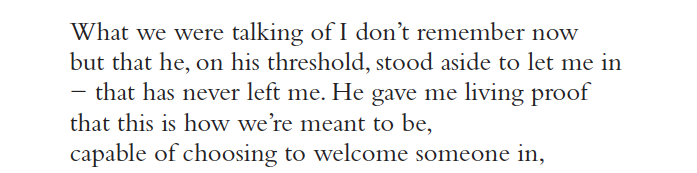
What we were talking of I don’t remember now
but that he, on his threshold, stood aside to let me in
− that has never left me. He gave me living proof
that this is how we’re meant to be,
capable of choosing to welcome someone in,

Angela Graham

Angela Graham has a poem published in a chapbook edited by Phil Cope called The Oldest Music (Parthian), published May 2023.

Her poem ‘The Irish Civil War, County Tipperary, Summer, 1922’ is currently touring Ireland as part of Poetry As Commemoration’s Poetry Juke Box curation. It is one of 10 poems selected from the whole of Ireland and is in Limerick and Derry as of 19th May. This major initiative marks the Decade of Centenaries, 1912 – 1922, one of the most turbulent in Ireland’s history.

You can also watch an NVTV documentary about Angela’s poetry in Ulster-Scots here.
Posted on

Friday Poem – ‘Consider’ by Angela Graham

This week’s Friday Poem is ‘Consider’ by Angela Graham from her collection Sanctuary: There Must Be Somewhere.

Sanctuary is – urgent. The pandemic has made people crave it; political crises are denying it to millions; the earth is no longer our haven. In Sanctuary: There Must Be Somewhere, Angela Graham and five other writers from Wales and Northern Ireland, addresses the many meanings of sanctuary from the inside. How we can save the earth, ourselves and others? How valid is the concept of a ‘holy’ place these days? Are any values still sacrosanct? We all deserve peace and security but can these be achieved without exploitation?

With Phil Cope, Viviana Fiorentino, Mahyar, Csilla Toldy and Glen Wilson

Consider
Why do you still call me ‘refugee’?
Do you want me to be forever fleeing?
I have fled. Now I am here,
trying to keep both feet on the ground
and find my balance.
Sometimes I feel I have two hearts.
One, the first-created
− taut as a drum-skin in my chest −
trembles at far-off shifts of energy
in the fault-lines of the home I left.
The other has grown itself around the first
as lymph spreads on the surface of a wound;
as albumen, fragile, tremulous,
helps a new life mesh itself together
somehow.
I was a refugee. Now I am here
where I have to do so much explaining,
where I have to live so much on your terms
and I am growing this second heart
as bravely as I can.
Where I came from will always be
where I come from
and now I come from
− and so let me be −
here.

Sanctuary: There Must Be Somewhere is currently: £4.99 in our January Sale

Create your free Seren account and enjoy 20% off every book you buy direct from us.

Watch Angela Graham reading her poem ‘Home’ on our Youtube channel:

Posted on

Short Story of the Month – ‘All Through the Night’ by Angela Graham

Our new short story of the month is ‘All Through the Night’ by Angela Graham from her debut short story collection A City Burning.

A man looks back to the night his marriage reached its tipping-point on a cliff-top in west Wales.

A city burns in a crisis − because the status quo has collapsed and change must come. Every value, relationship and belief is shaken and the future is uncertain.

In the twenty-six stories in A City Burning, set in Wales, Northern Ireland and Italy, children and adults face, in the flames of personal tragedy, moments of potential transformation. On the threshold of their futures each must make a choice: how to live in this new ‘now’. 

The story ‘All Through the Night’ was first published in the Irish journal Crannóg which nominated it for the prestigious Pushcart Prize in 2019. 

This is an excerpt, read the full story for FREE on the Seren website here.

All Through the Night

I look back now with a kind of dread, yet dread is about the future, about what’s going to happen, not what has already happened. So I dread…? The memory of pain.
          I never thought of myself as a man given to gestures. Imagination I do have, but I tend to keep it to myself.
          I remember the road: the little road under the starlight that summer. It was the year Mam and Dad sold the farm. I didn’t want it. They kept the farmhouse and the little bwthyn that had been the kernel of the homestead. You and I had used it for years already for holidays with the kids. They loved its thick walls and deep window-ledges.
          At Clogwyn Uchel, on the very edge of Wales, the roads are dark (some of them are tracks, really) and the stars sort of spread themselves out overhead, display themselves, with a careless glamour; or like something much more homely, like sugar spilt across a slate, but up there, up above. A sprinkling of sugar overhead. Very confusing if you thought about it too much. And higher into the sky – it’s hard to describe! – there’s a hazy cloud of them.  Growing up at Clogwyn Uchel and I never bothered to learn much about them. Anyway, the stars do what they do whether we notice them or not. They’re not waiting for our attention.
          On a clear night like that one they shed enough light to see your way and the chalky ground of the lane helps. It’s a glimmering path up to the bwthyn, reflecting light from far, far above. Sometimes it even seems to me as though a bit of the sky has dropped to earth because the little white stones are like a rough and tumble Milky Way between the hedges.
          You walked ahead of me, Mari. Blindly, I thought. Or like someone who’d been dazzled by something. Your feet took you.
          Your mind? Numbed.
          Probably. We all have to do so much guess-work about each other! What is she feeling?  What will she do next? What does she want?
          “Do you love him?” I called out. But you didn’t stop, or look back, or speak. I’m sure you heard me. You went on, into the little house.
          I couldn’t. I walked around it to where the sea suddenly presents itself. A shock! Always. Always that shiver at finding yourself on the edge of a cliff. Acres of water ahead in a dark mass. The endlessness of the sea. It doesn’t stop. It goes about its business, rushing and crushing, floating boats, flexing itself. That night it was shuddering.
          The stars. Some flung themselves down the sky. Mad bastards. Most looked on in a dignified way, blinking mildly at this recklessness.  And I thought of the song. Its beautiful tune.
          Holl amrantau’r sêr ddywedant
          Ar hyd y nos.

          Ar hyd y nos. All through the night.
          Nothing like the crappy English version.  Sickly-sweet, that.  And boring. “Soft the drowsy hours are creeping… visions of delight revealing… hill and vale in slumber steeping”. And the stars don’t get a look-in! Not a mention. You pointed that out to me. When you were learning Welsh. “How come…?” you asked. You were always asking that. “Why is the verb here? Why do I have to say…?” Whatever.
          And I’d say, “It just is, Mari. I don’t know why. Ask your teacher, cariad.  Gwyn knows all that stuff.”
          Yes, he did, didn’t he?

Finish reading ‘All Through the Night’ on the Seren website here.

A City Burning is available on the Seren website £9.99

Create your free Seren account and enjoy 20% off every book you buy from us.

Posted on

An interview with Angela Graham

Ahead of the launch of her debut short story collection A City Burning, we interview Angela Graham to find out more about the book and what inspires her.

In the twenty-six stories in A City Burning, set in Wales, Northern Ireland and Italy, children and adults face, in the flames of personal tragedy, moments of potential transformation. On the threshold of their futures each must make a choice: how to live in this new ‘now’. With a virtuoso control of tone, by turns elegiac, comic, lyrical, philosophical, A City Burning examines power of all types. The result is a deeply human book full of hauntingly memorable characters and narratives.

What is the meaning behind the title A City Burning?

In the opening story, ‘The Road’, a young girl witnesses her city blazing. She understands that this is a sign of the collapse of the status quo, of all the usual certainties. She is confronted with the need to react to this new situation. What values should guide her in this choice? I realised that this story encapsulates the theme of many stories in the collection – witnessing major change and having to work out a response. It seemed a fitting title for the book.

There is a theme of change in this collection, what, if anything, do you hope the reader can take away from this underlying message?

I haven’t thought in terms of such a message – at least, not while I was writing the stories. It wasn’t until late in the day that I saw that facing change was a link between them, and it took someone else, an editor, to point that out. In an important sense, I had to understand my own work from a more objective perspective. I’d like readers to recognise that ‘the given’ (whether positive or negative) can break down in very noticeable and in very subtle ways. One person sees a city burning, another sees some detail in a single photograph that opens their eyes. Usually, I believe few such opportunities for perception appear out of the blue. We have usually been sensitized to a shift in circumstances but we may be unwilling or unable to respond at an earlier point.

I’ve just looked up the etymology of ‘catastrophe’. The word comes from kata- ‘down’ + strophē ‘turning’. I imagine that as the point at which a wheel, goes into its irreversible downward momentum. We have watched the wheel move upwards and we know something has to give but we are not always prepared for it.

Words Flowering at Ty Newydd

There are a lot of different settings and ideas conveyed in these stories. Where do you draw your inspiration from?

Anywhere that’ll have me! To give an example, the story, ‘Life-Task’ which is set in northern Italy at the end of the Second World War came to me because a person who had just retuned from Italy recounted a story she’d been told by someone who’d had it from someone who’d heard it from the actual protagonist. It must have been brilliantly told originally to be so vivid (after passing through several tellings in this way) for it to reach me so powerfully that I could see the events as the story was shared with me. I went home and wrote it down. Of course, it helped that I had, for completely other reasons, been doing research into post-war Italy, had read Italian novels on the subject, and taken a particular interest in what happened in northern Italy when the Germans (the allies of the Italians) had been defeated. And, in writing a story, one has to aim for a satisfying balance between all the elements. This may introduce material which is not part of ‘the original’.

Do any of the stories draw on personal experience?

This is a book of fiction. It’s not memoir or autobiography. It’s all made up. But it’s true to experience, my own and that of many others.

Coasteering near Dunluce Castle, Co. Antrim

You engage with a number of different languages in the book including Ulster Scots in the story ‘Coasteering’. Why was it important for you to foreground these languages in the collection?

I have always been interested in languages and I’ve worked in Wales for a long time, a country where two languages are in use alongside each other. I learned Welsh as soon as I moved to Wales when I married a Welshman. In Northern Ireland I had much experience of the link between language and identity; even nuances of accent, in a city such as Belfast, are sifted for meaning. Whenever a chance has presented itself to get involved with a language I’ve tried to take it. For example, I did a crash-course in Romanian as part of the writing of a screenplay set in that country and it made a big difference, when I was researching there, that I could follow what people were saying. I learned Italian by ear when I was a teenager and, again, I wrote a screenplay, set in Puglia. Most of the time, people are pleased that one has made an effort to allow them to stay in the language in which they are most comfortable, most ‘themselves’.

In regards to Ulster Scots, that fascinates me. I have written the first draft of a novel in which two major characters are Ulster Scots-speakers and language, including Irish, is key to the book. Clashes over language and culture are deep-rooted in Northern Ireland but there is also great potential to overcome seeing language as an obstacle. I’ve worked with a number of Ulster Scots writers. My father’s family are Ulster Scots. It’s important to me that Ulster Scots takes its place in contemporary literary fiction.

Words from Ulster Scots displayed at the Seamus Heaney Centre, Bellaghy

What is your favourite story and why?

The Road. In its 800-or-so words I’d like to think it pushes that wheel up out of catastrophe; gives it a push into an upward turn.

You’ve added some new stories based on the pandemic in the last few months. Why did you decide to write about it and were they hard to write?

They were not hard to write in that I was fuelled by indignation at the plight of low-paid workers whose interests were not given proper consideration. I have personal experience of the ‘worlds’ of both stories and I felt able to depict them forcefully. I checked out facts, naturally, but the internal impetus was immediate. Once again, it seemed to me, the people who are considered ‘least’ in our society − least important, least powerful − were receiving least attention, whereas if their needs were a priority we’d have a better balanced society in which to live.

You turned to writing full time a few years ago. How did you first get into writing and what has it been like working up to publication of your debut collection during the pandemic?

I committed solely to writing because I was busy with media work and I felt the need to sharpen my focus. Writing is what I have always done, since I was about six years old. My first poem was published in a mainstream magazine when I was seven and I wasn’t one bit surprised at the time. I knew that was what magazines were for – publishing stuff. I had a very child-like view of things. Of course. Very naïve. It’s by no means easy to get work published. And that’s a good sign – there are so many exceptionally talented writers.

I’ve always written but usually for the screen. I’ve done journalism and radio work and non-fiction tv tie-in work and poetry. A City Burning is my first chance to pull a substantial amount of fictional material together into a coherent whole.

Once I’d negotiated the early days of the pandemic – the practicalities − the pandemic (because I was lucky to stay well) made no great difference to the practice of writing at a desk. There were fewer distractions. But there was no access to libraries and I had planned to do an in situ major piece of writing for a month and the restrictions made that impossible. I had to re-invent the form of the work. It’s a book on my childhood in Belfast, partially supported by a Support for the Individual Artist Programme award from the Arts Council of Northern Ireland and the National Lottery.

Acquiring a cover photo was hard in the circumstances. It would have been lovely to have had the launch I had been hoping for in Belfast’s No Alibis bookstore and I would have had a small one in Ballycastle, County Antrim which is where I’ve spent lockdown. Ballycastle Library is accepting a copy of the book, I’m pleased to say. Filming and editing a promotional video had to be done by ingenious means by my director husband, John Geraint. Sending paper proofs back and forth was interesting because of blips in the postal service. But the attention from Seren’s staff has been the key thing and that was undiminished.

Angela Graham on Ballycastle Beach, Co. Antrim

A City Burning is available on the Seren website £9.99

Create your free Seren account and enjoy 20% off every book you buy from us.

Join us tonight for the virtual launch of A City Burning which starts at 7pm. Angela will be in conversation with Phil George and there will be readings from the book by Viviana Fiorentino, Liam Logan and Geraint Lewis.