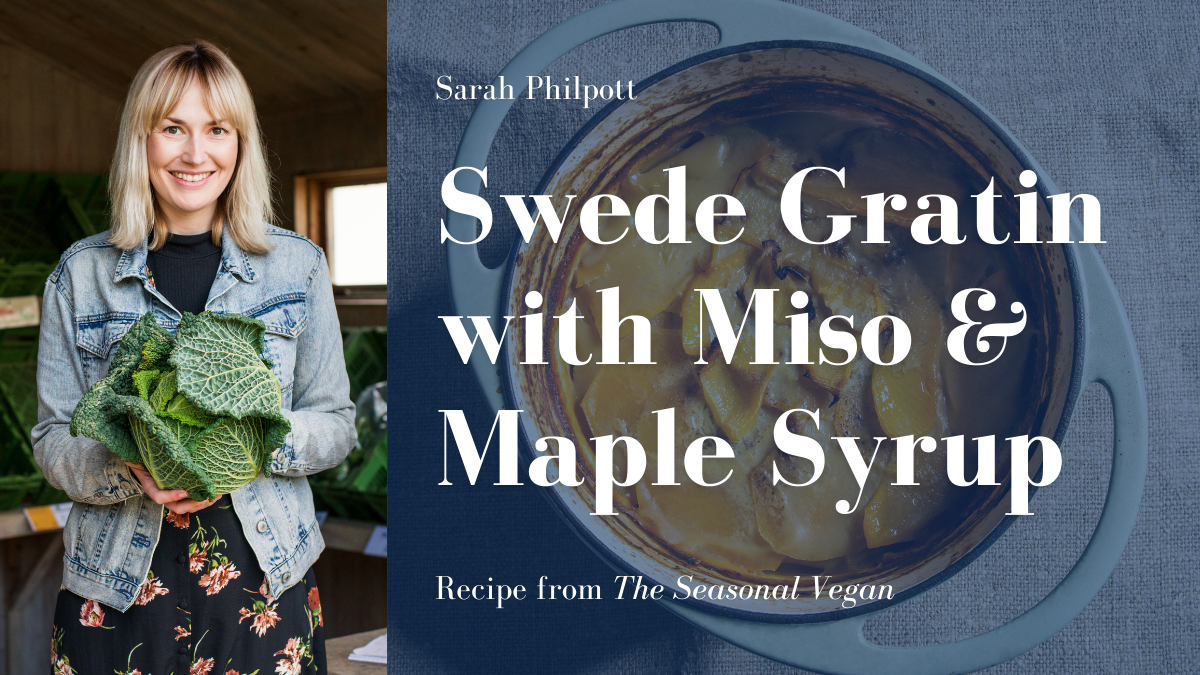
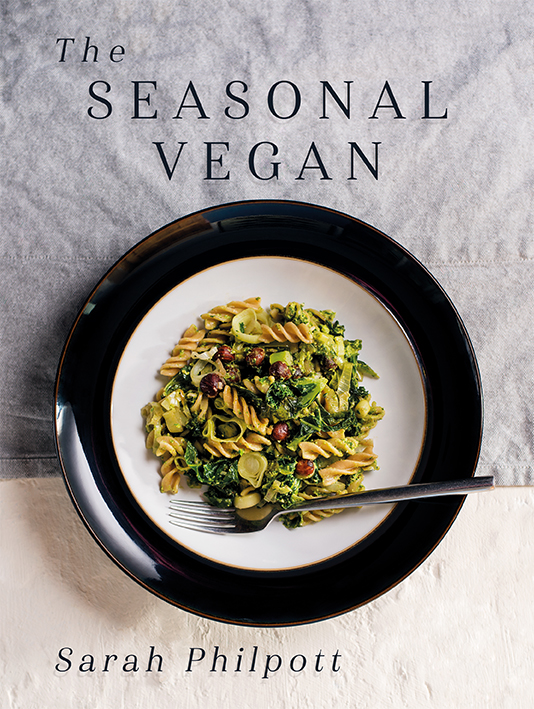
Are you trying Veganuary this year? The 70 simple but delicious recipes in The Seasonal Vegan by Sarah Philpott are a great introduction to a vegan diet and there are plenty of comforting dishes in the winter section to get you through the colder months like this hearty Swede Gratin with Miso & Maple Syrup.
The Seasonal Vegan is a kitchen diary of seasonal recipes with a delicious mixture of Sarah Philpott’s fine food writing and Manon Houston’s beautiful photography. This guide to eating with the seasons takes a realistic approach to shopping cheaply and sustainably and proves that the vegan lifestyle is anything but expensive.
2 large swedes, peeled and sliced thinly, lengthways
2 tbsp rapeseed oil
2 garlic cloves, peeled and crushed
3 tbsp plain flour
A generous pinch of salt
500ml oat milk
250ml vegetable stock
1 tbsp apple cider vinegar
2 heaped tsp white miso paste
2 tbsp maple syrup
Salt and pepper
A grating of fresh nutmeg
First of all, make the sauce. Heat the oil in a large saucepan over a medium heat, then add the garlic and sauté for 2-3 minutes, until soft and translucent. Add the flour and salt and stir rapidly. Cook for a minute, then gradually add the plant milk and hot stock and stir through, then add the miso paste, maple syrup and vinegar. Cook for another 5 minutes, stirring all the while. Try to get out all the lumps if you can.
Now, turn the oven on to 200C. Slice the swede thinly then use a little oil to grease a casserole or large ovenproof dish. Spread a layer of slices along the bottom and cover with some of the sauce. Add another layer of swede and add more sauce, then place a final layer of swede on top and season with salt and pepper and a grating of fresh nutmeg. Cover with a lid or foil and place on the top shelf of the oven. Bake for 45 minutes then remove the lid or foil and bake for another 25-30 minutes, until golden brown. For a really crisp topping, place it under the grill (lid off) for the final 5 minutes.
Why not also try Sarah’s other book The Occasional Vegan which contains 70 more easy, home-cooked recipes suitable for newcomers and long-time vegans alike.
If you’re still looking for a last minute gift, you can’t go wrong with Daniel Butler’s new book The Owl House. This pastoral exploration of mid-Wales is beautifully observed, full of evocative observations that can only have been lived to have been accrued. Here is a wintry extract from the chapter ‘Weather’.
Daniel Butler has lived in the Cambrian Mountains near Rhayader for twenty-five years, absorbing the world around him and charting its changes slow and rapid. His passion for the natural world was compounded when two wild birds, barn owls, nested at his farm. Through charting his relationship with the birds, he embarks on a pastoral exploration of his locale, rich as it is in wildlife of all kinds. His new book The Owl Houseis a rich and vivid portrait of one of the most remote and sparsely populated areas of Britain, broad in its horizons yet full of fascinating detail. The perfect gift for any lover of the natural world and mid-Wales.
…
Winter bird activity is not just about survival. I used to think the breeding season was a spring phenomenon, but for many creatures the concept seems to lurk as a constant background urge.
Even in the depths of winter there are signs of what’s to come. Mistle thrushes start to gang up towards the end of August in family groups which later join together to form small flocks. They give off their instantly recognisable football rattle calls as they bounce through the air above the fields, but by the end of the year these groups have disbanded. Instead of looking for the security of a flock to evade predators, the males are beginning to get a head start on next year’s breeding season. They do this by searching for a berry-laden food source. Indeed, the bird’s name comes from its fondness for mistletoe, that strange shrub, a living green sphere that hangs in bunches from the apparently lifeless limbs of oaks and apple trees. A glance at its fleshy white berries and strange green leaves and it isn’t difficult to see why the druids apparently venerated it as a sign of life in the depths of winter. The oak or crab apple host would be no more than a black skeleton, yet its passenger would appear the embodiment of life. Mistletoe is rare in Radnorshire, although it is common enough a few miles away in the acres of Herefordshire cider orchards.
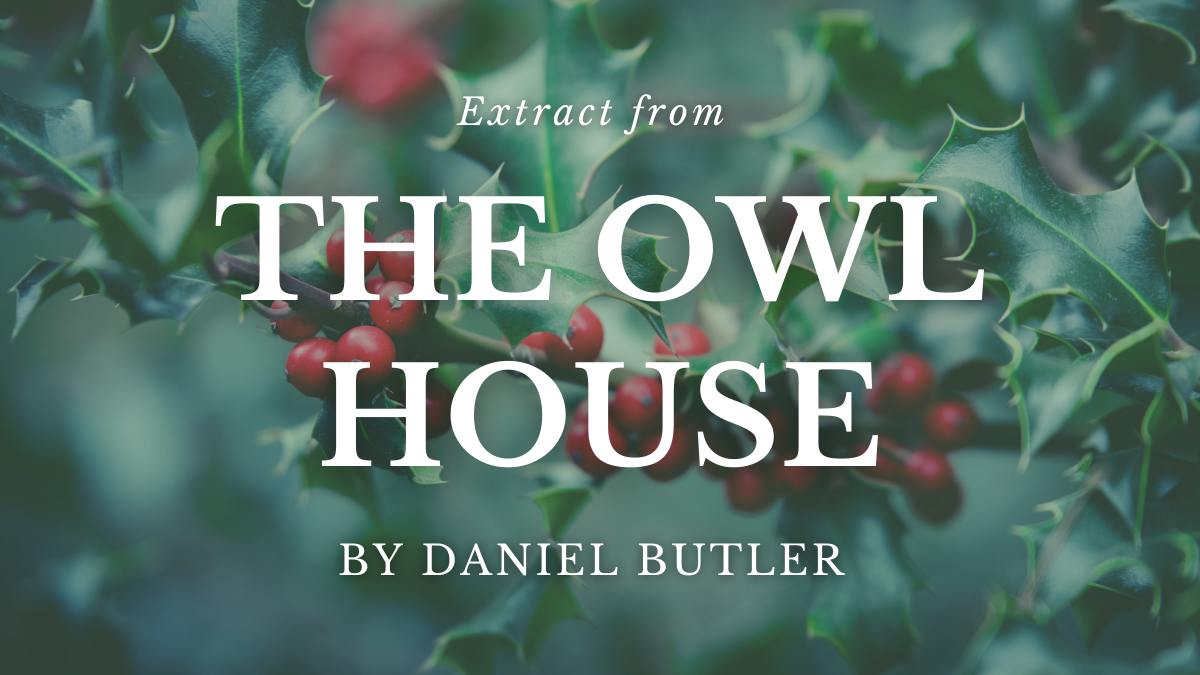
My mistle thrushes are drawn mainly by the lure of another tree beloved by pagans and one which is, if anything, even more associated with Christmas. There is a particularly splendid and always well-endowed holly halfway down the lane. The berries grow slowly all autumn, green and hard and invisible among the glossy spiked leaves until they burst into view by turning red seemingly overnight.
By the time I go to collect a few decorative sprigs in early December, there will already be a resident mistle thrush. His favourite perch is near the crown to gain a good vantage point. He sits here like a miser crouched over his hoard, jealously watching for thieves or rivals which may try to steal his crown. At my approach he flies off giving his characteristic rattling calls of alarm towards the row of neighbouring pines. He perches there and with binoculars I can just make him out staring warily at me, filled with terrors that his jewelled kingdom might be raided in his absence.
He is not always in the holly, however, sometimes he is lurking among the ‘sallies’ (goat willows) that straggle along the banks of the nearby stream. This probably indicates the proximity of a sparrowhawk or goshawk, and he’s waiting for the danger to pass. Normally he’s a pugnacious fellow, fiercely defending his scarlet treasure from a host of increasingly hungry thieves. His greatest ire is reserved for sexual rivals, but he will defend his prize from smaller redwings and fieldfares, doves and even wood pigeons. He does this by intimidation rather than actual violence, flying at them only to veer off at the last second. At stake is not just a precious food supply at the leanest time of year, but the implications this has for the breeding season ahead. The fatter and fitter he is at winter’s end, the better his chances of attracting the best mate, for any bird that can finish the lean months in good condition is clearly a good breeding prospect. So he spends the winter fighting for food and sex.
By Christmas tawny owls are also beginning to stake out breeding territories, hooting out their instantly recognisable ‘toowhit, too-woo’ calls and at about the same point the garden robins become increasingly evident. The clichéd seasonal card image of a robin on a snow-covered spade handle as a representation of the season of goodwill and peace couldn’t be further from the truth. These are testosterone-pumped pugilists, determined to fight all rivals. At first they are driven by the need to protect their food supplies and territories and will pick fights with any other robin – even potential future mates. Once, after a heavy snow fall, I was looking at the crowds of finches, tits and nuthatches hanging on the feeders outside the kitchen window when my eye was caught by flying puffs of snow on the back lawn. Two robins were scrapping in the soft powder, bouncing into view as they pecked and kicked in fury, only to sink almost out of sight whenever they paused. No sooner had the last tiny crystals fallen back, however, than the furious tussle would resume.
Yes you read that right, we’re already thinking about Christmas! We’re excited to announce the return of our annual Christmas Poetry Competition.
With only three months left until the big day, it’s time to put on your festive thinking caps and send in your best seasonal poems.
What’s the prize? The winning entry will be posted right here on the Seren blog as Friday Poem during December and you will also receive a Seren book bundle (your choice of fiction or poetry) and a small festive hamper.
How to enter? Upload your poem via our Google form as a Word Doc or PDF. The full rules, terms and conditions can be found at the top of the form.