Posted on

Books to read this Valentine’s Day

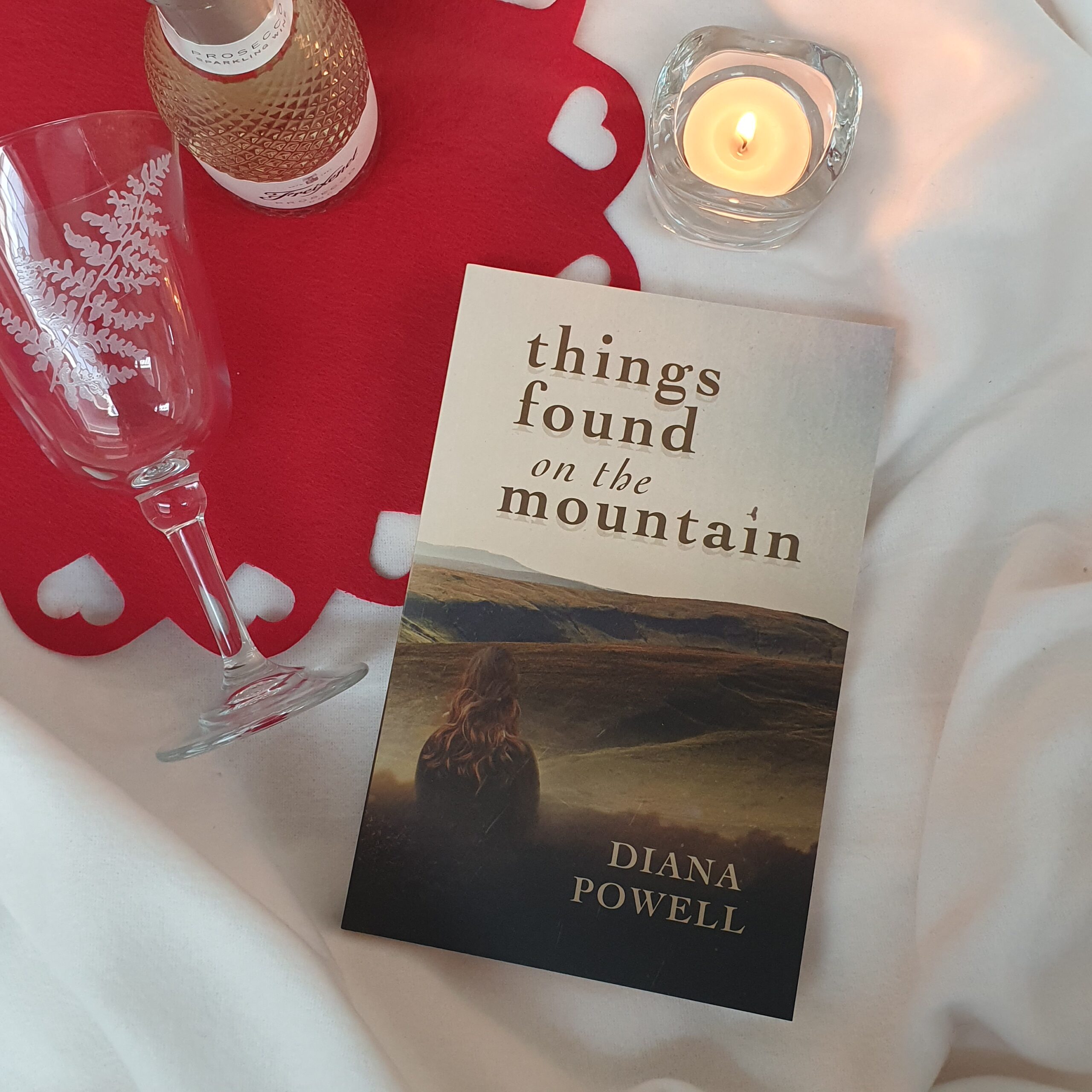
Photograph of Things Found on the Mountain laid out on a blanket with a lit candle and a small bottle of wine

Love can come in many forms, so in honour of Valentine’s Day, we’re highlighting a range of books which consider love in different ways. Shop here on our website or visit your local bookshop.

Things Found on the Mountain by Diana Powell

This cover shows an image of a young woman, facing away, looking out over the rolling hills of the black mountains. The text reads: Things Found on the Mountain. Diana Powell.

Farmer’s daughter Beth is a child of nature, utterly at one with the rugged landscape of the Black Mountains on which she tends her family’s sheep. But change is coming. The modern world arrives with the construction of a reservoir in a neighbouring valley. Part of the mountain is taken away to build the dam; there are people, machinery, noise. Then the farms are emptied of their young men by the First World War, including Beth’s beloved brother Daniel, who goes missing in action. Her mother turns to religion, her father falls silent. Beth takes to the mountain, and a solitude interrupted by the arrival of a colony of artists led by the charismatic Eric Gill. She finds solace in Gill’s apprentice, Gabriel. But when the colony decides to move on, Beth is faced with a terrible choice: can she leave the Mountain to be with the one she loves?

Miriam, Daniel and Me by Euron Griffith

This cover shows a black and white image of a woman in profile. She has cropped hair and is wearing a 1960s style hat. The text reads: Miriam, Daniel and Me. Euron Griffith.

“When he smiled it really did feel as if the chilly Caernarfonshire wind had stopped for a few seconds and as if the place had suddenly got warmer.”

When Miriam fell in love with Padraig life seemed simple. But soon she discovered that love is a treacherous business. Everything changed when she met Daniel. She was taken down an unexpected path which would dictate and dominate the rest of her life.

Spanning three generations of a North Wales family in a Welsh-speaking community, Miriam, Daniel and Me is an absorbing and compelling story of family discord, political turmoil, poetry, jealousy… and football.

You’ll Never Be Anyone Else by Rachael Clyne

This cover shows a colourful painting of a person lying on a chair, perhaps in a therapist’s office, talking to another figure who sits on a chair beside them. The text reads: You’ll Never Be Anyone Else. Rachael Clyne.

Rachael Clyne’s You’ll Never Be Anyone Else presents a direct and assured voice, demanding that we think carefully about what it takes to reconcile being different. She advises the reader to ‘Stop drinking the poison / labelled “Hate me.” / It’s that simple. I didn’t say easy.’ Clyne also has an alter-ego “Girl Golem” reminiscent of a superhero but based on the mythical man made from clay and spells to protect Jewish people from persecution. Through this empowering persona, Clyne opens up an exploration of Jewish and lesbian identity. Surveying attitudes in the present day and in the past, these poems explore migrant heritage, sexual identity, domestic violence and ageing. Treating even dark subjects with playful wit and colourful imagery, Clyne is a distinctive voice with a powerful message about self-acceptance.

Return to Hendre Ddu by Siân James

This cover shows a photograph of a young woman dressed in 1920s style clothing looking over her shoulder towards the camera. The text reads: Return to Hendre Ddu, Sian James

When injured war hero Tom Evans returns from the slaughter of France in 1917, the west Wales family farm of Hendre Ddu seems the perfect place to find peace.

But life has moved on. Tom’s sister, Catrin, is married and pregnant; his father, Josi, remarried. Tom, too, looks for love, but domestic life runs anything but smoothly. Still struggling to face up to the horrors of war, the son who has been so critical of his father’s affair must now come to terms with his own passion.

Return to Hendre Ddu is a tumultuous sequel to Siân James’ classic novel A Small Country. Once again Siân James’ talent for character and dialogue weaves an intriguing tale of early twentieth century family life in rural Wales.

Kidnap Fury of the Smoking Lovers by Peter Benson

This cover shows an abstract painting of a fiery sun shining red, yellow and orange rays. The text reads: Kidnap Fury of the Smoking Lovers, Peter Benson

Twenty years old Fargo Hawkins dropped out of school and now works as a gardener for Harry Swaine, an abusive butcher with a chain of shops on the south coast of England. After witnessing a fight between Harry and Anne (his wife) Fargo steals a car and together he, Anne and a dog called Radar go on the run. They have £9,653, a bag of apples, a penknife and three bottles of wine. An incandescent Harry, a firm of private detectives and their emotions chase them across the country.

After a series of close calls, near misses and other adventures, Anne and Fargo pitch up at a caravan site in North Wales, where they find work and lie low. But a man as possessive as Harry is not to be denied. As their journey draws to a close, Fargo and Anne find themselves at the cottage of late poet R.S. Thomas. But what will become of Harry?

In Orbit by Glyn Edwards
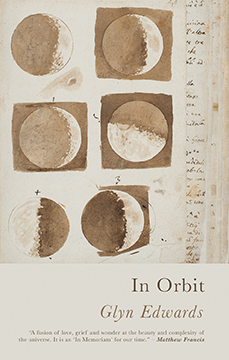
This cover shows a sepia-toned watercolour illustration by Galileo depicting the 6 phases of the moon. The text reads: In Orbit. Glyn Edwards.

In Orbit is a deeply moving account of love, longing, and loss. On receiving news of a beloved teacher’s death, a man struggles with the loss of a relationship sustained by deep admiration and unrequited love. Memories of their shared journey are separated in three orbits where the man’s past, present, and future are punctuated by intense grief.

In Orbit not only grieves the loss of the teacher, but also toxic standards for boys and men. Beyond human connection, sustenance is found in the moon, the stars, the sky, and nature. The discovery of a badger’s track or the treasure of a bird egg reminds us how small our trajectories are in the context of the more-than-human: an answer perhaps to the grieving process.

Masque by Bethany W Pope

Masque by Bethany W Pope

Masque is not the story you think you know. Promising and beautiful young singer Christine is ambitious to reach new heights of excellence amid the gilt trappings of the Palais Garnier. But despite being devoted to her art, she finds herself caught between the twin evils of her dangerous and enigmatic singing master and her impetuous patron Raoul’s ‘romantic’ vision of her as a bourgeois wife. Her own desire to follow her operatic career becomes her guiding light, but none of them can control the directions in which their passions lead them. Sumptuously gothic and full of psychological insight, Masque evokes a gilded era of decadence and sensuality where love, rage and murder meet, with explosive results.

The Turpentine Tree by Lynne Hjelmgaard

This cover shows a vibrant painting of a tree in the background. In the foreground are rocks with bright orange sand and brightly coloured grass in between them. The text reads: The Turpentine Tree, Lynne Hjelmgaard.

In her new collection The Turpentine Tree Lynne Hjelmgaardemploys strong, sensuous imagery to explore displacement, solitude and the search for connection. The tree of the title poem is an enduring symbol of memory, fragile but persistent against the passage of time. Drawing on her own memories from a life uprooted by time spent at sea, widowhood, and loss, Hjelmgaard conjures vivid portraits of family, friends and loved ones, including her late partner Dannie Abse.

Celebrating universal themes of love, loss and letting go, this tender collection is a reminder of how it feels to be alive. An essential addition to Lynne Hjelmgaard’s compelling body of work.

Posted on

Queer’s the Word: Readings for LGBT+ History Month

Daryl Leeworthy, author of A Little Gay History of Wales and Elaine Morgan: A Life Behind the Screen, shares some of the top books you should be reading this LGBT+ History Month.

Since the removal of Section 28 from the statute book in 2003, Britain’s queer communities have come together each February to celebrate a history which was for so long hidden in plain sight. Each year, LGBT+ History Month has a theme: in 2021 it is ‘Body, Mind, Spirit’. Anyone who has watched Russell T. Davies’s masterpiece, It’s A Sin, will know just how much each of those elements can be affected by absorbing oneself in aspects of the queer past and present. The books I have chosen for this short article penned as a contribution to LGBT+ History Month, each represent a different side of life.

Let’s start with the master historian, Jeffrey Weeks, who was born in the Rhondda in 1945, and his landmark book, Coming Out. First published by Quartet in 1977, and released in a new edition in 2016, Coming Out brings Britain’s queer history to life. It is radical. It is rooted in the ideas of gay liberation – about which more in a moment – and in the left-wing politics of the 1970s. But it is not an artifact of an earlier time, so much as an endlessly absorbing and fascinating excavation of a past richly experienced but all-too-easily cloaked in the horror of criminal codes and lavender scares. Weeks’s great triumph is to bring queer history back down to street level. In his long career, Weeks went on to write about Edward Carpenter, theories of sexuality, and the triumph of the queer civil rights movement through signature legislation such as same-sex marriage. This spring he turns his attention to his Welsh roots in a masterful memoir, Between Worlds.

To understand the Gay Liberation Front itself, there is no better work than Lisa Power’s No Bath But Plenty Of Bubbles, an oral history of the movement in London, which was originally published in 1995 by Cassell. Long out of print and difficult to get hold of, it has recently been re-released as an e-book to mark GLF’s fiftieth anniversary. By the time the book appeared in the mid-1990s, the world had changed completely from that envisaged by the GLF activists twenty years before – but rarely for the better. The age of consent, set at 21 since 1967, fell to eighteen in 1994 but the opportunity to bring about equality at 16 was narrowly missed. Section 28 was on the statute book and ruining the lives of a generation of queer children (me included). HIV/AIDS wreaked havoc all over the world, amongst queer and non-queer communities alike. Lisa Power wrote a book of history, then, but one designed as a kick into gear, a serious attempt to recover something of the spirit and purpose of the Gay Liberation Front and to make the world better for everyone. Twenty five years later, we know it succeeded.

After a year living with the COVID-19 pandemic, many of us are feeling an enormous strain and frustration. We have come to think of the virus as a once in a century event – it is not. But that tells us something about how societies remember and how we as individuals remember, too. Studies have shown that the descendants of those most directly impacted by traumatic events carry with them a genetic memory – an imprint of that harm which cannot be got rid of. It is especially apparent amongst Holocaust survivors and their children and grandchildren. For queer people, especially, it is also true of HIV/AIDS, the other great global pandemic of the past fifty years. To understand the interplay between trauma and memory, there is no better novel than Rebecca Makkai’s The Great Believers. Published in 2018, it focuses on Chicago and brings to life a community which was forced to adapt and compelled to live with death and danger, day after day. But it is a universal story, one which can – and in its comparison with COVID-19 does – affect us all.

But what of Wales? When I wrote A Little Gay History of Wales a few years ago, I had a delightful afternoon reading Sion Eirian’s 1979 novel, Bob yn y Ddinas. It’s not really a queer novel except for a passage where the title character, Bob, goes into the Duke Of Wellington pub in central Cardiff and encounters a neighbourhood drag queen who buys a drink for everyone in the snug, but not him. He was outside the community. This was truth, not fiction. For a period in the late-1970s, the Duke of Wellington joined its neighbour the King’s Cross and the nearby Golden Cross and Bristol Hotel as part of the small gay scene of those years. This was Real Cardiff, as Peter Finch would describe it, tough and grimy and poor; the place as it was before the corporate towers arrived and the rents shot up.

My last choice takes me back to the Rhondda and to another queer emigré who made his way to London: the novelist Rhys Davies. In his lifetime, Rhys Davies never openly acknowledged his homosexuality. Privately, and to his friends, and partners, it was a different story. He cruised guardsmen on the streets of interwar London; he cruised men in the various European cities in which he lived; he was in Germany like Christopher Isherwood and saw the rise of the Nazis; he wrote very queer novels which take little decoding for modern readers; and became close friends and a beneficiary of the noted American lesbians Gertrude Stein and Alice Toklas. Alas, much of the writer’s work is now out of print but his memoir, Print of a Hare’s Foot, first published in 1969, appears as a Seren Classic. More so than Mike Stephens’s prize-winning biography, which doesn’t really get to the heart of its subject’s sexuality, I’m afraid, Print of a Hare’s Foot is the best place to start with a writer who is to Wales what Oscar Wilde is to Ireland.

Daryl Leeworthy is the Rhys Davies Research Fellow at Swansea University. He is the author of A Little Gay History of Wales (2019) and of Elaine Morgan: A Life Behind the Screen, which is out now with Seren.

Elaine Morgan: A Life Behind the Screen is available on the Seren website: £9.99

A Little Gay History of Wales is published by University of Wales Press: £11.99

Consider supporting independent bookshops with a purchase via bookshop.org.