Posted on

An Interview with Robert Minhinnick

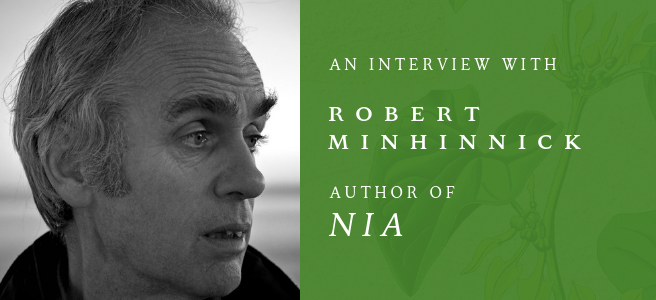
Robert Minhinnick is one of Wales’ (some would say Britain’s) most eminent writers. Next month we publish his latest novel Nia, the third book in his coastal trilogy all set in the same fictional resort. Ahead of its publication on the 1st October, Robert talks to us about the novel’s themes, its characters and what inspires him.


In Nia, dreams, memory and time all flow into one, leaving the reader to decide for themselves what is real and what is in Nia’s imagination. What about this structure draws you to it when writing and how is it important to the development of your characters?

Frankly, ‘madness’ is a big part of my life, and how it is socially perceived. Schizophrenia continues to play a role in my family, via my mother and her sister, aged 93 and 91. During World War II, my father contracted malaria, in Burma. The result was periodic delirium. My writing tries to explore ‘madness’ and delirium, and relate them to memory and dreams and the very act of writing ‘fiction’.

Throughout the book you touch on themes of the environment and climate change. Do you think it is important that authors use their voice to highlight issues to their audiences, and why in particular are they important to you?

You’re interviewing someone who is co-founder of Friends of the Earth Cymru, in 1984, and the charity ‘Sustainable Wales’, ongoing.

This is your third novel set in the same fictional community, each with interlinking characters but separate, stand-alone stories. How have the community and its inhabitants changed over the course of the series? Will we see any more writing set in the same place?

The fairground is a constant theme. It’s a powerful metaphor, a constant source of drama. I can see it from my attic. I like the idea of a particular family or community being examined.  After all, staying/belonging are familiar themes in fiction.

Nia is a book dominated by sunshine, even drought. Limestone Man experienced a suffocating sea-fret. The town’s economic circumstances always play a part, as does its history, and they are very much based on Porthcawl where I live. The street names, for instance, are the names of ships wrecked off the Porthcawl coast.

You take Porthcawl and the Merthyr Mawr dunes as the inspiration for your fictional town. Why did you choose to reimagine that place?

I write about where I live. I decided long ago that I should celebrate Porthcawl and the areas between the mouths of the rivers Ogwr and Cynffig. My writing is one way of achieving this. In Nia, I also celebrate my time in Saskatchewan, and my brief periods in Kerala and Amsterdam. Writing about different places can create an interesting friction – a little like icebergs grinding against each other in the South Saskatchewan river.

Some may say that the structure of Nia is reminiscent of that of prose poetry. How does your long career as a poet influence your prose style?

Originally, Nia possessed chapter names. I dispensed with these at a late stage, as I felt they directed the reader too forcibly. One of my friends is disappointed by the first two novels in that there seems no real ‘resolution’. Of course, I tell him, even death does not resolve matters…

How has your fiction style developed over the course of writing this series? Did the process of writing Nia differ from that of your previous novels? 

I’m older. But still wishing to learn. The character of Nia is developed because some years ago the former fiction editor at Seren, Penny Thomas, told me I should strengthen my female characters.

Nia is obsessed with words. What is your relationship with them?

Well, obsessional might be the correct description.

Another blurred boundary between time and place, comes about through the travel stories vividly recounted by Nia’s friends throughout the book. In what way is the theme of travel important to the book, and to Nia’s story in particular?

I wanted to write about Saskatchewan. There are poems actually written there incorporated into the text of Nia. Also memories of visiting Auschwitz, Amsterdam, Kerala and New York. But the editing process removed many references…

Nia’s perception of her life seems unstable throughout: she constantly questions her own sanity and her role as a mother. These kinds of traits can be seen in the lead characters of your other two novels as well. What draws you to this type of character as a narrator?

All my narrators are ‘unreliable’, and plagued by self-doubt, dreams and delusion. That’s why memory blends into delirium. The fairground is an excellent means of depicting this. I look at the eyes of my grandchildren as they encounter the funfair, or ‘the shows’ as we used to call it, and wonder what they see…

At the heart of Nia’s story, is her dream expedition with her friends into the unexplored caves beneath the dunes. Why did you choose to centre the action of your book on a caving expedition, and what is the significance of the trip to Nia?

It’s a fictional expedition, but Nia doesn’t dream it. Yet she experiences many other dreams in this novel about the dunes, their history, flora and fauna.  ‘The Shwyl’ caves are based on ‘the Schwyll’ cave system, which provided fresh water for the Bridgend area (including the Seren office) until recently, using ‘the Great Spring of Glamorgan’, which emerges in Ewenni.

Thus, it’s a real place, little known yet fascinating. Perhaps Nia feels intimidated by the travel stories of Isaac Pretty and Skye, and it’s her way of competing with two seemingly powerful personalities, who have returned to her community.

Nia will be available on the Seren website from the 1st October 2019. Pre-order your copy now. 
Robert Minhinnick’s ‘Sea Holly’ series is a set of three novels that follow generations of one family – the Vines – and a cast of characters brought up in the same location, which is dominated by the sea, wild duneland, and a funfair. 
Posted on

Friday Poem – ‘Archaeology’, Robert Minhinnick

Archaeology Friday Poem Robert Minhinnick

September has arrived, but our Friday Poem looks back to August’s Legend of the Month: Robert Minhinnick. ‘Archaology’ is from his sixth collection, Hey Fatman.

Hey Fatman is full of the rich, sometimes strange, always telling, detail that is to be expected from one of Britain’s most compelling poets. The book opens with poems set in and around Minhinnick’s native South Wales, and includes a sequence based on the history of an ancestral house, Dunraven. We then move on to work inspired by the poet’s travels in South America and the U.S.A. The whole volume presents us with a series of vivid portraits, and our featured poem, with its subject who ‘ran shouting/ From his house with his hair on fire’, is no exception.


Robert Minhinnick Archaeology Friday Poem


Hey Fatman is available from the Seren website: £5.95

Join our free Book Club for 20% off every book you buy from us.

Posted on

Legend of the Month: Robert Minhinnick

Robert Minhinnick Legend of the Month

Each month we are celebrating one fantastic Seren author in honour of Wales’ Year of Legends. This month the spotlight falls on Robert Minhinnick – and as a special treat, all his books are 30% off.

Robert Minhinnick, born near Neath in 1952, has published numerous poetry books, collections of essays, novels, and short stories. His book To Babel and Back – a series of essays from America, Iraq and Wales – won the Wales Book of the Year Award in 2006. His first poetry collection was published more than thirty years ago, and he has won the Forward Poetry Prize twice. He has also received an Eric Gregory Award for his poetry and in 1998 he won a Cholmondeley Award.
He founded Friends of the Earth Cymru in 1984 and has worked as a writer in residence in Canada, travelling back there regularly to give readings. He was Editor of Poetry Wales magazine from 1997 until 2008.
Until the end of the month, you can enjoy 30% off all Robert Minhinnick’s books. Find out more about the poetry, fiction and essays available below.

limestone man robert minhinnickLimestone Man
RRP £9.99
NOW £6.99
Minhinnick’s latest novel is a meditation on age and opportunity, and introduces us to Richard Parry: a painter who cannot paint, a writer who doesn’t write. Parry’s obsession is Lulu, that ‘orphan off the street’, his aboriginal  ‘green child’. But on returning from Australia to his hometown he finds it has become notorious for the suicides of young people. As Parry tries to connect past and present he is haunted by dreams of Australia and of his youth. Yet is Parry all he seems?

Island of Lightning
RRP £9.99
NOW £6.99
The author travels from his home in south Wales to Argentina, China, Finland, Iraq, Tuscany and Piemonte, Malta, New York, Zagreb, Lithuania and the lightning island of Malta. In conventional travel essays and leaps of imaginative narrative his subjects include the annual Elvis convention in Porthcawl, Neolithic sculptures, poets playing football, the body of a saint and the definition of cool. His themes are big ones: the relationship of man and landscape, man and time, man and nature, immigration and war, in one sense ultimately humankind itself.

The Keys of Babylon
RRP 8.99
NOW £6.29
This Wales Book of the Year-shortlisted and Edge Hill-longlisted collection of 15 linked stories gives voices to migrants around the globe. The Keys of Babylon is both a fictional record of, and an exploration into their lives, and the characters reflect a comprehensive mix of hope, success, failure, fear, indifference and passion as their stories intertwine to create the final narrative.

Sea Holly
RRP £7.99
NOW £5.59
Sea Holly is Robert Minhinnick’s stuning debut novel, a story of drifting, burnt-out lives, shadowed by the mysterious disappearance of a vivacious young girl.
“John Vine? He has it all. Home, family, career. You can’t knock that. But he has this worm inside him, this dissatisfaction… A boy of twenty, that’s OK, he’s going to dream. But a man of fifty? With a young piece who thinks he’s not half bad?…believe me that’s when everything’s going to come loose.That’s when it’s going to get dangerous.”
Sea Holly was shortlisted for the RSL Ondaatje Prize.

To Babel and Back
RRP £7.99
NOW £5.59
Join Robert Minhinnick on a journey across a radioactive planet. Researching the use of depleted uranium in modern weapons, the writer follows a deadly trail from the uranium mines of the USA into Saddam Hussein’s Iraq. Here, he is led into the temples of a deserted Babylon and to what his guides insist is the site of the Tower of Babel. Interspersed with these ‘radioactive writings’, which seem part documentary, part dream, are essays on a host of different places.

Badlands
RRP £6.95
NOW £4.86
In these essays the writer travels from the impoverished of Albania to the scorched suburbia of Silicon Valley. On the way he encounters a foreign country called England, twenty thousand frozen lakes, and a desert of dinosaur bones. The people of Badlands include Coleridge and Ryan Giggs, Colonel Sanders and Freud, plus a host of minor deities from the numbing world of celebrity. Urban and rural, tragic and absurd, Badlands is a real place. But where the borders of Badlands begin, or finish, is difficult to say.

Green Agenda
RRP £7.95
NOW £5.56
In the 1970s, it was ignorance, in the 1980s, enthusiasm, and from the 1990s environmental issues were greeted with a peculiar fatalism. Green Agenda, the first popular volume of its type to be published in Wales, confronts head on our ideas of what constitutes ’the environment’ and how we perceive it. These essays acknowledge the danger of allowing environmental concern to flourish within a green ghetto, the perils of over-speculation, the banality of ’issues’.

Watching the Fire Eater Robert MinhinnickWatching the Fire-eater
RRP 8.99
NOW £6.29
Watching the Fire-eater covers variety of subjects: third world poverty and the internationalism of alcohol, rugby through the eyes of a vegetarian, nuclear power, sunbathing and a thanksgiving dinner for the demise of Margaret Thatcher. But at the core of this essay collection is a vivid series of attempts to strip away the exhausted mythologies of the writer’s own country and the increasingly-packaged places he visits. Watching the Fire-eater was the Wales Book of the Year Award winner, 1993.

Hey Fatman
RRP £5.95
NOW £4.16
Hey Fatman by Robert Minhinnick is full of the rich, sometimes strange, always telling, detail that we have come to expect from one of Britain’s most compelling poets. The book opens with poems set in and around his home country of south Wales, and includes a sequence based on the history of an ancestral house, Dunraven. We then move on to work inspired by the poet’s travels in South America and the U.S.A. This includes the title poem ’Hey Fatman’, a splendid baroque essay on the characters gathered in a Rio beach bar.


Find a great selection of books by our other legendary writers on the Year of Legends page.