Following the sad passing of Ruth Bidgood, and in celebration of International Women’s Day, this week’s Friday Poem is ‘Interviewing’ from Ruth’s award-winning collection Time Being.
Ruth Bidgood’s Time Being, winner of the Roland Mathias Prize, is emphatically a collection of location. The history and nature of the poet’s particular region of mid-Wales inspire these poems. Bidgood avoids sentimentality but not sentiment: an observation can engender joy or sorrow or fear uncluttered by irony. These descriptions are sharp and memorable, tending to a cool accuracy. Nature is not always benign, but often inescapably dark and mysterious, lyric and move towards a more epic, multi-faceted form equal to the many experiences of her long life.
In Her Own Words: Women Talking Poetry and Wales is a collection of interviews with women poets from Wales. The interviews variously explore topics ranging from personal biography, the complex joys and strains of balancing life with art, issues of cultural politics, gender, family life, to the women’s often contrasting experiences of various kinds of change, including political devolution.
The Black Place is a dark and gorgeously multi-faceted artwork, like a black diamond. Tamar Yoseloff eschews the sentimental, embraces alternatives, offers antidotes to cheery capitalist hype. The central sequence in this collection, ‘Cuts’, is a characteristically tough look at the poet’s cancer diagnosis and treatment. The diagnosis arrives at the same time as the Grenfell Tower disaster, a public trauma overshadowing a private one. These poems focus on the strangeness of the illness, and of our times – they refuse to offer panaceas or consolations.
In the twenty-six stories in A City Burning, set in Wales, Northern Ireland and Italy, children and adults face, in the flames of personal tragedy, moments of potential transformation. On the threshold of their futures each must make a choice: how to live in this new ‘now’. Some of these moments occur in mundane circumstances, others amidst tragedy or drama.
With over 250 contributors, Women’s Work brings together generous selection of poetry by women, with an emphasis on twentieth-century poetry in English. Featuring poets from the USA, Canada, England, Ireland, Scotland, Wales, Australia, and New Zealand, it is arranged by thematic chapters that touch on various aspects of modern life. Women’s Work aims to be a touchstone of women’s thoughts and experiences; to be entertaining and relevant as well as inclusive and representative of some of the best poetry published today.
When Nula’s husband James, an Irish documentary filmmaker, becomes forgetful they put it down to the stress of his work. But his behaviour becomes more erratic, and he is eventually diagnosed as suffering from Pick’s Disease, an early onset and aggressive form of dementia. The Longest Farewell is the true story of Nula’s fight with her husband’s disease, and how this terrible time held a happy ending.
In 2007, in a chance conversation with her mother, Jasmine Donahaye stumbled upon the collusion of her family in the displacement of Palestinians in 1948. She set out to learn the story of what happened, and discovered an earlier and rarely discussed piece of history during the British Mandate in Palestine. Losing Israelis a moving and honest account which spans travel writing, nature writing and memoir. It explores the powerful and competing attachments that people feel about their country and its history, by attempting to understand and reconcile her conflicted attachments, rooted in her family story – and in a love of Israel’s birds.
Kim Moore’s eagerly-awaited second collection All The Men I Never Married is pointedly feminist, challenging and keenly aware of the contradictions and complexities of desire. The 48 numbered poems take us through a gallery of exes and significant others where we encounter rage, pain, guilt, and love. A powerful collection of deeply thoughtful and deeply felt poetry.
The Colour of Grass by Nia Williams is a story about families, past and present, and life’s unexpected connections. Helen’s family is falling apart. There are no answers from her husband. She can’t communicate with her daughter. So she turns to other relatives: the ones who are dead and gone. Straightaway she finds herself floundering in a new world of friends, secrets, enemies and family history enthusiasts. Clandestine meetings, a mugging, and the surprisingly tragic story of her mystery grandmother – all of these weave themselves into Helen’s present and her unknown past.
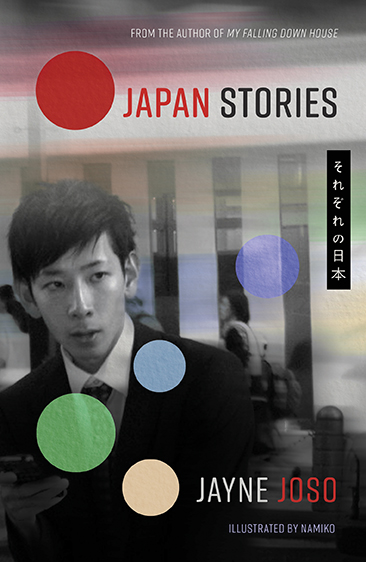
Japan Stories is a spellbinding collection of short fiction set in Japan by Jayne Joso. Each centres on a particular character – a sinister museum curator, a son caring for his dementia-struck father, a young woman who returns to haunt her killer, and a curious homeless man intent on cleaning your home with lemons! Together, these compelling narratives become a mosaic of life in contemporary Japan, its people, its society, its thinking, its character. Illustrated by Manga artist Namiko, Japan Stories provides a window into a country we would all love to know more deeply.
Forbidden Lives is a fascinating collection of portraits and discussions that aims to populate LGBT gaps in the history of Wales, a much neglected part of Welsh heritage. Norena Shopland reviews the reasons for this neglect while outlining the activity behind the recent growth of the LGBT profile here. She also surveys LGBT people and their activity as far back as Giraldus Cambrensis’ Journey Through Wales in the twelfth century.
Earlier this year, we shared an archive article written by our founder Cary Archard in 1981 shortly after Seren, then called Poetry Wales Press, branched out into traditional publishing. In a second post, Cary shared some of the long-lasting friendships which helped Seren grow into the press it is today. In this new post, he reflects on some of the great books and writers we have published over the years, many of which continue to resonate today.
From Poetry Wales Press to Seren
It may have all begun with the realisation that many poets in Wales were not being published but soon my ambition widened. Not just poets but writers were being neglected. So within Poetry Wales Press, the Seren imprint was set up for prose, and in 1989 the name Poetry Wales Press was quietly dropped and the briefer, friendlier, more aspirational SEREN became the masthead (much easier to fit on the spine too) in recognition that the intention now was to publish the full range of genres – from poetry, of course, to fiction, biography, essays, even art and photography books.
I must mention two early debates. At the start, publishers in Wales applied for grant support (from the Arts Council) on a book by book process. Seren initiated a fundamental change when it became the first publisher to receive a block grant which enabled us to plan an annual programme of publications. The result was startling: from half a dozen titles a year to a dozen and soon to twenty or more. The press’s performance was regularly assessed but the new approach was clearly ground-breaking and soon other publishers in Wales benefitted from the same practice. The second debate could be more heated. Should Seren confine itself to Welsh authors? There was certainly a need. The question was; was Seren a publishing house in Wales or a publishing house for Wales? If a good proposal came from outside Wales, should it be disregarded? What if it made sense commercially to publish? Finally it was decided the focus would always be on Wales and its writers but there should also be a recognition of the wider world, its influences and opportunities. (Even extended later to books in translation.)
The growth of the Series
One of the fruits of the block grant approach was our series of Series. One of the first was the comprehensive Border Lines Series edited by the remarkable poet and critic, John Powell Ward. With over twenty titles it included introductory biographies of writers, composers and artists of the Welsh Marches. A reader might have expected to see Elgar, Vaughan, Margiad Evans, Kilvert and Housman, but the Series also included Chatwin, Ellis Peters and Francis Brett Young. Its distinctive yellow and green jacketed volumes have now become collectors’ items. This was soon followed by the ‘REAL’ Series, edited by the wonderful Peter Finch who started with his own idiosyncratic ‘Real’ guides to Cardiff and then persuaded other writers to write their own very personal takes on their home towns. With more than two dozen titles, the Series seems to grow annually. If you want to find out about the real Port Talbot, Cambridge or Glasgow you know where to go.
A very different sort of series ran from 2009 to 2013. In New Stories from the Mabinogion, edited by Penny Thomas, ten contemporary Welsh authors chose one of the medieval tales to reinvent and retell in their own ways. The result: ‘Seren’s series….may be the greatest service to the Welsh national epic since Lady Charlotte Guest (The Guardian)’. A mention should also be made of the look of these books and of Matthew Bevan’s beautiful designs.
Three first novels
From all the wonderful books published in the last forty years, I’d like to draw attention to three first novels. In 1988 Seren published Christopher Meredith’s Shifts, a novel that has become a classic of post-industrial Welsh life. It’s that rare thing, a fiction of real working lives. ‘A beautiful, under-stated first novel. More than a bitter, angry novel, Shifts is a sad and loving one. The prose is spare and poetic, at once plain and rich, musical in its rhythms of speech and clear descriptions’, sang the New York Times. It was followed by many more books of poetry and prose by Meredith, most recently Please and Still, that Seren has been privileged to publish.
A 2004 debut novel began with ‘Many years ago a strange incident took place in this town. The event, which went unobserved by the rest of the world, would have sunk into obscurity here also, but for the scribblings of an old bar tender and dogsbody at the Blue Angel’. This was Mr Vogel by Lloyd Jones a man who had walking, crisscrossed the whole of Wales absorbing its stories and characters out of which he fashioned a book which stretched the conventions of novel writing to breaking point. Jan Morris, no less, called it, ‘One of the most remarkable books ever written on the subject of Wales’. It went on to win the McKitterick Award and be shortlisted for the Everyman Wodehouse Prize. Lloyd’s second novel, Mr Cassini, won the Wales Book of the Year Award in 2007. His novels remain two of the most exciting and original books which Seren has published.
And the third of these first novels: The Last Hundred Days by Patrick McGuinness, who was better known at the time as a poet, was longlisted for the Man Booker Prize 2011. Set in a paranoid Bucharest in 1989, it vividly captures the tensions of Ceausescu’s last days. This thrilling story was probably the most commercially successful of all Seren’s novels. ‘A wonderfully good read, giving one a convincing taste of how it might be to live under the most surreal kind of communist rule…’ was typical of the reviews it garnered. It won the Wales Book of the Year Award for 2012 and the Writer’s Guild Award for Fiction. Patrick’s exciting ‘detective’ novel, Throw Me to the Wolves (Jonathan Cape) won the Encore Award. Seren has recently published Patrick’s encyclopaedic, Real Oxford in our Real Series.
Our gift guide returns for 2021 with loads of great new recommendations. From old favourites to brand new books that are hot off the press, find something for everyone this Christmas.
Bar 44 Tapas y Copas by Owen and Tom Morgan
Bar 44 Tapas y Copas is the perfect gift for hardcore foodies and home cooks alike. Packed with over 100 out of this world recipes which elevate Spanish cuisine to exciting new heights, it includes dishes for any occasion. Chicken sobrassada and spiced yoghurt, beetroot gazpacho, tuna tartare with apple ajo blanco, lamb empanada, strawberry and cava sorbet and pear and olive oil cake are just some of the dishes you can try at home. There’s even a chapter dedicated to sherry and Spanish wines with some fantastic cocktails mixed in for good measure. What more could you want?
The new one year Seren Gift Subscription is the perfect present for any book lover. The recipient will receive three brand-new Seren books across the year plus a range of other subscriber perks. Buy today and we’ll post them a gift card explaining who the gift is from to open on Christmas Day in advance of the first book arriving in January 2022. Every new subscriber will receive a Seren tote-bag, notebook and pen with their first delivery.
Two book deal – Please and Still by Christopher Meredith
Published simultaneously earlier this year, renowned author Christopher Meredith’s two new books will satisfy any literature lover. His poetry collection Still uses the title word as a fulcrum to balance paradoxical concerns: stillness and motion, memory and forgetting, sanity and madness, survival and extinction. Meanwhile his short novel Please is a verbally dazzling tragicomedy about hidden passion and regret in which octogenarian language geek Vernon tries to find a way to write the story of his long marriage.
One of this year’s most highly anticipated poetry books, All The Men I Never Married is the astounding new collection by Kim Moore. Pointedly feminist, challenging and keenly aware of the contradictions and complexities of desire, this collection speaks to the experiences of many women. The 48 numbered poems take us through a gallery of exes and significant others where we encounter rage, pain, guilt, and love.
In Real Oxford, Professor Patrick McGuinness guides us through the past, but also the present Oxford, as he walks the city from the station to the ringroad. He tracks its canals and towpaths, its footbridges and tunnels to introduce us to the unnoticed and reflect on the familiar, revealing that the ‘Real Oxford’ is more than dreaming spires, bicycles, and Inspector Morse. This is a guide to Oxford unlike any other.
Japan Stories is a spellbinding collection of short fiction set in Japan by Jayne Joso. Each centres on a particular character – a sinister museum curator, a son caring for his dementia-struck father, a young woman who returns to haunt her killer, and a curious homeless man intent on cleaning your home with lemons! This work also includes Joso’s stories, ‘I’m not David Bowie’ and ‘Maru-chan’ an homage to Yayoi Kusama. Together, these compelling narratives become a mosaic of life in contemporary Japan, its people, its society, its thinking, its character. Illustrated by Manga artist Namiko, Japan Stories provides a window into a country we would all love to know more deeply.
100 Poems to Save the Earth edited by Zoë Brigley and Kristian Evans
A book for both the climate conscious and poetry fanatics, this landmark anthology brings together 100 poems by the best new and established contemporary poets from Britain, Ireland, America and beyond. They invite us to fine-tune our senses, to listen to the world around us, and pay attention to what we have been missing. The defining crisis of our time is revealed to be fundamentally a crisis of perception. We must act now if we are to save the only planet we have.
“Easily the most remarkable work of fiction to come out of Wales in a thousand moons” says Jon Gower. This outstanding debut novel from Hammad Rind is a satirical comedy which takes inspiration from the dastan, an ornate form of oral history. Forced onto the street by a power cut, the unnamed narrator finds himself sheltering in a cemetery where he comes across four others – a grave digger, an aristocrat, an honourable criminal and a messiah – each with a past, and with a story to tell. Crimes have been committed, dark family secrets revealed, fortunes rise and fall, the varieties of love are explored, and new selves are discovered in a rich round of storytelling. And as the Disappointed Man discovers, a new story is about to begin…
In Welsh Quilts expert author Jen Jones presents an authoritative guide to the history and art of the quilt in Wales. Driven by her desire to see this gloriously high-quality craft revived, Jones set out to research the topic which led to the creation of her extensive quilt collection, now housed in the Welsh Quilt Centre in Lampeter. Including stunning, high resolution images of the bold designs and intricate stitching of the quilts in her collection, Welsh Quilts is the essential book on the subject, whether you are a quilter yourself, or simply interested in quilting heritage.
Troeon : Turnings by Philip Gross, Cyril Jones and Valerie Coffin Price
This beautifully illustrated, bilingual collection (a great gift for Welsh learners) sees two poets, each confident in their own traditions, meet in the hinterland between translation and collaboration – Cyril Jones from the disciplines of Welsh cynghanedd, Philip Gross from the restless variety of English verse. Rather than lamenting the impossibility of reproducing any language’s unique knots of form and content in translation, they trust each other to explore the energies released. Valerie Coffin Price’s striking letter press designs make this a fantastic gift.
Fans of historical crime fiction are sure to be captivated by Leslie Scase’s latest Inspector Chard mystery. In Fatal Solution Inspector Thomas Chard once again finds himself faced with a murder in bustling Victorian Pontypridd. On the face of it the case appears unremarkable, even if it isn’t obviously solvable, but following new leads takes Chard into unexpected places. A second murder, a sexual predator, industrial espionage and a mining disaster crowd into the investigation, baffling the Inspector and his colleagues and Chard finds his own life at risk as the murderer attempts to avoid capture. In this page-turning story of detection, both Chard and the reader are left guessing until the final page…
Tide-race is Brenda Chamberlain’s remarkable account of life on Bardsey Island (Ynys Enlli in Welsh), a remote and mysterious island off the coast of North Wales, where she lived from 1947 to 1961, during the last days of its hardy community. The combination of Bardsey, ancient site of Christian pilgrimage, wild and dangerous landscape, and Brenda Chamberlain, Royal Academy trained artist, results in a classic book, vividly illustrated by the author’s line drawings.
Much With Body by Polly Atkin is a Poetry Book Society Winter Choice. The beauty of the Lake District is both balm and mirror, refracting pain and also soothing it with distraction. Much of the landscape is lakescape, giving the book a watery feel, the author’s wild swimming being just one kind of immersion. There is also a distinct link with the past in a central section of found poems taken from transcripts of the journals of Dorothy Wordsworth, from a period late in her life when she was often ill. In common with the works of the Wordsworths, these poems share a quality of the metaphysical sublime. Their reverence for the natural world is an uneasy awe, contingent upon knowledge of our fragility and mortality.
Part biography, part memoir, Just You and the Page by acclaimed novelist Sue Gee is a must-read for the aspiring writer. Opening in 1971, with the dramatist Michael Wall hammering out his plays on a portable typewriter, and concluding in 2020, when the novelist and academic Josie Barnard is teaching students to compose novels on Instagram, Gee interviews twelve distinctly different writers about their craft. As she examines what has shaped them and their careers, several themes emerge: struggle, inspiration, dedication, and above all, resilience.
A Last Respect edited by Glyn Mathias and Daniel G. Williams
A must-have anthology for fans of contemporary Welsh poetry, A Last Respectcelebrates the Roland Mathias Prize, awarded to outstanding books of poetry by authors from Wales. It presents a selection of work from all eleven prize-winning books, by Dannie Abse, Tiffany Atkinson, Ruth Bidgood, Ailbhe Darcy, Rhian Edwards, Christine Evans, John Freeman, Philip Gross, Gwyneth Lewis, Robert Minhinnick, and Owen Sheers.
Miner’s son Morlais Jenkins is already being educated away from his background at grammar school when he is adopted, on the death of her own son, by the wife of the local colliery owner. Despite the heavy price, Morlais’s parents recognise the opportunity for their son to make a better future. Morlais is a gifted poet and, stiffled by middle class life, his adoptive mother encourages him to be neither working class or middle class, but true to his talent. As Morlais struggles to find his place between his two families, his two backgrounds and his desire to become a poet, this enthralling novel by Alun Lewis is the journey of a boy who becomes a man.
By turns laugh out loud funny and deeply sad, The Amazingly Astonishing Story (which was shortlisted for Wales Book of the Year) is a frank and surprising look into a child’s tumultuous mind, a classic story of a working-class girl growing up in the 60s. Her Catholic upbringing, a father torn between daughter and new wife, her irreverent imagination and determination to enjoy life, mean this really is an amazing story (including meeting the Beatles).
Our series of regional poetry pamphlets celebrates the beauty, history, and lively everyday goings-on of four areas of Wales: Pembrokeshire, Snowdonia, the Borders, and the capital city of Cardiff. Each pamphlet comes with an envelope and a postcard – the perfect stocking filler for your loved ones this Christmas.
The ‘city of light’ under German occupation: Paris, a place, a people, lives in flux. And among these uncertainties, these compromised loyalties, these existences under constant threat, lives Marcel Petiot, a mass murderer. A doctor, a resistance fighter, a collaborator: who can tell? Stretching backwards and forwards through the twentieth century, this remarkable multi-form novel combines fiction, journals, poetry and images in its investigation of what war can let loose, and how evil can dominate a man. The compelling debut novel by Tony Curtis.
Grahame Davies revisits his own university town in Real Cambridge to examine it anew and discovers another Cambridge away from A List alumni, Nobel prizes and scientific discoveries. Behind the picture-postcard image of punts, Pimms and polymaths, is the working East Anglian fenland community that gave us Pink Floyd, Association Football, the Society for Psychical Research, the Cambridge Folk Festival, the Reality Checkpoint – and the graffiti protestor who sprayed his messages in Latin… Tourists and armchair travellers alike will be surprised by the discoveries Davies makes in this offbeat exploration.
In The Owl House, Daniel Butler charts his relationship with two barn owls which nested in the barn of his rural mid-Wales home. In this pastoral exploration of his locale, rich in wildlife of all kinds, he roams the mountains and forests, takes trips to the coast, encounters all manner of animals and birds, and grows to understand the relationship between the local people and their surroundings. A rich and vivid portrait of one of the most remote and sparsely populated areas of Britain – mid-Wales – broad in its horizons yet full of fascinating detail.
Carolyn Jess-Cooke’s new poetry collection is both keenly political and deeply personal. As well as tender poems about family and mental health, there are two sequences: Songs for the Arctic, inspired by field work done for the Arctic at the Thought Foundation, poems that are vividly descriptive of an extreme landscape sensitive to the effects of global-warming. And The House of Rest, a history in nine poems of Josephine Butler (1828-1906), who pioneered feminist activism, and helped to repeal the Contagious Diseases Act 1869. Jess-Cooke is unafraid of dark material but is also ultimately hopeful and full of creative strategies to meet challenging times.
While away the long winter nights with this enthralling collection of short fiction by Mary-Ann Constantine. Two doctors and a folklorist meet in northern Brittany in 1898, determined to prove that leprosy still exists. But their ardour for collecting evidence draws them into a dark, watchful landscape where superstition is rife. From poignant and dangerous obsessions with the iconic (a Romano-British figurine; a carved wooden Christ-child; a bronze angel) to direct, often puzzled conversations with ghosts, the characters in this book all strive to make contact with the impossible.
Illustrated with stunning photographs, The Golden Valley is Phil Cope’s personal account of the Garw valley where he has lived for thirty-five years. In it he explores the valley’s history: sparsely worked agriculture; boom-town coal exploitation; sudden, followed by gentle, post-industrial decline; attempts at re-invigoration through heritage and leisure; and now, existing in a post-covid world. He photographs everything from the ancient Garw hilltops, to the terraced houses of the coal villages, to the valley’s outstanding areas of natural beauty.
In this contemporary retelling from Seren’s New stories from the Mabinogionseries, award-winning writer Fflur Dafydd transforms the medieval Welsh Arthurian myth of the Mabinogion’s ‘Culhwch and Olwen’ into a 21st century quest for love and revenge. Life is tough for Cilydd, after his wife Goleuddydd, who is nine months pregnant, seems to vanish into thin air at a supermarket one wintry afternoon. Cilydd gets his cousin, Arthur – a private eye who has never solved a single case – to help him with the investigation. So begins a tale of intrigue and confusion that ends with a wild boar chase and a dangerous journey to the House of the Missing.
Newspaper Taxis edited by Phil Bowen, Damian Furniss and David Woolley
January 1963. ‘Please, Please Me’ by The Beatles shoots to number one. So begins a new era, in which one band transforms the face of music, youth and popular culture. Taking in everything from the music, their influence, the way we lived then and the way we live now, this book is a response to the Beatles’ creativity and capacity to influence successive generations. With contributions by a myriad of poets including, Simon Armitage, Carol Ann Duffy, Elaine Feinstein, Peter Finch, Adrian Henri, Philip Larkin, Lachlan Mackinnon, Roger McGough, Sheenagh Pugh, Jeremy Reed and Carol Rumens. Beatles fans young and old will want this anthology to add to their collection.
This new edition of The Green Bridge, collects work by twenty-five of the Wales’s foremost writers of the twentieth century in an entertaining and varied anthology. Horror, satire, humour, war, tales of the aristocracy, of navvies, love, and madness, industry, the countryside, politics and sport: these stories provide insight into the changing values of Wales and the world. Includes work by Dannie Abse, Glenda Beagan, Ron Berry, Duncan Bush, Brenda Chamberlain, Rhys Davies, Dorothy Edwards, Caradoc Evans, George Ewart Evans, Margiad Evans, Sian Evans, Geraint Goodwin, Nigel Helseltine, Richard Hughes, Emyr Humphreys, Glyn Jones, Gwyn Jones, Alun Lewis, Clare Morgan, Leslie Norris, Ifan Pughe, Alun Richards, Jaci Stephen, Dylan Thomas and Gwyn Thomas.
Auscultationmeans listening and specifically, in medicine, listening to sounds that come from the body’s internal organs. If listening is a central theme of this collection, it is also about being heard. Ilse Pedler is poet of breadth and depth. There are poems about waiting rooms and surgical instruments, about crisis calls, about overhearing farmers and pet owners and colleagues. There are poems about surviving a stern childhood and a heartbreaking sequence about being a stepmother. This is a compelling debut from a striking new voice.
Television naturalist Iolo Williams picks his top 40 nature sites in Wales. From Cemlyn on Anglesey to the Newport Wetlands, from Stackpole in Pembrokeshire to the Dee Estuary, Williams criss-crosses Wales. His list takes in coastal sites from marshes to towering cliffs – plus Skomer and other islands – mountains, valleys, bogs, meadows, woods and land reclaimed from industry. Drawing on his considerable knowledge, Williams guides readers and visitors to the natural delights of each site. Naturalists of all kinds will find much to enjoy in this beautifully illustrated book.
Founded in 1965, Poetry Wales is Wales’ foremost poetry magazine. Edited by Zoë Brigley, the magazine publishes internationally respected contemporary poetry, features and reviews in its triannual print and digital magazine. Its mission is to sustain and preserve the artistic works both inspiring our literary present and shaping our literary future. The perfect gift for any poetry lover.
Today’s guest post is by Kristian Evans, co-editor of the landmark anthology 100 Poems to Save the Earth – vital reading as world leaders meet in Glasgow for COP26.
Our climate is on the brink of catastrophic change. 100 Poems to Save the Earth invites us to fine-tune our senses, to listen to the world around us, pay attention to what we have been missing. The defining crisis of our time is revealed to be fundamentally a crisis of perception. For too long, the earth has been exploited. With its incisive Foreword from editors Zoë Brigley and Kristian Evans, this landmark anthology is a call to action to fight the threat facing the only planet we have.
Leaders from the world’s governments and businesses are currently meeting in Glasgow for the UN Climate Change Conference (COP26). Delegates are attempting to create a roadmap towards a zero-carbon future, to find ways to prevent the earth from warming by more than 1.5C, and to explore other technological and financial options to help us mitigate climate change.
Considering the results of previous conferences, we can be forgiven for feeling less than optimistic about this one. Surely here are the same old people, using the same old tools, trying to make the problem conform to the same old solutions they have found for it.
Einstein famously said “no problem can be solved by the same consciousness that created it. We need to see the world anew.”
So how does our culture see the world today? What does ‘nature’ mean to those of us in the West? What does our way of life tell us about our unconscious beliefs and attitudes to it? What might ‘seeing the world anew’ mean?
empty your paradise onto a desk: your white sands, green hills and fresh fish. Shine the lamp on it like the fresh hope of morning, and keep staring at it till you sleep.
From ‘A Portable Paradise’ by Roger Robinson – 100 Poems to Save the Earth
Since the Enlightenment, it has become the custom to see nature as a machine, something inert, a predictable resource, perfectly intelligible to reason. Animals are considered to be little more than complicated robots – it’s ok to test cosmetics, drugs and ammunition on them. Nature can be dominated, controlled and tamed. There is nothing truly strange or mysterious out there, certainly no ghost haunting the moving the parts.
We find these beliefs reflected in our perception of human life: consciousness is only a brain process, life has no intrinsic meaning and ends completely in death. We don’t have souls and should find fulfilment in material things, tools and toys that will, we are promised, get bigger and better year after year. Get it while you can and drink it dry, because time is running out and soon you will be gone.
At least, that’s how it used to be. That was the dream. Poets were never quite convinced by it and climate change and the ecological crisis are now ringing a very loud alarm. Blake railed against the oppression of a rationalising utilitarian mind he saw embodied in ‘the dark Satanic mills’. The Romantics, foreshadowing Freud, found plenty of evidence that the Enlightenment had a concealed dark side, that it was haunted and shaped by the superstitions it thought it had banished.
Illustration of ‘The Ancient Mariner’ by artist David Jones
Coleridge’s ‘The Rime of the Ancient Mariner’ is now often read as an ecological fable, a warning of the consequences of adopting a violent, domineering attitude to nature. Most of us will have seen images of dead Albatross chicks, their stomachs stuffed full of the bits of plastic they’ve been fed by the parent bird, the shiny junk plucked from the waves, fragments of the rubbish with which we fill our own lives. We’re all the Mariner now, it seems; every one of us has killed the Albatross.
Yet at the end of his terrifying hallucinatory voyage to the edges of the world, to the edges of himself, the Mariner does “see the world anew.” He is reconciled to a vision of nature as a complex web of relationships, beautiful and strange, everything intertwined with everything else.
Albatros chick
What if we were no longer separated and isolated, disconnected from nature and each other? We too might see a world transformed. What was once viewed as a collection of dead, inert or robotic objects, might now be experienced as a community of vibrantly alive subjects, multi-faceted aspects of a cosmos full of meaning, intelligence and imagination not confined to humans, but distributed throughout everything.
When we were editing 100 Poems to Save the Earth thoughts such as these were never far from our minds. Poets have always kept an ear open to communication from the earth, imagining what the birds and fish and fungi, the oceans and forests might say. It’s not hard to hear them. They are only saying what our own souls are saying after all. Stop. Change. Please listen.
It is as if there were some irresistible force blowing us over into a strange new century that billows beyond us, between our thin heart-beats.
From ‘Climate’ by George Szirtes – 100 Poems to Save the Earth
It’s time also to listen to those of us beyond the West, especially indigenous peoples, who are often on the front line of climate change and habitat and biodiversity loss, and who still hold a vision of the possibility of a meaningful existence with an intelligent world. As Ozawa Bineshi Albert of Climate Justice Alliance says, “Solutions to the climate crisis must come from those communities most directly impacted. At COP26, the orientation of the international community must come from them, not economists, corporations and politicians who created the problems in the first place. Solutions can’t be about us without us.”
The ecological crisis is transforming us, forcing us to reassess the relationship between mind and nature, forcing us to revise our cultural assumptions and beliefs about who we are, where we are going and what we want to become. COP26 might attempt technological solutions and new finance initiatives. It might be an exercise in perception management that enables business as usual. A new dark age might be closer than we realise.
Whatever happens, if we don’t jettison the old mechanistic worldview and learn to see the world anew as alive and intelligent, we will remain stuck in the old ways of thinking that got us into this crisis in the first place.
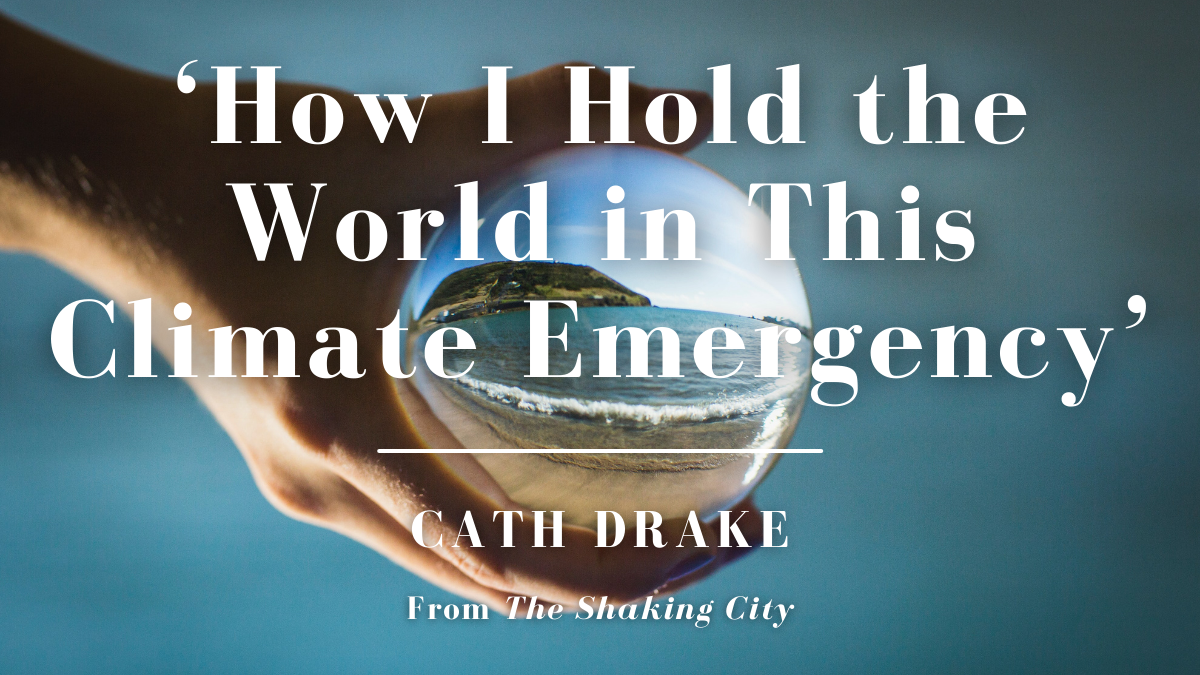
Our Friday Poem this week is ‘How I Hold the World in This Climate Emergency’ by Cath Drake from her debut collection The Shaking City, which is longlisted for The Laurel Prize 2021.
The shaking city of Australian poet Cath Drake’s debut poetry collection is a metaphor for the swiftly changing precarity of modern life within the looming climate and ecological emergency, and the unease of the narrator who is far from home. Tall tales combine with a conversational style, playful humour and a lyrical assurance. The poet works a wide set of diverse spells upon the reader through her adept use of tone, technique, plot and form. She is a welcome new voice for contemporary poetry.
This week our Friday Poem is ‘On Wonder Woman’s Island’ by Alison Binney from her debut pamphlet Other Women’s Kitchens which is the winner of the Mslexia Poetry Pamphlet competition 2020.
Other Women’s Kitchens is Alison Binney’s debut pamphlet of poems and introduces us to a gifted new voice who writes with flair and feeling about coming out and coming of age as a gay woman in 21st century Britain. The collection explores the challenges of discovering and owning a lesbian identity in the 1980s and 1990s and the joy of finding both love and increased confidence in that identity as an adult. An adroit admixture of the heart-wrenching and the humorous, the book features shaped and ‘found’ pieces, traditional narrative and compact prose poems. Beautifully entertaining, pointedly political and often very funny, Other Women’s Kitchens is essential reading. Seren is thrilled to be presenting this author’s first collected work.
Yesterday, the Slate Landscapes of Northwest Wales were awarded World Heritage Status meaning they are now on the Unesco list of World Heritage Sites alongside landmarks the Pyramids in Egypt, the Taj Mahal in India, the Grand Canyon and the Great Wall of China.
The Gwynedd slate mines in Snowdonia were once said to have “roofed the 19th Century world” as slate from its quarries was exported around the globe. In this extract from Miriam, Daniel and Me by Euron Griffith, John Meredith is teaching apprentices how to cut slate in the same historic location.
When Miriam fell in love with Padraig life seemed simple. But soon she discovered that love is a treacherous business. Everything changed when she met Daniel. She was taken down an unexpected path which would dictate and dominate the rest of her life.
Spanning three generations of a North Wales family in a Welsh-speaking community, Miriam,Daniel and Me is an absorbing and compelling story of family discord, political turmoil, poetry, jealousy…and football.
…
John Meredith could slice slate as thin as paper. At the quarry he told the fresh crop of young apprentices who crowded around him every September that all they needed to do was find the sweet spot. Because a piece of slate was almost like a living thing. He would ask the boys if they’d ever stroked a cat. Some of them looked at each other with uncertainty. The braver ones would mumble that they had. So John Meredith explained that a cat always responded to a human hand and would guide it towards the spot where it wanted to be touched. The same was true of slate.
“Look at this mountain”, he’d say, directing their confused but eager faces to the massive whale of rock that they were precariously balanced upon. “What we’re doing is ripping this beautiful material out of Mount Orwig’s belly. Newly-mined slate rumbles past us on these trains and trucks – huge slabs. Raw. Listen to the groaning and squealing of the metal wheels. That tells you how heavy it is. You’d think it was cold and unfeeling wouldn’t you? But slate is alive boys. Trust me. As alive as you or me.”
It was a well-rehearsed lecture, delivered every year and honed, by now, as perfectly as one of his slices of slate. These were the less sturdy boys. The ones who had been deemed unsuitable for face-work. They’d been sent over by Mr MacNamara to learn how to cleave slate into thin slices using only a mallet and chisel and John Meredith was the best they had. A true artist. Now he was telling them about cats and saying that slate was alive. He knew they probably thought he was a bit mad.
“Okay boys,” he’d say, sticking the rolled-up cigarette behind his ear, “see how I’m tapping away at the rock with the blade of the chisel? What I’m searching for is that sweet spot. The place where, with one sharp tap of the mallet, the slate can be split cleanly and perfectly. That sweet spot is very important boys. It’s the key that opens up the treasure. But like with a new cat, it takes a while to find it. Unlike with a cat however, with slate you only get one chance. Get it wrong and you blow it. Which is why it’s important that you get it right. Otherwise all the men in Orwig – the men down in its bowels risking life and limb every day – won’t be happy with you. The last thing they want to see is their hard work wasted.”
He tapped the wooden hilt of the chisel. The blue-grey rock surrendered into two swooning squares.
“See how they’re both the same thickness boys? Pass them round. They’ve both got to be exactly the same thickness otherwise they’re no good.”
The apprentices would all look at each other anxiously but, in time, most of them got the hang of it. Mr MacNamara always congratulated him on training up a new generation of skilled craftsmen and if he only knew how valuable he really was, Mr MacNamara thought, he could probably demand double his wages.
This week’s Friday Poem is ‘Slave Bangle, Wales’ by Maggie Harris from the pamphlet Poems from the Borders. Maggie recently won the Poetry WalesWales Poetry Award judged by Pascale Petit.
Poems from The Borders is part of Seren’s pamphlet series celebrating the spirit of place. Featured poems range from “the spine of the A470”, through Monmouthshire, over the dramatic Brecon Beacons, and also through the Black Mountains towards Hay-on-Wye, towns in Herefordshire and Radnorshire and along rivers, the Wye and Severn.
This year we’re celebrating 40 years since Seren was established as Poetry Wales Press. In the first of a series of posts looking back at our history, founder Cary Archard shares an archive article written shortly after the press was first set up.
“The following piece of optimism was written exactly forty years ago, at Seren’s birth. In it I gave a brief account of what led to the setting up of the press. Its name at the start was Poetry Wales Press and it wasn’t until 1989 that it became Seren. Two of the first three books were first collections of poetry by two young writers called Mike Jenkins and Nigel Jenkins (and encouraging new, young writers is still central to the press), the third was a miscellany of writing by the older, more established Dannie Abse. All three were close collaborations between publisher and authors. All three were produced without any public subsidy or support, though it’s fair to say quite soon such support was offered to enable the infant to grow. At the time, there were people who thought I was crazy, but the risk seems to have paid off.” – Cary Archard
Poetry Wales Press
Photo of Cary Archard by Martin W. Roberts
Sometimes I pretend to myself that my present position as small press publisher came about fortuitously. Circumstances were to blame, not I. After all, would anyone in his right mind enter such a risky business, even in a small way, at such an especially risky time? There may have been times in the past when a fairly bookish person might have longed to start his own press for all sorts of vaguely literary and romantic reasons, but is 1981 the time to emulate Keidrych Rhys or the Woolfs? Surely these hard-headed days are too uncomfortable for such dreamers?
On the surface (pretending circumstances were in control), things were like this. In the summer of 1979, Christopher Davies, the publishers of Poetry Wales, asked J. P. Ward and myself whether we would be willing to take over the publication of the magazine which they had produced and distributed for eleven years. There were probably many reasons for the publisher’s decision, but with the experience of hindsight, I have no doubt that a major consideration was the enormous degree of time and effort that is involved in the production of the magazine. John Ward and I welcomed the opportunity to be both editors and publishers and an agreement was reached which was satisfactory to the outgoing publishers and ourselves. We felt that the magazine couldn’t but benefit by being completely in the hands of its editors. Then, about the same time as our first number appeared in the summer of 1980, J. P. Ward discovered that the pressure of his other work was too great and he decided, reluctantly, to end his active involvement with the magazine. And so, Poetry Wales was left in the relatively inexperienced hands of the present editor who was forced by the exigencies of the situation to learn as much as he could about the business of publishing and distribution.
So, you see, it was, on the surface, circumstances that brought Poetry Wales into my hands. Yet that is too simple an explanation. I had already worked on the magazine for seven years and when you work on a small magazine you get to love it. You care about it and fuss over it as you would a child. (If you were to ask an editor’s family, they might say it assumes more importance than a child.) It’s very difficult to remain unmoved when you hear hard things said about it. Then, besides all this accumulated natural feeling, there was my desire that the magazine should not change its character, something which could happen should it fall into other hands. I saw (and see) its character as broad based, attempting to cover a variety of styles, presenting the best of what is being written in Wales–– primarily in English but most certainly in both languages. The magazine should avoid the coterie: no one should be able to talk about the typical Poetry Walespoem. The magazine’s tone, I believe, should be unpretentious and, as far as possible, non-political. (This does not mean, of course, that individual poems or articles might not be ‘political’. Neither am I so naïve as to imagine that political attitudes do not influence my judgements about poetry. An editor, I think, should be aware of this problem and try to compensate for his tendencies.) I am pleased when readers write in, as they have done, to tell me that the magazine is too left-wing, too respectable, too loose, too Welsh, not Welsh enough: all these conflicting views suggest the balance is about right.
The question remains: how did the magazine become the Press? Part of the answer is that from publishing the magazine I became interested in publishing books. After all, producing Poetry Wales is a bit like producing a quarterly paperback. Then there was my position as editor of the last six booklets in the Triskel poetry series which has been started by Meic Stephens in 1966 and which the publishers, Christopher Davies, has decided to discontinue. I knew from that editorial experience that there were good collections of poetry by young writers waiting to be published. (Indeed I am proud to have published among my first books the first book-length collections of two such fine poets as Mike and Nigel Jenkins.) Again, then, it could be said that circumstances spurred me on: some substitute was needed to replace the Triskel series. It was at this time that I began talking about my publishing ideas to Dannie Abse on our walks, near our homes, along the cliffs between Ogmore-by-Sea and Southerndown. I ought to mention here a particular feature that marks all small press publishing, namely, the close relationship that exists between writer and publisher. This active collaboration has been the most rewarding feature of all the books I have worked on so far. It may have been Dannie who had the original idea from which the Press Miscellany series has grown. Certainly, I doubt whether without his encouragement I would have started the press at all. The idea behind the Miscellany series was that I should publish a selection of a Welsh writer’s work to demonstrate his range and versatility, to get away from the idea that a writer was only a poet or novelist and that anything else he wrote could be safely disregarded. At the same time, some very interesting stories, articles and poems could be rescued from magazines. The first volume has already been published and those who had forgotten what an extraordinarily fine prose writer Dannie Abse is have been delighted by Miscellany One. Miscellany Two by Emyr Humphreys and Miscellany Three, a collection of unpublished writing by Alun Lewis, will be published later in the year.
These then were the circumstances that led to the first books, but I would be less than honest– less than human– were I to leave things at that. Actions are governed by beliefs as well as circumstances. One of my beliefs about the Welsh is that they lack confidence in their own achievements and especially in the achievements of their writers. (I’m talking here about the English speakers in particular.) This belief has been reinforced in different ways. To begin with, the story of a friend’s experience. Robert Watson was born in Newbridge and, until recently, taught in Gowerton. He writes articles and reviews and contributes to magazines like Tract, Use of English and Poetry Wales. He also writes novels, working long hours into the night often after a hard day’s teaching. The point of this story is that Robert hoped his novels would be published in Wales. However, Welsh publishers were not interested. Reluctantly, he left Wales to teach in England and soon after his first novel Events Beyond the Heartlands, set in Wales and a serious attempt to engage with contemporary issues, was published by Heinemann of London. It is ironic that Yr Academi Gymreig’s competition ‘A Novel for Wales’ should come too late for Robert Watson – and it says something about Welsh publishing that the publisher involved in the competition should be English. The competition might help a Welsh novelist to get his work published but it will do nothing to help restore the Welsh writer’s confidence in Welsh publishers.
Wherever I glance I seem to see this lack of confidence. When Book News produced a special issue last year for the Frankfurt Book Fair did it confidently support our contemporary English language writers? No. Instead we were given articles about writers such as David Jones and R. S. Thomas, safely established figures whose books are not published in Wales. When I turn to Professor Gwyn Jones’s anthology, The Oxford Book of Welsh Verse in English, I cannot help but notice how heavily he has lent on the part Welshness of established English poets like Wilfred Owen and Edward Thomas and on the translations from Welsh language writers, with the consequent neglect of many fine English language writers working in Wales today. Isn’t this another example of lack of confidence? Or look at the way the new magazine Arcade treats writers. Its series of profiles on writers is an excellent idea but what it has meant so far is that writers are treated as news personalities. Their writings have been largely neglected.
The problem, then, is a general lack of confidence in the achievements and potential of our writers, and at a time, too, when we have, I firmly believe, many good writers working in Wales. This is where I hope Poetry Wales Press can contribute something important. I want to publish new books of poetry regularly, and occasionally books of prose, of articles and criticism. The first three books were published without Welsh Arts Council grants but to continue without their support would mean publishing very infrequently. If the momentum is to be kept up, I shall need their financial help. And this is where I am not sure the present system of grant support is of the right kind. The present method of submitting each manuscript to the Literature Committee for separate consideration is too bureaucratic. If the ‘wrong’ reader is chosen by the Committee, your manuscript may not receive a grant. There are inevitable delays. Besides, no publisher worth his salt wants his judgements discussed and his plans altered by a committee. I think the Literature Committee ought to show more confidence in publishers and award block grants so that they can get on with their job. It seems to be inconsistent, for example, that a block grant can be awarded to a magazine like Poetry Wales which produces what are, in effect, four paperbacks a year but that a block grant cannot be made to a publisher to produce four unrelated books. I am confident that the Literature Committee which has made bold and imaginative decisions in the past (such as the creation of its own bookshop which has made an invaluable contribution to the literary life of Wales) will think constructively about this problem.
Robert Watson prefaced his first novel with a quotation of Nietszche which begins: ‘We no longer see anything these days that aspires to grow greater’. Placing the emphasis on ‘aspires’. I would like to think that Poetry Wales Press aspires to do something to improve the general state of publishing in Wales. Risking immodesty, I would like to think that its inception isn’t only related to personal circumstances but that it is also, in its own way, part of recent attempts (like Sally Jones’s Alun Books) to help Welsh writing ‘grow great’.
Celebrating 40 years of independent publishing in 2021
What’s your favourite Seren book from the last 40 years? We’d love to know! Tag us in your photos on Twitter, Facebook or Instagram using the hashtag #Seren40.
Create your free Seren account and enjoy 20% off every book you buy direct from us.