Though certain parts may be seeing rain this weekend, the warm weather continues – and what better time than summer to explore all the UK has to offer?
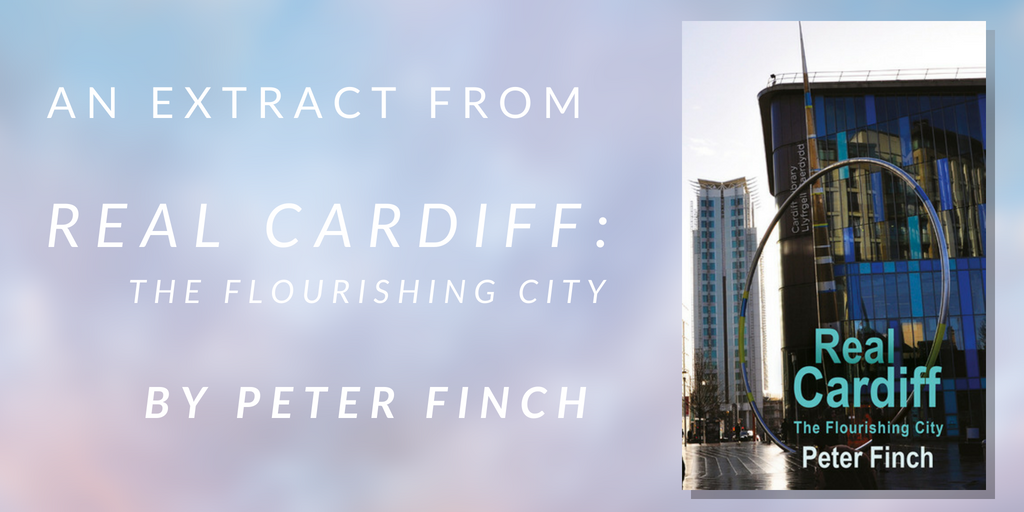
 Our Real Series – a collection of intimate and entertaining guide books written by local writers – offers an insider’s view of the places it celebrates. The most recent addition to the series is Real Cardiff: The Flourishing City by Cardiff author and legend Peter Finch. So whether you’re an armchair traveller, or someone looking forward to a trip to the Welsh Capital sometime soon, we hope you enjoy this glimpse into the history of Cardiff – specifically, the area in which famous children’s author Roald Dahl grew up.
The whole of the Real Series – and all our other Seren books – are 50% off until midnight, Sunday 29 July, on the Seren website.
ROALD DAHL’S CARDIFF NORTH LEY
I catch the train at Cardiff Central. This is the City Line which began in the city’s north east and now, after looping in a great U through the city’s heart is about to head north again. I’m in the two-car Sprinter and I’m standing. Every single seat is occupied by pupils from Bishop of Llandaff High School. Kids, bags, blazers, headphones, chewing.
The windows stream as the train steams. Around us is railway land, an industrial cityscape full of rail sheds, engine bays, carriage washeries, repair shops and assembled new track in stacks like a giant train set. This south west of the city on view from the tracks is the capital with its guard down. Backs of mosques, tottering streets, unkempt gardens, the yards of Brains brewery, warehouses stacked with building materials, and even more open and right now empty rail beds. It reminds me of London, how the land looks as you reach Paddington or Waterloo.
But it doesn’t last. After the carriages have disgorged a hundred uniformed school kids at Fairwater, the cuttings emerge, wooded banks and scrub masking the housing above. It’s leafy suburbia giving an impression of empty countryside. A green west Cardiff, a place that doesn’t change.
It’s freezing. This is January. The train has reached Radyr where it will rest a while before returning the way it came. I’m off, up the footbridge steps, plastered thickly with Network Rail road salt. No one but no one will slip and sue here. In a previous, smaller, steam-filled incarnation, the Radyr train would have served Roald Dahl’s father, Harald, who did a daily commute in to what was then called Bute Road Station. His ghost is there on the platform now, eye glasses, three-piece suit, white starched collar. He looks like a disapproving headmaster. His railway season ticket was found inside his expensive leather wallet when he died in 1920. That was on April the 11th. The ticket was valid until the 23rd.
Like most in Cardiff at this time Harald’s business was coal. With his partner Ludvig Aadnesen he had established a business as a colliery agent and provider of all that ships docking in the world’s leading coal port would need. Provisions, ropes, oil for their lamps, food. The profits flowed.
In 1917 Harald had bought Tŷ Mynydd (Mountain House), set on rising ground a mile north of the Radyr rail station. As befits the successful businessman Harald was, here was life on a grand scale. 150 acres of land, outbuildings, cottages, a piggery, lawns, formal flower borders, terraces, its own electricity generator and an enormous Victorian house.
In photographs it looks like part of Hogwarts. It had multiple chimney stacks, mock Tudor gables, a tiled roof larger than most churches’ and greenhouses to the side to rival those of Dyffryn House, to the west of Cardiff. This is the place Roald, the great author, remembers with nostalgia, recalling the fields full of shire horses and dairy cows. There are photographs of him as a four-year-old out on the lawns and terraces, in the fields among the sheaves of corn, sitting on the wall of the piggery and of the house itself, which is resplendently decorated with both the Union Jack and the Norwegian Flag. No Welsh dragon in sight.
Like Cefn Onn, Tŷ Mynydd also had railway connections. The house had been built in 1883 by George Fisher, Director of the Taff Vale Railway. When he died in 1891 the property passed to his son, H. Oakden Fisher, Chair of both the TVR and the Cardiff Gaslight and Coke Company Ltd, although his real interest lay with the military. He was Lieutenant Colonel of the Glamorgan Volunteer Artillery. Harald bought the estate in 1918. When he died in 1920, his second wife, Sofie Magdalene, moved to smaller premises back in Llandaff. Tŷ Mynydd then became the property of the architect Sir Beddoe Rees, MP and for a brief time in the 1930s was turned into St Maur’s College, a small private boarding school for girls.
In 1967 the house and most if its outbuildings were demolished. This was the first full-blooded rush at clearance following the war. Cardiff was expanding. Property developers had no interest in the preservation of inefficient, draughty piles such as Tŷ Mynydd. On its lands a whole housing estate could be build. It had to come down.
I take the road up out of the station’s gully. Already the old shunting yards and waste ground lining the river have been populated with high density brick town housing. There’s little public space. Most structures are distinct from each other, laid at angles as if thrown there like dice. Room for breath is restricted and corners are rounded. Access is on turning roads named after De Clare, Norman Lord of the City, Aradur Hen, an ancient local croft that gave us the name Radyr, and Goetre Fawr, the farm that once worked these lands. Behind the aptly named Junction Terrace is a field replete with three grazing llamas, tall-necked beasts which, despite the ll of their name, are about as common in Wales as kangaroos. Food To Go which has signs offering coffee and warmth is closed. I head up along rising Heol Isaf in the direction of the Village of Fire.
In 1841 the ten cottages of Pentre Poeth (Warm Village) were all that existed of what is now Morganstown, upper Radyr – that part of Cardiff north of the M4’s périphérique grip. This is where the workforce of the developing fire-filled ironworks at Pentyrch lived, an element of Cardiff’s lost industrial heritage. Heol Isaf was and still is the main road to Tŷ Mynydd. It’s no distance to cover. In my ears I’ve got Emmylou playing through the buds. 1970s country, when what she sang was the edge. Alabama down home. Dahl wouldn’t have stood for this. He preferred Beethoven.
The Tŷ Mynydd estate has been built on; the fields are gone. The line of the original entrance path running up from Tŷ Mynydd Lodge has been preserved in the rising bends of MaesYr Awel. The detached late-sixties houses along it turn eventually to a U-shaped cluster of apartment blocks. Cwrt Tŷ Mynydd is the appropriately named first; after that the developer gave up and resorted to names with a strong English resonance – Norfolk Court, York Court, Windsor. It’s a marketing thing. Here, near the eastern edge of Wales, where the language thins, the Anglo norm dominates.
Beyond the apartment courts, circled like a residential wagon train, there’s a copse, ancient pine trees, all that remains of what once was here. For the Dahls of the nineteen teens this would all now be virtually unrecognisable. A local walking his young daughter to the primary school at the former estate’s southern end tells me, yes, he knows about Dahl and the great house. He points me back towards the still extant Tŷ Mynydd Lodge which faces Heol Isaf. And there it is, the gatehouse preserved, doing time now as an up-market B&B. The Llandaff Society have installed a celebratory plaque above the front door. Over the years since Roald would have known it the building has been much extended. But there’s enough original left for the Dahlian spirit to soar. I can see him outside, short pants, laced leather shoes, hat, overcoat with enormous buttons. Mama holding his hand.
Real Cardiff: The Flourishing City is currently half price on the Seren website: £9.99 £4.99
Thinking of visiting cities elsewhere in the UK? Find the perfect insider’s guidebook to enrich your trip:


See the full list of Real books on the Seren website: all half price until midnight, Sunday 29 July!



 The tender, unexpectedly hopeful poem comes from Williamson’s upcoming collection