Posted on

International Day of the Girl 2016

international day of the girl

Today is International Day of the Girl, a day designed to raise awareness about gender inequality and the barriers girls come up against, from birth to adulthood. In recognition, here are a few Seren writers whose books highlight the challenges girls and women face.

Six Pounds Eight Ounces, Rhian Elizabethsix pounds eight ounces
‘My first word was clock only it came out as cock. That was when my mother knew I was trouble.’
Rhian Elizabeth’s introduces us to Hannah King, a self-assured young girl brought up in the Rhondda Valley within a community that offers little prospect for her future. Situated in turbulent surroundings, in conflict with family and community, Hannah is pulled towards a dark instability. Both comic and tragic, this is a gripping portrayal of girlhood in Wales.


The Way the Crocodile Taught Me, Katrina Naomithe way the crocodile taught me
In Katrina Naomi’s collection we see a girl in fear of her domineering step-father whose ‘flashing anger’ (‘Portrait of my Step-father as a Xmas Tree’) threatens to bubble up at every turn. We see the trials a woman can face: sexual assault, aggression, misuse. This is an emotive collection that refuses to shy away from depictions of violence and abuse, yet remains resolutely uplifting.


folk music sheenagh pughFolk Music, Sheenagh Pugh
Set in a country lying somewhere between Wales and central Asia, in a time which might be the middle ages or the near-present, Folk Music is a work of fiction that draws parallels with the oppressive, patriarchal regimes still existing today. Central to the story is the convention that, on marriage, a woman does not speak to anyone, except in private to her husband, until the birth of her first child. Pugh explores the possibility for both oppression and empowerment in this subtly-entwined narrative, which asks whether the abandonment of tradition is a positive thing, or may leave us only with rootlessness and dislocation.


fighting-pretty-smallFighting Pretty, Louise Walsh
Walsh peers into the macho world of boxing with tenderness and telling humour. Reeling from divorce, jobless and living back home with her embittered father, Lizzie throws everything she has into training to be a boxer. Despite battles with her weight and other demons, Lizzie fights on, determined someday box for Wales, and wear the coveted red vest. This story breaks down the barriers separating men and women in sport, just as the Olympics have begun to give women better representation (in 2012, for the first time, 10 men’s Boxing events at the London Olympics were joined by three women’s events).


the tip of my tongue trezza assopardiThe Tip of my Tongue, Trezza Azzopardi
This re-telling of the Mabinogion story Geraint and Enid transforms a medieval heroine who won’t be silenced into a brace 1970’s girl from downtown Splott in Cardiff, who, no matter how difficult the circumstances, always seems to get the last word.
The original Enid from Celtic mythology defends her misguided husband by warning him of approaching villains, even though he has forbidden her to speak. Trezza Azzopardi’s young Enid is also unlikely to respect a gagging order.


This list features just a few of the many talented Seren women writers. Discover them all on our website.


Want to get involved with International Day of the Girl? Join the conversation online by using the hashtag #DayoftheGirl on Twitter.


Posted on

Friday Poem – ‘Making Out’, Deryn Rees-Jones

friday poem making out deryn rees-jones

This week our Friday Poem is ‘Making Out’ by Deryn Rees-Jones, which originally appeared in her second collection, Signs Round a Dead Body, and also features in her generous new What It’s Like to Be Alive: Selected Poems.

Both collections (along with Deryn’s other books The Memory Tray, QuiverAnd You, Helen and Burying the Wren) are half price until midnight on Sunday, 9th October as part of our National Poetry Day sale.

Deryn Rees-Jones What It's Like To Be Alive Selected PoemsWhat It’s Like to Be Alive marks a mid-career milestone in the life of this highly-acclaimed writer. From the poems written in her teens and early twenties included in her exciting debut The Memory Tray to her most recent exploration of time and grief, we see the arc of development in her writing over twenty-five years as she visits and revisits the concerns that are the mainstay of her writing: memory, love, desire, and heartbreak in all its manifestations. The following poem originally featured in Signs Round a Dead Body, Deryn’s second collection.

Making Out

Now it was airports that she needed –
to sit there going nowhere
counting aeroplanes like sheep,

with Concorde like an archaeopteryx or angel
and Egypt, Russia, the Azores and Lithuania
spinning in her head. She’d sit there

writing letters that she knew she wouldn’t send,
telling him about the dull, red moon, the way
the landscape then, so pale, unreal,

the fishermen, the midnight seas
had been tattooed like hieroglyphs
in blues and golds

deep into her skin. It was his hands, I think,
she could imagine best
travelling across her. But she thought about the way

he’d kiss her too, the way she’d smile, nod yes
to his demolishing her. The way he’d start
to reassemble, slowly, in the rented bed

her mouth, her throat, her shoulders, breasts,
her knees, her arms, her thighs, her calves, and love etc.


Until midnight on Sunday 9 October,What It’s Like to Be Alive: Selected Poems is half price: only £6.49 (RRP £12.99). Buy your copy now to take advantage of this fantastic offer.


Save

Posted on

50% off all Seren poetry collections for National Poetry Day

national poetry day sale 50% off

Today is National Poetry Day, and in celebration we are offering a whopping 50% off all our fabulous poetry books.

Seren have been dedicated to publishing poetry since the 1980s, and so there are a stunning number of titles on offer – everything from the classic bestsellers like Dannie Abse’s Welsh Retrospective and Sheenagh Pugh’s Selected Poems to our newest offerings, like Caroline Smith’s topical The Immigration Handbook and Tony Curtis’ hot-off-the-press From the Fortunate Isles: New and Selected Poems.

national poetry day 50% off sale Seren

Hurry to take advantage of this offer as it ends at midnight on Sunday, 9 October. We hope you discover great new poetry, on this most poetic of days…

Explore the Seren poetry shop and find new poetry for less

Posted on

An extract from Masque by Bethany W. Pope

an extract from Masque by Bethany W Pope

Enjoy this extract from Bethany W. Pope’s debut novel, Masque, now available from serenbooks.com (or your local bookshop!)

Masque by Bethany W PopeAbout Masque:
Masque is a richly gothic retelling of Gaston Leroux’s The Phantom of the Opera. Centre stage is would-be opera singer Christine, who, despite being devoted to her art, attracts the attention of both the Phantom, and rich theatre owner Raoul. The resulting mix of love, rage, art and murderous intent, is explosive.


This extract begins on p.11 of the novel and is our first introduction to The Phantom – Erik – a deformed and complex character, both monstrous and kind. Unlike Leroux’s original The Phantom of the Opera story, Masque is told from the perspective of the three main characters, so we see directly into the mind of the much-maligned Phantom, and can judge him as we see fit…


ERIK
1.
My father was a master mason. I never met the man but I
spent the first decade of my life inside the house he built
and so I feel I know him. The lathes of the attic communicated
with me as much through their shape (he was
exacting when he laid out the angles of the eaves) as did
the notations he left in pencil on the undersides of the
unfinished, unpainted struts which supported the ceiling. I
inherited the crabbed handwriting he used to mark out his
measurements, though I am far more articulate than he ever
was in artistry, architecture, or print.
Although he was skilled with the trowel and could lay
travertine so tightly that its texture was more like marble
than limestone, he was more renowned for the beauty of
his person that the skill of his hands. He won my mother
with his looks and he left her a sad ghost of the gay girl he
married, haunting the house that he built on Rue Rouge.
I learned about him through the letters he left to my
mother, retained by her in memory of their apparently passionate
courtship.They were bound by a blue ribbon, an
appropriate memento of an innocent girl. One envelope
contained a bright lock of hair that must have been his,
since mother’s was as dark as a sewer rat’s. The letters were
naïve, almost innocently crude. They were full of phrases
about the things that he wished that he could do to her
body and peppered with prayers for many years of marital
bliss. They were written in the kind of cheap ink that an
uneducated man would favour. He did not expect them to
last, or be held on to.The sepia was grainy and badly mixed,
this combined with his handwriting in such a way that it
seemed as though his words were written out by a sexually
precocious child with a fondness for experimenting with
matchsticks. As I said, my handwriting is no better, but at
least the ink I use is superior.
I always thought that writing was a bit like the telepathy
those spiritualists in the paper are always talking about. It
makes sense, if you think about it; one mind communicates
to another through a series of black blotches which transmit
thoughts directly into another’s brain. You, reading this,
whoever you are, can hear my voice (a sweet, trained tenor)
without ever having to worry about viewing the flesh that
produces it.This is lucky for you: all my gifts are internal.
In any case, my current habitations remind me of my
childhood home. These damp vaults are rather like the basement
where my mother moved my crib once the
neighbours complained that my cries disrupted their business.
The house my father built was tall and narrow, the
walls of dark grey granite, polished to the high shine of
gravestones. He meant his home to be a living monument
to his skill and a permanent advertisement for his services.
The roof was tiled with slabs of greenish slate, and the
windows were small and imperfectly glassed. When I was
older, I replaced them as a gift for my mother. I spent a
whole afternoon removing the warped and watery panes,
replacing them with sheets I’d poured myself. I learned the
art of glazing, sneaking every night to the factory down the
street. When the time came that I had spent enough hours
watching the midnight production shift pouring the sheets
of reddish molten sand into the mould, I tried my hand at
it myself. I waited until the Michaelmas holiday and stole
the machinery (I provided my own materials, lugging bags
of silicone that I’d found in the cellars among the unopened
bottles of wine and the skeletons of rodents). I love the look
of glass as it is being poured. It is honest, then, about itself.
Cooled, it only seems a solid. It never fully hardens. Over
centuries, window glass will melt.
There is no such thing as stasis.
In any case, my mother loved the finished product; windows
that let the light in without warping what she saw on
the street. She was so thrilled she squeezed my upper arm
through the thick fabric of my jacket. I swear she almost
hugged me. In any case, for once she did not shudder at my
smell or flinch away from the feel of my corpselike body.
The houses on either side of ours were dedicated, in their
own way, to music. Dancing girls and cabaret, absinthe and
cheap champagne that the likes of those poets who styled
themselves ‘Romantic’ drank themselves to death in. My
widowed mother hired men to refurbish the attic into a
series of rooms that she furnished with sticks she’d bought
from brothels, closed in raids by the province governor the
previous summer. She did not sleep on them and rarely
bothered to change the sheets, so she didn’t have to worry
about bedbugs. She made a good living, I must say, giving
the drunks who seethed from her neighbours in the early
morning a bed off of the streets.
For my fifth birthday she made me my first (and for a
long time only) birthday present; a mask cut from a length
of chamois that she bought from a glover. It was more like
a loose sack with holes cut for eyes than a proper garment
but it did its job well. The sight of me ceased bothering her.
As I grew older, she let me come up more frequently –
although once she had a steady stream of lodgers I never
had the run of the attic again – my father’s writing was long
since buried behind plaster. I wore the mask without complaint
– it was far from uncomfortable and it had a nice smell,
as did the sachets of mint and violet that she sewed into my
clothing. If she almost never touched me, she did love me as
best as she was able, being young and easily frightened.
After a few years of proving my capacity with panes of
glass and basic home repairs, she hired a blind tutor to teach
me letters, music, mathematics. He would come and sit for
hours in my basement room, complaining of the effect of the
chill on his bones and making me memorise many disparate
packets of learning. When I surpassed his ability to teach, as
I soon did, I had many books close at hand and I turned to
them to expand my knowledge. I read everything from
Archimedes to fairy stories. As I recall, I had a special affection
for La Belle et la Bête. My mother bought me as many books
as she could afford through mail-order – often secondhand.
She resold them after I had squeezed them of their nutrients,
though I demanded permission to keep the fairy tales. They
were a balm to me, with their stories of transformation. They
provided me with a sharp and dangerous hope.


Buy your copy of Masque now: £9.99

Claim 20% off this and all future orders when you become a Seren Book Club member

Posted on

Friday Poem – ‘Savoy Hotel, London’, Rosie Shepperd

friday poem rosie shepperd

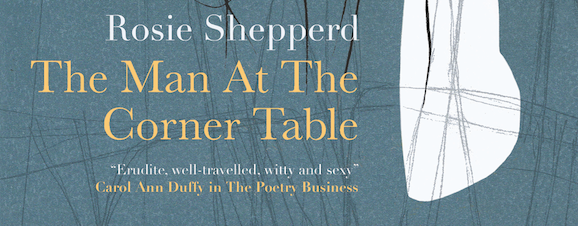
This week our Friday Poem is from Rosie Shepperd’s tantalising debut, The Man at the Corner Table. You can hear Rosie read from this collection live on National Poetry Day, 6 October, at Berkhamsted Waterstones alongside Caroline Smith and Graham Clifford.

the man at the corner table rosie shepperdThe Man at the Corner Table crackles with the unexpected. The voice is one of urban sophistication; a merciless charm that teases and tempts us with sensual evocations of food and place. The reader is surprised with tastes, scents, colours and textures. There is a winning insistence on detail offered with an irony that blends into satire.


Savoy Hotel, London
Those nights downstairs at the American Bar;
it’s not just the chairs that show gilt in the telling.
Back then we were almost quite something.
You and London were lean;
your eyes, a fraction off-centre as you
struggled not to say,
We have this connection. My God.
You overplayed.
And not just your hand.

My role in this mellow
drama was to shift that arse
you loved to chase and twitch my best side
close to the oh-so-Maraschinos.
Too long ago, they were fruit in a tree.
Some tree.
I guess they were something for me
to play with; the pretence
we were ever friends was just
a way to simulate sharing.

30:70 and I never found out
who made the best bet
but I do know that’s the wrong word.
Early is just another kind of late and
anyway, you were always
there each night, every night. There’s
no fool like a blind
fool; thank God I didn’t see the edge
till I was over and out
the other side.


Buy your copy of The Man at the Corner Table now: £9.99

Claim 20% when you become a Book Club member

Posted on

National Poetry Day 2016: All you need to know

National Poetry Day is an annual celebration of poetry and all things poetic. Started in 1994 by William Sieghart, it has engaged millions of people across the country with reading, writing and listening to poetry.

This year, National Poetry Day is taking place on Thursday 6th October. The 2016 theme is Messages – think texts, emails, letters, cards, speech; sad messages, hopeful ones, happy messages and even unspoken ones. They could be spooky, paranormal messages or those you hear every day, such as “hello” and “goodbye”.

Say it with a poem – be inspired by this years theme of Messages, and write a poem of your own to express yourself!

poetry-book-coverposterfinalupdate2-675x1024Download this year’s FREE poetry eBook – Messages: National Poetry Day 2016 is a free anthology of wonderful Messages poems – old and new. The fourteen poets in this eBook (created by MacMillan Children’s Books with Forward Arts Foundation) are all National Poetry Ambassadors.
Featured poets: Deborah Alma, Liz Brownlee, Paul Cookson, Sally Crabtree, Joseph Coelho, Matt Goodfellow, Sophie Herxheimer, Rachel McCrum, Brian Moses, Michaela Morgan, Joshua Seigal, Roger Stevens and Indigo Williams.

Download your free copy of the National Poetry Day 2016 anthology here.

Get involved! Attend one (or more) of the many National Poetry Day events happing all over the UK.
There are loads of events happening on and around National Poetry Day, 6th October, including two of our own:

First Thursday: New Fiction and Poetry at Chapter, Cardiff
Seren’s monthly celebration of new poetry and fiction returns after the summer break. Join us for readings from our special guests and then the famous open mic.
Cardiff poet and author Peter Finch presents: The Roots of Rock, from Cardiff to Mississippi and Back, and Jayne Joso reads from her new novel, set in the outskirts of tokyo: My Falling Down House.

Berkhamsted Waterstones: Caroline Smith, Graham Clifford & Rosie Shepperd
Celebrate National Poetry Day at Berkhamsted Waterstones with an evening of poetry readings, featuring three Seren poets: Caroline Smith (The Immigration Handbook), Graham Clifford (The Hitting Game) and Rosie Shepperd (The Man at the Corner Table).

Take a look at the National Poetry Day events map and go along to anything that catches your eye.

Take advantage of free online resources – There are loads of resources on the National Poety Day website, including advice on how to get your school enjoying poetry, news, and free poems to read and share. Take a look here.


Seren’s own celebrations will kick off with a flash poetry sale – keep an eye on our website (or social media channels) on 6th October to take advantage of our special National Poetry Day book offers!


Save

Posted on

Friday Poem – ‘What the Dead Don’t Know’, Anne-Marie Fyfe

Friday Poem What the Dead Don't Know Anne-Marie Fyfe

Our Friday Poem this week is taken from Anne-Marie Fyfe’s latest collection, House of Small Absences.

House of small absencesAnne-Marie Fyfe’s poems have long dwelt on the role that the spaces we inhabit, the places in which we find security, play in our lives: House of Small Absences is an observation window into strange, unsettling spaces—a deserted stage-set, our own personalised ‘museum’, a Piedmont albergo, underground cities, Midtown roof-gardens, convent orchards, houseboats, a foldaway circus, a Romanian sleeper-carriage—the familiar rendered uncanny through the distorting lenses of distance and life’s exigencies, its inevitable lettings-go…


What the Dead Don’t Know

Grows quickly, daily, from the perimeter
of a postage stamp, until it’s twice the size
of Norway, and growing fast.

What the deceased can’t understand
is why they don’t still hear from us
day-by-day, hour-by-hour.

What the departed don’t see
is how the lead story has moved on.

What the dead won’t say
is more or less what they didn’t say
when they had the chance. Diplomacy,
tact, reserve: these things endure.


Buy your copy of House of Small Absences now: £9.99

Claim 20% when you become a Seren Book Club member


Posted on

Friday Poem – ‘VII’ from Batu-Angas, Anne Cluysenaar

batu-agas Anne Cluysenaar

In celebration of the brief heatwave that has hit the UK, we are taking this week’s Friday Poem from Anne Cluysenaar’s tropical Batu-Angas: Envisioning Nature with Alfred Russel Wallace.

Batu-Angas Anne CluysenaarAlfred Russel Wallace (1823-1913) was one of the most famous scientists of the 19th century and is best known today as the co-discoverer, with Charles Darwin, of the theory of evolution through natural selection. Wallace’s life and work are the inspiration for this beautifully considered collection of poems. Why the title? As Anne Cluysenaar explains in her Foreword:

It was during an acute bout of malaria on the volcanic island of Ternate that it ‘flashed upon’ Wallace how life evolves through natural selection … From the local language of Ternate itself, Wallace had borrowed the phrase ‘batu-angas’ to describe the ‘burnt rocks’ or cooled lava he saw there. The phrase struck me as as suitable title for this sequence because it could be said to symbolise the visible world at any one time – a world now, thanks to Wallace and Darwin, known to maintain a seeming stasis only, amid the flowing lava of evolution.


VII

batu-angas-blogBatu–Angas is available from our website: £8.99

Sign up to the Seren Book Club and save 20%


Save

Posted on

Friday Poem – ‘Autumn Elegy’, Leslie Norris

Friday Poem Autumn Elegy Leslie Norris

Our Friday Poem this week marks the coming of autumn, and is taken from Leslie Norris: The Complete Poems, edited by Meic Stephens.

Leslie Norris Collected PoemsThis landmark publication of over 300 poems is a testament to a publishing life of more than sixty years. The late Leslie Norris, who died in 2007 at the age of 86, was best known as a nature poet and elegist of passion and rare expression. Lyrical and individual, to his closely observed poems, each word weighed and in its correct place, Norris introduces a strong metaphysical element which makes the poems, as Edward Lucie-Smith noted, “much larger than the sum of their parts”.


Autumn Elegy

September. The small summer hangs its suns
On the chestnuts, and the world bends slowly
Out of the year. On tiles of the low barns
The lingering swallows rest in this timely

Warmth, collecting it. Standing in the garden,
I too feel its generosity; but would not leave.
Time, time to lock the heart. Nothing is sudden
In Autumn, yet the long, ceremonial passion of

The year’s death comes quickly enough
As form veins shut on the sluggish blood
And the numberless protestations of the leaf
Are mapped on the air. Live wood

Was scarce and bony where I lived as a boy.
I am not accustomed to such oppulent
Panoply of dying. Yet, if I stare
Unmoved at the flaunting, silent

Agony in the country before a resonant
Wind anneals it, I am not diminished, it is not
That I do not see well, do not exult,
But that I remember again what

Young men of my own time died
In the Spring of their living and could not turn
To this. They died in their flames, hard
War destroyed them. Now as the trees burn

In the beginning glory of Autumn
I sing for all green deaths as I remember
In their broken Mays, and turn
The years back for them, every red September.


Buy your copy of Leslie Norris: The Complete Poems now: £25.00

Claim 20% off when you become a Seren Book Club member


Posted on

An Interview with Caroline Smith

An interview with Caroline Smith The Immigration Handbook

Today we are joined by Caroline Smith, whose new poetry collection The Immigration Handbook weaves together stories of hope, frustration and pain, drawn from Smith’s experience as an Immigration Caseworker.

CarolineSmith CropCaroline Smith was born in Ilford and grew up in Hertfordshire. She originally trained as a sculptor at Goldsmith’s College. Her first publication was a 30-page narrative poem, ‘Edith’. Smith’s first full collection, The Thistles of the Hesperides (Flambard), is about the community of West Pilton in Scotland where Caroline lived in the 1980s when it was one of the most deprived housing estates in Europe. Using imagery and structure from Greek mythology, and direct stories from observed lives, the poet weaves a dense and dramatic tension between the harshness of reality and the lyricism of myth. Published widely in journals like Poetry Wales, Poetry Review, Staple, Orbis and Stand, she has twice won prizes in the Troubadour Poetry Competition.  Smith has had work set to music, broadcast on the BBC and is also the author of a musical play, The Bedseller’s Tale, that was performed at the Edinburgh Festival Fringe.  She lives in London with her family.

 The Immigration Handbook Caroline SmithYour new poetry collection, The Immigration Handbook, brings to life the stories from migrants and refugees that you hear every day in your work as an Immigration Caseworker. What made you choose to transcribe these deeply affecting stories, and was the process cathartic?

Writing thousands of letters to the Home Office over the years, I think about language, what turns a letter into a poem, the different functions of language and how by changing the angle or perspective on a subject you can show it afresh. My book is another way of contributing to the immigration debate, but it is primarily a book of poetry. It’s the stuff of my life so it’s what I make art out of.

When I was younger I couldn’t decide if I wanted to be a priest or a sculptor – so I campaigned for women’s equality and ended up as a poet! But in a sense these twin strands have come together in my poetry; my interest in social justice and my training as a sculptor who needs always to recreate the world in a different way.

I’ve never found writing cathartic. When I am most upset about something I want it to stop, I don’t write my way out of it. I see my work as an Immigration Caseworker and my poetry as separate. I get angry and try to change the system, but for poetry I need distance and reflection and I enjoy the creative process; the juxtaposition of odd fragments, creating something new, although I suppose it is cathartic in a Nietzschean way….. ‘Every art and every philosophy may be regarded as a healing… in that respect maybe.

Your poems are often (unsurprisingly) rather bleak, as they describe characters who have lost hope, who feel abused by the system, who don’t know where to turn. Do you hope the collection inspires people to see beyond the statistics and recognise the humanity of those seeking citizenship?

Yes that is exactly what I am hoping people will find in my poems – despite the bleakness, a celebration of humanity. My poetry contributes to the immigration debate; not by putting forward a set of arguments like I do in my letters to the Home Office, but by showing the humanity of people trapped in the system. Not every asylum seeker or refugee is a hero or angel. I have painted people as they are – with both frailties and resilience. We all have the same longings and desires to make something of our lives, it’s just that the people I see in our immigration surgery have a much tougher journey than most of us have ever had to bear.

You have a knack for finding humour in surprising places, for instance in your poem ‘Judgements’, which cleverly and comically portrays the bureaucracy behind judgements made on applications:

“… if the appellant claimed
that relevant matters did not happen I should not
exclude the possibility that they did not happen
(although believing that they probably did)”

Is humour an important part of poetry writing for you? And does it follow you into the workplace, and other aspects of your life?

Tragedy and comedy sit very close to each other. I’ve received so many misspelt letters…’I have been arrested by six uninformed guards’…with wormiest regards’‘I love your cuntry’!

Satire and the use of comedy is important in art. Slapstick and the absurd sharpen the truth of a situation. The most wildly improbable stories, can actually accentuate pathos and provide a break in the bleakness. Humour is also a great tool for showing up the absurdity and dysfunctionality of the Home Office which cruelly traps people without status and documents for years. It is the startling and unbelievable that is often true; whereas the predictable stories are most likely to be fabricated.

The Immigration Handbook was written over a number of years. Were these poems always destined to be released as a collection, or did the idea to publish these stories together come much later?

I always intended them to be a sequence of poems on the subject. I remember the night I started writing this collection. I filled a book with scrawling notes of incidents, characters and injustices. But it is one thing to have an idea for a poem, but then you have to wait for all the elements to come together and it often ends up going off in a completely different direction. Because I have so many stories fermenting in my head, unexpected elements mesh together.

Both my previous collections included sequences of poems. I’ve never been interested in writing a novel, but I love the opportunities presented by writing a number of individual poems that can work together and spark off each other to come at an idea from different angles and perspectives. Although I don’t write formally, the form of the poems are critical to me. I used to approach a sculpture from all angles as once.  I would use different materials and found objects set against each other to break up the surface, juxtaposing different textures. And I think I do the same with poems using different intensities; some highly worked, some quick ‘line drawings’, some found reports. The difference today is that I’m carrying my studio of scraps and fragments and found objects around in my head!

And finally, tell us about your plans for the future- where will we see your name next, and are there any festival or events appearances you can tell us about?

I had a great time reading at the Ledbury Festival earlier this summer and my book launch at the Nehru Centre in London was just fantastic – courtesy of the Indian High Commissioner! I have a whole series of readings lined up for the autumn in Cardiff, London, Aberystwyth and I’m doing a couple of Festivals in Bristol and Chorleywood as well as a special event with Waterstones in Berkhamsted for National Poetry Day.

I am really enjoying giving readings and talking about my book but already the restlessness to create and my dissatisfaction with the world as it is, is pushing me back to my writing desk. When I have lots of ideas in my head I find it distracting to read. Now The Immigration Handbook is out I’m reading as much as I can, going to lots of poetry events and every play that I can get tickets for.

17th September: Free Verse, The London Poetry Book Fair.
3
rd October: Poetry Can Festival, Bristol.
6
th October: National Poetry Day, Waterstones Berkhamsted, Herts.
15
th October: Chorleywood LitFest, 12 noon The Junction, Chorleywood, Herts.
18
th October: Lumen Poetry Series, 19:00 Tavistock Place, London.
26
th October: Aberystwyth University, English & Creative Writing Society.
27
th October: Waterstones Aberystwyth.
30th October: Cardiff Book Festival.
24
th November: 19:30 Waterstones Piccadilly.

The Immigration Handbook is available on our website. Buy your copy now: £9.99
Claim 20% off when you become a Seren Book Club member

Save