
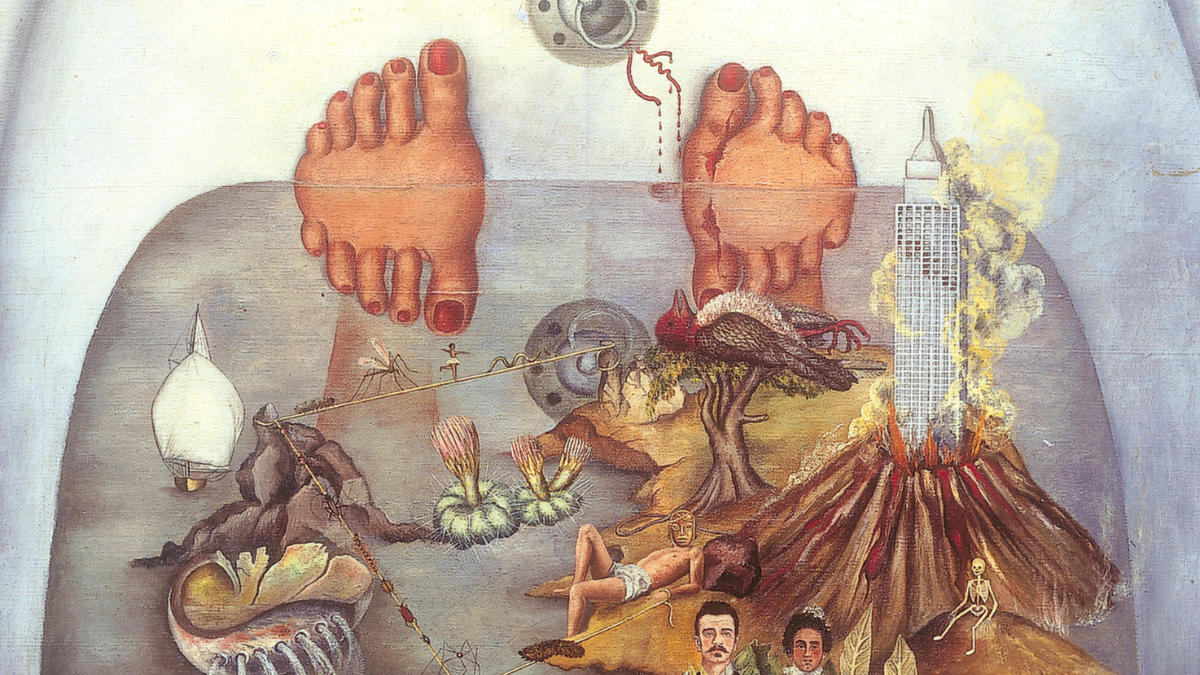
Following International Women’s Day, this week’s Friday Poem is ‘My Birth’ by Pascale Petit from her collection What the Water Gave Me: Poems After Frida Kahlo.

Following International Women’s Day, this week’s Friday Poem is ‘My Birth’ by Pascale Petit from her collection What the Water Gave Me: Poems After Frida Kahlo.

As COP26 continues in Glasgow, this week’s Friday Poem is ‘For a Coming Extinction’ by Pascale Petit which features in the anthology 100 Poems to Save the Earth.

Our climate is on the brink of catastrophic change. 100 Poems to Save the Earth invites us to fine-tune our senses, to listen to the world around us, pay attention to what we have been missing. The defining crisis of our time is revealed to be fundamentally a crisis of perception. For too long, the earth has been exploited. With its incisive Foreword from editors Zoë Brigley and Kristian Evans, this landmark anthology is a call to action to fight the threat facing the only planet we have.

100 Poems to Save the Earth is available on the Seren website: £12.99
Create your free Seren account and enjoy 20% off every book you buy from us.
Read our COP26 guest post from 100 Poems to Save the Earth co-editor Kristian Evans.

This week our Friday Poem is ‘The Children’s Asylum’ by Pascale Petit, which was originally published in The Huntress, and later featured in Tokens for the Foundlings, an anthology inspired by the Foundling Hospital.
 Established in 1741, The Foundling Hospital was essentially Britain’s first orphanage, and admissions were catalogued by tokens – coins, scraps of ribbon, needlework – symbols of maternal hope left by the children’s parents. Tokens for the Foundlings is an anthology of poems about orphans, childhood and family inspired by and supporting the work of the Foundling Museum in Bloomsbury. It brings together many of the finest poets from Britain, Ireland and the USA, among them Seamus Heaney, Carol Ann Duffy, Gillian Clarke, and our featured poet today, Pascale Petit.
The Huntress is Pascale’s T.S. Eliot shortlisted third collection, and re-imagines a painful childhood through a series of remarkable and passionate transformations.
Petit says, “I wrote ‘The Children’s Asylum’ after my mother died, and left a trunk of journals and letters in which I found her description of being committed to a “loony bin” when she was nine years old. Later in life her mental illness became worse, and it’s this that I wrote about in my seventh collection Mama Amazonica (Bloodaxe, 2017), where the “madwood” of ‘The Children’s Asylum’ has turned into the whole Amazon rainforest, and her psychiatric ward is a place haunted by giant talking water lilies, jaguars, caimans and hummingbirds.”

The Huntress is available on the Seren website: £7.99
Tokens for the Foundlings is available on the Seren website: £12.99
(all royalties from sales are donated to the Foundling Museum, in support of its work)
Join our free Book Club for 20% off every book you buy from us.
This week our Friday Poem is ‘Self-Portrait with Monkey’ by Pascale Petit, taken from her 2010 poetry collection, What the Water Gave Me: Poems After Frida Kahlo.
 The poems of What the Water Gave Me are narrated through the voice of the twentieth-century Mexican painter, Frida Kahlo. The collection features a diverse range of biographical verse poems: some are interpretations of Kahlo’s work; others are inspired by the painter but also draw on aspects of Petit’s own experience as a visual artist, where she can be seen to create art with words. Through her vivid style, which evokes a closeness to nature and an understanding of pain and redemption, Petit offers us a valuable insight into Kahlo’s life.
‘Self-Portrait with Monkey’ is inspired by Kahlo’s 1938 oil painting of the same name: the iconic Mexican artist sits with a monkey draped around her shoulder and ribbons in her hair, framed by a background of leaves.

What the Water Gave Me: Poems After Frida Kahlo is available from the Seren website: £8.99
Join our free Book Club for 20% off every book you buy from us.
Our Friday Poem this week is ‘Blackbird’ by Pascale Petit, from her collection Fauverie.
 Weaving together hardship and beauty, ‘Blackbird’ invokes the image of a bird’s feathers as an abstract comfort in the face of confinement: ‘each number / became a blackbird’s feather.’
This volume has childhood trauma and a dying father at its heart, and the poems skillfully transform painful experiences into expressions of grief. Fauverie redeems the darker forces of human nature while celebrating the ferocity and grace of endangered species: at its heart is the title’s name-sake: the big-cat house in the Jardin des Plantes zoo. Paris, too, takes centre stage – a city savage as the Amazon, haunted by Aramis the black jaguar and a menagerie of wild animals.
Blackbird
When they locked me
in the cellar
and told me to count
slowly to a hundred,
each number
became a blackbird’s feather
and all the darkness
sang
through the keyhole
of my yellow beak.
Fauverie is available from the Seren website: £9.99
Join our free Book Club for 20% off every book you buy from us

This week, our Friday Poem is ‘My Father’s Wardrobe’, from Pascale Petit’s Fauverie, which was shortlisted for the T.S. Eliot Prize 2014.
The Fauverie of this book is the big-cat house in the Jardin des Plantes zoo. But the word also evokes the Fauves, ‘primitive’ painters who used raw colour straight from the tube. Like The Zoo Father, Petit’s acclaimed second collection, this volume has childhood trauma and a dying father at its heart, while Paris takes centre stage – a city savage as the Amazon, haunted by Aramis the black jaguar and a menagerie of wild animals. Transforming childhood horrors to ultimately mourn a lost parent, Fauverie redeems the darker forces of human nature while celebrating the ferocity and grace of endangered species. Five poems from Fauverie won the 2013 Manchester Poetry Prize and the manuscript in progress was awarded an Arts Council England Grant for the Arts.
My Father’s Wardrobe
after Peter Redgrove
In the late afternoon he begins his toilette –
he has limestone pyjamas threaded with fossils,
a nightshirt of catacombs through which his dreams drip.
He has a dressing gown woven with petrol fumes, between its folds
echo car-horns and the murmur of tourists.
He tries on the long rail of awakening suits.
He dresses from the quarries that built Paris.
He wears a cathedral cloak with chimera eyes.
His raincoat is stuccoed with spouting gargoyles.
He has trousers that are stained-glass windows,
casting shadows like candied fruit as he walks.
His cravat is a knotted métro train,
one tie is an escalator, another a fountain
with Saint-Michel fighting Satan.
A carousel turns silently between his knees
and in it a boy is singing on a lacquered foal.
He has a shirt of hotel fronts
and a waistcoat of bridges under which bateaux mouches glide.
He emerges from the trapdoors of nightclubs
in a wedding suit of pavements that steam in the sun
and in it he marries the dawn.
He has a jacket made of wind-blown newspapers
and a cocktail suit of cigarette smoke
with balconies for pockets. Sometimes
he wears a suit of ash that scatters when he moves.
Pascale Petit will be at Tŷ Newydd Writing Centre, March 14-19, along with Robert Minhinnick for Writing the Wild: A Poetry Course. To book tickets, visit the Tŷ Newydd website.
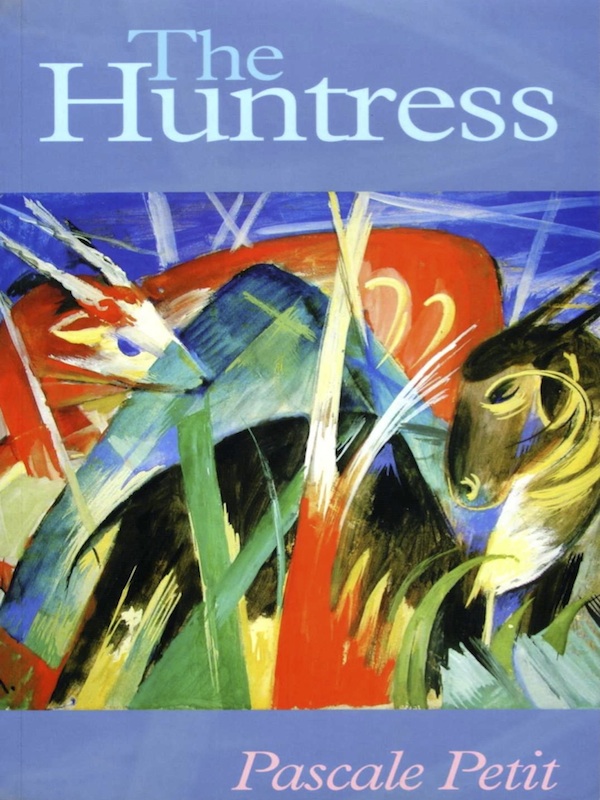
This week’s poem comes from Pascale Petit’s third collection, The Huntress, published in 2005.
In Pascale Petit’s highly-charged third collection, a daughter is haunted by her mentally ill mother, and a painful childhood is re-imagined through a series of remarkable and passionate transformations. The feared mother is a rattlesnake, an Aztec goddess, a Tibetan singing bowl, a stalagmite, a praying mantis, a ghost orchid. These culminate in a long central poem where the daughter escapes her huntress as a cosmic stag. Underlying these poems is an intense mystical vision that lifts the dark material of the subject matter above the merely personal.
The Snake House
It’s time to go up to your front door, Mother,
and ring the rattling buzzer of a bell,
the door with two curved fangs.
I go in, into the muscular throat of the hall,
down the tunnel that’s closing now
to a pinpoint of light.
I’m in the swallowing living-room,
washing it for you, half-alive,
like a man preparing for the rain-dance
in the dry arroyo. He reaches
into the pit and washes the snakes
so that later when he dances with the ‘little mothers’
in his mouth, they won’t bite.
I’m a child playing in the pen
with my pet rattlers,
giving them bread and milk.
As long as I’m unscared
they won’t strike. And you’re saying,
“Only a girl-child can do this”.
My cheeks are almost seamless now,
countless grafts hide the necrosis.


This Saturday is Indie Book Day – hooray!
What is Indie Book Day?
Indie Book Day is an entire day dedicated to supporting and celebrating our independent publishers and bookstores.
Great! How can I get involved?
Simple! To take part in Indie Book Day all you have to do is visit your local independent bookstore on March 21st and buy yourself a book that has been published by an independent publisher – the genre doesn’t matter! Then post a picture of your new book, its cover, or, even better, you with the book and post it on any social media site of your choice using the hashtag #indiebookday.
So, will you take up the challenge?
Look out for some Seren titles in your local independent bookstore this Saturday. Until then, here are some recommendations to whet your appetite!
 My Family and Other Superheroes introduces a vibrant and unique new voice from Wales. The superheroes in question are a motley crew. Evel Knievel, Sophia Loren, Ian Rush, Marty McFly, a bicycling nun and a recalcitrant hippo – all leap from these pages and jostle for position, alongside valleys mams, dads and bamps, described with great warmth. Other poems focus on the crammed terraces and abandoned high streets where a working-class and Welsh nationalist politics is hammered out. This is a post-industrial valleys upbringing re-imagined through the prism of pop culture and surrealism.
Easter 1955.  As Lilia Sugar scrapes the ice from the inside of the windows and the rust from the locks in Sugar Hall, she knows there are pasts she cannot erase. On the very edge of the English/Welsh border, the red gardens of Sugar Hall hold a secret, and as Britain prepares for its last hanging, Lilia and her children must confront a history that has been buried but not forgotten.

When Tessa’s best friend organises a surprise TV makeover, Tessa is horrified. It’s the last thing she needs – her business is on the brink of collapse, her marriage is under strain and her daughter is more interested in beauty pageants than student politics. What’s more, the ‘Greenham Common angle’ the TV producers have devised reopens some personal history Tessa has tried to hide away. Then Angela gets in touch, Tessa’s least favourite member of the Greenham gang, and she’s drawn back into her muddy past.
 The Fauverie of this book is the big-cat house in the Jardin des Plantes zoo. But the word also evokes the Fauves, ‘primitive’ painters who used raw colour straight from the tube. Like The Zoo Father, Petit’s acclaimed second collection, this volume has childhood trauma and a dying father at its heart, while Paris takes centre stage – a city savage as the Amazon, haunted by Aramis the black jaguar and a menagerie of wild animals. Transforming childhood horrors to ultimately mourn a lost parent, Fauverie redeems the darker forces of human nature while celebrating the ferocity and grace of endangered species. Five poems fromFauverie won the 2013 Manchester Poetry Prize and the manuscript in progress was awarded an Arts Council England Grant for the Arts.
 A light-hearted novella exploring the strange case of a Swansea woman who is apparently possessed by the spirit of Dylan Thomas. Naturally all is not as it seems. The woman, who works in the Dylan Thomas Centre, meets a rather different Dylan from the one she knows by repute, one who doesn’t really fit in with the ghosts of other poets in heaven and is desperate to train himself to join the fitter shades of the long distance runners instead. Her own life, which has been lonely and sad, is completely transformed by the encounter.
 Lucy Swann is trying on a new life. She’s cut and dyed her hair and bought new clothes, but she’s only got as far as a small town in northern France when her flight is violently cut short. When Inspector Vivier and his handsome assistant Sabine Pelat begin their investigation the chance encounters of her last days take on a new significance.
Lucy’s death, like a stone thrown into a pool, sends out far-reaching ripples, altering the lives of people who never knew her as well as those of her loved ones back home.
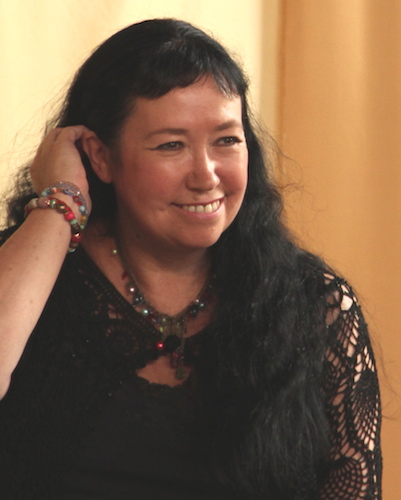
Pascale Petit has been shortlisted for the 2014 TS Eliot Prize for the fourth time with her collection Fauverie, A collection every bit as vivid and emotive as the art of the Fauves that the title evokes.
Described as ‘the prize most poets want to win’ (Sir Andrew Motion, former Poet Laureate) and ‘the world’s top poetry award’ (Irish Independent), the TS Eliot prize is awarded to the author of the best new collection of poetry published in the UK and Ireland each year.
Pascale has previously been shortlisted for the TS Eliot prize with her earlier collections The Zoo Father (2001, Seren), The Huntress (2005, Seren) and What the Water Gave Me: Poems after Frida Kahlo (2010, Seren).
Pascale will be reading alongside ten fellow shortlisted poets including Fiona Benson, Ruth Padel and Michael Longley at the Southbank Center’s Royal Festival Hall on 11th January, with the winner of the £20,000 prize being announced at an awards ceremony on the 12 January 2015.
Helen Dunmore will chair the judging panel for the 2014 prize alongside Sean Borodale and Fiona Sampson.
 Pascale Petit tells us about her favourite places in Paris, The big cat house of the Jardin des Plantes zoo and it’s devilishly handsome inhabitant Aramis, teases us with the possibility of a novel and tells all about her new book Fauverie .
Hi Pascale, tell us about your new collection Fauverie and how the idea originated?
The title Fauverie comes from the name of the big-cat house in the Jardin des Plantes zoo. It’s an amazing art deco building and has an interior where the cats sleep and are publicly fed, and an octagonal exterior, which thankfully has been enlarged. To me it’s the heart of Paris, which to me, historically and personally is a savage place. I was born there and spent five unhappy years there as child. For decades I wouldn’t go back as I was scared of it, but then my father contacted me after a thirty-five year absence and I visited him as he was dying. Over those visits I fell in love with Paris. In a way Fauverie is my account of that love affair with my home town. But mainly it’s about my relationship to my estranged father during the few years I knew him. I felt that writing about Paris could be a way of writing about him as it was very much his city.
Another building I’m obsessed with is Notre-Dame cathedral and the book began with a few poems about my father and the cathedral. The cathedral became like a friend. I discovered that my father had spent many years living in hotels that were overlooked by it and its towers with those gargoyles and chimeras, so he was observed by this stone zoo. I went up the four hundred stairs to the gargoyle galleries. I started writing the book with those poems. In fact the first poem, ‘My Father’s City’, I had started writing when I was writing The Zoo Father, my second collection, but couldn’t get right then.
What was your research process for this book?
All the poems in the book were written in Paris! I edited them in London where I live but very rarely wrote one there. I rented rooms in Paris for a month at a time and wrote very intensively, usually I’d end up with about twelve to fifteen poems. I got up very early and wrote or read to help get me going then went out to the zoo in the late afternoon or to Notre-Dame or other places. Every time I went to Paris (about three or four times a year) I’d discover some new place in this city that was so strange to me yet so familiar. One of those wonders was Sainte-Chapelle, a revelation. Then the Musée de la Chasse et de la Nature, my favourite museum. Also, in the Jardin des Plantes’ main museum there is a very sad hall dedicated to endangered and extinct animals, most of them stuffed.
The collection features a lot of wild animals, which was your favorite animal to write about?
Aramis the black jaguar! I’ve seen the young keeper kiss him on his mouth through the mesh just before feeding him. He’s four years old but large for his age. He’s actually a rich dark brown with black rosettes. He was in the Fauverie for two years while the larger zoo at Vincennes was being renovated, and that’s where I visited him when I wrote this book, in the Fauverie. Now I visit him at Vincennes zoo, where there are also two young gold jaguar sisters, kept separately from him as they are not yet old enough to mate. When they’re old enough he will have a choice of one as his mate.
Were there any poems that were particularly difficult to write?
I suppose the poems that describe the cellar I was placed in as a small child. I visited the building where we lived on the Boulevard de Grenelle, and twice I went down into the cellar. I couldn’t believe how scary it was, so medieval and narrow. It was like going into a nightmare. I had had nightmares about it throughout my life but thought I’d made them up because there was a window in the cellar and I thought that cellars don’t have windows. But there it was this tiny window at the top of the spiralling stairs, looking out onto the courtyard! Apart from those poems there were certainly a number that I couldn’t get right and took months of rewrites. I kept going back to the Boulevard de Grenelle, to the famous market outside our door, under the métro aérien, and to the park where I played, and even the horrible school.
Your relationship with your father, like in The Zoo Father, is at the fore of this collection. How has it evolved and impacted on your writing since the Zoo Father?
When I wrote The Zoo Father I was in shock – my father had just contacted me and I felt too angry to write at first, then I realised I could through the animals and my travels in the Amazon. It’s now fifteen years since he died and I felt compelled to try again, with more distance, hoping for more compassion. He was suffering from emphysema and was caged himself, could never go out so I did feel very sad for him at the time. Then he died and I lost him again, and he had never acknowledged that he’d done anything wrong, but he had done some pretty bad things. Fauverie is my attempt to redeem him, and perhaps mourn him, but it’s hard to mourn someone I barely knew.
You’ve dealt with some pretty big subjects over the years through your poetry, are there any subjects you wouldn’t write about?
Yes there are, I’m a private person even though I write personal stuff about my parents. But the speaker of my poems is not the actual me, so my poems are fictionalised.
What is the most inspirational book you’ve read and why?
There are so many it’s hard to choose one. I’ll choose two. The first was a Time Life book I found in a library, a south American library in Hyde Park that no longer exists. The book was about South American animals and in it I found the most exquisite photograph I’ve ever seen. It was of a suitcase and it contained forty live hummingbirds. I carried a photocopy of it with me but lost it. Eventually I managed to track the book down and ordered a copy so I have the photo in full colour. I’ve also found another photo of hummingbirds in a suitcase, both are of suitcases belonging to the Brazilian hummingbird expert Augusto Ruschi. The first photo led me to write ‘The Strait-Jackets’, the first poem in The Zoo Father. I’ve just written a poem about the second of those photos.
The second book was crucial to my development as a poet. It was called Waterfalls of the World by Rita Margaret Barton and was published in 1974. The cover features Iguazu Falls. I found this book in 1992, during a tough time in my life, and it was like discovering a friend. It was also the book that led me to to see the highest waterfall in the world Angel falls, in Venezuela’s Lost World. So in a way this book led to all my subsequent obsessions with the Amazon, because once I saw Angel Falls I became fascinated by the whole landscape, table mountains, the flora and fauna, the tribes and their rituals, and their spiritual worlds. It all came from that one book that appeared when I so needed it. Of course there are also countless poetry books that are important to me but it would take too long to name them all.
What are you working on next?
I’m writing a sequence of poems for the Medicine Unboxed prize, it’s called Mama Amazonica. I’ve written it this month in Paris. I was very lucky to be shortlisted for the prize for the proposal. I won’t say more about it just now as it’s a work in progress. There is also a novel in the background!
Fauverie is available to order from the Seren website with 20% off when you join our online book club.

This September, you’re invited to explore the unseen and the unsettling. From dark and menacing landscapes to the everyday terrors of domestic settings disturbingly close to home, these stories will horrify and delight in equal measure. Be prepared, for ‘this is a land of ancient power, and even more ancient beings...’ Pre-order the latest addition to our Welsh Gothic series, ‘Giving the Darkness Life’ on our website now.
.
Stories by @markblayney1, Mary-Ann Constantine, @damianwalforddavies, Caradoc Evans, Dorothy K. Haynes, @lucie_mckhardy Arthur Machen, Elinor Mordaunt, John Llewellyn Probert, L.T.C. Rolt, @priyasharma1000, Edward Thomas, Elizabeth Walter and D.P. Watt
.
@inpressbooks @books.wales #WelshGothic #SerenBooks #NationalYearOfReading2026 #SpookySeason #AutumnBooks

We had a wonderful time listening to @megan.c.hayes talking about her memoir ‘Glimmering’ with Kath Little from @bardic_books at St Illtud’s church in Llantwit Major on Saturday. Diolch yn fawr to everyone who joined us and to Kath for hosting! Copies of ‘Glimmering’ are available now in your local bookshop.
.
#Glimmering #Memoir #SerenBooks #IndependentBookshop #NationalYearOfReading2026
Ebooks available now! ‘In Search of Sea Dragons’, ‘Muslim Wales’ and ‘The Waters That Raised Us’ are now available from all major ebook retailers meaning you can take them with you on the go 🎉 Do you prefer reading ebooks, print books or both?
.
@severn.sea.fossils @azimwales @tayloredmonds #Ebooks #Kindle #SerenBooks #BooksFromWales #LoveReading
🏆@maggiepoet continues her winning streak having won the Guyana Prize for Literature Poetry Award with her collection ‘I Sing to the Greenhearts’! Available now in bookshops nationwide and on our website!
.
#AwardWinning #GuyanaPrize #Poetry #PoetryBooks #SerenBooks


