Posted on

Friday Poem – Sound Archive

Sound Archive

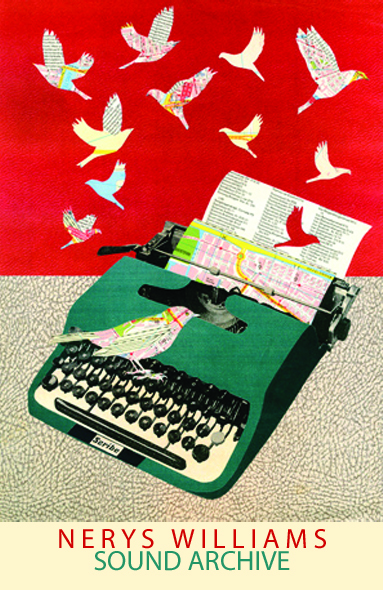
This week’s poem is from Nerys Williams’ debut collection, Sound Archive, which won the 2012 DLR Strong Award.

Sound Archive is the strikingly original first collection of poems from Nerys Williams. Using formal strategies similar to modernist painting: abstraction, dislocation, surrealist juxtaposition, the poet conjures a complex music, intriguing narratives, and poems full of atmosphere that query identity, gender, and the dream of art as a vehicle for emotion and meaning. There is a playful lightness of touch and tone and for every serious inquisition like ‘An Anatomy of Arguments’ or ‘Conversations with Cocteau’, there is a poem that will muse on ‘Canter’s Starstruck Diner, L.A.’ or on the ‘artifacts’ left by Marilyn Monroe, in ‘Marilyn’s Auction House’. Williams confronts our preconceptions about what it might mean to be a woman writing against the background of two formidable traditions: that of Welsh-speaking Wales and of English literature. A thoughtful, subtle and fascinating first collection.

Sound Archive
for Cliff Anderson

It takes patience this piecing
of noise in an archive for voices.

Chronicled on my silver-silicon
a focus of of gravity gone, scene unset.

Tempos in the unthreading
of flight beating.

Misremembered movement
the voice still says:

Do not package me
as an afterthought or a bulletin.

Though I have never been to Spain
I understand attachment theory
and have been told of thanatology.

Raise your glass to this last flourish
as I switch from Andante to Largo

I toast Dubrovnik, Elvis and Chopin
free the slaves of my imagination.

I will wear boaters in the rain
and fill one room with flowers.

I will raise hell in remaining chapels
never searching for injunctions nor pardons.

I will be the sage on the hill
filling in for memorial towers.

I will finish that string quartet
begun at twenty-five.

I will flirt with the ladies at the till
and get my groceries free.

I will smoke over the baby grand
turning to my right for a tumbler of gin.

I will mark a map of all colours felt
frame them into a continent.

There will be methods to my madness
which I will name kinetic imbalance.

On this day
thought is blown over the wall
over trees to the road,

jazzed up and jiving
a bouquet of spectral dandelions
for you to hold.
Order Sound Archive from our website.

Posted on

Friday Poem – About my Daughter

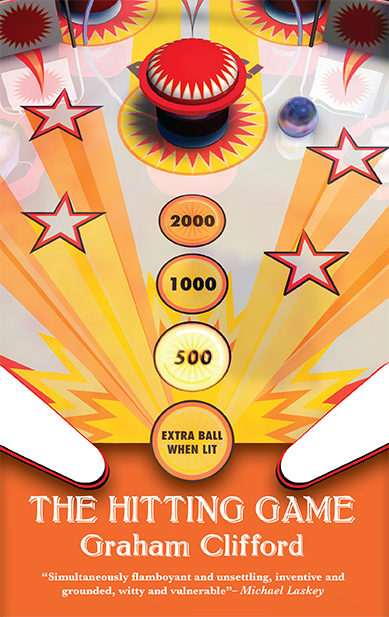
This week’s poem is from Graham Clifford’s debut collection, The Hitting Game, published in 2014.

The Hitting Game is the first collection of poems by the London-based poet Graham Clifford. The vibrancy of the poet’s voice and the immediacy of his claims  upon our attention are clear.

Characters first appear as ‘you’ in ‘Obvious Constellations’, ‘Amazing’ and ‘Trying’, as if we’ve arrived in the middle of a conversation. Incidents are approached from disarmingly intimate and also entertainingly oblique angles, as in ‘Shorn’. These are urban poems where nature appears like a strange intrusion: a flock of swallows ‘flick about dusk like black flames’. There is also a gentleness and empathy, particularly in regards to children, as in ‘About my Daughter’ where the word ‘echoes: ‘the er-ing sound of doubt/mixed with ought.’ There is humour and pathos as in the poem about a chimp and her keeper.

These are poems full of unexpected dramas and fresh enchantments, they provoke as well as delight.

About my Daughter

How right the word seems,
so drawn out,
the er?-ing sound of doubt
abutting ought.

I stand in the dark
taking heat from you
spasming to slip my grip
full of voodoo, my daughter
a little scarecrow stuffed with eels
curling and flipping to get away.

Used light from cars
queasily slides across the wall,
shards and slices identically rearrange
with such recurring precision –
this long trapezoid, that misty rhombus
locked into the same move as tomorrow,
then its tomorrow.
A deadlocked endgame.

Doubt: ought; her. Daughter.
At last loose in my arms,
I lay you as if broken
into sleep’s black mouth.

Order The Hitting Game from our website.

Posted on

Friday Poem – A Horse in the Dark

This week’s poem is from Meirion Jordan’s debut collection, Moonrise, published in 2008.

Finely held moods and moments resonate throughout this unusually accomplished first book. The rich, complex history of Wales often crops up in expected, as in the post industrial imagery of ‘A Camera at Senghenydd Pit’, and then, in often unexpected contexts: ‘The New World’ is a vision, a cross between ‘Under Milk Wood’ and an early J.G. Ballard novel, of post-global warming Wales, with a polyglot population: “Ronaldinho Davies/wowing the crowds at the Millennium Stadium” and swamped by tropical vegetation: “cobalt lizards and coral snakes/swallowing the cottages an Llandinam/ the mahoganies uprooting Carno’s hearths”.Another apocalyptic scenario prevails in ‘Pirate Music’ where a typical weekend in the binge-drinking culture unravels vividly as one of Dante’s circles of Hell.

Such inversions of myth are rife in this book. There is a freshness with which classical motifs echo in thoroughly modern contexts. A girl on a motorbike: “you fly your hair like a flag” is a glimpse of a goddess at speed. ‘The Head of an Athlete in an Ionian shipwreck’ is the past as ghost: “his smile as white as alum”. What starts as portraiture sometimes veers off in darkly mysterious incantatory digressions as in ‘The Magdalen College Chef’ whose “souffles bloom from a dipped fork./Upstairs his ragouts seethe under the grins of dons and demons”.

There are also clever, out and out satires like ‘The Nuclear Disaster Appreciation Society’ where “We love to watch/the palm trees beating in the thorium breeze…” and ‘Blockbuster Season’ where the protagonist is bizarrely ensared by the cliché plots and B-list actors of the cinema “Darth Vader using my Ford Fiesta to escape from Colditz…”. The plot twists and clever inversions available in these poems often recall science fiction writers like Philip K. Dick. Engaging, musically deft, an intelligence that wears its learning lightly, this is a sparkling debut from one of the most promising young poets Wales has seen in some time.

A Horse in the Dark

Quiet, quiet; do not dream
it is the owl parting fronds
of starlight, the water
muttering in abandoned mines.

It is the stillness falling
and pooling, drop
after drop

it is the clouds spooling past on wires.

Soon you will hear oaks
pushing their mouths to the soil’s tap,
the rushes drinking
far down the hill.

The lidless quartz blinks
at the snap of a twig’s shadow;

a nothing so breathless.
It champs at a giant sky.

Order Moonrise from our website.

Posted on

Friday Poem – South Shore House, Long Island

the man at the corner table rosie shepperd

This week’s poem is from Rosie Shepperd’s debut collection, The Man at the Corner Table.

The Man at the Corner Table crackles with the unexpected. The voice is one of urban sophistication; a merciless charm that teases and tempts us with sensual evocations of food and place. The reader is surprised with tastes, scents, colours and textures. There is a winning insistence on detail offered with an irony that blends into satire.

The poems adopt a deadly seriousness to the business of comedy.  In‘It isn’t just the under-floor heating that makes me lie down in the kitchen’, the poem explores the ineffable by sending it up in a domestic setting that subverts as it disconcerts.

The gorgeous place settings of these poems are not just carefully delineated backdrops. They toy with our interpretations of ‘at table’. As in a Dutch master ‘tablescape’, they become symbolic of our relation to ourselves, to others and the world.

These poems are exquisite meals, to be devoured amidst surprising intimacies, like the search for solace that is edging towards something more in ‘Balthazar Bakery, Spring Street, NY. Others explore troubling scenarios of grief and loss, such as the heartbreak in ‘You all have lied…’. Sometimes the poems appear like postcards from beautifully observed moments of exile, as in ‘Chorinho’ – where the author is hounded and haunted by unease. As in Elizabeth Bishop’s ‘Questions of Travel’ there is artfulness in this unease, and an obligation to close observation that resolutely refuses to moralize.

South Shore House, Long Island

Now the man who does the garden
has stopped gardening. Each Thursday he drifts
through the hothouse, composting silence.
His cash-in-hand drips home to Peru to feed
his sister and her children, Ana and round Amparo.
The youngest lives in an iron bed
on the longest, thinnest tubercular ward.
He will see them next year and waits without complaint,
sleeping his lunch hour in the coolness of the arbor
while the filthy cleaner flicks about your desk.
There’ll be ash under your chair and white musk
between the cushions. She checks empty
drawers and drops damp family secrets.
I pick them off and forget them.

The foxes are back tonight
savaging the trash, nosing the scent of bones.
Perhaps the ribcage of a roast.
Egg boxes, sticky with protein.
They find nothing, but I hear
their icy sex and cannot shake them.
One is injured; his eye reflects
a single bulb from the not quite busted light.
Rime hangs on his breath.
Lightly, he lifts a front leg. Up.
Slowly down. Up. I watch the dark space
between us, feel the fog
settle back. We are again separate.
I am not afraid of being alone.
I am alone because I am not afraid.

Order The Man at the Corner Table from our website.

Posted on

Friday Poem – The woman in the sun, a letter

This week’s poem is from Rebecca Perry’s collection little armoured, winner of the 2011 Poetry Wales Purple Moose Prize.

little armoured is a brilliant book, which emits light and heat like the electric heater one of its poems describes as

a humming like a bee in the corner
of the room, its orangeness
brighter than your eyes expect.

Its miniatures and transforming images sometimes recall Elizabeth Bishop, its tonally various sequences Paul Muldoon, but this is a young poet who already discovered her own voice in these exact and tender, smart and moving poems.“

– John McAuliffe

The woman in the sun, a letter

I want my feet to tingle with cold again.
I want to be cold with you.
I want you to put your hands between my thighs in bed,
and I would clench them tight for you,
like daisies in a flower press.
I want to press my nipples onto your shoulder blades,
and leave tiny licks of saliva on your back, cold as skis.

I am full of tears.
All day they roll out of my eyes
and fizz to nothing by my feet.
They splash my breasts and for a second it is dark there,
then no. I am dry. I am a pillar of salt.

My body is warmed from the inside out.
My stomach is molten inside my body,
my lungs bubble from the heat of it,
my heart in your hand would be like
taking a potato straight from the oven,
my bones are the wood of a campfire,
my skin is bed sheets slept in for a day and night.

Order little armoured from our website.

Posted on

Friday Poem – Metamorphic

Zoë Skoulding Museum of Disappearing Sounds

This week’s poem is from Zoë Skoulding’s 2013 collection, The Museum of Disappearing Sounds.

The disappearing sounds of Zoë Skoulding’s collection may be either in the rich sonic environments that the poems observe, or in the resonance of words themselves, which exist in traces of speech and breath.

‘The Man in the Moone’ takes its title from a 17th century work of science fiction in which lunar inhabitants can communicate their thoughts via music alone. But rather than aspiring to reach beyond language, these poems focus on the spaces that words occupy, looking at how ‘a sentence reverses itself between two pairs of eyes’ or noting ‘the distance drifted by a word shaken loose from border controls’.

Skoulding’s characteristically inventive approach to form emerges in a fractured sonnet sequence based on the coincidences of room numbers. Repeated actions build haunting interior spaces which the reader is invited to enter, each poem becoming a room in which sound ‘bounces off four walls’, as memory accumulates in the subtle rhythms of everyday life.

These poems can provoke states of eerie unease, or of passion evoked with shimmering densities of verbal texture. We can feel the ice in ‘Gwydyr Forest’ “Freezing under feathered/ water landscapes”. Provisional landscapes in which the ground itself is ‘aslant’ call for an active state of perception in which ‘I can do more dangerous things /just with my eyes’.

Exploratory and alive to the senses, The Museum of Disappearing Sounds creates new perspectives on language and the world in which it exists.

Metamorphic

The split slate weathers, lichen colonies
advancing where I stumble in mud, shocked
blood pulsing through limbs, vertical

I tilted in the scent of pine, violent green,
a wood’s engine buzz. Up against the wall
my voice comes back not mine: between ear

and stone a rock face turned aside. What’s
unintelligible isn’t silent, isn’t transcendent
blank: it’s most of it, including you – this

noise, irresolute as rain, where harmony’s
nothing but the hard facts adding up.

Order The Museum of Disappearing Sounds from our website.

Posted on

Friday Poem – What I Did in My Summer Holidays

This week’s poem is from Kathryn Simmonds’ second poetry collection, The Visitations, originally published in 2013.

The Visitations is the follow-up to Kathryn Simmonds’ Forward Prize-winning debut, Sunday at the Skin Launderette. As with her previous collection, an appealing voice prevails, though this simplicity is something of a veil, through which the author, with subtle shifts of language and perspective, manages to imply darker themes and worlds unseen. The tone is often simultaneously satirical and elegiac and the collection abounds with sudden moments of strange illumination: a lime tree strikes up a conversation; a life coach finds an old passport; an infant teeters on the brink of speech. Here are poems where the physical and metaphysical meet, where questions of new motherhood are set against those of faith, and the larger conundrum of how to live.

What I Did in My Summer Holidays

Never ask for an ice-cream confidently or menacingly or using
any other adverb. And if you’re in pain, show me where it hurts
and how. Love is an abstract noun. Dialogue gives the effect
of real speech but with all the boring rubbish taken out.
Every thought you’ve ever had has been thought better and by
someone else. Does anyone have any questions? We talked
last week about the stanza, you might think of stanzas as little
rooms: what are you going to do in yours? Are you going to just
lie there watching light reinvent itself? The second line doesn’t
scan. Yes, flair is better. For homework, sit in a soft chair and
describe the exact experience, no, don’t do that, write down a
conversation you hear on a bus; go out in the rain and open
your mouth; make a list of everything in your bathroom cabinet.
Try not to break your line on an article. The first person
you have to please is yourself, but if nobody else is pleased
you have a problem. Fill out the form and give it back to me:
te-dum te-dum te-dum te-dum te-dum. Notice that beautiful line
where the widow’s hands are likened to the wings of a dead bird.
Less is more, but sometimes less is less. What do librarians get paid?
I’ve never seen that particular noun used as a verb. But it’s too late
now to get to grips with the Dewey Decimal System.
Did anyone else have a problem with the turnip metaphor?

Order The Visitations from our website.

Posted on

Friday Poem – Post-Script: For Gweno

This week’s poem is another taken from WW2 writer Alun Lewis’s Collected Poems, to celebrate the launch of Dr. John Pikoulis’s latest biography, Alun, Gweno & Freda, which is now available to order from our website.

For more information about Alun Lewis and the ongoing centenary celebrations, be sure to check out the Alun Lewis website, Twitter and Facebook.

Post-Script: For Gweno

If I should go away,
Beloved, do not say
‘He has forgotten me’.
For you abide,
A singing rib within my dreaming side;
You always stay.
And in the mad tormented valley
Where blood and hunger rally
And Death the wild beast is uncaught, untamed,
Our soul withstands the terror
And has its quiet honour
Among the glittering stars your voices named.

Order Alun Lewis’s Collected Poems from our website.

Posted on

Friday Poem – A Brief History of Topiary

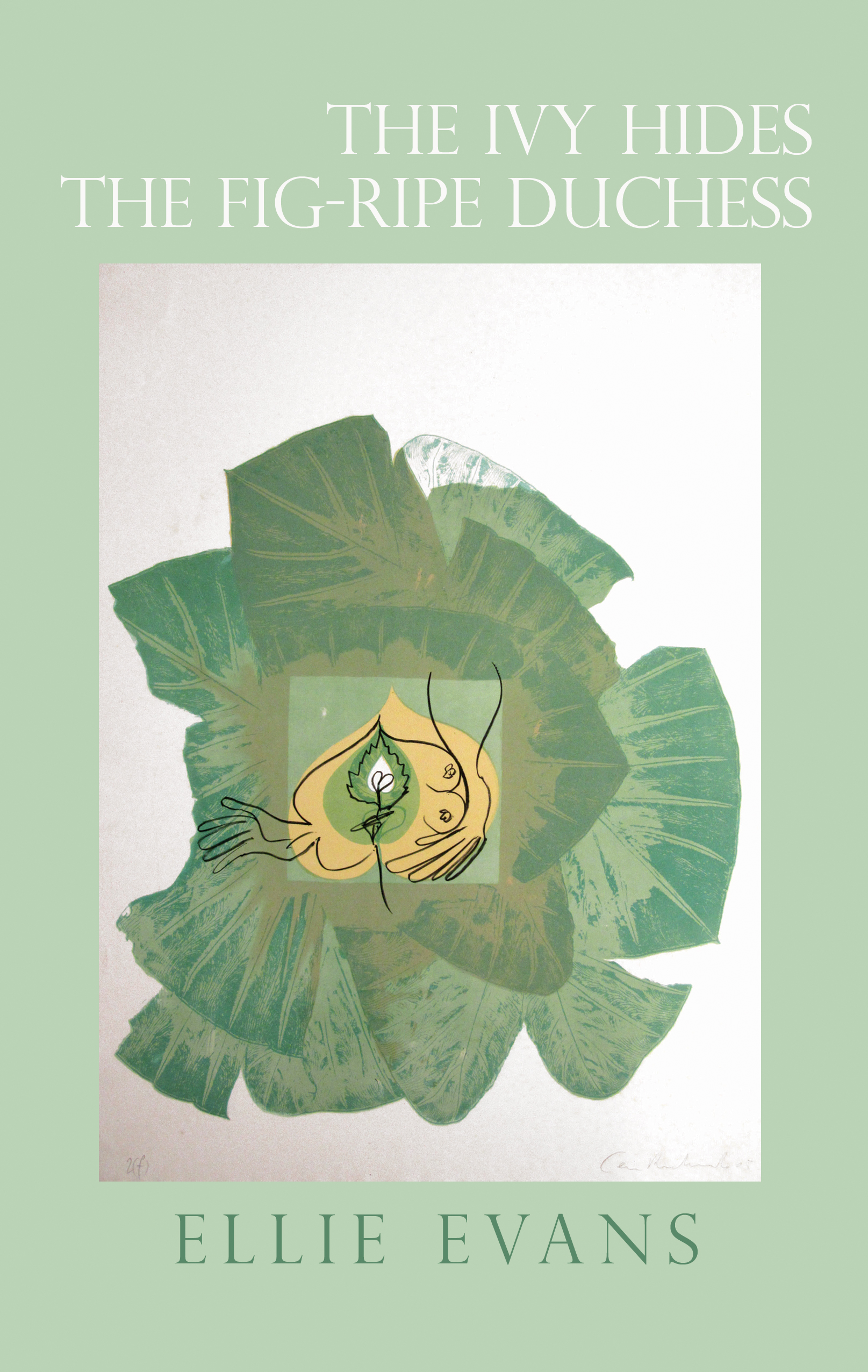
This week’s poem comes from the late Ellie Evans’s collection, The Ivy Hides the Fig-ripe Duchess, published in 2011.

The Ivy Hides the Fig-ripe Duchess is an exhilarating first collection of poems from Ellie Evans. Using a surrealist palette of imagery and a tightly focused idiom, the author takes us on strange journeys:to the post-apocalyptic world of the title poem, or into a skewed 18th century Venice in ‘The Zograscope’. These strange worlds are always to the purpose, they are, as Marianne Moore famously said of poetry ‘imaginary gardens with real toads in them.’ We obliquely unearth childhood trauma, fraught or intense relationships and also a singular (and perhaps also Welsh?) delight in rebellion, and in escape through the imagination. Poems like ‘Picnic with Earthquakes’ and ‘Jekyl Island, Georgia’ deftly align exotic locales (Eastern Europe, South East Asia, Greece and the USA,) with intimate states of mind. A fascination with art and history emerge in: ‘A Brief History of Topiary’ and ‘Two Monologues from The Odyssey’. There is also a palpable delight in technique: you will find a sonnet, a villanelle, triolets and a concise free verse where she employs rhyme, half-rhyme, and subtle alliteration.

A Brief History of Topiary

That September, in the Garden Nursery
three hundred yew cuttings, Taxus baccata,
stubbled in green, were ranked
in rows of fifty, in identical brown pots.

They were like schoolgirls waiting in Assembly
cross-legged and silent in the new Sports Hall
where the morning sun cast shadows on looped ropes
and blue lines on the floor for goals and penalties.

Years later, the young yews were planted out as hedges,
so they grew together sideways, twined, supported
each other. They made a garden room for picnics,
plays, dalliance and tennis. Some had alcoves

gouged out of them, to enclose pillars or gods,
satyrs and herms. Others were cut through, so
you could look out to another garden
or to a borrowed view. A few were special:

allowed to grow above the rest, until
frames were bolted round them. When they’re mature,
you don’t see these underlying structures for cones,
or balls, or obelisks, or whatever.

Purists won’t use frames, of course, but rely
on frequent trimming, checking from all angles.
Whichever method you chose, remember:
all stray shoots must be pinched out.

At night, the moon plays tricks on topiary,
on the giant women with their stove-pipe hats,
their capes and skirts like bells, who look as though
they’ll stride off to the woods, tearing the garden down.

Order The Ivy Hides the Fig-ripe Duchess from our website.

Posted on

Friday Poem – In Hospital: Poona

This week’s poem is from Alun Lewis: Collected Poems, edited by Cary Archard, to celebrate Lewis’s centenary earlier this week. Lewis was one of the most compelling writers of the Second World War, whose premature death in 1944 – when he was only 28 – was a grave loss to Britain’s literature community.

For more information about Lewis, check out his website and find out everything you need to know about the continuing centenary celebrations on Twitter.

In Hospital: Poona

Last night I did not fight for sleep
But lay awake from midnight while the world
Turned its slow features to the moving deep
Of darkness, till I knew that you were furled,

Beloved, in the same dark watch as I.
And sixty degrees of longitude beside
Vanished as though a swan in ecstasy
Had spanned the distance from your sleeping side.

And like to swan or moon the whole of Wales
Glided within the parish of my care:
I saw the green tide leap on Cardigan,
Your red yacht riding like a legend there,
And the great mountains, Dafydd and Llewelyn,
Plynlimmon, Cader Idris and Eryri
Threshing the darkness back from head and fin,
And also the small nameless mining valley

Whose slopes are scratched with streets and
sprawling graves
Dark in the lap of firwoods and great boulders
Where you lay waiting, listening to the waves-
My hot hands touched your white despondent shoulders

– And then ten thousand miles of daylight grew
Between us, and I heard the wild daws crake
In India’s starving throat; whereat I knew
That Time upon the heart can break
But love survives the venom of the snake.

Order Alun Lewis: Collected Poems from our website.