Posted on

An extract from Larkinland by Jonathan Tulloch

Extract Larkinland Jonathan Tulloch

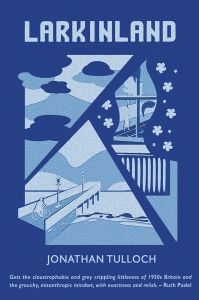
Larkinland Jonathan TullochJonathan Tulloch’s remarkable Larkinland is a novel which expertly and minutely captures the essence of Philip Larkin and his poetry. Tulloch deftly builds Larkin’s poems into a sustained landscape, fills it with Larkin’s characters and just for good measure adds a version of Larkin himself – meet Arthur Merryweather: librarian, poet and would-be great romantic.

In the extract below, having newly (and rather unhappily) moved to a new town, Merryweather embarks on his first journey to his new place of employment: the university library…


This extract begins on page 49 of Larkinland.

8.

Hiding behind his (local) morning newspaper on the trolley, Merryweather felt as though he were going not to a library but a hospital for the prognosis of some lump. The Monday morning breakfast table repeated on him as much as the kippers: that barrage of sauce bottles, chewing jaws and bad breath.
Contrary to expectations, a pleasant surprise awaited him at the university. Instead of the utilitarian, redbrick barrack rising from a raw building site his successful novelist friend had led him to expect, he found half hidden in lawns and willows, a country house brocaded with ivy. A post box was quickly located, and the weekend’s letters dispatched.At the Aide to the Vice-Chancellor’s office he had to wait for half an hour. ‘What does he want?’ he heard the administrator ask his secretary.
‘Something about the library, sir.’
‘Library? What does he want with the library?’
‘You appointed him as the new head librarian, Sir.’
‘Did I?’
Throughout their brief cup of tea, the Aide to the Vice-Chancellor continually rearranged pens on his desk as though working out some enigmatic puzzle. His curly beard and fringe gave him the look of a merino sheep. This ovine resemblance reminded the librarian that the man on the other side of the desk had been the silent partner in the interviewing panel at the British library, though he clearly didn’t remember Merryweather. ‘Found digs yet, Merriman?’
‘Yes, thank you.’ His mother’s son, in the face of authority Merryweather demurred from making correction.
The Aide to the Vice-Chancellor paused in his pen arranging. ‘The town does have some good areas; I’ve always maintained that. How do you find arrangements on the river? Yes we are rather out on a limb. Where the train runs out, the land too, wot? And we’re just left with the mud and the sky. The natives, well you might like them or you might not; on the whole the students can sometimes be keen. Not a bit like that dreadful novel doing the rounds.’ Merryweather suppressed a grin. His friend, and chief correspondent, was the writer of the deliciously scandalous academic novel doing the rounds. ‘Well, no doubt you’ll be anxious to see your little fiefdom. Very good of you to come in today, Merriman. Above and beyond…’
Was everybody off their rocker here? The librarian puzzled as, interview over, he headed in the direction the Aide to the Vice-Chancellor’s secretary had pointed out.
Merryweather’s fiefdom was yet another surprise. Had his luck changed? Leaning out of some children’s story, a pair of manorial gateposts offered a secretive avenue of chestnut trees. The avenue graciously ushered the librarian to a brownstone building bearing the simple sign: Library. In summer, that dead wood adhering to the walls would be rambling roses; spring, when it arrived, promised bluebells. For now, a robin piped the melancholy carol of a T.S. Eliot April; all that was missing was a gardener’s fork for it to perch on and begin conducting the way to a secret garden.And there was the garden fork!
Not a city sound to be heard as the new head librarian mounted his library steps for the first time. Above the door, a sculpted stone figure in the art deco style reclined on lintel. The figure – reclining or hovering? – peered down at him. Was it an angel? Art deco, the final and least expected touch. The ghosts of Evelyn Waugh’s bright young things. Et in Arcadia Ego blah, blah, blah. That was one thing about librarianship, it might be sexless and bloody boring, but, like a convalescence from a good bout of measles, it gave one plenty of time to read.
The angel watched Merryweather push and pull the entrance door, shunt and shove, thrust and shoulder. All in vain, it was locked. No sign of anyone within. No lights. Nose pressed against the glass, all the new man could see was a darkling, marble vestibule. Skulking in the shadows like a Neanderthal peering from his cave, the bust of some beetle-browed philanthropist frowned at the disturber of his peace. Knocking unanswered, Merryweather got on his knees and called through the low letterbox.
‘Oi!’ A shout from the chestnuts. The librarian struggled to his feet. Was it directed at him? ‘Yes, you, you lanky sod. What’s your game?’
For a moment, he thought the person breaking from the undergrowth, all whirring arms and neck, was a policeman. Only when the official reached him did the librarian realise his mistake. ‘I’m trying to get in,’ Merryweather explained.
‘Oh you are, are you? Well you’re not going to.’ Not the sprightliest of men, the college porter was out of breath. ‘Can’t you see it’s closed?’ Merryweather’s trilby, tie, briefcase and British Warm seemed to mollify the custodian. ‘Thought you were some grubby student.’
‘Actually – I’m the new head librarian.’
Torn between suspicion and a professional sense of caste, the porter took off his hat and scratched his head.‘Didn’t they tell you? Nowt’s open today. No students. Nothing.’ Suspicion reared to the fore.‘ How do I know you’re who you say you are? No one told me. I didn’t even know the last one had gone.’
Feeling rather ludicrous, Merryweather opened his briefcase to bring out a copy of The Library, the journal of the Bibliographical Society. The porter flipped through the pages with a yawn. ‘No, I don’t suppose you’d read something like that unless you really were a librarian.’
‘Well exactly.’
The porter fell back on the eternal sigh of his breed, as well as the habitual mix of pronouns. ‘Better come with me, sir, and I’ll see if we can’t sort you out for yourself. I’m Harry. Harry Oxley.’
Harry led him back up the chestnut avenue and across a chain of secluded lawns to where a more municipal, Winifred Holtbyish building stood. A hushed maze of parquet floors contained the porter’s lodge. Merryweather was installed on an ancient chair beneath an enormous dovecote of pigeonholes. Smelling the lodge’s varied woods and listening to the porter on the phone, he felt gratitude for having missed both the war and national service. Easy to imagine a rifle range, wet feet, and the porter, a sergeant major, explaining how to strip a Bren gun for the hundredth time. Four separate phone calls had to be made, two of them trunk. At last the hugest bunch of keys Merryweather had ever seen was plucked from a hook. ‘If you’d like to come along with me, Mr M.’ Jingling like some Dickensian turnkey, the porter led him back through the parquet labyrinth, over the lawn, through the enchanted gates and down the chest- nut avenue to the library. ‘That wants taking down,’ Harry declared, looking up at the angel as he unlocked the door. ‘Or one of these fine days it’ll come down and crush a student flat.’
Passing through the philanthropist’s marble gaze, they entered the library proper. After the imposing entrance and almost grand vestibule, the first impression was frankly underwhelming. Something about the size of a real tennis court presented itself. Less fiefdom than corner shop. Well, not quite that bad. As Merryweather’s eyes grew accustomed to the half-light, he saw that the shelves were almost spectacularly tall. They towered into a shadowed silence bound by a lofty gallery. Above that, high windows. Following Harry, Merryweather found that the premises had a second, identical room, which gave access to a couple of smaller reading rooms. In total, the whole concern was on the scale of a thriving branch library. The high windows gave the vague feel of a mausoleum. Merryweather felt half at home. When Harry switched a flick, the gruelly light barely thickened. ‘Bloody bulb’s gone again,’ he said, voice amplified to a giant’s timbre by the cavernous emptiness. ‘Pardon my French.’
There was another surprise. Following his guide between tight, dark shelves, the new librarian stepped into a well of light. A dome rose high above him. It had been hidden from him by the tall stacks. A metal staircase wound steeply up the side of the dome. ‘Careful coming up here, Sir.’ The steps creaked as the pair mounted them, the echo rippling through the several deeps of the library.‘They all like this?’ the porter asked, stopping halfway up.
‘Beg pardon?’ asked Merryweather, not sure the stairs were exactly safe.
‘Are all libraries so loud?’
‘I’ve never really thought about it.’
‘They’re supposed to be quiet, but they’re not, not when nobody’s in them. It’s only when they’re full that they’re quiet. What do you make of that?’
‘Interesting,’ said the new head librarian only quarter lying.
The winding stair led to a smoked glass door marked Head Librarian in rather skittish swirls. The porter opened up. By some architectural sleight of hand, instead of the storeroom attic Merryweather had been expecting, the room was commodious to the point of extravagance. Decorous cornices, oil paintings, armchairs, and, wonderfully incongruous, a chaise longue. Two pairs of generous windows to boot. After the crypt-like library, the view – chestnut avenue, gateposts, a lawned middle distance bound by tree-lined road – opened up like the vista from a headland. ‘Its acoustic is the opposite of a theatre,’ Merryweather said, without turning from the window. ‘That’s what makes them so loud. Libraries. Paradoxically so, given all the signs for silence.’ His eyes narrowed as he continued to gaze at the view whose limit was described by a bicycle trolling through a tracery of leafless branches. ‘A theatre is designed for projection, a library, introspection. On stage, one seeks to be heard by hundreds, a library has a far greater ambition. It aims to reach…’ Merryweather broke off. He could see Harry making off under the chestnuts. ‘And so forth.’
Shoulders easing with this unexpected bonanza of solitude, Merryweather sat at his desk. Solid as a tug. Just as well, more than likely it would be required to haul him into the waters of middle-age. Perhaps beyond. It offered all the tools of the trade. Ink bottle, ink well, blotting paper, telephone, in and out trays, an ashtray (plain), pen holder (rather decorative), enough drawer space for concealing a dismembered corpse let alone a bottle of Glenlivet, paper too, sufficient thereof for the writing of a novel. Except his novel-writing days were over, that was a business best left to his successful friend. Merryweather suppressed a belch of regret, but it was that morning’s kippers not the brace of his own unsuccessful novels, which had found little favour with the reading public when published just after the war. With the nearly pleasurable air of being a ship’s captain finding himself alone not only on his bridge but on the whole vessel, Merryweather lit the fire from the ample basket of logs, and then his first Park Drive of the day. A relatively exciting though not entirely trustworthy feeling flickered with the flames as he sat on the chaise longue: he’d be able to write poetry here.


Larkinland is currently half price on the Seren website: £9.99 £4.99

Half price offer ends midnight, Sunday 29 July.


Posted on

Summer Sale: a whole week of half price books

Seren Summer Sale Half Price books

The sun is shining, school’s out for the summer, and – what’s this? All our books are half price!

Half price summer sale
Fiction, non-fiction and poetry – and this is just a tiny portion of it…

Whether you’re looking for some poetry to dip into, or an immersive holiday read – we’ve got you covered. We’ve even picked out a few highlights below…

Best for…
Holiday reading:
Maria Donovan The Chicken Soup Murder£9.99 £4.99
A dear elderly neighbour has died under suspicious circumstances and the only one searching for justice is eleven-year-old Michael. No-one believes his cries of ‘murder’, so how will he prove his version of events? This is a truly touching coming-of-age story with an addictive mystery at its heart.


Best for…
Dipping into in moments of peace:
£9.99 £4.99
Elizabeth Parker’s debut book of poems is delicate, precise, and utterly captivating. From flowing rivers to the Forest of Dean, let yourself be lured into landscapes both captivating and strangely unfamiliar.


Best for…
Armchair reading:
£12.99 £6.49
For at least the last 1,500 years, Capel-y-Ffin has been a spiritual retreat: a beautiful, lonely, timeless place where people have gathered to escape from the outside world. And so it was for artists Eric Gill and David Jones: with fascinating insight, Jonathan Miles explores their years spent in this Welsh wilderness, and its promise of religious and artistic evolution.


Best for…
Livening up a long journey:
Christopher Meredith Brief Lives£9.99 £4.99
Whether reading on a stuffy train, whilst waiting at the airport or, perhaps, somewhere more peaceful, these six masterful short stories will transport you: to the South China Sea in 1946 to a nameless place at the end of time, and many others in-between. Christopher Meredith is a writer at the height of his powers – these beautifully crafted stories are all the proof you need.


Best for…
Broadening the mind:
Barney Norris The Wellspring£12.99 £6.49
Acclaimed novelist and playwright Barney Norris ponders cultural identity and the nature of creativity in these conversations with his father, David Owen Norris – ‘quite possibly the most interesting pianist in the world’ (Toronto Globe and Mail). This is a deeply personal, entertaining and at times provocative study of how people and societies find their voice.


Best for…
Keeping you up past bedtime:
Ross Cogan Bragr£9.99 £4.99
Norse gods tumble out of Ross Cogan’s new collection, intermingling with the environmental concerns so pressing in the modern day, and eulogies for vanishing wildlife. The pitch-perfect re-tellings of creation myths and bloodthirsty battles will hold you spellbound until the last page.


Our Summer Sale lasts for one week only – so treat yourself and have a browse before midnight on Sunday, 29 July! Who knows what gems you’ll find…

50% discount subject to availability. Excludes forthcoming titles.


Posted on

Friday Poem – ‘History’, Zoë Skoulding

Last night, in front of a packed audience, we were thrilled to witness Zoë Skoulding accepting a Cholmondeley Award for an outstanding body of poetic work. In celebration, our Friday Poem today is ‘History’, a poem from Zoë’s latest collection, The Museum of Disappearing Sounds.

Friday Poem Zoë Skoulding

Zoë Skoulding Museum of Disappearing SoundsThe disappearing sounds of Skoulding’s collection may be either in the rich sonic environments that the poems observe, or in the resonance of words themselves, which exist in traces of speech and breath. These poems can provoke states of eerie unease, or of passion evoked with shimmering densities of verbal texture. Exploratory and alive to the senses,The Museum of Disappearing Sounds creates new perspectives on language and the world in which it exists.


Friday Poem Zoë Skoulding History


The Museum of Disappearing Sounds is available from the Seren website: £8.99

Join our free Book Club for 20% off every book you buy from us.

Posted on

Friday Poem – ‘Swan’, Ross Cogan

Friday Poem Ross Cogan Swan

Our Friday Poem this week is ‘Swan’, from Ross Cogan’s new collection, Bragr.

Ross Cogan BragrWhether it’s myth intended to explain the constellations, the secret of eternal life, or the bloodthirsty tale of the mead of poetry, Ross Cogan’s collection Bragr (meaning ‘poetry’ in Old Norse) is a reimagining of Norse mythology for our times. The collection also focuses on environmental concerns: the earth’s incredible beauty seems all the more fragile in the face of habitat loss and global warming.
In ‘Swan’ the poet recalls an archaeological excavation of a neolithic settlement in Denmark that unearthed a remarkable grave. The excavation was detailed in Simon Mithen’s book, After the Ice.


Swan Ross Cogan Bragr


Bragr is available from the Seren website: £9.99

Join our free Book Club for 20% off every book you buy from us.


Posted on

The Chicken Soup Murder Shortlisted for Rubery Book Award

We are thrilled to announce that Maria Donovan’s debut novel, The Chicken Soup Murder, has been shortlisted for the 2018 Rubery Book Award’s Fiction category. The Chicken Soup Murder is one of eight titles to reach the shortlist.
Part crime fiction and murder mystery, part meditation on grieving, friendship and family, The Chicken Soup Murder is a coming-of-age story narrated with resilience and humour by Michael, whose cosy young life is threatened by bullying and blasted by visitations from the biggest bully of them all: Death.
The Rubery Book Award is the longest established book award based in the UK for independent and self-published books, and besides fiction, it has prizes for outstanding works of poetry, non-fiction, children’s & YA fiction, and illustrated children’s books.
The category winners and 2017 Book of the Year will be announced soon. For more information see the Rubery Book Award website.


Posted on

Short Story of the Month | ‘Dolls’ Hospital’, Christopher Morley

Our new Short Story of the Month is ‘Dolls’ Hospital’ by Christopher Morley.

A young boy’s persistent curiosity sets him on an adventure to the mysterious Doll’s Hospital, in which he learns that not only dolls need mending.

Christopher Morley was born in Nottingham in 1946.

He is a retired primary school teacher, a fine artist and short story writer.


Dolls’ Hospital

This is an extract. Read the full short story for free on the Seren website.

The Dolls’ Hospital was at the top of Alfreton Road near to Canning Circus. I had been aware of it ever since we had taken to visiting friends at Bobber’s Mill. It was necessary to catch a trolley bus, and the stop was almost outside the Dolls’ Hospital. Waiting for the trolley bus gave me enough time to gaze at the window display. The Hospital was a shop front of one large window, a recessed entrance and a much smaller window. Boards obscured the interior of the premises but afforded shallow display areas. On display were mostly dolls and teddy bears. Some were bandaged or had an arm in a sling. One teddy with a leg in plaster was propped up on a crutch. Some dolls wore old fashioned nurses’ outfits and tended patients in shoe-box beds. The main fascination for me was the small group of lead soldiers that represented the Army Medical Service. A wounded redcoat was being carried by blue tunic stretcher bearers towards a Florence Nightingale figure waiting at the entrance to a white medical tent. I wondered if there were more soldiers to be seen inside, but the Hospital was never open when I was there. There was a notice on the drawn down door blind that said that the hours were 9:30am to 5pm, with a lunch break between 12:30 and 1:30. Also the Hospital was open only Tuesday, Wednesday and Thursday. We visited our family friends on Saturdays. Anyway I didn’t have an excuse to go inside because I had no dolls that needed treatment, and I would never dare just go in for a look.

~o~

Mrs Hilton said that it would be nice to hear some diary entries read out. I shrank down hoping I wasn’t chosen, not because I couldn’t write or because I was nervous of reading aloud. I never seemed to have anything suitable to write about. Playing at soldiers and going to the cinema with my parents seemed so commonplace. Julia Billington was eager to read her diary. It was a sad account of her pet Chow-Chow who chewed off an arm belonging to her favourite doll. I sat up. I resolved to speak with her on the way home.

I caught up with Julia and Lorraine. Lorraine glared at me when I broke the rules and spoke to Julia. Julia beamed and listened.

‘You can get your doll’s arm mended at the Doll’s Hospital.’

When I told her where it was her ready smile faded. She had no idea where Alfreton Road was, and her parents wouldn’t let her go far without a suitable escort.

‘I could take you next week, it’s the holiday.’

Lorraine’s eyes bored into me. Julia resumed her smile and agreed to meet me at the bus terminus opposite her house on Tuesday to catch the 9:40 into town.

~o~

I fretted about this adventure all weekend, but was reassured when I saw Julia waiting beside the Number 19 with a parcel under arm. We sat downstairs on the left so as to be ready to get off. She peeled back the brown paper enough to show where the missing arm should be.

‘I told my Mother I was going to play with Mickey Hazeldine. What did you say?’

‘Oh, I said I was going to look at new dolls in Beeston with Lorraine. I’m allowed to go to Beeston if I’m with a friend. Lorraine’s really gone to her cousin’s.’

‘Tickets, please.’

The conductor was looming with his ticket machine. It was the one that my Mother said was lairy. He certainly was full of himself.

‘Two halves to Canning Circus, please.’

He grinned as he wound out the tickets, ‘Family outing is it?’

‘Yes,’ replied Julia, ‘We are taking baby to the hospital. She’s got polio.’

The conductor backed off. Julia was quick. Being a redhead she had had plenty of practice batting off silly remarks.

We got off just after the Drill Hall where the Territorial Soldiers met. It was only a couple of minutes’ walk around Canning Circus to get onto Alfreton Road. As soon as we turned the corner we could see the sign for the Dolls’ Hospital standing out from the wall. It was just about ten o’clock. There was a light on in the Hospital, much to my relief. The door pinged when I pushed it open.

Continue reading ‘Dolls’ Hospital’ for free here.


Posted on

Friday Poem – ‘Dear Anne Monroe, Healthcare Assistant’, Bryony Littlefair

Friday Poem Bryony Littlefair Dear Anne Monroe NHS

July 2018 marks 70 years of the National Health Service Act and the NHS. In celebration, acclaimed poet Owen Sheers has produced a new ‘film-poem’ showing twenty-four hours in the NHS, ‘To Provide All People’ – now available to watch on BBC iPlayer. This week’s Friday Poem by Bryony Littlefair, ‘Dear Anne Monroe, Healthcare Assistant’, also gives us a glimpse inside our healthcare system.

Giraffe Bryony LittlefairAn apology opens this powerful poem, in which a healthcare assistant faces up to a patient’s pre-op fear and resistance: ‘I’m sorry that my sister will not let you take her blood/ for the operation that will save her life.’ Everyday struggles are presented in a stark light: the ‘gulped-down cheese and lettuce/ sandwich’, the intrusive questioning of ‘where it is you’re from originally’.
The politics in Littlefair’s poems are mostly implicit in the stories told, only occasionally bursting through like an urgent message. Giraffe, her Mslexia Prize-winning pamphlet, expertly merges the poet’s wit and wonderful humanity with novelistic qualities and a feminist kick: this is a beguiling, beautiful and entertaining debut.

Bryony Littlefair Dear Anne Monroe NHS


Giraffe is available from the Seren website: £5.00

Join our free Book Club for 20% off every book you buy from us.


Posted on

RSL elects Barney Norris as one of 40 new fellows

Award-winning playwright and author Barney Norris has been named as one of the Royal Society of Literature’s new 40 Fellows under 40. Playwrights Bola Agbaje and James Graham join him on the diverse list, which is 73% female and 30% BAME.
‘We want the pulse of the RSL to keep time with the efflorescing, irrepressible, bold expressiveness of what writers are writing now, and we share a passionate commitment to what literature can do. Some of the writers will be using T S Eliot’s pen when they sign the Roll book. In one of his poems, Eliot asked, “What place is this, what land, what quarter of the globe?” Literature in the UK, in all its exciting diversity of method, material, and voice, can take us some way to an answer. I salute the RSL Council’s decision to elect these writers Fellows, and I certainly am proud and happy to introduce them here today.’ Marina Warner, RSL President
Barney Norris is a graduate of the universities of Oxford and Royal Holloway, his plays are At First Sight and Missing​. His poetry, stories and other writings have been published in various magazines. He is the author of two acclaimed novels: Five Rivers Met on a Wooded Plain (2016) and Turning for Home (2018). His memoir The Wellspring​, which contains conversations with his father David Owen Norris, was published in June 2018.Barney is the co-artistic director of the theatre company Up In Arms (www.upinarms.org.uk), works as Max Stafford-Clark’s assistant at Out of Joint, and has previously worked and trained under Bernard O’Donoghue, Andrew Motion, Jo Shapcott, Thelma Holt, Peter Gill and David Hare, and at Salisbury Playhouse, Oxford Playhouse, the Royal Court and the Bush.


Posted on

National Poetry Day commission for Katrina Naomi

In preparation for National Poetry Day, BBC Local Radio has commissioned new poems for #PoetryForAChange – twelve UK poets, including our very own Katrina Naomi (author of The Way the Crocodile Taught Me) will be writing under the theme of ‘change’: real-life changes big or small; external events that prove to be turning points for a community; or a glimpse of new possibilities that transform thoughts and feelings. 
The poems will be broadcast on National Poetry Day, 4th October. Listen in to your local radio station on the day – Katrina Naomi will be representing BBC South West.


Posted on

Friday Poem – ‘Teaching the Trumpet’, Kim Moore

Friday poem Kim Moore

In advance of Kim Moore’s appearance on BBC Radio 3’s Private Passions this Sunday, our Friday Poem is ‘Teaching the Trumpet’, from Kim’s debut collection, The Art of Falling. 

The Art of Falling Kim MooreThe Art of Falling is Kim Moore’s first poetry collection and has already made big waves, with judges of the Geoffrey Faber memorial prize crowning it winner, and praising it as ‘thrilling language at its most irresistible and essential.’ ‘Teaching the Trumpet’ is one of many poems in this collection that confront the reader with startling realism. Alongside, we are offered portraits of John Lennon, Hartley Street, and a Tuesday at Wetherspoons, and the devastating central sequence, ‘How I Abandoned My Body To His Keeping’, which recounts an abusive relationship.
If you would like to hear about some of the inspiration behind ‘Teaching the Trumpet’, listen in to BBC radio 3’s Private Passions at 12pm on Sunday (or listen online, whenever you want) where Kim will be discussing her love of brass instruments.


Kim Moore Teaching the Trumpet


The Art of Falling is available on the Seren website: £9.99

Join our free Book Club for 20% off every book you buy from us.