Posted on

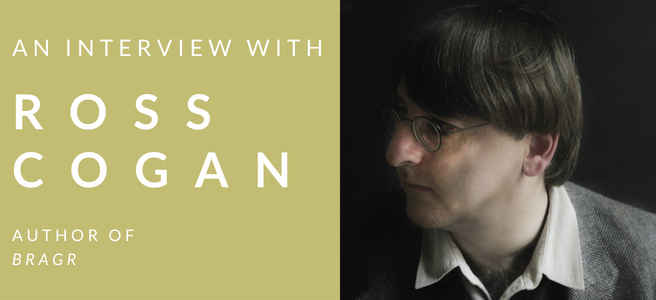
An interview with poet Ross Cogan

Ross Cogan BragrBragr is Ross Cogan’s third collection of poetry, an compelling mix of environmental woes, apocalyptic predictions, and richly reimagined tales from Norse mythology.

Where does Cogan’s inspiration come from, and what does he hope readers will take away from Bragr? In this interview, we aim to find out.


Where does your interest in Norse mythology stem from, and what made you
choose to combine your environmental concerns with these ancient characters, who are so detached from our modern woes?
I can’t remember when I first became interested in Norse mythology as such, though I have been interested in history and mythology since I was at school. But I would challenge the idea that the Gods and mortals of Norse myth (or other myths for that matter) are at all remote from our ‘modern woes’. The Norse Gods, like many pagan Gods, are personifications of different aspects of our world. Odin, for example, is associated with knowledge, wisdom, poetry and healing but also battle and death; Frigg, his wife, with wisdom and foreknowledge; Thor isn’t just the God of thunder, storms and strength, but also of farming and crop fertility; while Freyja is associated with love, sex, fertility and beauty but also, like Odin, war and death. Each would have had their sacred places, and the landscape would have been full of its spirits and monsters, and heavy with sacred associations. So to me the connections between the ancient Gods and our modern concerns are striking.

Through the course of Bragr a world is created in which the environment is
considered unimportant until it is too late. The ‘Bestiary’ section reads as a lament to the loss of many of Earth’s animals whereas the poem ‘Ragnarök’ describes the earth succumbing to a major natural disaster. However, the concluding poem of the collection, ‘Wreath’, is optimistic in comparison, suggesting that it is possible for the earth to recover. Does this interpretation match your own views on the planet’s environmental state?
During its 4.5 billion-and-something year history the earth has survived all sorts of major changes. It’s been far hotter than it is now and far colder. And for about 3.8 billion of those years there has been life on earth of some kind. But individual species come and go with dizzying regularity. At the moment we humans are busy fouling our nests and bringing about the sixth great mass extinction event in earth’s history. But the fact that this is the sixth mass extinction shows that the earth will survive and life will survive and, given time, recover. I’m less optimistic – in fact downright pessimistic – that human life will survive. But I don’t want to rule it out. Most people have heard of the great battle of Ragnarök that spells the ‘doom of the Gods’. However in my experience few realise that it doesn’t signify the end of the world or even the end of the Gods; a few survive, as do a few people, to start the cycle again. Personally I’m from the apocalyptic edge of the environmental movement, along with writers like Paul Kingsnorth (whose recent essay collection
‘Confessions of a Recovering Environmentalist’ is outstanding). I believe that
humanity won’t change its ways and that, even if it could, it’s too late; we’ve passed a tipping point and are heading towards a catastrophe from which no amount of wind farms and solar panels will save us. But I’d like to think that the door is still open, just as the writers of the original Eddic verse did, for remnants of humanity to survive and thrive. That’s the role of ‘Wreath’ in the collection.

If you could only recommend one poem from Bragr that is the epitome of your own values, which would you choose?
‘Lapstrake’. One of the best experiences you can have as a poet is when a poem breaks free from your control and you realise that you’re not writing it any more, it’s writing itself through you. It’s very rare in my experience, but this was one of them. The word is an old one for what’s better known as clinker building – the process of boat building where each stave overlaps the next. It’s a genuine art – boats built like this are very beautiful. But it also tends to result in craft that are versatile, stable, responsive, easy to handle and flexible enough to deal with high seas. The Vikings sailed to America in ships built like this. The poem emerged from my realisation that their shipwrights were, to an extent, following natural forms. It reflects my deeply-held belief that humans are often at their best when they live in harmony with the rest of the natural world, work with it and borrow natural models for use in their own creation. It also reflects my enormous respect for the skills of traditional craftspeople. I’ve always seen poetry as primarily a craft enjoining upon its practitioners the duty to practice for years, study the forms and the great poetry of the past, and never to be satisfied with substandard work. If I ever produce a poem half as amazing as the Gokstad ship, I will be happy. By the way, I was delighted when Carol Rumens chose ‘Lapstrake’ as her Guardian Poem of the Week for 6 August, so you can read it, along with her perceptive commentary, on the Guardian website.

The poems ‘Willow’ and ‘Wreath’ seem to mirror each other, as in both a tree
miraculously grows from branches removed from the tree. The central difference between the two is the environment in which it occurs; ‘Willow’ occurs in a land of plenty, whereas ‘Wreath’ takes place following a natural disaster. What conclusions do you hope readers will draw when reading these two poems in conjunction?
I see now that ‘Willow’ and ‘Wreath’ are companion pieces of a sort, but I must admit that it’s also a happy accident that they came to be written since both also describe real events. I really did plant a willow branch in the ground to mark a row of vegetables and it really did take root and grow into a sapling which, several years later I took down (it was now shading out the vegetable seedlings). I also pruned back a horse chestnut and was surprised when, the following year, the branches that I’d stacked up and supposed were dead, broke into leaf. As it happens there are a number of myths concerning trees that take root from branches planted in the ground. Most famously Joseph of Arimathea’s staff is supposed to have become the Glastonbury Thorn, but the Anglo-Saxon St Etheldreda’s staff apparently became the greatest Ash tree in the land – which looks to me like a pagan borrowing, since the link to Yggdrasil, the world-tree, is obvious. I was aware that trees could do this, and that willow branches in particular had a great ability to take root. However I was genuinely surprised by the Horse Chestnut. I’ve talked above about the role of ‘Wreath’ in the collection, representing as it does the possibility of redemption and survival after the calamity of Ragnarök. So reading the two poems together (and remembering that I didn’t specifically write them to be companion pieces – that just happened), they seem to me to reflect the way in which, in our time of plenty, we have tended to grow complacent and will cheerfully disregard, even hold in contempt, the miracles that occur on a daily basis.

In ‘Kvasir’s blood’, other names for the blood are listed including “the Mead of Poetry”. Do you feel that pain and suffering is essential for creating poetry or do you think you can write with emotional detachment and still create powerful work?
I know that many poets find that, as Henry de Montherlant said, “happiness writes in white ink on a white page”. Some have certainly done their best work when they were depressed. However, just as there are a lot of different poets with different personalities, I don’t think there’s one rule that suits everyone, and poetry written from joy or with emotional detachment can also work. Personally – and this is probably just a reflection of my own personality – I have a lot of sympathy with Wordsworth’s claim that poetry “takes its origin from emotion recollected in tranquillity”, as I need complete calm to write well. I can’t write when it’s noisy, or when I am upset (or for that matter overjoyed) about something. It almost feels as if, for me at least, writing poetry has something of the flavour of meditation, where you attain enough distance to be able to reflect upon and examine the emotions and
ideas that have provoked it. This also imposes some practical constraints: in order to write not only do I need quiet, I also need time – typically I book out a minimum of three or four uninterrupted hours and spend the first of these sitting and staring at a blank sheet before the words come to me. Incidentally, ‘Kvasir’s Blood’ is not actually blood but really is mead, or perhaps wine or some other fermented drink (Kvass is a traditional drink made across Russia and the Baltic from rye bread). So you might also ask ‘is the consumption of alcohol essential for creating poetry?’

What did you find most challenging about bringing the collection together, and what piece of advice would you give to aspiring poets who are trying to do the same?
I mentioned above my conviction that poetry was a craft and should be treated as such. And one of the things that means for me is cultivating patience. If you are learning how to play a musical instrument or build a cabinet, you will need to spend thousands of hours playing the same scales over and over again, or whole days sanding down joints until they fit perfectly. But few, if any, of us are born with patience. So the most challenging thing about writing, in my experience, is not writing. Lots of writing tutors now advise young poets to get into the habit of writing every day – which is fine if they’re going to treat it purely as an exercise and throw most of it away. What I would stress is that it’s just as important to know when you are too tired or emotional, or just lacking in inspiration, to write, and then have the courage to wait. Aspiring poets aren’t necessarily going to like this, but the advice I would give them is not to publish too early. There is a lot of pressure on young writers – especially those who want to get jobs in creative writing – to get that book out in their mid-, or even early, twenties when they can still be ‘the next big thing’. But this can lead people to rushing into print with work that’s not as good as it could have been, and possibly regretting it. Personally I didn’t publish my first book until I was thirty five, and looking back I wish I had held my nerve even longer.

What are your plans for the future? Are there any new works or events we can look out for?
With luck I will be doing a number of readings over the next year or two linked to Bragr. Other than that, like a lot of writers, I don’t much like talking about work in progress, but let’s just say I have a number of ideas I’m developing at the moment.


Ross Cogan will be reading from Bragr at Buzzwords in Cheltenham, Sunday 2nd September. You can also catch him at the Cardiff Book Festival, where he will be performing alongside a chorus of poetic voices in the Friday Night Poetry Party, Friday 7th September


Posted on

Friday Poem – ‘Red Road Flats’, Caroline Smith

Friday Poem Red Road Flats Caroline Smith

This week our Friday Poem is ‘Red Road Flats’, from Caroline Smith’s poignant and hard-hitting collection, The Immigration Handbook, in which the poems are carefully crafted tributes to the gut-wrenching stories Smith hears every day in her work as an Immigration Caseworker.

The Immigration Handbook Caroline SmithThis poem is based on a true story of a family who committed suicide following the refusal of their asylum claim. Before being ‘dispersed’ to Glasgow by the Home Office, they lived in Wembley and the father regularly came to our immigration surgery for help. I can see him pacing by the window in a worn, grey suit with a big brief case held against his chest, constantly checking the window for someone following him. He once pointed to a white delivery van outside the building: certain there was a satellite tracking dish inside. He brought with him an envelope of white powder he claimed he’d been sent. We had it tested through the House of Commons security – it was harmless.

After their deaths, I read back through the letters and glimpsed the terror of the world he had created and believed he was trapped in; where he could no longer trust appearance as reality, where the known world is not what it appears to be. A world where truth was constructed to harm him. Welcome to the Home Office.
Caroline Smith


Caroline Smith Friday Poem Red Road Flats


The Immigration Handbook is available from the Seren website: £9.99

Claim 20% off every book you buy from us when you create a free Seren account.


Posted on

Friday Poem – ‘Roots’, Lynne Hjelmgaard

Our Friday Poem this week is ‘Roots’ by Lynne Hjelmgaard, from her collection A Boat Called Annalise.

A Boat Called Annalise Lynne Hjelmgaard‘A Boat Called Annalise is a triumphant collection of poetry, marking a new embarkation for Hjelmgaard as a poet. It’s a collection which can be read time and time again, and will especially be appreciated by readers looking for new beginnings, those experiencing life’s traumas and working through the healing process called grief.’ Wales Arts Review
Lynne Hjelmgaard’s most recent collection, A Boat Called Annalise vividly recalls a sailboat journey, as well as a journey through marriage, and ultimately grief. ‘Roots’ is one of the movingly elegiac poems in the final section, in which the poet reflects on mortality and happiness. Her work is full of sentiment without being sentimental.


Roots Friday Poem Lynne Hjelmgaard


A Boat Called Annalise is available from the Seren website: £9.99

Enjoy 20% off every book you buy from us when you create a free Seren account.


Posted on

Seren shortlisted for Social Business Wales Award

We are delighted to announce that we at Seren have been shortlisted for the ‘Consumer Facing’ category in this year’s Social Business Wales Awards. 
The awards night will be held on Wednesday 26th September at Cardiff’s City Hall. Entrants come from a range of social businesses but to reach the shortlist, all must ‘demonstrate a dynamic, entrepreneurial and ambitious attitude that are driving the sector forward’.
Part of the Social Business Wales project, which is delivered by the Wales Co-operative Centre, the Awards are funded by the European Regional Development Fund and Welsh Government. The principal sponsor for this year’s Awards is Natwest, with additional sponsorship provided by Legal & General, Acuity Legal, Arup, BIC Innovation, Cowshed PR, ISG Plc, Social Investment Cymru and the Co-op. 
The Awards ceremony will be hosted by Welsh tenor and TV star, Wynne Evans, with evening entertainment provided by south Wales based social enterprise, Gymfinity. 
Tickets for the ceremony and conference the following day can be booked at: http://wales.coop/sbwconf2018
​​
 

Posted on

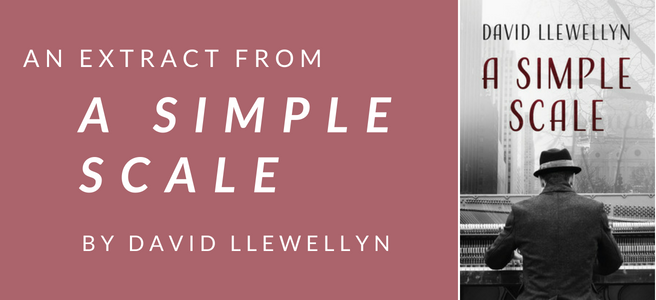
An extract from A Simple Scale by David Llewellyn

David Llewellyn A Simple Scale Extract

In David Llewellyn’s compelling new novel, A Simple Scale, a single piece of music starts a story that takes us from Soviet Russia and McCarthyite Hollywood to post-9/11 New York, as the mystery of the lives of two gay composers is uncovered.

In the immediate aftermath of 9/11, a man arrives in New York to claim that the theme tune of a popular tv series, said to be written by composer Sol Conrad, in fact belongs his grandfather Sergey, an eminent Russian composer who was sent to the gulag by Stalin, and from whom Sol stole the score. Conrad’s young PA Natalie is determined to defend her elderly employer, but as she digs deeper she discovers worlds of which she barely knew – Russian labour camps, McCarthyism, repressive governments, and the plight of homosexuals in the USA and USSR during the twentieth century.
Rich in detail and atmosphere, David Llewellyn explores the points at which the personal and the political meet. Throughout, his depiction of ’30s Leningrad, ’50s California and post-9/11 New York is only too believable.

Our featured extract begins on page 24 of the novel. It opens onto a wintery scene, in what was then Leningrad…


Chapter 2:
LENINGRAD, FEBRUARY 1950

Another time, another place; the city grey, the snowflakes falling in the street like ashes. Beneath the station’s clock tower, two heavy doors swing open with a gasp, and Sergey Grekov steps out, his coat held around him and his gloveless hands clasped tightly in his armpits. Thirty-seven years old but prematurely grey and uncommonly thin, he looks at Leningrad as if it still might be a mirage.
From everything he has been told these last few years, he was anticipating ruins. Hollow buildings and charred timbers, streets strewn with rubble. Instead, he finds it repainted and rebuilt,and yet the place is different,as if everything has been moved around in his absence, as you might rearrange the furniture in an old room.
He’s unaccustomed to choice. When he comes to a junction, he can go in any direction; left, right, straight ahead. The space is almost limitless. No perimeter fence, no watchtowers, no guard dogs. Yet this isn’t complete freedom. His papers tell him where to go and when. The tenement, the factory. Disobey them, and there’s every chance they could send him
back.
The streets around the station are almost empty. The few people he passes look shabby, not how he remembers them. Moscow was always the peasant city, the place where people look as if they’ve just arrived from the country. Not Leningrad. Not Piter.
Moskovsky Prospect is busier, especially once he’s crossed the bridge. There, he moves through a shuffling black mass of other people, winter coats and hats dusted with snow. A xylophone-ribbed dog shivers and keeps pace with him along the gutter. Red and white trams whisper through the slush, passengers pressed against windows opaque with steam. The bell of a nearby clock strikes one.
The last time he saw this street it was through the windows of a police car, in the early hours of a Tuesday morning. It was August then, the air already humid, and stuffier still inside the car. He remembers an agent, a lad barely older than twenty, lighting his cigarette for him – his own hands were cuffed – and the way the car was filled almost immediately with smoke.
As a young man, Leningrad’s winters seemed so much colder than this – far too cold to consider walking very far – but the last leg of his journey was spent in a train compartment with ten others. They took it in turns to sit, but there was no room to lie down and sleep. Cold as it might be, it’s good to be out in the open. Besides, he has known far colder.
His papers tell him to report to the tenement building no earlier than 3pm and so, to pass the time, he finds a café where he orders coffee, black bread and a bowl of rassolnik.
The secret police and their informants were everywhere in the north; guards spying on prisoners and even prisoners spying on guards. No-one trusted anyone. But what about here, in this café? The skinny lad behind the counter, perhaps. The old woman eating some indeterminate grey mush out of a chipped bowl. The crooked figure hunched over a newspaper in the far corner.
The soup, when it arrives, is mostly barley and carrots, little in the way of meat. Sergey dips his bread into the soup. He hasn’t eaten in more than a day. The broth dances on his tongue. Its warmth spreads out, from his chest and through his limbs and into his fingers and toes. He closes his eyes, and when he opens them again he senses someone staring at him.The figure in the corner; the small man with stooped shoulders, his face drawn, pinched and beetle-browed. Though as threadbare and hungry-looking as everyone else in the city, this man could be secret service.
After studying him a moment longer, the stranger gets to his feet, tucks his newspaper into the inside of his overcoat, and crosses the café.
“Seryozha?” he says, his smile a gash of yellow teeth and greyish gums.“Sergey Andreievich?” Sergey nods slowly, waiting for the stranger’s smile to fade, and for him to say there’s been a mistake, that Sergey should never have been released, that his rehabilitation is incomplete and that he will be placed on the very first train back to Komi, by orders of the MGB.
“Do I know you?” he asks.
The stranger laughs. “Know me? Sergey! Of course you know me! It’s me! Vasily Nikolayevich. Sidorov! Vasya!”
Vasily Sidorov. A name he’s neither said nor spoken nor even thought about in years. When did they last see one another? Perhaps the night of the premiere, or in the days that followed. No, his memory of that time is too clouded to picture the exact scene. When he first laid eyes on him, however… this he remembers clearly.
A rehearsal room, backstage at the Kirov. Secretary Remizov taking Sergey on a tour of the theatre, introducing him as “our latest genius”. Echoing against a polished floor, the sound of a piano playing one of Chopin’s nocturnes. In the studio, holding the bar, a young man, eighteen or nineteen, with dark, lightly curled hair, performing a series of degage, and stopping only when he noticed the presence of a stranger.
Now, in the café, Sergey’s innards clench. He hardly recognises him.
Vasya?”
The man draws out the facing chair and sits.
I knew it was you!” he says. “I work nights at the children’s hospital, and every day I come here for lunch, which is really supper, I suppose. But every day I come here, and I know everyone who comes in, if not by name then by face. I see them every day. But you, as soon as you walked in, I thought, ‘Hold on, he’s new.’ And then I looked at you again, and I realised it was you.”
Yes,” says Sergey, smiling almost painfully. “It’s me.”
How long has it been? Ten years? Fifteen?”
Twelve.”
Twelve years. Well. Can you imagine? Twelve years. Incredible. I heard you were up in Archangel, writing music for a theatre company. That’s what everyone was saying. Is it true?”
Sergey shakes his head.
Oh,” says Vasily. “They must have got it wrong. But you’re here now.”
Sergey nods.
And it’s so good to see you! I hardly see anyone these days. We were, well, you know… One oughtn’t say such things in public, but people like us, the artists, we weren’t exactly front of the queue when the rations were being handed out. Were you here at all, during the blockade?”
Sergey shakes his head.
Of course not. Silly question. But you were lucky. Say, are you going to eat all of that bread?” “Yes.” “Only, if you weren’t, I have some wood in my flat that I could swap. It’s good, too. It’s not damp and it won’t burn too quickly, not like some of the cheap shit that’s going around.”
No, I’m quite hungry, so-”
Do you have a place to stay?” Sergey tells him that yes, he has a place to stay, in Kirovskiy, near the Kirov plant.
Nice, nice,” says Vasily.
Is it?”
Oh, yes. And prestigious, too. You’re lucky. Have you moved in yet?”
Not yet, no,” says Sergey. “I only got here an hour ago.”
Oh, well,” says Vasily. “If you’ve not moved in yet, they might not have wood. In your rooms, I mean. They don’t always give you fuel, when you move in. Some places, it takes weeks. So, you know, if you don’t have any…”
Sergey draws his plate closer and dunks what’s left of his bread into the rassolnik.
You must be hungry,” says Vasily. “I know they don’t always have much bread on the trains. I’ve heard, a friend once told me, if you want a bigger ration of bread…” His voice drops to a whisper. “If you want a bigger ration of bread, you have to give the ticket inspector a blowjob. Is that true?”
Sergey smiles. “I wouldn’t know.”
Oh, then you must be hungry,” says Vasily, laughing and coughing at the same time.“Say, listen. I live near here. When you’re finished, let’s go to mine. I’m on the third floor, so it’s not too cold,and I have some vodka.”
A loaded invitation, but Sergey has nowhere else to go and two hours till he can report to his tenement. When the bill is settled he and Vasily walk the short distance to Vasily’s building, just off Sennaya Square.
Twelve years ago Vasily Sidorov lived not so far from here, in an apartment complex on Sadovaya Street, and Sergey remembers summer parties when they would congregate on a small terrace overlooking the square ,and they would drink champagne; Soviet champagne, of course, but ice cold, and sparkling and as crisp as a fresh apple.
Vasily’s new building has no terrace. One of its two entrances is sealed shut by a frozen snowdrift, and the other opens only when Vasily barges into it with such force that Sergey worries he – and not the door – might break.
Once inside, they are taken up to Vasily’s floor by a gloomy hallway and a flight of stairs that smells strongly of piss, while Vasily’s room smells mustily of tobacco smoke, mildew and dust. Sergey recalls Vasily having a small collection of illicit Persian rugs and a mantelpiece crammed with ornaments, but this new place – if it can be called new – is sparse, decorated only with a few pieces of old furniture. The floor and the walls are bare.
Please, sit,” says Vasily. “I’ll get us some vodka. I only have one glass. Do you mind having yours in a teacup?”
Not at all.”
What am I saying? You have the glass, I’ll have the teacup. As you may be able to tell, I don’t do much entertaining these days…” Vasily opens a cupboard and takes out the vodka, a chipped teacup and a cloudy tumbler. He crosses the room with an awkward, scuttling motion; bug-like, a spider creeping along a skirting board. He was once the most graceful man Sergey had ever met. Small in build, but not feminine. Women and men alike considered him beautiful. Now he reminds Sergey of a gargoyle or some grinning demon, a didko, from an old folktale. He takes to the sagging armchair opposite, and for a moment they sit in silence; Vasily still smiling at him, scrutinising him.
It’s incredible,” he says, at last. “That you came here. To Leningrad. It isn’t often men come back. Usually, well, usually they’re sent to some other place. Remember Remizov?”
As if the room has grown a degree or two colder, Sergey flinches. “Yes,” he says. “I remember him.”


A Simple Scale is available to pre-order on the Seren website: £9.99

Join our free Book Club for 20% off every book you buy from us.


Posted on

An interview with Cardiff author & legend, Peter Finch

Interview Cardiff Peter Finch

The Eisteddfod will soon be in full swing in Cardiff’s beautiful Bay area. We can’t wait to welcome you to Wales’ capital city – and to introduce you to our resident Cardiff expert, Peter Finch, who will be signing copies of his new book on the Welsh Books Council stand (84) on Wednesday 8 August, 1:00pm.

As you prepare for the marvellous week ahead, we thought you might enjoy learning a little more about the Welsh capital – so here is our interview with Peter Finch, who – as ever – is full of fascinating insight into his home city.

Peter Finch

Peter, you have been writing about Cardiff for quite some time now, with the first ‘Real Cardiff’ book having appeared in 2004. What do you perceive as the most radical change Cardiff has undergone in the last decade?
Changes to Cardiff seem to work in twenty year cycles rather than decades.  We didn’t have the Bay nor the Barrage, the Millennium Centre not the Senedd in 1980 but by 2000 we did.  In 2000 and other than right on campus there was barely a purpose-built student let available anywhere in the city.  Today they are everywhere, gargantuan, gleaming, glowing, growing, rocketing up in every district from right next door to the old Gaiety Cinema on City Road to the city’s highest of new high rises, the Bridge Street Exchange, at the bottom of Charles Street.  In the pipeline are plans for more.  Purpose Built Student Accommodation (PBSA) erected against a background of weak planning control and easy to manage building regulation they are the cash cows of property developers everywhere.   Put them up and then apply for change of use.  The cityscape will never be the same again.  In 2000 we had a green belt running right round the city.  Today that belt has shifted to become instead a green wedge, a green splash, a green smear.  In its place are the city’s new districts.  Plas Dwr, Churchlands and all the others. Cardiff expands. And expands. And expands.

The ‘culinary odyssey of City Road’ is marvellously well documented in Real Cardiff: The Flourishing City. For hungry Eisteddfod-goers, where would you recommend trying first?
.CN, the internet suffix for China, is the name of the city’s best Chinese eatery by far.  Here you can get top end Sichuan king prawn in chilli and pepper sauce, healthy option Kung Po chicken, and north east China salad in a style you’ll find hard to beat anywhere else in the city.  Failing that and for kebab fans Al Wali’s Omani Restaurant half way down and hiding behind a bus stop is pretty decent.  For Omani read Persian or Iranian or Egyptian, or Middle Eastern.  City Road is a feast from one end to the other offering meals at price points everyone can reach.

If you could be transported to any period of Cardiff’s history, which would you choose?
I think I’d want to see the heroic period of Cardiff’s industrial expansion in action first hand.  That would mean arriving in 1861 at the Royal Arcade and finding the very first Cardiff Free Library on the first floor.  Out the back they’d have a time machine, naturally, so having got here I could then get back.  I’d use it to slide back a further few years to 1849 to see Brunel move the Taff in order to build Cardiff General Rail Station for his South Wales broad gauge railway.  I’d spot a few numbers and then rush forward to 1886 to visit the brand new Coal Exchange, have a drink in the just opened Grand Hotel on the new Westgate Street, buy some cockles at the brand new indoor market and finally climb up the shiny new statue of John Bachelor to top his head with a road mender’s lamp, traffic cones not yet having been invented.   This was the period that made Cardiff, when the population boomed and when modern invention and business innovation flooded the place.  That flourishing must have been simply thrilling to watch.

Psychogeography is a particularly inventive way of mapping a place – how did you first become interested in it?
The Situationists who flourished between the fifties and the seventies were international social revolutionaries and avant garde artists.  I was running the journal second aeon at the time, a Welsh-based home for a world of avant garde poetry, so naturally I took note.  These people interested me.  They were an onward growth of the Dadaists and the Surrealists and seemed to me to be right at the cutting edge.  One of their members was Guy Debord ­– the man who invented psychogeography, the exploration of mainly urban environments for what they were rather than where they led.  The sense of place became more important than the place itself.  Why not view a city as an entity rather than a destination?  This was something I needed to try for myself.

Peter Finch Real Cardiff Flourishing CityWhat did you find most challenging in your process of writing Real Cardiff: The Flourishing City?
In writing these books you don’t sit about waiting for inspiration to strike, no hoping for those rays of Blakean stuff to come pouring down through the air and infest your work.  None of that.  This is work..  I need to immerse myself in my subject. Research it, walk through it, think about, talk about, listen to it, feel it.  I make notes.  Constantly.  I record things on the camera, take snaps, use the phone.  I check out the maps.  I check out the old ones and then the new ones.  I check  just how the used to spell the name of the place I am interested in.  Why was Rumney called Rompney? Why was Cardiff called Kairdiv?

I accumulate what I need to say and then find a way of starting out and saying it.  The starting is so important.  Get that right and the rest will flow. I work hard walking and thinking, note book always with me, and into it I make notes of how my start might go.  The walking helps the flow.  I ignore passers-by, I ignore interrupters, I am working so this poor and rude behaviour is entirely reasonable.

It’s also true that you then need to check and then check again.  I reread and redraft.  I get help from others to check too and I listen to what they say.  I recheck my spellings.  I look at what others have said and I try not to repeat them.  I acknowledge them if I do.

What’s the most challenging?  Transcribing interviews.  Getting that right.  And remembering to ask the right questions in the first place.  I always double check with my interviewees.  I let the subject see what I intend including and ask them if they are happy.  If they aren’t or I’ve got it wrong somehow then I put it right.

And finally, in the closing pages of The Flourishing City, you wonder about Cardiff ‘how it could be’, and tell us, ‘Cities are never finished’. Is it also true, then, that you’ll never be finished exploring this city of yours?
I think that once a city gets above a certain size there will always be new things to discover about it.  Not only is Cardiff big enough to keep me permanently involved but it is also changing constantly, often at a bewildering rate.  No matter which part of it I find myself in there are always new things to look at, new roads to walk down, new paths to follow and new routes to create.  Tracking the lost can be just as thrilling as delighting in the newly discovered.  The moment I finish a volume of Real Cardiff something new or different or previously unseen appears.  Buildings get built.  Buildings get torn down.  Populations flourish.  Roads and walkways bend and turn offering new and different vistas.  This capital of ours is a great Welsh place, far more involving than most people think. Try it. Just arrive and open your eyes. Real Cardiff: The Flourishing City will give you a few hints.


Real Cardiff: The Flourishing City is available from the Seren website: £9.99

Join our free Book Club for 20% off every book you buy from us.
 

Posted on

Friday Poem – ‘Return to Cardiff’, Dannie Abse

Dannie Abse Return to Cardiff

The National Eisteddfod is coming to Cardiff, and with just a few hours to go, we couldn’t think of a better Friday Poem to feature than Dannie Abse’s ‘Return to Cardiff’.

Wales, and Cardiff in particular, haunted the imagination of the great Dannie Abse. In Welsh Retrospective he writes movingly about the Cardiff of his childhood, home of his beloved Bluebirds football team, and also about the small village of Ogmore-by-Sea, location of early holidays and for many years his home in Wales. Selected from the whole of Dannie Abse’s writing career, the book includes such well known and well-loved poems as ’In the Theatre’ and our featured poem today, ’Return to Cardiff’, alongside many previously uncollected poems. Welsh Retrospective gives fascinating insights into Dannie Abse’s Wales and his versatility as a poet.


Friday Poem Return to Cardiff Dannie Abse


Listen to Dannie Abse performing this remarkable poem at Seren’s First Thursday event, December 2009:


Welsh Retrospective is available from the Seren website: £8.99

Join our free Book Club for 20% off every book you buy from us.


Posted on

May by Naomi Krüger longlisted for Not the Booker

The Guardian’s ‘Not the Booker’ longlist has just been revealed and Naomi Kruger’s debut novel, May, is one of 140 titles to be nominated. Also on the list are a number of books by fellow Welsh independent publishers: Ironopolis by Glen James Brown (Parthian), Ash by Alys Einion (Honno), Albi by Hilary Shepherd (Honno), and The Offline Project by Dan Tyte (Graffeg).
Voting is open for just one week – to vote, simply choose your two favourite books and leave a review in the comments section of the longlist announcement page (you have to have a Guardian account to do so). Please include the word ‘vote’ in your comment or it may not be counted. 
We wish the best of luck to Naomi, whose startling novel, with its sensitive depictions of dementia, heartbreak and loss, is truly unforgettable.


Posted on

An extract from Real Cardiff: The Flourishing City, by Peter Finch

Real Cardiff Peter Finch extract

Though certain parts may be seeing rain this weekend, the warm weather continues – and what better time than summer to explore all the UK has to offer?

Peter Finch Real Cardiff Flourishing CityOur Real Series – a collection of intimate and entertaining guide books written by local writers – offers an insider’s view of the places it celebrates. The most recent addition to the series is Real Cardiff: The Flourishing City by Cardiff author and legend Peter Finch. So whether you’re an armchair traveller, or someone looking forward to a trip to the Welsh Capital sometime soon, we hope you enjoy this glimpse into the history of Cardiff – specifically, the area in which famous children’s author Roald Dahl grew up.

The whole of the Real Series – and all our other Seren books – are 50% off until midnight, Sunday 29 July, on the Seren website.


ROALD DAHL’S CARDIFF NORTH LEY

I catch the train at Cardiff Central. This is the City Line which began in the city’s north east and now, after looping in a great U through the city’s heart is about to head north again. I’m in the two-car Sprinter and I’m standing. Every single seat is occupied by pupils from Bishop of Llandaff High School. Kids, bags, blazers, headphones, chewing.
The windows stream as the train steams. Around us is railway land, an industrial cityscape full of rail sheds, engine bays, carriage washeries, repair shops and assembled new track in stacks like a giant train set. This south west of the city on view from the tracks is the capital with its guard down. Backs of mosques, tottering streets, unkempt gardens, the yards of Brains brewery, warehouses stacked with building materials, and even more open and right now empty rail beds. It reminds me of London, how the land looks as you reach Paddington or Waterloo.
But it doesn’t last. After the carriages have disgorged a hundred uniformed school kids at Fairwater, the cuttings emerge, wooded banks and scrub masking the housing above. It’s leafy suburbia giving an impression of empty countryside. A green west Cardiff, a place that doesn’t change.
It’s freezing. This is January. The train has reached Radyr where it will rest a while before returning the way it came. I’m off, up the footbridge steps, plastered thickly with Network Rail road salt. No one but no one will slip and sue here. In a previous, smaller, steam-filled incarnation, the Radyr train would have served Roald Dahl’s father, Harald, who did a daily commute in to what was then called Bute Road Station. His ghost is there on the platform now, eye glasses, three-piece suit, white starched collar. He looks like a disapproving headmaster. His railway season ticket was found inside his expensive leather wallet when he died in 1920. That was on April the 11th. The ticket was valid until the 23rd.
Like most in Cardiff at this time Harald’s business was coal. With his partner Ludvig Aadnesen he had established a business as a colliery agent and provider of all that ships docking in the world’s leading coal port would need. Provisions, ropes, oil for their lamps, food. The profits flowed.
In 1917 Harald had bought Tŷ Mynydd (Mountain House), set on rising ground a mile north of the Radyr rail station. As befits the successful businessman Harald was, here was life on a grand scale. 150 acres of land, outbuildings, cottages, a piggery, lawns, formal flower borders, terraces, its own electricity generator and an enormous Victorian house.
In photographs it looks like part of Hogwarts. It had multiple chimney stacks, mock Tudor gables, a tiled roof larger than most churches’ and greenhouses to the side to rival those of Dyffryn House, to the west of Cardiff. This is the place Roald, the great author, remembers with nostalgia, recalling the fields full of shire horses and dairy cows. There are photographs of him as a four-year-old out on the lawns and terraces, in the fields among the sheaves of corn, sitting on the wall of the piggery and of the house itself, which is resplendently decorated with both the Union Jack and the Norwegian Flag. No Welsh dragon in sight.
Like Cefn Onn, Tŷ Mynydd also had railway connections. The house had been built in 1883 by George Fisher, Director of the Taff Vale Railway. When he died in 1891 the property passed to his son, H. Oakden Fisher, Chair of both the TVR and the Cardiff Gaslight and Coke Company Ltd, although his real interest lay with the military. He was Lieutenant Colonel of the Glamorgan Volunteer Artillery. Harald bought the estate in 1918. When he died in 1920, his second wife, Sofie Magdalene, moved to smaller premises back in Llandaff. Tŷ Mynydd then became the property of the architect Sir Beddoe Rees, MP and for a brief time in the 1930s was turned into St Maur’s College, a small private boarding school for girls.
In 1967 the house and most if its outbuildings were demolished. This was the first full-blooded rush at clearance following the war. Cardiff was expanding. Property developers had no interest in the preservation of inefficient, draughty piles such as Tŷ Mynydd. On its lands a whole housing estate could be build. It had to come down.
I take the road up out of the station’s gully. Already the old shunting yards and waste ground lining the river have been populated with high density brick town housing. There’s little public space. Most structures are distinct from each other, laid at angles as if thrown there like dice. Room for breath is restricted and corners are rounded. Access is on turning roads named after De Clare, Norman Lord of the City, Aradur Hen, an ancient local croft that gave us the name Radyr, and Goetre Fawr, the farm that once worked these lands. Behind the aptly named Junction Terrace is a field replete with three grazing llamas, tall-necked beasts which, despite the ll of their name, are about as common in Wales as kangaroos. Food To Go which has signs offering coffee and warmth is closed. I head up along rising Heol Isaf in the direction of the Village of Fire.
In 1841 the ten cottages of Pentre Poeth (Warm Village) were all that existed of what is now Morganstown, upper Radyr – that part of Cardiff north of the M4’s périphérique grip. This is where the workforce of the developing fire-filled ironworks at Pentyrch lived, an element of Cardiff’s lost industrial heritage. Heol Isaf was and still is the main road to Tŷ Mynydd. It’s no distance to cover. In my ears I’ve got Emmylou playing through the buds. 1970s country, when what she sang was the edge. Alabama down home. Dahl wouldn’t have stood for this. He preferred Beethoven.
The Tŷ Mynydd estate has been built on; the fields are gone. The line of the original entrance path running up from Tŷ Mynydd Lodge has been preserved in the rising bends of MaesYr Awel. The detached late-sixties houses along it turn eventually to a U-shaped cluster of apartment blocks. Cwrt Tŷ Mynydd is the appropriately named first; after that the developer gave up and resorted to names with a strong English resonance – Norfolk Court, York Court, Windsor. It’s a marketing thing. Here, near the eastern edge of Wales, where the language thins, the Anglo norm dominates.
Beyond the apartment courts, circled like a residential wagon train, there’s a copse, ancient pine trees, all that remains of what once was here. For the Dahls of the nineteen teens this would all now be virtually unrecognisable. A local walking his young daughter to the primary school at the former estate’s southern end tells me, yes, he knows about Dahl and the great house. He points me back towards the still extant Tŷ Mynydd Lodge which faces Heol Isaf. And there it is, the gatehouse preserved, doing time now as an up-market B&B. The Llandaff Society have installed a celebratory plaque above the front door. Over the years since Roald would have known it the building has been much extended. But there’s enough original left for the Dahlian spirit to soar. I can see him outside, short pants, laced leather shoes, hat, overcoat with enormous buttons. Mama holding his hand.


Real Cardiff: The Flourishing City is currently half price on the Seren website: £9.99 £4.99

Thinking of visiting cities elsewhere in the UK? Find the perfect insider’s guidebook to enrich your trip:

Poet Ian Spring overlays the current map of Glasgow with the map of his memory and experience.
‘Bard of Barnsley’ Ian McMillan delves into the past of the area of South Yorkshire in which he was born and still lives.
Poet Chris McCabe looks at the art, attractions and ‘oozy’ docklands history of this slice of London.
Novelist Clare Dudman explores her richly historic city as you won’t find it in other guidebooks.


See the full list of Real books on the Seren website: all half price until midnight, Sunday 29 July!

Posted on

Friday Poem – ‘I Am In Love With Myself People Say’, Marianne Burton

Marianne Burton Friday Poem Kierkegaard

Our Friday Poem this week is ‘I Am In Love With Myself People Say’, from Marianne Burton’s new collection, Kierkegaard’s Cupboard.

Did you know: all our books (including Marianne’s) are half price this week?  Take a peek at our website before the offer ends.

The life of Søren Kierkegard has inspired this new book of poems, in which Burton delves in to the extensive writings both by and about the influential Danish philosopher. Kierkegaard’s Cupboard is split into six sections, each section inspired by an aspect or event in Søren Kierkegaard’s life.
‘I Am In Love With Myself People Say’ takes inspiration from The Seducer’s Diary  – a fictional parallel to Kierkegaard’s failed relationship with his beloved Regine. Intending to make their broken engagement easier for Regine to bear, Kierkegaard portrays himself as the unworthy seducer to her fictional counterpart, Cordelia. In Burton’s poem we feel the full force of Johannes’ self-serving love: the sonnet form serving in defence of the speaker, rather than praise for its object.


I Am In Love With Myself People Say


Kierkegaard’s Cupboard is currently half price on the Seren Website: £9.99 £4.99

Half price offer ends midnight, Sunday 29 July.