Posted on

Friday Poem – Some Christmas Haiku

A Christmas themed haiku by Peter Finch

Some Christmas Haiku

On the moors
The snow caught by grass
No one to see it

Not Christmas holy silent night
But the Holiday season
Above the cloud same old moon

Cinio Nadolig
Boldy praising Iesu
Menu’s in English

In the Chapel
Old wood
After so many years still shining

Through the dense firs
Light of a wrecked car
Burning

Early snow
On the berried holly
Some cretin starts complaining

Old man
Pulling crackers by himself
Sound clear to the big dipper

Sound of retching
Three man in an empty street
Crushing larger cans

Street guitarist mangles carols
On the shopkeeper’s face
The shopkeeper’s mask

Posted on

Friday Poem – Bitumen and Rust

The Hitting Game, Graham Clifford

This Friday, our poem Bitumen and Rust, comes from Graham Clifford’s collection The Hitting Game. The vibrancy of Clifford’s voice and the immediacy of his claims upon our attention are clear in this lively collection. Incidents are approached from disarmingly intimate and entertainingly oblique angles. These are urban poems where nature appears like a strange intrusion. There is gentleness and empathy, humour and pathos, with poems full of unexpected dramas and fresh enchantments, which provoke as well as delight.

Bitumen and Rust

In the end you didn’t buy an angle-poise light
called lack – it must mean something aspirational
in another language. Driving home, a green-brass prick

of a church wedged in-between semis began to glow
as if a prayer just got answered. As if. Polystyrene
tea in cup holders. Dirty little seas rich as slicks

of sewage-juice in ruts we trudged in a landscape
ruined with bitumen and rust, by slung piglet carcasses
still eyeing fly-tipped, shoddy white goods.

There is more than one disputed memory
We tug apart like foxes: under branches
Sweating out winter, the colder, wet side of freezing

I found clay pigeon shrapnel like smashed, thick 45s.
You first saw the sun drown in two ponds at the outskirts
Where, where we know turned in to where we don’t.

Spuds and beet surfaced from dirt, sick bits;
it was me that bit an onion like an apple. Barbed wire –
you slam on the brake so as not to kill

a man selling premature roses in the road.
Everyone is full of music to make it better.
Jittery clouds scarper to the margin like bath foam,

soap-touched. Suddenly, above us is baby blue.
You won’t be around forever; laugh: tea –
barbed wire that disappeared into tree bark.

Get it in time for Christmas! The Hitting Game is available to buy with 20% off when you join our online book club.

Posted on

Friday Poem – A Birthmother’s Catechism

This Friday’s poem, A Birthmothers Catechism, comes from Carrie Etter’s collection Imagined Sons. The giving up of a first-born son for adoption is the central story, and the way the ramifications of this act echo down the years through the protagonist’s life is movingly embodied. The poems describe various scenes in which the son is ‘encountered’. They are sometimes straight-forwardly realistic, almost like film clips; then there are dream slices full of surreal images; brief comedies or tragedies; and short lyrical laments. This is one of those brave, rare and heartfelt books that will stay with the reader. It has both a compelling urgency and a passionate purpose.

A Birthmother’s Catechism

What do you want?

After twenty hours on trains, I stand on the platform
and stare at I know not what

What do you want?

Rub the leaves between your fingers and smell a ripe lemon

What do you want?

When a stranger compares her mortgage to signing away
her firstborn, I nod and cannot speak

What do you want?

The hangman sold the rope by the inch as a panacea

What do you want?

Houndstooth daisies, in a small, extended fist

[soundcloud url=”https://api.soundcloud.com/tracks/179439755″ params=”auto_play=false&hide_related=false&show_comments=true&show_user=true&show_reposts=false&visual=true” width=”100%” height=”450″ iframe=”true” /]

Get Carrie Etter’s Imagined Sons here

Posted on

Jonathan Edwards Shortlisted For The 2014 Costa Poetry Award

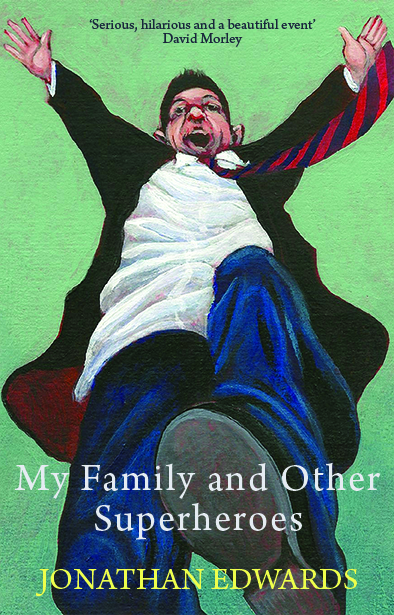
This cover shows a colourful painting of a school boy stomping with excitement viewed as if looking from the ground. The text reads: My Family and Other Superheroes, Jonathan Edwards.

Jonathan Edwards has been shortlisted for the 2014 Costa Poetry Award with his debut book of poetry, My Family and Other Superheroes. The news comes just a few months after the collection was shortlisted for the Fenton Aldeburgh Poetry Prize.

The Costa Book Awards honour some of the most outstanding books of the year written by authors based in the UK and Ireland. There are five categories – First Novel, Novel, Biography, Poetry and Children’s Book.

Edward’s heroes are a motley crew: Sophia Loren, Marty Mcfly and Evel Knievel jostle for space on the pages alongside Valley’s mams and dads, The kebabby in Merthyr and the traditional Welsh costume.

The judges: Owen Sheers, Anna Dreda, and Charlotte Runcie said of Jonathan’s book:
“Joyful and dynamic – a collection that’ll make you laugh and make you think.”

Edward’s superheroes will have to fight it out with the likes of  Colette Bryce, Lavina Greenlaw and Kei Miller for the esteemed award. The category winner will be announced on 5th January with one of the five category winners chosen as the overall Costa Book of the Year later in the month.

Get a copy of Jonathan’s award worthy collection here. Save 20% when you join our online book club.

Posted on

Friday Poem – MIG–21 Raids at Shegontola

Midnight, Dhaka Mir Mahfuz Ali

This Friday’s poem, MIG–21 Raids at Shegontola, comes from Mir Mahufuz Ali’s debut collection Midnight, Dhaka. Rich in visual and aural descriptions, Mahfuz writes with a shocking directness about the atrocities he witnessed as a child in war-torn Bangladesh. In later poems his trauma becomes transformative, and his poetry the key to unlocking memories of a childhood that are rich in nuance, gorgeous in detail and evocative of a beautiful country. They celebrate the human capacity for love, survival and renewal.

MIG–21 Raids at Shegontola won the  2013 Geoffrey Dermer Prize for poetry. Mahfuz will be accepting the MDA award for best contribution to the Arts by an Asian artist presented by Julie Morgan, Am at a ceremony in Cardiff on 8th November.

MIG–21 Raids at Shegontola

Only this boy moves
between the runes of trees
on his tricycle
when an egle swoops,
releases two arrows
from it’s silver wings and melts
away faster than lightning.
Then a loud whistle
and a bang like dry thunder.
In a blink the boy sees
his house roof sink,
feel his ears ripped off.
The blast puffs up a fawn of smoke
bigger than a mountain cloud.
The slow begonias rattle
their scarlet like confetti.
Metal Slashes
the trees and ricochets.
Wires and pipes snap
at the roots, quiver.
The whirling smoke packed
witch bricks and cement,
chicken feathers and nigella seeds.
When the cloud begins
to settle on the ground,
the boy makes out buckled iron rods.
White soot descents
as he finds himseld dressed
like an apprentice baker.

Get 20% off Midnight, Dhaka when you join our online book club.

Posted on

Seren Talks to … Jo Mazelis

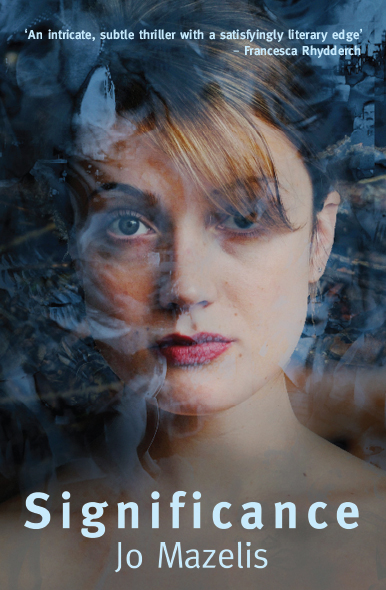
Jo Mazelis, Significance

We’ve been talking to Jo Mazelis about life as a writer, feminism, meeting PD James and her new book, Significance.

During the 1980s, Jo worked as a graphic designer, photographer and illustrator for the magazines City Limits, Women’s Review, Spare Rib, Undercurrents, Everywoman and New Dance.  Jo is author of short stories, non-fiction and poetry. Her stories and poetry have been broadcast on BBC Radio 4 and published in various anthologies and magazines. Her collection of stories, Diving Girls, was short-listed for the Commonwealth ‘Best First Book’ and Wales Book of the Year.

How did you come up with the title ‘Significance’?

The title came to me quite early in the writing process and in a sense it guided the whole book and became its philosophical fulcrum. Because the story was about crime – in particular violent crime – the reader begins to search for significance (or clues) in each event as the narrative develops. This parallels how direct and indirect witnesses to crime see greater significance in banal events and perceive them as vital parts of a larger picture. Beyond that I wanted to explore how people’s view of the world is altered by certain events, and how they may change their entire course of action due to a chance encounter. It’s a fairly well known phenomena now, that despite the digital age with its instant news from across the globe people still feel more affected by a tragedy or disaster the closer they are to it. I don’t think it is because as a species the human race can be unfeeling, rather it’s information overload. But it feels wrong somehow when a newscaster reports that ‘floods in country x killed three thousand people – one man, Professor Smith a geologist from the UK is believed to be among the dead’ His death is no more or less tragic than the other 2,999 yet he is given greater attention.

My point was I suppose to draw attention to significance and question how meaning and value are not fixed but entirely malleable or transient, depending on the viewpoint of the spectator.

On another level the character Lucy quite dramatically changes her appearance just before setting off on her trip, these changes alter how she is perceived – she looks younger, more girlish, less serious and more vulnerable. Is she the same person?

Because I was thinking about how meaning is bestowed to a greater or lesser extent on objects or emotions or experiences I explored how different characters create or define significance in their lives; whether through revolutionary politics, religion, astrology, love, medicine or history.

The chapters are very short and focus on different people, the minor characters all have fleshed out back stories and motivations – what was your aim in doing that?

Literature in all its forms has by its very nature created ‘the minor character’ whose role is perceived as of less interest than the major characters but whose presence creates plot points and realism. A novel in which many characters have equal weight would be impossible to write, read or even consider – though some novelists have attempted versions of it in different forms for example David Mitchell in Ghostwritten and also The Bone Clocks.

In a sense all individuals think of themselves as the heroes (or main characters) in the drama of their lives – they may recognize that as a waitress or factory worker or medical student their individual actions cannot shape world history but no one really considers him or herself a minor character and they are not minor characters to those closest to them.

In particular I did not want to create a narrative in which the victims of crime become mere ciphers, there only to create a mystery for the detectives to unravel or for the psychology of the murderer to be displayed. I particularly didn’t want to say very much about the killer at all – despite his actions I wanted him to be the most insignificant character. Many people have commented on how after a notorious murder or series of murders the name or tagline of the killer is remembered while the victims’ names are forgotten. In some ways this stems from how these stories are told in the media so we have Jack the Ripper or The Boston Strangler or The Yorkshire Ripper – maybe this is due in part to the circumstances of those crimes – in that the actions of one killer were known but his identity was not. I think the case of Fred and Rosemary West proves this point, as while the disappearance of many young women was known about, none of these cases were linked and thus there was no perpetrator to be sought and given a nickname prior to the discovery of the bodies. Instead, when the crimes were discovered, it almost seemed as if the house itself stood in for the monster, with 25 Cromwell Street becoming a byword of horror.

Racism, feminism, sexism – these are all themes that are touched upon in Significance. Are these themes important to you?

These are absolutely key to my perspective and clearly inform what I write about and how these topics are covered – at the same time I would hate to be led by the sort of dogma that sees all men as bad and all women as essentially good. In fiction one is usually looking at the world at a micro rather than macro level – so that it is the individual’s actions and belief systems that I tend to explore when I write especially by finding a psychological basis for their actions.

While I was working in publishing in London in the 1980s I read a few books about violent crime towards women including The Lust To Kill: A Feminist Perspective on Sexual Murder and The Streetcleaner: Yorkshire Ripper Case on Trial by Nicole Ward Jouve. These were upsetting books to read but both in a sense interrogated society as a whole, seeing sexual killers as symptoms of a greater ill. A case in point was when a few newspapers spoke of The Yorkshire Ripper’s ‘First INNOCENT victims’ implying that the other murdered women were GUILTY. Clearly a society that views any of its members as implicitly deserving of violent death is not a healthy one.

At the same time in the 70s and 80s racism was still a major issue – a friend of my mine at college – a young Asian man – showed me a large scar on his neck where years before he’d stabbed by skinheads in an unprovoked attack that mirrored the later fatal attack on Stephen Lawrence in South London.

One of the characters in Significance is an idealistic young African who becomes a suspect mainly because the colour of his skin causes his actions to be misinterpreted – even when he is simply running or attempting to do a good deed.

In many instances I am interested in the distorting lens of other people’s perception and the construction of personality and identity.

You photographed and interviewed some literary giants, including Margaret Atwood, PD James and Fay Weldon, during your career as a journalist and photographer. Did meeting these women inspire you to write or have you always been a writer?

I had a very vivid and conscious sense of seeing these writers as real people – I think before that I’d had very lofty ideas of what a writer might be like. It sounds terribly naïve but it was this recognition – for example hearing PD James say that it was a need for money due to her husband’s ill health that galvanized her to begin writing novels was a surprise. Not that it was the idea of money which motivated me rather it was that it gave me glimpse of the possible.

Did any of these women give you writing advice?

No – it wouldn’t have been appropriate for me to ask – I was there in their homes or hotels or publishers’ offices as a photographer. It was quite enough that I was peering at them from behind a camera or ordering them about and moving their furniture. I was usually there at the same time as an interviewer who had enough questions of their own and the time we were allowed was usually limited. My focus was very much on getting a good photograph – which in those pre-digital days required all my attention, especially as often I was only given five or ten minutes at the end of the interview to get my pictures.

I can’t imagine what I might have asked any of them even if I could have. Besides which I wasn’t really actively writing then – the odd review or non-fiction article perhaps – writing was something that I perhaps saw on the distant horizon that I might sail towards one day if the weather looked fair.

Why did you choose to become a writer?

This is a difficult question because it partly feels as if writing chose me rather than vice versa. I have always felt that deep down this was not something I was meant to do. This sounds very contradictory – but I think it has to do with my early perceptions of writers as a group of people who were academic high achievers, who read widely, went to university and were generally the exact opposite of me. At eighteen I wanted to be a painter, but after one year at Art College it spat me out leaving me disillusioned with myself, lost, confused and directionless. I had no idea what to do, hardly any qualifications and haunted shameful feelings of failure. I could no longer draw or paint as the blank paper before me no longer represented hope or the development of skills. I wrote a little poetry but this was really only just a private means of recording my feelings about many aspects of my life and how I perceived the world. I began to read a great deal – everything from Maxim Gorky to Flannery O’Connor to Ted Hughes and Sylvia Plath to Erica Jong and George Orwell and Hardy and Herman Hesse and Richard Brautigan. I read quite a bit of non-fiction too, Elaine Morgan’s ‘The Descent of Women’ and Phyllis Chesler’s ‘Women and Madness’, ‘The Family’ by Ed Sanders and books about women’s art and poetry, others about politics, witchcraft, prisons, psychology and social issues. All these books were part of the zeitgeist then, although isolated as I was, I’m not sure where or how I was managing to tap into it. I suppose I just wandered into places like The Uplands Bookshop and spied these books there – esoteric works published by Picador and Paladin in particular were always displayed on revolving stands and were a different format from other paperbacks. I was reading into an ideology but I’m not sure I would have put it that way at the time. I was trying to understand the world I suppose and maybe the drive to do that is stronger if you feel you have no place in it.

So I became a writer very slowly by degrees of disaster, despair and determination. I signed up for an evening class in ‘Creative Writing’ in London in 1979 or 1980 and the first thing the tutor said was that it was highly unlikely that any of us would ever become writers – confirming what I had always thought – I went to one, maybe two more classes then dropped out – what was the point? I began to write in earnest in 1987 and my first story was published in 1988 but my first book ‘Diving Girls’ wasn’t published until 2002 so I suppose this proves I have staying power if nothing else.

What’s next? Will you be sticking with novels or returning to short stories?

I have always written short stories – I forced myself to stop entirely for the four years it took to write Significance but I very quickly began again when the novel was finished. I suppose part of this question refers not so much to what I will write but what sort of book might I publish next? I have a large number of short stories already written – some of which have appeared in magazines like The Big Issue or Tears in the Fence, others have been collected in anthologies published by Honno and Seren, others that are yet to see the light of day and others that perhaps deserve to stay in darkness. So as a writer I would very much like to bring out another book (or two) of short stories, but I equally have several novels in various states of progress that I would like to see published. Of course what any writer may like is not what they necessarily get – publishing has changed, the market for books has transformed beyond recognition, people, especially in areas like Wales, the North of England, Scotland are struggling to pay for even the staples of life so are unlikely to buy books in such a quantity as to keep the market buoyant.

Despite this I tend to see each piece of writing as a challenge – can I make this story or poem or novel or paragraph the best I can? Will it ever be finished or published? As Sylvia Plath famously said, ‘Nothing stinks like a pile of unpublished writing’ and I feel that’s true – it shouldn’t be – but it is. All that unpublished writing represents failure and wasted time and all sorts of unpleasant feelings for their creator.

So I will be continuing to write both short stories and novels and other genres of writing too, besides that fact of creation everything else is uncertain.

Get 20% off Significance from our website when you join our online book club.

Posted on

Jaki McCarrick Longlisted for the Irish Laureate Award

The Scattering author, Jacki McCarrick has been longlisted for the first Irish Laureate Award. Jaki is one of thirty four Irish writers to be nominated for the award and she sits on the longlist alongside names such as Anne Enright, Roddy Doyle, Donal Ryan and Eimear McBride

Launched by the Arts Council in summer 2014, the €150,000 award aims to find a writer who has made a significant contribution to Irish literature and with an internationally recognised body of work.

Jaki is an award winning playwright and short story writer. Her first collection of short stories, The Scattering, a series of skillfully crafted stories focusing on borders, was shortlisted for the Edge Hill award. Her plays have won numerous awards including SCDA National playwriting competition and the Papatango New Writers Award.

Nominations were made by 119 organisations and individuals, with each providing a reason for their selection. Nominations came from book clubs, bookshops, arts organisations, poets, playwrights and libraries.

The first Irish Laureate for Fiction will be announced in January 2015 and the recipient is expected to be an author that has had “a considerably positive impact on readers” and “demonstrated commitment to engaging with the public, the media and the literary sector”.

Posted on

Dylan Moore on why Shifts is the Greatest Welsh Novel

Dylan Moor on why Shifts by Christopher Meredith deserves your vote to be crowned as the greatest Welsh novel of all time. Taken from Wales Arts Reviews original post.

The title of Christopher Meredith’s 1985 debut novel refers to both the monotonous patterns of working class life and the changes to such routines that remain forever beyond the control of the people whose lives come to be defined by them. In a country famous for coalmining, and a Heads of the Valleys region more famous in the literary world for the romances of Alexander Cordell, Shifts is the novel of the declining steel industry. Moreover, the year of its setting – 1977 –  confirms its ostensibly undramatic events as a kind of full stop, the last dregs of the industrial South Wales that had existed for at least a century and a half, about to turn into something else.

Focusing on four characters bound together by the closure of the steel plant in the town – unnamed but quite possibly Meredith’s native Tredegar – Shifts is a study in how men and women are forced by circumstance to take control of their own destinies, even if sometimes it seems they are determined to let life pass them by. Jack Priday is the protagonist; recently returned to Wales after some years spent in Norfolk and Lancashire, he is attempting to rebuild his life a couple of valleys over from his original home, like a ‘salmon coming home to spawn.’ Jack lodges first with Connie, a middle-aged widow, but then settles with his workmate and former schoolfriend Keith, a local history enthusiast now married to Judith, herself seeking a new way forward when familiar routines are dislocated. And then there is Rob – known mysteriously as ‘O’ – bullied at work and seeming to symbolise the great emptiness in all of the characters’ lives; it is O who both opens and closes the novel, forcing us to consider issues of circularity and time, life and death, being and nothingness.

Meredith’s achievement is a significant one – easily ranking as a Great Welsh Novel – not only because of the skilful way that he combines these grand themes with humour and pathos. An unshowy understated quality marks the prose throughout and despite its depth and complexity, Shifts is a down-to-earth book in keeping with its humble environs, great also because of Meredith’s fine ear for dialect and the basic ingredients of character, setting and plot. Keith’s interest in local history is just one way in which the author subtly layers the humdrum events of the actual story with resonance and complexity; here too is Meredith’s chance to explore the shifts at the beginning of the industrial age and with a deftness of touch play the birth of the town out against what seem to be its death throes.

It is no wonder that the New York Times Book Review said of Shifts that ‘the prose is spare and poetic, at once plain and rich, musical in its rhythm of speech and clear description.’ It is a perfect critical encapsulation of Meredith’s style that also belies the essential Welshness at the book’s core. Like very great novels, the power of Shifts is to evoke universal themes in a believably rendered microcosmic reality. When Jack talks of his former life in Accrington, it seems to Keith like ‘the ends of the earth’. He and Judith cannot afford to heat the house; some of the central storyline’s persistent sexual tension arises from their getting changed in front of the two-bar electric heater in the living room. Meredith captures perfectly the reality of life in what many might be tempted to call late 1970s working class Britain. But his canvas is not nearly so wide. It stretches, geographically, from the steelworks to the unheated house, from the town’s pubs up onto ‘the tops’ where the long-dead victims of cholera and poverty lie undisturbed by time or memory; timewise, it lasts a single season: as the plant closes down, the winter thaws.

Shifts perfectly approximates the precise sub-dialect of Blaneau Gwent. It is all ‘en’ for ‘isn’t’, the redundant auxiliary ‘do’ and frequent use of ‘bastard’ as an adjective. In addition to accent, and the mercilessly cruel and foulmouthed banter of the workplace (‘bastard’, I can assure you, is mild), Meredith draws on his own experiences as a steelworker to deliver a strikingly realistic picture of a world we rarely see in fiction:

… the blast furnaces, the open hearth, the scrap bay, the coke ovens, all recently shut and decaying, and then the parts still working; the hot mill, slabyard, galv, pickler, cold mill, tinning lines, and all the other departments servicing these; boiler shop, sling shop, shoe shop, medical centre, garages, offices, railway lines, bridges…

But Shifts isn’t simply a work of gritty realism, nor is it a kitchen sink drama (although there is plenty of careful detail that paints a picture of the everyday); there is a thread of symbolism running through the novel that lifts it, wholesale, out of the read-once-and-always-remember category of classic to the lofty position I am claiming for it today. As Richard Poole points out in his ‘Afterword’ to the Seren Classics edition, beneath the text’s ‘seemingly plain skin beats an ambitious symbolist heart’; it is a novel ripe for academic interrogation not only because of its historical, cultural, psychological and linguistic specificities – its brilliantly evoked microcosm of time and place at a (dis)juncture in the region’s, and the nation’s history – but also because of its rich, highly patterned, subtext. Apart from all of that, it’s a great, engrossing, read.

So, if as a nation we seek to venerate a book that helps us understand ourselves and our circumstances, and that uses the novel’s power to investigate the psychological fallout of socio-historical trauma while at the same time being skip-along readable and viciously funny, let’s stop the search here. The book is Shifts.

If you agree with Dylan, ten you can vote for Shifts here.

Posted on

The Hunt for the Greatest Welsh Novel

In just a few days we will know which book has been named the greatest Welsh novel of all time. Earlier in 2014, Wales Arts Review set out to find the greatest Welsh novel. 25 of Wales top writers were asked to nominate a title, old or new, and argued their case in a series of essays.  A panel of over 50 leading Welsh literary figures then whittled this list down to a shortlist of just six.

Included on the shortlist are two Seren authors. Emyr Humphreys was nominated by Gary Raymond for his novel A Toy Epic, while Dylan Moore argued the case for Christopher Meredith’s Shifts. Joining Meredith and Humphreys on the shortlist are Bruce Chatwin’s On The Black Hill, Un Nos Ola Leuad by Caradog Prichard, The Life of Rebecca Jones by Angharad Price and Raymond Williams’ Border Country.

The overall winner will be decided by a public vote and you have until midnight on 12th October to vote for your greatest Welsh novel.

Posted on

Francesca Rhydderch and Jonathan Edwards – Prize Worthy Authors For £6


It’s been a big week for Seren authors.  The Rice Paper Diaries author, Francesca Rhydderch, has been shortlisted for the BBC National Short Story Award with her story, The Taxidermists Daughter, while Jonathan Edwards has been shortlisted for the Fenton Aldeburgh First Collection Prize, with his book of poetry My Family and Other Superheroes. To celebrate, both Francesca and Jonathan’s books will be £6 this weekend. Hurry, offer ends at midnight on Sunday 21st.

my_family_and_other_superheroes72Edward’s superheroes are a motley crew: Evel Knievel, Sophia Loren, Ian Rush, Marty McFly, a bicycling nun and a recalcitrant hippo, all leap from these pages and jostle for position, alongside Valleys mams, dads and bamps, described with great warmth. Other poems focus on the crammed terraces and abandoned high streets where working-class and Welsh nationalist politics is hammered out. This is a post-industrial valleys upbringing re-imagined through the prism of pop culture and surrealism.

Sthe_rice_paper_diaries72pring 1940, newly wed Elsa Jones is finding her way in Hong Kong’s ex-pat society. Lonely and homesick, she finds an ally in her Chinese amah Lin, but their friendship is clouded by Lin’s own longing to be reunited with her sister and the simpler life of her childhood. When Hong Kong falls to the Japanese, Elsa and her husband Tommy are captured and interned in a  camp on the southern side of the island. Divided by nations, the prisoners struggle to survive, but in this closed world of desperation a there can be no secrets, and relationships are tested beyond endurance.