Posted on

Ritual, 1969 | An interview with Jo Mazelis

Ritual, 1969 Jo Mazelis interview

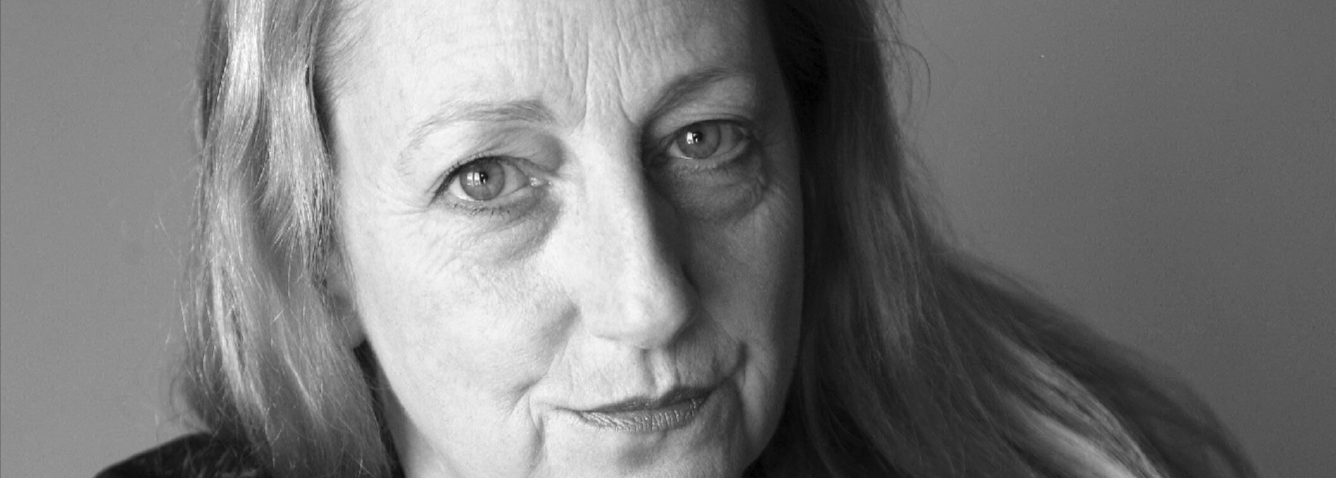
Our Marketing Officer Rosie Johns talks to Jo Mazelis about her new short story collection, Ritual, 1969, which is newly available.

Have you got a burning question of your own you would like to ask Jo? Or would you like your copy of Ritual, 1969 signed? If so, come to John Smith’s bookshop, Swansea, this Thursday for the book launch. This event is free to attend, all are welcome, and refreshments will be provided. Find more details here.

Ritual, 1969 by Jo Mazelis

What are little girls made of? What will they become? Will they run away to the circus or become dressmakers, teachers or servants? From the playground to adulthood the path is beset with misunderstandings, missed dates and hidden traps for the unwary.
This darkly gothic collection of stories explores the unsettling borderland between reality and the supernatural. Ranging from early twentieth-century France to 1960s South Wales and contemporary Europe, Jo Mazelis’ singular vision and poetic language creates characters caught up in events and feelings they do not fully understand or control, giving the book its uncanny focus. Not all is as it seems in a world where first impressions may only conceal disguises and false trails – and there’s no going back.
A thrilling third collection from the author of Jerwood Award winning novel Significance.

Your novel Significance was set in France while many of the stories in Ritual, 1969 are located in Wales. As a Welsh writer, do you see any importance in the issues of place and identity?

I think with Significance it had to be set abroad because I wanted to explore ideas about escape and rebirth as a starting point. The same novel could, I suppose, have been set in a small coastal town in Wales, but it just wouldn’t have been the same – I mean in the sense of my imaginative process. It had to be in an unfamiliar territory, yet one that is perceived as innocent and safe.

The stories in Ritual, 1969 weren’t planned or written as a collection – therefore the fact that so many are set in Wales is probably due to my thinking and experiences over the last twelve years or so. This also raises the question of whether Welsh writers should only write about Wales and the Welsh. The MA I did many years ago was ‘Writing the Celtic Archipelago’ and involved a sort of comparative study of the 20th century literature of small nations; from Wales to Éire, Northern Ireland and Scotland. In one tutorial I raised the issue of Muriel Spark as she wasn’t included in the course and was firmly told that she was not a Scottish writer. The argument was that she didn’t write about Scotland or live there, which I have always found rather puzzling. Then very recently I read Ian Rankin’s introduction to Spark’s novel Symposium and his first words were, ‘Muriel Spark was the greatest Scottish novelist of modern times’.  He goes on to say that although she lived abroad, ‘her roots are evident in everything she wrote.’ Aside from feeling vindicated after almost twenty years, I think his words make clear something I have always believed, namely that my roots inform everything I write.

The period when these stories were written also coincides with my travelling all over Wales for a variety of reasons, so the landscape figures directly as a place of reality and imagination. I also made a sort of conscious effort to travel imaginatively through time, so that the stories are set in different periods as well as different locations.

Ritual, 1969 contains stories that are often given hauntingly uncertain endings. What made you choose to give the reader so much room for interpretation?
The writer Paul Auster said, ‘The one thing I do in all my books is to leave enough room in the prose for the reader to inhabit it’. I suppose I must do the same but unconsciously. Saying that it seems almost deliberately vague or evasive to attribute any aspect of writing to the unconscious because it suggests that what the writer is producing is a stream of consciousness or work that is unmediated or without art or craft, but this is my experience.

When I write I don’t think about any potential or ideal reader and very often I have no idea where a story is going. It is a process of discovery for me as much as for the reader. When I first began seriously writing stories in 1987 I had not studied literature or creative writing beyond GCSE as I had gone to Art College not university. I had however read a great deal, but I think because I was essentially self-taught, I tended to doubt myself and worried that ‘real’ writers would not work in the same way as me. ‘Real’ writers would have the whole thing mapped out and they wouldn’t rely on intuition or the unconscious. I later read something John Fowles said about his novel The French Lieutenant’s Woman; how he had a recurring image during the autumn of 1966 of ‘A woman [who] stands at the end of a deserted quay and stares out to sea’ and he explained that he wrote the book to discover her story. It was this and other things a broad range of writers said which made me realise I was not unique in my approach and that was reassuring.

It has often been my experience that I don’t notice the underlying themes of my stories until after publication. It is only then that my later university education in literature seems to kick in and I can begin to analyse my work more like an academic. I realise that very often my fiction can be read on two levels, one which is simply the plot and characters, and the other which is connected to philosophy, politics, myth and culture. So the story ‘A Bird Becomes a Stone’ could be read as a crime mystery. Actually it’s a story whose title I changed several times and the other titles were far more prosaic. At the point I changed the title for the third or fourth time I thought I was being almost flippantly artful, but later I realised that the new title with a living thing, a bird, changing into a dead thing, a stone actually was the key to the story’s meaning. This was not just in the sense that something dies, but it also speaks to the whole process of art – a bird carved out of a stone, or a film of a bird or a poem will outlive the bird itself. Does this mean that a carved representation is somehow more important than the living creature?

A similar question is evident below the surface in ‘The Flower Maker’ a story set during a period of war and turmoil concerning a displaced woman who makes and sells artificial flowers from scraps of silk and satin in order to survive. Art and what should be sacrificed for it emerges in story after story, whether it is poetry or circus performance or film or photography or novels. If the endings to my stories are enigmatic then perhaps it’s because I can’t and won’t answer that question.

There are many female characters who seem to be struggling for survival and against alienation throughout the collection. Did the diversity of female characters and experiences in these stories appear with a conscious plan in mind?
As with my other collections of short fiction, these stories were written over a fairly long period of time – some were created as far back as 2003, others as late as December 2015, so there was no guiding principle as such, no sense of any relationship between them in terms of a book. Penny Thomas, my editor at Seren was really helpful in selecting these from the rather larger group of stories I presented her with, thus helping the book to become a cohesive whole. I think the effect of this is that the stories speak to one another; though clearly I was also at different times experimenting with the idea of linked stories.

If these stories have a common theme then I think it might be that they expose gender as an artificial construct, so much so that it almost seems as if all of the female characters are ‘performing femininity’ rather that behaving naturally or instinctively. In this sense there is once again a dichotomy between the false and the real, the surface and what lies beneath; between art and nature, dreams and reality.

In my earlier short story collections Diving Girls and Circle Games there were far more stories about men and their particular perspectives  –  I was interested in ideas about patriarchy and men’s internalised view of their ‘natural’ superiority, so these characters were often white, middle-class Englishmen. Of course you can’t generalise about anyone on account of their gender, race, class or religion, and it was fairly hard to get inside the head of some of these male characters, especially at moments when they were acting badly, then performing mental tricks of self-justification, but these stories were an important aspect of my feminism because they interrogated power itself at a micro-level. Having said that I also wanted to interrogate or dispel some myths, for example those to do with a relationship between a lecturer and a student (who is over the age of eighteen) as I felt that such a relationship would not be simply about a predator and his victim. It seemed important that the female character has to have some degree of free will, that she is responsible for her own choices.  Just as he is.

I suppose in some ways I am exploring the limits of knowledge and how none of us can really understand how it feels to be someone else, or why people do the things they do whether for good or ill. In the story ‘Word Made Flesh’ which was commissioned by Wales Arts Review, a young Irish woman is never listened to. Because no one knows her tragic story she grows increasingly lonely and alienated and cannot sleep at night – so in this story it’s a case of important knowledge not withheld but ignored.

These themes about knowledge also appear in the stories about teenage girls and children, recurring again and again in different guises, whether it is a poem that never gets discussed, or the secrets and/or fantasies of many of the characters. It could be argued that a lot of these characters are trying to live their lives according to the wrong script – which is the case in ‘Whose Story Is This Anyway’ and ‘The Murder Stone’. One of the questions I am asking is, why are people so deceived and so enduringly self-deceiving? Why do so many women feel so self-conscious about their imperfections, so eager to construct their image based on artificial and/or idealised figures whether these are dolls or glamorous female celebrities?

The two epigraphs at the start of the book by William Blake and Mary Wollstonecraft are there as lodestones to the stories’ meaning, but were added long after most of the stories were written.  One addresses the issue of corrupted beauty and nature, the other the issue of truth with particular regard to education and these themes are revisited in many of the stories.

Which character was the hardest to bring to life, and why?
Characters either come to life or they don’t. I tend not to think of them as separate entities from the story itself – they are woven in, creating a tapestry, rather than appliquéd on. Or perhaps instead of using a metaphor which employs a traditionally female art form I might say that the idea for a story appears in my mind like a block of marble. I chip away at it to reveal the figures and the narrative that is locked in the stone.

I wish I could give a simple answer to this question but after writing fiction for so long I have acquired something I learned about via Flannery O’Connor, namely ‘the habit of art’. I began to read the stories of Flannery O’Connor in 1975, then in 1988, when I began to steadfastly write, I bought ‘Mystery and Manners: Occasional Prose’ which is a collection of her non-fiction work. O’Connor has been a huge and enduring influence on my short stories making me wonder some time ago if the notion of Southern Gothic couldn’t be extended to absorb Southern Welsh Gothic. Strangely, many years ago I bought a rare hardcover 1st edition of a Flannery O’Connor novel for 50p. I was exceedingly poor for many years, in debt and fear and worry constantly which is a miserable way to live. Then in an idle moment I looked up the value of this particular O’Connor novel and found it was worth a lot of money – I had a brief and dizzy moment of thinking that Flannery had saved me, that this was fate that it was her book not any other. There was only one problem, the copy I possessed had no dust jacket and this meant it was virtually worthless. So if there is a lesson to be learned from that it is that an author’s worth is in their words, not in any abstract artefact. Though the story might have had a more rewarding and uncanny ending had I sold the book for thousands.

To return to the question, I think if a character fails to come to life then the story is a failure and I abandon it. I’ve got a lot of abandoned stories; some might be worthy of resuscitation, others are beyond hope. I think the cause of the half-written stories is usually lack of time – I find I can’t begin a story then pick up the thread weeks later, the original impulse or train of thought has gone. Sometimes a story will just emerge fully formed and my pen can barely keep pace with my mind – but that is a fairly rare occurrence and it hasn’t happened for a couple of years.

One of the recurring themes in this collection seems to be the idea that the journey towards womanhood is fractured and complicated. Where did your focus on this theme stem from?
This is complicated – in part it was due to the fact I was researching the late sixties and early seventies for another novel. This research was focused on the general history of the period but also specifically Swansea where I grew up. I have also been working on several autobiographical pieces for years now, though nothing so organised as a full length book, though I did at one point think about putting all of these together and calling it ‘Experiments in Autobiography: a Sampler’. One of these memoir pieces was published in New Welsh Review in 2015 as ‘The Girl in Red Boots’ – other pieces have appeared in non-fiction anthologies published by Honno, Parthian and Pandora, and in the online journal, Wales Arts Review.

One of these pieces was about an unforgettable and terrible event that occurred in the early seventies. This was brought vividly back to life in 2003 when the identity of a serial killer who murdered three girls in the Swansea area was discovered using DNA. I had been at the same nightclub on the same Saturday as the murdered girls. My friend and I were a similar age; we were probably dressed in similar clothes, may have danced next to those girls. I always think it could have been me and my friend – we were just lucky, unlike them.

Because of this autobiographical writing I was thinking very deeply about the 60s and 70s time the news broke about Jimmy Savile and his crimes. I think it is almost impossible to make people understand how very different things were up until the 1990s. Indeed it was hard for me to remember or perhaps trust my memory about the period: during my research I found that news stories in the local and national papers that were quite mind-boggling; there was a man who had battered his wife to death who was given a suspended sentence from a sympathetic judge because it was said the woman nagged him, while a young man was sent to prison for two years for possession of a very trifling amount of cannabis, and in a report about a school teacher having a relationship with one of his pupils the girl was referred to as a ‘Lolita’, the implication being that this teenager had tempted a ‘good and respectable family man’.

The other source for a lot of the 1969 stories were several books by Peter and Iona Opie which confirmed everything I remembered about The Levitation Game but also rhymes and games I had forgotten. From them I found the quite remarkable fact that The Levitation Game was first recorded in the seventeenth century. These games, and the lore of the playground, were passed on through generations of children, were not part of the taught curriculum and are for the most part left behind in childhood. I think, though it’s hard to be certain, that finally, under pressure from health and safety, television, smart phones and the greatly curtailed freedom of children to ‘go out and play’ they are now disappearing.

I think as a woman it is easier for me to understand how female lives can be fragmented, but that doesn’t mean that men’s aren’t also – or at least some men’s. I certainly found my early life to be difficult, both at home, at school and at Art College aged eighteen – the last of these was probably the worst but perhaps only because everything that happened before came to a head at that point. So at nineteen, after one year of college, my education stopped and I worked for years and years in a variety of low paid jobs as a waitress, chambermaid, shop assistant, barmaid and library assistant. I had no sense of any future, hardly any useful qualifications, no A levels, no confidence, seemingly no hope. I had also lived through a variety of personal tragedies, terrible experiences and other disturbing and often inexplicable events. So the idea of a fragmented life is very familiar to me.

You can purchase your copy of Ritual, 1969 direct from our website, or get your copy at the John Smith’s launch event, 21 April, 12:00-2:00pm.


Posted on

Spring into a New Series: discover New Stories from the Mabinogion

Spring into a New Series Mabinogion

The sun has started to shine, flowers are blooming, so why not ‘spring’ into a new series?

Spring into a new series kobo sale

If you haven’t yet discovered our New Stories from the Mabinogion series, then now is the perfect time. Until 14 April, the first book in the series, White Ravens by Owen Sheers, is only 99p in the Kobo Spring into a New Series sale.

The eleven stories in the Mabinogion come from two medieval Welsh manuscripts, with roots dating back many centuries earlier. They bring us Celtic mythology, Arthurian romance, and their own view of the Island of Britain. There is enchantment and shapeshifting, conflict, peacemaking, love and betrayal. In this series commissioned by Seren, the old tales are at the heart of the new. Each author reinvents a story in their own way: creating fresh, contemporary tales that speak to us as much of our own world as of events long gone. Based on ‘Branwen, Daughter of Llyr’, White Ravens is a haunting novella from an acclaimed writer.

“a gripping contemporary story… brilliantly absorbs the magical elements of the original” The Guardian

So what are you waiting for? If you have an e-book reader then don’t hesitate – go to the Kobo store and purchase your eBook copy for only 99p. And if you would prefer a paperback, you can find all eleven stories on our website.


Posted on

Enter our poetry books giveaway to win two new collections

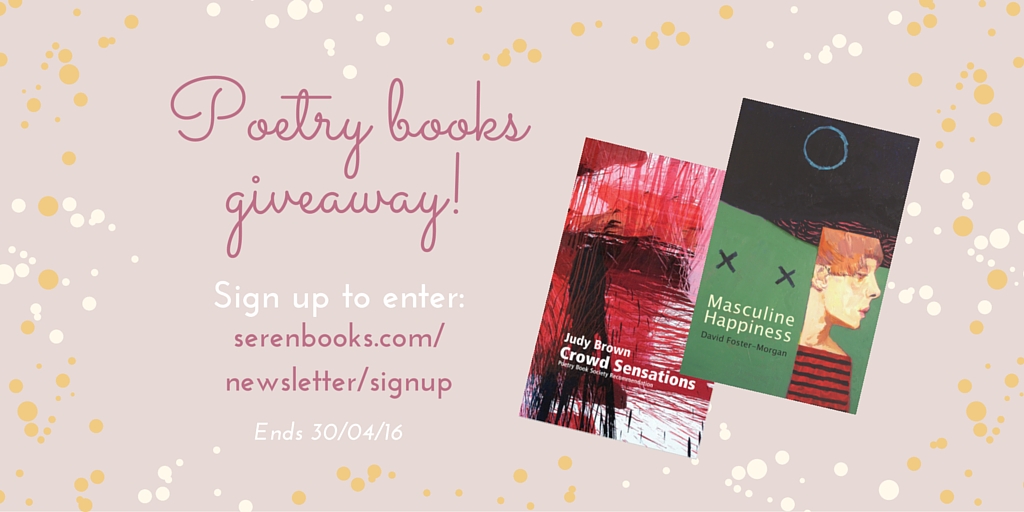
We are celebrating the launch of two fantastic new books, Crowd Sensations by Judy Brown and Masculine Happiness by David Foster-Morgan, by giving you the chance to win a copy of each! All you have to do is sign up to our newsletter here before 1st May 2016 and you’ll be entered into the prize draw.

Read below to find out more about the book launch as well as the books themselves…

newsletter giveaway April-1.jpg

Join Judy Brown and David Foster-Morgan at The Yorkshire Grey for a dual poetry book launch, celebrating the release of both Judy’s Crowd Sensations and David’s Masculine Happiness. Both poets will be reading from their new collections, and there will be opportunities to ask questions and request signed copies of the books. The event will take place between 19:00 and 21:00 on Tuesday 19th April, 2016 at The Yorkshire Grey in London. You can find more details on our website.

Elterwater Rain Crowd Sensations Judy Brown
Crowd Sensations
, Judy Brown
Poet Judy Brown’s new collection is a worthy follow-up to her Forward Prize-nominated debut, Loudness. Brown is a poet of dazzling contrasts, of thoughtful paradox, intimate confidences and precise evocations.
Read more


Masculine happiness
Masculine Happiness
, David Foster-Morgan
The provocative debut poetry collection this Cardiff-based poet. Born and based in Wales, Foster-Morgan has long been a presence in the poetry world, having had poems published widely in magazines and with appearances at workshops, festivals, and events.
Read more


One lucky winner will be chosen at random from all our subscribers on 1st May 2016, so if you would like a copy of each of these lovely poetry collections in your bookcase then hurry and sign up for our newsletter before the end of the month.


Posted on

An Easter Egg from Seren

easter egg 30% off sale

Happy Easter everyone! We have a special Easter egg on the website for you: 30% off books across the Seren store.

The Easter holiday carries with it the message of new beginnings, so why not begin a new book? Our 30% offer includes our gorgeous poetry, fiction and non-fiction titles, so there is something for everyone.

easter egg 30% off


We hope you find something new to bury your nose in this Easter.

Offer ends midnight, Monday 28th March.

Shop now


Posted on

Happy St Patrick’s Day 2016

st patricks day 2016

Happy St Patrick’s Day to every one of you, far and wide.

St Patrick's Day 2016


And here’s our bookish Irish flag in honour of the day, pieced together using just a few of our green, white and orange books.

Here is the full list of titles featured in our St Patrick’s Day ‘flag’:

Poetry and Privacy: Questioning Public Interpretations of Contemporary British and Irish Poetry;
The Ivy Hides the Fig-Ripe Duchess;

The Scattering;
The Dragon and the Crescent;
Crossing Over;
Masculine Happiness;
Bilbao – New York – Bilbao;
The Woman at the Window;
All the Souls;
The Hitting Game;
Dirt Roads;
Big Low Tide;
Zen-Cymru;
Christmas in Wales;
The Shop;
If You Fall I Will Catch You;
Midas’ Daughter;
Eros Proposes a Toast;
The Visitations;
Playing House;
Midnight, Dhaka;
Daniel’s Beetles.

We have been lucky enough to add some great Irish and Ireland-based authors to our list over the years who have written some gorgeous books.

Of special mention (and visible in the ‘flag’, above) is Jaki McCarrick’s The Scattering, a collection of nineteen stories, many of which are set on the Irish border. One of the stories ‘The Visit’ won the Wasafiri Prize for new fiction, and many have been published to much acclaim in literary magazines.

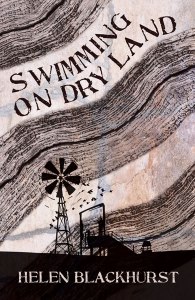
Another Irish voice that has recently appeared is Helen Blackhurst. Her debut novel Swimming on Dry Land, which follows a family’s quest for a new life in the Australian outback (as well as their search for missing 4-year-old daughter Georgie), was released just before Christmas.

In Liam Carson’s family memoir Call Mother a Lonely Field, the author’s Irish-speaking, West Belfast childhood is described through still-present echoes of the Second World War, dystopian science fiction, American comic books and punk rock. The memoir was shortlisted for the RSL Ondaatje Prize 2013.

We hope you enjoy St Patrick’s Day!

st patricks day patrick flag ireland irish


Posted on

Happy St David’s Day 2016

happy st davids day 2016

Dydd Gŵyl Dewi Hapus! Happy St David’s Day to one and all.

This is a day to celebrate Welshness, so that means warm Welsh cakes, bunches of fresh daffodils and one or two good Welsh books to read.

Why not celebrate this St David’s Day by investing in a new book published by one of the fabulous Welsh publishers? Visit your local bookshop or gwales.com to see the great selection of Welsh books out there.

happy St David's Day


Want to know more about our Welsh publishing friends? Read a little about each of them below.

Parthian’s long list of gorgeous titles include Rebecca F. John’s award-winning short story collection Clown’s Shoes.

Firefly Press have loads of great children’s books including Branford Boase-longlisted Aubrey and the Terrible Yoot.

Honno has a well-deserved reputation for publishing some of the best women’s literature in Wales.

Gwasg Carreg Gwalch publishes an astounding range of Welsh interest books for adults, children and visitors to Wales in both Welsh and English language.

Cinnamon are an innovative press, publishing fiction, poetry and non-fiction books, not defined by genre but by their ability to be thought-provoking and to say something new.

Gomer is the oldest publisher still running in Wales and publishes across the board with children’s titles, plays, poetry, bilingual books and more.

Graffeg have produced and published over 100 illustrated books since 2003, with titles about food, arts, culture, heritage and architecture, gardens, landscapes, photography, sport and lifestyle.

Y Lolfa started out as unofficial printers to the new, activist Welsh Language Society in the ’60s, and have evolved to produce an ever-widening range of popular books in both Welsh and English.

University of Wales Press publishes around 70 new books and journals a year, primarily in the fields of European studies, philosophy, literature, history, Welsh and Celtic studies.

And lastly there’s us here at Seren, bringing new poetry, fiction and non-fiction to you each year. From our list we suggest Jerwood Fiction Uncovered Prize-winner Significance, Man Booker Prize-longlisted The Last Hundred Days or Costa Poetry Award-winner My Family and Other Superheroes for some extra-special St David’s Day reading.

There is an astounding amount of literature produced in Wales each year, everything from fiction, to guide books, to scholarly material. We hope you find a new book to fall in love with this St David’s Day. Support Welsh publishing, because #WelshBooksMatter.


Posted on

Happy Valentine’s Day

happy valentine's day from Seren

Love is all around and we here at Seren would like to wish you all a happy Valentine’s Day.

Whether you spend the day in the arms of a loved one or in the pages of your favourite book, we hope you enjoy it.

Happy valentine's day


And as an extra treat for you on this most hallowed day, we have taken 35% off selected poetry titles (ending midnight tonight).

Love yo’self! Find captivating poetry in our Valentine’s poetry sale.

http://www.reactiongifs.com/r/rdj-heart.gif


Posted on

Books for your Beloved | Valentine’s Poetry Sale

valentines sale 2016

Poetry is food for the soul, and the gift of a carefully-chosen collection of poems is the perfect romantic gesture.

For Valentine’s Day, we at Seren have hand-picked a few poetry collections your partner will fall head-over-heels for. All our Valentine’s picks are 35% off until midnight on that most magical day, February 14th, so take a look below and find the perfect book for your beloved.

My Family and Other Superheroes by Jonathan Edwards
my family and other superheroes jonathan edwardsWinner of the Costa Poetry Award 2014, this vibrant and dynamic debut introduces one of Wales’ most intriguing new voices. The superheroes in question are a motley crew. Evel Knievel, Sophia Loren, Ian Rush, Marty McFly, a bicycling nun and a recalcitrant hippo – all leap from these pages and jostle for position, alongside valleys mams, dads and bamps, described with great warmth. This is a post-industrial valleys upbringing re-imagined through the prism of pop culture and surrealism.

£9.99 £6.49


The Man at the Corner Table by Rosie Shepperd
the man at the corner table rosie shepperdRosie Shepperd’s debut poetry collection crackles with the unexpected. The voice is one of urban sophistication; a merciless charm that teases and tempts us with sensual evocations of food and place. The reader is surprised with tastes, scents, colours and textures. There is a winning insistence on detail offered with an irony that blends into satire.
These poems are exquisite meals, to be devoured amidst surprising intimacies.

£9.99 £6.49


Infragreen by Kate Bingham
infragreenPerceptive, persuasive and intricately made, these poems take the reader on a startling and unfamiliar journey through everyday experiences and phenomena. Her keen eye, reflectiveness and quiet wit endow her subjects with a shimmering freshness.
In Bingham’s hands, the familiar sights and hypnotic routines that normally lull the brain into unthinking acquiescence are the starting points for finding new richness in the world around us and our participation in it.

£9.99 £6.49


Masculine Happiness, David Foster-Morgan
Masculine happinessThe thoughtful and winning debut collection from Wales-based David Foster-Morgan. Complex, ironic, layered, fashioned with an acute and subtle intelligence, these poems are as likely to reference Elvis as Borges.
Humour, astute satire and insightful character poems are combined here in this collection of beautiful, multi-layered poems.

£9.99 £6.49


Playing House by Katherine Stansfield
playing house katherine stansfieldA concise wit, a distinct voice and an unsettling view of the domestic characterise these poems whose subjects are the ordinary as viewed through the author’s satirical yet sympathetic eye. John Lennon’s tooth, an imaginary ‘Canada’, bees in Rhode Island, cats and office politics are all peculiar grist to this author’s mill. She presents both historical subjects such as Captain Scott of the Antarctic, and common objects, such as household bleach, from a skewed perspective, adding humour, drama and a quietly distinctive pathos.

£9.99 £6.49


Cohabitation by Kate Bingham
cohabitation kate binghamA brisk wit and intelligence characterises these poems by Kate Bingham. Her subjects are friends, family, work, the experiences of any day, but her keen and compassionate focus brings these moments vividly to life. Her gift is a point of view that is startling, moving and humorous.
Reflective and playful, intimate and exuberant, these poems have a wry, deliberate logic of their own which makesCohabitation an engaging as well as an illuminating first collection.

£6.95 £4.52


For Valentine’s deliveries, we recommend ordering before Thursday 11th February.

Why not share your love for poetry with us on Twitter? Use the hashtag #BooksForMyBeloved to tell us what you and your partner will be reading on Valentine’s Day.

Posted on

5 things to do for your loved one on St Dwynwen’s Day

5 things to do for your loved one on St Dwynwen's Day

On this day each year, people all over Wales celebrate St Dwynwen’s Day, named for the Welsh patron saint of lovers.

According to legend, Princess Dwynwen (who lived at around 400 AD) was the most beautiful and spirited of the many daughters of King Brychan Brycheiniog, founder of a medieval kingdom in what is today the Brecon Beacons of South Wales. She fell in love with a man named Maelon, yet her father had already promised her in marriage to another, so she prayed to God to be released from loving Maelon. Once asleep, an angel appeared and gave her a potion, which turned her ill-fated lover into a block of ice.

Upon waking, Dwynwen prayed again for the curse to be broken and God granted her three wishes: that Maelon be thawed, that Dwynwen herself never marry, and that the fate of all true lovers will be safeguarded through all time. As a mark of gratitude, Dwynwen devoted the rest of her life to God. Her reputation spread, and finally she became known as Santes (“Saint”) Dwynwen, paitron saint of lovers.

Here at Seren, we’ve been pondering how best to show your loved one how much they mean to you in the spirit of St Dwynwen. Here are five suggestions we’re sure will bring a smile to their face…

1. A simple cuppa
Wales can be a cold and rainy place (sometimes!), so what better to warm the heart of your S/O than a hot brew?

2. A private poetry reading
Select a poem or two to read to your special someone. We recommend ‘Making Love’ from David Foster-Morgan’s Masculine Happiness, and ‘The Love Songs of Davy Blackrock’ from Boy Running by Paul Henry.

3. A romantic walk
There are so many beautiful areas in Wales, so why not explore one of them with the person you love? Anglesey (St Dwynwen’s home) is the perfect choice, and there are lots of other outstanding areas.

4. A carefully chosen book
Show you know your partner’s interests and present them with a thoughtfully selected book to enjoy. Bonus points if it’s one of ours!

5. A home-cooked meal
Restaurants are romantic. But making something edible – nay, delicious – with your own two hands? Now that is a gesture of love.

http://www.reactiongifs.com/wp-content/uploads/2013/02/heart-back.gif


Happy St Dwynwen’s Day, everyone.

Posted on

50% Off All Books: Editors’ Picks

50% off all books this week

2016 has arrived and with it, our January sale. For one week only, enjoy 50% off all books available on our website!

That being said, we know choosing which books to buy can be a little tricky so our three editors are on hand to give their book recommendations. Be it poetry, fiction or non-fiction that tickles your fancy, we have suggestions for one and all.

Mick Felton Non-Fiction Editor
Mick Felton – Non-Fiction Editor

As our non-fiction editor, Mick sees a wide variety of books each year, including everything from history, crime, autobiography, music and sport. So which two books does Mick think you need most on your shelf?


The Road to Zagora by Richard Collins
The Road to Zagora

After being diagnosed with Parkinson’s Disease, Richard Collins sets off with his partner Flic on a once-in-a-lifetime adventure. The Road to Zagora is a singular travel book which takes in India, Nepal, Turkey, Morocco, Peru, Equador and Wales.
Though not shy about the hardships of the disease, any sentiment of self-pity is denied through Collins’s resolute and independent-mindedness and the quality of writing.
£9.99  £5.00

Losing Israel by Jasmine Donahaye
Losing Israel

After discovering by chance that her family had colluded in the eviction of Palestinians in 1948, Jasmine Donahaye set out to learn the story of what happened. Her discoveries challenged everything she thought she knew about the country and her family. Losing Israel is a moving and honest account which spans travel writing, nature writing and memoir. Jasmine explores the powerful and competing attachments people feel for their country and its history, by attempting to understand and reconcile her conflicted attachments, rooted in her family story – and in a love of Israel’s birds.
£12.99 £6.50


Amy Wack Poetry Editor
Amy Wack – Poetry Editor

Amy has read and enjoyed a dazzling array of poetry over the twenty-plus years she’s been with us. Trying to narrow down her choices to just two books was hard, but here goes…


A Formula for Night: New and Selected Poems by Tamar YoseloffTamar_quicksand cover

The eagerly awaited summation of Tamar’ work, encompassing selections from four published print volumes: Sweetheart, Barnard’s Star, Fetch and The City with Horns; and poems from her collaborations with artists: Formerly, Marks and Desire Paths.
The book also includes a generous selection of beautiful new poems, which are often artful explorations of paradox: death/birth, dark/light, clarity/mystery.
£12.99 £6.50

House of Small Absences by Anne-Marie Fyfe
House of small absences
Anne-Marie Fyfe’s poems have long dwelt on the role that the spaces we inhabit, the places in which we find security, play in our lives: House of Small Absences is an observation window into strange, unsettling spaces—a deserted stage-set, our own personalised ‘museum’, a Piedmont albergo, underground cities, Midtown roof-gardens, convent orchards, houseboats, a foldaway circus, a Romanian sleeper-carriage—the familiar rendered uncanny through the distorting lenses of distance and life’s exigencies, its inevitable lettings-go.
£9.99 £5.00
Penny Thomas


Penny Thomas – Fiction Editor

Which fictional words would Penny have you delve into first? We’ve published a beautifully varied range of books, and below are just two of Penny’s favourites.

Swimming on Dry Land by Helen Blackhurst
swimming_on_dry_land_72
Twelve-year-old Monica Harvey is looking for her sister Georgie, who has disappeared. The Harvey family has recently moved to Akarula, south-west Australia, having been persuaded to set out in search of a new life by their rich Uncle Eddie, who owns the town. Unbeknownst to them, Georgie isn’t the first person to vanish.
As their dream-like vision of life in outback Australia begins to be tainted my mystery and deceit, the history of the land unfolds and answers to the strange disappearances slowly suggest themselves.
£9.99 £5.00

Foreign Bodies by Candy Neubert
foreign bodies
Fresh from the UK, Emma thinks she has fallen in love with a place, a person, and pursues the man of her dreams with a colonial zeal. But for all her poetic sensibilities, she seems unaware of the destruction she is capable of leaving in her wake.

A beautifully written first novel, Foreign Bodies explores the spaces between people, and the nature of encounters in romantic idylls on the other side of the world.
£7.99 £4.00


Don’t forget, absolutely everything on our website is 50% off– so if you’re eager to see beyond our suggestions, then go forth and discover a new read for the New Year on our website.

https://media.giphy.com/media/VcizxCUIgaKpa/giphy.gif

Half price offer ends midnight, Sunday 10th January. Happy book hunting!