Posted on

Friday Poem – ‘Seamus on the Tube’, Tony Curtis

Friday Poem Seamus on the Tube Tony Curtis

Last night saw us at Chapter, Cardiff, with Tony Curtis and Cynan Jones for November’s First Thursday event, and today we are featuring one of the new poems Tony read on the night – for all of you who missed his entertaining performance.

From left: Tony Curtis, Amy Wack (Seren Poetry Editor), Cynan Jones

From the Fortunate Isles: New and Selected Poems, Tony CurtisTony Curtis has been writing poetry for fifty years, and his new collection, From the Fortunate Isles: New and Selected Poems contains poems from ten of his published collections, as well as fifty pages of new poems. This is a poet whose themes and variations remain consistent: a deep affection for his roots in West Wales, tender attachments to family, a profound interest in the wars of the last century, and an abiding fascination for all art forms, particularly painting and poetry.


Seamus on the Tube

Looking away, not looking away –
The happenstance of what may change everything;
Those standing commuters moving off at Charing Cross
For the Bakerloo Line and then your eyes lifting

Above those seated opposite, as one does, to read
Between faster Broadband and Las Vegas –
“Where your accent is an aphrodisiac,” it says,
And where “what happens here, stays here,”

The Railway Children where in the white cups
Of the telegraph wires a young boy knows
That words are carried in the shiny pouches of raindrops.
Like this poem carried for you in the red and white Tube

On the Northern Line in cold January’s real freeze;
Snow is promised in the suburbs so everyone’s scarved
Against the weather. Words taking you back to the fifties
And his boyhood summers before everything changed.

Reaching Warren Street, you’ve read it
Four or five times, absorbed the innocent wisdom
And sense of the thing. Those people opposite
See a crazy old man mouthing words, appearing to sing.


Buy your copy of From the Fortunate Isles now: £12.99

Claim 20% off when you become a Seren Book Club member

Posted on

Free extracts from our favourite Halloween books: read them if you dare…

read these free extracts from our favourite Halloween books

Get yourself in the Halloween spirit – read these chilling extracts from our favourite spine-tingling stories.

trick or treat: happy Halloween from Seren

Ritual, 1969 by Jo MazelisRitual 1969 by Jo Mazelis
From ‘The Twice Pricked Heart’:


When Margaret returned to the cottage she saw that her father and stepmother had retired to bed, though it was not yet night.
She put Esmerelda in a chair and the child settled down to sleep as she sang softly to her. The light in the room was made strange by the dark sky and glittering snow. The quiet of the house seemed to swell with each passing second. Margaret sat upon the settle and took up the workbasket and began to mend her father’s shirt. It was torn under the arm and this she made good before turning it over to inspect it for other signs of wear. She froze at what she saw, for there on the chest where it lay over his heart she found a small puncture hole, the edges of which were stained in a halo of what must be dried blood. She gasped to see this for to her mind such a wound was unlikely to strike the same place twice.
A chill crept over her flesh and looking up she saw that the sun was at the lowest point in the sky and shadows filled the room. Then while she looked about her she saw a movement in the darkest corner of the room that she likened to a moving cloth, such as a woman’s cloak, for there was a sort of fluttering wavelike movement to it. Never had she perceived the like before and there was nothing in the room to cast such a shadow.
She kept to her place too terrified to move or make a sound, then just at the moment when she had made up her mind to gather Esmerelda in her arms and flee the house, she heard a step upon the stair and there was the sailor’s eldest daughter, dressed in her shift and a wrap, her cheeks aglow, her eyes bright and her lips red and wet and swollen.
‘Bring me cheese,’ she said, ‘and bread and wine.’

Want to keep reading? Buy your copy of Ritual, 1969 now: £8.99


Sugar Hall Tiffany Murrayfrom Sugar Hall by Tiffany Murray:


His cry echoed in the empty shed, his breath coming out in puffs of white. Dieter thought about London: he thought of the broken buildings and the cracks, he thought of the wide spaces and the rubble, and he thought of all those adventures he was missing. He gazed up at the dust dancing and the cobwebs pulsing, and Dieter heard a noise.

‘Pop!’ it said. Then,‘Pap!’

There were sparks and a shimmer that had to settle. Then, by the window and the filthy crates, there was a boy’s face.

The face was moving as if the boy was already standing up, but there was no body beneath it.

The Cheshire Cat, Dieter thought, as the face moved towards him. He gripped his pa’s crisp shirt tight, he stopped breathing, but he was determined that this time he wouldn’t run away.

The face was making a strange noise, as if tiny wings were fluttering in its throat. Dieter felt the balloon’s skin crackle beneath him; there was electricity: a crackle beneath his bottom and a crackle in the air.

He’s not a duppy, Cyn, Dieter thought, he won’t hurt me.

‘I – I brought you this shirt, these trousers,’ Dieter said. ‘I thought you’d be cold.’

Then Dieter wondered how the boy could use the shirt if he didn’t have a body.

A hot breeze of golden sparks cut through the freezing air and suddenly the boy was all there: his chest, his arms and legs, his neck and around that a silver collar. The boy shook himself and stretched up: Dieter had never seen anyone so naked, not even himself. The boy walked from those filthy storage chests and it was soundless, but Dieter watched the pitpat, pitpat of his footprints in the dust. Pitpat, pitpat; like steps in the sand and no one there.

The boy was thin. He was small, but Dieter couldn’t tell how old he was.

The boy hunched over and bent into a squat. His arms dropped, hands palmup and circling in the dust like little fish. The golden sparks were gone and Dieter saw the boy was pale for all his blackness.

Want to keep reading? Buy your copy of Sugar Hall now: £8.99


Masque by Bethany W PopeFrom Masque by Bethany Pope:


It was my job to see that she was properly dressed for company, to escort her to the room to meet her lover and the other admiring gentlemen, and then to change the subject any way I could when her natural whimsy took a turn for the disgusting as it often might.

One night, while De Changy was speaking to his managers (this was, you remember, two sets of managers back) she started speaking to a tall, nearly skeletal man who had appeared, dressed in a cloak and dinner jacket, a fine fedora aslant, shadowing a face as bland and unlined as a new-born baby’s. Her laughter had grown its most dangerous edge, the short hairs on my neck, cheeks, and arms rose in fear. La Sorelli was sweet, and she had a good heart, but her tongue could suddenly become impolitic and there were many investors present there this evening.

Annie and the stranger were standing at the point where the glorious stairs that make the Palais Garner famous intersect and form an enormous marble Y, glittering in the light refracted in a thousand tear-shaped crystals that drip from the tremendous chandeliers and gaslight torches. Whoever he was, he stood terribly erect, his gloved hands hidden behind his narrow waist, clutching a fine ebony stick. My friend, who I was meant to be watching, was sloppily drunk, spreading her barely covered breasts against the wide, pink-veined bannister. I could not read his face as he looked at her, his features were oddly stiff, expressionless, but the arch of his body signalled contempt. I rushed to her side, a quickly as I could, pleased that my new silk shoes did not slap against the carved stone stairs, pleased that I did not slip and crack my skull against the pavement…

Want to keep reading? Buy your copy of Masque now: £9.99


Bonus: download Jaki McCarrick’s short story, ‘Blood’, for free!
‘Blood’ from The Scattering by Jaki McCarrickShabby academic Fred Plunkett, working alone in his aunt’s Victorian house, has his peace disturbed by a sleek intruder with matt red lipstick, a lampblack dress and high, plastic heels. Lara claims to be researching vampires and the theory that Dracula fled his native Transylvania to take refuge in the Cooley Mountains of Ireland, in Fred’s home town. But when she smiles, submerged thoughts of blood and desire begin to wake in Fred’s mind…

Download ‘Blood’ for free from amazon.co.uk

‘Blood’ is one of nineteen stories in Jaki McCarrick’s critically acclaimed short story collection, The Scattering, available from the Seren website: £8.99


Posted on

Friday Poem – ‘Elegy for David Beynon’, Leslie Norris

Aberfan Friday Poem Elegy for David Beynon by Leslie Norris

Today marks 50 years since the Aberfan disaster, 21 October 1966, when a mountain of coal waste slid into Pantglas school and 19 houses, killing 144 people, 116 of them children.

Today is a day of solemn remembrance, and in this spirit, our Friday Poem is ‘Elegy for David Beynon’ by Leslie Norris, written after a teacher who died trying to shield five children from the slurry.

Leslie Norris was born in Merthyr Tydfil in 1921, and many of his works transform local incidents into poems of great depth and significance. ‘Elegy for David Beynon’ is among his most anthologised poems, and with its poignancy and sincere emotion, it is not hard to see why.


Friday Poem Elegy for David Beynon Leslie Norris

‘Elegy for David Beynon’ is taken from Leslie Norris: The Complete Poems, edited by Meic Stephens.


Posted on

The true story behind Alun Lewis’ poem, ‘Burma Casualty’

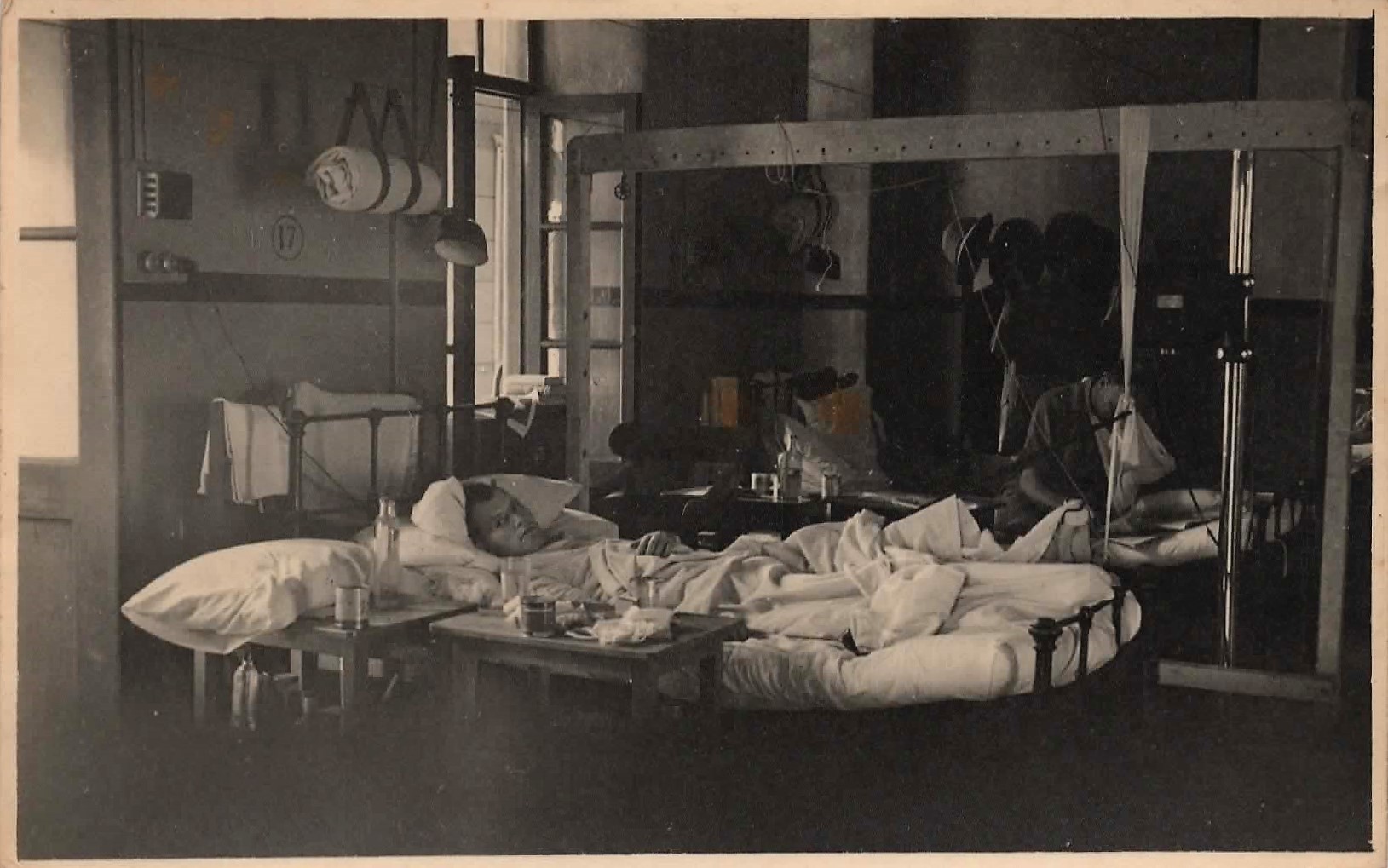
In January 1943, after fracturing his jaw during a regimental football match, Alun Lewis spent 6 weeks in Poona Hospital. In this blog post, Maggie Evans, whose father lay injured in Poona in the bed next to Lewis’, tells the true story behind the poem ‘Burma Casualty’.

As a child, “My Dad’s in a poem”, was my default position when any Dad boasting was called for.  “Don’t believe you”, was the usual reply, but here I had them.  I could run to the shelf and produce the evidence. There, in a slim volume entitled Ha! Ha! Among the Trumpets, was the poem, entitled ‘Burma Casualty’ and even more exciting, with a dedication – To Capt. G. T. Morris, Indian Army – My Dad!

It was years before I actually read the poem and even longer before I was capable of understanding it, but the magic of a special poem about my own special Dad has never faded.

Dad was born on 12th July 1911 in the Eastern Valley of South Wales. His given names were Thomas Griffiths but he was always known as “Griff”. To me and my two older brothers he was just our Dad, and the fact that he had one stiff leg shorter than the other and had to wear funny, built up shoes was of no consequence. We were children of the Second World War and post War period – war wounds were common. Dad didn’t ever let this hamper him. He wouldn’t accept a Disabled Badge for instance, and wouldn’t countenance anyone thinking of him in this way. He carried us on his shoulders and took us swimming and walking just like any other Dad and so I never fully understood the extent of his injuries until recently, when following a house move, I found bundles of his letters and photographs from that time. Reading the letters he sent from hospital in Poona sent me straight back to the poem – and now for perhaps the first time I was able to understand it.

In February 1942 Dad was fighting in the Burma Campaign with the 17th Indian Division which was decimated at the Battle of Sittang Bridge during a retreat from the Japanese. He was badly wounded, carried off the bridge by unknown hands, and ended up in hospital in Poona where he remained until late 1943.  Earlier that year he had for six weeks a new neighbouring bedfellow – one Alun Lewis, also a Welshman, who had sustained a shattered jaw in a football match. The sharing of his experiences with Alun resulted in ‘Burma Casualty’.

Thomas “Griff” Griffiths in Poona Hospital
Thomas “Griff” Griffiths Morris in Poona Hospital

Re-reading the poem now reveals how much Dad shared with Alun of his pain and fear – showing that at times he might have welcomed death as a release from his own physical pain and from the loss of so many comrades.

Thomas Griffiths and his wife on their wedding day
Thomas Griffiths Morris and his wife on their wedding day

But his letters to his sister from the same time show that as he recovered, his focus was on re-stablishing his family life with my Mum, his childhood sweetheart, and my oldest brother, born in 1940, whom he had never met.  He resisted Death, the ‘beautiful singing sexless angel’, preferring ‘his wife’s sweet body and her wilful eyes’ (though, like any child, however advanced in age, I confess to being unable to think of my mother in these terms without feeling slightly queasy!)


Dad never spoke of his experiences of jungle warfare and rarely mentioned his time in hospital. When pressed, he spoke of his friend, Alun Lewis, as something of a tortured soul. As an adult I have come to understand and love Alun’s poetry, not because he allowed my childhood self to hold its own on the boasting front, but for his luminous verse with its dark undercurrents. I can now say with pride, “my Dad knew a true poet’.

burma-casualty


‘Burma Casualty’ is one of the many poems featured in Alun Lewis: Collected Poems. Buy your copy now from our website: £9.99.


Posted on

Short Story of the Month | ‘Intervals in making lace’ by Diana Powell

short story intervals in making lace diana powell

Our new short story of the month is ‘Intervals in Making Lace’ by Diana Powell. This is one of a collection of stories set in the Black Mountains, where a group of women artists gather to work. As they do so, they spin tales of their childhoods, coloured by the folklore and landscape of their surroundings. But what do they really remember?

Diana Powell Intervals in making laceDiana Powell was born and brought up in Llanelli, and studied English at Aberystwyth University. She writes mainly short stories and novels. She won the last PENfro short story prize, and the 2013 Allen Raine Award. This year, she was a runner-up in the Cinnamon competition, and was longlisted for the Sean O Faolain, and the Over the Edge. Her work has appeared in a number of print publications, including The Lonely Crowd and Brittle Star.
 

Intervals in making lace

This is an extract. Read the full short story for free on our website.


………

………………..

…………………………

How do you describe a gap? It is, after all, a place with nothing there. You could say ‘an opening with two clear ends’ perhaps – like a break in a fence or a mountain pass (both easily found in our hilly, farm-shod landscape). Or holes in a fishing net; a clearing in a wood …  to let water out; to let light, animals, people, gather.

All these are gaps. All physical entities (although there is nothing there). There are plenty of examples both natural and man-made, difficult, but not impossible, to explain.

But how do you make sense of the other kind of gap – the less substantial, belonging to the mind, or the spirit?

Recently, I have been enduring such a gap in my life: a break in its normal proceedings. An accident. It was an accident: all my own fault, of my own making. There is no one else to blame.

Just like then, whatever they may have said.

‘Foolish Bron! Daydreaming again!’ Words from the past echo down to me. The voices of my mother and father, or sisters, fondly scolding. ‘Off in cloud-cuckoo-land, Bron? Again?’ True, then; true, now. For yes, I was daydreaming. You’d think I would have learnt … I had learnt! For a long time, I had! But no, my thoughts wandered away, and my body followed, leaving the stove on, and the towel draped too close. Easily done; it could happen to anyone! Though there are, no doubt, those who whisper about my fondness for a glass of whisky; a second glass. Those such as the old women in the Square, who tutt behind me as the till girl in Mace slips the bottle into a brown paper bag; all the while dismissing and excusing, somehow, their own favoured tipples – as if sherry and gin do not count as the devil’s potions, brewed to steal your wits and lead you to Hell.

But there was no whisky that night, though I am happy to admit to it on other occasions. After all, it is a quick, easy way of making gaps in your existence, if that is what you are after.

So … there was a fire, as testified by those who pulled me from it, and by the charred detritus of my worldly goods – and of my body. Yes, my body bears witness, but not my mind. Not my consciousness, for I remember nothing. Even the knowledge of the stove and tea towel were presented to me later. Lucky, some say. Better that way – to have been pushed into such dense oblivion by the fumes, and to fall from that into an even deeper chasm of unconsciousness (the greatest depth of my gap), so that I did not know the worst of the pain, or the prodding, patching and finishing that was needed to put me back together again, into some reasonable fashion. Did not know … until I finally woke and had to face the torment, and battle through it (such floundering, such darkness, then!) Making tentative steps forward into painful reality, interspersed with welcome lapses back into insensibility … one step forward, two steps back. Onwards, upwards, until…

Until I am here. Now. Again. Yes, I have come through on the other side. For there is always this about gaps – the suggestion that they can be bridged or crossed; that they are something to emerge from. It may take time, and much effort. But, with some luck, and hope, you can make it. Maybe.

That is how it seems to me now – now that I am trying to put my life back together, and make sense of it all. Yet, in truth, none of what happened should have been strange to me. I should have been prepared. I should have known all about absences from consciousness; lapses from reality. I should have remembered. But back then we called such things by different names. We wrapped them in strange words, or wove them into magical imaginings, all meant to cloak, disguise or simply hide them. And so the truth was left unsaid, replaced by uncertainty and bewilderment. Another kind of gap; a deep, churning river that you struggled through, leaving you reaching for understanding like a drowning man gasping for air. But since I came back here, amongst you, memories have been returning – not from the accident, but from my earliest years, as if they are needed now. Like the echoing words, they flash into my mind, clear, not clouded. And beyond them, something else is taking shape – something not fixed, yet, not fully revealed, but which, if I start with what is definite, will also, perhaps, become more clear, so that I, too, will have some kind of story…


Continue reading ‘Intervals in making lace’ for free here.


Posted on

Friday Poem – ‘Autumn Elegy’, Leslie Norris

Friday Poem Autumn Elegy Leslie Norris

Our Friday Poem this week marks the coming of autumn, and is taken from Leslie Norris: The Complete Poems, edited by Meic Stephens.

Leslie Norris Collected PoemsThis landmark publication of over 300 poems is a testament to a publishing life of more than sixty years. The late Leslie Norris, who died in 2007 at the age of 86, was best known as a nature poet and elegist of passion and rare expression. Lyrical and individual, to his closely observed poems, each word weighed and in its correct place, Norris introduces a strong metaphysical element which makes the poems, as Edward Lucie-Smith noted, “much larger than the sum of their parts”.


Autumn Elegy

September. The small summer hangs its suns
On the chestnuts, and the world bends slowly
Out of the year. On tiles of the low barns
The lingering swallows rest in this timely

Warmth, collecting it. Standing in the garden,
I too feel its generosity; but would not leave.
Time, time to lock the heart. Nothing is sudden
In Autumn, yet the long, ceremonial passion of

The year’s death comes quickly enough
As form veins shut on the sluggish blood
And the numberless protestations of the leaf
Are mapped on the air. Live wood

Was scarce and bony where I lived as a boy.
I am not accustomed to such oppulent
Panoply of dying. Yet, if I stare
Unmoved at the flaunting, silent

Agony in the country before a resonant
Wind anneals it, I am not diminished, it is not
That I do not see well, do not exult,
But that I remember again what

Young men of my own time died
In the Spring of their living and could not turn
To this. They died in their flames, hard
War destroyed them. Now as the trees burn

In the beginning glory of Autumn
I sing for all green deaths as I remember
In their broken Mays, and turn
The years back for them, every red September.


Buy your copy of Leslie Norris: The Complete Poems now: £25.00

Claim 20% off when you become a Seren Book Club member


Posted on

Friday Poem – ‘In September’, John Ormond

Friday Poem in September John Ormond

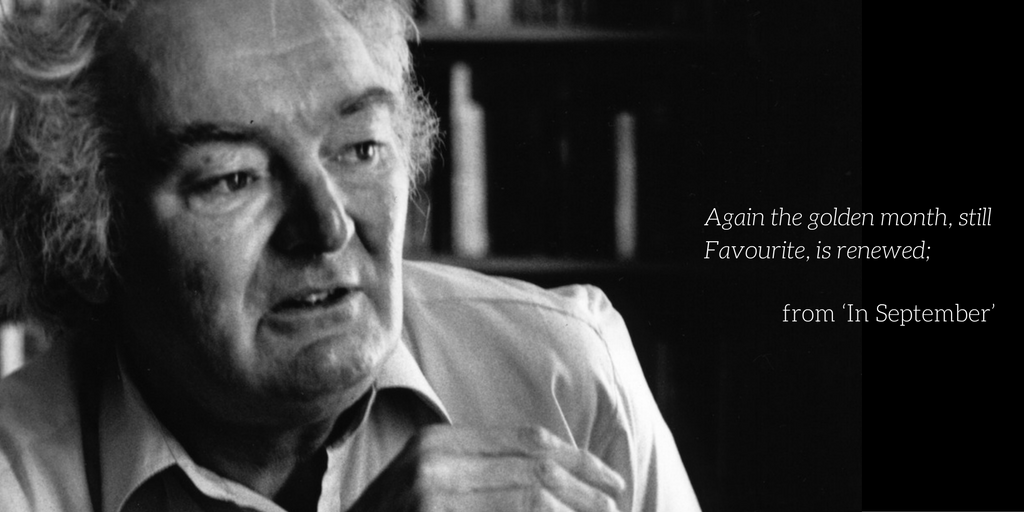
For this week’s Friday Poem we have ‘In September’ by John Ormond, from his Collected Poems, edited by Rian Evans. The poem was written for Glenys in celebration of their wedding anniversary, which fell on the 21st September. Since the two were married in 1946, that would have been 70 years ago.

John Ormond Collected PoemsPenned late on the night of the 20th of September, probably 1970, because he’d forgotten to buy a card, it was deemed by them both to be infinitely preferable. Memories of key moments in their courtship are woven into the lines, while the storm door was the big black outer door of their home in Conway Road. The poem appeared in various anthologies: one which pleased Ormond was the Almanacco internazionale dei Poeti 1975 (La Pergola Edizioni) containing the Italian translation ‘In Settembre’ by the eminent translator, poet and critic Roberto Sanesi.


In September

Again the golden month, still
Favourite, is renewed;
Once more I’d wind it in a ring
About your finger, pledge myself
Again, my love, my shelter,
My good roof over me,
My strong wall against winter.

Be bread upon my table still
And red wine in my glass; be fire
Upon my hearth. Continue,
My true storm door, continue
To be sweet lock to my key;
Be wife to me, remain
The soft silk on my bed.

Be morning to my pillow,
Multiply my joy. Be my rare coin
For counting, my luck, my
Granary, my promising fair
Sky, my star, the meaning
Of my journey. Be, this year too,
My twelve months long desire.


John Ormond: Collected Poems draws together all of Ormond’s work, including unpublished material. It includes notes and commentary of the poems, and a bibliography of Ormond’s prose writing, films and writing about him. An index of titles and first lines completes this essential book.

Buy your copy now: £14.99

Claim 20% off as a Seren Book Club member


Posted on

Friday Poem – ‘A Pembrokeshire Artist’, Tony Curtis

A Pembrokeshire Artist Tony Curtis Llangwm

This week we have a treat for you – our Friday Poem is one of the new poems from Tony Curtis’ forthcoming From the Fortunate Isles: New and Selected Poems (Seren, October 2016).

From the Fortunate Isles: New and Selected Poems, Tony CurtisFrom the Fortunate Isles, published in celebration of the author’s 70th year, features poems from ten of Curtis’ published collections as well as a substantial number of new poems. This is a poet whose themes and variations remain consistent: a profound interest in the wars of the last century, an abiding fascination for all art forms, particularly painting and poetry, tender attachments to family, and (most evident in the poem below), a deep affection for his roots in West Wales.


A Pembrokeshire Artist
John Knapp Fisher (1931 -2015)

An evening with the rain coming in,
that sea so cold and unsettled, a heavy graphite,
you’d not have gone out with your mackerel lines
in the Viking or any of her successors
from the stone-brick embrace of Porthgain.

We’ve eaten our fill at your wake, John,
the Sloop Inn squeezed tight
with suits, black ties and memories.
Wives, patrons, grandchildren.
Photos of you through all seven ages on the screen.

Inland to Wolf ’s Castle and as far south as the cathedral
the farms, haggards and holiday lets
shrug down for the cold night.
You’d have worked to conjure the reluctant light
discovered in them under this empting, moonless sky.

And the first scurp coming would have dabbed
your paper, blossomed and been coaxed,
smudged, into the finished sketch.
Now the county will have to sing its own spirit,
compose its own shape, keep its own watch.


If you would like to listen to Tony read from his forthcoming collection and other books in his native Pembrokeshire, don’t miss his event at the Llangwm Literary Festival, Saturday 12th August. More details here.

You can buy copies of Tony Curtis’ poetry collections, anthologies he has edited, critical essays, and other writing direct from us (20% off for Book Club Members):
Crossing Over
Heaven’s Gate
Tokens for the Foundlings (ed Tony Curtis)
After the First Death (ed Tony Curtis)

Wales at War
Real South Pembrokeshire
Keep an eye out on the Seren website – Tony’s new collection, From the Fortunate Isles: New and Selected Poems, is coming soon…

Posted on

Friday Poem – ‘Skirrid Fawr’, Owen Sheers

friday poem skirrid fawr owen sheers

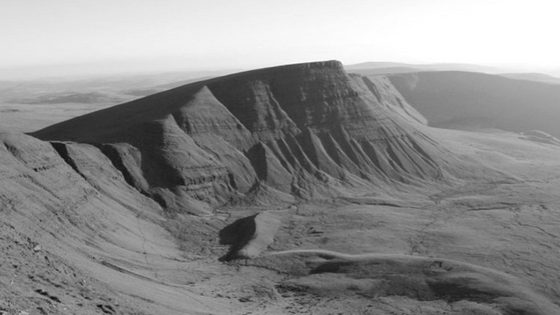
Today marks the start of the National Eisteddfod, this year in Abergavenny, and our Friday Poem talks of an area just a few miles north – Ysgyryd Fawr, or The Skirrid. The poem is taken from Abergavenny poet Owen Sheers’ second collection, Skirrid Hill.

skirrid fawr friday poem owen sheersIdeas of separation and divorce are important in Owen Sheers’ eagerly-awaited follow up to his acclaimed debut collection The Blue Book. The geographical divides of borders, the separation of the dead and the living, the movement from childhood to adulthood, the ending of relationships. Such divides are both moments of ‘mark-making’ and moments of absence. In this collection it is often the awareness of such separation – past or impending – and the juxtaposition of these diverse states – that provides the friction from which the poems are born.


Skirrid Fawr

Just like the farmers who once came to scoop
handfuls of soil from her holy scar,

so I am still drawn to her back for the answers
to every question I have never known.

To the sentence of her slopes,
the blunt wind glancing from her withers,

to the split view she reveals
with every step along her broken spine.

This edge of her cleft palate,
part hill, part field,

rising from a low mist, a lonely hulk
adrift through Wales.

Her east-west flanks, one dark, one sunlit,
her vernacular of borders.

Her weight, the unspoken words
of an unlearned tongue.


Buy your copy of Skirrid Hill from the Seren website: £8.99
Claim 20% off when you become a Book Club Member.

Save

Save

Save

Posted on

Aspie-Chromatics | Carol Rumens on Asberger’s, ASC and Poetry

aspie-chromatics carol rumens asberger's syndrome poetry

Carol Rumens is the author of sixteen collections of poems, as well as occasional fiction, drama and translation. Here she talks about Asperger’s Syndrome and Autistic Spectrum Condition (ASC), the misunderstandings and mysteries still surrounding these conditions, and how her awareness of Asperger’s Syndrome has affected her understanding of her own creative process.

Aspie –  someone with Asperger’s Syndrome

Chromaticsthe study of colour

When my grandson was diagnosed with autism it was as if a stone had been hurled into a quiet pool. The ripples spread through his immediate family, particularly affecting my two daughters (one being his mother) and myself. We re-evaluated our lives from a dizzy perspective. Autistic spectrum condition is a genetic condition. It’s a doubtful gift passed from generation to generation. A lot of us were implicated!

At first I was very uncomfortable with the idea that I had Asperger’s Syndrome. I’d always considered myself eccentric. My self-esteem relied on a sense, since earliest childhood, that I was creative, one of those people who could paint, draw, play music and write, even if they weren’t always very good at thinking straight or mixing with the other kids. I was an introvert – fine. So were a lot of intelligent people. I didn’t need close friends: I needed a room of my own, plus a typewriter. So what?

Perhaps being an Aspie made me less guilty of the wrongs I’d done to others in my life, but, equally, I was less responsible for the good. The best of my ‘good’ self – my poetry – was just a symptom, an expression of pathology.

I began the “On the Spectrum” sequence partly to express that grief. But I soon struck notes of defiance and humour. I remembered strange, disconcerting experiences I’d had as a child, and I measured them against some of the diagnostic criteria of Asperger’s Syndrome. Some were in tune with the criteria. But others weren’t.

I will have more questions in future: I haven’t finished telling the story. For instance, it’s said that Aspies lack empathy, and that we misunderstand metaphor. I wonder where this leaves the Aspergers poets – or indeed the women with Aspergers.

Sensory over-stimulation is one of the affects of Autistic Spectrum Condition: there’s neurological and experiential evidence. But wouldn’t that susceptibility be more likely to increase empathy? Perhaps autistic people, especially women (the gender which is socially conditioned for empathy) have an excess rather than a lack of response to others, but deny it because it feels chaotic and scary? An inability to grasp metaphor might be the result of a similar subconscious defence-mechanism –because metaphor is also sensuously stimulating, and therefore potentially disruptive.

Poetry might attract people with ASC because it provides techniques of controlling sensation. It allows heightened experience in the safe ‘environment’ of the page, line and stanza. It foregrounds pattern-making. It allows repeated patterns to be safely interrupted. I realise now that, whatever the genetic ‘prompt’ towards an activity for an individual, it doesn’t invalidate the activity. Being an Aspie poet doesn’t damage the poetry, but the pride.

And so, having overcome my pride and prejudice, a faintly crusading element entered my attitude to autism. The condition needs a lot more fresh thinking. I’m not generally someone who wants poetry to earn its bread as a foot-soldier in the army of good causes. But I want to speak for a greater understanding of autism, and I choose to do it through the medium I’m best able to employ. Rather than use poetry as propaganda, I would simply ask it to report back sometimes from the field, like a travel correspondent in the complex, many-coloured terrain of a newly discovered country.

What I’d like to do now, besides filing more dispatches, is to edit an anthology of poems by autistic poets. Certain poets have already ‘come out’ and I suspect there are potentially many more. Autism is a richer, wider, more polychromatic spectrum than so far defined. In fact, to know autism would be to know consciousness, which would be to see God. I don’t think anyone can, but I hope we can build some better microscopes.


Animal People Carol RumensCarol Rumens’ latest collection, Animal People, is available on the Seren website. The striking final sequence, ‘On the Spectrum’, focuses particularly on Asperger’s Syndrome and how it may be experienced by young women, as well as exploring some of the effects of Autistic Spectrum Condition (ASC).

Buy your copy now: £9.99
Claim 20% off when you become a Book Club Member


Save

Save