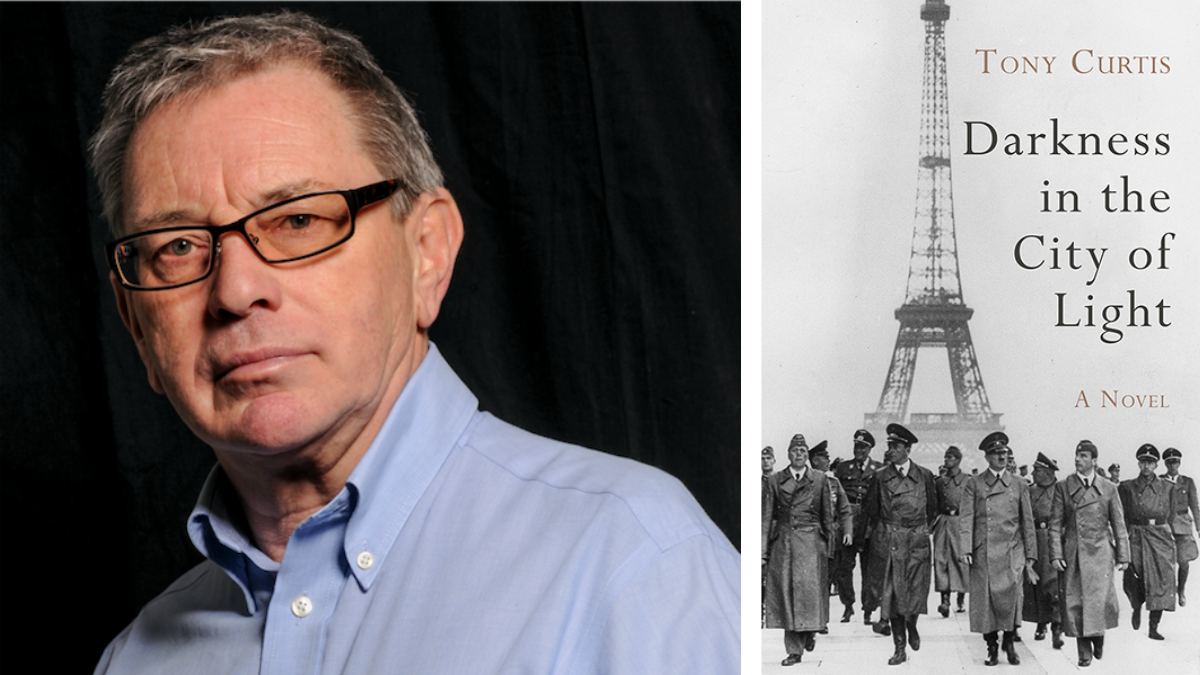
Tony Curtis has been shortlisted for The Society of Authors Paul Torday Memorial Prize with his debut novel Darkness in the City of Light.
The Paul Torday Memorial Prize is awarded annually to the best debut novel by an author over the age of 60. This year’s stellar shortlist includes five debut novels including Lessons in Chemistry by Bonnie Garmus and Murder at Evensong by Reverend Richard Coles. Judge Kathy O’Shaughnessy commented, “…the novels on this shortlist were wonderfully varied. It was a pleasure to see such excellent writing… Each book showed a true writer’s commitment to making the subject come alive, and compellingly pulled this reader forward.”
Darkness in the City of Light is one of two novels on the shortlist published by an independent publisher and the only published by a publisher in Wales. The full shortlist is:
Tony Curtis for Darkness in the City of Light (Seren)
Jonathan Franklin for Red Road Green (Sparsile Books Ltd)
Bonnie Garmus for Lessons in Chemistry (Doubleday, Penguin Random House)
Julie Owen Moylan for That Green Eyed Girl (Michael Joseph, Penguin Random House)
Reverend Richard Coles for Murder Before Evensong (Weidenfeld & Nicholson)
The winner will be announced on the 29th June at Southwark Cathedral in a ceremony celebrating all of the Society of Authors Awards. The ceremony can be watched online for free, or you can purchase tickets to attend in person.
You can view the full shortlists for all of The Society of Authors Awards on their website.
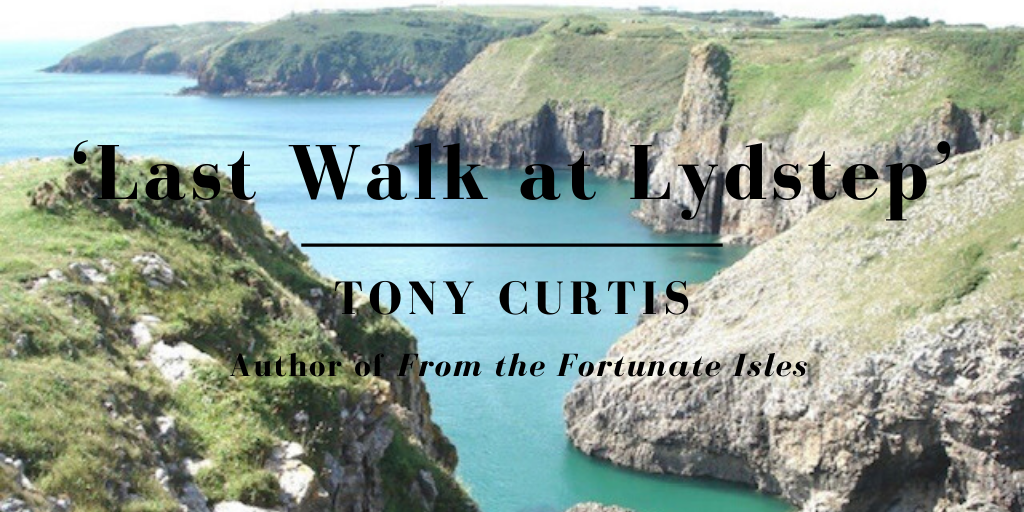
This week’s Friday Poem is ‘Last Walk at Lydstep’ by Tony Curtis which he has written during lockdown. Tony is the author of numerous collections of poetry, most recently From The Fortunate Isles: New and Selected Poems.
From the Fortunate Islesfeatures poems from ten of Tony’s published collections, as well as a substantial number of new poems. This is a poet whose themes and variations remain consistent: a deep affection for his roots in West Wales, tender attachments to family, a profound interest in the wars of the last century, and an abiding fascination for all art forms, particularly painting and poetry.
Today is International Conscientious Objectors Day. Celebrated on the 15th May every year, it is a day to remember those who have established and are maintaining the right to refuse to kill, both in the past and today. There have been a number of notable COs within art and literature in Wales and in this guest post Tony Curtis reflects on them.
Concerning Some Conchies: A brief survey of some notable COs in Welsh art and letters
On May 15th this year we commemorate International Conscientious Objectors Day. In my 2007 book Wales at War: Essays on Literature and Art I found myself writing a chapter on pacifism and conscientious objectors in Wales. I was ill-prepared, but had been let down by a fellow academic and the book was past its projected publication deadline. There have been more useful sources published since then and I have more reasons to re-visit the subject having found out about my father’s court-martial in 1943. I try to deal with this in the poem ‘Pro Patria’ (From the Fortunate Isles: New and Selected Poems, Seren, 2016) but I am still to be convinced that his leaving the army and brief imprisonment can be explained by the CO story some members of my family clung to.
Whatever happened, the whole thing’s been
washed away – personal feelings, the loss of face,
a Field General Court Martial
before they packed you off to Lincoln Prison
and a cell alongside the ne’er do wells,
Quakers and spivs, malingerers, wastes of space.
What is certain is that I had several writer and artist friends who really had been COs and had suffered the consequences. Two of the earliest and most valued supporters and influences on my early writing career were Glyn Jones (1905-95) and Roland Mathias (1915-2007). In 1940 Glyn had registered his objection to the war, despite the fact that, as a teacher, he would have been unlikely to be conscripted immediately anyway. He was sacked from his teaching job in Cardiff, but later found another post. Glyn’s reasons for protesting were rooted in his Christian belief. His position is an interesting contrast to that of his friend Dylan Thomas, who sent letter after letter to Glyn and others in a desperate attempt to avoid conscription. Glyn’s close friend, the artist John Elwyn (1916-97) was also a CO. In the middle of his studies at the Royal College of Art, in 1940 he objected and was directed to farm work in what was then the village of Lisvane, north of Cardiff. His paintings of Ceredigion are luminous and celebratory, as in this fitting cover to Glyn’s Selected Poems.
More determined and honest in his position than Dylan was their contemporary Roland Mathias, the poet, critic and founding editor of The Anglo-Welsh Review, who was jailed twice for his objections. Roland’s father had served as an army chaplain in the First World War and had retired before the Second with the rank of Colonel. However, Roland’s mother was a firm and unyielding pacifist who had no sympathy for army life and profoundly influenced Roland. He was adamant; the wing forward for St Helens RFC, “One scarcely expects to find a pacifist in a rugby pack”, as a glowing match report observed, absolutely refused any wartime activity that might have been seen to condone the fighting.
On the occasion of his second term of imprisonment, with hard labour, his pupils at the Blue Coat School in Reading raised the money to secure his release. For he had suffered:
Seven-square days that bleach and crack
Between the wells and balconies
And concrete exercise…
The significant Welsh language poet Waldo Williams (1904-71) wrote of the horrors of the Swansea Blitz in ‘Y Tangnefeddwyr’. He was from a Baptist upbringing, though later a Quaker, embodied the two main strands of conscientious objection in Wales – religion and politics – as he was also a Labour Party member in the Thirties. Waldo maintained his position throughout his life; he lost his teaching job in the war, and he later refused to pay taxes to support the Korean War. He too was jailed on two occasions as a protest against conscription and National Service: “The sick world’s balm shall be brotherhood alone.” Williams was undoubtedly influenced by the poetry and politics of the older Pembrokeshire poet T.E. Nicholas.
T.E. Nicholas (1879-1971) ‘Niclas y Glais’, was a pacifist through both world wars. He and his son Islwyn were jailed on ludicrous charges of fascism in 1940. A committed Christian and Communist, a non-conformist minster who later trained as a dentist, Nicholas wrote his admired Prison Sonnets after spells in Swansea and Brixton and these were published during the war. He had also preached consistently against the Great War and would surely have been imprisoned then if he had not been an ordained minister.
In the last decade of his life I became friends with the writer and artist Jonah Jones (1919-2004) whose remarkable life has been celebrated in the Seren books An Artist’s Life and Dear Mona: Letters from a Conscientious Objector (edited by son Peter Jones). Fascinated by John Pett’s illustrations to Dylan Thomas poems in issues of Wales magazine, Jonah followed his fellow Conchie into the army as an unarmed medic in the Parachute Regiment. He described the exhilaration and terror of jumping: “…when I jump, once I’m in the slipstream, I just ride it like a witch riding her broom.” After jumps over occupied Europe in support of the Allied offensive Jonah arrived at the Belsen concentration camp. After witnessing those horrors he said he knew his objection had been wrong.
The artist, collector and critic Arthur Giardelli (1911-2009), as a teacher in Folkestone, was evacuated to the south Wales valleys and there, after his sacking as a CO, was instrumental in setting up the Dowlais Settlement. After the war, Arthur moved to Pendine, then into south Pembrokeshire; he contributed greatly to the practice and teaching of art in Wales for the next sixty years, particularly in his innovative paper and shell constructions and his work for the 56 Group. His re-location to Wales, as that of the refugee Polish Jew Josef Herman, was one of the significantly positive consequences of the dislocation that war can bring.
Emyr Humphreys is one hundred and one years old this year. The pre-eminent novelist of the twentieth century in Wales, his work is predicated on a non-conformist faith which meant that he registered as a CO in the Second World War and, in common with Jonah Jones, worked on the land. He later undertook relief work with displaced persons in Italy and Egypt. For over sixty years his books, broadcasting work and criticism have reflected a commitment to Wales that is unparalleled.
Therefore prepare the stage for a decent action
Present the right alignment for a crime
International crisis is a personal situation
Prison, wall, bandage and the lime.
(‘Courage’)
Conscientious Objection in Wales may be traced from D. Gwenallt Jones (1899-1968) the Welsh Nationalist and Christian poet, who was one of the most notable COs in the Great War. Conscripted in 1917, he objected and was sent to Wormwood Scrubs and then a work unit at Dartmoor. It may be argued that this tradition and those principles informed and guided later protest movements. The arson carried out at Penrhos, at the proposed site of a bombing school by Saunders Lewis, D.J. Williams and Lewis Valentine at Penrhos in 1936 and later the Tryweryn actions and protests of 1965, are all part of the narrative of resistance in Wales to British policies.
So too the C.N.D. protests in Wales which included the occasion when R.S. Thomas and others sat down in the road in front of the council offices in Carmarthen town where a nuclear bunker was said to have been built. The Greenham Common fence camps of 1981-2000 which began with the march from Cardiff to Berkshire by the Women for Life on Earth group would also be a significant example of those principles of peaceful protest. The artist Ifor Davies (b. 1935) continues to explore this legacy of protest.
There is a tradition of religious and socialist action which in the literatures and art of our country have been an important element in our challenge of self-identification. Today there is an opportunity again to reflect on COs from Wales and their continuing influence.
Tony Curtis
Tony Curtis is a poet, critic, essayist and expert on Welsh Art. He is the author of numerous collections of poetry, including his latest: From the Fortunate Isles: New and Selected Poems. He has also written volumes of critical work on poets and artists and edited popular anthologies of poetry. He is Emeritus Professor of Poetry at the University of South Wales, where he established and was Director of the MPhil in Writing for many years. He has been elected to the Royal Society of Literature and has toured widely reading his poetry to international audiences.
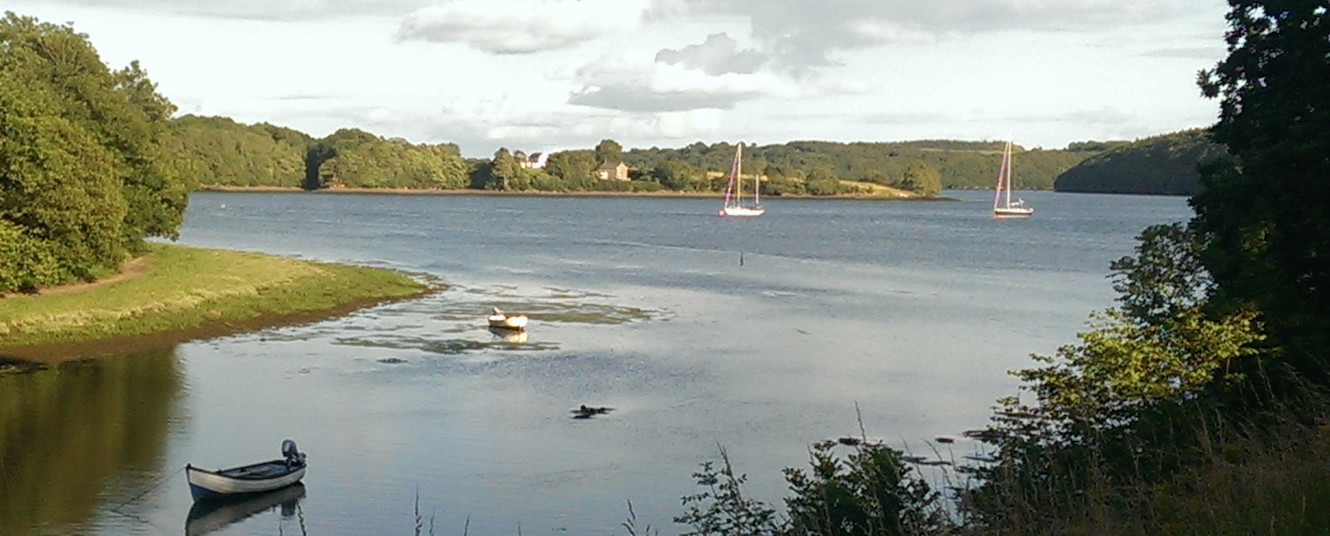
This week’s Friday Poem is ‘Taken for Pearls’ by Tony Curtis which appears in our regional pamphlet Poems from Pembrokeshire.
Last week Tony read poems from the pamphlet alongside Amy Wack at the Llangwm Literature Festival as part of the Poems from Pembrokeshire tour. The next stop is the Tenby Museum on Wednesday 21 August where Tony and Amy will be joined by several other poets for another afternoon of readings.
Poems from Pembrokeshire is part of Seren’s pamphlet series celebrating the spirit of place. An area of supreme but also disquieting beauty, Pembrokeshire has been the home to saints and pirates, the cradle of Tudor Kings and subject to oil spills and annual invasions of summer visitors. The undeniable loveliness of its off-shore islands: Ramsey, Grassholm, and Caldey, contrasts with the often harsh life of settlers, of monks and sea-fishing folk of the past, such as the stoic ‘Boatmen’ of Tenby.
Did you know? All of our regional pamphlets come with an envelope and a post card making them the perfect gift – keep them for yourself or send to a loved one. View the full range here.
Can’t make the reading of Poems from Pembrokeshire at the Tenby Museum? Amy Wack will also be at the Poetry Bookshop in Hay-on-Wye on Wednesday 28 August reading from Poems from The Borders. Find out more here.
Create your free Seren account and enjoy 20% off every book you buy from us.
To all Dads, Grandads and those soon-to-be: we wish you a very happy Father’s Day. In celebration, we are happy to announce that all orders placed on our website in the next week will come with a complimentary ‘Dad joke’ to add to your collection.
Mums, children, friends – we are so sorry. Because surely Dad won’t be able to resist treating himself to Mike Rees’ fascinating Men Who Played the Game, which pays tribute to sportsmen who fought in the Great War. He certainly won’t be able to stop himself from getting a copy of Lloyd Jones’ magnificent, newly back-in-print novel, Mr Vogel. And you can try, but we highly doubt you’ll be able to stop Dad from indulging in a little musical nostalgia with Peter Finch’s personal history of rock and pop: The Roots of Rock, from Cardiff to Mississippi and Back.
Christmas is fast approaching, so our Friday Poem this week is a festive one from Tony Curtis, originally published in Letting Go (1983) and again, just recently, in Tony’s new From the Fortunate Isles: New & Selected Poems.
From the Fortunate Isles features poems from ten of Tony’s published collections, as well as a substantial number of new poems. This is a poet whose themes and variations remain consistent: a deep affection for his roots in West Wales, tender attachments to family, a profound interest in the wars of the last century, and an abiding fascination for all art forms, particularly painting and poetry.
The Infants’ Christmas Concert
A moment of hush, held breath –
the fairies and robbers, the soldiers
and dancers are in position
– then the piano begins.
This sounds otherworldly,
each note a drop of water falling distantly.
Angels swallow trumpets,
a robot trips and turtles in his cardboard shell;
the ballerina crumples and cries.
They may not know why, but still
perform for us the pattern of sentiment,
superstition and love: we sigh,
smile, laugh and applaud.
“The Rich Man gave them a bag of gold
and everyone cheered on the day
the church had a new bell.”
The couple are starched in best white –
as the singing swells, they marry
and claim their gold.
It is intensely sad and fleetingly
realises the ghosts of our innocence.
Flashlights – the year’s frozen
for this instant.
Keep that – don’t move – stay there,
stay somewhere like that for ever.
It all builds to The Nativity:
Joseph, Mary and the three glittering Kings
change without age, time after time.
Only the baby Jesus doll remains,
a scarred and worn wooden face held magically
fresh each year in the laundered swaddling.
The audience – parents and children in arms,
grandparents and neighbours, point and giggle,
there’s a glow and, finally, we all sing.
This has worked some sort of renewal,
some sort of an ending.
Last night saw us at Chapter, Cardiff, with Tony Curtis and Cynan Jones for November’s First Thursday event, and today we are featuring one of the new poems Tony read on the night – for all of you who missed his entertaining performance.
From left: Tony Curtis, Amy Wack (Seren Poetry Editor), Cynan Jones
Tony Curtis has been writing poetry for fifty years, and his new collection, From the Fortunate Isles: New and Selected Poems contains poems from ten of his published collections, as well as fifty pages of new poems. This is a poet whose themes and variations remain consistent: a deep affection for his roots in West Wales, tender attachments to family, a profound interest in the wars of the last century, and an abiding fascination for all art forms, particularly painting and poetry.
Seamus on the Tube
Looking away, not looking away –
The happenstance of what may change everything;
Those standing commuters moving off at Charing Cross
For the Bakerloo Line and then your eyes lifting
Above those seated opposite, as one does, to read
Between faster Broadband and Las Vegas –
“Where your accent is an aphrodisiac,” it says,
And where “what happens here, stays here,”
The Railway Children where in the white cups
Of the telegraph wires a young boy knows
That words are carried in the shiny pouches of raindrops.
Like this poem carried for you in the red and white Tube
On the Northern Line in cold January’s real freeze;
Snow is promised in the suburbs so everyone’s scarved
Against the weather. Words taking you back to the fifties
And his boyhood summers before everything changed.
Reaching Warren Street, you’ve read it
Four or five times, absorbed the innocent wisdom
And sense of the thing. Those people opposite
See a crazy old man mouthing words, appearing to sing.
From the Fortunate Isles, published in celebration of the author’s 70th year, features poems from ten of Curtis’ published collections as well as a substantial number of new poems. This is a poet whose themes and variations remain consistent: a profound interest in the wars of the last century, an abiding fascination for all art forms, particularly painting and poetry, tender attachments to family, and (most evident in the poem below), a deep affection for his roots in West Wales.
A Pembrokeshire Artist John Knapp Fisher (1931 -2015)
An evening with the rain coming in,
that sea so cold and unsettled, a heavy graphite,
you’d not have gone out with your mackerel lines
in the Viking or any of her successors
from the stone-brick embrace of Porthgain.
We’ve eaten our fill at your wake, John,
the Sloop Inn squeezed tight
with suits, black ties and memories.
Wives, patrons, grandchildren.
Photos of you through all seven ages on the screen.
Inland to Wolf ’s Castle and as far south as the cathedral
the farms, haggards and holiday lets
shrug down for the cold night.
You’d have worked to conjure the reluctant light
discovered in them under this empting, moonless sky.
And the first scurp coming would have dabbed
your paper, blossomed and been coaxed,
smudged, into the finished sketch.
Now the county will have to sing its own spirit,
compose its own shape, keep its own watch.
If you would like to listen to Tony read from his forthcoming collection and other books in his native Pembrokeshire, don’t miss his event at the Llangwm Literary Festival, Saturday 12th August. More details here.