Posted on

Friday Poem – ‘On the Sudden Passing of a Crow’, Eoghan Walls

Friday Poem On the Sudden Passing of a Crow Eoghan Walls

Happy Friday, everyone. This week our Friday Poem is taken from Eoghan Walls’ debut collection, The Salt Harvest. Eoghan has just been shortlisted for the prestigious Manchester Poetry Prize – so do send all your good luck his way.

the_salt_harvest72Dark and evocative, the poems in The Salt Harvest involve rich, multi-layered descriptions of the natural world, and cast a sardonic and tender eye on the human condition. The climates of Walls’ native Ireland inspire both the muscular imagery and the complex forms of work. Also apparent is an ambivalent, often deeply ironic attitude towards a culture once steeped in religion, whilst threads of humour and an imaginative playfulness run throughout.


on the sudden passing of a crow eoghan walls


The Salt Harvest is available from the Seren website: £8.99 (£7.19 for Book Club members)


The Seren Book Club is free a free, no-purchase-necessary subscription and and gives you 20% off all orders from the Seren website. Sign up now and save money every time you shop with us.


Posted on

Friday Poem – ‘Armistice Day ’77, Honiton’, John Tripp

John Tripp Friday Poem Armistice Day

Today, to mark Armistice Day, our Friday Poem is one of remembrance and silence from John Tripp’s Selected Poems.

John Tripp Selected PoemsA well known and popular figure on the poetry scene, John Tripp’s untimely death in 1986 meant the loss of a ’devoted and passionate poet’, as John Ormond calls him in the Introduction to this book. Pithy, regretful, bitter, angry, at times tender, John Tripp’s poetry was always engaged with the issues which most mattered to him.

Selected Poems draws on all John Tripp’s books, together with work published since the last of those collections, Passing Through (1984), and previously unpublished poems.


Armistice Day ’77, Honiton

The two minutes’ silence was cut to one
that November day; it was a busy world.
By chance, on my way to a gig
I walked into a ceremony of six
in the rain: crosses in a ring, and the poppies soaked.

Down two sides of the slab were names
linked to this piece of England – the sound
of country stock grown old in duty
and the acceptance of pointless loss.
Names going back to Minden and before.

(Were these the only ones left
to remember their dead?
Already sixty seconds were lopped
off any dignity. Would their children
forget, as I had forgotten?)

No more came. On some other day
I might have felt an interloper
marring their ritual. At eleven o’clock
the men took off their hats
and we all bowed our heads.

A minute in the rain in a country town
may whisper the whole grief of history.
Picture a knot of seven around that block,
the red wet poppies, and just for a moment
a complete and utter silence in the world.


John Tripp: Selected Poems is available from the Seren website: £4.95


Posted on

Friday Poem – ‘Seamus on the Tube’, Tony Curtis

Friday Poem Seamus on the Tube Tony Curtis

Last night saw us at Chapter, Cardiff, with Tony Curtis and Cynan Jones for November’s First Thursday event, and today we are featuring one of the new poems Tony read on the night – for all of you who missed his entertaining performance.

From left: Tony Curtis, Amy Wack (Seren Poetry Editor), Cynan Jones

From the Fortunate Isles: New and Selected Poems, Tony CurtisTony Curtis has been writing poetry for fifty years, and his new collection, From the Fortunate Isles: New and Selected Poems contains poems from ten of his published collections, as well as fifty pages of new poems. This is a poet whose themes and variations remain consistent: a deep affection for his roots in West Wales, tender attachments to family, a profound interest in the wars of the last century, and an abiding fascination for all art forms, particularly painting and poetry.


Seamus on the Tube

Looking away, not looking away –
The happenstance of what may change everything;
Those standing commuters moving off at Charing Cross
For the Bakerloo Line and then your eyes lifting

Above those seated opposite, as one does, to read
Between faster Broadband and Las Vegas –
“Where your accent is an aphrodisiac,” it says,
And where “what happens here, stays here,”

The Railway Children where in the white cups
Of the telegraph wires a young boy knows
That words are carried in the shiny pouches of raindrops.
Like this poem carried for you in the red and white Tube

On the Northern Line in cold January’s real freeze;
Snow is promised in the suburbs so everyone’s scarved
Against the weather. Words taking you back to the fifties
And his boyhood summers before everything changed.

Reaching Warren Street, you’ve read it
Four or five times, absorbed the innocent wisdom
And sense of the thing. Those people opposite
See a crazy old man mouthing words, appearing to sing.


Buy your copy of From the Fortunate Isles now: £12.99

Claim 20% off when you become a Seren Book Club member

Posted on

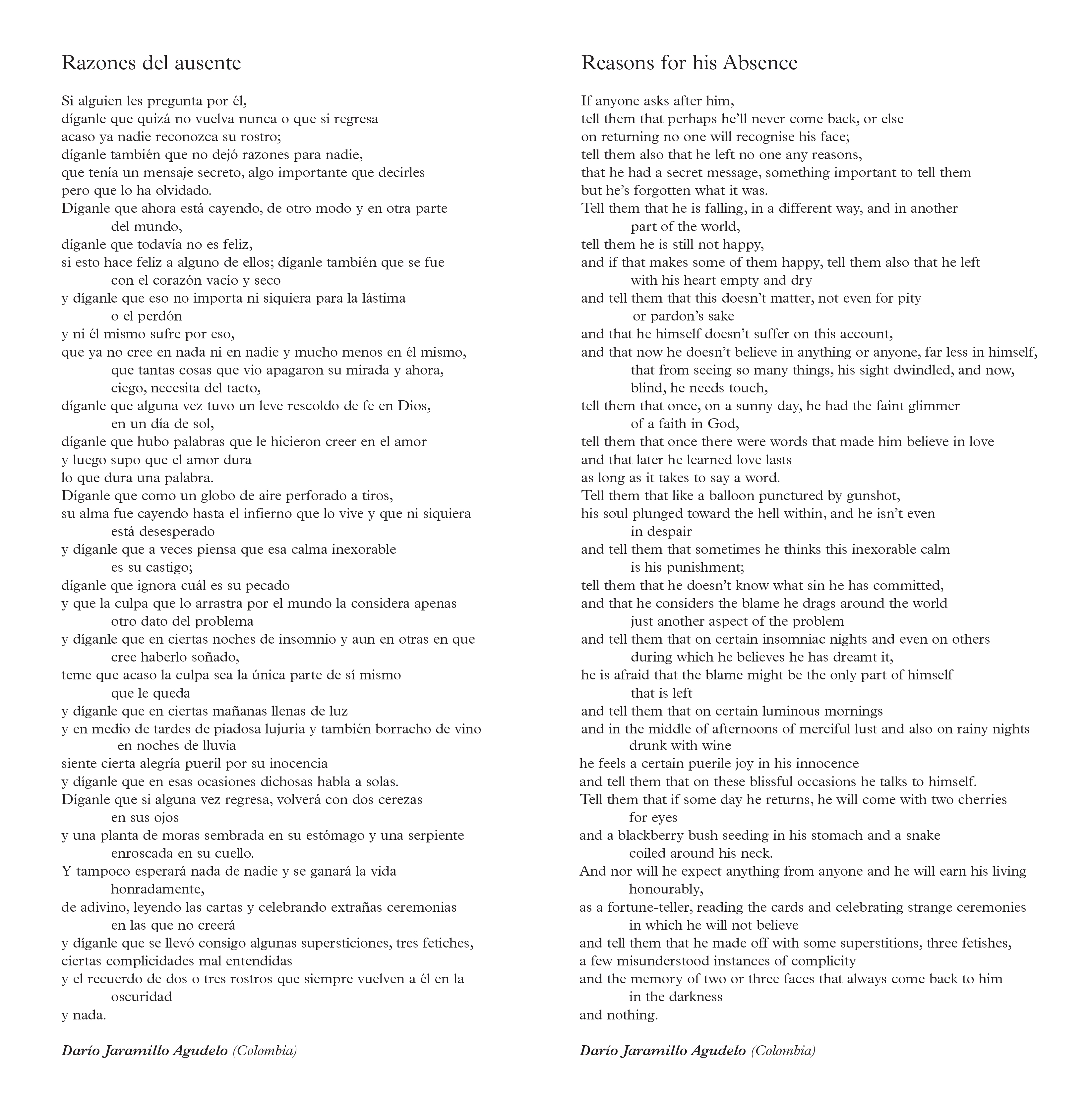
Friday Poem – ‘Reasons for his absence’, Darío Jaramillo Agudelo (translated by Richard Gwyn)

Friday Poem Dario aramillo Agudelo Richard Gwyn

This week our Friday Poem is ‘Reasons for his absence’ by Darío Jaramillo Agudelo, from Richard Gwyn’s hot-off-the-press anthology, The Other Tiger: Recent Poetry from Latin America.

The Other Tiger by Richard GwynThe Other Tiger (the title is a nod to Borges – “the one not in this poem”) is a much-needed bilingual anthology of contemporary poetry, containing 156 poems by 97 South and Latin American poets. It includes work from Argentina, Colombia, Mexico, Peru, Nicaragua, Chile, Uruguay, Venezuela, Cuba, the Dominican Republic, Ecuador, Costa Rica, Bolivia and El Salvador.


About Darío Jaramillo Agudelo
Agudelo is an internationally acclaimed poet, novelist and essayist. He graduated in law and economics from the Universidad Javeriana of Bogotá, and worked for many years in various roles with state cultural and arts organisations. He has been shortlisted or winner of several awards for his work, including the Colombian National Eduardo Cote Lamus prize for poetry (1978), and the José María de Pereda Prize for the short novel (2010). The most recent edition of his Selected Poems is his personal anthology Basta cerrar los ojos (México DF: Era, 2014).

A note on ‘Reasons for his absence’, from Richard Gwyn:
I was attracted to this poem by its epistolary style, and by the device of news being relayed about an absent party. The lack of clarity surrounding the reasons for the man’s absence holds particular poignancy in a country such as Colombia, where ‘disappearances’ were – at the time of the poem’s composition, in the late 1970s – already becoming an everyday occurrence. The slightly elevated or ‘baroque’ language and incantatory style creates a strange juxtaposition with the content, which describes a life of sensual dissolution. The curiosity is stirred by the profound sense of loss or lack with which the absentee seems infused, wherever he is. Whether his exile is literal or metaphoric is never made clear.

My principal concern with the translation of this poem concerned the title. The Spanish noun ‘razón’ can mean a range of things, including ‘reason’ or ‘information’, or even ‘explanation’, depending on context. Similarly ‘ausente’ – here a noun, but commonly an adjective – could be translated in a number of ways: ‘the absent one’ sounded too much like translatorese, ‘the missing person’ subject to over-interpretation in the context of recent Latin American history. In the end I chose ‘his absence’, which deviates from the original in a grammatical sense but conveys the meaning of the phrase accurately. A second concern was the repetition in the Spanish of ‘díganle’ (literally: tell him), which, since it refers back to ‘alguien’ (anyone) in line 1, I chose to translate as the generic ‘tell them’.

 I attempted to re-create the long, rolling cadences of the original in my translation, alongside the reiteration of the introductory ‘tell them that . . .’.

I have also tried to reproduce the bereft tone that reflects the absentee’s solitude, and the distance he has chosen to maintain from those he left behind.

 When I read this poem out loud at an event – as I do from time to time – it still makes the hairs on the back of my neck stand on end. I can’t say that happens with many poems, but with this one it happens every time.

Reasons for his Absence
(click to enlarge image)
Project1 the other tiger new order_Layout 1

Buy your copy of The Other Tiger now: £14.99
Claim 20% off when you become a Seren Book Club member

Save

Save

Posted on

Friday Poem – ‘Making Out’, Deryn Rees-Jones

friday poem making out deryn rees-jones

This week our Friday Poem is ‘Making Out’ by Deryn Rees-Jones, which originally appeared in her second collection, Signs Round a Dead Body, and also features in her generous new What It’s Like to Be Alive: Selected Poems.

Both collections (along with Deryn’s other books The Memory Tray, QuiverAnd You, Helen and Burying the Wren) are half price until midnight on Sunday, 9th October as part of our National Poetry Day sale.

Deryn Rees-Jones What It's Like To Be Alive Selected PoemsWhat It’s Like to Be Alive marks a mid-career milestone in the life of this highly-acclaimed writer. From the poems written in her teens and early twenties included in her exciting debut The Memory Tray to her most recent exploration of time and grief, we see the arc of development in her writing over twenty-five years as she visits and revisits the concerns that are the mainstay of her writing: memory, love, desire, and heartbreak in all its manifestations. The following poem originally featured in Signs Round a Dead Body, Deryn’s second collection.

Making Out

Now it was airports that she needed –
to sit there going nowhere
counting aeroplanes like sheep,

with Concorde like an archaeopteryx or angel
and Egypt, Russia, the Azores and Lithuania
spinning in her head. She’d sit there

writing letters that she knew she wouldn’t send,
telling him about the dull, red moon, the way
the landscape then, so pale, unreal,

the fishermen, the midnight seas
had been tattooed like hieroglyphs
in blues and golds

deep into her skin. It was his hands, I think,
she could imagine best
travelling across her. But she thought about the way

he’d kiss her too, the way she’d smile, nod yes
to his demolishing her. The way he’d start
to reassemble, slowly, in the rented bed

her mouth, her throat, her shoulders, breasts,
her knees, her arms, her thighs, her calves, and love etc.


Until midnight on Sunday 9 October,What It’s Like to Be Alive: Selected Poems is half price: only £6.49 (RRP £12.99). Buy your copy now to take advantage of this fantastic offer.


Save

Posted on

National Poetry Day 2016: All you need to know

National Poetry Day is an annual celebration of poetry and all things poetic. Started in 1994 by William Sieghart, it has engaged millions of people across the country with reading, writing and listening to poetry.

This year, National Poetry Day is taking place on Thursday 6th October. The 2016 theme is Messages – think texts, emails, letters, cards, speech; sad messages, hopeful ones, happy messages and even unspoken ones. They could be spooky, paranormal messages or those you hear every day, such as “hello” and “goodbye”.

Say it with a poem – be inspired by this years theme of Messages, and write a poem of your own to express yourself!

poetry-book-coverposterfinalupdate2-675x1024Download this year’s FREE poetry eBook – Messages: National Poetry Day 2016 is a free anthology of wonderful Messages poems – old and new. The fourteen poets in this eBook (created by MacMillan Children’s Books with Forward Arts Foundation) are all National Poetry Ambassadors.
Featured poets: Deborah Alma, Liz Brownlee, Paul Cookson, Sally Crabtree, Joseph Coelho, Matt Goodfellow, Sophie Herxheimer, Rachel McCrum, Brian Moses, Michaela Morgan, Joshua Seigal, Roger Stevens and Indigo Williams.

Download your free copy of the National Poetry Day 2016 anthology here.

Get involved! Attend one (or more) of the many National Poetry Day events happing all over the UK.
There are loads of events happening on and around National Poetry Day, 6th October, including two of our own:

First Thursday: New Fiction and Poetry at Chapter, Cardiff
Seren’s monthly celebration of new poetry and fiction returns after the summer break. Join us for readings from our special guests and then the famous open mic.
Cardiff poet and author Peter Finch presents: The Roots of Rock, from Cardiff to Mississippi and Back, and Jayne Joso reads from her new novel, set in the outskirts of tokyo: My Falling Down House.

Berkhamsted Waterstones: Caroline Smith, Graham Clifford & Rosie Shepperd
Celebrate National Poetry Day at Berkhamsted Waterstones with an evening of poetry readings, featuring three Seren poets: Caroline Smith (The Immigration Handbook), Graham Clifford (The Hitting Game) and Rosie Shepperd (The Man at the Corner Table).

Take a look at the National Poetry Day events map and go along to anything that catches your eye.

Take advantage of free online resources – There are loads of resources on the National Poety Day website, including advice on how to get your school enjoying poetry, news, and free poems to read and share. Take a look here.


Seren’s own celebrations will kick off with a flash poetry sale – keep an eye on our website (or social media channels) on 6th October to take advantage of our special National Poetry Day book offers!


Save

Posted on

Friday Poem – ‘What the Dead Don’t Know’, Anne-Marie Fyfe

Friday Poem What the Dead Don't Know Anne-Marie Fyfe

Our Friday Poem this week is taken from Anne-Marie Fyfe’s latest collection, House of Small Absences.

House of small absencesAnne-Marie Fyfe’s poems have long dwelt on the role that the spaces we inhabit, the places in which we find security, play in our lives: House of Small Absences is an observation window into strange, unsettling spaces—a deserted stage-set, our own personalised ‘museum’, a Piedmont albergo, underground cities, Midtown roof-gardens, convent orchards, houseboats, a foldaway circus, a Romanian sleeper-carriage—the familiar rendered uncanny through the distorting lenses of distance and life’s exigencies, its inevitable lettings-go…


What the Dead Don’t Know

Grows quickly, daily, from the perimeter
of a postage stamp, until it’s twice the size
of Norway, and growing fast.

What the deceased can’t understand
is why they don’t still hear from us
day-by-day, hour-by-hour.

What the departed don’t see
is how the lead story has moved on.

What the dead won’t say
is more or less what they didn’t say
when they had the chance. Diplomacy,
tact, reserve: these things endure.


Buy your copy of House of Small Absences now: £9.99

Claim 20% when you become a Seren Book Club member


Posted on

Friday Poem – ‘VII’ from Batu-Angas, Anne Cluysenaar

batu-agas Anne Cluysenaar

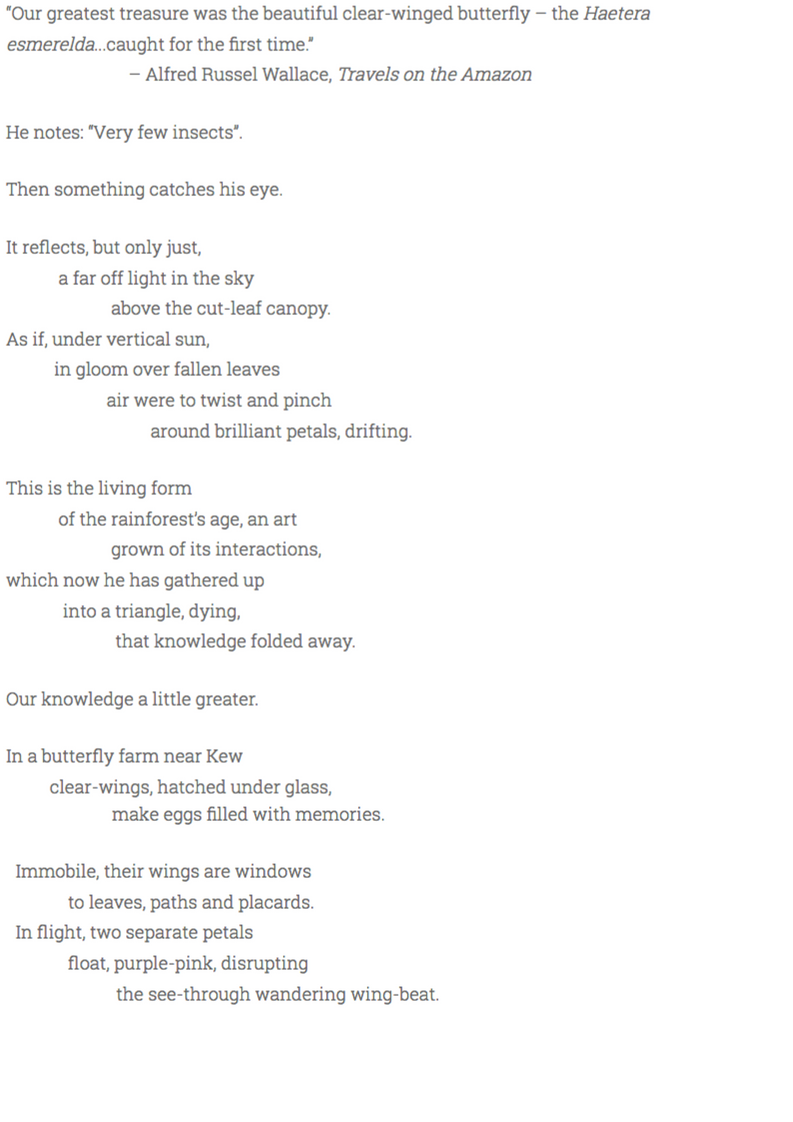
In celebration of the brief heatwave that has hit the UK, we are taking this week’s Friday Poem from Anne Cluysenaar’s tropical Batu-Angas: Envisioning Nature with Alfred Russel Wallace.

Batu-Angas Anne CluysenaarAlfred Russel Wallace (1823-1913) was one of the most famous scientists of the 19th century and is best known today as the co-discoverer, with Charles Darwin, of the theory of evolution through natural selection. Wallace’s life and work are the inspiration for this beautifully considered collection of poems. Why the title? As Anne Cluysenaar explains in her Foreword:

It was during an acute bout of malaria on the volcanic island of Ternate that it ‘flashed upon’ Wallace how life evolves through natural selection … From the local language of Ternate itself, Wallace had borrowed the phrase ‘batu-angas’ to describe the ‘burnt rocks’ or cooled lava he saw there. The phrase struck me as as suitable title for this sequence because it could be said to symbolise the visible world at any one time – a world now, thanks to Wallace and Darwin, known to maintain a seeming stasis only, amid the flowing lava of evolution.


VII

batu-angas-blogBatu–Angas is available from our website: £8.99

Sign up to the Seren Book Club and save 20%


Save

Posted on

Friday Poem – ‘Autumn Elegy’, Leslie Norris

Friday Poem Autumn Elegy Leslie Norris

Our Friday Poem this week marks the coming of autumn, and is taken from Leslie Norris: The Complete Poems, edited by Meic Stephens.

Leslie Norris Collected PoemsThis landmark publication of over 300 poems is a testament to a publishing life of more than sixty years. The late Leslie Norris, who died in 2007 at the age of 86, was best known as a nature poet and elegist of passion and rare expression. Lyrical and individual, to his closely observed poems, each word weighed and in its correct place, Norris introduces a strong metaphysical element which makes the poems, as Edward Lucie-Smith noted, “much larger than the sum of their parts”.


Autumn Elegy

September. The small summer hangs its suns
On the chestnuts, and the world bends slowly
Out of the year. On tiles of the low barns
The lingering swallows rest in this timely

Warmth, collecting it. Standing in the garden,
I too feel its generosity; but would not leave.
Time, time to lock the heart. Nothing is sudden
In Autumn, yet the long, ceremonial passion of

The year’s death comes quickly enough
As form veins shut on the sluggish blood
And the numberless protestations of the leaf
Are mapped on the air. Live wood

Was scarce and bony where I lived as a boy.
I am not accustomed to such oppulent
Panoply of dying. Yet, if I stare
Unmoved at the flaunting, silent

Agony in the country before a resonant
Wind anneals it, I am not diminished, it is not
That I do not see well, do not exult,
But that I remember again what

Young men of my own time died
In the Spring of their living and could not turn
To this. They died in their flames, hard
War destroyed them. Now as the trees burn

In the beginning glory of Autumn
I sing for all green deaths as I remember
In their broken Mays, and turn
The years back for them, every red September.


Buy your copy of Leslie Norris: The Complete Poems now: £25.00

Claim 20% off when you become a Seren Book Club member


Posted on

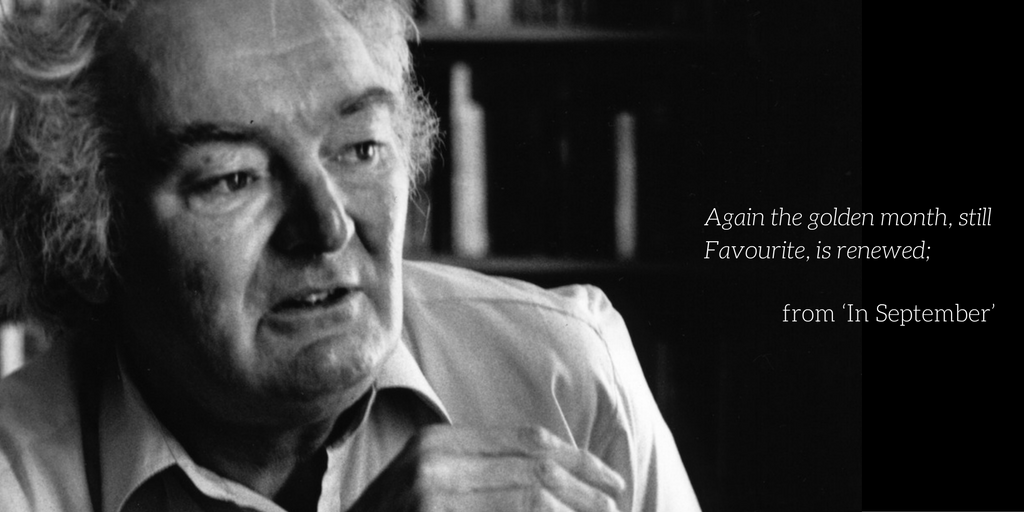
Friday Poem – ‘In September’, John Ormond

Friday Poem in September John Ormond

For this week’s Friday Poem we have ‘In September’ by John Ormond, from his Collected Poems, edited by Rian Evans. The poem was written for Glenys in celebration of their wedding anniversary, which fell on the 21st September. Since the two were married in 1946, that would have been 70 years ago.

John Ormond Collected PoemsPenned late on the night of the 20th of September, probably 1970, because he’d forgotten to buy a card, it was deemed by them both to be infinitely preferable. Memories of key moments in their courtship are woven into the lines, while the storm door was the big black outer door of their home in Conway Road. The poem appeared in various anthologies: one which pleased Ormond was the Almanacco internazionale dei Poeti 1975 (La Pergola Edizioni) containing the Italian translation ‘In Settembre’ by the eminent translator, poet and critic Roberto Sanesi.


In September

Again the golden month, still
Favourite, is renewed;
Once more I’d wind it in a ring
About your finger, pledge myself
Again, my love, my shelter,
My good roof over me,
My strong wall against winter.

Be bread upon my table still
And red wine in my glass; be fire
Upon my hearth. Continue,
My true storm door, continue
To be sweet lock to my key;
Be wife to me, remain
The soft silk on my bed.

Be morning to my pillow,
Multiply my joy. Be my rare coin
For counting, my luck, my
Granary, my promising fair
Sky, my star, the meaning
Of my journey. Be, this year too,
My twelve months long desire.


John Ormond: Collected Poems draws together all of Ormond’s work, including unpublished material. It includes notes and commentary of the poems, and a bibliography of Ormond’s prose writing, films and writing about him. An index of titles and first lines completes this essential book.

Buy your copy now: £14.99

Claim 20% off as a Seren Book Club member