Posted on

Friday Poem – The Formula for Night

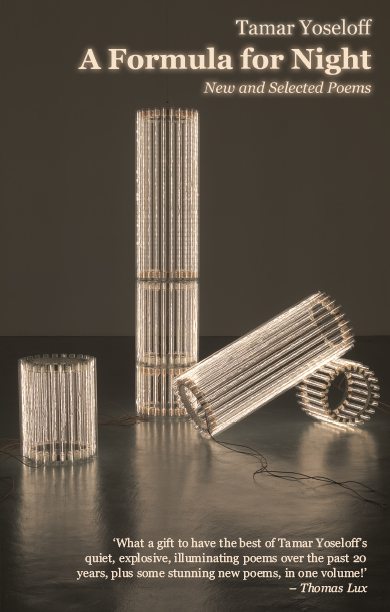
Tamar Yoseloff A Formula for Night

This week’s poem comes from Tamar Yoseloff’s latest collection, A Formula for Night: New and Selected Poems.

Tamar Yoseloff is a poet whose career has been profoundly influenced by the visual arts. A Formula for Night: New and Selected Poems is the eagerly awaited summation of her work, encompassing selections from four published print volumes: Sweetheart, Barnard’s Star, Fetch and The City with Horns (now mostly out of print); and poems from her collaborations with artists: Formerly, Marks and Desire Paths. The book also includes a generous selection of beautiful new poems. The title poem is based upon an installation by Welsh artist Cerith Wyn Evans. An image from his work, a light sculpture, is used for the cover of the book. 

The poet’s first collection, Sweetheart, was a PBS Special Commendation and the winner of the Jerwood/Aldeburgh First Collection Prize. She was the recipient of an Arts Council New Writing award which helped her complete her second manuscript, later published as Barnard’s Star. Of her collaborations, Marks was published as a limited-edition artist’s book and pamphlet by Pratt Contemporary Art in 2007. Desire Paths was a limited-edition portfolio produced by Galerie Hein Elferink in the Netherlands. Both books feature work by artist Linda Karshan.

More recently, Formerly, a chapbook of poems based on forgotten London locations, with accompanying photographs by Vici MacDonald, was the debut publication of their co-founded imprint, Hercules Editions. Formerly was shortlisted for the Ted Hughes Award in 2012.  Exhibitions of the poems and photographs have appeared in two venues in London: the Poetry Society’s Poetry Café and the Saison Poetry Library at the Southbank.

The new poems are often artful explorations of paradox: death/birth, dark/light, clarity/mystery. In the ‘Swimmer of Lethe’  the protagonist says: ‘I’ve mastered surface/ here everything is under.’ Atmospheres are conjured, surfaces interrogated and humans are often found woefully or wonderfully implicated in their settings in unexpected ways. A misunderstood creature, the ‘Muntjac’, is seen with tender clarity ‘Now white with May/tar and fern on his delicate hooves…’. The poet’s vocabulary is spiky, sometimes ferociously so. Sex is another paradox, its violence at times palpable: from ‘Pictures of Spring’:  ‘I bend and break, bend/ and break, contort my limbs/ into these lovelocked shapes.’  ‘Hospital Time’: ‘collapses, folds the days into sterile gauze,/
a thousand different words for hurt’ beautifully evokes the estranging, atmosphere of a hospital but slowly evolves to become a moving elegy to the poet’s mother. 

The Formula for Night

It’s getting late. Light
floods the public bar,
you’re the final one to leave.
The mirror’s silver eye
gives you back yourself, precise.
You’ve lived your life through
glass, you miss the brush

of skin, someone whispering
your name.You hear it now,
a calling on the wind, insistent,
a small but steady flame.
You carry in your bones a gasp
of summer heat, the formula
for night.You arrive at the end-

of-pier reveal – the heart-stop hour,
when this world briefly yields
to the next: a door that creaks
an inch or two to catch
a blinding beam. You want
to understand what can’t
be seen, the fact behind

the trick, the wires hidden
from your view, the blue breath
that powers the machine.
Raise your eyes to read the stars –
streetlight’s glare has cast them
dark; once-bright bulbs,
trembling elements crack

and fizzle as they die. Their light
is obsolete. But close
your eyes, and still you find
gold impressed beneath
your lids, a moment lived.
And when you open them again,
darkness is what’s left.

Order A Formula for Night: New and Selected Poems from our website.
Posted on

Friday Poem – The Death of Doc Emmett Brown in Back to the Future

my family and other superheroes

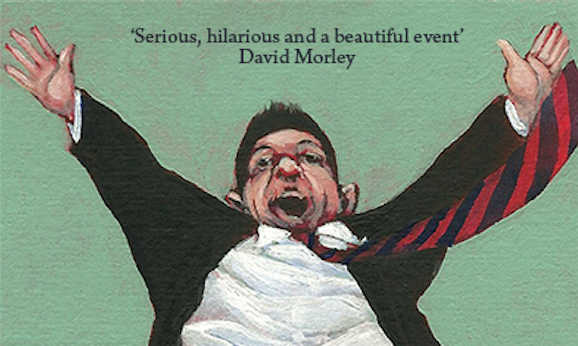
This week’s poem comes from Jonathan Edwards’ Costa Award-winning debut collection, My Family and Other Superheroes.

My Family and Other Superheroes introduces a vibrant and unique new voice from Wales. The superheroes in question are a motley crew. Evel Knievel, Sophia Loren, Ian Rush, Marty McFly, a bicycling nun and a recalcitrant hippo – all leap from these pages and jostle for position, alongside valleys mams, dads and bamps, described with great warmth. Other poems focus on the crammed terraces and abandoned high streets where a working-class and Welsh nationalist politics is hammered out. This is a post-industrial valleys upbringing re-imagined through the prism of pop culture and surrealism. If the author’s subjects have something in common with RS Thomas, or even Terry Street-era Douglas Dunn, his technique and approach owe at least as much to contemporary American poets like James Tate and David Wojahn.

The Death of Doc Emmett Brown in Back to the Future

I sit here in the darkness with my father,
slurping Pepsi, passing popcorn round.
The Libyans come fast around the corner,

pump Doc Brown with automatic fire.
My feet are dangling, inches from the ground.
I sit here in the darkness with my father,

as Marty hits 88 miles an hour,
goes back to ’55, to warn Doc Brown.
The Libyans come fast around the corner,

pump Doc Brown with automatic fire:
he gets up, dusts his bulletproof vest down.
I sit here in the darkness with my father,

who starts to gently snore. Now time goes quicker:
the cinema’s knocked down, moved out of town;
the Libyans come fast around the corner

on DVD. My boy asks for Transformers
instead as, from the wall, his bamp looks down.
I sit here in the darkness with my father.
The Libyans come fast around the corner. 

Order My Family and Other Superheroes from our website.

Posted on

Win a Signed Copy of Star-Shot!

It’s competition time!
To celebrate the upcoming release of Mary-Ann Constantine’s debut novel, Star-Shot, we’ll be giving away a signed copy to one lucky follower!
This isn’t just going to be any competition, however, this is going to be an interactive competition!
National Museum Cardiff plays a big part in Star-Shot, so here at Seren we thought it was only right that museums play a part in our competition. We challenge you to take to Twitter and tweet us a picture of you standing outside your nearest museum using the hashtag #ImStarShot, and you’ll be entered to win a signed copy of the book.
The competition ends in a month’s time, on the 5th November, so get your entries in and spread the museum love – we can’t wait to see your photos!

Posted on

Friday Poem – The Snake House

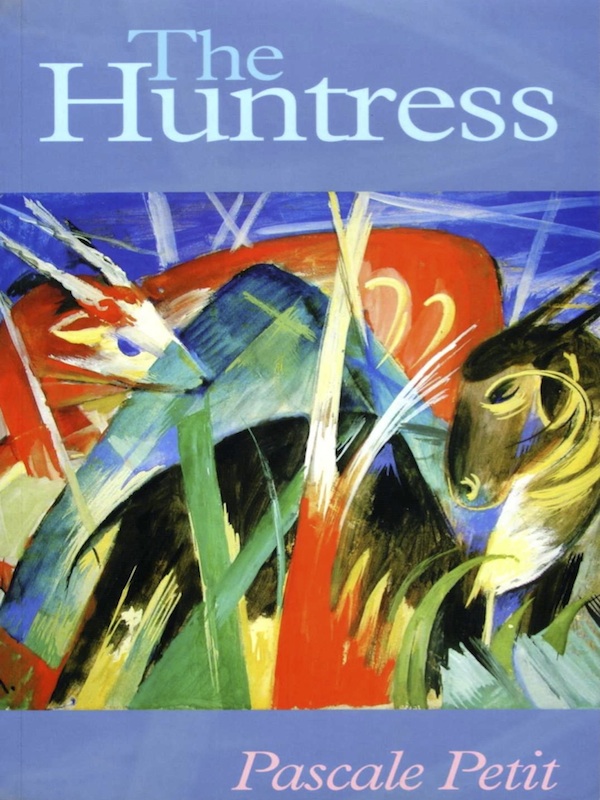
This week’s poem comes from Pascale Petit’s third collection, The Huntress, published in 2005.

In Pascale Petit’s highly-charged third collection, a daughter is haunted by her mentally ill mother, and a painful childhood is re-imagined through a series of remarkable and passionate transformations. The feared mother is a rattlesnake, an Aztec goddess, a Tibetan singing bowl, a stalagmite, a praying mantis, a ghost orchid. These culminate in a long central poem where the daughter escapes her huntress as a cosmic stag. Underlying these poems is an intense mystical vision that lifts the dark material of the subject matter above the merely personal. 

The Snake House

It’s time to go up to your front door, Mother,
and ring the rattling buzzer of a bell,
the door with two curved fangs.
I go in, into the muscular throat of the hall,
down the tunnel that’s closing now
to a pinpoint of light.
I’m in the swallowing living-room,
washing it for you, half-alive,
like a man preparing for the rain-dance
in the dry arroyo. He reaches
into the pit and washes the snakes
so that later when he dances with the ‘little mothers’
in his mouth, they won’t bite.
I’m a child playing in the pen
with my pet rattlers,
giving them bread and milk.
As long as I’m unscared
they won’t strike. And you’re saying,
“Only a girl-child can do this”.
My cheeks are almost seamless now,
countless grafts hide the necrosis.

Order The Huntress from our website.

Posted on

The Northern Poetry Library

Poet Carolyn Jess-Cooke (Boom!) is taking part in a project aimed at promoting the Northern Poetry Library’s importance on the UK’s literary landscape.
Established in 1968 and managed by Active Northumberland, the Northern Poetry Library, is the largest collection of contemporary poetry outside of London and contains the work of all the major poets writing in English since the end of the Second World War. This new project, led by poet Lisa Matthews, will include setting up poets in residence across the region to work with the communities and take part in various events with the aim of getting people of all ages to visit and get involved.
As well as Carolyn and Lisa, other poets involved in the project include John Challis, Linda France, Jo Colley and Degna Stone. The poets will create their own work inspired by the poetry collection, including digital responses for the new platform, and develop a programme so that community groups can write their own poetry and produce text-based artwork.
Later in the project there will also be an exhibition at Woodhorn Museum, and Palace Green Library focusing on the topics of Collections, History and Contemporary Poetry.
There will be a launch party at the Northern Poetry Library at 7pm on Thursday 8th October which is free to attend.

Posted on

Seren at Crickhowell Literary Festival

Wales will see the return of the Crickhowell Literary Festival this month, and this year several of our authors are taking part!

Francesca Rhydderch, author of the 2014 Wales Book of the Year The Rice Paper Diaries and co-editor of New Welsh Short Stories, will be in conversation with Oliver Balch, reading from her work and answering any questions from the audience. She will also be leading a Fiction Writing Masterclass!

Poet and novelist Christopher Meredith will be at the festival for an evening of reading and discussion, and several of our other poets will also be reading from their work. Paul Henry and Philip Gross will be reading poems from Boy Running and A Fold in the River inspired by the rivers Usk and Taff, and Anne-Marie Fyfe will be reading from her latest collection, House of Small Absences, while Costa Award-winner Jonathan Edwards will be reading from his own work.

Whether it’s poetry or prose that mosts interests you, there’s something for everyone at Crickhowell this year. Find out more about all of our upcoming events on our website!

Posted on

Seren at the Crickhowell Literary Festival

Wales will see the return of the Crickhowell Literary Festival this month, and this year several of our authors are taking part!
Francesca Rhydderch, author of the 2014 Wales Book of the Year The Rice Paper Diaries and co-editor of New Welsh Short Stories, will be in conversation with Oliver Balch, reading from her work and answering any questions from the audience. She will also be leading a Fiction Writing Masterclass!
Poet and novelist Christopher Meredith will be at the festival for an evening of reading and discussion, and several of our other poets will also be reading from their work. Paul Henry and Philip Gross will be reading poems from Boy Running and A Fold in the River inspired by the rivers Usk and Taff, and Anne-Marie Fyfe will be reading from her latest collection, House of Small Absences, while Costa Award-winner Jonathan Edwards will be reading from his own work.
Whether it’s poetry or prose that mosts interests you, there’s something for everyone at Crickhowell this year. Find out more about all of our upcoming events on our events page!

Posted on

Friday Poem – Autumn, 1939

This week’s poem comes from the Collected Poems of WW2 writer Alun Lewis, whose centenary we are celebrating throughout the year, to mark the Autumn equinox which occurred earlier this week.

Alun Lewis (1915-1944), the remarkable poet and story writer, died, aged 28, in Burma during the Second World War. Some critics see him as the last of the great Romantic poets, a twentieth century Keats. Others view him as the bridge between pre-war poets like Auden and Yeats to post-war poets such as Hughes and Gunn. He was born and raised in Depression-struck south Wales and, following degrees in history at Aberystwyth and Manchester, became a teacher there. Early in 1940, despite his pacifist inclinations he enlisted and, after long periods of training, joined the war in India.

Becoming a soldier galvanised Lewis’s writing. By 1944 he had written two collections of poems and one of short stories, all published to considerable acclaim. Firmly established with Keith Douglas as the leading writer of the Second World War, Lewis’s death in an accident while on active service was huge loss to English literature. This Collected Poems comprises a body of work which has endured and which transcends the label ‘war poetry’; it is complete in itself and full of promise of greater things.

Autumn, 1939

The beech boles whiten in the swollen stream;
Their red leaves, shaken from the creaking boughs,
Float down the flooded meadow, half in dream
Seen in a mirror cracked by broken vows,
Water-logged, slower, deeper, swirling down
Between the indifferent hills who also saw
Old jaundiced knights job listlessly to town
To fight for love in some unreal war.

Black leaves are piled against the roaring weir;
Dark closes round the manor and the hut;
The dead knight moulders on his rotting bier,
And one by one the warped old casements shut.

Order Collected Poems from our website.
Posted on

What’s a Book Worth?

What's a Book Worth-

At the beginning of the month, the launch of writer and historian Mathew Lyons’ campaign What’s a Book Worth? was announced.

The aim of the campaign is to look beyond the monetary worth of the books we own and love, and instead is asking readers to film themselves talking about the books that mean the most to them and to share their video on Twitter using the hashtag #WhatsABookWorth on Monday 28th September. If you’re a little camera shy, then an alternative way to spread the love is to write a short blurb for a book you love instead, and share it on social media.

If you want to know a little more about the campaign then check out this article on The Bookseller, the What’s a Book Worth? website and follow @WhatsABookWorth on Twitter! We’ll be keeping an eye on the hashtag on Monday, and we can’t wait to see some of your favourite books – we may even share some of our own!

Posted on

Emily Hinshelwood’s Stories of Change

Emily Hinshelwood (On Becoming a Fish) is collaborating with Canolfan Maerdy and the University of South Wales’ George Ewart Centre for Storytelling to kick off a series of five free writing workshops throughout October and into November.
There will be five workshops in total from Thursday 1st October through to Thursday 5th November, during which Emily will be using fun and informal exercises to encourage participants to transform their memories, anecdotes, newscuttings and photographs into a book of stories, poems and scripts that will then be released before Christmas this year. The aim of the project, Stories of Change, is to produce a book in which writers explore their connection with the Ammanford and Swansea Valleys area through whichever form they prefer, whether their inclination is towards poetry or prose. No previous writing experience is necessary to take part – only enthusiasm!
Refreshments will be provided at the workshops, and there is also a creche available for any participants with children. For more information, or to book a place on one of the workshops, email Emily at [email protected] or telephone Canolfan Maerdy on 01269 826893.