Posted on

Friday Poem – ‘Four Poets in a Bookshop’ by Abeer Ameer

This week’s Friday Poem is ‘Four Poets in a Bookshop’ by Abeer Ameer from her debut collection Inhale/Exile.

This cover shows a closeup painting of someone cutting reeds. The text reads: Inhale/Exile Abeer Ameer

Cardiff-based poet Abeer Ameer writes of her forebears in her first collection, Inhale/Exile. Dedicated to the “holders of these stories”, the book begins with a poem about a storyteller on a rooftop in Najaf, Iraq, follows tales of courage and survival, and ends with a woman cooking food for neighbours on the anniversary of her son’s death.

Four Poets in a Bookshop

In the land of two rivers and hanging gardens,
four poets meet in a bookshop. No one can know.
Portrait of Saddam watches; they hide under the cloak
of Arabic lexicon. They share with one breath
meanings that turn the Master’s key
to worlds where Adam was taught the names.

Trees, reborn as pages, witness the names
of four and those gathered to reach the Gardens,
as they escape their locked chests without key.
They are four men who know.
Reading between lines of apocalypse, each strained breath
foretells of beasts with their daggers and cloak

scarring minds and hearts of men by Baathist cloak.
Present are bygone days of Karbala’s names
which poets dare to mention under their breath.
Alive and well with the Lord of the Gardens.
Willing to exchange this world for the next, four know
that informants sell to the cruellest bidder for neighbours’ key.

Saddam’s spies claw to learn of persons key
and clothe their families in mourning cloak.
Three-quarters give eyes, tongues and nails. They know
they must not, to treachery, yield any names.
Silent skin, dipped in acid, bastes in hanging gardens
bearing to keep hidden secrets beyond dissolved breath.

No haste nor waste for ordained beat and breath
nor desire for the iron key
to dust’s throne; they dream of other gardens.
Longing only to reunite with the People of the Cloak
and the Most Compassionate through His Names.
Those clinging to ebbing sands of time do not yet know

The bookshop bears witness to what few mortals know.
Its shelves and books inhale each whispered breath
and all that poetry and scripture, names.
Kerosene warms the last poet. He clutches the bookshop’s key,
drinks black tea sugar cannot sweeten and wears a black cloak.
Alone; his companions have already reached the Garden.

Many years after a shroud is his cloak and cancer takes his breath,
the names of seekers are still hidden. Their key is kept buried in the earth
upon which gardens grow, and reed beds and shrines know how to Read.

Inhale/Exile is available on the Seren website: £9.99

Create your free Seren account and enjoy 20% off every book you buy from us.

Posted on

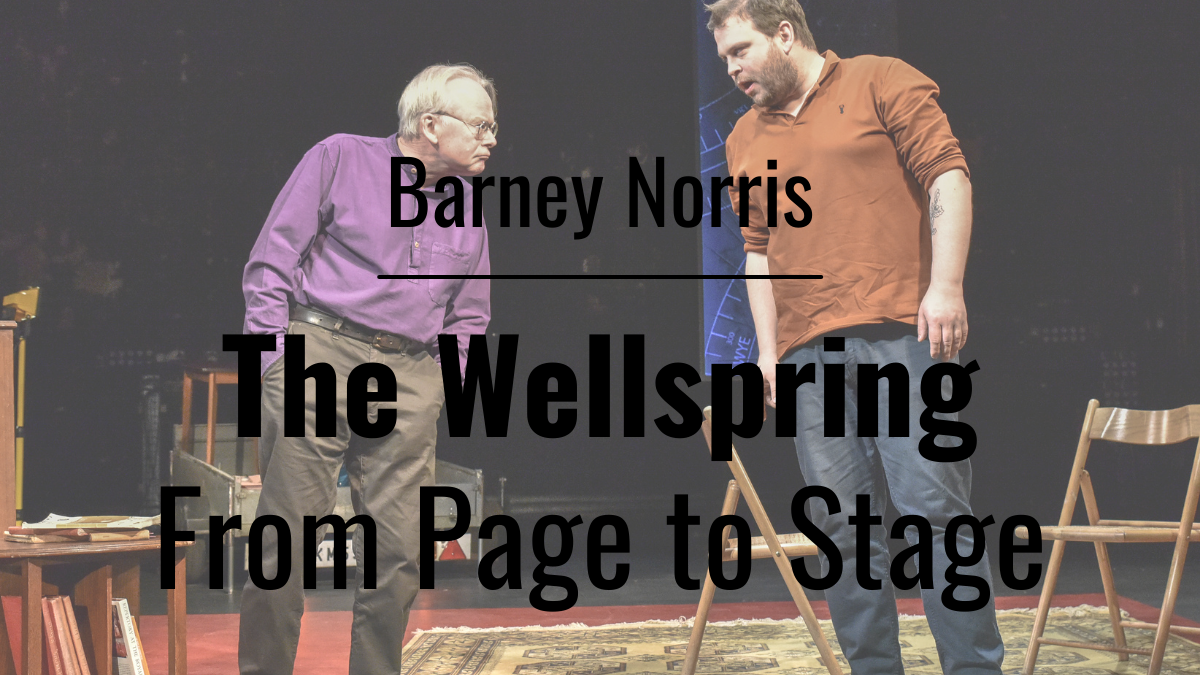
Barney Norris – The Wellspring: From Page to Stage

In this guest post, Barney Norris discusses the link between his memoir The Wellspring and his new stage production of the same name currently touring the UK. Catch Barney and his father David Owen Norris performing The Wellspring at the Oxford Playhouse from today.

Barney Norris' 'The Wellspring: Conversations with David Owen Norris' cover; a greyscale sketch of a countryside scene with a single square turret in the middle.

In The Wellspring acclaimed novelist and dramatist Barney Norris conducts a conversation with his even more acclaimed father, the pianist and composer David Owen Norris, on creativity, cultural identity, and how the two intertwine. In addition to being called ‘quite possibly the most interesting pianist in the world’ (Toronto Globe and Mail) and ‘a famous thinker/philosopher of the keyboard’ (Seattle Times), Norris senior is a respected and longstanding television and radio presenter who has worked with a huge range of musicians, conductors and composers in the concert hall and on the airwaves.

The Wellspring

Seven years ago, I was sitting outside Romsey Abbey when the thought came to me that I should write a book of interviews with my father. David Owen Norris, my Dad, has had many jobs – he’s a pianist, a broadcaster and a teacher, among other things. He’s also a composer, and while we were touring a piece of music he’d written, that I’d written some accompanying poems for, I had the idea of writing a book about this aspect of his life. Partly as a way of amplifying his work; partly to trace the journey of one artist from childhood into creativity, as a means of exploring how that journey happens for every artist; partly as a way of knowing my Dad better. I called up Mick Felton at Seren Books, a publisher with the courage and heart to take on quixotic, idiosyncratic projects of this nature, who had previously published my study of the Welsh theatre artist Peter Gill, To Bodies Gone, and who I occasionally besiege with poetry in the hope that he’ll one day let me have a collection (I’m doing the same thing now, here in this blog, not ever so subtly, look!), and he agreed to publish the book if we wrote it.

Barney Norris lays a table cloth on a table while David to his left brings a saucepan on a chopping board to the table.
Photo by Robert Day

What emerged from that process was a sequence of three long interviews with my Dad, loosely grouped around the activities of ‘listening’, ‘playing’ and ‘writing’. I think you can map these onto any artist’s trajectory: they start by absorbing the world, then explore the art form that interests them, and finally, if things go their way (if kind and visionary publishers give them a collection, say), they find a way to make a statement. Dad’s particular version of that journey took in lots of specific things – he’s a study in a particular kind of Englishness, a particular rural culture and a particular artistic context as well. We were very proud of the book, and all the more so when the theatre I was working with at the time, Northampton’s Royal and Derngate, asked me whether we’d consider adapting the book for the stage. Being a book of interviews, it was done in dialogue, after all – so why couldn’t it work live?

Barney Norris sits centre stage on a chair while David Norris sits diagonally to him in the bottom-left corner, facing a piano
Photo by Robert Day

Dad and I got together in the rehearsal room in December 2019 to work out whether it was possible. The first big decision we made was that we mustn’t use the original book too closely as source material – they had to be companions to each other, palimpsests of one another, because an evening where we read out an abbreviated version of the book wouldn’t work. Reading and performing are so fundamentally different, and require such a different kind of writing. In addition, the relationship in the book – that of interviewer and subject – wouldn’t wash onstage. Onstage, everyone visible to the audience has equal weight in the overall picture; one of them can’t be the interviewer, secondary characters don’t exist. I would need to take up more space in the play we made.

Barney Norris sits with his feet on a chair in front of him (centre stage), right index poised in the air, waiting to say something
Photo by Robert Day

So we created something that slightly resembled a winterbourne – the previous Wellspring, my book of interviews with Dad, had passed through this way the previous winter, and now, in a different winter, new water would make its way through the same gullies and eddies of our life stories. Whatever we created would take the same path, passing through all of the same material, but the summer that has passed between the two projects would inevitably mean everything was somehow different. What emerged, then, was a story that seemed both strikingly different, and strikingly the same. It’s a huge privilege to have got to explore this, the idea of telling the same story twice. Part of what I’m writing is my own journey through life, and the changes in my relationship with my father, after all; I am watching my time pass as I retell this tale from its source again, and note how I change it each time.

Both Norrises smile as David sits by the piano(bottom right stage corner)  while Barney stands centre stage addressing the audience.
Photo by Robert Day

Barney Norris

Visit the Oxford Playhouse website for tickets to see ‘The Wellspring’ this week www.oxfordplayhouse.com/events/the-wellspring.

The Wellspring is available on the Seren website for £12.99.

Create your free Seren account and enjoy 20% off every book you buy from us.

Posted on

Friday Poem – ‘From the Cockpit Window’ by Anne-Marie Fyfe

This week’s Friday Poem is ‘From the Cockpit Window’ by Anne-Marie Fyfe from her collection House of Small Absences.

This cover shows a painting of a girl carrying a dolls house, standing in the garden of big house. The text reads: House of Small Absences, Anne-Marie Fyfe

Anne-Marie Fyfe’s poems have long dwelt on the role that the spaces we inhabit, the places in which we find security, play in our lives: House of Small Absences is an observation window into strange, unsettling spaces—a deserted stage-set, our own personalised ‘museum’, a Piedmont albergo, underground cities, Midtown roof-gardens, convent orchards, houseboats, a foldaway circus, a Romanian sleeper-carriage—the familiar rendered uncanny through the distorting lenses of distance and life’s exigencies, its inevitable lettings-go…

From the Cockpit Window
Here, above,
cracks in the buildings are filled with battered moonlight.
– Elizabeth Bishop, The Man-Moth
The full moon is being held hostage
tonight. A two-hundred-&-seventy degree vista
and all I make out are roof-garden umbrellas,
latticed fire escapes, jungles of wisteria
straggling around water-tower struts.
Uplighters cast panther shadows
and Egyptian columns against the cloudswirl
that drapes the Chrysler pinnacle.
There’s a low-altitude nosedive, a rattle
of applause on the wing. Our world
is hurtling towards sudden resolution.
Tumbling zeros play needle roulette,
the spirit bubble’s way out of kilter.
Close enough now to smell garbage scows,
charred pretzels, onions, to hear
taxis honking, meters ticking,
the steam whoosh of airshafts.
On my tongue there’s the after-taste of metal fatigue.
Who’ll answer my entryphone? How long
before they empty the closet of shirts
and jackets, their sleeves hanging aimless.

House of Small Absences is available on the Seren website: £9.99

Create your free Seren account and enjoy 20% off every book you buy from us.

Posted on

Gifts for Mother’s Day

With Mother’s Day just around the corner, we’ve rounded up a list of books that would make great Mother’s Day gifts. Browse the list below, or visit our new titles page for more ideas.

Auscultation – Ilse Pedler

This cover shows a digital image of an orange butterfly resting on the cord of a stethoscope. The text reads: Auscultation, Ilse Pedler. "Unique and utterly original" Kim Moore.

Auscultation means listening and specifically, in medicine, listening to sounds that come from the body’s internal organs. If listening is a central theme of this collection, it is also about being heard. Ilse Pedler is poet of breadth and depth. There are poems about waiting rooms and surgical instruments, about crisis calls, about overhearing farmers and pet owners and colleagues. There are poems about surviving a stern childhood and a heartbreaking sequence about being a stepmother. This is a compelling set of poems from a striking new voice.

Writing Motherhood – Ed. Carolyn Jess-Cooke

This cover shows a painting of two mothers and their young daughters looking out at the reader. The text reads: Writing Motherhood, A Creative Anthology. Edited by Carolyn Jess-Cooke

Through a unique combination of interviews, poems, and essays by established writers, Writing Motherhood interrogates contemporary representations of motherhood in media and literature. It asks why so many novels dealing with serious women’s issues are packaged in pink covers with wellies and tea cups, and demonstrates how the exquisite moments of motherhood often enrich artistic practice rather than hinder it. Writing Motherhood is a vital exploration of the complexities of contemporary sexual politics, publishing, artistic creation, and 21st Century parenting.

Cecil & Noreen – Patrick Corcoran

This cover shows a close up sepia image of an elderly couple's hands. The text reads: Cecil & Noreen, Patrick Corcoran.

Cecil & Noreen is a poignant, subtle and amusing love story in which an elderly couple reminisce about their marriage. In a nursing home, Cecil recollects the memories through the aide-memoir of Noreen’s preserved letters which he keeps in a box by his bed. Noreen visits the ailing Cecil twice daily, and provides a more reliable version of the events the letters describe. Both are committed Catholics. The novel opens with their first meeting at church, at which Noreen accidentally floors Cecil with a ceremonial banner. Beautifully-written and deeply compassionate, Cecil & Noreen ennobles the ’ordinary’ lives of its characters. 

Waterfalls of Stars – Rosanne Alexander

This cover shows a photo of Skomer Island surrounded by rough seas. The sky is an eerie green where a storm meets blue sky and sunshine. The text reads: Rosanne Alexander, Waterfalls of Stars: My ten years on the Island of Skomer

When Rosanne Alexander’s boyfriend Mike was offered the job of warden of Skomer Island, they had just ten days to leave college, marry (a condition of employment) and gather their belongings and provisions. In Waterfalls of Stars, Rosanne Alexander relates their experiences, including her observations of the island’s wildlife and landscape. Her lyrical evocation of the natural world will inspire and entertain anyone who has felt the need for escape.

The World, the Lizard and Me – Gil Courtemanche

This cover is orange. Shadowy figures of children fighting in a war and a bright lizard are overlaid in the background. The text reads: The World the Lizard and Me, Gil Courtemanche

The World, the Lizard and Me is a novel of testament to the plight of children caught up in the civil wars of Central Africa. First published in 2009, this translation by David Homel is the first in EnglishThe World, the Lizard and Me follows the life of Claude Tremblay who, from the age of eleven has sought justice for thousands of voiceless victims. Now an investigator at the International Criminal Court in The Hague, he is pursuing Thomas Kabanga, a warlord charged with creating child soldiers in the Congo. Gil Courtemanche draws on his own experiences to write a novel of gripping immediacy.

Women’s Work – Edited by Eva Salzman and Amy Wack

This cover shows a painting of a child looking over the edge of a table, looking a  jug teetering on the edge of falling over. The text reads: Women's Work: Modern Women Poets Writing in English.

With over 250 contributors, Women’s Work brings together generous selection of poetry by women, with an emphasis on twentieth-century poetry in English. Featuring poets from the USA, Canada, England, Ireland, Scotland, Wales, Australia, and New Zealand, it is arranged by thematic chapters that touch on various aspects of modern life. Women’s Work aims to be a touchstone of women’s thoughts and experiences; to be entertaining and relevant as well as inclusive and representative of some of the best poetry published today.

Welsh Quilts – Jen Jones

This cover shows a close up of an intricate grey and red quilt with a starburst shape in the centre. The text reads: Welsh Quilst, Jen Jones. Foreword by Kaffe Fassett, Patterns by Sandie Lush.

In Welsh Quilts expert author Jen Jones presents an authoritative guide to the history and art of the quilt in Wales. Driven by her desire to see this gloriously high-quality craft revived, Jones set out to research the topic which led to the creation of her extensive quilt collection, now housed in the Welsh Quilt Centre in Lampeter. Including stunning, high resolution images of the bold designs and intricate stitching of the quilts in her collection, Welsh Quilts is the essential book on the subject, whether you are a quilter yourself, or simply interested in quilting heritage.

Call Mother a Lonely Field – Liam Carson

This cover shows a black and white photo of Liam Carson's parents in the 1940s. The text reads: Liam Carson, Call Mother a Lonely Field. "A short but intense portrayal of his parents and the divided city where they made their loves. It will leave you enriches no matter your origins." Bernard MacLaverty.

Call Mother a Lonely Field mines the emotional archaeology of family, home and language as the author attempts to break their tethers, and the refuge he finds within them. Liam Carson confronts the complex relationship between a son thinking in English, a father dreaming in Irish ‘in a room just off the reality I knew’, and a mother who, after raising five children through Irish, is no longer comfortable speaking it in the violent reality of 1970s Belfast.

Love and Fallout – Kathryn Simmonds

This cover shows an illustration of a woman lying fully clothed in a bath reading a book. The text reads: Love and Fallout, Kathryn Simmonds.

When Tessa’s best friend organises a surprise TV makeover, Tessa is horrified. It’s the last thing she needs. What’s more, the ‘Greenham Common angle’ the TV producers have devised reopens some personal history Tessa has tried to hide away. Moving between the present and 1982, and set against the backdrop of the mass protests which touched thousands of women’s lives, Love and Fallout is a book about friendship, motherhood and the accidents that make us who we are. A hugely entertaining novel from debut novelist and award-winning poet Kathryn Simmonds.

A Second Whisper – Lynne Hjelmgaard

This cover shows an abstract painting  of two grey figures against a background of a blue, grey and yellow. The text reads: A Second Whisper, Lynne Hjelmgaard. "these poems tell the story of a special late love after bereavement, as well as of loves of all kinds, and the very experience of being alive." – Gillian Clarke

A Second Whisper is a thoughtful and sensitive collection that reflects the changing identities of a woman: in motherhood, in widowhood, in friendship and grief. Hjelmgaard looks back upon her life in New York, Demark, The Caribbean, and London. There are elegies to her late husband as well as to her mentor and partner, the renowned Welsh poet Dannie Abse, who died in 2014. Her lyrics are precise, warm in tone, and suffused with optimism for the future.

The Old And The Young – Margiad Evans

This cover shows a black and white photo of Margiad Evans in a box in the centre. The text reads: The Old And the Young, Margiad Evans. Seren Classics.

First published in 1948, The Old And The Young is a collection of short stories by Margiad Evans (1909-1958). These many of these fifteen stories, all but one written during the Forties, the hardships of rural living are exacerbated by the war. Men are absent, families are separated, women have to shoulder added burdens. This collection is testament to the quiet heroism of the home front, to the stoic resourcefulness of those who have no cenotaph. Indeed, in war or in peace, it is Evans’s ability to delineate the defining nature of small incidents, and to uncover in a precise locality moments of profound spirituality, which raise The Old And The Young to the level of a classic.

The Stromness Dinner – Peter Benson

This cover shows a geometric painting of overlapping blue, yellow and green circles. The text reads: The Stromness Dinner, Peter Benson

Ed Beech is one half of Beech Building Services. He’s based in Bermondsey but no job’s too small, no distance too great. So when he’s asked to do some work on a house in Orkney, he loads the van with paint, tools and sandwiches, and takes off. He gets nervous around farm animals and large ships, and he’s never been so far north, but when he’s joined by Claire, his client’s city banker sister, he discovers that in Stromness, anything is possible.

Seren Gift Subscription – one year

Seren Gift Subscription

If you’re looking for a gift that will last a whole year, why not treat Mum to a one year Seren Gift Subscription? Seren Subscribers receive three brand-new Seren books across the year – one poetry, one fiction and one non-fiction – plus a host of other exclusive perks. We’ll post them a gift card explaining who the subscription is from, as well as a welcome pack containing a Subscriber tote-bag, notebook and pen in anticipation of their first book arriving in May 2022.

Browse our new titles pages for more great gift ideas.

Create your free Seren account and enjoy 20% off every book you buy from us.

Posted on

Friday Poem – ‘Interviewing’ by Ruth Bidgood

Following the sad passing of Ruth Bidgood, and in celebration of International Women’s Day, this week’s Friday Poem is ‘Interviewing’ from Ruth’s award-winning collection Time Being.

This cover shows a mid-wales valley shrouded in mist beneath a sky tinged pink by the sunrise. The text reads: Ruth Bidgood. Time Being. A Poetry Book Society Recommendation

Ruth Bidgood’s Time Being, winner of the Roland Mathias Prize, is emphatically a collection of location. The history and nature of the poet’s particular region of mid-Wales inspire these poems. Bidgood avoids sentimentality but not sentiment: an observation can engender joy or sorrow or fear uncluttered by irony. These descriptions are sharp and memorable, tending to a cool accuracy. Nature is not always benign, but often inescapably dark and mysterious, lyric and move towards a more epic, multi-faceted form equal to the many experiences of her long life.

Interviewing 

When I was the one with the recorder 
I liked the richness of dark and light
in their reminiscing, the unexpectedness, 
the shocks and laughter, but not 
the drooping voice they used for saying 
“All gone now, all over”, 
or “Water under the bridge, eh?” – 
as if there was something wrong 
with ending on a high note, 
or moving to the present without 
that cloying downbeat refrain. 

So now when she comes, this likeable girl 
with her little gadget, her young hands 
(no slack skin, no gravespots) setting it up, 
I’m my own censor, ignoring 
her questions’ invitation 
to lament, her disappointed eyes 
thirsty for the juice of my tears.

Time Being is available on the Seren website £8.99

Poems from this collection are also featured in A Last Respect, an anthology of poems by the eleven winners of the Roland Mathias Prize.

Create your free Seren account and enjoy 20% off every book you buy from us.

Posted on

10 Books for International Women’s Day

To celebrate International Women’s Day we’ve put together a list of ten books by and about women which you should read.

In Her Own Words – Alice Entwistle

In Her Own Words: Women Talking Poetry and Wales. Alice Entwistle.

In Her Own Words: Women Talking Poetry and Wales is a collection of interviews with women poets from Wales. The interviews variously explore topics ranging from personal biography, the complex joys and strains of balancing life with art, issues of cultural politics, gender, family life, to the women’s often contrasting experiences of various kinds of change, including political devolution.

The Black Place – Tamar Yoseloff

This cover shows an abstract painting by Georgia O'Keefe of rolling red and orange hills in the desert. The text reads: The Black Place, Tamar Yoseloff."Yoseloff makes us look at the world, and then look at it again to see something new" - Time Dooely

The Black Place is a dark and gorgeously multi-faceted artwork, like a black diamond. Tamar Yoseloff eschews the sentimental, embraces alternatives, offers antidotes to cheery capitalist hype. The central sequence in this collection, ‘Cuts’, is a characteristically tough look at the poet’s cancer diagnosis and treatment. The diagnosis arrives at the same time as the Grenfell Tower disaster, a public trauma overshadowing a private one. These poems focus on the strangeness of the illness, and of our times – they refuse to offer panaceas or consolations.

A City Burning – Angela Graham

This cover shows a fiery sunset above Belfast reflected in the windscreen of a car. The text reads A City Burning by Angela Graham

In the twenty-six stories in A City Burning, set in Wales, Northern Ireland and Italy, children and adults face, in the flames of personal tragedy, moments of potential transformation. On the threshold of their futures each must make a choice: how to live in this new ‘now’. Some of these moments occur in mundane circumstances, others amidst tragedy or drama.

Women’s Work – Edited by Eva Salzman and Amy Wack

This cover shows a painting of a child looking over the edge of a table, looking a  jug teetering on the edge of falling over. The text reads: Women's Work: Modern Women Poets Writing in English.

With over 250 contributors, Women’s Work brings together generous selection of poetry by women, with an emphasis on twentieth-century poetry in English. Featuring poets from the USA, Canada, England, Ireland, Scotland, Wales, Australia, and New Zealand, it is arranged by thematic chapters that touch on various aspects of modern life. Women’s Work aims to be a touchstone of women’s thoughts and experiences; to be entertaining and relevant as well as inclusive and representative of some of the best poetry published today.

The Longest Farewell – Nula Suchet

A photo of James Roberts, Nula's husband. The text reads: The Longest Farewell: James, Dementia and Me.

When Nula’s husband James, an Irish documentary filmmaker, becomes forgetful they put it down to the stress of his work. But his behaviour becomes more erratic, and he is eventually diagnosed as suffering from Pick’s Disease, an early onset and aggressive form of dementia. The Longest Farewell is the true story of Nula’s fight with her husband’s disease, and how this terrible time held a happy ending.

Losing Israel – Jasmine Donahaye

Jasmine Donahay, Losing Israel. Winner of Creative Non-Fiction Category Wales Book of the Year 2016

In 2007, in a chance conversation with her mother, Jasmine Donahaye stumbled upon the collusion of her family in the displacement of Palestinians in 1948. She set out to learn the story of what happened, and discovered an earlier and rarely discussed piece of history during the British Mandate in Palestine. Losing Israel is a moving and honest account which spans travel writing, nature writing and memoir. It explores the powerful and competing attachments that people feel about their country and its history, by attempting to understand and reconcile her conflicted attachments, rooted in her family story – and in a love of Israel’s birds.

All the Men I Never Married – Kim Moore

This cover shows a collage of a man made up of tiny images of nature. The text reads: All the Men I Never Married, Kim Moore. "These are searing, musical reckonings." Fiona Benson

Kim Moore’s eagerly-awaited second collection All The Men I Never Married is pointedly feminist, challenging and keenly aware of the contradictions and complexities of desire. The 48 numbered poems take us through a gallery of exes and significant others where we encounter rage, pain, guilt, and love. A powerful collection of deeply thoughtful and deeply felt poetry.

The Colour of Grass – Nia Williams

This cover shows a photo of a tree looking up from the base. The text, laid out as if on a family tree, reads: Nia Williams, The Colour of Grass

The Colour of Grass by Nia Williams is a story about families, past and present, and life’s unexpected connections. Helen’s family is falling apart. There are no answers from her husband. She can’t communicate with her daughter. So she turns to other relatives: the ones who are dead and gone. Straightaway she finds herself floundering in a new world of friends, secrets, enemies and family history enthusiasts. Clandestine meetings, a mugging, and the surprisingly tragic story of her mystery grandmother – all of these weave themselves into Helen’s present and her unknown past.

Japan Stories – Jayne Joso

This cover shows a black and white photo of a young japanese man in a black suit.

Japan Stories is a spellbinding collection of short fiction set in Japan by Jayne Joso. Each centres on a particular character – a sinister museum curator, a son caring for his dementia-struck father,  a young woman who returns to haunt her killer, and a curious homeless man intent on cleaning your home with lemons! Together, these compelling narratives become a mosaic of life in contemporary Japan, its people, its society, its thinking, its character. Illustrated by Manga artist Namiko, Japan Stories provides a window into a country we would all love to know more deeply.  

Forbidden Lives – Norena Shopland

Forbidden Lives: LGBT Stories from Wales. Norena Shopland. Foreword by Jeffrey Weeks

Forbidden Lives is a fascinating collection of portraits and discussions that aims to populate LGBT gaps in the history of Wales, a much neglected part of Welsh heritage. Norena Shopland reviews the reasons for this neglect while outlining the activity behind the recent growth of the LGBT profile here. She also surveys LGBT people and their activity as far back as Giraldus Cambrensis’ Journey Through Wales in the twelfth century.

Find many more fantastic titles by female authors on the Seren website.

Create your free Seren account and enjoy 20% off every book you buy from us.

Posted on

Friday Poem – ‘Portrait of the Artist Asleep’ by Ben Wilkinson

This week’s Friday Poem is ‘Portrait of the Artist Asleep’ by Ben Wilkinson from his collection Same Difference which was published earlier this week.

This covers shows an abstract painting made up of blues and grey. There are splashed of red and green down the left hand side and a face-like smudge in the centre. The text reads: Same Difference, Ben Wilkinson "Formally dextrous... likes to keep the reader on their toes." The Poetry Review

Same Difference is the formally acute second collection by Ben Wilkinson. Carefully crafted, and charged with contemporary language, the poems play with poetic voice and the dramatic monologue, keeping us on our toes and asking just who is doing the talking. Throughout, he ‘steps into the shoes’ of French symbolist poet Paul Verlaine (1844-96), reframing his voice for modern readers. Brimming with everyone from cage fighters and boy racers to cancer patients and whales in captivity, Same Difference is gritty, darkly ironic and often moving – a collection for our times.

Portrait of the Artist Asleep
after Verlaine
She looks for all the world like some deadbeat angel,
foetal but hopeful, an inch of light haloing
her temple. She’s restless, sure, half mumbling
to herself as the door rocks gently in its frame,
stirred by a breeze the way her waking thoughts
follow whatever her eyes light on, even you.
Truth is, she’ll be up and gone before you know,
back among the world and brilliant with it,
and you, friend, won’t even make a painting
or poem, whichever she turns her hand to next.
You’re no more her muse than the lamp distilled
in the mirror she’ll fix her face in before she leaves.

Same Difference is available on the Seren website: £9.99

Create your free Seren account and enjoy 20% off every book your buy from us direct.

Catch Ben reading from Same Difference in person at Bolton Central Library on Tuesday 8th March. Visit boltonenglish.com for more details.

Posted on

Reading for St David’s Day

Happy St David’s Day / Dydd Gŵyl Dewi Hapus. 1st March not only marks the first day of Spring, but also St David’s Day here in Wales. To celebrate, we’ve rounded up a list of great books by some of our Welsh authors. How many of these have you read?

Miriam, Daniel and Me – Euron Griffith

This cover shows a black and white image of a woman's head in profile. She is looking down and is wearing a 1960s style hat. The background is cream fading to blue at the bottom. The text reads: Euron Griffith, Miriam, Daniel and Me

Miriam, Daniel and Me, Euron Griffith’s first novel in English, is a gripping story of relationships and simmering unrest in 1960s Gwynedd, driven by love, jealousy and vendetta. Spanning three generations of a North Wales family in a Welsh-speaking community, Miriam, Daniel and Me is an absorbing and compelling story of family discord, political turmoil, poetry, jealousy… and football.

A Place of Meadows and Tall Trees – Clare Dudman

This cover shows a painting of a tree leaning to the right with green leaves on one side and bare branches on the other. It is surrounded by dry yellow grass. The text reads: Clare Dudman, A Place of Meadows and Tall Trees.

A Place of Meadows and Tall Trees is a lyrical and insightful evocation of the trials of the first Welsh Patagonian colonists as they battle to survive hunger, loss, and each other. Impoverished and oppressed, they’d been promised paradise on earth: a land flowing with milk and honey. But what the settlers found after a devastating sea journey was a cold South American desert where nothing could survive except tribes of nomadic Tehuelche Indians, possibly intent on massacring them.

Gen – Jonathan Edwards

This cover shows a colourful abstract painting of people out on a busy street on a sunny day. The text reads: Gen, Jonathan Edwards. Winner of the Costa Book Award for Poetry 2014.

The poems in Costa award-winning poet Jonathan Edwards’s second collection Gen, celebrate a Valleys youth and young manhood, offering the reader affectionate portraits of family members alongside pop culture figures like Harry Houdini and Kurt Cobain, and real and imagined Welsh histories. 

A Last Respect – Glyn Mathias and Daniel G. Williams

This cover shows a painting of rolling green fields stretching towards a blue lake in the distance. Fluffy clouds hover in the blue sky above. The text reads: A Last Respect: The Roland Mathias Prize Anthology of Contemporary Welsh Poetry. Edited by Glyn Mathias and Daniel G. Williams.

A Last Respect celebrates the Roland Mathias Prize, awarded to outstanding poetry books by authors from Wales. It presents a selection of work from all eleven prize-winning books, by Dannie Abse, Tiffany Atkinson, Ruth Bidgood, Ailbhe Darcy, Rhian Edwards, Christine Evans, John Freeman, Philip Gross, Gwyneth Lewis, Robert Minhinnick, and Owen Sheers. It is a who’s who of contemporary poetry which shows the form in good health in Wales.

Inhale/Exile – Abeer Ameer

This cover shows a close up painting of someone cutting yellow reeds in the heat of the sun. The text reads: Inhale/Exile, Abeer Ameer. "These poems remind us that even in the darkest times, there is light and there is love" - Katherine Stansfield

Cardiff-based poet Abeer Ameer writes of her forebears in her first collection, Inhale/Exile. Dedicated to the “holders of these stories”, the book begins with a poem about a storyteller on a rooftop in Najaf, Iraq, follows tales of courage and survival, and ends with a woman cooking food for neighbours on the anniversary of her son’s death.

Wales’s Best One Hundred Churches – T.J. Hughes

This cover shows a photo of a ruined Welsh church surrounded by green hills beneath a blue sky. The text read: Wales's Best One Hundred Churches, T.J. Hughes. "A really wonderful book" – Simon Jenkins

Illustrated in colour Wales’s Best One Hundred Churches encompasses a millennium of churches around Wales, from tiny St Govan’s tucked in its cliff-face, through ruined Llanthony to the magnificence of the cathedrals at Llandaff and St David’s. It is an invaluable repository of history, art and architecture, spirituality and people’s lives which will appeal to the historian and the tourist, communicants and those without a god.

Four Dervishes – Hammad Rind

This cover shows an cartoon of an old box TV sitting on the hazy, dry ground. The text reads: Four Dervishes, Hammad Rind. "Easily the most remarkable work of fiction to come out of Wales in a thousand moons" – Jon Gower

Four Dervishes draws on a long tradition of storytelling as it skewers issues like religious bigotry, injustice, the denial of women’s rights, and class division. Lavishly inventive, verbally rich, an exotic confection, this novel is both darkly thematic and humorously playful.

The Meat Tree – Gwyneth Lewis

This cover shows a cardboard cutout of a tree and a woman with a ragged dress in relief against a red background. The text reads: Gwyneth Lewis, The Meat Tree. New Stories from the Mabinogion.

A dangerous tale of desire, DNA, incest and flowers plays out within the wreckage of an ancient spaceship in The Meat Tree: an absorbing retelling of the Blodeuwedd Mabinogion myth by prizewinning writer and poet Gwyneth Lewis. An elderly investigator and his female apprentice hope to extract the fate of the ship’s crew from its antiquated virtual reality game system, but their empirical approach falters as the story tangles with their own imagination. By imposing a distance of another 200 years and millions of light years between the reader and the medieval myth, Gwyneth Lewis brings this tale of a woman made of flowers closer than ever before, perhaps uncomfortably so. After all, what man can imagine how sap burns in the veins of a woman?

We Could Be Anywhere By Now – Katherine Stansfield

This covers shows an abstract collage of a woman in 1920s style dress looking out over a balcony with into the blue sky. The text reads: We Could Be Anywhere By Now, Katherine Stansfield. "multi-layered and full of surprising transitions" - Patrick McGuinness

In her second collection, We Could Be Anywhere by Now, Katherine Stansfield brings us poems about placement and displacement full of both wry comedy and uneasy tension. Stints in Wales, Italy and Canada, plus return trips to her native Cornwall all spark poems delighting in the off-key, the overheard, the comedy and pathos of everyday life.

Please – Christopher Meredith

This cover has a blue background. The yellow text reads: Please , Christopher Meredith.

Christopher Meredith’s fifth novel Please, full of humanity, sly humour and verbal invention, is his shortest and arguably his funniest, most innovative and most outrageous. It’s a tragicomedy touching on themes of the limits of knowledge, on isolation, and male frailty in new and playful ways as octogenarian language geek Vernon, whose never written anything longer than a memo, tries to write the story of his long marriage.

Visit our new titles page for more fantastic books by Welsh authors.

Create your free Seren account and enjoy 20% off every book you buy from us.

Posted on

Friday Poem – ‘Steel’ by Paul Henry

To celebrate the Six Nations and St David’s Day on the 1st March, this week’s Friday Poem is ’Steel‘ by Paul Henry from The Brittle Sea: New and Selected Poems.

This cover shows an abstract painting by Antony Goble of a red moon-shaped face amidst a swirling blue seal The text reads: Paul Henry, The Brittle Sea, New and Selected Poems

With a musician’s ear and an artist’s eye, Paul Henry’s poems of love and fatherhood, informed by the Welsh-speaking community of his childhood, bridge both the rural and urban experience. The Brittle Sea reacquaints readers with Henry’s vast gallery of characters, from the boy having his hair cut in ‘Daylight Robbery’ to the ghosts of his long, Newport poem, ‘Between Two Bridges.’ The new poems section includes the popular ‘Steel’, inspired by the Welsh national rugby team; others which revisit some of ‘The Visitors’ from The Milk Thief; and a moving elegy for the painter Anthony Goble.

Steel

(i) 10

Turn like a key
in the game’s lock
and open the score
with a kick –
open a door in the air
onto blue sky.

I dreamt I opened a door
in the sky
and half the world cheered.
I dreamt I surfaced
into a roar.
No sky was like this before.

Dart like a hare
through a hedge at dusk
and open the score
with a try –
open a door
in the earth.

I dreamt I opened a door
in the earth
and rose into light
out of an underworld
where, for years,
I carried their ghosts on my back.

Flash like a link
in a steel chain
like the sun on the sea
or a wave
in the industry
of a rising tide.

I dreamt I surfaced
into a roar.
The seagulls
shrill as whistles
were red and white.
I dreamt my ghosts had taken flight.

The Brittle Sea is available on the Seren website: £9.99

Paul Henry’s forthcoming collection As if To Sing is available to pre-order now on the Seren website. Publishing 11th April 2022.

Create your free Seren account and enjoy 20% off every book you buy direct from us.

Posted on

Celebrating Welsh Dark Skies Week

The 19th to the 27th February 2022 is the inaugural Welsh Dark Skies Week, a week-long series of events designed to raise awareness of light pollution and how it impacts wildlife, our health and our view of the stars. Wales has one of the largest percentages of protected dark skies in the world. The events this week also recognise the effort undertaken to preserve these protected landscapes for future generations.

In his book Dark Land, Dark Skies, astronomer Martin Griffiths marries the constellations as we know them with ancient Welsh stories from the Mabinogion to create a new perspective on the the night skies. Find out more in this extract.

This cover shows a photo of a black sky filled with stars. The text reads: Dark Land, Dark Skies, Martin Griffiths

In Dark Land, Dark Skies astronomer Martin Griffiths subverts conventional astronomical thought by eschewing the classical naming of constellations. He researches the past use of Welsh heroes from the Mabinogion in the naming of constellations, combining astronomy with a new perspective on Welsh mythology. The result is an informative and provocative guide to star-gazing which will delight amateur and professional astronomers alike. 

Dark Land, Dark Skies

One cannot escape the majesty of the heavens, the overwhelming perception of being a very small part of such a monumental edifice as the starry sky above us. Yet at the same time, one cannot help but feel at one with it. Such is the magnitude and wonder of our universal home that it comes as no surprise that the heavens have been studied from the time that man first walked the Earth. Every ancient civilization looked to the stars, grouped them into constellations and imbued them with a narrative hoping that the wisdom seen in the night sky would have a marked effect upon the course of life they could lead.

The ancient peoples of Britain, and especially the Cymru or the tribes that eventually would live in the land of Wales, also had their own cultural affinity for the sky. Many of the tales they told were shared in oral traditions that have been lost over the centuries. Others were recorded in post-Roman Britain by bards who kept the traditions alive.

In the immortal words of Monty Python: “what have the Romans ever done for us”? Well, they left us an invaluable system of writing and Roman script, so ancient tales began to be recorded by those who could read and write after the Roman system of education. This script was used to create the first poems and stories about Wales that drew upon some earlier oral traditions and tales. The oldest collected tales are from sources in thirteenth century Wales and probably date back to the fifth and sixth centuries, the time of the poets Taliesin and Aneirin. Both feature the lives of the princes of an extended kingdom of Wales: Aneirin was born in Edinburgh and wrote his classic tale of battle and loss Y Gododdin after the Anglo-Saxon invasion of eastern England. He is the first to mention some of the deeds of King Arthur. Conversely, Taliesin probably moved from court to court as his works in the Book of Taliesin praise king Urien of Hen Ogledd (now northern England and southern Scotland) and Brochfael Ysgithrog of Powys amongst others. This shows that Welsh as a language was highly influential in Britain at the time, and was probably the lingua franca of most of the country. So, tales of the great deeds and how they fitted into the sky would be commonplace in Celtic, early English and Pictish culture due to this literary influence.

The majority of old Welsh tales and poetry are known from a few volumes, Hanes Taliesin, the Black Book of Carmarthen, the Red Book of Hergestand the White Book of Rhydderch. Collectively some of these tales, poems and insights became the Mabinogion, the folk tales of Wales which were translated into English and published by Lady Charlotte Guest, albeit in a rather bowdlerized Victorian fashion, as a way to bring these tales to the masses that flooded into Wales during the eighteenth and nineteenth centuries to work the iron and coal that put the country at the forefront of the industrial revolution. It also raised the language and culture of Wales to a status probably not enjoyed previously and gave Welsh literature, folklore and storytelling a similar status to classical Greek and Roman myths and poetry.

Today the Mabinogion and its related texts are a great resource of academic scholarship and argument. But that is not what I intend to explore here. Instead I will take some of these ancient tales and marry them to the constellations that they pre-figure in the sky or at least are associated with in legends and tales across the Celtic systems of Wales, Ireland and Scotland, including that of some English folk tales that have an origin in Celtic myths. I will do this to show that there is a rich culture of sky lore that ties events, stories and meanings together in a way that is fairly unique to Wales, and which is as important as the classical Greek myths that are usually used to illustrate the night sky.

Also of importance to this book is the fact that the night sky is threatened by increasing light pollution and that the education system that disseminates such myths, in English, Welsh or science classes, is also threatened. Many people in urban areas have never encountered the Milky Way or seen a truly dark sky. Additionally, they have probably not been introduced to the night sky or its store of treasures in a way that ties the wonders of our modern understanding to the cultural roots of the past. This book is intended to redress that balance, not only to show some of the beauty of the night sky, but to marry that beauty to the ancient Celtic landscape and tales of Wales.

The number of dark sky parks and dark sky reserves is now increasing due to the coordinated efforts of the International Dark Sky Association, the Commission for Dark Skies in the UK and other interested bodies globally. The scourge of light pollution and the carbon footprint necessary to generate the power to light up the night sky needlessly is now being recognized by smaller groups and public interest bodies such as local councils and national parks.

Wales is fortunate to have two International Dark Sky Reserves: Brecon Beacons National Park and Snowdonia National Park, areas where the dark night sky is preserved for future generations. These beautiful landscapes and their pristine skies are joined by the Elan Valley Dark Sky Park in mid-Wales and by ongoing work toward ensuring dark sky communities in Anglesey and the Pembroke Coast National Park. Wales may truly be called the first Dark Sky Nation, a fact of which we can all be proud as the heritage of both land and sky are safeguarded for future generations.

Capitalizing on this status it is possible to build and utilize a small observatory for public education and to enhance the experience of the night sky for everyone. The Brecon Beacons International Dark Sky Reserve has such an observatory and a teaching classroom at the National Park Visitor Centre, which has been used extensively for training and for public events since it opened in 2014.

Using such an observatory can be a wonderful experience, especially for urban-based astronomers who don’t have access to very dark skies. Even those who may have portable equipment and have taken advantage of the dark sky status of the National Park enabling them to enhance their viewing will find the facilities at the observatory will allow access to the wonders of the night sky that they cannot reach from light-polluted areas.

In the case of the Brecon Beacons Observatory (BBO), its 30cm f5 reflector on a driven EQ6 mount thrilled over a thousand visitors in its first year of operation. Fitted with a piggybacked 120mm refractor for DSLR imaging or just visual observing and an Atik 314L CCD camera for imaging of objects, this small observatory has added to the experience of tourists and local astronomical societies within the national park and in south Wales generally. The BBO also has the advantage of a classroom at the visitor centre to enable education throughout the year. It is a place where the public can receive astronomy presentations and enjoy the warmth and conviviality of hot drinks on tap!

George Borrow, the nineteenth century Victorian gentleman traveler wrote in his book Wild Wales of the brooding, dark landscapes he encountered as he traversed the country. Those landscapes still exist in the heights of the Snowdonia mountains, the Cambrian range, the wine red hills of the Brecon Beacons, the shaded uplands of Mynydd Preselli and in the moorland landscapes of mid Wales. The mysterious waters of Wales’ lakes, mountain tarns, rivers and seas are at the heart of many tales that tie semi-mythical figures who trod the land with the starry patterns of the sky. That is the landscape and skyscape that I wish to bring to life and share with generations to come: the spectacle, wonder, curiosity and pride aroused in me from these old tales that I first learned as a boy. I hope that I have done them justice.

As so many of these old tales have been passed down orally, many aspects of them have changed over the years. Some of the associations between land, tale and sky are just discernable, whilst others are obvious in their placement with a particular constellation. Others share common themes across many cultures, and tales were probably shared among peoples, evolving and dispersing as their cultures fractured after the Roman withdrawal from Britain and greater Europe. It is not my intention to gerrymander tales into particular groups, but to make those possible connections plain and tell not just the Welsh side of the story but to include the classical interpretations too.

I hope that the reader enjoys this journey through the Welsh mythological landscape. I also hope that knowing some of these tales and their heavenly associations will bring a new interest to the night sky and any stargazing experience they will have.

Martin Griffiths BA BSc MSc FRAS FHEA

Brecon Beacons Observatory

Visit discoveryinthedark.wales for more information about Welsh Dark Skies Week 2022.

Dark Land, Dark Skies is available on the Seren website: £9.99

Create your free Seren account and enjoy 20% off every book you buy direct from us.