This week’s Friday Poem is ‘On Suitors’ by Katrina Naomi from her collection Wild Persistence.
Katrina Naomi’s this collection Wild Persistence is a confident and persuasive collection of poems. From the first poem we are warned to be on guard for the off-guard, to suspend our expectations of pure realism and to stay awake for what comes next. Though never didactic, the poetic voice convinces us of the need to live well, to take time to celebrate, dance, make love, embrace the outdoors, muse over the biography of someone admirable, make a stand for feminism.
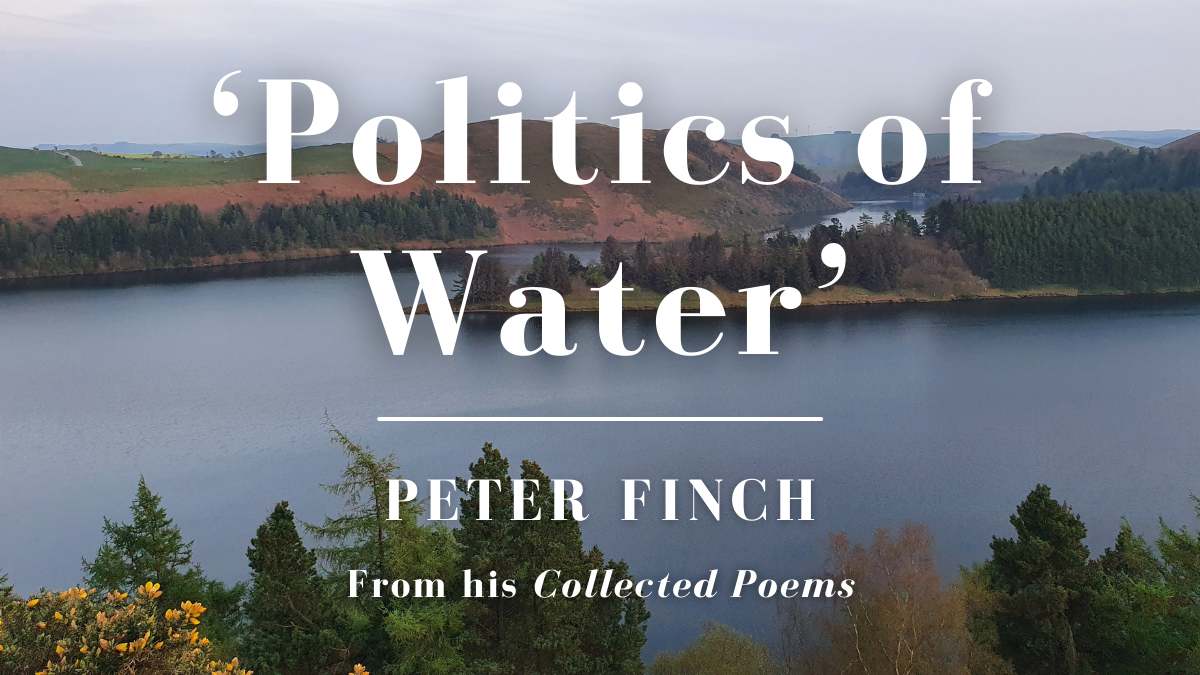
This week’s Friday Poem is ‘Politics of Water’ by Peter Finch. Originally published in his 1996 collection Math, it now features in Volume One of his newly publishedCollected Poems.
Peter Finch’s remarkable career spans over fifty years. He has been taking poetry to places it didn’t know it wanted to go from the beginning; blending the avant-garde, concrete, visual, sound, performance and more conventional forms to create something unique. His new two-volume Collected Poems, edited by Andrew Taylor, cement his reputation as one of Britain’s leading poets.
Volume One brings together work from long lost chapbooks, broadsheets and limited editions, as well as more conventionally published work. Volume Two focuses on the second half of Finch’s career with poems from later collections sitting alongside works from his prose books and those engraved in the public realm on sculptures, walls and buildings, particularly in his native Cardiff. Nerys Williams and Ian McMillan provide appreciative forewords to each volume.
Order the Collected Poems Complete Set on the Seren website for £30.00, or buy them individually for £19.99 each.
We launched the Collected Poems at Jury’s Inn in Cardiff earlier this week. Watch the live stream recording on demand on our AM channel now amam.cymru/seren.
This week’s Friday Poem is ‘Rhys’ by Rhian Edwards from her collection Clueless Dogs.
Clueless Dogs is the multi-award-winning debut collection by Rhian Edwards. Full of verve and humour, Rhian Edwards’ language has a winning honesty and intensity. Poems like ‘The Welshman Who Couldn’t Sing’ chronicle a fraught childhood in Bridgend, south Wales, where the sensitive child escapes through imaginative games of ‘Playing Dead’ and ‘Broken Lifeboat’. Later poems explore teenage lusts, student rivalries, damaged peers and tense situations. Although the author doesn’t flinch from ruthless depictions, in which we are often implicated by her use of the second person ‘You’, there is an underlying sweetness, an elegiac thread to this remarkable collection.
This week’s Friday Poem is ‘Samuel Taylor Coleridge Walking from The Queen’s Head…’ by Jonathan Edwards from his collection Gen.
Gen is a book of lions and rock stars, street parties and servants, postmen and voices. In the opening sequence’s exploration of youth and young manhood, the author sets his own Valleys upbringing against the 50s youth of his parents and the experience of a range of pop culture icons, including Kurt Cobain and Harry Houdini. These poems give way to a sequence of monologues and character sketches, giving us the lives of crocodiles and food testers, pianists and retail park trees.
This week’s Friday Poem is ‘Under One’s Hat’ by Hannah Hodgson from her debut collection 163 Days.
Hannah Hodgon is an award-winning poet and a palliative care patient. In her compelling debut collection163 Days, she uses a panoply of medical, legal, and personal vocabularies to explore what illness, death and dying does to a person as both patient and witness.
“Hannah Hodgson takes us to the paradoxical heart of poetry itself” – Caroline Bird
To celebrate Earth Day, this week’s Friday Poem is ‘The Creel’ by Kathleen Jamie from 100 Poems to Save the Earth.
Our climate is on the brink of catastrophic change. 100 Poems to Save the Earth invites us to fine-tune our senses, to listen to the world around us, pay attention to what we have been missing. The defining crisis of our time is revealed to be fundamentally a crisis of perception. For too long, the earth has been exploited. With its incisive Foreword from editors Zoë Brigley and Kristian Evans, this landmark anthology is a call to action to fight the threat facing the only planet we have.
100 Poems to Save the Earth invites us to fine-tune our senses, to listen to the world around us, pay attention to what we have been missing. The defining crisis of our time is revealed to be fundamentally a crisis of perception. For too long, the earth has been exploited. With its incisive Foreword, this landmark anthology is a call to action to fight the threat facing the only planet we have.
In Wild Places UK television naturalist Iolo Williams picks his favourite forty wildlife sites from the many nature reserves around the country. As this informative and lavishly illustrated book demonstrates, all forty places are packed with the widest variety of trees, plants, birds, animals and insects. Williams draws on his enormous knowledge to guide readers and visitors to the natural delights of each site. Wild Places will show them rarities like the osprey, where to find almost six hundred different species of moths, or an incredible 51 species of caddis fly. Readers will discover where to find birds, both rare and in huge numbers, where hares box and otters swim, where to spot dolphins and salmon, and where to see whales and sharks.
Carolyn Jess-Cooke’s new poetry collection is both keenly political and deeply personal. The opening poem ‘now’ features a seemingly peaceful domestic scene of a family lounging at home as the starting point for meditation on history, time, mortality and the fate of the planet: I think of what tomorrow asks and what is yet/ to be done and undone, how many nows make up a life/ and what is living. There are hints of a struggle with depression stemming from a difficult childhood, inspiring Jess-Cooke to express her experiences with her child and their autism diagnosis.
Resonant, complex, rich in heft and texture, these are mature poems that grapple with serious themes. André Mangeot’s Blood Rain opens with a deeply personal love poem (“Remember, too, our secret pool?”) that also introduces the natural world and it’s endangerment – one of several key themes in a book that addresses some of the most troubling man-made issues now facing us all. The second poem, ‘Bellwether’, reflects this: a subtle socio-political piece, a warning in a time of populism and radicalisation. This breadth of awareness and range is part of the collection’s appeal, giving the poems an urgent topicality and depth.
Much With Body is the startlingly original second collection by poet Polly Atkin. The beauty of the Lake District is both balm and mirror, refracting pain and also soothing it with distraction: unusual descriptions of frogs, birds, a great stag that ‘you will not see’. Much of the landscape is lakescape, giving the book a watery feel, the author’s wild swimming being just one kind of immersion. There is also a distinct link with the past in a central section of found poems taken from transcripts of the journals of Dorothy Wordsworth, from a period late in her life when she was often ill. In common with the works of the Wordsworths, these poems share a quality of the metaphysical sublime. Their reverence for the natural world is an uneasy awe, contingent upon knowledge of our fragility and mortality.
When Rosanne Alexander’s boyfriend Mike was offered the job of warden of Skomer, a small uninhabited island off the south west tip of Wales, they had just ten days to leave college, marry (a condition of employment) and gather their belongings and provisions for the trip to the island. This was the first of many challenges Rosanne and Mike faced during their ten years on the nature reserve, from coping with periods of isolation when they were the island’s only inhabitants, to dwindling food supplies during the winter when rough weather made provisioning from the mainland impossible. Thrown on their own resources they had also to deal with catastrophes like the devastation of the island’s seal colony following an oil spill.
The shaking city of Australian poet Cath Drake’s debut poetry collection is a metaphor for the swiftly changing precarity of modern life within the looming climate and ecological emergency, and the unease of the narrator who is far from home. Tall tales combine with a conversational style, playful humour and a lyrical assurance. The poet is able to work a wide set of diverse spells upon the reader through her adept use of tone, technique, plot and form.
Nia Vine is about to fulfil her dream of exploring an unmapped cave system. With her will go two friends who were brought up in the same seaside town. These companions are international travellers, but Nia, who has recently become a mother, feels her experience insignificant compared with that of her friends. While the three explore, Nia finds herself obsessed by a series of dreams that finally lead to a shocking revelation. Page-turningly evocative, immersive and compelling, Robert Minhinnick has written a novel in which realism and poetry collide and mingle.
In Dark Land, Dark Skies, astronomer Martin Griffiths subverts conventional astronomical thought by eschewing the classical naming of constellations and investigating Welsh and Celtic naming. Ancient peoples around the world placed their own myths and legends in the heavens, though these have tended to become lost behind the dominant use of classical cultural stories to name stars. In many cases it is a result of a literary culture displacing an oral culture.
Find these titles and many more on the Seren website serenbooks.com.
Create your free Seren account and enjoy 20% off every book you buy from us.
This week’s Friday Poem is ‘Somniloquy’ by Paul Henry from his new collection As If To Sing.
The power of song, to sustain the human spirit, resonates through As if to Sing. A trapped caver crawls back through songs to the sea; Welsh soldiers pack their hearts into a song on the eve of battle, ‘for safe-keeping’; a child crossing a bridge sings ‘a song with no beginning or end’… Rich in the musical lyricism admired by readers and fellow poets, As if to Sing is an essential addition to this poet’s compelling body of work.
“A poet at the top of his game.” – Radio Wales Review Show
This week’s Friday Poem is ‘When it Rains, I Think of You’ by Eric Ngalle Charles from his new collection Homelands.
In Homelands Eric Ngalle Charles draws on his early life raised by the matriarchs of Cameroon, being sent to Moscow by human traffickers, and finding a new home in Wales. Rich in tone, subject and emotion, Charles’ poetry moves between the present and the past, between Africa and Europe, and between despair and hope. It discovers that historical injustices now play out in new forms, and that family tensions are as strong as the love within a family. Despite the difficulties Charles has faced, Homelands contains poems of fondness, warmth and humour and, as he returns to Cameroon to confront old ghosts, forgiveness.
This week’s Friday Poem is ‘Four Poets in a Bookshop’ by Abeer Ameer from her debut collection Inhale/Exile.
Cardiff-based poet Abeer Ameer writes of her forebears in her first collection, Inhale/Exile. Dedicated to the “holders of these stories”, the book begins with a poem about a storyteller on a rooftop in Najaf, Iraq, follows tales of courage and survival, and ends with a woman cooking food for neighbours on the anniversary of her son’s death.