Posted on

Friday Poem – The Voice in which my Mother Read to Me

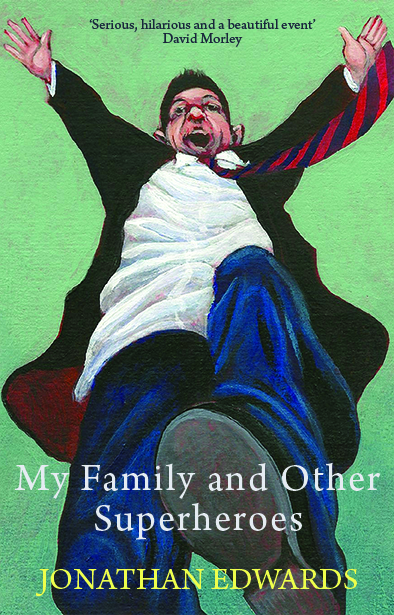
This cover shows a colourful painting of a school boy stomping with excitement viewed as if looking from the ground. The text reads: My Family and Other Superheroes, Jonathan Edwards.

The Friday poem is back f0r 2015 and we’re kicking off with The Voice in Which my Mother Read to Me from Jonathan Edwards’ Costa Poetry Award Winning collection My Family and Other Superheroes.

The Voice in which my Mother Read to Me

isn’t her good morning, good afternoon, good night voice,
her karaoke as she dusts, make furniture polite voice,
her saved for neighbours’ babies and cooing our dog’s name voice.

It isn’t her best china, not too forward, not too shy voice,
or her dinner’s ready, your room looks like a sty voice,
or her whisper in my ear as she adjusts my tie voice.

It’s not her roll in, Friday night, Lucy in the Sky voice,
her Sunday morning, smartest frock, twinkle-in-the-eye voice,
that passing gossip of the vicar with the Communion wine voice.

It’s not her ‘Gateau – no, ice cream – no… I can’t make the choice’ voice.
It’s not her decades late, fourth change, ‘Is this skirt smart enough?’ voice.
It’s not her caught me with the girl from number twenty-one voice.

That voice which she reserved for twelve-foot grannies, Deep South hobos,
that sleepy, secret staircase, selfish giants, Lilliput voice.
That tripping over, ‘Boy, why is your house so full of books?’ voice.

[soundcloud url=”https://api.soundcloud.com/tracks/183594834″]

My Family and Other Superheroes is available from the Seren website. Save 20% when you join our online book club.

Posted on

Friday Poem – Bitumen and Rust

The Hitting Game, Graham Clifford

This Friday, our poem Bitumen and Rust, comes from Graham Clifford’s collection The Hitting Game. The vibrancy of Clifford’s voice and the immediacy of his claims upon our attention are clear in this lively collection. Incidents are approached from disarmingly intimate and entertainingly oblique angles. These are urban poems where nature appears like a strange intrusion. There is gentleness and empathy, humour and pathos, with poems full of unexpected dramas and fresh enchantments, which provoke as well as delight.

Bitumen and Rust

In the end you didn’t buy an angle-poise light
called lack – it must mean something aspirational
in another language. Driving home, a green-brass prick

of a church wedged in-between semis began to glow
as if a prayer just got answered. As if. Polystyrene
tea in cup holders. Dirty little seas rich as slicks

of sewage-juice in ruts we trudged in a landscape
ruined with bitumen and rust, by slung piglet carcasses
still eyeing fly-tipped, shoddy white goods.

There is more than one disputed memory
We tug apart like foxes: under branches
Sweating out winter, the colder, wet side of freezing

I found clay pigeon shrapnel like smashed, thick 45s.
You first saw the sun drown in two ponds at the outskirts
Where, where we know turned in to where we don’t.

Spuds and beet surfaced from dirt, sick bits;
it was me that bit an onion like an apple. Barbed wire –
you slam on the brake so as not to kill

a man selling premature roses in the road.
Everyone is full of music to make it better.
Jittery clouds scarper to the margin like bath foam,

soap-touched. Suddenly, above us is baby blue.
You won’t be around forever; laugh: tea –
barbed wire that disappeared into tree bark.

Get it in time for Christmas! The Hitting Game is available to buy with 20% off when you join our online book club.

Posted on

Friday Poem – A Birthmother’s Catechism

This Friday’s poem, A Birthmothers Catechism, comes from Carrie Etter’s collection Imagined Sons. The giving up of a first-born son for adoption is the central story, and the way the ramifications of this act echo down the years through the protagonist’s life is movingly embodied. The poems describe various scenes in which the son is ‘encountered’. They are sometimes straight-forwardly realistic, almost like film clips; then there are dream slices full of surreal images; brief comedies or tragedies; and short lyrical laments. This is one of those brave, rare and heartfelt books that will stay with the reader. It has both a compelling urgency and a passionate purpose.

A Birthmother’s Catechism

What do you want?

After twenty hours on trains, I stand on the platform
and stare at I know not what

What do you want?

Rub the leaves between your fingers and smell a ripe lemon

What do you want?

When a stranger compares her mortgage to signing away
her firstborn, I nod and cannot speak

What do you want?

The hangman sold the rope by the inch as a panacea

What do you want?

Houndstooth daisies, in a small, extended fist

[soundcloud url=”https://api.soundcloud.com/tracks/179439755″ params=”auto_play=false&hide_related=false&show_comments=true&show_user=true&show_reposts=false&visual=true” width=”100%” height=”450″ iframe=”true” /]

Get Carrie Etter’s Imagined Sons here

Posted on

Friday Poem – Sea’s Answer

Short Days Log Shadows Sheenagh Pugh

This Friday’ poem, Sea’s Answer, comes from Sheenagh Pugh’s new collection Short Days, Long Shadows. Taking inspiration from the Shetland Islands, these poems are steeped in the wilder weathers and views of rugged coastlines, sweeping sea-vistas and the hardy historical characters who have inhabited these lands. There is a lovely pared-down spareness, and elegiac formality to  these poems, mixed with plenty of humour, and Sheenagh has as much to offer the general reader as it does the specialist, who will admire her artful use of traditional forms.

Sea’s Answer

I was talking to the sea the other day,
(you get that way, at my age)
and I said, I wish I knew why,

when I figure you, every image
fails me. They are, after all, accurate,
for what that’s worth: the scalloped edge

of lace, the beaten metal sheet,
pewter under cloud, copper at sunrise,
the pleated silk, anyone can see it,

and if they have been seen by many eyes,
still they are none the less true
the thousandth time. I don’t believe in clichés;

words don’t just stop working. But you
swallow each likeness, each true word
and spit it out, rejected; how

does that work?
                     Its stony throat wide,
the sea yawned, breathed out with the hawk
of a consumptive, and answered

“I am not like anything; you speak
of things made or named in my honour,
out of your own hunger, to be like
me. I am myself the metaphor.”

Get Short Days, Long Shadows here. Save 20% when you join our online book club.
Posted on

Jonathan Edwards Shortlisted For The 2014 Costa Poetry Award

This cover shows a colourful painting of a school boy stomping with excitement viewed as if looking from the ground. The text reads: My Family and Other Superheroes, Jonathan Edwards.

Jonathan Edwards has been shortlisted for the 2014 Costa Poetry Award with his debut book of poetry, My Family and Other Superheroes. The news comes just a few months after the collection was shortlisted for the Fenton Aldeburgh Poetry Prize.

The Costa Book Awards honour some of the most outstanding books of the year written by authors based in the UK and Ireland. There are five categories – First Novel, Novel, Biography, Poetry and Children’s Book.

Edward’s heroes are a motley crew: Sophia Loren, Marty Mcfly and Evel Knievel jostle for space on the pages alongside Valley’s mams and dads, The kebabby in Merthyr and the traditional Welsh costume.

The judges: Owen Sheers, Anna Dreda, and Charlotte Runcie said of Jonathan’s book:
“Joyful and dynamic – a collection that’ll make you laugh and make you think.”

Edward’s superheroes will have to fight it out with the likes of  Colette Bryce, Lavina Greenlaw and Kei Miller for the esteemed award. The category winner will be announced on 5th January with one of the five category winners chosen as the overall Costa Book of the Year later in the month.

Get a copy of Jonathan’s award worthy collection here. Save 20% when you join our online book club.

Posted on

Friday Poem – MIG–21 Raids at Shegontola

Midnight, Dhaka Mir Mahfuz Ali

This Friday’s poem, MIG–21 Raids at Shegontola, comes from Mir Mahufuz Ali’s debut collection Midnight, Dhaka. Rich in visual and aural descriptions, Mahfuz writes with a shocking directness about the atrocities he witnessed as a child in war-torn Bangladesh. In later poems his trauma becomes transformative, and his poetry the key to unlocking memories of a childhood that are rich in nuance, gorgeous in detail and evocative of a beautiful country. They celebrate the human capacity for love, survival and renewal.

MIG–21 Raids at Shegontola won the  2013 Geoffrey Dermer Prize for poetry. Mahfuz will be accepting the MDA award for best contribution to the Arts by an Asian artist presented by Julie Morgan, Am at a ceremony in Cardiff on 8th November.

MIG–21 Raids at Shegontola

Only this boy moves
between the runes of trees
on his tricycle
when an egle swoops,
releases two arrows
from it’s silver wings and melts
away faster than lightning.
Then a loud whistle
and a bang like dry thunder.
In a blink the boy sees
his house roof sink,
feel his ears ripped off.
The blast puffs up a fawn of smoke
bigger than a mountain cloud.
The slow begonias rattle
their scarlet like confetti.
Metal Slashes
the trees and ricochets.
Wires and pipes snap
at the roots, quiver.
The whirling smoke packed
witch bricks and cement,
chicken feathers and nigella seeds.
When the cloud begins
to settle on the ground,
the boy makes out buckled iron rods.
White soot descents
as he finds himseld dressed
like an apprentice baker.

Get 20% off Midnight, Dhaka when you join our online book club.
Posted on

Friday’s Poem – A Birthmother’s Catechism (September 11, 1986)

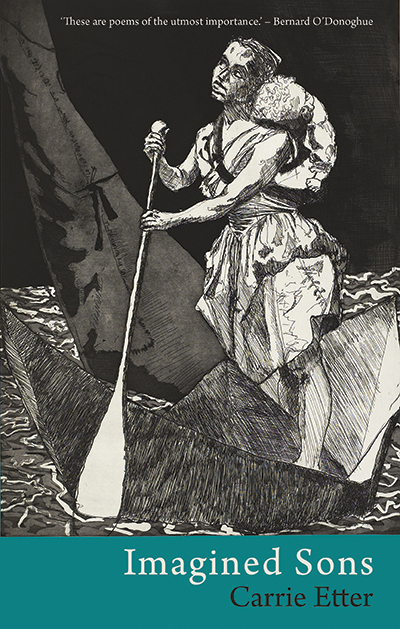
imagined Sons Carrie Etter

This Friday’s poem, A Birthmother’s Catechism (September 11, 1986), comes from Carrie Etter’s collection Imagined Sons, A book of vivid, heartbreaking poems on the experience of giving up a child for adoption. Etter imagines the possible destinies for the child and presents us with various scenarios from the tragic to the absurd: a baker, a surfer, a rapist, even the olive in her Greek salad.  Dispersed among these narratives are the ‘Birthmother’s Catechisms’, These narratives provide numerous answers to persistent questions, How did you let him go? What is the anniversary of loss?

A Birthmother’s Catechism (September 11, 1986)

What is the anniversary of loss?

A national day of mourning

Really now, what is the anniversary of loss?

My mother and I watch TV well past her usual bedtime

What is the anniversary of loss?

Where the swan’s nest had been, widely scattered branches and some crumpled beer cans

What is the anniversary of loss?

Sometimes the melancholy arrives before the remembering

What is the anniversary of loss?

Some believe it is impossible to spend too much on the memorial

What is the anniversary of loss?

When I say sometimes the melancholy comes first, I know the body has its own memory

What is the anniversary of loss?

The wishbone snapped, and I clung to the smaller piece

Posted on

Pascale Petit Shortlisted for the 2014 TS Eliot Prize

Pascale Petit

Pascale Petit has been shortlisted for the 2014 TS Eliot Prize for the fourth time with her collection Fauverie, A collection every bit as vivid and emotive as the art of the Fauves that the title evokes.

Described as ‘the prize most poets want to win’ (Sir Andrew Motion, former Poet Laureate) and ‘the world’s top poetry award’ (Irish Independent), the TS Eliot prize is awarded to the author of the best new collection of poetry published in the UK and Ireland each year.

Pascale has previously been shortlisted for the TS Eliot prize with her earlier collections The Zoo Father (2001, Seren), The Huntress (2005, Seren) and What the Water Gave Me: Poems after Frida Kahlo (2010, Seren).

Pascale will be reading alongside ten fellow shortlisted poets including Fiona Benson, Ruth Padel and Michael Longley at the Southbank Center’s Royal Festival Hall on 11th January, with the winner of the £20,000 prize being announced at an awards ceremony on the 12 January 2015.

Helen Dunmore will chair the judging panel for the 2014 prize alongside Sean Borodale and Fiona Sampson.

Posted on

Friday Poem – There’s no such thing as pandas

What if I told you that pandas weren’t real? That they were just people in suits? This Friday’s poem, There’s no such thing as pandas, taken from Katherine Stansfields collection Playing House, suggests just that. A concise wit, a distinct voice and an unsettling view of the domestic characterise these poems whose subjects are the ordinary as viewed through the author’s satirical yet sympathetic eye.

There’s no such thing as pandas

I cut my teeth on Newsround where ‘And finally’
meant pandas: pandas on planes, panda love
at London Zoo, the Queen unveils a new panda.
There was something about them, even then.
Those tricks-of-a-hypnotist eyes. The big pads
moving like hands. Were they shoes
inside the feet? I wasn’t sure until I saw
the sneezing baby make her mother
lurch in shock on YouTube. Then I knew:
pandas are just people in suits, having us on.

Don’t miss Katherine reading at the Aberystwyth Arts Center bookshop on Thursday 23rd October at 6:30pm. Find out more.

Posted on

Friday Poem

This Friday’s poem, Nun on a Bicycle, comes from Jonathan Edwards’  debut collection My Family and Other Superheroes. A collection that takes inspiration from the unlikeliest of subjects including: Sophia Loren, the kebabby in Merthyr and a nun on a bicycle, My Family and Other Superheroes has been shortlisted for the Fenton Aldeburgh First Collection Prize. The winner of the esteemed award will be announced at the Aldeburgh Poetry Festival in November.

Nun on a Bicycle

Now here she comes, rattling over cobbles,
powered by her sandals, the gentle downhill
and the grace of God. Now here she comes, her habit

what it was always waiting to become:
a slipstream. Past stop signs, the pedestrian
traffic at rush hour, the humdrum mopeds,

on a day already thirty in the shade:
with her robe fluttering like solid air,
she makes her own weather. Who could blame her,

as the hill sharpens, she picks up speed and smiles
into her future, if she interrupted
the Our Fathers she’s saying in her head,

to say Whee, a gentle Whee, under her breath?
O cycle, sister! Look at you now, freewheeling
through the air conditioning of the morning –

who’s to say the God who isn’t there
isn’t looking down on you and grinning?