Posted on

Guest post: Maths and Metaphor – Judy Brown

Judy Brown’s new collection Lairs was partly born out of a residency Exeter University’s Institute of Data Science and Artificial Intelligence. In this guest post she discusses the experience and how maths and poetry have more in common than you might think.

This cover shows a sci-fi inspired collage of a girl sitting in a field at dusk looking towards a black, star filled orb in the distance. Red mountains rise up behind it beneath a purple sky. The text reads: Lairs, Judy Brown.

Lairs brings together something primal and secret – the lair as haven for a wild or feral animal – with the poem framed as a mathematical equation. In these terms, the ‘lair’ is a kind of nest, a beautiful accumulation of dense detail. The poems are introspective, by turns mocking, fearful and analytical. Judy Brown’s use of language is innovative, while maintaining moments of vulnerability and moving self-awareness. In these exquisite poems, the lair is both the community at large and a dark and intricate interior space where something wild still survives.

Maths and Metaphor

Before this summer, if someone had told me maths could be as much fun as writing poems, it wouldn’t have been a long chat. Professor Beth Wingate, mathematician and poet, did say as much to me in July but by then it was too late: it had become obvious. Residencies teach you things – often not what you expected.

This was a summer of empty campus lawns, rain, whiteboards crammed with notation, hours spent looking up half-heard maths phrases on Wikipedia, metaphors I splashed everywhere and tried to hold onto to avoid panic, attempts not to look stupid, looking stupid despite everyone saying, kindly, ‘There are no stupid questions.’ And lots of questions, lists of them collected amongst my drawings and notes in a big A3 sketchbook – a necessary navigation aid in this slightly frightening, very exhilarating experience. This sort of messy process is how I write anyway, I just hadn’t ever been quite so at sea. 

Stacks of sketch books from Judy's residency. The pages are filled with notes, pictures and bright sketches.
Judy Brown’s residency sketchbooks

To backtrack a little: Arts and Culture University of Exeter has a programme that matches creative practitioners with research academics. The area under consideration can be quite sharply defined, the methodology and the outcome full of openness. I’d been attracted by the measured strangeness in the language used by Professor Peter Challenor, a statistician whose work involves producing approximations of what complex mathematical models (of the human heart, the ocean, the climate) would be likely to predict across a wide range of situations, together with exact assessments of how much you can rely on those predictions. The models themselves are often too expensive and slow to be run as many times as you’d like – just like the planet and the human body – so the techniques used by Peter’s team in the Institute of Data Science and Artificial Intelligence are of critical value, but also a little magical, seeming to create bricks out of straw. 

Peter had said in his brief ‘There is always a discrepancy,’ but I had no idea how many sorts of discrepancy existed. The team’s specialisation is called uncertainty quantification – and when didn’t a poet love a paradox?

I was lucky. Peter turned out to be interested in everything, a member of the Poetry Book Society, and an eloquent explainer who could shift in and out of maths notation and take up my hesitant and extravagant metaphors to talk to me in a language I knew. 

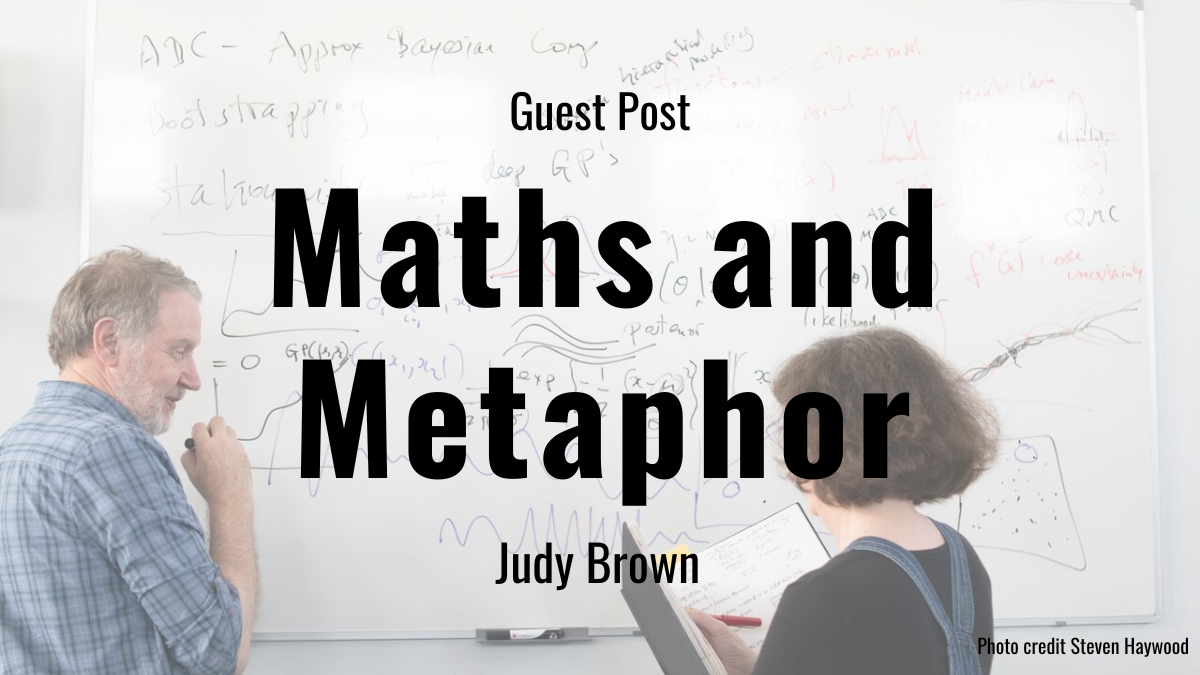
Judy Brown takes notes in her sketch book whilst Peter Challenor maps out an equation on a large whiteboard.
Judy Brown and Professor Peter Challenor. Photo credit: Steven Haywood

I had five weeks of great conversations – about writing on proper blackboards, machine learning, the problems of multidimensionality, different types of probability, heart surgery, whether a mathematical model is a metaphor, the importance of pattern and of deviations from it.  We talked about Jack Underwood’s essay ‘On Poetry and Uncertain Subjects’ (The Poetry Society) – how our kind of uncertainty made poems hospitable, how unacknowledged uncertainty for Peter made things dangerous.

I only have a maths GSCE but I wasn’t too worried. I quite like feeling a subject is full of things I don’t know and knew that the not-knowing would itself generate ideas that would lead to poems. In the end I felt I’d been allowed to walk further into another world than I anticipated, with tiny, occasional flavours of what it might be like to know how to move in those regions as of right. As with poetry, it turns out that even small amounts of maths are worth having.

I knew that metaphor is what I think with, and where many of my poems originate – it’s central, not decorative. The fact that I couldn’t think anything without it was demonstrated very clearly over these weeks when I kept asking ‘What is it like in there?’, ‘What kind of creature is it?’ That was our difference, maybe – the poet’s obsession with specificity where a small precise detail stands in for a big abstract thing. Or maybe it’s not so different, I still don’t know.

The experience also underlined the importance of play for writing, and for problem-solving. At school I always wanted a structure to put what I learned in – that’s often what a teacher gives you – a particular shaped bucket, and you fill it. Here I had no time to get even a small bucket; there were only the structures I already had – metaphor, language, question, answer, and sometimes just the process of sitting and drawing.

Close up picture of notes from one of Judy's sketchbooks. The word language stands out in bold black letters.
Close up of one of Judy’s sketchbooks

This was semi-feral learning in the sense that when people told me about their work I was able to choose the questions and Peter’s team worked to give me answers that might make sense in the language of the asking. I also tried to learn as much of their talk as I could – even a few equations. It felt amazing for someone middle-aged to be learning in this essentially childlike way, like a car wash for the brain. It felt just like writing.

I’ve written quite a few poems from this – now on the Arts and Culture website and in issue 2 of Finished Creatures magazine, and migrating into the manuscript of my next collection Lairs. I have lots more drafts and ideas. While the maths is not always apparent, I couldn’t have written them without that huge new space in my head. I’m slowly reading a book about calculus and watching the odd MIT lecture or Isaac Newton Institute seminar on probability or uncertainty quantification. It still feels flukey, strange, to be treasured.

Judy Brown

Read Judy’s maths-inspired poem ‘Some Security Questions’ on the Exter Arts and Culture website.

‘Uncertain Rigours’, a short film by Steve Haywood about the residency, can be viewed on the Exter University Arts and Culture website.

This article was first published by The Poetry Society in their Winter 2019 edition of Poetry News.

Lairs is available on the Seren website: £9.99

Create your free Seren account and enjoy 20% off every book you buy direct from us.
Posted on

Guest post: Zoë Brigley – What is Ecojustice?

In this guest post Zoë Brigley, co-editor of landmark anthology 100 Poems to Save the Earth, looks at ecojustice – what it is, why it’s important – and talks about its place within the anthology and in poetry more widely.

100 Poems to Save the Earth. Edited by Zoë Brigley and Kristian Evans.

Our climate is on the brink of catastrophic change. 100 Poems to Save the Earth invites us to fine-tune our senses, to listen to the world around us, pay attention to what we have been missing. The defining crisis of our time is revealed to be fundamentally a crisis of perception. For too long, the earth has been exploited. With its incisive Foreword from editors Zoë Brigley and Kristian Evans, this landmark anthology is a call to action to fight the threat facing the only planet we have. 

What is Ecojustice?

After recently publishing 100 Poems to Save the Earth with Kristian Evans, I received many questions about ecojustice. With resolutions for the new year being made, this felt like a good time to talk about why ecojustice is important, and to spotlight some of the poets from the anthology.

In basic terms, ecojustice links ecological movements to global social justice movements, a move which is necessary because sometimes environmental movements have been coopted by groups with racist or bigoted agendas. (See this article in The Guardian by Jeff Sparrow on eco-fascism). Ecojustice refuses environmental narratives based on restricting or blaming people with fewer privileges, but instead listens to the voices of social justice activists. Very often, groups with fewer privileges experience most acutely the deprivations and hardships caused by climate crisis. Environmental changes are already horribly real for populations in the Global South. There are also, however, more direct connections between the active oppression of groups with fewer privileges and environmental exploitation.

Earlier this year, I spoke to scientist Kerry Ard about economic inequality and pollution, and how certain neighborhoods in American cities (often inhabited by low-income people, often of the global majority) are sidelined when it comes to their needs for clean air and unpolluted water. The obvious example is the water crisis in Flint, Michigan – I strongly recommend the documentary Flint: Voices from a Poisoned City by Elise Conklin. Or you could take for example the oil pipelines in the US that damage Native communities environmentally but also in terms of rising sexual violence against Native women. Here’s an interesting article too that explains the links between #BLM, racial justice and climate justice.

So social justice and climate justice are not two separate projects, and according to Raisa Foster and Rebecca A. Martusewicz, ‘Environmental and social impoverishment can be traced to the same deeply embedded cultural ways of thinking and being that our industrialized systems use and are created from’. Foster and Martusewicz hint at something that many writers have emphasized – see Wendy Wheeler in A New Modernity (1999).  The Baconian, empirical worldview dominating Western thinking has also caused deep, intractable problems.

Foster and Martusewicz describe how dualism in ‘Western industrial society’ has dictated ‘where we locate value’ and ‘what we learn to identify as inherently inferior or superior’. They conclude: ‘Social and ecological violence is born in and maintained by this fundamentally violent hierarchical structure:  culture–nature,  mind–body,  reason–emotion,  man–woman, and civilized–savage’. Thinking in the context of Latin America – a contested site of some of the most biodiverse areas in the world, Verónica Schild suggests that dualistic thinking is inherent in a capitalist society, as capitalism seeks to extract value from sites of nature as well as poor women, both of which exist on the other side of a constructed binary. She also notes that many indigenous activists have already made the connection between the capitalist shaping of nature and the shaping of women’s lives. Although our anthology was mainly focused on writers from the UK and Ireland, we did give a flavour of writing from around the Anglophone world, including indigenous poets like Carter Revard, Gwen Nell Westerman, Craig Santos Perez, and Ellen van Neerven.

"We cannot live / with the seas in our bellies" - Ellen van Neerven, 'Love and Tradition'

van Neerven is an award-winning writer and editor of Mununjali Yugambeh (Southeast Queensland) and Dutch heritage. van Neerven indicated in interview that her work has parallel themes that are ‘environmental’ and ‘anti-government.’ This comes together in van Neerven’s poems as, in Jeanine Leane’s words, ‘In this built-up and built-over environment the poet asserts the continuation of Aboriginal culture’ and ‘Australia is a nation imagined and constructed over many Aboriginal nations.’ Leane sees in van Neerven’s work the importance of ‘the role of women as gatherers of often small but essential items of food that sustain the clan – lizards, insects, bugs, berries, fruits, frogs, seeds, tubers’ but also ‘as gatherers and keepers of family histories, knowledge and secrets from Country that are handed down to nurture and sustain future generations.’

In 100 Poems to Save the Earth, we included ‘Love and Tradition,’ dedicated to van Neerven’s Aunty Nancy Bamaga. The poem is a prayer registering the danger of rising sea levels. Sparsely written, ‘Love and Tradition’ carefully maps out the problem while also calling on the wider community to recognise the effects on the indigenous community. van Neerven poses what Leane calls ‘the everyday activism that occurs in the Aboriginal home, differing from the more public or “loud” expressions of activism’ but posing ‘the home front as a sovereign space of nurture, growth and actualisation.’ 

There are many other poets in the anthology writing about ecojustice. For example, Ross Gay’s poem, ‘A Small Needful Fact,’ emphasizes the nurturing work of Eric Garner at the Parks and Rec, before he was killed in a racist murder by police. Kazim Ali in ‘Checkpoint’ emphasizes the pettiness of customs officials juxtaposed with portentous events in nature which seem to accuse humanity. The Cyborg Jillian Weise explores the body and nature in the context of disability, commenting on the hierarchies and judgements imposed on both. Sean Bonney’s ‘Our Death / What If the Summer Never Ends,’ Erin Robinsong’s ‘Late Prayer’ and many other poems in the anthology call out capitalism and its detrimental effects on nature and people.

"Some of us voted. Some of us put on balaclavas. There were several earthquakes. Endless strategies of tedious indifference. Some major buildings and some statues defaces. Declaration of endless war. Parties in the park. Criminalisation of drinking. Several dead friends." - Sean Bonney, 'Our Death / What If the Summer Never Ends'

Many poems speak of ecojustice in global terms. In interview with Nicholas Wroe, Welsh/Indian poet Tishani Doshi has commented on how transnationally, women often ‘have to navigate economic and environmental hostilities’. In Doshi’s work, concerns for women and for the environment mingle and jostle, and she also challenges the centrality of human beings over nature or the greater-than-human. In ‘Self’, the poem included in the anthology, there is an acknowledgement that the world does not necessarily need people. Also thinking on a global scale, Vidyan Ravinthiran’s ‘More Context Required’ seems to grapple with global circulation of information about climate crisis and social justice, which can’t be fathomed from ‘beautiful computer-generated maps.’ Other poems register how war creates disconnectedness from land and people, as populations are killed by remote control. Mir Mahfuz Ali comments on the violence of war in ‘MIG-21 at Shegontola,’ where a boy riding a bicycle seems to be the only survivor of an idyllic rural community destroyed by missiles.

Some poets speak from a spirit of hope in the face of climate and social injustice. Roger Robinson’s ‘A Portable Paradise’ turns to wisdom from his grandmother about rewilding ourselves – carrying a paradise within us in spite of injustices we may face. Registering awe of the greater-than-human, Carter Revard describes a happy afternoon as two Native boys explore nature in ‘Over by Fairfax, Leaving Tracks.’ The poem extends into networks of global capitalism, across time and space towards a profound thought about how nature might be preserved in our memory – if we survive.

"stippled tracks from soles made / in Hong Kong, maybe with Osage oil. / Lawrence and Wesley pick blue-speckled flints / along our path, one Ponca boy / in braids, one part Osage / in cowboy hat." - Carter Revards, 'Over by Fairfax, Leaving Tracks'

What you won’t find in the anthology are moralizing or didactic poems for the simple reason that we don’t think they are very effective. As we suggest in the anthology introduction, poems that work through clichéd or even moralizing trains of thought can be easily dismissed. Poems that seek to make people – already feeling immense guilt about climate crisis – to feel even more guilty don’t help. People are moved to act far more out of inspiration, hope and – yes! – sometimes fear than out of guilt. What tends to happen more often with didactic writing is that people turn away and put their heads in the sand.

That doesn’t mean that these poems aren’t moving, inspiring, brilliant, or that they don’t work on the reader in significant and subtle ways to make those connections between damage to people and the environment. According to Foster and Martusewicz, ecojustice proceeds ‘from the fundamental acknowledgment that humans are utterly dependent upon a complex and diverse ecological system,’ and ‘damages to the ecological system are damages to ourselves’.

Zoë Brigley

Books and Articles to Read

Leane, Jeanine (2020) ‘On the Power to Be Still’: rev. Throat by Ellen van Neerven. The Sydney Review of Books, August 3rd. https://sydneyreviewofbooks.com/review/van-neerven-throat/

Foster, Raisa and Rebecca A. Martusewicz (2018) ‘Introduction.’ Art, EcoJustice, and Education: Intersecting Theories and Practices, ed. Raisa Foster, Jussi Mäkelä, and Rebecca A. Martusewicz. London: Routledge: pp 1-9 (p. 1, 3).

Schild, V. (2019) ‘Feminisms, the Environment and Capitalism: On the Necessary Ecological Dimension of a Critical Latin American Feminism’, Journal of International Women’s Studies, 20(6), pp. 23–43 (p. 25). Available at: https://search-ebscohost-com.proxy.lib.ohio-state.edu/login.aspx?direct=true&db=qth&AN=137364832&site=eds-live&scope=site (Accessed: 15 October 2021).

Wroe, Nicholas. ‘Tishani Doshi: “I can go out alone at night but the dangers don’t go away.’ The Guardian, 27 July. https://www.theguardian.com/books/2019/jul/27/tishani-doshi-interview

Note

This article is based on a paper, ‘Justice, Ecologies, and Transnational Feminist Poetics: What Poetry Has to Say About Ecojustice’ given at the National Women’s Studies Association (NWSA) Convention this past October 2021. Thanks to the NWSA for including this paper.

Zoë Brigley is a poet and academic who has three PBS recommended poetry collections: The Secret (2007), Conquest (2012), and Hand & Skull (2019) (all from Bloodaxe). She has also published a collection of nonfiction essays Notes from a Swing State (Parthian 2019) and several chapbooks. She is Assistant Professor in English at the Ohio State University where she produces an anti-violence podcast: Sinister Myth. She won an Eric Gregory Award for the best British poets under 30, was Forward Prize commended, and listed in the Dylan Thomas Prize. She is the current editor of Poetry Wales Magazine.

100 Poems to Save the Earth is available on the Seren website: £12.99

Create your free Seren account and enjoy 20% off every book you buy from us.

Posted on

Guest Post – Polly Atkin: On Co-Tenancy 

In Much With Body I wanted to write into and around the relationship between us – as individuals, as humans – and the ecosystems we live in. I wanted explore to what Sarah Jaquette Ray and Jay Sibara call the ‘contingency between environments and bodies’ that is central to disability poetics, with a focus on the particular environment I have made my home.[1] In many ways this is an extension of conversations begun in my previous collection, Basic Nest Architecture, which revolve around questions of belonging, of location and dislocation, of co-habitation, of what it is to live in a sick body in an ailing world. I’ve always found it difficult to separate myself from my environment, to draw a clear line or apprehend a solid barrier between me and the rest of the world, to be certain what is internal or external. This sense of permeability, coupled with a complicated sense of bodily risk, determines all of my encounters with the world, all of my movements through it.

Photo of a deer on a hillside.

I wanted to bring that sense of permeability into these poems – from those drawn from Dorothy Wordsworth’s Rydal Journals, that place rain and pain in parallel, both leaching in an out of the body – to the poems about the frogs and toads who come into our house every summer. We are none of us able to call ourself separate from one another.

Photo of a frog

There is a kind of eco-poetry, and a broader kind of nature writing, that wants to remove the human observer from the observation, to cut out the body of the writer from the writing. It sees the human as degrading the nonhuman, as distracting, diverting essential attention. I can’t help seeing this tendency in nature writing to blot out the body of the writer as coupled to the tendency Virginia Woolf writes about in her essay ‘On Being Ill’ to present the body as a clear pane of glass to see the world through. I am not a clear pane of glass. My noisy, interrupting body never lets me forget its presence. As Woolf writes, ‘all day, all night, the body intervenes’. To me the relationship between the intervening body and the other outside is the poem. To pretend otherwise is the distraction.

Photo of an owl amongst the branches of a tree.

I wanted to bring the intervention of the body into the foreground of these poems, whether they are centred on an encounter with a deer, or an owl that won’t be photographed, or a disappearing hospital, or the body’s internal machinations. I cannot write an owl, but I can write myself observing an owl, what observing it in my body gives me, what the co-presence of our bodies in the same space does, what it changes, what it enables. I wanted to write about co-habitation, about co-tenancy of a shared home, whether that is a woodland, society, or our bodies. Luckily for me, my co-tenants were obliging.

Polly Atkin

This cover shows a painting of a swimmer floating on her back in a blue green lake.

Much With Body is the startlingly original second collection by poet Polly Atkin. The beauty of the Lake District is both balm and mirror, refracting pain and also soothing it with distraction. Much of the landscape is lakescape, giving the book a watery feel, the author’s wild swimming being just one kind of immersion. There is also a distinct link with the past in a central section of found poems taken from transcripts of the journals of Dorothy Wordsworth, from a period late in her life when she was often ill. In common with the works of the Wordsworths, these poems share a quality of the metaphysical sublime. Their reverence for the natural world is an uneasy awe, contingent upon knowledge of our fragility and mortality.

Polly Atkin’s latest collection Much With Body is available on the Seren website: £9.99

Create your free Seren account and enjoy 20% off every book you buy direct from us.


[1] Sarah Jaquette Ray and Jay Sibara, ‘Introduction’, in Disability Studies and the Environmental Humanities Toward an Eco- Crip Theory, ed by Sarah Jaquette Ray and Jay Sibara (Lincoln & London: University of Nebraska Press, 2017), p.1.

Posted on

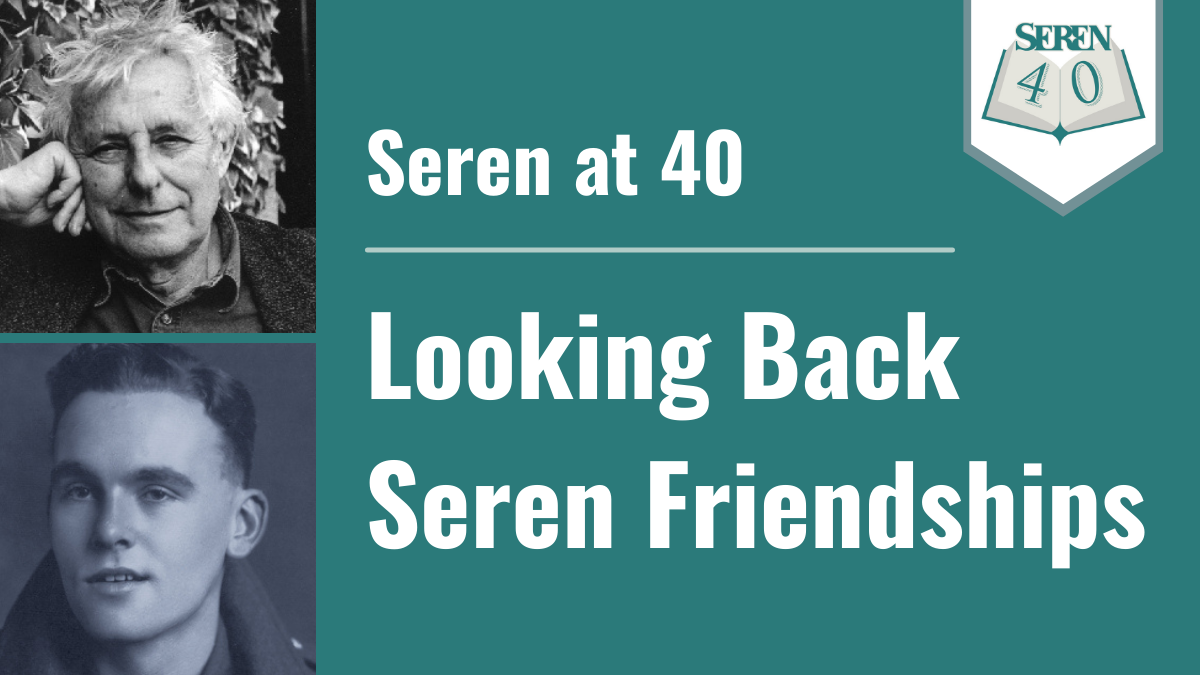
Seren at 40: Looking Back – Seren Friendships

As we continue to celebrate our 40th anniversary, our founder Cary Archard looks back at some of the long-lasting friendships which helped Seren grow into the press it is today.

Seren Friendships

Looking back, I’m struck by how important friendships have been to Seren’s progress the last forty years. ‘They came into our lives unasked for’ is the first line of ‘The Uninvited’, the first and earliest poem in Dannie Abse’s Collected Poems. I first met Dannie at a reading soon after he and his wife Joan bought Green Hollows, their home in Ogmore-by-Sea, in the early Seventies. It was the start of a forty year friendship. From the beginning of Seren, Dannie was an enthusiastic supporter, always particularly keen we should encourage and develop our poets. When within a year of start-up, running things from home became physically impossible, my living room already overflowing with parcels of books and a bigger space needed, Dannie offered the use of the annexe to his Ogmore house.

Black and white photo of poet Dannie Abse.
Dannie Abse

Ogmore-by-Sea was a wonderful place to be based. From the upstairs office window you could look across the grey sea to Devon or muse on the terrors of ‘the eternal, murderous fanged Tusker Rock’ (‘A letter from Ogmore-by-Sea’). Across the road was the Craig-yr-Eos Hotel (since turned into flats) where at lunchtimes you could discuss work over a pie and seek inspiration at the bar. Subsequent office locations have never been so romantic or so characterful. Seren’s super modern, hi-fied, all modcons, present office in the middle of Bridgend just doesn’t have the same charm. Looking back it’s tempting to think that life generally was better then, the pace slower, the publishing world kinder. A time when friendship influenced the decisions. Pressure now seems greater. Success however modest has its price perhaps. Dannie has been much missed since his death in 2014.

(A footnote: Dannie’s wonderful autobiographical novel, Ash on a Young Man’s Sleeve set in Cardiff in the thirties and Forties, published in 1954, never appeared on my Cardiff grammar school syllabus; instead for O level we were offered Harrow and the British army in Churchill’s My Early Life.)

From one chance friendship to another. Also in the early Seventies, I found myself teaching English in the Cynon Valley where I had grown up. I’d applied for the post of a history teacher in Swansea but missed the deadline for applications. Some kind officer in the Glamorgan office had noticed I had appropriate qualifications and sent me the details of the English job. I was lucky. Fortunate also to have arrived there just before Mrs Lewis, highly respected and loved Senior Mistress and German teacher, retired. So it was, ‘totally unasked for’, that I became a colleague of Gweno, wife of Alun Lewis (1915-1944), one of Wales’s finest twentieth century writers. At the time, I knew next to nothing about Lewis’s poetry and stories, even though I had grown up in the same valley. And as far as I can remember, his name had never been mentioned in my grammar school education.

Covers of Morlais, Alun Lewis Collected Poems and Alun, Gweno and Fred (John Pikoulis)
Covers of Morlais, Alun Lewis Collected Poems and Alun, Gweno and Freda (John Pikoulis)

Gweno and I became friends. It was a friendship which led to Seren’s most important publishing achievement, namely the publication of Alun Lewis’s Collected Poems, Collected Stories, and his Letters to my Wife. (Lewis is a wonderful letter writer; comparing him to Keats no exaggeration.) When Gweno returned to her family home in Aberystwyth, I often made that steep climb to ‘The Chateau’, a striking red house, high on the hill overlooking the bay. We talked about Alun, the young Cynon Valley boy (he was under thirty when he died in Burma), his family (I got to know Mair his sister later on), her involvement in his second book of poetry, Ha! Ha! Among The Trumpets, her guardianship of his reputation, and the progress of John Pikoulis’s biography. To be entrusted to publish the author’s work by his wife was a remarkable privilege. It was an unforgettable day when on one visit she brought me a packet inside which was a faded manuscript tied in a red ribbon. It was Alun’s copy of his unpublished early novel, Morlais, which Seren published in 2015, Lewis’s centenary. Just in time. Gweno sadly died the year after.

Cary Archard

Dannie Abse: A Source Book is available on the Seren website: £14.99

Morlais by Alun Lewis is available on the Seren website: £12.99

Create your free Seren account and enjoy 20% off every book you buy direct from us.

To celebrate our anniversary we’re asking our readers to share their favourite Seren books from the last 40 years on social media. Tag us in your photos on Twitter, Instagram and Facebook using the hashtag #Seren40.

Find out more about how Seren was founded in our previous Seren at 40 post: In the beginning