Posted on

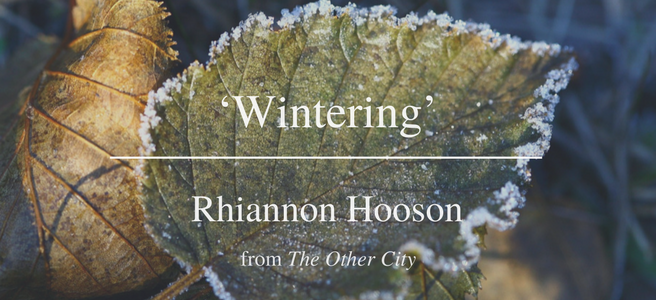
Friday Poem – ‘Wintering’, Rhiannon Hooson

Friday Poem Rhiannon Hooson Wintering

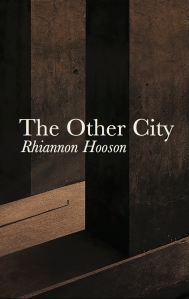
Rhiannon Hooson’s incredible debut collection, The Other City, has just appeared on the Wales Book of the Year shortlist – and this week our Friday Poem is one from its pages: the seasonally-appropriate ‘Wintering’.

The Other City Rhiannon HoosonThe Other City offers us elegant, artful verse of precision and insight. Sharply focused, beautifully resonant, deeply felt, these poems tend to travel in distinct streams: characters like Zeus, Narcissus, Ariadne, and Ganymede sit alongside reworkings of Welsh history, both ancient and modern. Other poems explore the idea of otherness and the uncanny, where actions are done and undone, and the familiar made unfamiliar.
This is a poet who can re-imagine scenes from Greek myth, from Welsh history, and make them as urgent and compelling as her poems about personal relationships.


Rhiannon Hooson Wintering


The Other City is available from the Seren website: £9.99

Join our free Book Club for 20% off every book you buy from us.


Posted on

Friday Poem – ‘Drumlins have no personality’, Siobhán Campbell

Friday Poem Drumlins Siobhán Campbell

Our Friday Poem this week is Siobhán Campbell’s ‘Drumlins have no personality’, from her latest collection, Heat Signature.

Heat Signature Siobhan CampbellSiobhán Campbell’s poetry is of a strange breed: simultaneously comic and brutal, intelligent and whimsical. In Neil Leadbeater’s newly published review, he points to the ‘profoundly challenging and entertaining’ nature of Campbell’s new poems. Heat Signature is Siobhán’s sixth collection, and its complex style is entirely characteristic of the poet’s spikey voice: infused with an intelligence that resists easy answers to the conundrums that have faced her Irish homeland, but also suffused with a grudging admiration for the citizens who have survived their tumultuous history.

A note on the poem: drumlins are small hills shaped like half-buried eggs, formed by underlying glacial ice. The name comes from the Irish word droimnín (“littlest ridge”).


Siobhán Campbell Drumlins


Heat Signature is available on the Seren website: £9.99

Join our free Book Club for 20% off every book you buy from us.


Save

Posted on

Friday Poem – ‘The Children’s Asylum’, Pascale Petit

This week our Friday Poem is ‘The Children’s Asylum’ by Pascale Petit, which was originally published in The Huntress, and later featured in Tokens for the Foundlings, an anthology inspired by the Foundling Hospital.

Established in 1741, The Foundling Hospital was essentially Britain’s first orphanage, and admissions were catalogued by tokens – coins, scraps of ribbon, needlework – symbols of maternal hope left by the children’s parents. Tokens for the Foundlings is an anthology of poems about orphans, childhood and family inspired by and supporting the work of the Foundling Museum in Bloomsbury. It brings together many of the finest poets from Britain, Ireland and the USA, among them Seamus Heaney, Carol Ann Duffy, Gillian Clarke, and our featured poet today, Pascale Petit.
The Huntress is Pascale’s T.S. Eliot shortlisted third collection, and re-imagines a painful childhood through a series of remarkable and passionate transformations.

Petit says, “I wrote ‘The Children’s Asylum’ after my mother died, and left a trunk of journals and letters in which I found her description of being committed to a “loony bin” when she was nine years old. Later in life her mental illness became worse, and it’s this that I wrote about in my seventh collection Mama Amazonica (Bloodaxe, 2017), where the “madwood” of ‘The Children’s Asylum’ has turned into the whole Amazon rainforest, and her psychiatric ward is a place haunted by giant talking water lilies, jaguars, caimans and hummingbirds.”


The Children's Asylum Pascale Petit Friday Poem


The Huntress is available on the Seren website: £7.99

Tokens for the Foundlings is available on the Seren website: £12.99
(all royalties from sales are donated to the Foundling Museum, in support of its work)

Join our free Book Club for 20% off every book you buy from us.


Posted on

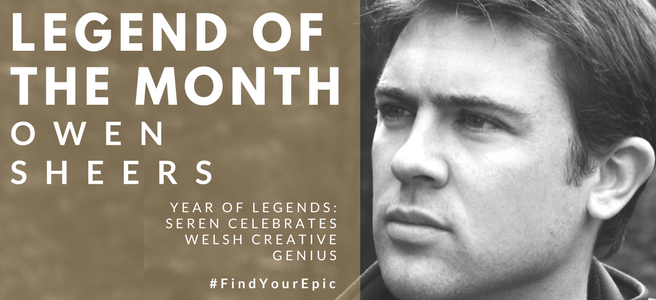
Legend of the Month: Owen Sheers

Legend of the Month Owen Sheers

Each month we are celebrating one fantastic Seren author in honour of Wales’ Year of Legends. This month the spotlight has fallen on Owen Sheers, whose stunning poetry and fiction are regular Seren bestsellers.

Owen SheersOwen Sheers is an author, poet and playwright from Wales. His first poetry collection, The Blue Book (Seren, 2000), was shortlisted for the Forward Poetry Prize Best First Collection and ACW Book of the Year 2001. Skirrid Hill (Seren, 2006), his second collection, won a Somerset Maugham Prize and was longlisted for Welsh Book of the Year. Sheers’ debut prose work The Dust Diaries (Faber & Faber), won the Welsh Book of the Year 2005. His first novel, Resistance (Faber & Faber), has been translated into eleven languages.

In 2009 Owen contributed to Seren’s ‘New Stories from the Mabinogion’ series with White Ravens, a contemporary response to the myth of Branwen, Daughter of Llyr. He published The Gospel of Us in 2012 – a novel based on his dramatisation of The Passion for the National Theatre of Wales, set in the streets and clubs of Port Talbot and starring Michael Sheen. Sheers’ latest novel, I Saw A Man (Faber & Faber), was published in June 2015.

We hope you enjoy Owen’s poem ‘Intermission’, from Skirrid Hill, which featured as our Poem of the Month in the Seren Newsletter.

Owen Sheers Intermission Skirrid Hill


Find Owen Sheers’ books on the Seren website.

Discover a great selection of books by our other legendary writers on the Year of Legends page.


Save

Posted on

Friday Poem – ‘Blood Testing Piglets’, Ilse Pedler

Friday Poem Blood Testing Piglets Ilse Pedler

Our Friday Poem this week is ‘Blood Testing Piglets’ from Ilse Pedler’s debut poetry pamphlet, The Dogs that Chase Bicycle Wheels.

The Dogs that Chase Bicycle Wheels Ilse Pedler Friday PoemWinner of the 2015 Mslexia Poetry Pamphlet Competition, poet Ilse Pedler often writes from her perspective as a working Veterinary Surgeon. From her earliest days as a student of Applied Zoology at Bangor University, where she worked with hill sheep and had to visit an abattoir in Caernarfon, she has been involved at close-quarters with animals. Her deep knowledge and genuine love of them informs this art. A secondary theme is secrets: those we keep from others, those we keep from ourselves, those nature keeps from us.
Sometimes poignant, often comic, the poems in The Dogs that Chase Bicycle Wheels display a keen intelligence and dynamism.


Isle Pedler Blood Testing Piglets


The Dogs that Chase Bicycle Wheels is available from the Seren website: £5.00

Join our free Book Club for 20% off every book you buy from us.


Save

Save

Posted on

The Poet and The Artist – R.S. Thomas and Elsi

R.S Thomas Elsi

As the Eglwys Fach R.S. Thomas Literary Festival approaches, we look at the poet’s relationship with his first wife, the artist Mildred ‘Elsi’ Elridge.

R.S. Thomas has long been considered one of the greats of Welsh poetry with his bleak but masterful verse. His relationship with his first wife, Elsi, has been one of his most profound subjects – but it has also been one of the least understood, and commented upon, by readers of his poetry.

Elsi was a brilliant and accomplished artist, who moved from the illustrious worlds of the Wimbledon and Royal Colleges of art to the Welsh borders of Oswestry where she met Thomas, a young curate at the time. The couple soon married in 1940. Their partnership briefly mixed with artistic collaboration when she illustrated the dust jacket of his first poetry collection, ‘Stones of the Field.’ Apart from this, however, her once prolific outpouring of artwork steadily declined, as did appreciation of her works once her husband rose to fame. Glyndwr University has done much to bring that work back into recognition, having held a large range of Elsie’s art since 2010. Their championing of her art was the catalyst for an exhibit at Abbot and Holder in London this April, before the pieces, including the ‘Dance of Life’ – a six-panelled mural widely considered to be her magnum opus – returned to their permanent home at the university’s Creative Industries Building for a new exhibition in October.

Undoubtedly, Thomas’ rising profile and the decreasing recognition of Elsi’s art punctuated their relationship with tension. In ‘The Way of It’, Thomas commended his wife’s talents, the ease with which her fingers transformed ‘paint into flowers’ while simultaneously suggesting the underlying strain within their relationship. ‘She is busy after for hours,’ he wrote, ‘rubbing smiles into wounds.’

Once found, Elsi’s art has a remarkable, even poetic range with enigmatic self-portraits and haunting landscapes alongside intricate studies of birds and wildlife. She used many mediums, from sculpture to oils, watercolours and sketches. All her talent was deeply moving to her husband, the man their only son, Gwydion, claimed was “visually illiterate” before meeting his wife. Her detailed studies of birds are especially poignant to their relationship, and as such, references to birds and the feather-like fragility of life frequently occur in Thomas’ poems. According to ‘A Marriage’, written after Elsi’s death, they ‘met under a shower of bird notes,’ and she ‘had done everything (in life) with a bird’s grace.’ His proposal was even followed by a joint effort to rescue a buzzard they discovered stuck in a gin trap in the moor.

The absences in their relationship have often been marked upon, even turned to sensational commentary. Thomas’ own comments, easily taken cold to the point of cruelty, such as: ‘I was alone when I was living with her’ suggest a love long worn into ambivalence by the quiet invasion of daily routine and drudgery. As Thomas’ poetry addresses, the restraint of their relationship was not all weakness. ‘Anniversary’ suggests the strength of endurance, of living side-by-side, ‘using the same air’ in spite of the distance between them.

His observations of early tenderness, his observation of an artistic equality they yearned for but never reached, the absolute precision of his descriptions of the artistic housewife who would not have her dormant creative spirit beaten; all these reveal something ‘graceful’, even loving, behind their silences. The language of looks and communication through touch are often present in Thomas’ poetry, even when words are absent. In ‘Pension’ they parry ‘sharp looks’, in ‘He and She’, ‘noiselessly they conversed’, and in ‘Remembering’, Thomas urges the reader to ‘take her hand in your hand’ to prove that ‘if, blind, it is not dumb’. All this builds a portrait of a marriage that though often tense, forged a profound connection and understanding through time.

Each deeply influenced the other. Their worn love, her power in her final absence, death – these are harsh beauties Thomas offers, and that enrich Elsi’s work.

Thomas wrote: ‘I never thought in this poor world to find/ Another who had loved the things I love’. Now, that love is shared and amplified by our opportunity to see her first great love, her art, and to revel in the complex facets of their relationship that his poetry reveals.

Don’t miss the R.S. Thomas Literary Festival at St Michael’s Church, Eglwys Fach, Ceredigion, which takes place on Friday 15 – Sunday 17 September. Festival leaflet and further information available here.


Golden Wedding

Cold hands meeting,
the eyes aside –
so vows are contracted
in the tongue’s absence.

Gradually
over fifty long years
of held breath
the heart has become warm.


‘The Golden Wedding’ is taken from R.S Thomas: Poems to Elsi. Available on the Seren website: £9.99

Join our free Book Club for 20% off every book you buy from us.

Posted on

Friday Poem – ‘Miner, Abercynon, 1985’, Duncan Bush

Friday Poem Duncan Bush Miner Abercynon

Late last month we were shocked and saddened to learn of Duncan Bush’s passing. This week our Friday Poem is one of our favourites from The Hook.

The Hook Duncan BushThe Hook combines powerful early poems from two of Duncan Bush’s prize-winning collections: Aquarium (1983) and Salt (1985), together with several poems published in pamphlet form at the time of the 1984-85 Miners’ Strike, including our featured poem ‘Miner, Abercynon, 1985’.
The poems in this book focus on a number of themes that Duncan Bush continually refined over the years. His central concerns are the nature of work, the impact of industry on its environs, and the fate of modern man at the centre of a complicated web of social, political and personal forces.


Friday Poem The Hook Duncan Bush


The Hook is available from the Seren website: £7.95

Join our free Book Club for 20% off every book you buy from us.


Posted on

Friday Poem – ‘Archaeology’, Robert Minhinnick

Archaeology Friday Poem Robert Minhinnick

September has arrived, but our Friday Poem looks back to August’s Legend of the Month: Robert Minhinnick. ‘Archaology’ is from his sixth collection, Hey Fatman.

Hey Fatman is full of the rich, sometimes strange, always telling, detail that is to be expected from one of Britain’s most compelling poets. The book opens with poems set in and around Minhinnick’s native South Wales, and includes a sequence based on the history of an ancestral house, Dunraven. We then move on to work inspired by the poet’s travels in South America and the U.S.A. The whole volume presents us with a series of vivid portraits, and our featured poem, with its subject who ‘ran shouting/ From his house with his hair on fire’, is no exception.


Robert Minhinnick Archaeology Friday Poem


Hey Fatman is available from the Seren website: £5.95

Join our free Book Club for 20% off every book you buy from us.
Posted on

Friday Poem – ‘The Battle of Gwen Strad’, Taliesin, translated by Tony Conran

Tony Conran’s unrivalled anthology of Welsh poetry through the ages, Welsh Verse, has just returned to print. This week our Friday Poem is Conran’s translation of ‘The Battle of Gwen Strad’, by sixth century poet, Taliesin.

Welsh Verse Tony ConranWelsh Verse is a milestone of translation, containing poetry from the sixth century to the late twentieth century. Virtually every significant poet (or poem: there are several Anonymous entries over the centuries) is present, and every poetic form: the epics of Taliesin and Aneurin, the poets of the medieval princes, Tudor poets, Non-conformist poets, hymn-writers, Romantics, Social Realists and political Nationalists. Welsh Verse also includes an Introduction full of insight into the history of poetry in the Welsh language, and into the challenges of translating it, particularly over so many centuries and styles.
Taliesin is often referred to, in legend and in medieval Welsh poetry, as ‘Taliesin Ben Beirdd’ (‘Taliesin, Chief of Bards’). ‘The Battle of Gwen Strad’, along with several of his other poems, sings the praises of King Urien.

Taliesin poem


*Presumably before the Anglo-Saxons took Catraeth (Catterick) – see under Aneirin. Urien was Taliesin’s patron, king of Rheged in Cumbria and S.W. Scotland. The Eden is a river in Cumbria.


Welsh Verse is available from the Seren website: £12.99.

Join our free Book Club for 20% off every book you buy from us.


Posted on

Friday Poem – ‘For a Foot’, Kathryn Gray

Friday Poem For a Foot Kathryn Gray

This week our Friday poem is ‘For a Foot’ by Kathryn Gray, taken from her 2004 debut collection, The Never-Never

Kathryn Gray The Never-NeverPropelling us from the rain-lashed back-streets and housing estates of Wales, to London, California and beyond, the poems of The Never-Never offer us unique tales of friendship, love and loss, of exile and the distant promise of home. Gray’s accessible style in which she combines playful and serious, allusive and direct with an intellectual wit, makes for an extremely readable collection.
In ‘For a Foot’, the speaker reminisces about a one-legged figure, fierce and ferocious, and the prosthesis that hid their lost limb, obscuring ‘What happens at the bare knuckle/ of life’.


For a Foot Kathryn Gray


The Never-Never is available from the Seren website: £7.99.

Join our free Book Club for 20% off every book you buy from us.