Posted on

50th Anniversary of the Severn Bridge | An extract from Edging the Estuary

Severn Bridge

The original £8m Severn bridge was opened by the Queen on 8 September 1966, heralding a new economic era for South Wales. In celebration, here is an extract from Edging the Estuary by Peter Finch, in which Peter meets the men continuing the traditional method of Lave net fishing on the River Severn, at times directly below the bridge.

Edging the Estuary Peter FinchAbout Edging the Estuary:
In the Middle Ages the port of Cardiff stretched from Chepstow to Gower. Peter Finch, archetypal Cardiffian, sets out to explore his heritage, walking the Welsh side of the Severn Estuary and reclaiming his personal memories in addition to discovering the lives of others. And with a detour to Maismore, the highest tidal point of the estuary, he walks the English side too, taking in the differences with Wales, reviving past links and looking at his homeland from abroad. On his journey he sees the estuary as border, a highway for trade and ideas, an industrial zone, and a place where people spend their leisure. Rich in anecdote, evocative in description, Finch’s book takes in villages and cities, power stations and fishermen, castles and caravans, leg-aching walks and deckchairs on the beach.

The Lave Fishing Grounds

The novelist and poet Richard Brautigan went trout fishing in America. There the fish were made of a precious and intelligent metal. Trout steel in the snow-filled rivers. Among them he found the dharma or the Buddha, or love or something. I’d never done any of that. I’d never really thought much about fishing anyway other than logging that lots of people did it. Blokes in wool hats sitting on piers, pond sides, river edges waiting and on their faces that distant look. It seemed all about waiting. And I couldn’t be doing with that.
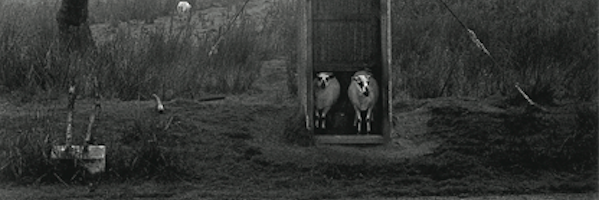
At the end of Black Rock Road, to the east of Sudbrook, is the small park the council has created facing Black Rock. In a corner is the Black Rock Lave Net Heritage Fishery’s hut. Hand built in local stone. A salmon in wrought iron adorns the front. For most of the year the hut is closed and locked but today it’s not. Martin Morgan, a fifty-year-old steelworker from Undy, is in action out front. Spread on the grass he has replicas of the fishtraps that have been used in these waters since medieval times. They’ve now been banned by the Environment Agency in an attempt to conserve fish stocks. “There used to be other methods of fish catching that are gone too,” Martin tells me. “Stock boats, drift nets, tuck nets. Those ways are over.”
The putt, a great ten-foot-long assemblage of bent willow in the shape of an open-mouthed giant cone, is the older method. The example Martin shows me is a replica made from an ancient original pulled from the river muds. These things go back to the eleventh century. The cone would be pegged to the river bed facing an ebb tide and once a salmon had swum in, it couldn’t then get back out.
Also on show are replicas of putchers – smaller five-foot cones made originally of woven hazel or willow but from the 50s onwards of aluminium mesh.These would be assembled in racks known as engines with sometimes a hundred or more in a single array. These would be strung out across the river like radar sets. Salmon was the target but they also caught whitefish and eels and anything else that drifted in.
These were the fixed engines, the fish henges. In the sixteenth century, Rawlins White, the Cardiff martyr, operated something similar at the Rhymney River mouth. The remains of ancient putcher racks have been discovered by estuarial archaeologists in waders, stepping through the glutinous mud between the river’s rapid tides. The largest, containing some fifteen hundred baskets swung out into the waters opposite Goldcliff.
The archaeologist J.R.L. Allen has used aerial photographs of the Estuary to uncover a complex pattern of fish traps dating from Mesolithic times to virtually the present day. His shots show putcher lines running just off the river shores like the claw prints of giant birds. Further out are the remains of rod and wattle fencing, formed into complexes of stone and woodposted weir. Fish dams, intertidal fish pools, fish gullies. Fish capture has gone on in these waters for thousands of years. But it’s all banned now. Regarded as being as bad as fishing with dynamite. All that’s left are the lave fishers. Eight of them. The Environment Agency refuses to issue any more licences.
Lave fishing uses large Y-shaped nets each individually made by the fisherman. The net has willow arms known as rimes hinged onto a stout handle called the rock staff, made of ash. Fishermen wade into an outgoing tide and wait. They can stand for hours with the Severn’s tides falling around them. They call this cowering. Much more exciting is stalking, where the fisherman spots a fish moving over the sandbanks and gives chase.
Caught fish are dispatched with a short wooden baton known as a knocker. Weights are anything from five to seventeen pounds. The record was held by Martin’s great grandfather. He landed a monster that weighed in at fifty-six pounds. There’s a silver-coloured replica back at the hut. The net they also knit themselves. It was once made of hemp. Smacker Williams, in Sudbrook in the 1960s, could knit a single net in a day. That was going some. When he went, the practice died out, but Martin’s fishermen have revived it. They use nylon cord today.
At the Heritage Fishery they are all lave fishermen, although as the season is so short they double up for the rest of the year with rod and line. They used to fish from February right through until October but the Environment Agency have now got them down to a mere three months. 1st June to the 31st August. They’re allowed to catch an absolute total of fifteen fish, five a month, and that’s it. Not much. Martin thinks the Agency would be happiest if it could close the lave fishermen down.
The Agency is at odds with the Heritage authorities who see the Black Rock fishermen as a relic of Wales’ traditional past and something to be encouraged. Martin tells me that last week they had a camera team along from Wedi Saith who brought a Teifi coracle fisherman with them to compare traditions. We’re out on the mud now, walking through the glutinous slime to get into the fishermen’s tiny boat. “You take care,” says Martin. “We’ve had camera crews slip here and go sprawling. They always somehow manage to save their equipment, though.” In my Homebase green wellingtons I take it slow.
The fishing grounds all have names that don’t appear on most maps. Grandstand, The Hole, The Monkey Tump, Lighthouse Vere, The Marl, The Looby and Gruggy. We row west of the Second Severn Crossing to anchor in waters that are moving at around five knots and are at least eight feet deep. “This new bridge was built right across our traditional fishing grounds,” Martin tells me.We watch his brother Richard in the distance striding along the shoreline, net over his shoulder. “It’s made the mudbanks shift and created new ones but we can still fish.”
He and Tim Bevan, a tinplate printer from Sudbrook, are in the water now, chest deep, nets below the surface, that look of concentrated desire mixed with endless patience on their faces. Catching fish is all a matter of getting the wind in the right place and the spring tide flowing. “Are things right today?” I ask. “Could be.” But in the end it turns out they’re not.
During the two-hour window between tide ebb and flow I watch the water drop more than four feet. Fields of rocks emerge around me. Hundreds of boulders running in all directions like this was the Russian Steppes. The brown water slows from a rush to a drifting crawl.You can hear the muted traffic roar on the bridge high above. But the water itself is silent. The boat shifts on its anchor mooring then bumps against rocks below. Martin has walked off hundreds of yards into the distance. His brother, once separated from us by a river depth too great to navigate, now strides across, net over his shoulders, nothing caught where he was either.
Looking west the river runs off into a silver distance that points right out into the Atlantic. You’d think there’d be ship traffic but there is none. Nothing floats by. Just the ripples. “It would have been better if we’d caught something,” says Martin. But half of fishing is the activity itself. Richard Fox and Rob Evans, two other Lave Fisherman in action today have been working the river east of the bridge. “They’ve not been with us that long,” says Martin. “And they’re the only two who haven’t caught their first fish.We’ve two more days left. They’ll be out tonight, 2.00 am, fishing in the dark, just to catch up.”
We’re back on shore now. The fishiest thing we’d seen all day was a tiny mullet about five inches long that Tim had in his net and then threw back. I missed that, too busy taking photos of English coast, power stations, or Sudbrook from the estuary distance, pumping station and the Seven Tunnel Great Spring outfall, still rushing fresh water into the river after all these years.
The EU control that limits catches is contained in Annex 11 of the EC Habitats Directive (council directive 92/43/EEC). It ripples off the tongue. But irrelevant today. Down the pub now, yes.


Buy your copy of Edging the Estuary now: £9.99

Claim 20% off when you join the Seren Book Club
Save

Posted on

Friday Poem – Hunting For The Man With Huge Ear Lobes

friday poem peter finch zen cymru

This week our Friday Poem is taken from Peter Finch’s collection Zen Cymru.

zen cymru peter finchNot one for quiet meditations, Finch’s voice in Zen Cymru is: loud, bewildered, satirical, furious, sad, fearful and funny. This is a Wales that missed its revolution in ‘I Chew Gum and Think of Rifles’. This is a Wales beset by: rain, the ghosts of hard-drinking poets, of holy wells guarded by heifers, of sports crowds, Ikea, sheep, “enormous storm clouds”, and the ‘Entry of Christ Into Cardiff, 2005’.
Finch is a well-known performance poet and his poems have the immediacy and the dramatic impact of pieces conceived for the stage. Formal innovation is allied with themes that are resonant and deeply humane.


Hunting For The Man With Huge Ear Lobes

It’s difficult discussing Buddhism over
whiskey. It makes you laugh.
When you reach the tenets which
concern eternal suffering it’s hard.
I imagine my father here with me. I am
explaining reincarnation but he won’t
have any of it. I am no returned wood louse,
he insists. The bottle on the table
between us is going down at a terrific rate.

We aren’t anything, says my father,
any of us, and when we go it’s just
dark, you can’t figure it, can you?
He’s drunk, my father,
he waves his hands, this is how it is.

My father tells me alcohol is best consumed
lying down. Less chance of hurting
the living. We try this. His face still has that
lopsided look it had when I last saw him
flat-out in the morgue.

He is the greater vehicle, I am the lesser.
We drive on in the darkness looking for a
smiling man with huge ear lobes. He’ll
have the answer, I say. No, says my father,
breathing softly. No he won’t.

 
Buy your copy of Zen Cymru from our website. Sign up to be a Seren Book Club member to claim 20% off.

Posted on

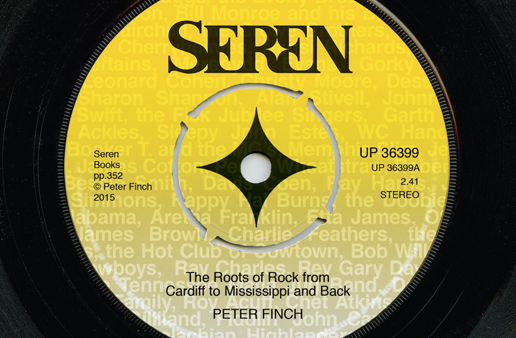
The Roots of Rock, from Cardiff to Mississippi and Back: Listen Online

The Roots of Rock, from Cardiff to Mississippi and Back

Peter Finch’s latest book The Roots of Rock, from Cardiff to Mississippi and Back charts the evolution of rock and popular music, from a 1950s valve radio playing in a suburban Cardiff terrace to the reality of the music among the bars of Ireland, the skyscrapers of New York, the plains of Tennessee, the flatlands of Mississippi and the mountains of North Carolina. For each chapter there is a playlist of suggested records to listen to whilst reading, to bring alive Peter’s many sharp-witted stories. To give you a taste of Peter’s world of music, we’ll be creating playlists for each chapter which you can listen to on our Youtube Channel. The first of these is now available, so take a listen below…

Chapter 1: Howlin’ Wolf in City Road

This entertaining book is part musical autobiography, part travel literature and also an exploration of how music can create a world for the listener that is simultaneously of and beyond the place in which is is heard.

The Roots of Rock, from Cardiff to Mississippi and BackFinch gives us sharp-eyed accounts of gigs from Champion Jack Dupree to the Garth Mountain Boys, muses on the importance of the Dansette record player, ponders why Elvis never came to Wales (except multiply in Porthcawl’s legendary Elvis Festival), visits musical shrines and theme parks – Dollywood, Grand Ole Opry, Graceland, Stax, rides along with singing cowboys and recalls his attempt to form a band, The Blueswailers. Add in music in Ireland and Wales (and in Welsh), the Bible Belt, Sister Rosetta Tharpe, Etta James, Ray Charles, Bert Jansch, Taylor Swift, Alan Stivell, Chet Atkins, the Appalachian Mountains and Pigeon Forge and Finch’s world of music is as broad as the last six decades allows.

We hope you enjoyed the playlist above. You can buy the book on our website.

Posted on

Friday Poem – Some Christmas Haiku

A Christmas themed haiku by Peter Finch

Some Christmas Haiku

On the moors
The snow caught by grass
No one to see it

Not Christmas holy silent night
But the Holiday season
Above the cloud same old moon

Cinio Nadolig
Boldy praising Iesu
Menu’s in English

In the Chapel
Old wood
After so many years still shining

Through the dense firs
Light of a wrecked car
Burning

Early snow
On the berried holly
Some cretin starts complaining

Old man
Pulling crackers by himself
Sound clear to the big dipper

Sound of retching
Three man in an empty street
Crushing larger cans

Street guitarist mangles carols
On the shopkeeper’s face
The shopkeeper’s mask

Posted on

‘Real South Pembrokeshire’

The latest release in The Real Series.
Released 13th June 2011 by Tony Curtis.

Poet, and past resident and frequent visitor Tony Curtis roams south Pembrokeshire, from costal resorts of Tenby and Saundersfoot, west to the surfers of Stackpole and Barafundle and north to the Landsker, the cultural boundary between English speaking south Pembs and the Welsh speaking north. On his tour round half-county Curtis takes in many contrasts, from Pembrokshire’s famous new potatoes to the oil refineries of Angle, from farmworkers to immigrant artists, from the excited tourism of Folly Farm and Oakwood Park to the tranquillity of Bosherston Ponds and timeless beauty of Broadhaven beach.

In keeping with the series Curtis views his area through the eyes of a local and as a visitor, digging into his own Pembrokeshire backstory – and deeper into its history- but also observing keenly the Pembrokeshire of the new century. The mix of new and old, of memoir, anecdote and history gives us new insights into patters and the vivacity of life in one of the most beautiful places in Britain.

Posted on

‘Real Bloomsbury’

Published 15th November 2010 by Nicholas Murray.

“His (Murray) amiably informative and well-illustrated book is the ideal companion to any tour.” 
The Independent

Birthplace of Christian Socialism. Site of the British Museum, University College, RADA, the Friends House, the BMA, Great Ormond Street Hospital. Bloomsbury is crammed with history and with contemporary decision-making. But there is also working class Bloomsbury and, now, Bengali Bloomsbury in the east.

Biographer and novelist Nicholas Murray walks this crowded square mile or so, among the locals, the students, the tourists, alone or in the company of local characters, to give Bloomsbury the ‘Real’ series treatment of history, memoir, ‘psychogeography’ and oblique approaches to the familiar. His entertaining and informative text is accompanied by equally oblique images, the sort you won’t find in either tourist guides or regular history books. All of which present Bloomsbury as it’s never been portrayed before: intimate, contemporary, exploratory and occasionally downright strange.

‘Real’ Series Editor: Peter Finch
www.bibliophilicblogger.blogspot.com

Posted on

‘Real Llanelli’

Published 3rd December 2009 by Jon Gower.

Llanelli stands on several borders in Wales. Industrial town, or still belonging to its rural Carmarthenshire hinterland? Welsh or Englishspeaking? Plaid or Labour? Shaped by its workers or by the small number of families who employed them? It all makes Llanelli that much more interesting than a town of its size has any right to be.

Jon Gower has written a lively and engaging account of Llanelli and its environs, from how to pronounce ‘Llanelli’ to how a village in rural Carmarthenshire became a European centre for iron, steel and tinplate. He examines this industrial heritage but also its residue today, hitching a lift on the delivery of Llanelli-manufactured widgets to a manufacturer in Germany. He charts the industrial decline and transformation into leisure, particularly sport (Stradey or Parc y Scarlets?) beer and the environment. Then there’s the nearby cockling, farming inland and the leisure/ ecological development of the coastal path and park.

Shaped by and shaping all these things are the people: steelworkers, farmers, professional and amateur sportsmen, artists and writers, the small local bourgeoisie, the famous who may have left the town but still carry a part of it in them.The Llanelli identity may be complex but it is embraced by an almost tribal people.

Broadcaster, journalist and writer Jon Gower proves well- equipped to explore Llanelli and its culture in both languages in an entertaining book full of fresh insights and fascinating stories. From Burry Port to Trimsaran it’s all there.

‘Real’ Series Editor: Peter Finch

Posted on

‘Real Cardiff Three’

Published 26th November 2009 by Peter Finch.

Since Peter Finch began his capital trilogy in 2002, Cardiff has changed enormously. In Real Cardiff Three Finch checks out the new, from Torchwood to St David’s 2, while continuing his authorial dig, revealing the places and people who make the city what it is.

En route he looks across Cardiff from its tallest buildings, seeks out subterranean passages, spends a day at Ely race course, storms Treoda Castle (if only he could find it), discovers the secret life of Whitchurch hospital and takes his geiger counter to atomic Cardiff. Full of pathos and comedy, nostalgia and blistering contemporary commentary, this volume is sure to become as popular as Real Cardiff and Real Cardiff Two.

‘Real’ Series Editor: Peter Finch

Posted on

‘Real Liverpool’

Published 1st January 2009 by Niall Griffiths.

In population terms, Liverpool isn’t a huge city (it is dwarfed by Birmingham), but it looms colossally in the history (recorded and mythical) of the British Isles, and indeed the world. Real Liverpoolis Niall Griffiths’ antidote to some of mawkish twaddle that has marked Liverpool’s year as European City of Culture. Griffiths’ love/hate relationship with the city of his birth is central to the book. He explores the various facets of the city – its maritime and merchant histories, class divisions, sectarian divides, Celtic influences, and the siege mentality underpinning the celebrated Scouse humour. Nor does he flinch from Liverpool’s dark side: the money from the slave trade, the drugs, the urban blight, the fallout from Thatcherism, the internecine violence. Jamie Bulger, Heysel, Hillsborough, the Dockers’ Strike, the Toxteth Riots, all of these and more are discussed.Real Liverpoolis underpinned by a strong autobiographical element which details the author’s birth and formative years in the city, his movement away from it, the abiding pull it exerts. In addition, Griffiths interviews many people connected closely to the city, from personal friends and family members to artists and workers. From the Wirral to Warrington, Anfield to Everton, Bootle to Diddyland, Griffiths criss-crosses Liverpool by the Ferry and through the Tunnels, from John Lennon airport to the racecourse and down the docks, building a picture of a city which, whatever its faults, is never dull.’Real’ Series Editor: Peter Finch
Posted on

‘Real Wales’

Published on 1st January 2009 by Peter Finch.

In this ambitious offering from the Real… series, following acclaim for Real Cardiff and Real Cardiff Two, Finch takes on the alien land he didn’t know was his, until he grew and went to see it: Real Wales. A cotton-wool nation, full of football and big-brother slim-screen television, or a land of demons, where white robed druids would wail at you through a never ending mist?

In muscular, syncopated and witty prose, Finch presents 30 years of journeys through the familiar, the bizarre, and to all those places on the TV weather map he never before had cause to visit.

In a country of small and scattered populations, who are all certain of who they are, and where doubt is a quality none possess, Finch comes across poetry in Merthyr, an abandoned castle in Dinas Powys, UFOs and Waldo Williams in West Wales, Jack Kerouac on the beach at Gwbert, the military at Epynt, bizarre sports in Llanwrtyd, flying gravy in Cricieth, panic on Snowdon, and a stripper at the Royal Welsh.

Whether reading a mountain as Braille or clearing a tent at Hay with one poem, Finch seeks to embrace the permanently stern independence of spirit he sees across the country. Personal but never pedestrian, in a country where the past is so near the surface but can never quite be picked up, he accompanies oddballs and novelists, historians and local experts, to find something usually forgotten in a world of oil-powered multi-national commercial empires and federal enormity: Small is beautiful.

‘Real’ Series Editor: Peter Finch