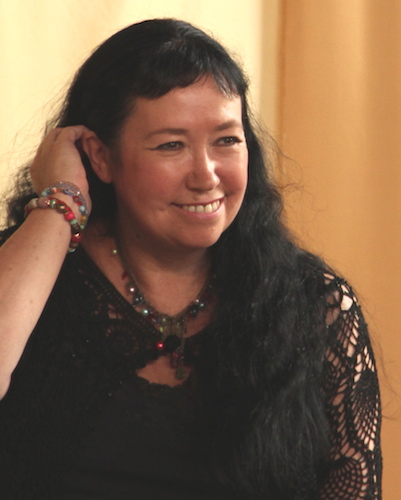
Pascale Petit tells us about her favourite places in Paris, The big cat house of the Jardin des Plantes zoo and it’s devilishly handsome inhabitant Aramis, teases us with the possibility of a novel and tells all about her new book Fauverie .
Hi Pascale, tell us about your new collection Fauverie and how the idea originated?
The title Fauverie comes from the name of the big-cat house in the Jardin des Plantes zoo. It’s an amazing art deco building and has an interior where the cats sleep and are publicly fed, and an octagonal exterior, which thankfully has been enlarged. To me it’s the heart of Paris, which to me, historically and personally is a savage place. I was born there and spent five unhappy years there as child. For decades I wouldn’t go back as I was scared of it, but then my father contacted me after a thirty-five year absence and I visited him as he was dying. Over those visits I fell in love with Paris. In a way Fauverie is my account of that love affair with my home town. But mainly it’s about my relationship to my estranged father during the few years I knew him. I felt that writing about Paris could be a way of writing about him as it was very much his city.
Another building I’m obsessed with is Notre-Dame cathedral and the book began with a few poems about my father and the cathedral. The cathedral became like a friend. I discovered that my father had spent many years living in hotels that were overlooked by it and its towers with those gargoyles and chimeras, so he was observed by this stone zoo. I went up the four hundred stairs to the gargoyle galleries. I started writing the book with those poems. In fact the first poem, ‘My Father’s City’, I had started writing when I was writing The Zoo Father, my second collection, but couldn’t get right then.
What was your research process for this book?
All the poems in the book were written in Paris! I edited them in London where I live but very rarely wrote one there. I rented rooms in Paris for a month at a time and wrote very intensively, usually I’d end up with about twelve to fifteen poems. I got up very early and wrote or read to help get me going then went out to the zoo in the late afternoon or to Notre-Dame or other places. Every time I went to Paris (about three or four times a year) I’d discover some new place in this city that was so strange to me yet so familiar. One of those wonders was Sainte-Chapelle, a revelation. Then the Musée de la Chasse et de la Nature, my favourite museum. Also, in the Jardin des Plantes’ main museum there is a very sad hall dedicated to endangered and extinct animals, most of them stuffed.
The collection features a lot of wild animals, which was your favorite animal to write about?
Aramis the black jaguar! I’ve seen the young keeper kiss him on his mouth through the mesh just before feeding him. He’s four years old but large for his age. He’s actually a rich dark brown with black rosettes. He was in the Fauverie for two years while the larger zoo at Vincennes was being renovated, and that’s where I visited him when I wrote this book, in the Fauverie. Now I visit him at Vincennes zoo, where there are also two young gold jaguar sisters, kept separately from him as they are not yet old enough to mate. When they’re old enough he will have a choice of one as his mate.
Were there any poems that were particularly difficult to write?
I suppose the poems that describe the cellar I was placed in as a small child. I visited the building where we lived on the Boulevard de Grenelle, and twice I went down into the cellar. I couldn’t believe how scary it was, so medieval and narrow. It was like going into a nightmare. I had had nightmares about it throughout my life but thought I’d made them up because there was a window in the cellar and I thought that cellars don’t have windows. But there it was this tiny window at the top of the spiralling stairs, looking out onto the courtyard! Apart from those poems there were certainly a number that I couldn’t get right and took months of rewrites. I kept going back to the Boulevard de Grenelle, to the famous market outside our door, under the métro aérien, and to the park where I played, and even the horrible school.
Your relationship with your father, like in The Zoo Father, is at the fore of this collection. How has it evolved and impacted on your writing since the Zoo Father?
When I wrote The Zoo Father I was in shock – my father had just contacted me and I felt too angry to write at first, then I realised I could through the animals and my travels in the Amazon. It’s now fifteen years since he died and I felt compelled to try again, with more distance, hoping for more compassion. He was suffering from emphysema and was caged himself, could never go out so I did feel very sad for him at the time. Then he died and I lost him again, and he had never acknowledged that he’d done anything wrong, but he had done some pretty bad things. Fauverie is my attempt to redeem him, and perhaps mourn him, but it’s hard to mourn someone I barely knew.
You’ve dealt with some pretty big subjects over the years through your poetry, are there any subjects you wouldn’t write about?
Yes there are, I’m a private person even though I write personal stuff about my parents. But the speaker of my poems is not the actual me, so my poems are fictionalised.
What is the most inspirational book you’ve read and why?
There are so many it’s hard to choose one. I’ll choose two. The first was a Time Life book I found in a library, a south American library in Hyde Park that no longer exists. The book was about South American animals and in it I found the most exquisite photograph I’ve ever seen. It was of a suitcase and it contained forty live hummingbirds. I carried a photocopy of it with me but lost it. Eventually I managed to track the book down and ordered a copy so I have the photo in full colour. I’ve also found another photo of hummingbirds in a suitcase, both are of suitcases belonging to the Brazilian hummingbird expert Augusto Ruschi. The first photo led me to write ‘The Strait-Jackets’, the first poem in The Zoo Father. I’ve just written a poem about the second of those photos.
The second book was crucial to my development as a poet. It was called Waterfalls of the World by Rita Margaret Barton and was published in 1974. The cover features Iguazu Falls. I found this book in 1992, during a tough time in my life, and it was like discovering a friend. It was also the book that led me to to see the highest waterfall in the world Angel falls, in Venezuela’s Lost World. So in a way this book led to all my subsequent obsessions with the Amazon, because once I saw Angel Falls I became fascinated by the whole landscape, table mountains, the flora and fauna, the tribes and their rituals, and their spiritual worlds. It all came from that one book that appeared when I so needed it. Of course there are also countless poetry books that are important to me but it would take too long to name them all.
What are you working on next?
I’m writing a sequence of poems for the Medicine Unboxed prize, it’s called Mama Amazonica. I’ve written it this month in Paris. I was very lucky to be shortlisted for the prize for the proposal. I won’t say more about it just now as it’s a work in progress. There is also a novel in the background!
Fauverie is available to order from the Seren website with 20% off when you join our online book club.

 Weaving together hardship and beauty, ‘Blackbird’ invokes the image of a bird’s feathers as an abstract comfort in the face of confinement: ‘each number / became a blackbird’s feather.’



 As Lilia Sugar scrapes the ice from the inside of the windows and the rust from the locks in Sugar Hall, she knows there are pasts she cannot erase. On the very edge of the English/Welsh border, the red gardens of Sugar Hall hold a secret, and as Britain prepares for its last hanging, Lilia and her children must confront a history that has been buried but not forgotten.

 A light-hearted novella exploring the strange case of a Swansea woman who is apparently possessed by the spirit of Dylan Thomas. Naturally all is not as it seems. The woman, who works in the Dylan Thomas Centre, meets a rather different Dylan from the one she knows by repute, one who doesn’t really fit in with the ghosts of other poets in heaven and is desperate to train himself to join the fitter shades of the long distance runners instead. Her own life, which has been lonely and sad, is completely transformed by the encounter.
 Lucy Swann is trying on a new life. She’s cut and dyed her hair and bought new clothes, but she’s only got as far as a small town in northern France when her flight is violently cut short. When Inspector Vivier and his handsome assistant Sabine Pelat begin their investigation the chance encounters of her last days take on a new significance.