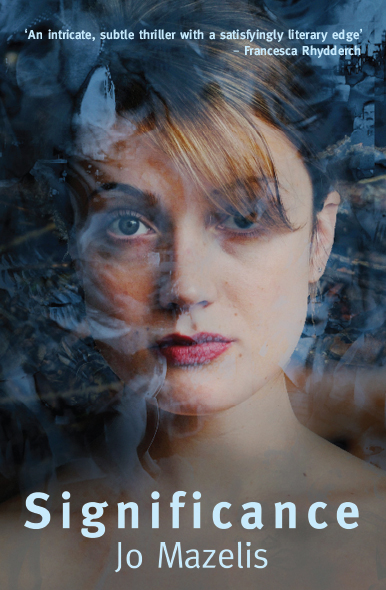
We’ve been talking to Jo Mazelis about life as a writer, feminism, meeting PD James and her new book, Significance.
During the 1980s, Jo worked as a graphic designer, photographer and illustrator for the magazines City Limits, Women’s Review, Spare Rib, Undercurrents, Everywoman and New Dance. Jo is author of short stories, non-fiction and poetry. Her stories and poetry have been broadcast on BBC Radio 4 and published in various anthologies and magazines. Her collection of stories, Diving Girls, was short-listed for the Commonwealth ‘Best First Book’ and Wales Book of the Year.
How did you come up with the title ‘Significance’?
The title came to me quite early in the writing process and in a sense it guided the whole book and became its philosophical fulcrum. Because the story was about crime – in particular violent crime – the reader begins to search for significance (or clues) in each event as the narrative develops. This parallels how direct and indirect witnesses to crime see greater significance in banal events and perceive them as vital parts of a larger picture. Beyond that I wanted to explore how people’s view of the world is altered by certain events, and how they may change their entire course of action due to a chance encounter. It’s a fairly well known phenomena now, that despite the digital age with its instant news from across the globe people still feel more affected by a tragedy or disaster the closer they are to it. I don’t think it is because as a species the human race can be unfeeling, rather it’s information overload. But it feels wrong somehow when a newscaster reports that ‘floods in country x killed three thousand people – one man, Professor Smith a geologist from the UK is believed to be among the dead’ His death is no more or less tragic than the other 2,999 yet he is given greater attention.
My point was I suppose to draw attention to significance and question how meaning and value are not fixed but entirely malleable or transient, depending on the viewpoint of the spectator.
On another level the character Lucy quite dramatically changes her appearance just before setting off on her trip, these changes alter how she is perceived – she looks younger, more girlish, less serious and more vulnerable. Is she the same person?
Because I was thinking about how meaning is bestowed to a greater or lesser extent on objects or emotions or experiences I explored how different characters create or define significance in their lives; whether through revolutionary politics, religion, astrology, love, medicine or history.
The chapters are very short and focus on different people, the minor characters all have fleshed out back stories and motivations – what was your aim in doing that?
Literature in all its forms has by its very nature created ‘the minor character’ whose role is perceived as of less interest than the major characters but whose presence creates plot points and realism. A novel in which many characters have equal weight would be impossible to write, read or even consider – though some novelists have attempted versions of it in different forms for example David Mitchell in Ghostwritten and also The Bone Clocks.
In a sense all individuals think of themselves as the heroes (or main characters) in the drama of their lives – they may recognize that as a waitress or factory worker or medical student their individual actions cannot shape world history but no one really considers him or herself a minor character and they are not minor characters to those closest to them.
In particular I did not want to create a narrative in which the victims of crime become mere ciphers, there only to create a mystery for the detectives to unravel or for the psychology of the murderer to be displayed. I particularly didn’t want to say very much about the killer at all – despite his actions I wanted him to be the most insignificant character. Many people have commented on how after a notorious murder or series of murders the name or tagline of the killer is remembered while the victims’ names are forgotten. In some ways this stems from how these stories are told in the media so we have Jack the Ripper or The Boston Strangler or The Yorkshire Ripper – maybe this is due in part to the circumstances of those crimes – in that the actions of one killer were known but his identity was not. I think the case of Fred and Rosemary West proves this point, as while the disappearance of many young women was known about, none of these cases were linked and thus there was no perpetrator to be sought and given a nickname prior to the discovery of the bodies. Instead, when the crimes were discovered, it almost seemed as if the house itself stood in for the monster, with 25 Cromwell Street becoming a byword of horror.
Racism, feminism, sexism – these are all themes that are touched upon in Significance. Are these themes important to you?
These are absolutely key to my perspective and clearly inform what I write about and how these topics are covered – at the same time I would hate to be led by the sort of dogma that sees all men as bad and all women as essentially good. In fiction one is usually looking at the world at a micro rather than macro level – so that it is the individual’s actions and belief systems that I tend to explore when I write especially by finding a psychological basis for their actions.
While I was working in publishing in London in the 1980s I read a few books about violent crime towards women including The Lust To Kill: A Feminist Perspective on Sexual Murder and The Streetcleaner: Yorkshire Ripper Case on Trial by Nicole Ward Jouve. These were upsetting books to read but both in a sense interrogated society as a whole, seeing sexual killers as symptoms of a greater ill. A case in point was when a few newspapers spoke of The Yorkshire Ripper’s ‘First INNOCENT victims’ implying that the other murdered women were GUILTY. Clearly a society that views any of its members as implicitly deserving of violent death is not a healthy one.
At the same time in the 70s and 80s racism was still a major issue – a friend of my mine at college – a young Asian man – showed me a large scar on his neck where years before he’d stabbed by skinheads in an unprovoked attack that mirrored the later fatal attack on Stephen Lawrence in South London.
One of the characters in Significance is an idealistic young African who becomes a suspect mainly because the colour of his skin causes his actions to be misinterpreted – even when he is simply running or attempting to do a good deed.
In many instances I am interested in the distorting lens of other people’s perception and the construction of personality and identity.
You photographed and interviewed some literary giants, including Margaret Atwood, PD James and Fay Weldon, during your career as a journalist and photographer. Did meeting these women inspire you to write or have you always been a writer?
I had a very vivid and conscious sense of seeing these writers as real people – I think before that I’d had very lofty ideas of what a writer might be like. It sounds terribly naïve but it was this recognition – for example hearing PD James say that it was a need for money due to her husband’s ill health that galvanized her to begin writing novels was a surprise. Not that it was the idea of money which motivated me rather it was that it gave me glimpse of the possible.
Did any of these women give you writing advice?
No – it wouldn’t have been appropriate for me to ask – I was there in their homes or hotels or publishers’ offices as a photographer. It was quite enough that I was peering at them from behind a camera or ordering them about and moving their furniture. I was usually there at the same time as an interviewer who had enough questions of their own and the time we were allowed was usually limited. My focus was very much on getting a good photograph – which in those pre-digital days required all my attention, especially as often I was only given five or ten minutes at the end of the interview to get my pictures.
I can’t imagine what I might have asked any of them even if I could have. Besides which I wasn’t really actively writing then – the odd review or non-fiction article perhaps – writing was something that I perhaps saw on the distant horizon that I might sail towards one day if the weather looked fair.
Why did you choose to become a writer?
This is a difficult question because it partly feels as if writing chose me rather than vice versa. I have always felt that deep down this was not something I was meant to do. This sounds very contradictory – but I think it has to do with my early perceptions of writers as a group of people who were academic high achievers, who read widely, went to university and were generally the exact opposite of me. At eighteen I wanted to be a painter, but after one year at Art College it spat me out leaving me disillusioned with myself, lost, confused and directionless. I had no idea what to do, hardly any qualifications and haunted shameful feelings of failure. I could no longer draw or paint as the blank paper before me no longer represented hope or the development of skills. I wrote a little poetry but this was really only just a private means of recording my feelings about many aspects of my life and how I perceived the world. I began to read a great deal – everything from Maxim Gorky to Flannery O’Connor to Ted Hughes and Sylvia Plath to Erica Jong and George Orwell and Hardy and Herman Hesse and Richard Brautigan. I read quite a bit of non-fiction too, Elaine Morgan’s ‘The Descent of Women’ and Phyllis Chesler’s ‘Women and Madness’, ‘The Family’ by Ed Sanders and books about women’s art and poetry, others about politics, witchcraft, prisons, psychology and social issues. All these books were part of the zeitgeist then, although isolated as I was, I’m not sure where or how I was managing to tap into it. I suppose I just wandered into places like The Uplands Bookshop and spied these books there – esoteric works published by Picador and Paladin in particular were always displayed on revolving stands and were a different format from other paperbacks. I was reading into an ideology but I’m not sure I would have put it that way at the time. I was trying to understand the world I suppose and maybe the drive to do that is stronger if you feel you have no place in it.
So I became a writer very slowly by degrees of disaster, despair and determination. I signed up for an evening class in ‘Creative Writing’ in London in 1979 or 1980 and the first thing the tutor said was that it was highly unlikely that any of us would ever become writers – confirming what I had always thought – I went to one, maybe two more classes then dropped out – what was the point? I began to write in earnest in 1987 and my first story was published in 1988 but my first book ‘Diving Girls’ wasn’t published until 2002 so I suppose this proves I have staying power if nothing else.
What’s next? Will you be sticking with novels or returning to short stories?
I have always written short stories – I forced myself to stop entirely for the four years it took to write Significance but I very quickly began again when the novel was finished. I suppose part of this question refers not so much to what I will write but what sort of book might I publish next? I have a large number of short stories already written – some of which have appeared in magazines like The Big Issue or Tears in the Fence, others have been collected in anthologies published by Honno and Seren, others that are yet to see the light of day and others that perhaps deserve to stay in darkness. So as a writer I would very much like to bring out another book (or two) of short stories, but I equally have several novels in various states of progress that I would like to see published. Of course what any writer may like is not what they necessarily get – publishing has changed, the market for books has transformed beyond recognition, people, especially in areas like Wales, the North of England, Scotland are struggling to pay for even the staples of life so are unlikely to buy books in such a quantity as to keep the market buoyant.
Despite this I tend to see each piece of writing as a challenge – can I make this story or poem or novel or paragraph the best I can? Will it ever be finished or published? As Sylvia Plath famously said, ‘Nothing stinks like a pile of unpublished writing’ and I feel that’s true – it shouldn’t be – but it is. All that unpublished writing represents failure and wasted time and all sorts of unpleasant feelings for their creator.
So I will be continuing to write both short stories and novels and other genres of writing too, besides that fact of creation everything else is uncertain.
Get 20% off Significance from our website when you join our online book club.





 As Lilia Sugar scrapes the ice from the inside of the windows and the rust from the locks in Sugar Hall, she knows there are pasts she cannot erase. On the very edge of the English/Welsh border, the red gardens of Sugar Hall hold a secret, and as Britain prepares for its last hanging, Lilia and her children must confront a history that has been buried but not forgotten.

 A light-hearted novella exploring the strange case of a Swansea woman who is apparently possessed by the spirit of Dylan Thomas. Naturally all is not as it seems. The woman, who works in the Dylan Thomas Centre, meets a rather different Dylan from the one she knows by repute, one who doesn’t really fit in with the ghosts of other poets in heaven and is desperate to train himself to join the fitter shades of the long distance runners instead. Her own life, which has been lonely and sad, is completely transformed by the encounter.
 Lucy Swann is trying on a new life. She’s cut and dyed her hair and bought new clothes, but she’s only got as far as a small town in northern France when her flight is violently cut short. When Inspector Vivier and his handsome assistant Sabine Pelat begin their investigation the chance encounters of her last days take on a new significance.


