Posted on

Enter the Seren Christmas Poetry Competition

Submit your Christmas-themed poem for entry to the Seren Christmas Poetry Competition!
Entries are now open for our Christmas Poetry Competition, judged by poetry editor Amy Wack. You are invited to submit one poem with a Christmas theme for consideration, before the closing date (21 November). All submissions will be read and the winner will be announced on 5 December.
What is the prize? The winning poem will be circulated to all Seren’s publishing and literary friends as the official 2016 Christmas card. The winner will also receive 25 printed copies of the card for personal use, to send to family and friends.
How do I enter? Visit the Submittable Entry Page and upload your poem (as a Word Doc or PDF). On this page you will also find the full terms and conditions.
 
Thank you and good luck to all those who enter, we look forward to reading your poems.


Posted on

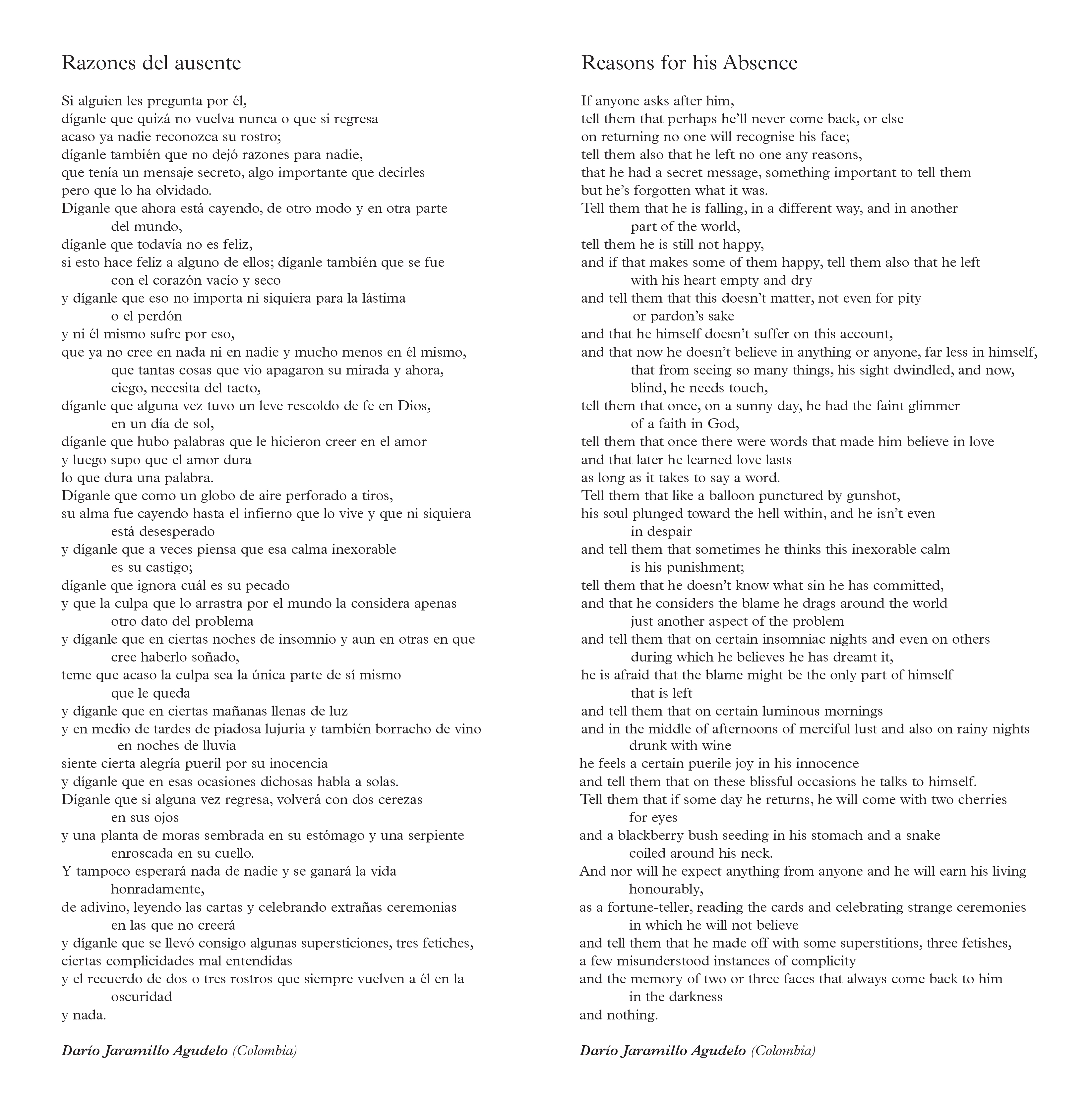
Friday Poem – ‘Reasons for his absence’, Darío Jaramillo Agudelo (translated by Richard Gwyn)

Friday Poem Dario aramillo Agudelo Richard Gwyn

This week our Friday Poem is ‘Reasons for his absence’ by Darío Jaramillo Agudelo, from Richard Gwyn’s hot-off-the-press anthology, The Other Tiger: Recent Poetry from Latin America.

The Other Tiger by Richard GwynThe Other Tiger (the title is a nod to Borges – “the one not in this poem”) is a much-needed bilingual anthology of contemporary poetry, containing 156 poems by 97 South and Latin American poets. It includes work from Argentina, Colombia, Mexico, Peru, Nicaragua, Chile, Uruguay, Venezuela, Cuba, the Dominican Republic, Ecuador, Costa Rica, Bolivia and El Salvador.


About Darío Jaramillo Agudelo
Agudelo is an internationally acclaimed poet, novelist and essayist. He graduated in law and economics from the Universidad Javeriana of Bogotá, and worked for many years in various roles with state cultural and arts organisations. He has been shortlisted or winner of several awards for his work, including the Colombian National Eduardo Cote Lamus prize for poetry (1978), and the José María de Pereda Prize for the short novel (2010). The most recent edition of his Selected Poems is his personal anthology Basta cerrar los ojos (México DF: Era, 2014).

A note on ‘Reasons for his absence’, from Richard Gwyn:
I was attracted to this poem by its epistolary style, and by the device of news being relayed about an absent party. The lack of clarity surrounding the reasons for the man’s absence holds particular poignancy in a country such as Colombia, where ‘disappearances’ were – at the time of the poem’s composition, in the late 1970s – already becoming an everyday occurrence. The slightly elevated or ‘baroque’ language and incantatory style creates a strange juxtaposition with the content, which describes a life of sensual dissolution. The curiosity is stirred by the profound sense of loss or lack with which the absentee seems infused, wherever he is. Whether his exile is literal or metaphoric is never made clear.

My principal concern with the translation of this poem concerned the title. The Spanish noun ‘razón’ can mean a range of things, including ‘reason’ or ‘information’, or even ‘explanation’, depending on context. Similarly ‘ausente’ – here a noun, but commonly an adjective – could be translated in a number of ways: ‘the absent one’ sounded too much like translatorese, ‘the missing person’ subject to over-interpretation in the context of recent Latin American history. In the end I chose ‘his absence’, which deviates from the original in a grammatical sense but conveys the meaning of the phrase accurately. A second concern was the repetition in the Spanish of ‘díganle’ (literally: tell him), which, since it refers back to ‘alguien’ (anyone) in line 1, I chose to translate as the generic ‘tell them’.

 I attempted to re-create the long, rolling cadences of the original in my translation, alongside the reiteration of the introductory ‘tell them that . . .’.

I have also tried to reproduce the bereft tone that reflects the absentee’s solitude, and the distance he has chosen to maintain from those he left behind.

 When I read this poem out loud at an event – as I do from time to time – it still makes the hairs on the back of my neck stand on end. I can’t say that happens with many poems, but with this one it happens every time.

Reasons for his Absence
(click to enlarge image)

Project1 the other tiger new order_Layout 1

Buy your copy of The Other Tiger now: £14.99
Claim 20% off when you become a Seren Book Club member

Save

Save

Posted on

Jasmine Donahaye shortlisted for V S Pritchett Memorial Prize

Jasmine Donahaye, author of Wales Book of the Year Non-Fiction winner, Losing Israel, has been shortlisted for the V S Pritchett Memorial Prize.
The annual prize of £1,000 is awarded to the best unpublished short story of the year. and Jasmine’s short story, ‘Theft’, a “haunting” period piece that harks back to its narrator’s experiences as an 11 year-old country girl hired to help a couple of visiting gentry collect birds’ eggs in remote bog-land, is among the four shortlisted.
On the judging panel are Sara Taylor, an American writer living in Norwich, author Aamer Hussein, and chief fiction reviewer for The Sunday Times and member of the RSL Council, Peter Kemp.
The winner will be announced at a public event featuring Ali Smith on Thursday 17th November.
The winning entry will be published in Prospect magazine and in RSL Review.


Posted on

Halloween tips for book lovers: have a spooktacular night in

halloween tips for book lovers spooktacular night in

If the thought of venturing outside gives you a fright, then why not stay in for the night? All Hallow’s Eve is right around the corner, and that means frights, delights, and a healthy dose of Halloween literature.

What could be better than a cosy night at home, candles flickering, the wind howling outside, and a good book in your hands? Staying in is the new going out, and we’re here to tell you how to make the most of Halloween from home.

1. Set the scene
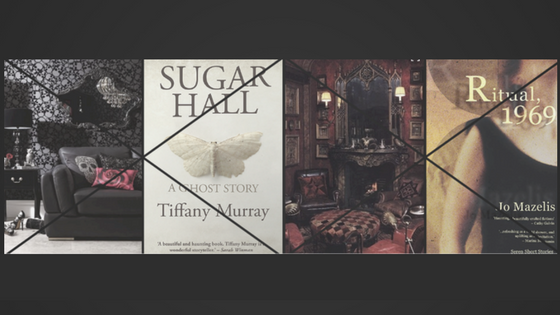
It’s all in the detail – hang up some spooky decorations, dim the lights and set some tall candles ablaze.

2. Play that spooky music
Some gorgeously gothic music will set you up for a night of horror. This Best of Dark Classical Music playlist should do the trick.

3. Choose your Halloween reading
Ghost stories, gothic, true crime or thriller – choose your poison. Take a look below for our spooktacular selection of dark and chilling literature…

Masque by Bethany W Pope

Masque, Bethany W. Pope
£9.99
This richly gothic re-telling of Gaston Leroux’s The Phantom of the Opera takes us to 19th Century Paris, where aspiring opera singer Christine is trapped between theatre owner Raoul’s ‘romantic’ vision of her as a bourgeois wife, and the mysterious Phantom’s murderous pursuit of artistic perfection.
Love, lust, adventure, romance, and the monstrous nature of unfulfilled creativity await you here. Everyone wears a mask. Look beneath it, if you dare…

Sugar Hall Tiffany MurraySugar Hall, Tiffany Murray
£8.99
Easter 1955. As Lilia Sugar scrapes ice from the inside of the windows and rust from the locks in Sugar Hall, she knows there are pasts she cannot erase. The red gardens of Sugar Hall hold a secret, and Lilia and her children must confront a history that has been buried but not forgotten.
This superbly chilling ghost story (named by David Mitchell as one of his six favourites) will have you on the edge of your seat.

Ritual, 1969 by Jo MazelisRitual, 1969, Jo Mazelis
£9.99
What are little girls made of? What will they become? From the playground to adulthood the path is beset with misunderstandings, missed dates and hidden traps for the unwary.
This darkly gothic collection of stories explores the unsettling borderland between reality and the supernatural. Ranging from early twentieth-century France to 1960s South Wales and contemporary Europe, Jo Mazelis’ stories portray characters caught up in events and feelings they do not fully understand or control. Not all is as it seems in a world where first impressions may only conceal disguises and false trails – and there’s no going back…

Sean Tyrone A Symphony of HorrorsSeán Tyrone: A Symphony of Horrors, Mark Ryan
£8.99
The brilliantly evoked valleys town of Aberuffern (the mouth of hell) becomes the central motif of this short novel, inspired by the Mexican novel Pedro Paramo by Juan Rulfo.
This is lively, blackly humorous and intelligent storytelling.


Witch, Damian Walford Davies
£8.99
With the narrative pull of a novel and the vibrancy of a play for voices, Damian Walford Davies’s Witch offers a thrilling portrait of a Suffolk village in the throes of the witchcraft hunts of the mid-seventeenth century. The poems in this collection are dark spells, compact and moving: seven sections, each of seven poems, each of seven couplets, are delivered by those most closely involved in the ‘making’ of a witch.

Murder-at-the-StarMurder at the Star, Steve Adams
£9.99
The murder of God-fearing, bible-quoting, partially deaf Thomas Thomas at the branch of Star Stores he managed in Garnant, South Wales has remained an unsolved mystery since it happened in 1921. Over £126 was missing from the store safe, yet there were oddities about the attack which suggested this was more than a robbery that went tragically wrong.
In classic cold case fashion, journalist Steve Adams’s extensive researches have finally identified the killer, and the almost century-old case can finally be closed…

Happy Halloween one and all, we hope you have a frightfully good evening.

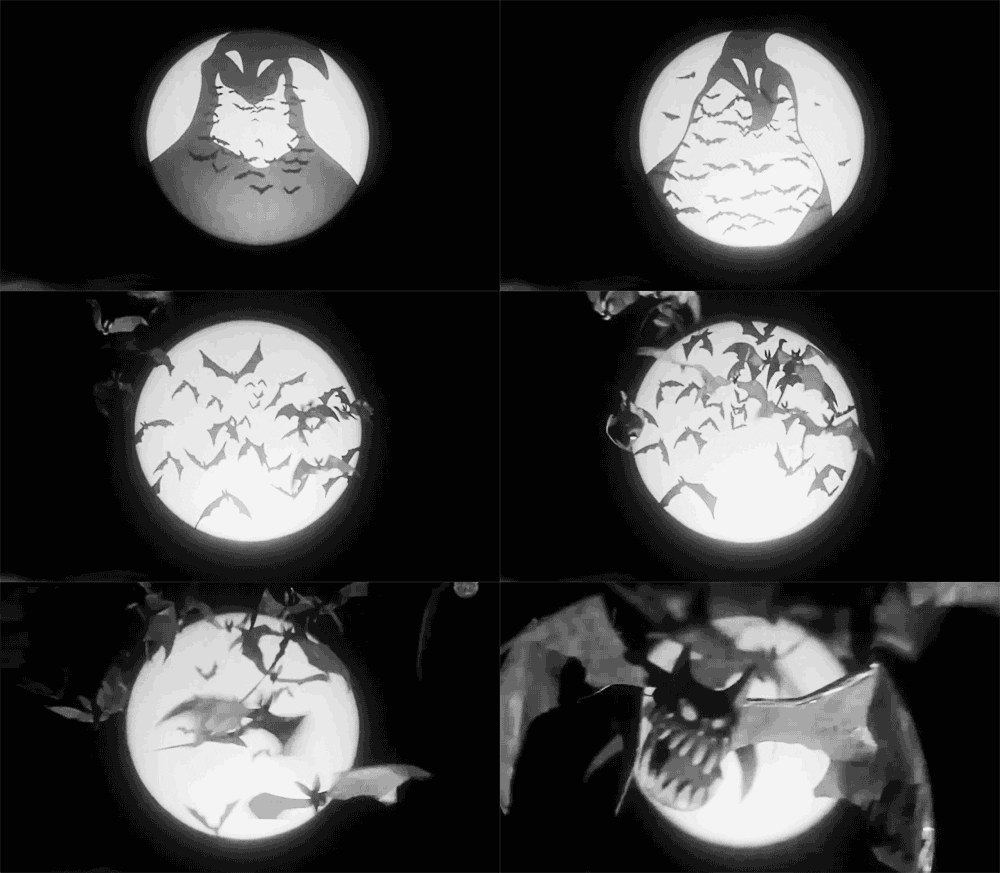
hoppip halloween art animation film

Save

Save

Save

Posted on

Frightfully good books to read this Halloween

Halloween is almost upon us, and what better to do than sit with a good book as the witching hour draws closer? See below for a selection of our darker and more chilling titles, from fiction, to poetry, to crime.
Masque, Bethany W. Pope£9.99This richly gothic re-telling of Gaston Leroux’s The Phantom of the Opera takes us to 19th Century Paris, where aspiring opera singer Christine is trapped between theatre owner Raoul’s ‘romantic’ vision of her as a bourgeois wife, and the mysterious Phantom’s murderous pursuit of artistic perfection.Love, lust, adventure, romance, and the monstrous nature of unfulfilled creativity await you here. Everyone wears a mask. Look beneath it, if you dare…
Sugar Hall, Tiffany Murray£8.99Easter 1955. As Lilia Sugar scrapes ice from the inside of the windows and rust from the locks in Sugar Hall, she knows there are pasts she cannot erase. The red gardens of Sugar Hall hold a secret, and Lilia and her children must confront a history that has been buried but not forgotten.This superbly chilling ghost story (named by David Mitchell as one of his six favourites) will have you on the edge of your seat.
Ritual, 1969, Jo Mazelis£9.99What are little girls made of? What will they become? From the playground to adulthood the path is beset with misunderstandings, missed dates and hidden traps for the unwary.This darkly gothic collection of stories explores the unsettling borderland between reality and the supernatural. Ranging from early twentieth-century France to 1960s South Wales and contemporary Europe, Jo Mazelis’ stories portray characters caught up in events and feelings they do not fully understand or control. Not all is as it seems in a world where first impressions may only conceal disguises and false trails – and there’s no going back…
Seán Tyrone: A Symphony of Horrors, Mark Ryan£8.99The brilliantly evoked valleys town of Aberuffern (the mouth of hell) becomes the central motif of this short novel, inspired by the Mexican novel Pedro Paramo by Juan Rulfo.This is lively, blackly humorous and intelligent storytelling.
Witch, Damian Walford-Davies£8.99With the narrative pull of a novel and the vibrancy of a play for voices, Damian Walford Davies’s Witch offers a thrilling portrait of a Suffolk village in the throes of the witchcraft hunts of the mid-seventeenth century. The poems in this collection are dark spells, compact and moving: seven sections, each of seven poems, each of seven couplets, are delivered by those most closely involved in the ‘making’ of a witch.
Murder at the Star, Steve Adams£9.99The murder of God-fearing, bible-quoting, partially deaf Thomas Thomas at the branch of Star Stores he managed in Garnant, South Wales has remained an unsolved mystery since it happened in 1921. Over £126 was missing from the store safe, yet there were oddities about the attack which suggested this was more than a robbery that went tragically wrong.In classic cold case fashion, journalist Steve Adams’s extensive researches have finally identified the killer, and the almost century-old case can finally be closed…

Posted on

Friday Poem – ‘Elegy for David Beynon’, Leslie Norris

Aberfan Friday Poem Elegy for David Beynon by Leslie Norris

Today marks 50 years since the Aberfan disaster, 21 October 1966, when a mountain of coal waste slid into Pantglas school and 19 houses, killing 144 people, 116 of them children.

Today is a day of solemn remembrance, and in this spirit, our Friday Poem is ‘Elegy for David Beynon’ by Leslie Norris, written after a teacher who died trying to shield five children from the slurry.

Leslie Norris was born in Merthyr Tydfil in 1921, and many of his works transform local incidents into poems of great depth and significance. ‘Elegy for David Beynon’ is among his most anthologised poems, and with its poignancy and sincere emotion, it is not hard to see why.


Friday Poem Elegy for David Beynon Leslie Norris

‘Elegy for David Beynon’ is taken from Leslie Norris: The Complete Poems, edited by Meic Stephens.


Posted on

The true story behind Alun Lewis’ poem, ‘Burma Casualty’

In January 1943, after fracturing his jaw during a regimental football match, Alun Lewis spent 6 weeks in Poona Hospital. In this blog post, Maggie Evans, whose father lay injured in Poona in the bed next to Lewis’, tells the true story behind the poem ‘Burma Casualty’.

As a child, “My Dad’s in a poem”, was my default position when any Dad boasting was called for.  “Don’t believe you”, was the usual reply, but here I had them.  I could run to the shelf and produce the evidence. There, in a slim volume entitled Ha! Ha! Among the Trumpets, was the poem, entitled ‘Burma Casualty’ and even more exciting, with a dedication – To Capt. G. T. Morris, Indian Army – My Dad!

It was years before I actually read the poem and even longer before I was capable of understanding it, but the magic of a special poem about my own special Dad has never faded.

Dad was born on 12th July 1911 in the Eastern Valley of South Wales. His given names were Thomas Griffiths but he was always known as “Griff”. To me and my two older brothers he was just our Dad, and the fact that he had one stiff leg shorter than the other and had to wear funny, built up shoes was of no consequence. We were children of the Second World War and post War period – war wounds were common. Dad didn’t ever let this hamper him. He wouldn’t accept a Disabled Badge for instance, and wouldn’t countenance anyone thinking of him in this way. He carried us on his shoulders and took us swimming and walking just like any other Dad and so I never fully understood the extent of his injuries until recently, when following a house move, I found bundles of his letters and photographs from that time. Reading the letters he sent from hospital in Poona sent me straight back to the poem – and now for perhaps the first time I was able to understand it.

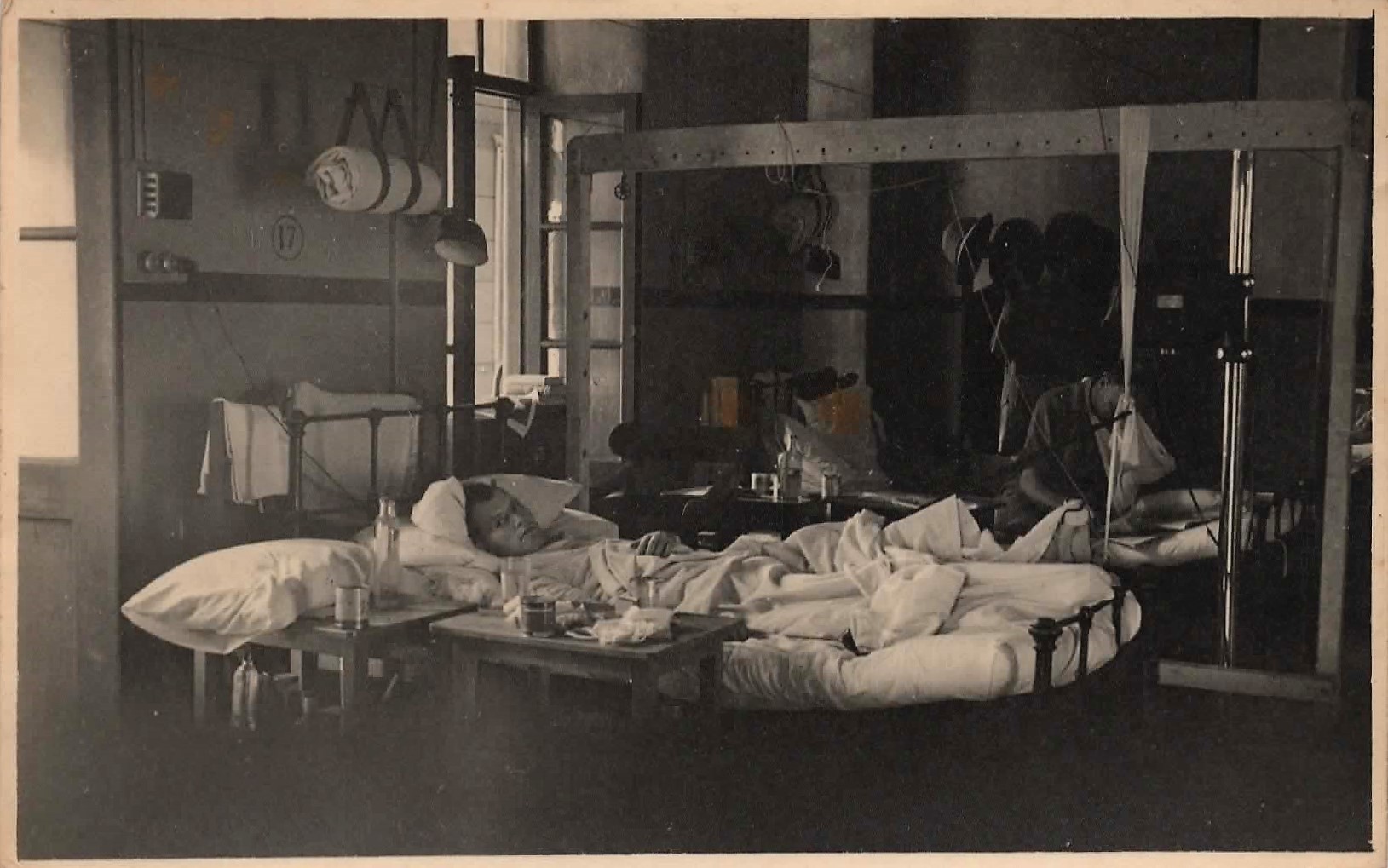
In February 1942 Dad was fighting in the Burma Campaign with the 17th Indian Division which was decimated at the Battle of Sittang Bridge during a retreat from the Japanese. He was badly wounded, carried off the bridge by unknown hands, and ended up in hospital in Poona where he remained until late 1943.  Earlier that year he had for six weeks a new neighbouring bedfellow – one Alun Lewis, also a Welshman, who had sustained a shattered jaw in a football match. The sharing of his experiences with Alun resulted in ‘Burma Casualty’.

Thomas “Griff” Griffiths in Poona Hospital
Thomas “Griff” Griffiths Morris in Poona Hospital

Re-reading the poem now reveals how much Dad shared with Alun of his pain and fear – showing that at times he might have welcomed death as a release from his own physical pain and from the loss of so many comrades.

Thomas Griffiths and his wife on their wedding day
Thomas Griffiths Morris and his wife on their wedding day

But his letters to his sister from the same time show that as he recovered, his focus was on re-stablishing his family life with my Mum, his childhood sweetheart, and my oldest brother, born in 1940, whom he had never met.  He resisted Death, the ‘beautiful singing sexless angel’, preferring ‘his wife’s sweet body and her wilful eyes’ (though, like any child, however advanced in age, I confess to being unable to think of my mother in these terms without feeling slightly queasy!)


Dad never spoke of his experiences of jungle warfare and rarely mentioned his time in hospital. When pressed, he spoke of his friend, Alun Lewis, as something of a tortured soul. As an adult I have come to understand and love Alun’s poetry, not because he allowed my childhood self to hold its own on the boasting front, but for his luminous verse with its dark undercurrents. I can now say with pride, “my Dad knew a true poet’.

burma-casualty


‘Burma Casualty’ is one of the many poems featured in Alun Lewis: Collected Poems. Buy your copy now from our website: £9.99.


Posted on

Short Story of the Month | ‘Intervals in making lace’ by Diana Powell

short story intervals in making lace diana powell

Our new short story of the month is ‘Intervals in Making Lace’ by Diana Powell. This is one of a collection of stories set in the Black Mountains, where a group of women artists gather to work. As they do so, they spin tales of their childhoods, coloured by the folklore and landscape of their surroundings. But what do they really remember?

Diana Powell Intervals in making laceDiana Powell was born and brought up in Llanelli, and studied English at Aberystwyth University. She writes mainly short stories and novels. She won the last PENfro short story prize, and the 2013 Allen Raine Award. This year, she was a runner-up in the Cinnamon competition, and was longlisted for the Sean O Faolain, and the Over the Edge. Her work has appeared in a number of print publications, including The Lonely Crowd and Brittle Star.


Intervals in making lace

This is an extract. Read the full short story for free on our website.


………

………………..

…………………………

How do you describe a gap? It is, after all, a place with nothing there. You could say ‘an opening with two clear ends’ perhaps – like a break in a fence or a mountain pass (both easily found in our hilly, farm-shod landscape). Or holes in a fishing net; a clearing in a wood …  to let water out; to let light, animals, people, gather.

All these are gaps. All physical entities (although there is nothing there). There are plenty of examples both natural and man-made, difficult, but not impossible, to explain.

But how do you make sense of the other kind of gap – the less substantial, belonging to the mind, or the spirit?

Recently, I have been enduring such a gap in my life: a break in its normal proceedings. An accident. It was an accident: all my own fault, of my own making. There is no one else to blame.

Just like then, whatever they may have said.

‘Foolish Bron! Daydreaming again!’ Words from the past echo down to me. The voices of my mother and father, or sisters, fondly scolding. ‘Off in cloud-cuckoo-land, Bron? Again?’ True, then; true, now. For yes, I was daydreaming. You’d think I would have learnt … I had learnt! For a long time, I had! But no, my thoughts wandered away, and my body followed, leaving the stove on, and the towel draped too close. Easily done; it could happen to anyone! Though there are, no doubt, those who whisper about my fondness for a glass of whisky; a second glass. Those such as the old women in the Square, who tutt behind me as the till girl in Mace slips the bottle into a brown paper bag; all the while dismissing and excusing, somehow, their own favoured tipples – as if sherry and gin do not count as the devil’s potions, brewed to steal your wits and lead you to Hell.

But there was no whisky that night, though I am happy to admit to it on other occasions. After all, it is a quick, easy way of making gaps in your existence, if that is what you are after.

So … there was a fire, as testified by those who pulled me from it, and by the charred detritus of my worldly goods – and of my body. Yes, my body bears witness, but not my mind. Not my consciousness, for I remember nothing. Even the knowledge of the stove and tea towel were presented to me later. Lucky, some say. Better that way – to have been pushed into such dense oblivion by the fumes, and to fall from that into an even deeper chasm of unconsciousness (the greatest depth of my gap), so that I did not know the worst of the pain, or the prodding, patching and finishing that was needed to put me back together again, into some reasonable fashion. Did not know … until I finally woke and had to face the torment, and battle through it (such floundering, such darkness, then!) Making tentative steps forward into painful reality, interspersed with welcome lapses back into insensibility … one step forward, two steps back. Onwards, upwards, until…

Until I am here. Now. Again. Yes, I have come through on the other side. For there is always this about gaps – the suggestion that they can be bridged or crossed; that they are something to emerge from. It may take time, and much effort. But, with some luck, and hope, you can make it. Maybe.

That is how it seems to me now – now that I am trying to put my life back together, and make sense of it all. Yet, in truth, none of what happened should have been strange to me. I should have been prepared. I should have known all about absences from consciousness; lapses from reality. I should have remembered. But back then we called such things by different names. We wrapped them in strange words, or wove them into magical imaginings, all meant to cloak, disguise or simply hide them. And so the truth was left unsaid, replaced by uncertainty and bewilderment. Another kind of gap; a deep, churning river that you struggled through, leaving you reaching for understanding like a drowning man gasping for air. But since I came back here, amongst you, memories have been returning – not from the accident, but from my earliest years, as if they are needed now. Like the echoing words, they flash into my mind, clear, not clouded. And beyond them, something else is taking shape – something not fixed, yet, not fully revealed, but which, if I start with what is definite, will also, perhaps, become more clear, so that I, too, will have some kind of story…


Continue reading ‘Intervals in making lace’ for free here.


Posted on

October Author of the Month: Jayne Joso

Jayne Joso is our October Author of the Month.
We recently published Jayne’s latest novel, My Falling Down House, which tells the story of a young Japanese salaryman who finds himself jobless, homeless and struggling to hold on to his sanity as he slowly attempts to rebuild his life from within a run-down, traditional wood and paper house.
Jayne Joso is a critically acclaimed writer, who in 2012 was awarded the Coracle International Writer’s Residency in Ireland. Her first novel, Soothing Music for Stray Cats (2009, Alcemi), was heralded as ‘the debut of a distinctive voice in contemporary British Fiction’ by social historian Joe Moran. Her latest novel, My Falling Down House, has already been praised widely, with Sho Konishi, Professor in Modern Japanese History at the University of Oxford, calling it ‘a remarkable achievement’.
October is an exciting month, as you can meet Jayne (and even purchase a signed copy of her book) on 20 October at the Daiwa Foundation, where Jayne will be hosting the event Joso’s Japan: Wood and Paper Houses. Here, Jayne will talk us through the essential elements of the Japanese wood and paper house, and how one of these enigmatic spaces came to settle itself as a character in its own right in My Falling Down House. Jayne will also focus on the increasing number of abandoned houses in Japan, presenting her photography of these spaces taken in remote parts of Japan such as Echizenhama and Teradomari.
 
Find out more about Jayne on her Seren author page.

Posted on

Friday Poem – ‘Making Out’, Deryn Rees-Jones

friday poem making out deryn rees-jones

This week our Friday Poem is ‘Making Out’ by Deryn Rees-Jones, which originally appeared in her second collection, Signs Round a Dead Body, and also features in her generous new What It’s Like to Be Alive: Selected Poems.

Both collections (along with Deryn’s other books The Memory Tray, QuiverAnd You, Helen and Burying the Wren) are half price until midnight on Sunday, 9th October as part of our National Poetry Day sale.

Deryn Rees-Jones What It's Like To Be Alive Selected PoemsWhat It’s Like to Be Alive marks a mid-career milestone in the life of this highly-acclaimed writer. From the poems written in her teens and early twenties included in her exciting debut The Memory Tray to her most recent exploration of time and grief, we see the arc of development in her writing over twenty-five years as she visits and revisits the concerns that are the mainstay of her writing: memory, love, desire, and heartbreak in all its manifestations. The following poem originally featured in Signs Round a Dead Body, Deryn’s second collection.

Making Out

Now it was airports that she needed –
to sit there going nowhere
counting aeroplanes like sheep,

with Concorde like an archaeopteryx or angel
and Egypt, Russia, the Azores and Lithuania
spinning in her head. She’d sit there

writing letters that she knew she wouldn’t send,
telling him about the dull, red moon, the way
the landscape then, so pale, unreal,

the fishermen, the midnight seas
had been tattooed like hieroglyphs
in blues and golds

deep into her skin. It was his hands, I think,
she could imagine best
travelling across her. But she thought about the way

he’d kiss her too, the way she’d smile, nod yes
to his demolishing her. The way he’d start
to reassemble, slowly, in the rented bed

her mouth, her throat, her shoulders, breasts,
her knees, her arms, her thighs, her calves, and love etc.


Until midnight on Sunday 9 October,What It’s Like to Be Alive: Selected Poems is half price: only £6.49 (RRP £12.99). Buy your copy now to take advantage of this fantastic offer.


Save