Posted on

Friday Poem – ‘Insomnia’, Tamar Yoseloff

Friday Poem Insomnia Tamar Yoseloff A Formula for Night

This week our Friday Poem is taken from Tamar Yoseloff’s newest collection, A Formula for Night: New and Selected Poems, which is half price on our website until midnight on Monday as part of the Seren summer sale.

Tamar Yoseloff A Formula for Night Tamar Yoseloff is a poet whose career has been profoundly influenced by the visual arts. A Formula for Night: New and Selected Poems is the eagerly awaited summation of her work, encompassing selections from four published print volumes: Sweetheart, Barnard’s Star, Fetch and The City with Horns (now mostly out of print); and poems from her collaborations with artists: Formerly, Marks and Desire Paths. The book also includes a generous selection of beautiful new poems. ‘Insomnia’, our Friday Poem, is one of these.


Insomnia

The clock’s small hands carry me
to the house where I was a child

and in those rooms peace settled
despite the war inside the TV,
the lunatic with an axe who filled
the drive-in screen. My parents said
no harm would come if I was good.

My room was buttercup yellow,
it was always spring; my Barbies
were missing arms or legs, while boys
came back from Nam in bags.
Everyone seemed old but they were young,

now everyone seems young, and I’m the one
crowding the night with phantoms.


Buy your copy of A Formula for Night now, half price until midnight, Monday 29th August!


Save

Save

Posted on

Friday Poem – ‘Bob’s Dogs’, Hilary Menos

Friday Poem Bob's Dogs Hilary Menos

It’s that time of the week again, and this time our Friday Poem is taken from Hilary Menos’ collection, Red Devon.

Originally a food writer and journalist, Hilary Menos’ poems are often inspired by rural farming life in Devon where she lived for some years.

Red Devon by Hilary MenosIn Red Devon, her second collection, Menos reveals her experiences as a “blow in” from upcountry moving into a tight-knit rural community and seeing at first hand some of the human and animal costs of the conflict between traditional farming methods and the demands of modern commercial agriculture. She also tells the story of a burgeoning love affair between farmer Grunt Garvey and haulier Jo Tucker, a romance which ends in tragedy. Alongside these two stories, one fictional and one very real, runs a concern for farmers around the world whose livelihoods – and lives – are threatened by global changes in agriculture.


Bob’s Dogs

There was the one dog, neither use nor ornament.
Each morning he lurked by the tanker’s dribbling spout
licking his chops. Spawned every cur in the district.
Bit the postman, once, and got away with it.

There was the other dog, two-bit brother to the first,
eyes like spilt milk. Danced on the slurry pit’s crust
one time too many, said Bob, and no good since.
Bit the builder’s foreman twice, and got away with it.

There was the third dog, each month went walkabout
under a chicken moon, fetching and shedding stars.
Deaf to everyone but Bob’s dad, now four years
bed-bound. What shall I say? Bit nobody, yet.

And lastly there was the bitch. Bit the child.
The four shots blew through the lanes and echoed loud
in the neighbour’s eyes. Only Bob shook my hand,
hitching his trousers up with a ‘Welcome, my friend.’

 
Buy your copy of Red Devon now: £8.99
Claim 20% when you become a Book Club member

Posted on

Friday Poem – ‘A Pembrokeshire Artist’, Tony Curtis

A Pembrokeshire Artist Tony Curtis Llangwm

This week we have a treat for you – our Friday Poem is one of the new poems from Tony Curtis’ forthcoming From the Fortunate Isles: New and Selected Poems (Seren, October 2016).

From the Fortunate Isles: New and Selected Poems, Tony CurtisFrom the Fortunate Isles, published in celebration of the author’s 70th year, features poems from ten of Curtis’ published collections as well as a substantial number of new poems. This is a poet whose themes and variations remain consistent: a profound interest in the wars of the last century, an abiding fascination for all art forms, particularly painting and poetry, tender attachments to family, and (most evident in the poem below), a deep affection for his roots in West Wales.


A Pembrokeshire Artist
John Knapp Fisher (1931 -2015)

An evening with the rain coming in,
that sea so cold and unsettled, a heavy graphite,
you’d not have gone out with your mackerel lines
in the Viking or any of her successors
from the stone-brick embrace of Porthgain.

We’ve eaten our fill at your wake, John,
the Sloop Inn squeezed tight
with suits, black ties and memories.
Wives, patrons, grandchildren.
Photos of you through all seven ages on the screen.

Inland to Wolf ’s Castle and as far south as the cathedral
the farms, haggards and holiday lets
shrug down for the cold night.
You’d have worked to conjure the reluctant light
discovered in them under this empting, moonless sky.

And the first scurp coming would have dabbed
your paper, blossomed and been coaxed,
smudged, into the finished sketch.
Now the county will have to sing its own spirit,
compose its own shape, keep its own watch.


If you would like to listen to Tony read from his forthcoming collection and other books in his native Pembrokeshire, don’t miss his event at the Llangwm Literary Festival, Saturday 12th August. More details here.

You can buy copies of Tony Curtis’ poetry collections, anthologies he has edited, critical essays, and other writing direct from us (20% off for Book Club Members):
Crossing Over
Heaven’s Gate
Tokens for the Foundlings (ed Tony Curtis)
After the First Death (ed Tony Curtis)

Wales at War
Real South Pembrokeshire
Keep an eye out on the Seren website – Tony’s new collection, From the Fortunate Isles: New and Selected Poems, is coming soon…

Posted on

Friday Poem – ‘Accent’, Carolyn Jess-Cooke

This week’s Friday Poem is taken from Carolyn Jess-Cooke’s debut collection, Inroads.  

The opening piece, ‘Accent’ where ‘stowaway inflections and locally-produced slang/have passports of their own’ is a praise poem for the versatility and joy of language, “The way sound chases itself in tunnels and halls, the way senses fold  memory…”.After this playful start, a difficult childhood is evoked through metaphor in poems like ‘Music Lesson’,‘One Thousand Painful Pieces’ and ‘Bitten’, all the more heartbreaking for being indirect.


Buy your copy of Inroads from the Seren website: £7.99

Claim 20% off when you become a Book Club Member.

Save

Posted on

Friday Poem – ‘Skirrid Fawr’, Owen Sheers

friday poem skirrid fawr owen sheers

Today marks the start of the National Eisteddfod, this year in Abergavenny, and our Friday Poem talks of an area just a few miles north – Ysgyryd Fawr, or The Skirrid. The poem is taken from Abergavenny poet Owen Sheers’ second collection, Skirrid Hill.

skirrid fawr friday poem owen sheersIdeas of separation and divorce are important in Owen Sheers’ eagerly-awaited follow up to his acclaimed debut collection The Blue Book. The geographical divides of borders, the separation of the dead and the living, the movement from childhood to adulthood, the ending of relationships. Such divides are both moments of ‘mark-making’ and moments of absence. In this collection it is often the awareness of such separation – past or impending – and the juxtaposition of these diverse states – that provides the friction from which the poems are born.


Skirrid Fawr

Just like the farmers who once came to scoop
handfuls of soil from her holy scar,

so I am still drawn to her back for the answers
to every question I have never known.

To the sentence of her slopes,
the blunt wind glancing from her withers,

to the split view she reveals
with every step along her broken spine.

This edge of her cleft palate,
part hill, part field,

rising from a low mist, a lonely hulk
adrift through Wales.

Her east-west flanks, one dark, one sunlit,
her vernacular of borders.

Her weight, the unspoken words
of an unlearned tongue.


Buy your copy of Skirrid Hill from the Seren website: £8.99
Claim 20% off when you become a Book Club Member.

Save

Save

Save

Posted on

Aspie-Chromatics | Carol Rumens on Asberger’s, ASC and Poetry

aspie-chromatics carol rumens asberger's syndrome poetry

Carol Rumens is the author of sixteen collections of poems, as well as occasional fiction, drama and translation. Here she talks about Asperger’s Syndrome and Autistic Spectrum Condition (ASC), the misunderstandings and mysteries still surrounding these conditions, and how her awareness of Asperger’s Syndrome has affected her understanding of her own creative process.

Aspie –  someone with Asperger’s Syndrome

Chromaticsthe study of colour

When my grandson was diagnosed with autism it was as if a stone had been hurled into a quiet pool. The ripples spread through his immediate family, particularly affecting my two daughters (one being his mother) and myself. We re-evaluated our lives from a dizzy perspective. Autistic spectrum condition is a genetic condition. It’s a doubtful gift passed from generation to generation. A lot of us were implicated!

At first I was very uncomfortable with the idea that I had Asperger’s Syndrome. I’d always considered myself eccentric. My self-esteem relied on a sense, since earliest childhood, that I was creative, one of those people who could paint, draw, play music and write, even if they weren’t always very good at thinking straight or mixing with the other kids. I was an introvert – fine. So were a lot of intelligent people. I didn’t need close friends: I needed a room of my own, plus a typewriter. So what?

Perhaps being an Aspie made me less guilty of the wrongs I’d done to others in my life, but, equally, I was less responsible for the good. The best of my ‘good’ self – my poetry – was just a symptom, an expression of pathology.

I began the “On the Spectrum” sequence partly to express that grief. But I soon struck notes of defiance and humour. I remembered strange, disconcerting experiences I’d had as a child, and I measured them against some of the diagnostic criteria of Asperger’s Syndrome. Some were in tune with the criteria. But others weren’t.

I will have more questions in future: I haven’t finished telling the story. For instance, it’s said that Aspies lack empathy, and that we misunderstand metaphor. I wonder where this leaves the Aspergers poets – or indeed the women with Aspergers.

Sensory over-stimulation is one of the affects of Autistic Spectrum Condition: there’s neurological and experiential evidence. But wouldn’t that susceptibility be more likely to increase empathy? Perhaps autistic people, especially women (the gender which is socially conditioned for empathy) have an excess rather than a lack of response to others, but deny it because it feels chaotic and scary? An inability to grasp metaphor might be the result of a similar subconscious defence-mechanism –because metaphor is also sensuously stimulating, and therefore potentially disruptive.

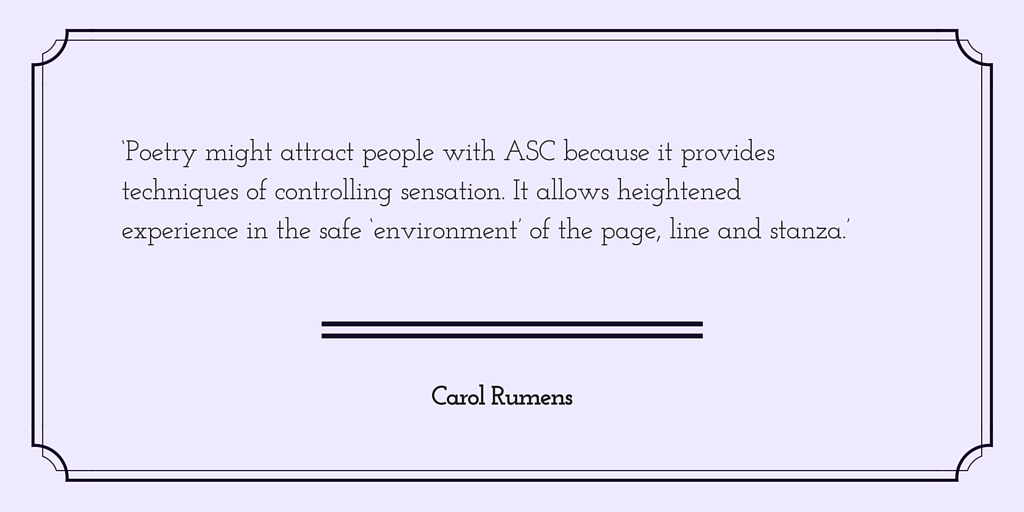
Poetry might attract people with ASC because it provides techniques of controlling sensation. It allows heightened experience in the safe ‘environment’ of the page, line and stanza. It foregrounds pattern-making. It allows repeated patterns to be safely interrupted. I realise now that, whatever the genetic ‘prompt’ towards an activity for an individual, it doesn’t invalidate the activity. Being an Aspie poet doesn’t damage the poetry, but the pride.

And so, having overcome my pride and prejudice, a faintly crusading element entered my attitude to autism. The condition needs a lot more fresh thinking. I’m not generally someone who wants poetry to earn its bread as a foot-soldier in the army of good causes. But I want to speak for a greater understanding of autism, and I choose to do it through the medium I’m best able to employ. Rather than use poetry as propaganda, I would simply ask it to report back sometimes from the field, like a travel correspondent in the complex, many-coloured terrain of a newly discovered country.

What I’d like to do now, besides filing more dispatches, is to edit an anthology of poems by autistic poets. Certain poets have already ‘come out’ and I suspect there are potentially many more. Autism is a richer, wider, more polychromatic spectrum than so far defined. In fact, to know autism would be to know consciousness, which would be to see God. I don’t think anyone can, but I hope we can build some better microscopes.


Animal People Carol RumensCarol Rumens’ latest collection, Animal People, is available on the Seren website. The striking final sequence, ‘On the Spectrum’, focuses particularly on Asperger’s Syndrome and how it may be experienced by young women, as well as exploring some of the effects of Autistic Spectrum Condition (ASC).

Buy your copy now: £9.99
Claim 20% off when you become a Book Club Member


Save

Save

Posted on

Friday Poem – ‘Outcast Hours’, Rhian Edwards

Clueless Dogs Rhian Edwards

This week our Friday Poem is taken from Rhian Edwards’ dark and sensual debut collection Clueless Dogs.

Winner of Wales Book of the Year 2013
Winner of the Roland Mathias Prize for Poetry 2013
Winner of Wales Book of the Year People’s Choice 2013
Shortlisted for the Forward Prize for Best First Collection 2012

clueless_dogs72Full of verve and humour, with a spiky syntax featuring hard-edged consonants, Rhian Edwards’ language has a winning honesty and intensity. Poems like ‘The Welshman Who Couldn’t Sing’ chronicle a fraught childhood in Bridgend, south Wales, where the sensitive child escapes through imaginative games of ‘Playing Dead’ and ‘Broken Lifeboat’. Later poems confidently explore teenage lusts, student rivalries, damaged peers and tense situations. Although the author doesn’t flinch from ruthless depictions in which we are often implicated by her use of the second person ‘You’, there is an underlying sweetness, an elegiac thread most evident in the poems of maturity.

Outcast Hours

White light weighs heavy, bullying
bright as squash courts. I fix a dirty look
on the electric clock. The walled
minutes stagger their blinks.

Wheel-footed suitcases scurry
about me like clueless dogs,
flip flops tick-tock
on the polished rink of the concourse.

One girl’s patience is vivid,
measured by the careful brush strokes
of plum on her toenails,
the soft turning of pages.

Her boyfriend hibernates,
his legs stretched out before him.
Ankles crossed, he wags his foot
conducting his concert of sleep.

A ponytailed mother raises
an eye for her wandering son.
Shc scoops him up and breathes in his scalp
in chase of a smell that is running away from her.

The antique couple are butchering time.
Their teeth tear through baguettes
raining faded confetti
onto their open laps.

Shy of games and companions, fidgeting
in plastic-boned chairs, we comb the air
for that splintered voice,
dictating when our sky will ship us.


Buy your copy of Clueless Dogs now: £8.99

Claim 20% off as a Book Club Member

Posted on

Friday Poem – ‘Talking in the Dark’, Christine Evans

Friday Poem Talking in the Dark Christine Evans

This week our Friday Poem is from Christine Evans’ sensitive collection, Growth Rings, which was shortlisted for Wales Book of the Year 2007.

Friday Poem Christine EvansThis collection from Christine Evans follows well-received ’Selected Poems’.  Hers is a persuasive voice, highly attuned to the vagries of the seasons, to the landscapes and inhabitants of the beautiful Llyn Peninsula in North Wales where the author has made her home.
As well as vibrant short lyrics on everything from ’Bluebells in Nanhoron’ to jets flying over Wales, there are a series of tender elegiac pieces on relatives, meditations on the last moments of Shelley and the fates of the Brontes, and a number of poems featuring the mysterious Island of Bardsey.

Talking In the Dark

Now the air is indigo with evening
together by the boathouse where we’ve sprawled
an hour or more, felt earth’s breath cooling,
we wake mind-echoes of ‘the real world’.
Night prompts us all to visions of tomorrow.

A subtle fullness, like a ripening field
contains us, names and knowledge weightless now.
The biosphere, Helen thinks, might still have the power
to heal pillage, maiming, poison. Protests fly:
excuse for doing nothing, weak, evasion.

Although we can’t agree what should be done
a tribal dignity begins to hover.
Shadows with eyes that hold the light, we are
communicators, not just talking faces.
First stars beckon in a deepening sky.

The universe accepts our hopeful voices
but sea demurs with one slow-hushing sigh.


Buy your copy of Growth Rings now: £7.99

Claim 20% off as a Book Club Member

Posted on

Friday Poem – ‘The Scarlet Lizard’, Caroline Smith

Friday Poem Caroline Smith

Last night saw us at Chapter, Cardiff, for July’s First Thursday event and among the readers was Caroline Smith with her new collection, The Immigration Handbook. This week we have a treat for you – you can listen to the Friday Poem being read by the author. Look below for the video, and accompanying poem text.

The Immigration Handbook Caroline SmithThe strikingly moving poems in Caroline Smith’s The Immigration Handbook are the fruit of the author’s career as an Immigration Caseworker for one of the most diverse inner-city areas in London. Her characters are careful composites of people she’s observed. They step vividly off the page, as if out of the headlines. Written over a period of years, as layered and infused with experience as the documents she discusses: letters folded and refolded, creased with time, Caroline Smith’s poems are a moving record of global people movement, the story of our time.

The Scarlet Lizard

Nothing moves
except the evening light
crossing the Judge’s room.
The lawyers’ skeleton arguments
lay piled on his desk.
They seemed to him brittle
as bleached poppies,
tapped of their seeds.

He longed to see the quick movement
of a scarlet lizard weaving unexpectedly
through the parched, cracked hexagons
of a legal phrase, to hear the snapped stick
fritter away from a hiding place;
to feel the cold, diaphanous weed grip
in the black current of a border crossing.

He needed to sense some quiver of
indecision, an odd detail
that would open the truth of their words;
chinks of light shining
through shuttered doors.


Buy your copy of The Immigration Handbook now from the Seren website: £9.99

Become a Book Club Member to claim 20% off.


Save

Posted on

An extract from Boy Running | Wales Book of the Year shortlist

extract from Boy Running Wales Book of the Year

The winners of the Poetry, Non-Fiction and Fiction Categories, and the overall Wales Book of the Year Winner, will be announced in just two weeks. Seren have two titles in the running for the awards, and before we find out the results, we thought you might enjoy reading an extract from each of our nominated books. Look below and you’ll find an extract from Boy Running by Paul Henry (shortlisted for the Open University in Wales Creative Non-Fiction Award).

Studio Flat

Socks hang like bats from a skylight.
They may be dry in time for the moon.
The camp site owner’s water-feature
drains more blood from the sun.

Cars queue for the narrow bridge.
Birds catch their pulses and fly.
I am suddenly old. What’s an attic
but a bungalow in the sky.

And where are you, my sons?
I heard your voices in the bells
of snowdrops pulled by the wind.
These tulips have lost their smell.

Perhaps I could tell you, one day
where the snowdrops went, why old men
dry their socks on the moon, and what
darkened the skylight, just then.


Ring

I can’t get the ring out of my finger.
How long till it disappears
this ghost ring, twenty years deep?
I’m branded. Is it the same with you?
Your fingers were slenderer than mine.


We hope you enjoyed reading this free extract from Boy Running by Paul Henry. Keep an eye on the Seren blog, as we will be announcing the Wales Book of the Year Awards results in just over two weeks time.

About Boy Running:
Paul Henry has gained a reputation as one of of the best poets in the UK. Boy Running is his beautiful sixth collection and the first to follow  The Brittle Sea: New and Selected PoemsAlso a singer-songwriter, Henry is known for his precise lyricism, intimate tone and a cast of characters inspired (like Dylan Thomas) by his childhood by the sea in Aberystwyth, West Wales.