Posted on

The Ones That Got Away

2015 is a year of important anniversaries at Seren. Not only does this year bring with it the celebrations for the centenary of WW2 writer Alun Lewis, but it also marks 70 years since the biggest mass-breakout of WW2, which happened right here in Bridgend.

Island Farm Camp was originally built to house the workers at the munitions factory in Bridgend when it was thought they’d much rather live close to their workplace than travel to and fro each day. Not surprisingly the women preferred to travel than to stay in the gloomy rooms provided, but when Europe found itself in need of places to keep POWs Island Farm, with its concrete huts and open fields, proved to be ideal.

70 years ago today, at around 10pm on the 10th March 1945, 70 POWs escaped from Camp 198 – better known as Island Farm – after digging a 70ft tunnel beneath the wire. Evidently, 70 was their lucky number.

Each of the escapees were divided into groups and were given maps, food and even a homemade compass, as well as identity papers which had been produced inside the camp. Some of them made it to Birmingham while others got as far as Southampton, and though all but one were eventually recaptured, it was an astounding feat. Yet it is still unknown as to who actually organised the escape.

70 years on Peter Phillips has taken it upon himself to explore the story of Island Farm in The German Great Escape. Phillips’ expert narrative sets the events at Island Farm against the broad sweep of history, from appeasement and re-armament, to the Blitz, the battles of the GIs who passed through, and the campaigns of the German top brass who were later camp inmates. Taking in tensions between the Wehrmacht and SS, a suspicious death and the British de-Nazification programme, Phillips also explores the regime under which the POWs were kept and their reception by the public in south Wales.

Order The German Great Escape from our website.

Posted on

Friday Poem – A Birthmother’s Catechism

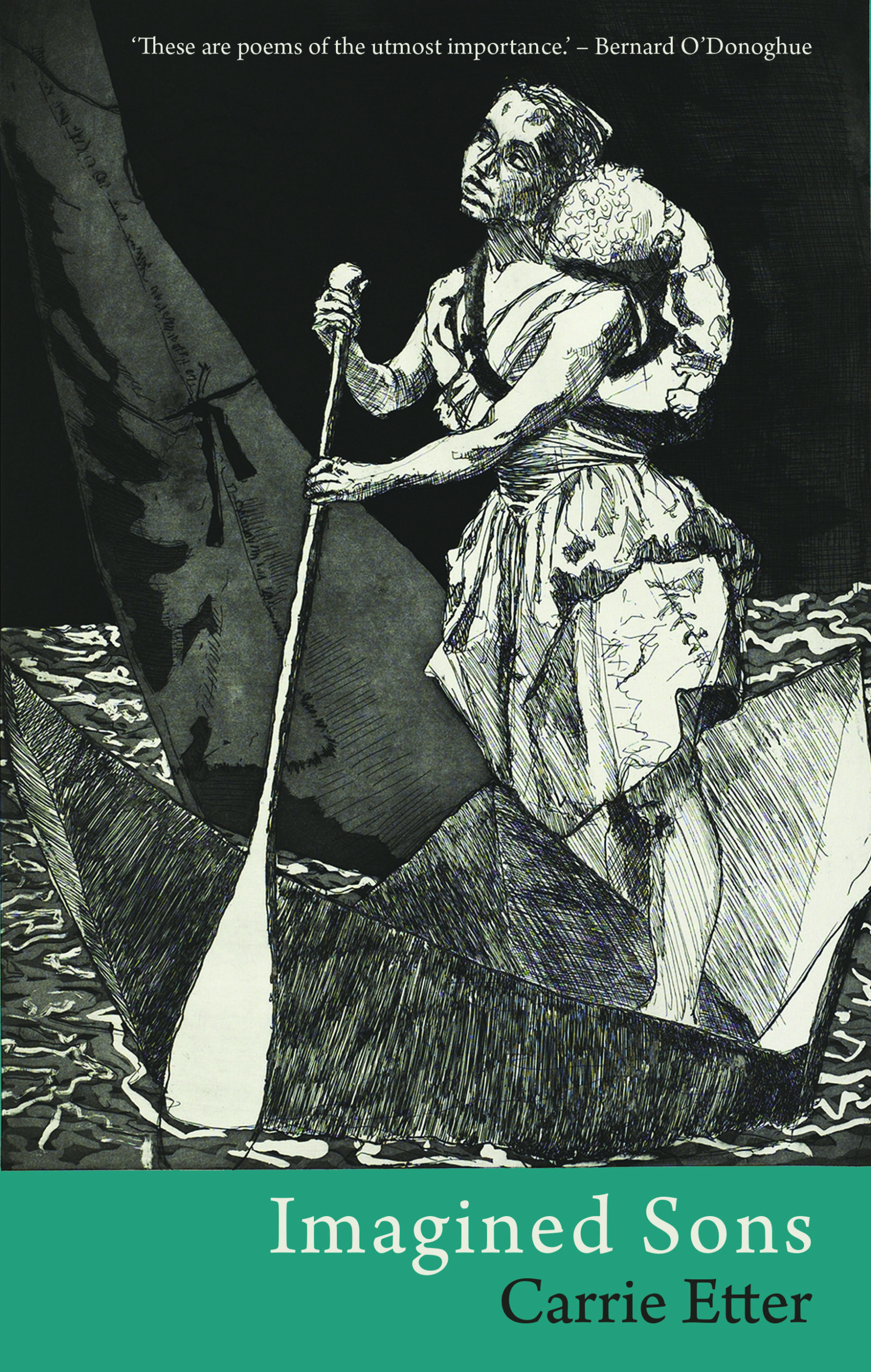
This week’s poem is from Carrie Etter’s Imagined Sons, first published in 2014, which has been shortlisted for the 2014 Ted Hughes Award for New Work in Poetry.

In Imagined Sons  Carrie Etter has written a book of vivid, heartbreaking poems on the experience of giving up a child for adoption. A prize-winning author, lecturer, critic and popular blogger, Etter imagines the possible destinies for the child and presents us with various scenarios from the tragic to the absurd. That the child’s birthday is also Sept. 11th adds a layer of irony and pathos, ‘What is the anniversary of loss?’ – asks the narrator in one of the ‘Birthmother’s Catechism’ poems. A pamphlet containing some of these poems was a Poetry Book Society Choice.

A Birthmother’s Catechism

How did you let him go?

With black ink and legalese

How did you let him go?

It’d be another year before I could vote

How did you let him go?

With altruism, tears, and self-loathing

How did you let him go?

A nurse brought pills for drying up breast milk

How did you let him go?

Who hangs a birdhouse from a sapling?

Order a copy of Imagined Sons from our website.

Posted on

An Interview with Damian Walford Davies

Today we’re chatting to poet Damian Walford Davies about his latest collection, Judas, which you can pre-order from our website here.

Damian is a poet, writer and librettist. He is the author of three Seren collections – Suit of Lights (2009), Witch (2012) and Judas (2015), together with the pamphlet Alabaster Girls (Rack Press, 2015) and the co-written volume, Whiteout (Parthian, 2006). He is Head of the School of English, Communication & Philosophy at Cardiff University, where he specialises in Romanticism, the two literatures of Wales, and Creative Writing.

Had you always wanted to write about Judas, whether it was Judas the man or Judas the metaphor, or did the poems in this collection quietly creep up on you?

Judas creeps up on you, certainly. I’ve always found him (or ‘it’ – Judas is a phenomenon, a problem, a crux (‘cross’), a paradox, a sore point) compelling. (The same with Lazarus, by the way, but that’s another, if related, story . . .) He is contradictorily represented in the canonical gospels, and that’s before we come to the second-century AD gnostic Gospel of Judas, where he is Christ’s confidant. There are a myriad of historical, theological, political and psychological arguments as to why Judas did what he did (if he did). To accept the historicity of Judas – which many scholars of first-century Palestine and early Christianity do not – means recognising him as an elusive figure. He is a no-man as well as a knot of contradictory representations, built up over twenty ideological centuries. (See Susan Gubar’s excellent 2009 biography of Judas.) This is the guy with the dark halo.

What is it you enjoy most about exploring history through poetry?

I like to write against big accepted narratives, intervene in them at personal, psychological levels, offer case studies of emotional quandaries, reveal terror on local, personal scales. I use the dramatic monologue for this, aiming for an imaginative inhabitation of voice and situation, aware at the same time that ventriloquising others has an ethics attached. This is Judas’s speaking platform, throughout. My previous Seren collection, Witch, did similar things, exploring how a witch is ‘made’ in the tense atmosphere of 1640s Suffolk. In Judas, I’m constantly negotiating suggestive gaps in the canonical gospel accounts. One has to be nuanced here, as well as bold. I made the decision from the outset to play with timescales, and so Judas is encountered during the week after the crucifixion, wandering through first-century Jerusalem one minute, but then clocking two women air kissing in the contemporary city’s Sheraton Hotel the next. Judas quotes Bob Dylan. Time is spliced; the Arab-Israeli conflict is as real to him as the Roman occupation. He is disturbed by a history that hasn’t yet happened. So I enjoy querying dogmatic versions of history, indulging in counterfactuals (which is more than a parlour game – it’s a way of changing the future). History always happens somewhere, and (like religion) is in many aspects terrifying. All this is not to say that the collection is iconoclastic, or without belief/faith, or blandly ‘materialist’. Quite the opposite. Multiple ironies mean that there are no final, fixed positions in this collection.

Throughout the collection you play around with many biblical images, such as the ‘thorns’ in ‘Annunciation 1’ and the ‘silver coins’ in ‘Denominations’. I imagine it would be difficult to write a poetry collection titled Judas without them! But did you ever worry about finding a new way to use imagery that has been around for centuries?

I saw it as an opportunity – to inflect, defamiliarise, and recontextualise these ‘core’ images. Judas is a collection in which all these images exist (I hope) in a complex, kinetic, shifting relationship. Did I worry about this? All the time. Poets must always be on edge, edgy. Poetry is about edgework. Judas is published at a time of political-religious crisis and horror. The collection is a reflection on fundamentalism, belief, faith, history, knowing, unknowing, violence, intolerance and human beings as agents and casualties of history. And (of course) beauty, friendship, love, worlds of spice.

You paint a very vivid picture of Jerusalem throughout the collection, picking out places like Yad Vashem in ‘In Vino’ and Ben Yehuda Street in ‘Siloam Pool’. Was giving your poems a specific setting important to you while writing the collection?

It was crucial. I was lucky enough to be able to visit Jerusalem in April 2012, and parts of the volume were written there in a hostel room under the muezzin’s recorded call to prayer and on the hostel’s roof, from which I could see the Al-Aqsa mosque to the east, the Church of the Holy Sepulchre to the west, and a sea of satellite dishes in between. And so the journeys that the shattered Judas takes through the old city are the ones I myself took through the narrow streets – full of managed but mangy colonies of cats – and souqs, around the Baths of Bethesda (a place of deep peace), down to the Garden of Gethsemane (from which I phoned my 93-year-old grandmother, who quite understandably asked ‘How big is it?’), back up to the ‘tufted wall’ of the Temple and through the four quarters of the divided (and machine-gun-patrolled) town. Judas is a map. Gethsemane, by the way, is tiny.

What, if anything, have you learned about Judas and the idea of evil through writing this collection?

He wants answers as much as we do. He’s still waiting.

Pre-order Judas from Seren’s website.

Posted on

Carrie Etter Shortlisted for the 2014 Ted Hughes Award for New Work In Poetry.

Carrie Etter has been shortlisted for the Ted Hughes Award for New Work in Poetry for her collection Imagined Sons, in which she reflects on the experiences of a birthmother who gave her son up for adoption.
Imagined Sons interweaves two kinds of poems to produce a deepening sense of a birthmother’s consciousness. In the ‘birthmother’s catechisms’, the same question—How did you let him go?, for one—evokes different answers over time, while the ‘imagined sons’ are prose poems in which the birthmother encounters her son once he’s come of age. His guises include a pilot, a criminal, even an olive. Through these two forms, Imagined Sons takes a non-confessional approach to what might otherwise be considered a confessional subject.
The Poetry Society’s Ted Hughes Award for New Work in Poetry seeks to recognise excellence in new poetry. The award acknowledges poetry that goes beyond just the page, highlighting exciting and outstanding contributions made by poets to our cultural life in 2014. This year the cultural and the everyday converge to create a thrilling shortlist.
Also making the shortlist are Patience Agbabi, Imtiaz Dharker, Andrew Motion and Alice Oswald. The winner of the £5000 will be announced on April 2nd 2015 at an event in Mayfair, London.
Established in 2009 by Poet Laureate and Vice President of the Poetry Society, Carol Ann Duffy, the £5,000 prize is funded with the annual honorarium the Poet Laureate traditionally receives from HM The Queen. The award is one of the only prizes to acknowledge the wide range of work being produced by poets – not just in books, but beyond. Previous winners of the prize include Maggie Sawkins in 2013 for Zones of Avoidance and Kate Tempest in 2012 for Brand New Ancients.

Posted on

Friday Poem – The Sound of a Diamond Planet

Short Days Log Shadows Sheenagh Pugh

The Sound of a Diamond Planet comes from Sheenagh Pugh’s collection Short Days, Long Shadows, published in 2014.

In this, her twelfth collection, noted poet Sheenagh Pugh steps into a new, northern landscape, the Shetland Islands, with poems steeped in the wilder weathers and views of rugged coastlines, sweeping sea-vistas and the hardy historical characters who have inhabited these lands. There is a lovely pared-down spareness, and elegiac formality to poems like ‘Travelling with Ashes’, ‘Staying’, and ‘Trondheim: January’ where the inhabitants appear lost in a ‘strange pink daylight’, and in ‘Gardening’ where ‘White stones are shaped like hearts’. The author’s characteristic dry humour emerges elsewhere as in ‘Extremeophiles’, a paean to bacteria – ‘chancers’ who live without sun. A poet who considers ‘too accessible’ to be the best sort of compliment, Sheenagh Pugh’s work has as much to offer the general reader as it does the specialist, who will admire her artful use of traditional forms.

Sheenagh will be reading at the Stanza Festival on the 5th March. For more information check out our website!

The Sound of a Diamond Planet

I seem to be surrounded
by things not quite there,

like the fieldmice munching
unseen inside my walls,

the spit of sand
uncovered at low tide,

the slick rock waiting to be
a waterfall again.

A planet, they say,
made all of diamond

resonates in its orbit,
light years beyond

human hearing, its brittle sound
broadcast in space.

Order Short Days, Long Shadows from Seren’s website.

Posted on

Top 5 Tips for Getting a Job in Publishing

Our Marketing Assistant, Jess, shares some tips on getting into the publishing industry after university.

It happens to the best of us. You’re enjoying student life, living on spaghetti hoops, cereal, and that questionable looking meat at the back of your fridge that you found for a suspiciously cheap price at the local supermarket. You’ve grown out of the ‘going to lectures in your pyjamas’ stage, but you still feel like a child playing at being a grown up, snuggled comfortably in the safety net that is higher education.

Then it hits you: you’re in your final year of uni. You need to start looking for a job.

Not to worry, my friend, we’ve all been there, and if you think the publishing industry is for you then you’re in luck: here are my Top 5 Tips for Getting a Job in Publishing. From one ex-student to another!

Work Experience

This may seem obvious, but you’d be surprised by the amount of people who are interested in publishing and yet never do any sort of placement, even if it’s just for a few days. The truth is you’re not going to know if publishing’s for you unless you give it a try; the last thing you want is to apply for a job you think you’ll love, only to discover too late that you’ve never hated anything more.

Plus most placements will give you the opportunity to find out which area of publishing you’re the most interested in – you might go into a placement expecting to like Publicity and finding yourself enjoying Marketing more, and once you know that you have a better idea of which vacancies you should be keeping an eye out for!

And perhaps most importantly, work experience gives you the chance to network. You’ll never leave a placement without a few new contacts under your belt, and with any luck one of those contacts could eventually become your employer.

If you’re thinking ‘but I can’t afford to do unpaid work in London’ then you needn’t worry. Our office is based in Bridgend and there are plenty of independent publishers all over the UK, so have a snoop around – you never know what you might find just around the corner!

Get Involved

Do you have your own blog? Do you review the books you read? Have you written for your uni magazine? Are you involved in any societies?

Don’t worry, the answer to all those questions doesn’t have to be a resounding yes. The point I’m trying to make is make sure you get involved in things outside your lectures and use them to build up your CV. Who knows, the fact that you were the Vice President of the Belly Dancing Society might just single you out from the other applicants.

Basically, if you’re interested in being an editor, for example, it certainly wouldn’t hurt if you’d already done some editing for your local newspaper!

Be Realistic

I know from experience that those are the two words no student ever wants to hear, not when your friends and family are telling you that you can do anything. The truth is you can’t expect to go straight into a high-flying job, so don’t be put off if the only vacancies you can find are positions as Editorial Assistants or Marketing Assistants – we all have to start somewhere! Just get your foot in the door, and then you can work your way up to your dream job.

And if we’re being honest, isn’t that way more satisfying than getting everything handed to you on a plate?

Be Open-Minded

So you want to be an Editor, but the only vacancies you can find are in Publicity. Apply anyway! If you’ve done your fair share of work experience there won’t be anything about a different department that’s too alien or intimidating for you, and there’s always the chance that you’ll be able to move between departments. Alternately, you may find yourself enjoying the job you have more than the one you initially wanted!

Keep Trying

And lastly, getting a job in publishing can be hard. We all know that in this climate it’s not unheard of for more than a hundred people to be vying for one job. If you don’t get the job you wanted first time around it doesn’t mean you never will, just keep gaining work experience and keep applying. You’ll get there!

Good luck!

Posted on

Friday Poem – The Tall Thin Tenor

God Loves You

The Tall Thin Tenor comes from Kathryn Maris’s collection God Loves You published in 2013.

Kathryn Maris borrows rhythms, vocabulary and themes from the Bible in this collection of poems. The result is more than artful parody, although a sly wit is in evidence. It is an approach that accommodates large themes, unravelling them in new ways.

The first section, ‘What will the neighbours think?, is a kaleidoscopic view of the sins and sinners of the modern city and opens, appropriately enough, with a vision of a flood to rival Noah’s. The poems feature domestic discord, gossip, suicide, celebrity and anxiety about the safety and behaviour of children and spouses. It says much about this poet’s meticulous poise and tone that we are lured into these scenarios with our sympathies fully engaged.

The following sections subvert scripture more directly. A mock-prayer opens: ‘My father, who art in heaven,/ sits under an umbrella that is his firmament’; a sonnet begins: ‘Kyrie eleison! I said it in the pub.’ Such burlesque moments mask poignant themes of praise or blame, as well as being funny. A skilful use of form is characteristic, as in the sestina ‘Darling, Will You Please Pick up those Books?’ Other pieces are set out in the numbered style of psalms or parables but have an entirely contemporary edge.

The Tall Thin Tenor

The tall thin tenor sings
The tall thin tenor sings to the young soprano
The young soprano sings the part of Poppea
The young woman Poppea has seduced the king
The tall thin tenor is king
The young soprano Poppea becomes the new young queen
The young soprano replaces the old queen Ottavia
The old queen Ottavia sings of replacement

The tall thin tenor sings over the soprano
The tall thin tenor sings over her to his small thin wife
His small thin wife holds a child in the stalls
His thin wife holds their quiet daughter
His small wife sings quietly to their daughter
The small wife is quiet when the queen sings

Kathryn will be reading at the Stanza Poetry Festival alongside fellow poets Carolyn Jess-Cooke and Hollie McNish on Friday 6th March. Find out more on our website here.

Order God Loves You from Seren’s website.

Posted on

Jonathan Edwards in India

My Family and Other Superheroes author Jonathan Edwards is behind today’s post after taking part in the ‘Walking Cities’ exchange. Part of the Dylan Thomas centenary celebrations and organised by the British Council, ‘Walking Cities’ pairs up UK and international writers, providing them with the opportunity to tour each other’s home cities through the eyes of their local host.

Earlier this month Tishani Doshi, author of the Mabinogion retelling Fountainville inspired by India’s own mythological landscape, showed Jonathan around Kolkata.

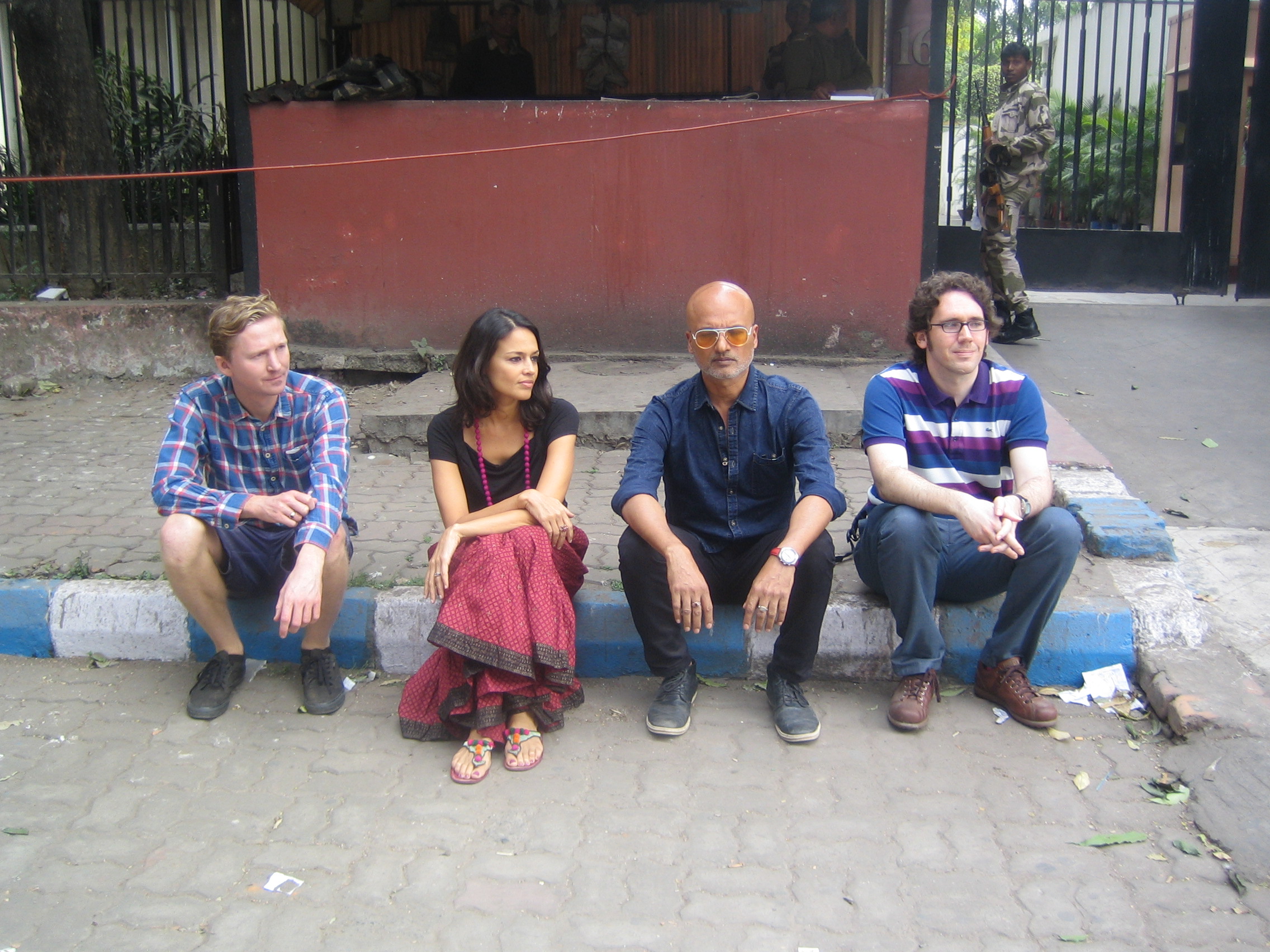
‘Now through your head there speed the words Hold on.’ As those words, the final line of a short poem about Kolkata I’d been working on since arriving in the great city, came out of my mouth, I looked in front of me at my audience. During the past year, I’d read poems at Sheep Festivals and school assemblies, in attics of restaurants and back rooms of pubs, with gangster rappers and Morris dancers, but none of that prepared me for the scene in front of me. I was reading poems to one poet from Swansea and two from India and behind them, a crowd of grinning and pointing residents of Kolkata had gathered. A rickshaw driver had stopped to take me in. Two Indian schoolboys giggled with eachIMG_3182 other. Behind them, the city’s distinctive yellow Ambassador taxis sped past. On the other side of the road, a man sat on the pavement gutting fish for sale, as murky water gurgled past his feet towards the drain. The next stall over was crammed with the most vibrantly coloured flowers I’d seen in my life. This was Kolkata.

The poem I was reading was the culmination of a film I was making with my exchange partners, Joe Dunthorne, Tishani Doshi and Jeet Thayil. Loosely inspired by Richard Linklater’s Slacker, our plan was to shoot, in one take, a series of conversations as we walked down Chitpur Road in north Kolkata. Joe Dunthorne would tell an anecdote about the time a local tried to pick him up by telling him he looIMG_3117ked like Princess Diana. Tishani Doshi would reflect on the quieter spaces of the city, its parks, its rivers. Jeet Thayil would grab hold of unsuspecting locals and shout haiku at them. The relay baton for this series of conversations would be a stool, passed from hand to hand, which would also be the platform from which I would deliver my embryonic poem.

As the content of these coIMG_3167nversations will tell you, Kolkata is a city of incredible variety and vibrancy. It is rich in history: we managed to find in the Park Street Cemetery the tomb of one of Charles Dickens’s sons, which was impressive yet surprisingly ramshackle. We went on a boat on the Hooghly river, fishingboat-bobbing our Welsh and Indian selves and chatting about our shared poetic concerns on a break from the madness of the city. We found a shared love of the sestina and wrote one collaboratively for Dylan Thomas, whose centenary celebrations the trip was part of. And we read together at the Kolkata Book Fair, the tents, stewards and professionalism of which reminded us of Hay-on-Wye, but with roughly, it seemed, a hundred times as many people. It was awesome to read poems like ‘Anatomy’ and ‘View of Valleys High Street through a Café Window’ in that setting.

One thing I struggled wIMG_3179ith during the trip, and continue to do so now I’m back and trying to develop my jottings into full poems, was how to write about this amazing city. Do I have any right to? My writing is so geographically rooted in Wales and in a set of experiences which are my own. How do I write about a completely different culture and way of living? The best I’ve come up with so far is to adapt the sort of descriptive, documentary, writing-in-situ style of a number of poems in my first collection to this completely new subject matter. To paraphrase something Jeet said, if you were simply to fIMG_3180ix a camera to the front of a taxi and record a drive through the streets of Kolkata, you’d have a truly astonishing film. The poems I’m working on out of the experience, including ‘Kolkata Street Scene’ with which I’ll end this blog, and which I read for the film, are attempts to replicate something like that.

Before I finish, though, I just want to take a moment to thank my collaborators – or co-conspirators – on this project. Joe, Tishani and Jeet are amazing writers and people who it was a joy to be with. Discovering the shared ground in our writing and also enjoying our differences, discussing process and the things we’re grappIMG_3172ling with, was an amazing experience. In May we’ll do the whole thing again in Swansea, culminating in an event at the South Bank Centre in London which will also involve Rhian Edwards and a number of other Welsh, Scottish and Indian writers. I’m already looking forward to it. In the meantime, I can’t wait to see the final cut of that film. A boy from Crosskeys standing on a stool in the middle of the street in Kolkata and shouting his loony poem at the colour, the dust, the grins. Yes, yes, grandchildren, I remember. That fella just by there look – that was me.
Kolkata Street Scene

There on the pavement, men in broken-down
patio chairs fiercely discuss
what’s for lunch and a dog has given up
on consciousness. A bus comes tooting at itself
to get out of the way and, in top floor flats, men take up
sniper positions. A flower stall guy names the price
for colour, as a passerby
spits his clear spit onto the street.
Here comes a girl on a motorbike, plaited ponytail
growing from her helmet like a towrope.
Now through your head there speed the words Hold on.

Posted on

Friday Poem – The Waking

Boom! Carolyn Jess-Cooke

‘The Waking’ comes from Carolyn Jess-Cooke’s collection Boom! published in April 2014.

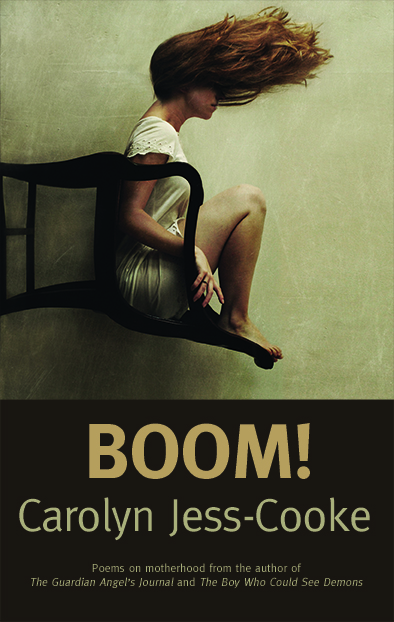
Boom! enacts the moment when the new baby arrives in the family ‘like a hand grenade’. ‘Becoming a mother changed me in every single way,’ says the author, ‘my first child – born in October 2006 – just about knocked me sideways. There were many reasons for this, but here’s the biggest one: I could not believe how public and political the (hugely personal) experience of motherhood was.’

A noted academic, author of a book about film and Shakespeare, and a best-selling popular novelist of The Guardian Angel’s Journal and The Boy Who Could See Demons, Jess-Cooke found, as many parents do, that the juggling act required to raise young children and continue a professional and creative life, is both exhausting and fulfilling.

Viewing motherhood from a multiplicity of artful angles, the author says, ‘Coupled with all this was the love I had for my children. It completely and utterly blew me away, how much I could love another human being.’

The Waking

Those first few days every part of her wakened,
the seedling eyes stirred by sunlight, tight fists
clamped to her chest like a medieval knight
and slowly loosening, as if the metal hands
were reminded of their likeness to petals
by the flowing hours. Her colors, too,
rose up like disturbed oils in a lake, pooling
through the birth-tinge into human shades,
her ink eyes lightening to an ancestral blue.
The scurf and residue of me on her scalp floated
easily as a pollen from the sweet grass of her hair.
She reminded me of a fern, each morning more
unfurled, the frond-limbs edging away from her
heart, the wide leaves of her face spread to catch
my gaze. Once, I saw the white down of her skin
cloud in my hands, the cream ridges of her nails
drift like crescent moons, the thick blue rope
she had used to descend me tossed like a stone,
as though she was finally free.

Carolyn will be discussin parenthood and poetry at the Stanza Poetry Festival on 6th March. Order Boom! from Seren’s website.

Posted on

What Editors Want – Fiction

Over the course of the coming year, we’ll be doing a series of blog posts on what editors and publishers are looking for in a book submission. Our fiction, poetry and non-fiction editors will be telling us what makes a great submission and sharing their tips for getting published.

Up first is fiction.  Seren’s fiction editor, Penny Thomas has had great success since she joined Seren in 2006 and consistently has books on major prize lists. In 2011 she preceded over The Last Hundred Days, which made its way on to the Man Booker longlist. Recent commissions include The Rice Paper Diaries, which won the  2013 fiction category at Wales Book of the Year and the 2013 Edge Hill shortlisted The Scattering. Penny was the driving force behind the hugely successful series, New Stories From The Mabinogion, which brought together ten top Welsh authors to rewrite the ancient myths of the Mabinogion in a modern day context.

Penny shares her secrets to success below.

“The short answer would be a bestseller please, and I suppose authors would be quite keen on this too. But if signing bestsellers were an exact science we’d all be driving Mercs, so what we really want is a manuscript we love and which is perfect for whichever list we are commissioning for. This sounds obvious but the last point is crucial. Occasionally the unexpected can be so glorious that an editor will choose it for their list. But in general there is very little point in sending a zombie horror novel to a publisher of romantic saga, or a children’s picture book to an adult contemporary fiction list – it sounds obvious, but it happens!

Tastes in reading matter vary as much as tastes in music, food or art … so much of what an editor is looking for is going to be subjective. But at Seren when I open the envelope, what I am hoping to find each time is an ms that blows me away with the brilliance of its language, the subtlety of its characters, the originality of its voice and a narrative that draws you in to its world so gently but insistently that you are way past the point of no return before you even think of putting it down. If it’s genuinely funny, happy, sad or thoughtful, or all at once, so much the better. There are no specifics about subject matter, style or location, a story worth telling and told extraordinarily is all we ask.”

Here are a list of Penny’s key dos and don’ts:

Do address to the right person and publisher if possible.

Do research their list first to be really sure your novel/story collection is right for them.

Don’t use cliché or try to sound too much like your favourite authors – think and speak for yourself or your characters through your writing.

Don’t rely on plot alone – it may not be enough.

Don’t send an overlong synopsis, a page is usually fine – the editor doesn’t care enough about the characters yet to be absorbed by what is happening to their mothers, daughters or second cousins in chapter 25.

Do remember that editors can be pedants – if you mess up the apostrophes on page one it’s easily sorted, but it doesn’t inspire confidence in the next three hundred.

Do be patient, the editor may love your work – they just haven’t found it yet in the midst of everyone else’s!