
Seren poet, Paul Henry will be reading at LOVE POETRY on 14th March, an exciting new poetry night in Birmingham
Seren poet, Paul Henry will be reading at LOVE POETRY on 14th March, an exciting new poetry night in Birmingham
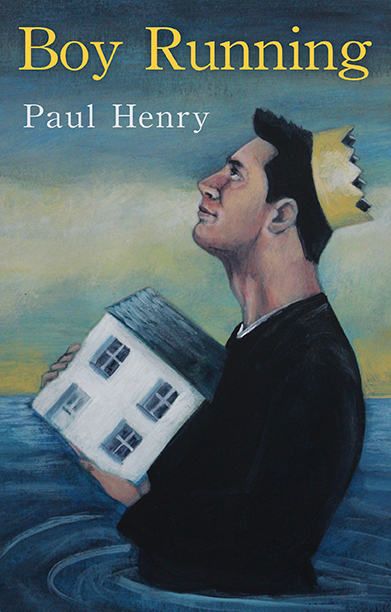
Studio Flat comes from Paul Henry’s sixth collection, Boy Running, available February 2015.
Boy Running has three distinct sections:
Recently reeling after a marital break up, poems such as Studio Flat deal with the aftermath of divorce. The poet is left to sift through the emotional fallout and the physical reminders of a shared life left behind: tables, lamps, metronomes, pianos, guitars. The poet’s sons are at the heart of this section where pathos is balanced by humour amidst the characters of a small country town.
A second section moves to the Welsh coastal town of Henry’s childhood, Aberystwyth, and the summer of 1969
In the final sequence we meet Davy Blackrock, a washed-up songwriter and modern day alter ego of Dafydd y Garreg Wen (David of the White Rock), the blind 18th century harpist and composer who fell asleep on a hill and dreamt the famous song which bears his name. In contrast to David of the White Rock, Davy Blackrock, ‘star of an ashen town’, drags his guitar from street to hotel to bedsit, an unsettled ghost who dreams of the perfect song.
Studio Flat
Socks hang like bats from a skylight.
They may be dry in time for the moon.
The camp site owner’s water-feature
drains more blood from the sun.
Cars queue for the narrow bridge.
Birds catch their pulses and fly.
I am suddenly old. What’s an attic
but a bungalow in the sky.
And where are you, my sons?
I heard your voices in the bells
of snowdrops pulled by the wind.
These tulips have lost their smell.
Perhaps I could tell you, one day
where the snowdrops went, why old men
dry their socks on the moon, and what
darkened the skylight, just then.
My Family and Other Superheroes author, Jonathan Edwards, has been invited to take part in the ‘Walking Cities’ exchange, which will see him trade places with an Indian counterpart in Kolkata in February.
Part of the Dylan Thomas centenary celebrations, and organised by the British Council, Walking Cities pairs up UK and international writers and enables them to tour each other’s respective home cities, providing an opportunity for the visiting poet to encounter the foreign city through the eyes of the local host.
Jonathan will be shown around Kolkata by fellow Seren author Tishani Doshi, whose modern Mabinogion retelling, Fountainville, was inspired by India’s rich mythological landscape. Walking with Jonathan and Tishani will be Welsh author Joe Dunthorne, whose short story, Rising, Falling, will be published in New Welsh Short Stories in March 2015, and Indian poet Jeet Thayil.
The tour will cumulate with an event at Kolkata Book Fair on 7th February, where Jonathan and his fellow travelers will share their insights from the experience.
The British Council will be recording Jonathan’s experience for a podcast, which will be featured in Guernica magazine, so you can keep up with the adventure.

Ivy Alvarez’ collection Disturbance is a gripping novel in verse that chronicles a multiple homicide, a tragic case of domestic violence, where a family was gunned down by the husband and father, the one person who promised to protect them.
The book features poems in a kaleidoscope of voices from all the characters involved. We first meet the family itself and witness how the father’s controlling attitude gradually escalates into violence. Then we get the aftermath: the authorities, police and neighbours, who all might have helped to prevent this tragedy. This is a very dark book, but a courageous one, ultimately about evil and its presence in our everyday lives.
Holes captures the immense anguish and heartbreak of a mother who was helpless to protect her son in this tragic case.
Holes
I pressed the button. No-one came. The police could not find me in the dark. They were also afraid of death… it might come for them instead. They waited behind a screen of trees, for the moon to uncover itself, silver the edges of their sirens, their dark cars. The pale pebbles in the driveway, left to imagine the river that used to wet them—they must tire of always staring up, sightless and at the mercy of everything. The police step on them. They creep only so close, but no closer. My son is dead on the ground. Someone close his eyes. But I am ignored in this as I have been with so many other things. His blood is cold now, blackening, drying up, stiffening the fabric of his jacket, soaking into the soil. There are holes in him I know nothing about, nothing to do with the boy I delivered to the world, my gift, small and pure. The dark is blue and cold. The trees conceal susurrations in their high skirts, branches uplifted like arms, wailing whispers… Black cars, old scars, my son’s open mouth, empty shotgun shells whistling smoke white dancing up and out
This year at Seren you’ll be hearing an awful lot about a man named Alun Lewis. Why? Lewis was the definitive writer of the Second World War, and this year marks the centenary of his birth. If you’d like to keep up to date with any news or events concerning the centenary, you can follow our Alun Lewis Twitter account here.
 Lewis was born on the 1st July, 1915 in Cwmaman. He won a scholarship to Cowbridge Grammar School when he was 11, and it was here that he began to write well-crafted, thought-provoking fiction. A bright and sensitive boy, his talent for writing was evident from a young age and didn’t go unnoticed by his teachers; he had several stories, including ‘The Tale of the Dwarf’ and ‘The End of the Hunt’, published in his school magazine, The Bovian.
At 17 he won another scholarship to study History at Aberystwyth University, achieving first class honours, and in 1935 he moved to Manchester to study for his MA with the intention of becoming a teacher. When his training was complete he taught at Lewis Boys’ School in Pengam.
A pacifist by nature, Lewis appeared to have no intention of joining the army when the Second World War cast its shadow over Britain, but he eventually joined the Royal Engineers and later qualified as a Second Lieutenant despite how unhappy military life made him. He was stationed with the South Wales Borderers until December 1942, where he arrived at a new station in Nira, India. In the same year his poetry collection Raiders’ Dawn was published. It would be the only collection published during his lifetime.
Just over a year later, in February 1944, Lewis was moved to Burma. There he and his men fought the Japanese on the front line, despite Lewis’s rank meaning he could have remained at headquarters. Though he missed his wife, his family and his home, and struggled with severe depression, he was determined to fight for what he believed was right.
A month later, on the 5th March, 1944, Lewis was found shot in the head after shaving and washing, and died from the wound six hours later. He was 29 years old. Though it is widely believed to have been a tragic accident, there are others who believe Lewis’s death was a suicide. One thing we can be certain of is that his premature death was a great loss to Welsh, and indeed British, literature.
Perhaps best known for his war poetry, Lewis was also a prolific writer of prose and wrote an abundance of short fiction during his lifetime. 1945 saw the publication of his second poetry collection, Ha! Ha! Among the Trumpets. Poems in transit, followed by Letters from India (1946) and In the Green Tree (1948).
As well as reprinting some of Lewis’s finest work, we at Seren also intend to bring you Morlais, Lewis’s unpublished novel!
If Lewis is a writer you’d like to learn more about, then look out for his biography, written by Lewis expert and enthusiast John Pikoulis, which is due to be published this July.
We’ve been chatting to poet Jonathan Edwards about his debut collection, My Family and Other Superheroes, which recently won the Costa Poetry Prize. Get a copy of that fantastic collection here.
Jonathan was born and brought up in Crosskeys, South Wales. He has an MA in Writing from the University of Warwick, has written speeches for the Welsh Assembly Government and journalism for The Big Issue Cymru, and currently works as an English teacher. He won the Terry Hetherington Award in 2010, was awarded a Literature Wales new writer’s bursary in 2011, and in 2012 won prizes in the Cardiff International Poetry Competition and the Basil Bunting Award. His work has appeared in a wide range of magazines, including Poetry Review, The North, Poetry Wales and New Welsh Review.
Throughout My Family and Other Superheroes you combine intimate glimpses of your own life with famous references to popular culture, like Back to the Future, and major historical events such as Henry VIII’s Acts of Union. Was this contrast something you intentionally strove to achieve throughout the collection?
I think, ultimately, that poets write about what they love. For me – all of us, I suppose – that means writing about family. The first poems with which I did that were successful with magazines, but some of the feedback I got – and I don’t know if this was a polite of saying the poems weren’t good! – was that to write about your family is to write for your family, to limit your readership to that select group of people. I really love my family, but I would also like lots of readers! So a solution was to write about things and people like Back to the Future, Evel Knievel, Gregory Peck and so on, which have a wider frame of reference. An important inspiration here was the American writer David Wojahn, whose collection Mystery Train, and particularly the sonnet sequence of the same name, is an object lesson in how to write poems about popular culture. The sonnets explore a number of apocryphal but plausible moments in pop culture, such as Francis Coppola teaching tribesmen the lyrics to ‘Light My Fire’ on the set of Apocalypse Now, or a time when Delmore Schwartz went to a Velvet Underground gig. At the same time, Wojahn writes these big, moving poems of family, very much in the school of another favourite writer, Mark Doty. So a combination of those things was what I was after, and the work of the British writer Jo Shapcott, and Wales and Seren’s own Deryn Rees-Jones, were also very important in getting me there.
Much of the collection is written from your point of view, yet in both ‘My Family in a Human Pyramid’ and ‘Evel Knievel Jumps Over my Family’ you refer to yourself and your family collectively as the ‘Edwardses’. Is it fair to assume the ‘Edwardses’ became a character itself during the writing process?
I think the first thing worth saying here is that I’m not entirely sure about the poems being written from my point of view. It’s true that their status as monologues isn’t as front and centre as it is in, say, some of my favourite poems by Carol Ann Duffy. There are poems in the book, though, such as ‘Girl,’ and ‘On the Overpass,’ which very much seek to make the reader respond to, and question, the poem’s speaker as much as its subject. I think, in any case, that to some extent all poems are monologues, all poems are written from their own point of view, far more than they are from the author’s. If it makes a poem work, I happily invent phantom children, brothers, ex-wives, all sorts of things. Perhaps I shouldn’t say this, as I don’t know if a supposed sincerity to the poems is part of their appeal, but the best story I can tell regarding the relationship between the poems and my own point of view concerns the poem ‘Gregory Peck and Sophia Loren in Crumlin for the Filming of Arabesque, June 1965.’ The poem imagines that my mother and father met in Crumlin at the filming of Arabesque, but the truth is that neither of them were anywhere near that village on that day – they actually met on the village corner a couple of years later, when my mam asked my dad if he wanted a chip! After the book came out though, a good friend said that he had found footage of the filming in Crumlin on youtube, and could see my mother standing there in the crowd! I really, really love that problematic relationship between poems and reality, the ability of poems to create as well as reflect reality.
With regard to this issue of ‘the Edwardses,’ that noun, and particularly its absurd plural, seemed a nice shorthand way of describing the togetherness and bonds of family that the two poems you mention are interested in. I was also thinking here of ‘The Simpsons.’ To some extent, we’re the first generation to live in post-Simpsons families, and, whether or not poetry wants to think about that, for my money it should – that same approach of using layers of pop culture allusions to ultimately say something about relationships between parents and children can be adapted, I think, to poetry. A number of the poems have episodes of The Simpsons as a direct influence. ‘My Family in a Human Pyramid,’ for example, is based around an episode where Springfield tries to break the world record for the world’s biggest ever human pyramid. The physical interconnectedness of the pyramid in the poem might say something about our bonds to our families and our ancestors, but what was in my mind at least as much was that pyramid in Springfield, and the way it collapses because Jimbo Jones realises he’s touching another boy’s hand! I think that connection with down-to-earth everydayness can keep you grounded and productive as a writer, without the idea of writing poems becoming too intimidating.
What is your definition of a superhero, and has that definition changed over the course of writing this collection?
For me, ‘superhero’ in the collection has two meanings. Firstly, there’s the world of pop culture superheroes, like Marty McFly, Ian Rush, Sophia Loren – these technicolour, larger-than-life characters who seem to inhabit another realm, and who I try to use to say something about ordinary life, and to make what I say striking and accessible. Secondly, I was interested in ordinary people as superheroes. Newport was an important place in the thinking of the book. If you think about how Newport has changed in the past twenty years, the way in which its high street has gradually grown less bustling, the way in which the removal of the Chartist mural represented an attack on its history – I was interested in reflecting the ordinary experience of those of us who live in this area and in the Valleys. ‘Starbucks Name Tag Says Rhian’ and ‘The Bloke Selling Talk Talk in the Arcade’ are among character sketches of Newport characters in the book – even bigger superheroes in their daily lives, for my money, than Evel Knievel or Doc Emmett Brown.
You appear to have a fascination with roots, and ties to both people and places, as seen in both ‘Lance Corporal Arthur Edwards (1900-1916)’ and ‘Anatomy’. Do themes such as family and a sense of belonging feature often in your work or are they themes you found yourself exploring specifically for this collection?
I think, from my earliest poems, I’ve always thought of writing as a way of thinking about roots. I don’t know if the sense of loss is more acute in my family than any other, but World War One to some extent cast a shadow – my father’s uncle was killed there, my paternal grandfather made it back but died before I was born. Then there are all the old family photos – the only one we have of my great grandfather, for example, shows him grinning, his hand on the knee of a woman who isn’t my great grandmother! Such characters are enigmatic, but also – look at their eyes, their curly hair – they’re me! – and so writing poems is a way of filling in the gaps, imagining yourself into that space.
More widely, I was of course interested in exploring my roots as a Welshman, especially in the second sequence of poems in the collection, which begins with ‘Anatomy.’ John Davies’s wonderful book ‘A History of Wales’ was an important inspiration – you can’t read about the centuries of linguistic, cultural and physical oppression, but also incredible achievement and pride, without wanting to pick up your pen.
Your poems feel very direct, particularly ‘Girl’ and ‘Brothers’, but are written in such a way that the directness translates into conversation rather than intimidation. Is talking to your reader, rather than talking at or around them, important to you as a writer?
I think sometimes the poems are addressed to specific people. ‘Decree Nisi,’ for example, is written to ‘Kelly,’ while ‘Lance Corporal Arthur Edwards 1900-1916’ talks directly to my great uncle. I think the thing is that a lot of poems I love do this. I’m thinking of a wonderful poem now by Tom French called ‘Night Drive,’ which is written to his mother, and another by Greta Stoddart, ‘You drew breath,’ written to her child – the astonishing work of those two writers was an important influence in terms of my thinking about family. I suppose addressing someone directly, particularly if they’re a family member, helps to enact the connections of family I wanted to think about in the poems. In addition, there’s always an increased sense of drama, urgency or even performance in the use of the second person – the monologue becomes an implied dialogue – which can help a poem to work. Along with humour, the choice of titles, the sort of accessible register I often use and the use of pop culture, it’s one of the things that some of the poems do to try and engage a reader, to involve readers in the poem and ultimately to move them. I think it’s that which every poet is ultimately after.
Having your debut collection win the Costa Poetry Award must be incredibly exciting. What are your future plans for your writing?
To go back to Tom French again – his first collection, Touching the Bones, is just absolutely astonishing, isn’t it? ‘Night Drive,’ ‘Touching the Bones,’ ‘Pity the Bastards’ – just amazing poem after amazing poem. The sort of thing that makes you so glad that poetry exists and makes you see what it’s for. I’m bad at making plans and rarely fulfil them in any way that can be traced to intention. Genuine poems arrive on their own terms and surprise you and won’t do what you tell them. All you can do is set out by such co-ordinates and keep going. Just this last month or so I’ve found myself writing more and more about characters from adolescence and childhood – a sort of Portrait of the Artist as a Young Dog in verse, which has really excited me. I’ve also got some sequences on the go about Welsh football and some sort of pseudo-responses to ideas in Shakespeare’s Sonnets, if that doesn’t sound too grand. The Costa Award is, of course, an incredible, incredible honour, which I still don’t know that I quite believe – to think that these things which I scribbled in my front room are out there, and that people like them, is something to feel enormously grateful for. I’ve also got a feeling that it means there will, as with the first book, be a lot more poems to come about coffee!
2015 has started with a bang here at Seren following Jonathan Edwards’ triumph at the Costa Book Awards with his debut poetry collection, My Family and Other Superheroes, and the excitement doesn’t end there! It may only be January, but already 2015 is set to be the best kind of busy.
Jonathan will be participating in an Open Mic Night at the Imperial Hotel, Merthyr Tydfil on Thursday 22nd January. It’s free entry, so if you want to congratulate Jonathan on his win in person or share some of your own work with a band of keen listeners it’s the perfect time to do so.
But if you feel as though your work isn’t quite ready for the public yet, why not take part in an online course? Beginning Friday 6th February, Jonathan will be leading ‘No Laughs Please, We’re Poets’; a 10-week online poetry course on comic poetry where you’ll explore a range of approaches to the comic poem and look at some brilliantly funny poems from esteemed poets such as Glyn Maxwell, Simon Armitage, Carol Ann Duffy and more!
What better way to get 2015 off to a productive start?
This year Seren is celebrating the centenary of Alun Lewis, the definitive writer of the Second World War. Well known for his war poetry, Raiders’ Dawn and other poems (1942) and Ha! Ha! Among the Trumpets. Poems in Transit (1945), Lewis was also an avid writer of short fiction.
If you want to keep track of the various events we’ll be hosting for the centenary throughout the year then make sure you’re following @AlunLewis100 on Twitter, and if Lewis is a writer you’d like to learn more about then look out for the publication of his biography, written by John Pikoulis, which is set to be released in July. Until then, there are plenty more new releases to look forward to!
The Art of Falling
Kim Moore
April, 2015
The Art of Falling is Kim Moore’s keenly anticipated debut poetry collection. A young poet from Cumbria, she writes with a compelling directness and power about her own life and those of others. Vigorously alive and often full of humour, there are poems about ordinary people: the scaffolders and plasterers, shoemakers and carers amongst us. Already a winner of multiple prizes, including the Northern Promise Award (2014), Moore writes poems that are both moving and memorable.
Rosie Shepperd’s The Man at the Corner Table is another sparkling debut collection, due to be released this year, along with new collections from established poets such as Paul Henry (Boy Running, February 2015), Anne-Marie Fyfe (House of Small Absences, April 2015) and Kate Bingham (Infragreen, June 2015).

Judas
Damian Walford Davies
February, 2015
Judas Iscariot – the byword for betrayal – tells his own story in Damian Walford Davies’s compelling and finely wrought new collection. Fully aware of how ancient enmities shape modern conflicts, the author draws on twenty centuries of representations of Judas to set out a tale that challenges our pre-conceived notions of holiness and betrayal.
March brings with it the release of A Fold in the River, a collaboration between T S Eliot prizewinning poet Philip Gross and visual artist Valerie Coffin Price exploring the River Taff through poetry and beautiful prints.
Terroir
Graham Mort
April, 2015
From England to Europe, Africa to South America, these stories by prizewinning writer Graham Mort explore relationships: father and child; man and wife; man and his environment. A rising star of winemaking understands his terroir, but oversteps the boundaries; a father taking his son on a day out is placed in unexpectedly terrifying circumstances; an aid worker in Uganda finds himself treading in his father’s footsteps. Sensitively told and beautifully written, Mort brings fresh perspectives to our place in the world around us.
His previous collection, Touch, won the Edge Hill Short Story Prize in 2011.
Coming in March is the release of Seren New Welsh Short Stories. Including work from some of the best contemporary Welsh writers such as Stevie Davies, Cynan Jones and Trezza Azzopardi, the collection is edited by Francesca Rhydderch, whose story ‘The Taxidermist’s Daughter’ was shortlisted for the 2014 BBC National Short Story Award, and Seren’s own fiction editor, Penny Thomas.
In June we will be welcoming the release of Limestone Man, the latest novel from prizewinning author Robert Minhinnick. A meditation on age and opportunity, it is the follow up to the 2007 Ondaatje shortlisted novel, Sea Holly.

Murder at the Star
Steve Adams
April, 2015
1921. In the mining town of Garnant, in South Wales, God-fearing, partially deaf shopkeeper Thomas Thomas was brutally murdered: stabbed, slashed and battered by his assailant. His safe is empty, the town is aghast. Scotland Yard are stumped. A number of suspects are identified but released. Who killed Thomas Thomas? For ninety years Thomas’s death remained a mystery, until journalist Steve Adams solved the case in Murder at the Star.
If your taste leans more towards the pastoral and the poignant then look out for Phil Cope’s Holy Wells: Scotland, coming in April, and Richard Collins’s The Road to Zagora, coming in May. Cope explores the beautiful, sacred wells of Scotland, while Collins’s memoirs, compassionate, funny and unmistakably human, tell of his inspiring travels after being diagnosed with Parkinsons Disease in 2006.
 Losing Israel
Jasmine Donahaye
June, 2015
How long does an attachment to a place or a culture last? Having lived more of her life outside Israel than in it Jasmine Donahaye questioned her relationship with the country and its people. The result was an uncovering of a piece of Israel’s hidden history, and of her family’s story. Revelations of the part her forebears played in the newly created Israel reveals unsettling knowledge about kibbutzim and land clearances. Challenged by this new and unwanted information, Donahaye’s notion of history and her understanding of Israel, of her grandparents and of her identity is completely transformed. Losing Israel is a moving and honest account which spans travel writing, nature writing and memoir. Through the author’s personal situation it explores the powerful and competing attachments that people feel about their country and its history.
To keep up to date with all of our releases and events, follow us on Twitter or find us on Facebook!

The Friday poem is back f0r 2015 and we’re kicking off with The Voice in Which my Mother Read to Me from Jonathan Edwards’ Costa Poetry Award Winning collection My Family and Other Superheroes.
The Voice in which my Mother Read to Me
isn’t her good morning, good afternoon, good night voice,
her karaoke as she dusts, make furniture polite voice,
her saved for neighbours’ babies and cooing our dog’s name voice.
It isn’t her best china, not too forward, not too shy voice,
or her dinner’s ready, your room looks like a sty voice,
or her whisper in my ear as she adjusts my tie voice.
It’s not her roll in, Friday night, Lucy in the Sky voice,
her Sunday morning, smartest frock, twinkle-in-the-eye voice,
that passing gossip of the vicar with the Communion wine voice.
It’s not her ‘Gateau – no, ice cream – no… I can’t make the choice’ voice.
It’s not her decades late, fourth change, ‘Is this skirt smart enough?’ voice.
It’s not her caught me with the girl from number twenty-one voice.
That voice which she reserved for twelve-foot grannies, Deep South hobos,
that sleepy, secret staircase, selfish giants, Lilliput voice.
That tripping over, ‘Boy, why is your house so full of books?’ voice.
[soundcloud url=”https://api.soundcloud.com/tracks/183594834″]
My Family and Other Superheroes is available from the Seren website. Save 20% when you join our online book club.
Jonathan Edwards has been awarded the Costa Poetry Award for his debut collection My Family and Other Superheroes.
The Costa Book Awards honour some of the most outstanding books of the year written by authors based in the UK and Ireland. There are five categories – First Novel, Novel, Biography, Poetry and Children’s Book.
Edward’s heroes are a motley crew: Sophia Loren, Marty Mcfly and Evel Knievel jostle for space on the pages alongside Valley’s mams and dads, the kebabby in Merthyr and the traditional Welsh costume, all described with great humour and warmth.
The poetry category judges: Owen Sheers, Anna Dreda, and Charlotte Runcie, described Jonathan’s book as“Joyful and dynamic – a collection that’ll make you laugh and make you think.”
The five Costa Book Award winners, each of whom will receive £5,000, were selected from 640 entries, and the books are now eligible for the ultimate prize – the 2014 Costa Book of the Year.
Edward’s superheroes will battle it out for the overall Costa Book of the Year awards alongside the other four category winners including best-selling titles Emma Healey’s Elizabeth is Missing (First Novel) and H is for Hawk by Helen Macdonald (Biography).
The winner will be announced at an awards ceremony hosted by presenter and broadcaster Penny Smith at Quaglino’s in central London on Tuesday 27th January 2015.
Previous recipients of the Costa Book of the Year award include Nathan Filer, Kate Atkinson and Hilary Mantel.
A Christmas themed haiku by Peter Finch
Some Christmas Haiku
On the moors
The snow caught by grass
No one to see it
Not Christmas holy silent night
But the Holiday season
Above the cloud same old moon
Cinio Nadolig
Boldy praising Iesu
Menu’s in English
In the Chapel
Old wood
After so many years still shining
Through the dense firs
Light of a wrecked car
Burning
Early snow
On the berried holly
Some cretin starts complaining
Old man
Pulling crackers by himself
Sound clear to the big dipper
Sound of retching
Three man in an empty street
Crushing larger cans
Street guitarist mangles carols
On the shopkeeper’s face
The shopkeeper’s mask

This September, you’re invited to explore the unseen and the unsettling. From dark and menacing landscapes to the everyday terrors of domestic settings disturbingly close to home, these stories will horrify and delight in equal measure. Be prepared, for ‘this is a land of ancient power, and even more ancient beings...’ Pre-order the latest addition to our Welsh Gothic series, ‘Giving the Darkness Life’ on our website now.
.
Stories by @markblayney1, Mary-Ann Constantine, @damianwalforddavies, Caradoc Evans, Dorothy K. Haynes, @lucie_mckhardy Arthur Machen, Elinor Mordaunt, John Llewellyn Probert, L.T.C. Rolt, @priyasharma1000, Edward Thomas, Elizabeth Walter and D.P. Watt
.
@inpressbooks @books.wales #WelshGothic #SerenBooks #NationalYearOfReading2026 #SpookySeason #AutumnBooks

We had a wonderful time listening to @megan.c.hayes talking about her memoir ‘Glimmering’ with Kath Little from @bardic_books at St Illtud’s church in Llantwit Major on Saturday. Diolch yn fawr to everyone who joined us and to Kath for hosting! Copies of ‘Glimmering’ are available now in your local bookshop.
.
#Glimmering #Memoir #SerenBooks #IndependentBookshop #NationalYearOfReading2026
Ebooks available now! ‘In Search of Sea Dragons’, ‘Muslim Wales’ and ‘The Waters That Raised Us’ are now available from all major ebook retailers meaning you can take them with you on the go 🎉 Do you prefer reading ebooks, print books or both?
.
@severn.sea.fossils @azimwales @tayloredmonds #Ebooks #Kindle #SerenBooks #BooksFromWales #LoveReading
🏆@maggiepoet continues her winning streak having won the Guyana Prize for Literature Poetry Award with her collection ‘I Sing to the Greenhearts’! Available now in bookshops nationwide and on our website!
.
#AwardWinning #GuyanaPrize #Poetry #PoetryBooks #SerenBooks


