Posted on

Friday Poem – The Formula for Night

Tamar Yoseloff A Formula for Night

This week’s poem comes from Tamar Yoseloff’s latest collection, A Formula for Night: New and Selected Poems.

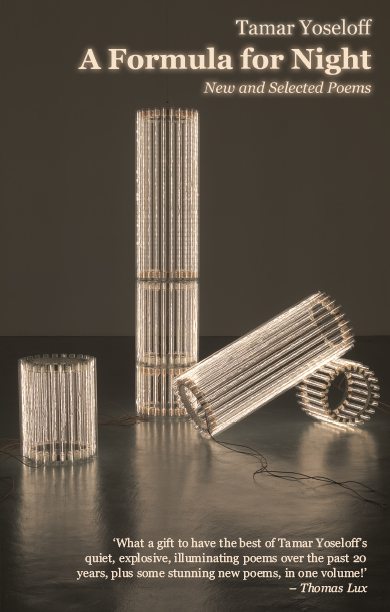
Tamar Yoseloff is a poet whose career has been profoundly influenced by the visual arts. A Formula for Night: New and Selected Poems is the eagerly awaited summation of her work, encompassing selections from four published print volumes: Sweetheart, Barnard’s Star, Fetch and The City with Horns (now mostly out of print); and poems from her collaborations with artists: Formerly, Marks and Desire Paths. The book also includes a generous selection of beautiful new poems. The title poem is based upon an installation by Welsh artist Cerith Wyn Evans. An image from his work, a light sculpture, is used for the cover of the book. 

The poet’s first collection, Sweetheart, was a PBS Special Commendation and the winner of the Jerwood/Aldeburgh First Collection Prize. She was the recipient of an Arts Council New Writing award which helped her complete her second manuscript, later published as Barnard’s Star. Of her collaborations, Marks was published as a limited-edition artist’s book and pamphlet by Pratt Contemporary Art in 2007. Desire Paths was a limited-edition portfolio produced by Galerie Hein Elferink in the Netherlands. Both books feature work by artist Linda Karshan.

More recently, Formerly, a chapbook of poems based on forgotten London locations, with accompanying photographs by Vici MacDonald, was the debut publication of their co-founded imprint, Hercules Editions. Formerly was shortlisted for the Ted Hughes Award in 2012.  Exhibitions of the poems and photographs have appeared in two venues in London: the Poetry Society’s Poetry Café and the Saison Poetry Library at the Southbank.

The new poems are often artful explorations of paradox: death/birth, dark/light, clarity/mystery. In the ‘Swimmer of Lethe’  the protagonist says: ‘I’ve mastered surface/ here everything is under.’ Atmospheres are conjured, surfaces interrogated and humans are often found woefully or wonderfully implicated in their settings in unexpected ways. A misunderstood creature, the ‘Muntjac’, is seen with tender clarity ‘Now white with May/tar and fern on his delicate hooves…’. The poet’s vocabulary is spiky, sometimes ferociously so. Sex is another paradox, its violence at times palpable: from ‘Pictures of Spring’:  ‘I bend and break, bend/ and break, contort my limbs/ into these lovelocked shapes.’  ‘Hospital Time’: ‘collapses, folds the days into sterile gauze,/
a thousand different words for hurt’ beautifully evokes the estranging, atmosphere of a hospital but slowly evolves to become a moving elegy to the poet’s mother. 

The Formula for Night

It’s getting late. Light
floods the public bar,
you’re the final one to leave.
The mirror’s silver eye
gives you back yourself, precise.
You’ve lived your life through
glass, you miss the brush

of skin, someone whispering
your name.You hear it now,
a calling on the wind, insistent,
a small but steady flame.
You carry in your bones a gasp
of summer heat, the formula
for night.You arrive at the end-

of-pier reveal – the heart-stop hour,
when this world briefly yields
to the next: a door that creaks
an inch or two to catch
a blinding beam. You want
to understand what can’t
be seen, the fact behind

the trick, the wires hidden
from your view, the blue breath
that powers the machine.
Raise your eyes to read the stars –
streetlight’s glare has cast them
dark; once-bright bulbs,
trembling elements crack

and fizzle as they die. Their light
is obsolete. But close
your eyes, and still you find
gold impressed beneath
your lids, a moment lived.
And when you open them again,
darkness is what’s left.

Order A Formula for Night: New and Selected Poems from our website.

Posted on

An Interview with Mary-Ann Constantine

star-shot

We had a chat with Mary-Ann Constantine about her debut novel, Star-Shot, which is out today!

Mary-Ann Constantine studies Romantic period literature, with an emphasis on Wales and Brittany, at Aberystwyth University and has published widely in these fields since 1996. Her short stories have appeared over a number of years in New Welsh Review and Planet and her first collection, The Breathing, was published by Planet in 2008. Her second collection, All the Souls, was published by Seren in 2013. Star-Shot is her first novel.

Star-Shot_72rgb

Part fable, part mystery, Star-Shot is a stylish debut novel set in and around Cardiff’s National Museum in a time that is almost, but not quite, our own. As their paths cross in a circumscribed world of benches, parks and galleries, a handful of characters reveal their stories of obsession, loss and recovery, creating a fragile network of relationships which will help to resist the inexorable channels of silence eating into the city. 

A brittle young woman sits on a bench in Gorsedd park, conscious of the powerful building behind her; a tall man carries a box full of a strange organic substance up the entrance steps; a young father explains the formation of stars to his tiny son.  As university researchers try to map and understand  the destructive silence snaking around them, it becomes clear that the linked lives of these and other marginal characters offer ways of countering its effects. Poignant and humorous, Star-Shot is an exploration of how objects and images can focus our grief and desire; it is also a meditation on the regenerative power of garden ponds, and the cosmic significance of frogs.

Was it your intention from the beginning to write a story in which Cardiff’s National Museum plays such a huge part, or did the museum gradually seep into the story while you were writing?

I think it was there as a physical presence from the beginning. The image I couldn’t get out of my head was the first one, of the girl on the bench with a building behind her. Once I realized which building it was, I knew it would be a central character.

Magical realism is a very divisive term. Would you describe your work as magical realism and, if so, what is it that draws you to the genre?

Why is it divisive? Like ‘sci-fi’? Not proper literature? I like stories where odd things happen; and I like fiction that doesn’t completely opt for one side or the other along a border you could loosely call realism. I’ve always liked the work of the Portuguese writer José Saramago and the Italian writer Italo Calvino. They introduce ‘impossibilities’ into everyday life and then – sometimes ruthlessly, far more ruthlessly than I could ever do – see them through. You can read the impossible elements allegorically, metaphorically, but they have to be convincing in the world of the novel or story itself.  

Throughout Star-Shot we follow several different characters. Were any of them particularly difficult, or particularly easy, to write?

I have no idea why this happened, but they all just appeared, one at a time, and started talking to each other; and I took an instant liking to them. I’ve not written anything this long before (and yes, I know, it’s pretty short for a novel), but the only other sustained narrative involving a clutch of characters was ‘The Collectors’ in All the Souls, and I had to fight them the whole time – I found them all, in their different ways, unpleasant or failing in some way. This lot (and they really aren’t based on people I know, either, which makes the whole thing even stranger) seemed extremely sympathetic. Even the Professor figure and Luke, both of whom started off as slightly caricatured secondary characters, turned out to have hidden depths. I was worried that the absence of what my kids call ‘bad guys’ might make the story rather insipid. Hope not.    

Which skills that you learned from writing short fiction helped you to write longer fiction, and which skills, if any, were more of a hindrance?

I found it a very different process. Stories work round a central image or kernel – and that was what I assumed the girl-on-the-bench-and-building was for a long time. I had the final scene clear in my head too. I was surprised when the distance between them turned out to be not a few hundred words but several thousand. The scenes kept unrolling, short and cinematic. Once I knew who was in them it was a matter of listening in to conversations, and the writing came much more easily than usual.

Finally, what’s the best book you’ve read so far this year?

Tricky; I tend to get absorbed in whatever I’m reading at the time – and I hate ‘best’. But I think possibly the hugely powerful, dark and weird Housekeeping, by Marilynne Robinson; and two crystal-clear collections by Tove Jansson, The Winter Book and The Summer Book. Perhaps the most important book, though, was Naomi Klein’s discussion of climate change, This Changes Everything.

Don’t forget to enter our competition for a chance to win a signed copy of Star-Shot!

Order Star-Shot from our website.

Posted on

Friday Poem – The Death of Doc Emmett Brown in Back to the Future

my family and other superheroes

This week’s poem comes from Jonathan Edwards’ Costa Award-winning debut collection, My Family and Other Superheroes.

My Family and Other Superheroes introduces a vibrant and unique new voice from Wales. The superheroes in question are a motley crew. Evel Knievel, Sophia Loren, Ian Rush, Marty McFly, a bicycling nun and a recalcitrant hippo – all leap from these pages and jostle for position, alongside valleys mams, dads and bamps, described with great warmth. Other poems focus on the crammed terraces and abandoned high streets where a working-class and Welsh nationalist politics is hammered out. This is a post-industrial valleys upbringing re-imagined through the prism of pop culture and surrealism. If the author’s subjects have something in common with RS Thomas, or even Terry Street-era Douglas Dunn, his technique and approach owe at least as much to contemporary American poets like James Tate and David Wojahn.

The Death of Doc Emmett Brown in Back to the Future

I sit here in the darkness with my father,
slurping Pepsi, passing popcorn round.
The Libyans come fast around the corner,

pump Doc Brown with automatic fire.
My feet are dangling, inches from the ground.
I sit here in the darkness with my father,

as Marty hits 88 miles an hour,
goes back to ’55, to warn Doc Brown.
The Libyans come fast around the corner,

pump Doc Brown with automatic fire:
he gets up, dusts his bulletproof vest down.
I sit here in the darkness with my father,

who starts to gently snore. Now time goes quicker:
the cinema’s knocked down, moved out of town;
the Libyans come fast around the corner

on DVD. My boy asks for Transformers
instead as, from the wall, his bamp looks down.
I sit here in the darkness with my father.
The Libyans come fast around the corner. 

Order My Family and Other Superheroes from our website.

Posted on

Win a Signed Copy of Star-Shot!

star-shot

star-shot competition

It’s competition time!

To celebrate the upcoming release of Mary-Ann Constantine’s debut novel, Star-Shot, we’ll be giving away a signed copy to one lucky follower!

star_shot_72dpi_rgb

Part fable, part mystery, Star-Shot is a stylish debut novel set in and around Cardiff’s National Museum in a time that is almost, but not quite, our own. As their paths cross in a circumscribed world of benches, parks and galleries, a handful of characters reveal their stories of obsession, loss and recovery, creating a fragile network of relationships which will help to resist the inexorable channels of silence eating into the city. 

A brittle young woman sits on a bench in Gorsedd park, conscious of the powerful building behind her; a tall man carries a box full of a strange organic substance up the entrance steps; a young father explains the formation of stars to his tiny son.  As university researchers try to map and understand  the destructive silence snaking around them, it becomes clear that the linked lives of these and other marginal characters offer ways of countering its effects. Poignant and humorous,Star-Shot is an exploration of how objects and images can focus our grief and desire; it is also a meditation on the regenerative power of garden ponds, and the cosmic significance of frogs.

Beautifully illustrated with woodcut-style motifs by Clive Hicks-Jenkins, this is a subtle urban novel with a supernatural twist.

This isn’t just going to be any competition, however, this is going to be an interactive competition!

National Museum Cardiff plays a big part in Star-Shot, so here at Seren we thought it was only right that museums play a part in our competition. We challenge you to take to Twitter and tweet us a picture of you standing outside your nearest museum using the hashtag #ImStarShot, and you’ll be entered to win a signed copy of the book.

The competition ends in a month’s time, on the 5th November, so get your entries in and spread the museum love – we can’t wait to see your photos!

Posted on

Win a Signed Copy of Star-Shot!

It’s competition time!
To celebrate the upcoming release of Mary-Ann Constantine’s debut novel, Star-Shot, we’ll be giving away a signed copy to one lucky follower!
This isn’t just going to be any competition, however, this is going to be an interactive competition!
National Museum Cardiff plays a big part in Star-Shot, so here at Seren we thought it was only right that museums play a part in our competition. We challenge you to take to Twitter and tweet us a picture of you standing outside your nearest museum using the hashtag #ImStarShot, and you’ll be entered to win a signed copy of the book.
The competition ends in a month’s time, on the 5th November, so get your entries in and spread the museum love – we can’t wait to see your photos!

Posted on

Friday Poem – The Snake House

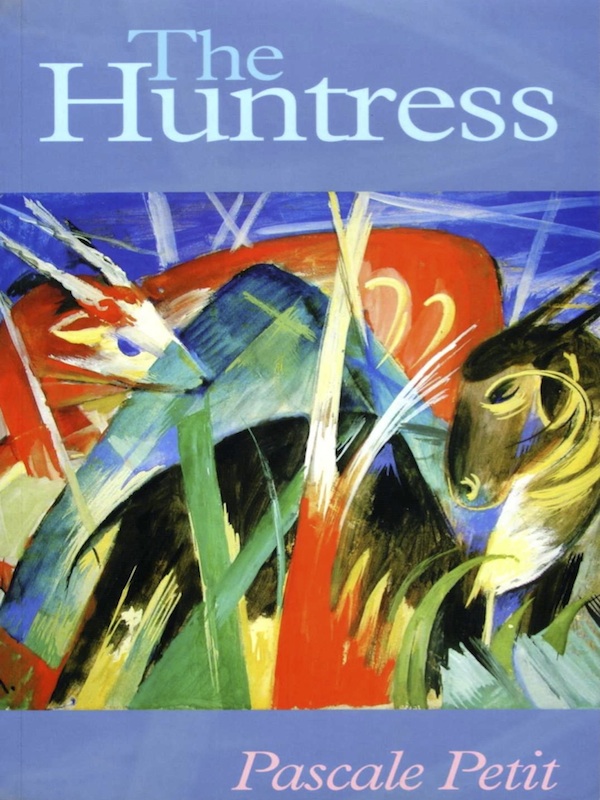
This week’s poem comes from Pascale Petit’s third collection, The Huntress, published in 2005.

In Pascale Petit’s highly-charged third collection, a daughter is haunted by her mentally ill mother, and a painful childhood is re-imagined through a series of remarkable and passionate transformations. The feared mother is a rattlesnake, an Aztec goddess, a Tibetan singing bowl, a stalagmite, a praying mantis, a ghost orchid. These culminate in a long central poem where the daughter escapes her huntress as a cosmic stag. Underlying these poems is an intense mystical vision that lifts the dark material of the subject matter above the merely personal. 

The Snake House

It’s time to go up to your front door, Mother,
and ring the rattling buzzer of a bell,
the door with two curved fangs.
I go in, into the muscular throat of the hall,
down the tunnel that’s closing now
to a pinpoint of light.
I’m in the swallowing living-room,
washing it for you, half-alive,
like a man preparing for the rain-dance
in the dry arroyo. He reaches
into the pit and washes the snakes
so that later when he dances with the ‘little mothers’
in his mouth, they won’t bite.
I’m a child playing in the pen
with my pet rattlers,
giving them bread and milk.
As long as I’m unscared
they won’t strike. And you’re saying,
“Only a girl-child can do this”.
My cheeks are almost seamless now,
countless grafts hide the necrosis.

Order The Huntress from our website.

Posted on

The Northern Poetry Library

Poet Carolyn Jess-Cooke (Boom!) is taking part in a project aimed at promoting the Northern Poetry Library’s importance on the UK’s literary landscape.
Established in 1968 and managed by Active Northumberland, the Northern Poetry Library, is the largest collection of contemporary poetry outside of London and contains the work of all the major poets writing in English since the end of the Second World War. This new project, led by poet Lisa Matthews, will include setting up poets in residence across the region to work with the communities and take part in various events with the aim of getting people of all ages to visit and get involved.
As well as Carolyn and Lisa, other poets involved in the project include John Challis, Linda France, Jo Colley and Degna Stone. The poets will create their own work inspired by the poetry collection, including digital responses for the new platform, and develop a programme so that community groups can write their own poetry and produce text-based artwork.
Later in the project there will also be an exhibition at Woodhorn Museum, and Palace Green Library focusing on the topics of Collections, History and Contemporary Poetry.
There will be a launch party at the Northern Poetry Library at 7pm on Thursday 8th October which is free to attend.

Posted on

Seren at Crickhowell Literary Festival

Wales will see the return of the Crickhowell Literary Festival this month, and this year several of our authors are taking part!

Francesca Rhydderch, author of the 2014 Wales Book of the Year The Rice Paper Diaries and co-editor of New Welsh Short Stories, will be in conversation with Oliver Balch, reading from her work and answering any questions from the audience. She will also be leading a Fiction Writing Masterclass!

Poet and novelist Christopher Meredith will be at the festival for an evening of reading and discussion, and several of our other poets will also be reading from their work. Paul Henry and Philip Gross will be reading poems from Boy Running and A Fold in the River inspired by the rivers Usk and Taff, and Anne-Marie Fyfe will be reading from her latest collection, House of Small Absences, while Costa Award-winner Jonathan Edwards will be reading from his own work.

Whether it’s poetry or prose that mosts interests you, there’s something for everyone at Crickhowell this year. Find out more about all of our upcoming events on our website!

Posted on

Seren at the Crickhowell Literary Festival

Wales will see the return of the Crickhowell Literary Festival this month, and this year several of our authors are taking part!
Francesca Rhydderch, author of the 2014 Wales Book of the Year The Rice Paper Diaries and co-editor of New Welsh Short Stories, will be in conversation with Oliver Balch, reading from her work and answering any questions from the audience. She will also be leading a Fiction Writing Masterclass!
Poet and novelist Christopher Meredith will be at the festival for an evening of reading and discussion, and several of our other poets will also be reading from their work. Paul Henry and Philip Gross will be reading poems from Boy Running and A Fold in the River inspired by the rivers Usk and Taff, and Anne-Marie Fyfe will be reading from her latest collection, House of Small Absences, while Costa Award-winner Jonathan Edwards will be reading from his own work.
Whether it’s poetry or prose that mosts interests you, there’s something for everyone at Crickhowell this year. Find out more about all of our upcoming events on our events page!

Posted on

Sugar Hall Read-a-Long!

Throughout October our Marketing Officer, Rosie, and Marketing Assistant, Jess, will be reading Tiffany Murray’s Sugar Hall – and you’re invited to join them!

Sugar Hall by Tiffany Murray. £8.99

Easter 1955. As Lilia Sugar scrapes the ice from the inside of the windows and the rust from the locks in Sugar Hall, she knows there are pasts she cannot erase. On the very edge of the English/Welsh border, the red gardens of Sugar Hall hold a secret, and as Britain prepares for its last hanging, Lilia and her children must confront a history that has been buried but not forgotten.

Based on the stories of the slave boy that surround Littledean Hall in the Forest of Dean, this is a superbly chilling ghost story from Tiffany Murray.

[youtube https://www.youtube.com/watch?v=KTQTL7_S-Wk]

Autumn is the perfect time to immerse yourself in a ghost story, and throughout the month Rosie and Jess will be sharing their reading progress on Twitter, Instagram and this blog – they may even dip their toes into YouTube if you can entice them there with treats, which you probably can. They like treats.

As with most things in life, the more the merrier! Rather than simply sitting back and watching the two of them scare themselves, why not join in? Update your reading progress on Twitter and Instagram with the hashtag #SugarHall (so inventive) and get in the mood for Halloween!

skelegif

You can order Sugar Hall from our website.