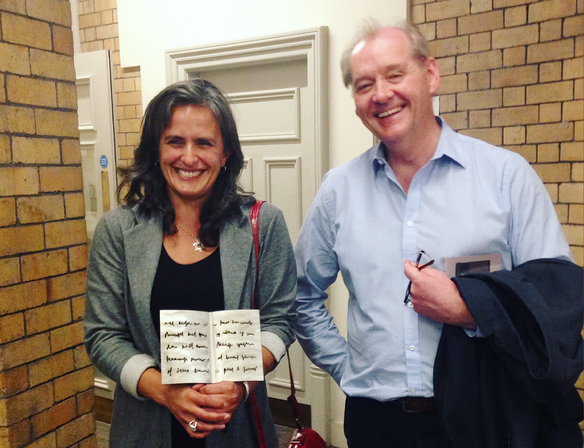
Jasmine Donahaye’s powerful memoir, Losing Israel, triumphed in the Creative Non-Fiction category against strong competition.
The three titles shortlisted for the Open University in Wales Creative Non-Fiction award all, in very different ways, dealt with examining Wales’ position in the world, themes of globalisation and the significance of culture.
Wales Unchained by Daniel G. Williams (University of Wales Press) was praised for its brilliantly entertaining, scholarly prose. Woman Who Brings the Rain (New Welsh Rarebyte) by Eluned Gramich was highly regarded, ‘small but perfectly formed’. Yet it was Losing Israel by Seren author Jasmine Donahaye that scooped up the prestigious award as her ‘strange book’, a weaving-together of birdwatching, memoir, creative writing, and travel, blew the judges away.
Judge Justin Albert urged the public to go out and buy copies of all three books, saying the quality of each is such that you won’t simply be able to read them once. We concur!
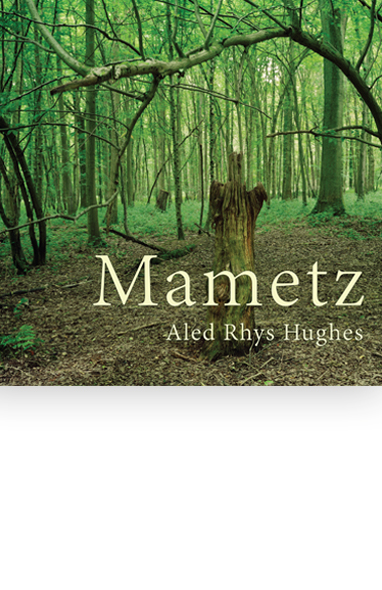
Aled Rhys Hughes has been visiting Mametz Wood, the site of the most significant battle in World War I for Welsh troops, for over five years. The striking contemporary photographs Hughes has taken over this period have just been published in Mametz, to mark the centenary of the Battle of Mametz Wood.
What inspired Hughes to keep returning to this landscape? Hughes explores this question in two special radio broadcasts, on BBC Radio Wales and BBC Radio Cymru, both available to listen to online.
‘Does a place retain some sort of memory of what’s happened there – over the years or over the centuries? It’s very clear to me that in Mametz Wood… there is a memory there of what’s happened a hundred years ago.’ – Aled Rhys Hughes
Listen in English to the Aled on the BBC Radio Wales Arts Show, or in Welsh to BBC Radio Cymru Stiwdio Gyda Nia Roberts.
About Masque: Masque is a richly gothic and psychological retelling of Gaston Leroux’s classic, The Phantom of the Opera. Centre-stage is promising young singer Christine who, despite being devoted to her art, attracts the attention of both the Phantom (Erik), and rich Parisian theatre owner Raoul. The intensely ambitious Christine finds herself caught between the twin evils of the Phantom’s murderous pursuit of artistic perfection and Raoul’s ‘romantic’ vision of her as a bourgeois wife. Control slips away as the three characters are led onwards by the intensity of their passions, and the beautiful masked skull of the opera house itself looms large over their respective fates. The resulting mix of love, rage, art and murderous intent, is explosive.
The winner of this giveaway will be chosen at random from all our email newsletter subscribers on 1st August 2016, so if you haven’t already, hurry and sign up for our newsletter before the end of the month if you want it to be you!
This week our Friday Poem is from Christine Evans’ sensitive collection, Growth Rings, which was shortlisted for Wales Book of the Year 2007.
This collection from Christine Evans follows well-received ’Selected Poems’. Hers is a persuasive voice, highly attuned to the vagries of the seasons, to the landscapes and inhabitants of the beautiful Llyn Peninsula in North Wales where the author has made her home.
As well as vibrant short lyrics on everything from ’Bluebells in Nanhoron’ to jets flying over Wales, there are a series of tender elegiac pieces on relatives, meditations on the last moments of Shelley and the fates of the Brontes, and a number of poems featuring the mysterious Island of Bardsey.
Talking In the Dark
Now the air is indigo with evening
together by the boathouse where we’ve sprawled
an hour or more, felt earth’s breath cooling,
we wake mind-echoes of ‘the real world’.
Night prompts us all to visions of tomorrow.
A subtle fullness, like a ripening field
contains us, names and knowledge weightless now.
The biosphere, Helen thinks, might still have the power
to heal pillage, maiming, poison. Protests fly:
excuse for doing nothing, weak, evasion.
Although we can’t agree what should be done
a tribal dignity begins to hover.
Shadows with eyes that hold the light, we are
communicators, not just talking faces.
First stars beckon in a deepening sky.
The universe accepts our hopeful voices
but sea demurs with one slow-hushing sigh.
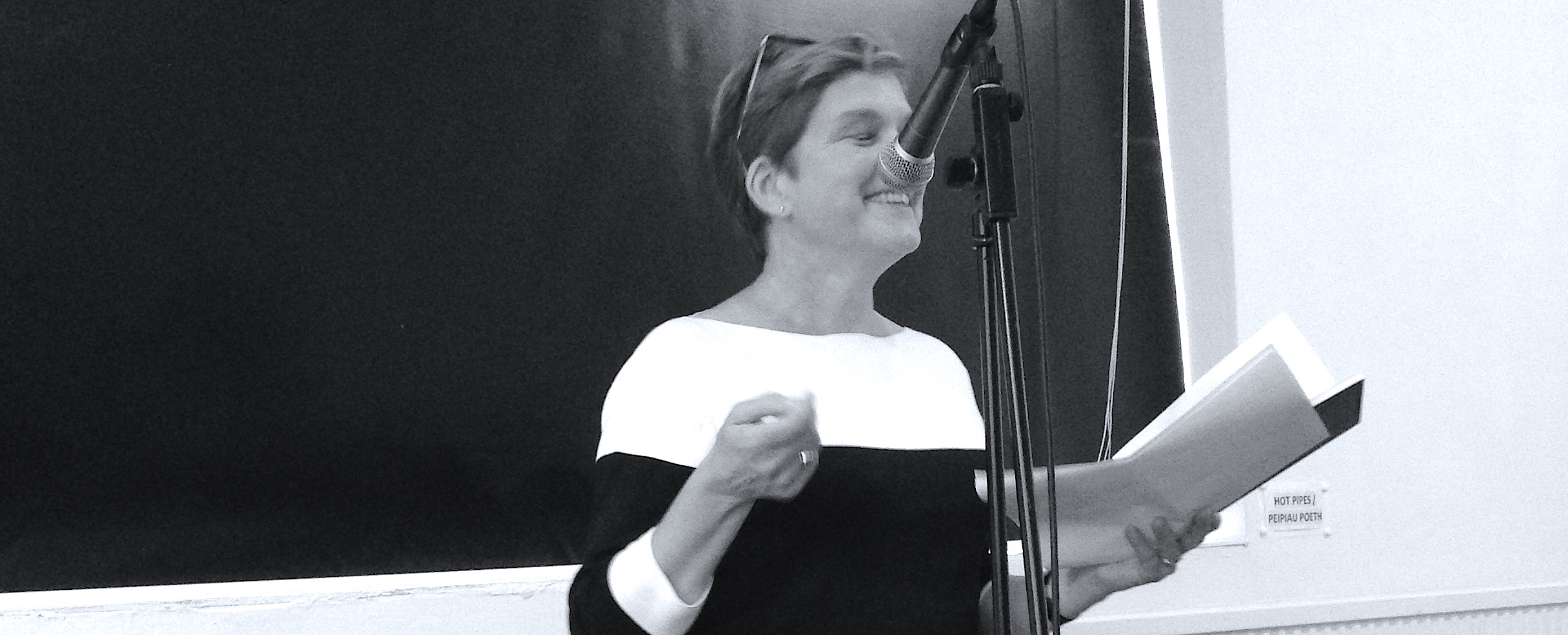
Last night saw us at Chapter, Cardiff, for July’s First Thursday event and among the readers was Caroline Smith with her new collection, The Immigration Handbook. This week we have a treat for you – you can listen to the Friday Poem being read by the author. Look below for the video, and accompanying poem text.
The strikingly moving poems in Caroline Smith’s The Immigration Handbook are the fruit of the author’s career as an Immigration Caseworker for one of the most diverse inner-city areas in London. Her characters are careful composites of people she’s observed. They step vividly off the page, as if out of the headlines. Written over a period of years, as layered and infused with experience as the documents she discusses: letters folded and refolded, creased with time, Caroline Smith’s poems are a moving record of global people movement, the story of our time.
The Scarlet Lizard
Nothing moves
except the evening light
crossing the Judge’s room.
The lawyers’ skeleton arguments
lay piled on his desk.
They seemed to him brittle
as bleached poppies,
tapped of their seeds.
He longed to see the quick movement
of a scarlet lizard weaving unexpectedly
through the parched, cracked hexagons
of a legal phrase, to hear the snapped stick
fritter away from a hiding place;
to feel the cold, diaphanous weed grip
in the black current of a border crossing.
He needed to sense some quiver of
indecision, an odd detail
that would open the truth of their words;
chinks of light shining
through shuttered doors.
Congratulations to Jasmine Donahaye for winning the New Welsh Writing Awards 2016 Best Travel Book Poll for Losing Israel, a moving and honest account of the author’s relationship with Israel, which spans travel writing, nature writing and memoir. Voted for by the public, Losing Israel was the overwhelming winner from a shortlist of three titles that comprised Wildwood: A Journey through Trees by Roger Deakin (Penguin) and A Time of Gifts by Patrick Leigh Fermor (John Murray). Losing Israel has also been shortlisted for the Wales Book of the Year 2016.
The winners of the Poetry, Non-Fiction and Fiction Categories, and the overall Wales Book of the Year Winner, will be announced in just two weeks. Seren have two titles in the running for the awards, and before we find out the results, we thought you might enjoy reading an extract from each of our nominated books. Look below and you’ll find an extract fromBoy Runningby Paul Henry (shortlisted for the Open University in Wales Creative Non-Fiction Award).
Studio Flat
Socks hang like bats from a skylight.
They may be dry in time for the moon.
The camp site owner’s water-feature
drains more blood from the sun.
Cars queue for the narrow bridge.
Birds catch their pulses and fly.
I am suddenly old. What’s an attic
but a bungalow in the sky.
And where are you, my sons?
I heard your voices in the bells
of snowdrops pulled by the wind.
These tulips have lost their smell.
Perhaps I could tell you, one day
where the snowdrops went, why old men
dry their socks on the moon, and what
darkened the skylight, just then.
Ring
I can’t get the ring out of my finger. How long till it disappears this ghost ring, twenty years deep? I’m branded. Is it the same with you? Your fingers were slenderer than mine.
We hope you enjoyed reading this free extract fromBoy Runningby Paul Henry. Keep an eye on the Seren blog, as we will be announcing the Wales Book of the Year Awards results in just over two weeks time.
About Boy Running: Paul Henry has gained a reputation as one of of the best poets in the UK. Boy Running is his beautiful sixth collection and the first to follow The Brittle Sea: New and Selected Poems. Also a singer-songwriter, Henry is known for his precise lyricism, intimate tone and a cast of characters inspired (like Dylan Thomas) by his childhood by the sea in Aberystwyth, West Wales.
On this day, one of the best-known English-language poets of the Second World War came into the world. Alun Lewis was born on 1 July 1915 in Cwmaman, Wales.
A year later, on 1 July 1916, the British Army would see its bloodiest day as The Battle of the Somme commenced, and over 57,000 British Soldiers became casualties on the first day alone.
Our Friday Poem this week is both in celebration of Alun Lewis’ birth, and in remembrance of all those who fought and died on the Somme.
Alun Lewis Some critics see Lewis as the last of the great Romantic poets, a twentieth century Keats. Others view him as the bridge between pre-war poets like Auden and Yeats to post-war poets such as Hughes and Gunn. He was born and raised in Depression-struck south Wales and, following degrees in history at Aberystwyth and Manchester, became a teacher there. Early in 1940, despite his pacifist inclinations he enlisted and, after long periods of training, joined the war in India.
‘All Day It Has Rained’ was written whilst Lewis was stationed with the Royal Engineers at Longmoor, Hampshire. It is among the poems featured in Alun Lewis: Collected Poems.
All Day It Has Rained
All day it has rained, and we on the edge of the moors
Have sprawled in our bell-tents, moody and dull as boors,
Groundsheets and blankets spread on the muddy ground
And from the first grey wakening we have found
No refuge from the skirmishing fine rain
And the wind that made the canvas heave and flap
And the taut wet guy-ropes ravel out and snap.
All day the rain has glided, wave and mist and dream,
Drenching the gorse and heather, a gossamer stream
Too light to stir the acorns that suddenly
Snatched from their cups by the wild south-westerly
Pattered against the tent and our upturned dreaming faces.
And we stretched out, unbuttoning our braces,
Smoking a Woodbine, darning dirty socks,
Reading the Sunday papers – I saw a fox
And mentioned it in the note I scribbled home; –
And we talked of girls and dropping bombs on Rome,
And thought of the quiet dead and the loud celebrities
Exhorting us to slaughter, and the herded refugees:
Yet thought softly, morosely of them, and as indifferently
As of ourselves or those whom we
For years have loved, and will again
Tomorrow maybe love; but now it is the rain
Possesses us entirely, the twilight and the rain.
And I can remember nothing dearer or more to my heart
Than the children I watched in the woods on Saturday
Shaking down burning chestnuts for the schoolyard’s merry play,
Or the shaggy patient dog who followed me
By Sheet and Steep and up the wooded scree
To the Shoulder o’ Mutton where Edward Thomas brooded long
On death and beauty – till a bullet stopped his song.
Want to see more Alun Lewis titles? Take a look at our website for biographies, short stories, poetry, and Lewis’ previously unpublished 1930’s novel, Morlais.
The coming months will see the commemoration of one of the most notorious battles in history. The Battle of the Somme, fought between July 1st and November 18th 1916, has left an indelible mark on the history of the twentieth century and, for Britain in particular, it symbolises the horrors of modern warfare.
One hundred and forty one days of horror. The casualties are well documented: the first day alone saw 57,470 British casualties, 19,240 of whom were killed. The second day, with 30,000 British casualties, was not much better. Add to that the French and German losses and you have total losses of dead and injured easily exceeding 1,000,000.
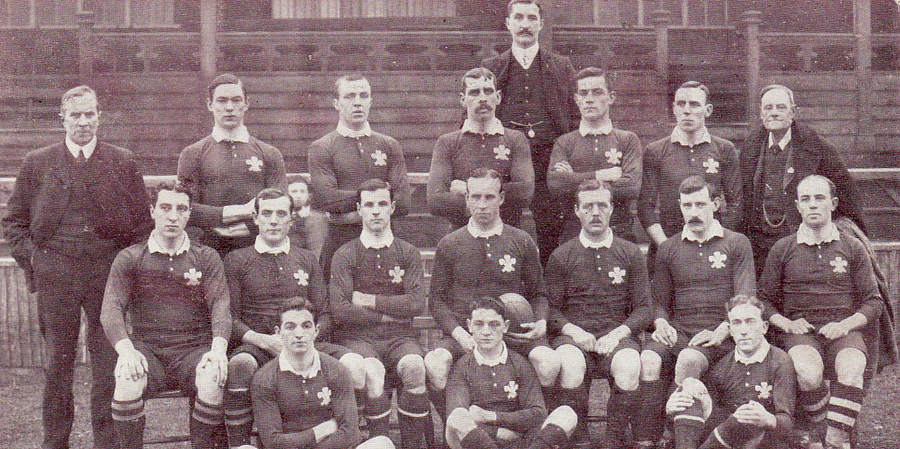
It was inevitable that many British sportsmen would be among the dead. Heart of Midlothian, Scotland’s table topping football team, lost 3 players on the first day while English cricket saw 3 notable all-rounders, Booth, Jeeves and Burns make the ultimate sacrifice. Welsh goalkeeper Leigh Roose, English footballers Evelyn Lintott and Donald Bell VC and England rugby captain Lance Slocock met the same fate. But what of Welsh rugby? What sacrifices were made by this small nation, a nation which was just at the close of its first rugby ‘Golden Era’? The answer is stark. The total number of Welsh rugby internationals to die as a result of the Great War was 13, 14 if one includes ‘Hop’ Maddock who died in December 1921 as a result of illness which had its roots in the battlefields of the Somme. No less than 5 of these unlucky and brave young men met their death on the Somme.
Charles Meyrick Pritchard
The first to appear in Mike Rees’ book, Men Who Played the Game: Sportsmen who gave their life in the Great War, is a true man of Newport, Charles Meyrick Pritchard. Charlie was the son of John Pritchard, a founder member of the Newport Rugby Club and part of a family that ran a wine and spirit business. Following an education at Newport Intermediate School and Long Ashton, Bristol, Charlie joined Newport RFC and by 1904 this twenty two year old, thirteen stone, six foot tall version of the modern backrow forward was in the Welsh team. A year later he was taking his place on the field to decide the unofficial championship of the world. The New Zealand All Blacks arrived in Cardiff unbeaten to be challenged by a strong Welsh team and Charlie was to play a huge part in what many regard as the most important match in rugby history. Wales deservedly won a thrilling, controversial match 3-0 but, although it was Teddy Morgan who scored the try, Charlie was the inspiration. Fellow players had no doubt in telling anybody who was not too excited to listen that Charlie had played a key role, “knocking ‘em down like ninepins” according to George Travers, a fellow hero and club colleague. Others talked of his willingness to be in the thick of the fight, disrupting the hitherto invincible All Blacks with his devastating tackling. Following this victory Charlie’s fame was assured but his career didn’t end there. In 1906 he was made captain of Newport, a position that he held for 3 years. On the international field he won a further 10 caps, (14 in all), a figure that would have been higher but for injury. He played in the championship winning Wales team of 1906 and in the first Grand Slam success in 1908. After missing out on a second Grand Slam in 1909, Charlie played his last game for Wales in 1910.
With the outbreak of war Charlie was quick to enlist. He joined the South Wales Borderers as a temporary Second Lieutenant in May 1915, was promoted to lieutenant at the end of July and was made a captain in the 12th Battalion the following October. Following a period of training, Charlie arrived on the Western Front in June 1916 in time for the Somme offensive and was quickly into the action. He and his men had been forced to take cover in the long grass from their own bombs and struggled to avoid the German searchlights. On the night of 12th/13th August Charlie was instructed to lead a raiding party on the German trenches with a view to taking as many prisoners as possible. He led his men into the trenches showing exceptional bravery in the process and, despite being wounded in the wrist, continued to encourage and lead his men in what was to prove to be a successful raid. He took one of the enemy prisoner but was wounded once again, taken back to the British front line and then to No1 Casualty Clearing Station shortly before dawn on the wet morning of August 13th. Here his concern for the success of the raid and his devotion to duty came to the fore asking, “Have they got the Hun?” “Yes” he was told, “Well I have done my bit,” Charlie replied, the last words that he was known to speak. He died, without ever leaving the Clearing Station, on August 14th 1916.
His commanding officer, Lieutenant Colonel Alexander, wrote to the family describing Charlie as being “as brave as a lion” and talking about how his death had “cast a gloom” over the whole Battalion. Others spoke of the deep affection in which he was held, the fine example that he set as to what a sportsman should be and his “private tenderness” who was “loved by all who came into contact with him”. Attempts to grant him the Distinguished Order failed, as only living soldiers were eligible, although he was given a Mention in Dispatches. Charlie was buried in Choeques Military Cemetery, one of 86 members of Newport Athletic Club who lost their lives in The Great War and remembered on the Memorial Gates at Rodney Parade. The thirty two year old left in Llwynderi Road, Newport, a grieving widow with two young children and the legacy of a true Welsh rugby hero.
John Lewis Williams
A second significant Welsh rugby player with Newport connections had already died on the Somme. John Lewis Williams is quite properly remembered as a prolific wing for both Cardiff and Wales, the most capped Welsh international to die in the conflict. However Johnnie Williams began his career at Newport in 1899 after leaving Cowbridge Grammar School. Born in Whitchurch in March 1882, Johnnie had an illustrious rugby career. After winning his first cap against the 1906 Springboks he went on to score a record seventeen tries in seventeen internationals, a record that was later equalled by Ken Jones and beaten by both Gerald Davies and Gareth Edwards in 1976. Illustrious company indeed! Noted for his swerve and sidestep, Johnnie was an integral part of three Wales Grand Slam winning teams in 1908, 1909 and 1911, one of the handful of Welsh players to achieve such a feat. Unsurprisingly, Johnnie also toured with the British Isles team which visited Australia and New Zealand in the summer of 1908 where he played in two of the three tests, scoring twelve tries on the trip. While making the long sea journey to the Southern Hemisphere, Johnnie earned himself a supplement to his two shillings a day out of pocket expenses by writing articles for the South Wales Daily News and the South Wales Echo. A well-educated man who earned his living as a principal clerk in a coal exporters based in Cardiff Coal Exchange, Johnnie was given the captaincy of his country for the game against France in Paris in 1911 due to his ability to speak French at the post match dinner. A couple of weeks later he played his seventeenth and final match for Wales in the victory over Ireland. His record was impressive with only two defeats in his Wales international career.
On the outbreak of war Johnnie joined the 16th Battalion of the Royal Welch Regiment and was, by July 1916, in the thick of the action on the Somme, in particular at Mametz Wood, a place synonymous with the Welsh losses in the Great War. The action which took place at Mametz between 7th and 12th July 1916 saw the 16th Royal Welch and the 11th South Wales Borderers suffer the most appalling losses. Johnnie went over the top on 7th July but heavy machine gun fire cut them down. Johnnie was severely wounded and his left leg was amputated. Infection set in and, although he was able to write to his wife Mabel that he was in good spirits, Johnnie died of wounds on 12th July. He was one of 190 officers and 3,803 other ranks who were casualties at Mametz. He had fought in distinguished company – the poets Siegfried Sassoon, Robert Graves and David Jones as well as the writers Frank Richards and Llewellyn Wyn Griffith all fought at Mametz but, unlike Johnnie, they survived to commit their experiences to paper. Johnnie was not so lucky. He left his wife of a mere eighteen months a widow in their Penarth home. His reputation as one of the great Welsh wings, however, remains firmly intact.
Dick Thomas
Alongside Johnnie, another Welsh international rugby player also made the supreme sacrifice. Born in Ferndale in October 1883, Dick Thomas had spent his early years working underground as a collier before joining the police force based in Mountain Ash. Dick, by now playing for Mountain Ash after short spells with Penygraig and Cardiff, had made his debut for Wales in the same game as Johnnie made his international bow. Although on the losing side against South Africa, Dick went on to win three more caps and contributed to victories in each of the 1908 and 1909 Grand Slam seasons. Only illness prevented him from winning more caps and possibly becoming a regular in the Welsh pack of this ‘Golden Era’. Dick was known as a tough uncompromising forward, who was also a Glamorgan Police heavyweight boxing champion. Never one to shirk a challenge, he went over the top on 7th July. His body was never found and he is remembered on the Thiepval Memorial, one of the 72,195 names on that ‘memorial to the missing’.
David ‘Dai’ Watts
Dick Thomas is not the only Welsh international named on the Thiepval Memorial. One week after Dick was lost and just three days after Johnnie Williams succumbed to his wounds, Dai Watts, a tough forward born in Maesteg in March 1886, was killed in action at Bazentin Ridge on 14th July. After a career spent playing for smaller valley clubs, Dai joined his hometown club, Maesteg where he became the first player from this club to be capped. Following impressive games for the Glamorgan League and then Glamorgan County, Dai was picked for the first international of 1914 against England. Wales lost this game 10-9, a match they should have won due to the supremacy of their forwards. England went on to win the Grand Slam under the captaincy of Ronnie Poulton, the glamorous young England centre who was killed in 1915, while the Welsh pack remained unchanged for their three subsequent victories and cement their reputation as ‘The Terrible Eight’. A long rugby career at international level appeared to be Dai’s destiny.
It was not to be. In the autumn of 1914 Dai joined the 7th (Service) Battalion, The King’s (Shropshire Light Infantry). In July 1916 they were involved in the Battle of Bazentin Bridge. At 3.25am on 14th July the KSLI were ordered to attack. Confronted by uncut wire they became easy targets and Dai was one of the 171 who lost their lives in this attack. There are no records of how this toughest of forwards met his end, only that his body was never recovered and that he left a widow and two children.
The third and final Welsh international named on the Thiepval Memorial is a player of a very different type to the tough, uncompromising miners, the forwards Dick Thomas and Dai Watts. Horace Wyndham Thomas was an outside half educated at Monmouth School and Cambridge University where he was a choral scholar. Born in Pentyrch near Cardiff in 1890, he originally attended Bridgend Grammar School before winning a scholarship at Monmouth. Both at Monmouth and Cambridge Wyndham excelled in a range of sports. Injury and choral duties prevented him gaining his ‘Blue’ but he finally achieved this in 1912 when he played his part in a Cambridge victory. Four days later this brilliant and elusive outside half made his debut for Wales in the match against the Springboks, a game which he nearly won for Wales with a late drop goal attempt which sailed narrowly wide. Many who saw this effort were adamant that the ball had actually gone through the posts and that Wales were ‘robbed’. He kept his place for the game against England a few weeks later but, although he played in this match, Wyndham had been offered a job with a firm of shipping agents in Calcutta. Immediately after the game Wyndham sailed to India to fulfil a five year contract, a huge loss to Welsh rugby. It was expected that Wyndham would be the Welsh outside half for years to come.
When war broke out Wyndham resigned his job and headed home to join the 14th (Reserve) Rifle Brigade. In August he was to be found on the Somme and on 3rd September he was attempting to capture trenches above the Ancre. The assault resulted in over 400 casualties, one of whom was Second Lieutenant Horace Wyndham Thomas. His body was never found and his name joined those fellow players on the Thiepval Memorial. Of all the Welsh internationals killed in the Great War perhaps Wyndham Thomas was the player whose potential was greatest and unfulfilled. Lost to rugby far too soon, Wyndham, with all his brilliance and talent, perfectly represents the sacrifices made by that generation of rugby players one hundred years ago.
The stories of these players, (with the exception of Dai Watts), are included in Men Who Played the Game. Mike Rees has included the contributions of sportsmen in The Great War from all corners of Britain and the wider Empire but, during this summer of 2016, none of the stories have greater significance than those of the Welsh rugby heroes on the Somme. It is fitting that we now remember their sacrifice made a century ago.