
We are pleased to announce that Martyn Crucefix’s new sixth full collection of original poems will be called The Lovely Disciplines, and will be published by Seren in 2017. Find out more on Martyn’s blog:
Friday Poem – ‘Savoy Hotel, London’, Rosie Shepperd
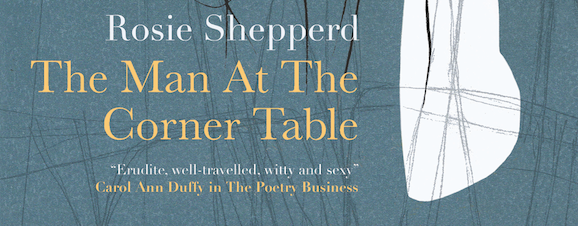
This week our Friday Poem is from Rosie Shepperd’s tantalising debut, The Man at the Corner Table. You can hear Rosie read from this collection live on National Poetry Day, 6 October, at Berkhamsted Waterstones alongside Caroline Smith and Graham Clifford.
 The Man at the Corner Table crackles with the unexpected. The voice is one of urban sophistication; a merciless charm that teases and tempts us with sensual evocations of food and place. The reader is surprised with tastes, scents, colours and textures. There is a winning insistence on detail offered with an irony that blends into satire.
Savoy Hotel, London
Those nights downstairs at the American Bar;
it’s not just the chairs that show gilt in the telling.
Back then we were almost quite something.
You and London were lean;
your eyes, a fraction off-centre as you
struggled not to say,
We have this connection. My God.
You overplayed.
And not just your hand.
My role in this mellow
drama was to shift that arse
you loved to chase and twitch my best side
close to the oh-so-Maraschinos.
Too long ago, they were fruit in a tree.
Some tree.
I guess they were something for me
to play with; the pretence
we were ever friends was just
a way to simulate sharing.
30:70 and I never found out
who made the best bet
but I do know that’s the wrong word.
Early is just another kind of late and
anyway, you were always
there each night, every night. There’s
no fool like a blind
fool; thank God I didn’t see the edge
till I was over and out
the other side.
Buy your copy of The Man at the Corner Table now: £9.99
Claim 20% when you become a Book Club member
The results are in: Graham Mort shortlisted for VC’s International Poetry Prize

Following on from his longlisting, Graham Mort has been shortlisted for The University of Canberra’s Vice-Chancellor’s International Poetry Prize, for his poem ‘Ordinary’. The prizewinner this year is Michael Lavers, for ‘Your Father at Fourteen’.
You can download Tremble, the anthology of entries for this year’s prize (which includes ‘Ordinary’ by Graham Mort) for FREE on the University of Canberra website.
Graham’s most recent poetry collection, Cusp (Seren, 2011) is available from our website.
Paul Henry & Stornoway singer Brian Briggs collaborate on song version of ‘The Glass Isle’

Poet Paul Henry has collaborated with the singer-songwriter Brian Briggs (best known as the frontman of British indie folk band Stornoway) to create a song version of his long poem-in-progress, ‘The Glass Aisle’, which is inspired by a stretch of the Monmouthshire & Brecon canal above Crickhowell.
About the collaboration, Paul Henry says:“Brian Briggs and I are writing songs together, in response to the poem as it develops (I was originally a songwriter). We’ve written five, so far.’
Paul and Brian will be performing the songs they have composed at an event at The Parish Hall, Crickhowell, on Monday 3 October. Find out more about the event here.
Want to listen to Stornoway’s music? You can find them on YouTube. Their song ‘Get Low’ is an office favourite.
National Poetry Day 2016: All you need to know

National Poetry Day is an annual celebration of poetry and all things poetic. Started in 1994 by William Sieghart, it has engaged millions of people across the country with reading, writing and listening to poetry.
This year, National Poetry Day is taking place on Thursday 6th October. The 2016 theme is Messages – think texts, emails, letters, cards, speech; sad messages, hopeful ones, happy messages and even unspoken ones. They could be spooky, paranormal messages or those you hear every day, such as “hello” and “goodbye”.
Say it with a poem – be inspired by this years theme of Messages, and write a poem of your own to express yourself!
 Download this year’s FREE poetry eBook – Messages: National Poetry Day 2016 is a free anthology of wonderful Messages poems – old and new. The fourteen poets in this eBook (created by MacMillan Children’s Books with Forward Arts Foundation) are all National Poetry Ambassadors.
Featured poets: Deborah Alma, Liz Brownlee, Paul Cookson, Sally Crabtree, Joseph Coelho, Matt Goodfellow, Sophie Herxheimer, Rachel McCrum, Brian Moses, Michaela Morgan, Joshua Seigal, Roger Stevens and Indigo Williams.
Download your free copy of the National Poetry Day 2016 anthology here.
Get involved! Attend one (or more) of the many National Poetry Day events happing all over the UK.
There are loads of events happening on and around National Poetry Day, 6th October, including two of our own:
First Thursday: New Fiction and Poetry at Chapter, Cardiff
Seren’s monthly celebration of new poetry and fiction returns after the summer break. Join us for readings from our special guests and then the famous open mic.
Cardiff poet and author Peter Finch presents: The Roots of Rock, from Cardiff to Mississippi and Back, and Jayne Joso reads from her new novel, set in the outskirts of tokyo: My Falling Down House.
Berkhamsted Waterstones: Caroline Smith, Graham Clifford & Rosie Shepperd
Celebrate National Poetry Day at Berkhamsted Waterstones with an evening of poetry readings, featuring three Seren poets: Caroline Smith (The Immigration Handbook), Graham Clifford (The Hitting Game) and Rosie Shepperd (The Man at the Corner Table).
Take a look at the National Poetry Day events map and go along to anything that catches your eye.
Take advantage of free online resources – There are loads of resources on the National Poety Day website, including advice on how to get your school enjoying poetry, news, and free poems to read and share. Take a look here.
Seren’s own celebrations will kick off with a flash poetry sale – keep an eye on our website (or social media channels) on 6th October to take advantage of our special National Poetry Day book offers!
Friday Poem – ‘What the Dead Don’t Know’, Anne-Marie Fyfe

Our Friday Poem this week is taken from Anne-Marie Fyfe’s latest collection, House of Small Absences.
 Anne-Marie Fyfe’s poems have long dwelt on the role that the spaces we inhabit, the places in which we find security, play in our lives: House of Small Absences is an observation window into strange, unsettling spaces—a deserted stage-set, our own personalised ‘museum’, a Piedmont albergo, underground cities, Midtown roof-gardens, convent orchards, houseboats, a foldaway circus, a Romanian sleeper-carriage—the familiar rendered uncanny through the distorting lenses of distance and life’s exigencies, its inevitable lettings-go…
What the Dead Don’t Know
Grows quickly, daily, from the perimeter
of a postage stamp, until it’s twice the size
of Norway, and growing fast.
What the deceased can’t understand
is why they don’t still hear from us
day-by-day, hour-by-hour.
What the departed don’t see
is how the lead story has moved on.
What the dead won’t say
is more or less what they didn’t say
when they had the chance. Diplomacy,
tact, reserve: these things endure.
Buy your copy of House of Small Absences now: £9.99
Claim 20% when you become a Seren Book Club member
Katrina Naomi – new Writer in Residence at the Arnolfini
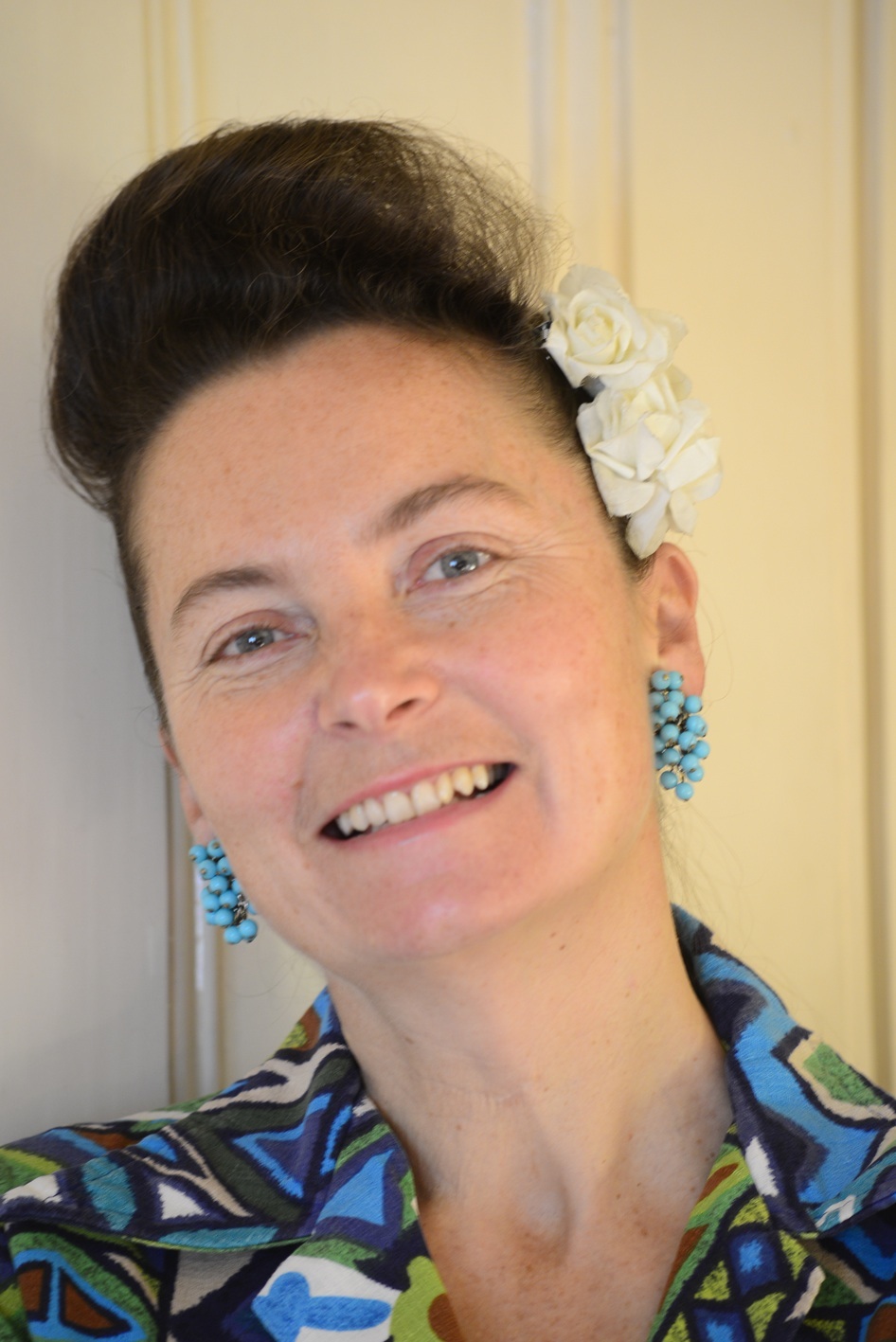
Katrina Naomi has been announced as writer-in-residence at the Arnolfini throughout their ‘Emotional Archaeology’ exhibition.
Regarding her being selected for the post she says:
I’m delighted to be Arnolfini’s writer-in-residence. I can’t stop smiling about it. I’m looking forward to Daphne Wright’s Emotional Archeology show, I like her themes and approach, and I’m interested in seeing where her art will take my poetry.
There will be a number of public outcomes to the residency, including a live presentation event in December. Keep an eye on the Arnolfini’s website and social media pages for updates.
Katrina Naomi is a poet, tutor and poetry mentor based in Cornwall. Her second full collection The Way the Crocodile Taught Me, (Seren, 2016) features in The Forward Book of Poetry 2017. Her 2015 pamphlet Hooligans, (Rack Press), was inspired by the Suffragettes.
Her poetry has appeared in ‘The Times Literary Supplement’, ‘The Poetry Review’, ‘The Spectator’, and on Radio 4. She received a PhD in Creative Writing from Goldsmiths in 2014 and an award from the Royal Literary Fund. In 2015 she became a post-doctoral researcher at Goldsmiths and was made a Hawthornden Fellow.
Friday Poem – ‘VII’ from Batu-Angas, Anne Cluysenaar
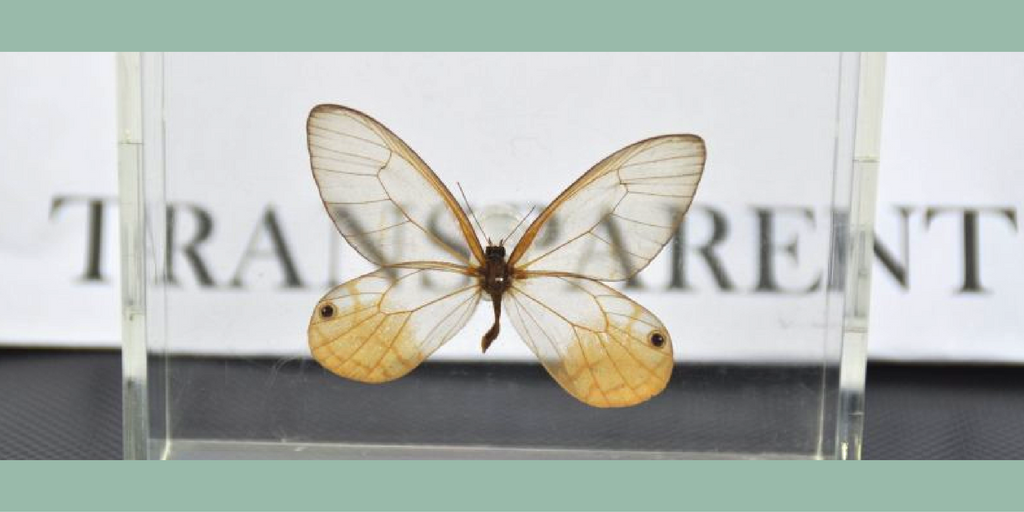
In celebration of the brief heatwave that has hit the UK, we are taking this week’s Friday Poem from Anne Cluysenaar’s tropical Batu-Angas: Envisioning Nature with Alfred Russel Wallace.
 Alfred Russel Wallace (1823-1913) was one of the most famous scientists of the 19th century and is best known today as the co-discoverer, with Charles Darwin, of the theory of evolution through natural selection. Wallace’s life and work are the inspiration for this beautifully considered collection of poems. Why the title? As Anne Cluysenaar explains in her Foreword:
It was during an acute bout of malaria on the volcanic island of Ternate that it ‘flashed upon’ Wallace how life evolves through natural selection … From the local language of Ternate itself, Wallace had borrowed the phrase ‘batu-angas’ to describe the ‘burnt rocks’ or cooled lava he saw there. The phrase struck me as as suitable title for this sequence because it could be said to symbolise the visible world at any one time – a world now, thanks to Wallace and Darwin, known to maintain a seeming stasis only, amid the flowing lava of evolution.
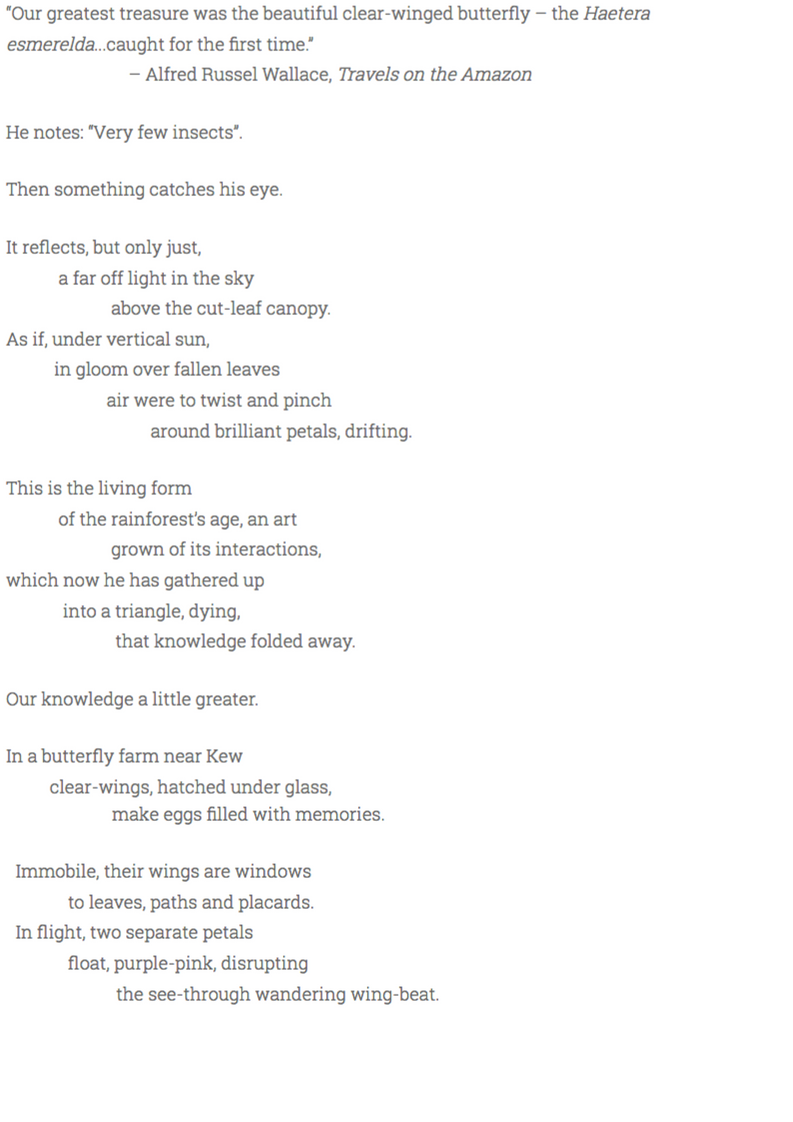
VII
 Batu–Angas is available from our website: £8.99
Sign up to the Seren Book Club and save 20%
Seren at the London Poetry Fair

Join us tomorrow at Conway Hall, 10:30am–4:30pm, for the Free Verse London Poetry Fair. 80+ publishers (including ourselves!) are exhibiting, and there will be free readings and discussions throughout the day.
Don’t miss: Seren poets Caroline Smith, Kate Bingham, Judy Brown and Rosie Shepperd will be reading from their latest collections at 11am in the Brockway Room (Conway Hall).
50th Anniversary of the Severn Bridge | An extract from Edging the Estuary

The original £8m Severn bridge was opened by the Queen on 8 September 1966, heralding a new economic era for South Wales. In celebration, here is an extract from Edging the Estuary by Peter Finch, in which Peter meets the men continuing the traditional method of Lave net fishing on the River Severn, at times directly below the bridge.
 About Edging the Estuary:
In the Middle Ages the port of Cardiff stretched from Chepstow to Gower. Peter Finch, archetypal Cardiffian, sets out to explore his heritage, walking the Welsh side of the Severn Estuary and reclaiming his personal memories in addition to discovering the lives of others. And with a detour to Maismore, the highest tidal point of the estuary, he walks the English side too, taking in the differences with Wales, reviving past links and looking at his homeland from abroad. On his journey he sees the estuary as border, a highway for trade and ideas, an industrial zone, and a place where people spend their leisure. Rich in anecdote, evocative in description, Finch’s book takes in villages and cities, power stations and fishermen, castles and caravans, leg-aching walks and deckchairs on the beach.
The Lave Fishing Grounds
The novelist and poet Richard Brautigan went trout fishing in America. There the fish were made of a precious and intelligent metal. Trout steel in the snow-filled rivers. Among them he found the dharma or the Buddha, or love or something. I’d never done any of that. I’d never really thought much about fishing anyway other than logging that lots of people did it. Blokes in wool hats sitting on piers, pond sides, river edges waiting and on their faces that distant look. It seemed all about waiting. And I couldn’t be doing with that.
At the end of Black Rock Road, to the east of Sudbrook, is the small park the council has created facing Black Rock. In a corner is the Black Rock Lave Net Heritage Fishery’s hut. Hand built in local stone. A salmon in wrought iron adorns the front. For most of the year the hut is closed and locked but today it’s not. Martin Morgan, a fifty-year-old steelworker from Undy, is in action out front. Spread on the grass he has replicas of the fishtraps that have been used in these waters since medieval times. They’ve now been banned by the Environment Agency in an attempt to conserve fish stocks. “There used to be other methods of fish catching that are gone too,” Martin tells me. “Stock boats, drift nets, tuck nets. Those ways are over.”
The putt, a great ten-foot-long assemblage of bent willow in the shape of an open-mouthed giant cone, is the older method. The example Martin shows me is a replica made from an ancient original pulled from the river muds. These things go back to the eleventh century. The cone would be pegged to the river bed facing an ebb tide and once a salmon had swum in, it couldn’t then get back out.
Also on show are replicas of putchers – smaller five-foot cones made originally of woven hazel or willow but from the 50s onwards of aluminium mesh.These would be assembled in racks known as engines with sometimes a hundred or more in a single array. These would be strung out across the river like radar sets. Salmon was the target but they also caught whitefish and eels and anything else that drifted in.
These were the fixed engines, the fish henges. In the sixteenth century, Rawlins White, the Cardiff martyr, operated something similar at the Rhymney River mouth. The remains of ancient putcher racks have been discovered by estuarial archaeologists in waders, stepping through the glutinous mud between the river’s rapid tides. The largest, containing some fifteen hundred baskets swung out into the waters opposite Goldcliff.
The archaeologist J.R.L. Allen has used aerial photographs of the Estuary to uncover a complex pattern of fish traps dating from Mesolithic times to virtually the present day. His shots show putcher lines running just off the river shores like the claw prints of giant birds. Further out are the remains of rod and wattle fencing, formed into complexes of stone and woodposted weir. Fish dams, intertidal fish pools, fish gullies. Fish capture has gone on in these waters for thousands of years. But it’s all banned now. Regarded as being as bad as fishing with dynamite. All that’s left are the lave fishers. Eight of them. The Environment Agency refuses to issue any more licences.
Lave fishing uses large Y-shaped nets each individually made by the fisherman. The net has willow arms known as rimes hinged onto a stout handle called the rock staff, made of ash. Fishermen wade into an outgoing tide and wait. They can stand for hours with the Severn’s tides falling around them. They call this cowering. Much more exciting is stalking, where the fisherman spots a fish moving over the sandbanks and gives chase.
Caught fish are dispatched with a short wooden baton known as a knocker. Weights are anything from five to seventeen pounds. The record was held by Martin’s great grandfather. He landed a monster that weighed in at fifty-six pounds. There’s a silver-coloured replica back at the hut. The net they also knit themselves. It was once made of hemp. Smacker Williams, in Sudbrook in the 1960s, could knit a single net in a day. That was going some. When he went, the practice died out, but Martin’s fishermen have revived it. They use nylon cord today.
At the Heritage Fishery they are all lave fishermen, although as the season is so short they double up for the rest of the year with rod and line. They used to fish from February right through until October but the Environment Agency have now got them down to a mere three months. 1st June to the 31st August. They’re allowed to catch an absolute total of fifteen fish, five a month, and that’s it. Not much. Martin thinks the Agency would be happiest if it could close the lave fishermen down.
The Agency is at odds with the Heritage authorities who see the Black Rock fishermen as a relic of Wales’ traditional past and something to be encouraged. Martin tells me that last week they had a camera team along from Wedi Saith who brought a Teifi coracle fisherman with them to compare traditions. We’re out on the mud now, walking through the glutinous slime to get into the fishermen’s tiny boat. “You take care,” says Martin. “We’ve had camera crews slip here and go sprawling. They always somehow manage to save their equipment, though.” In my Homebase green wellingtons I take it slow.
The fishing grounds all have names that don’t appear on most maps. Grandstand, The Hole, The Monkey Tump, Lighthouse Vere, The Marl, The Looby and Gruggy. We row west of the Second Severn Crossing to anchor in waters that are moving at around five knots and are at least eight feet deep. “This new bridge was built right across our traditional fishing grounds,” Martin tells me.We watch his brother Richard in the distance striding along the shoreline, net over his shoulder. “It’s made the mudbanks shift and created new ones but we can still fish.”
He and Tim Bevan, a tinplate printer from Sudbrook, are in the water now, chest deep, nets below the surface, that look of concentrated desire mixed with endless patience on their faces. Catching fish is all a matter of getting the wind in the right place and the spring tide flowing. “Are things right today?” I ask. “Could be.” But in the end it turns out they’re not.
During the two-hour window between tide ebb and flow I watch the water drop more than four feet. Fields of rocks emerge around me. Hundreds of boulders running in all directions like this was the Russian Steppes. The brown water slows from a rush to a drifting crawl.You can hear the muted traffic roar on the bridge high above. But the water itself is silent. The boat shifts on its anchor mooring then bumps against rocks below. Martin has walked off hundreds of yards into the distance. His brother, once separated from us by a river depth too great to navigate, now strides across, net over his shoulders, nothing caught where he was either.
Looking west the river runs off into a silver distance that points right out into the Atlantic. You’d think there’d be ship traffic but there is none. Nothing floats by. Just the ripples. “It would have been better if we’d caught something,” says Martin. But half of fishing is the activity itself. Richard Fox and Rob Evans, two other Lave Fisherman in action today have been working the river east of the bridge. “They’ve not been with us that long,” says Martin. “And they’re the only two who haven’t caught their first fish.We’ve two more days left. They’ll be out tonight, 2.00 am, fishing in the dark, just to catch up.”
We’re back on shore now. The fishiest thing we’d seen all day was a tiny mullet about five inches long that Tim had in his net and then threw back. I missed that, too busy taking photos of English coast, power stations, or Sudbrook from the estuary distance, pumping station and the Seven Tunnel Great Spring outfall, still rushing fresh water into the river after all these years.
The EU control that limits catches is contained in Annex 11 of the EC Habitats Directive (council directive 92/43/EEC). It ripples off the tongue. But irrelevant today. Down the pub now, yes.
Buy your copy of Edging the Estuary now: £9.99
Claim 20% off when you join the Seren Book Club


