Posted on

Short Story of the Month | ‘Hands’ by Rebecca Ruth Gould

Our new short story of the month is ‘Hands’ by Rebecca Ruth Gould.


‘What struck her most about him were his hands. They were long and lanky, like his body. Even more remarkable than their shape was the way he used them.’


Rebecca Ruth Gould’s work has appeared in NimrodKenyon ReviewTin HouseHudson ReviewWaxwingWasafiri, and Poetry Wales. She is the author of Writers and Rebels (Yale University Press, 2016) and translator of After Tomorrow the Days Disappear: Ghazals and Other Poems of Hasan Sijzi of Delhi (Northwestern University Press, 2016) and The Death of Bagrat Zakharych and other Stories by Vazha-Pshavela (Paper & Ink, 2019). A Pushcart Prize nominee, she was a finalist for the Luminaire Award for Best Poetry in 2017. She lives in Bristol and teaches at the University of Birmingham.


Hands


This is an extract. Read the full story for free on the Seren website.


What struck her most about him were his hands. They were long and lanky, like his body. Even more remarkable than their shape was the way he used them. When they first met, he shook her hands boldly and directly, as if it were a perfectly normal thing to do and not a violation of the law in the Islamic Republic of Iran. Taken aback, she forgot to respond. Her hand hung limply in his palm, until he dislodged it.

Just the day prior, she had read about a poet who had been arrested after returning from abroad, for shaking a woman’s hand. She wanted to warn him: You shouldn’t do that. You might end up in jail for shaking my hands. But he must know what he was doing, she reasoned, and who was she to tell him how to behave in his own country?

His hands didn’t fit anywhere, not in his pockets, or at his sides. They dangled oddly from his arms, like an expert swimmer more at home in a lake than on dry land. The lines on his palms were long, stretching from his wrist to his index fingers. If a fortune-teller—like the one she had just consulted with in Hafez’s tomb in Shiraz—had been asked to read his palms she would have predicted for him a long life, a fulfilling marriage and many children. His hands were like an autonomous body. She imagined them keeping her warm at night, soothing the aches in her back, providing a resting ground for her lips, caressing her hips.

Before they said goodbye that magical night in Tehran, she asked him why he decided to shake her hand. Without answer he waxed lyrical, in a different direction. “I dream of working wonders with my hands,” he said, “I want to become a perfumist. I want to make magic potions and aphrodisiacs based on ancient Iranian traditions.” Although it was not an answer, it opens a new mysterious horizon onto his soul. She wanted to know more.

Continue reading ‘Hands’  for free here

Posted on

Short Story of the Month | ‘The Purging’ by Drew Martyn

Our new Short Story of the Month is ‘The Purging’ by Drew Martyn.


‘One cloud and a couple of vapour trails lazed against a heat-paled blue sky and a warm afternoon slid slowly into evening; I was aware of none of it. I was seventeen and cool, she was sixteen and hot: that’s all you can see at that age.’

In the lazy days of summer, two teenagers are forced to grow up quickly as they are thrown into the real world by events beyond their control.


Drew and his family live in Wales where he enjoys writing, football, music and real ales. He’s had dark fiction published in a number of print anthologies including Horror Library volume 5 and Fortune: Lost and Found as well as online and in magazines including Isotropic Fiction and Dark Tales. In Heroic Fantasy Quarterly (May 2017) he toyed with sword and sorcery prose-poetry. In the past he’s also contributed articles and conducted interviews for a UK soccer website. If asked about inspiration, he’d witter on forever about Ray Bradbury, William Trevor and especially Georges Perec, so probably best not to…


The Purging

This is an extract. Read the full short story for free on the Seren website.

One cloud and a couple of vapour trails lazed against a heat-paled blue sky and a warm afternoon slid slowly into evening; I was aware of none of it. I was seventeen and cool, she was sixteen and hot: that’s all you can see at that age.

Her name was Alison. She had a body to turn heads and a face to turn hearts, and I swallowed hard and said something inane at the first smile she gave me. It was summer holidays, no school, time for fun. Time for growing up into the real world – and I had a lot of growing up to do and not much time to do it in.

She took me home to meet her family.

I’d heard a few things about them, mostly from Alison. That was ok: listen to her stories and her family were okay. But I heard rumours too. And then someone told someone else who told someone who told me… and those rumours I didn’t like one bit.

But, anyway, we were here, walking onto her estate. The people we passed looked surprisingly ok. Normal. They didn’t have two heads, or bite the heads off kittens or carry machetes or grenades. They didn’t snarl or even growl as we walked past. Most of them didn’t even frown.

It was a typical housing estate: a warren of streets, narrow alleys and short cuts, cars half-off half-on the pavement, some tidy front gardens, a few of them anyway, some just rubbish tips for the couldn’t care less brigade.

“My house is just up here,” Alison said as we turned a corner. I slowed the pace.

“It’s ok,” she reassured me, laughing. “Honest.”

We passed a few bedraggled houses, the ubiquitous mattress in one of the front gardens, a rusty pram in another. And then, for no apparent reason, the houses suddenly looked cleaner, more looked-after. It took me a few yards to realise it was because they didn’t have flaking paint on the doors and windows. And the cars were parked properly. And the lawns were mowed. Lawns? I realised these houses here had the first grass and flowers in front of them that I’d seen on the estate.

“Mine,” said Alison, opening a wrought iron gate. It squeaked a bit as we walked through. I suppose it had to give some sort of nod to the neighbourhood. Or a warning to those inside the house.

That thought both scared me and made me realise I was being a snob. Ew no; one didn’t tolerate unoiled hinges where I came from, certainly not.

I can be a prat sometimes, I reminded myself.

On the other hand this house even had coaching lamps, shiny and polished, each side of the front door. Nice. Bit over the top, common maybe, but nice.

I can be judgemental, too. Goes with being a prat.

Shit, she was opening the front door! I hung back but she grabbed my hand and pulled me along like some toy dog. A waft of soap and Brut hit me as we walked in. I was about to meet the family.


This is what I knew of them:

Da had a reputation that could scratch diamonds, and fists to match. This town was his town.

Ma loved her own. For everyone else there were razors and bullets, mostly wielded by her tongue. Mostly (apparently).

Big brother Paul took one look at me and said: “Get her pregnant and you marry her, or you’ll never see her again.” This wasn’t a threat, this was a vision.

I didn’t listen. I didn’t care. After all, I reasoned, what’s sight worth, when love itself is blind? Oh yeah, I’m a romantic. Bit of a poet, me.

In other words, an all round total prat.


Inside, her house gave no indication of being anything special. It looked sort of nice. Tidy, like. No dead bodies. No suitcases full of money. And definitely no guns.

“Hi Da,” said Alison.

Da stood in front of a large sideboard mirror shaving with a cutthroat razor, a bowl of soap suds in front of him, his white vest splashed grey with soapy water, his braces hanging to his knees.  A radio in an upstairs room spoke loudly of last year’s moon landing and something about The Beatles disbanding.

As soon as I appeared, Da turned into a statue, the razor blade slicing my reflection, only his eyes moving, following me.

“You Mike?”

“Yessir.”

Even if I wasn’t, I’d have had to say “Yessir” to that voice.

“Don’t call me ‘Sir’. Don’t call nobody ‘Sir’. When you’re with my girl, other people call you ‘Sir’. Understand?”

I almost said “Yessir.” Instead, I said “So they should.”

It was the right thing to say. He chuckled and carried on shaving.

“Thanks Daddy!” Alison said, grinning.

Mam called out “Alison” and Alison led me into the kitchen. Mam wiped her hands on a tea-towel and threw it onto the sink before turning around to face us.

She looked at me for a second, then “Why don’t you sit down, love?” in a way that said, quietly and gently, “Sit down or I’ll rip your throat out.”

So I sat down.

She looked me up and down. Like Alison, she had big blue eyes, but Mam’s were a mother’s eyes, an assessor’s eyes, looking for weapons and chinks in armour.

I looked at Alison.

Mam leaned forward. That meant “Stop looking at her. Look at me, good boy!”

She said “Still in school, love?”

I nearly lied, saying I had a job, maybe that would go down better. Mothers liked that sort of thing: mature young man and all that.

What came out was “Yes, I am.”

Mam’s eyes smiled then and she nodded. “It’s good you didn’t lie to me,” she whispered. I felt like she could see into my soul, and I blushed. Not cool.

Continue reading ‘The Purging’ for free here

Posted on

Short Story of the Month | ‘Flowers’, Emma Timpany

Flowers Short Story Emma Timpany

It’s World Book Day today and we have a new story for you to enjoy – Emma Timpany’s ‘Flowers’ is our Short Story of the Month.

‘This is the place: four fields in the shape of a rough parallelogram…’

Searching for a space to plant the seeds of her flowers and, indirectly, her future, a woman forges a subtle bond with a man undergoing his own struggle.

Emma Timpany grew up in Dunedin, in the far south of New Zealand, and now lives in Cornwall. She has a lifelong love of short story form. Her first collection, The Lost of Syros, was published in 2015. Her short stories have won three awards, including the Society of Authors’ Tom-Gallon Trust Award, and have been published in literary journals in England, New Zealand and Australia. She is co-editor of Cornish Short Stories: A Collection of Contemporary Cornish Writing and author of the novella Travelling in the Dark.


Flowers

This is the place: four fields in the shape of a rough parallelogram. On her left, one part of the closest field is enclosed behind wire mesh. A path runs through long, wet grass towards a gate in the fence. Ahead of her is an open-fronted barn with a caravan parked inside it, a chimney rising from its roof.
She cannot see anyone. She is about to leave when, looking again, she notices a figure kneeling inside the fencing.
She walks over but he does not seem to know she is there. He wears a suit, some kind of woollen weave, not tweed.
Hello.
Hello.
He is young, younger than her. He stands and wipes his hands on his clothes. His hair is flat and yellowish. Despite his smile, his face is the wrong kind of white. He has been ill. Is still ill, perhaps.
Rachel said you wanted someone to grow flowers.
Yes. He shakes his head as if confused. I only just woke up. I still have to sleep a lot. But I remember now.
She doesn’t know what to say. She doesn’t know what she was expecting but it was not this.
Are you cold? he says. It’s cold today.
And bleak, she does not say, this place is bleak.
Let’s have some tea.
The barn smells of dirt and straw, the caravan of damp. His bed is a heap of sleeping bags and blankets; the cups are stained with a thick layer of tannin. Roll-up butts huddle, crushed together in a jar lid.
Sit down. Here. He moves a pile of books from a seat. Rachel said you were a florist.
Well, yes. Sort of. I never meant to be. It wasn’t what I wanted.
He lights the camp stove, rolls a cigarette.
My family were. Florists, I mean. My grandfather lost his job in the Great Depression. Five kids and nothing to eat. So my grandmother started growing flowers. She doesn’t know why she is telling him this. She doesn’t tell anyone this. She shakes her head.
I don’t have any biscuits.
It doesn’t matter.
I only have goat’s milk. Is that okay?
Yes. She has never drunk goat’s milk. That’s okay.


It is raining. In her mind the earth has a red tint but now she sees that, under the rain, the soil is deep brown, black, almost. He has laid out some beds within the wire mesh, six rectangles of soil. The fence is to keep out the rabbits which will otherwise eat everything.
Look. He points to a line of feathery green leaves. I planted them in December and they’re up already.
Are they a type that grows in winter?
No. I was late putting them in because I was in hospital. All this should have been done earlier, in the autumn. This soil must be good soil.
It looks like good soil but she will not know until she starts to work it. The rain is heavy now, too heavy for her to begin.
In the shelter of the barn, he shows her rows of tools. Most are old but some are new, their dull, silver light an oddity amongst the rest, the well-used and the worn.


The next time, there is no sign of him, though she scans the field for a crouched figure in suit. Inside the barn, still air that could mistakenly be called warm but is only the cessation of wind. Through the caravan window, she sees him curled up on his side, blankets heaped around him, holes in the bottom of his socks.
She climbs over the rabbit fence and puts a bin bag, filled with bags of bulbs and packets of seeds, down by the side of the bed of freshly dug earth he indicated, last time, that she could plant. Returns to the barn for tools along the path of beaten grass. Begins to mark out a row.
The rows of vegetables in the neighbouring beds are all perfectly straight. By contrast, the trench she has made wavers. She goes back to her row and tries to even it up, mentally making a list of the things she will need – bamboo poles, string.
The soil smells slightly of iron, of leaves. Small stones appear occasionally but it has a lightness to it. She opens a packet of bulbs – tulips – and looks at them in the dim light. It is three months past the optimum time to plant them. She bought them cheaply from a local discount store but they look in good condition, a bright brown, shiny sheath on the outside of the pure white bulb. Plant at twice the depth of bulb. She lays them out fifteen centimetres apart then covers them.
The beds are larger than she thought. She adds sawdust to the list in her head. The last seeds she plants are poppies. Light, tiny, they are indistinguishable from the soil as soon as she sows them.
You’ve been busy. He is wearing an old oilskin over his suit.
Yes.
What have you been planting?
Bulbs, she says. Seeds. She fumbles for the packets and hands them to him. Her jeans are soaked from where she has been kneeling.
These are nice. He holds the empty poppy packet.
They were free. I wouldn’t have bought them. Because the flowers only last a day or so. Still, I can use the seed heads.
That’s a shame. About the flowers.
It’s often the way. The most beautiful don’t last.
He is looking at her rows.
I should have made them straight. Next time I’ll bring some string.
I’ve got some. Poles and string. Didn’t you see them in the barn?
No.
Before he got ill, he tells her, he was a set designer. Now he works on the field. The quiet here, the growing things. It is his way of making himself better.
Look, peregrine.
She does not want to look but, raising her head, she follows his finger to where the bird flies through veils of rain.
We should go in. Shelter from this. Do you want tea?
No, thanks. I’m soaked. She is cold now, having been still for so long. The thought of sitting in the caravan is not a pleasant one. I’ll be back next week.
She knocks mud off the spade and fork and carries them back to the barn. He opens the caravan door; warmth from the camp stove drifts out. Condensation fogs the windows. He is smiling at her, and she wonders what he is going to say.
Could you bring some milk when you come next time? I can’t have dairy. Goat’s milk. Or soya.
Sure, she says.
Back at the car she takes off her gumboots, her soaking coat, and loads them in the boot. Strips off her jeans and wraps her lower half in a blanket. Drives home that way.


From the highest point, where she now stands, and the high point opposite her, the land creases down, as if it has been folded on the diagonal, into the corner farthest from her. Because he is working near the bottom of the crease, it is hard to make out what he is doing.
She has forgotten the milk.
It has already started to bother her that it is his soil, his earth, his rules. That she is merely scratching, borrowing a few centimetres of surface. And yet she cannot imagine belonging to this place, it being hers. It is not what she would choose for herself. It is too high, too exposed. The jumbled boulders of the carn seem, at times, a reflection of her confusion. And then there is the cold, a deep earth-and-stone cold, the kind that gets in your bones. She wonders again what is wrong with him, what was wrong with him.
The quiet, though, also has a way of its own. In the way her life is away from this place, it feels like nourishment. Every action she initiates proceeds, un-thwarted, until it is complete. No-one else to consider except for the too-thin man she sees out of the corner of her eye.
She is planting Liatris spicata. The bulbs are dark, knobbly, a light hair of old, dried roots on their bases. Their hairiness reminds her of sea potatoes, found on the nearby beaches at low-tide. When she looks up she notices two parallel rows of bamboo canes, joined at their apex, stand in one of the beds.  Supports for beans, perhaps, or peas. Everything he does out here, in the beds, is so neat. But it is not neat in the barn or in the caravan.
No rain today but it is cold. Smoky-yellow light crouches at the edges of the sky. Next, she plants a row of Camassia leicthinii, a cultivar of quamash. The bulbs are white and smooth, small green shoots already sprouting from their apical points. It is far too late to be planting them. She tries to think of May, when these bulbs will produce long, straight, green stems, and then star-shaped flowers, blue and cream.
She hears the soft sound of his boots on the grass.  As she turns, reluctant to stop her work, she briefly wonders what he thinks of her. Her neck aches, so she rubs it.
More bulbs.
Yes. Look at these. She lifts an Eremurus stenophyllus tuber from brown paper, holding towards him the flat disc with leggy roots, like the dried limbs of a once fleshy spider.
And they’ll stay in the soil? Or will you lift them?
No. They’ll stay. They form clumps. Bulbs like these, perennials, reproduce themselves asexually. Clone themselves, basically. So you get more flowers year on year.
This seems to surprise him. She has no idea what he knows or doesn’t know about flowers.


The next time there are lots of people at the field. It takes her a while to find him. People talk to her, seem interested in what she is doing. They tell her things about the man who owns the field, assuming she knows more than she does. Without her prompting, his secrets spill out on the grass. They all seem excited by the fact that their friend has this surfeit of space. Many of them live on boats, in vans and caravans squeezed into corners of fields, fringes of towns and villages.
She sees him in the distance, reassesses his age down a notch and then down again. How aged he is by illness, by the experience of illness. It makes him more like her; it is the bridge that links her on one side and his friends on the other.
She has found out, quite recently, that her brother has been lying to her. For years, he has stolen from her, from the joint assets left to them by their parents. He calls what he did an act of love. It is not love. There is a chance that she will lose her house, lose everything she has worked for.
The friends start dragging dead wood into a circle. Some-one sets light to it. Bottles appear and a keg of beer. She plants Nectaroscordum siculum, an onion-paper fine sheath over its bulbs, which will one day be a handful of purple and green striped bells dangling from a wiggly stem. By the time she finishes, darkness is come. She looks over to the circle of light. The flames give his face the colour it normally lacks. She catches a glimpse of how he must have looked and how he might, perhaps, look again one day.


In the weak sunlight, the green tips of the first bulbs she planted poke through the earth, cast tiny purple shadows on the soil, and she sees what he has described to her but she has never really believed. There is a view of the sea. Distant, complex with lines of trees and land in the foreground and further back a skewed triangle of mint green water, a violet horizon.
Tomorrow, February tips into March. In the soil she finds a lime green grub, curled and sleeping. More seeds have broken through the earth; tiny as watercress, they tremble as if exhausted by the division of their first leaf into two. In the hearts of the hyacinths, flower spikes push upwards.
She knocks on the caravan door. No reply. She opens it, pulls a pint of goat’s milk from her pocket, leaving it on the floor where she hopes he will see it.
The goat’s milk was fresh today 28/2. See you next week?
She is annoyed that she brought him milk and he isn’t here. But she is also pleased. Words have stopped, are trapped inside her. She does not want to talk. She wants to plant flowers, row and rows of flowers, and wait and watch and tend them as they grow.


Thank you for the milk.
I didn’t bring any today.
What are you planting?
Lavender. She has bought plug plants and potted them on, hardened them off in her courtyard garden; against the vastness of the field, they seem tiny. She plants them through a layer of weed matting, cutting crosses and slotting one plant into each gap.
How long will they last for?
They’ll grow and get bigger for about ten years or so. And then they’ll die off.
As the day ends, she hears the sound of cars, footsteps and voices echoing down the track, the clink of bottles. The friends build a fire with new, dry boughs. They distract him, keep him busy, talking. In the fading light, he shifts from old to young, young to old.
Her back aches. She tidies her things and looks at what she has achieved. There is little to see; the bulk of her labour lies beneath the surface of the soil.
The sky is a serious blue, which means darkness is not far away. Through the still air she hears the sharp crackle of flames and smells dry wood burning.


Today she plants the last of the bulbs, some alliums, the Triteleia laxa, and the sweet pea seeds, pre-scored. The poppies and the cornflowers are through. The love-lies-bleeding. The soil is warming. The irises have produced grey, strap-fine leaves. A violet ground beetle scuttles away under her hand. An idea, a question, a friend of a friend – all of these things have led her here. Now, the hyacinths are opening. As she cuts through their thick, sappy stems, washes the dirt off the leaves and lower flowers, the few open bells release a clean, sweet scent.
He has also been planning and planting. She has helped him to lift off turf and peel it back, in preparation for a second row of beds.
The weeds have started to grow; the perennial buttercup, its net-like roots spread horizontally, is particularly hard to shift. She tracks the white roots of dandelions, zigzags of light in the dark soil, their wounds leaking a milky sap.


He digs for a while and then he stops and coughs. Whatever is wrong with him is taking its time to give up its hold.
He has gone to drink water, hand resting on the tap until the coughing eases. His clothes still hang on him like the clothes on a scarecrow. When was he last well? When did he last live in a house? She considers this coldness, rising from the earth, his enemy. She thinks he does not do enough to protect himself against it. How can he become better if he is not warm?
How will he get better if he drinks from filthy mugs?
He has seen her looking at him and now he beckons her. She climbs over the fence, her shoulders tense.
He points to a new ridge of earth by the side of the barn. From here she can see thin sticks are planted in it.
Willows, he says.
They’ll grow big.
I know.
Why here?
Because this is where the house will go.
You’re building a house?
One day.
To live in?
Isn’t that why most people build houses?
I thought…But she doesn’t know what she had thought.
He begins talking about dwelling rights, planning permission. The house will be built out of straw bales, with wool as insulation.


She cuts the Camassia leicthinii ‘Alba’, secures five stems with a rubber band and drops them in a bucket. The alliums are ready, tall Gladiator and the squat lavender starburst of Allium christophii. Once they are all cut and bunched, she moves them into the shade. Dahlia tubers lie in the trench. She covers them with soil, then plants sedum around the edges of the bed, a type with purple-black leaves and, come September, small, hard, ruby flowers.
She is beginning to realise that he did not think she would plant anything permanent. He expected that she would grow flowers from seed and harvest them, an annual crop. There has been this miscommunication right from the beginning, probably the result of her reluctance to talk, his assumption that flowers were grown in the same way as vegetables.
She tells herself it does not matter. Everything she plants, with a couple of exceptions, can be dug up again and moved. Like people, flowers travel: transplanted with care, they usually manage to re-establish themselves, to put down new roots.
Twice in her life she has tried to run away from flowers, the first time from her family’s floristry business, the second time when, out of necessity, she worked as a florist in London. Yet here she is, back among them. They follow her, it seems. Or she, unwittingly, unwillingly, follows them. They present themselves to her as opportunities, the only options.
She knows their common and Latin names. Some have been her companions since earliest childhood, their names learnt alongside her own; they have always been amongst the most important inhabitants of her world. The flowers she grows, that line up wonkily behind her back like a beautiful army, are not as delicate as they look. They are survivors.
She is ready to go. She walks over to where he is working, beside the willow bank.
Goodbye, she says.
I’m going to get a digger in, to grade the earth flat for the house, he says. I’ll get them to scoop out a pond while they’re here.


I brought you some milk, she says.
Come and see the pond, he says.
A shallow basin has been scraped out below the flower beds, the excess soil tipped at the southerly edge, building it up into a bank; the effect is pleasing, as if the far lip of the pond were somehow floating above the lower parts of the field.
In her childhood garden, there was a stream, dividing the formal beds around the house from the secret spaces of a stand of native bush. A simple bridge, arch-backed, connected the two worlds. She remembers what it was to paddle in that stream, the little beach of pale gold gravel it left before it exited the property, edged by a rustling screen of bamboo.
So water, yes.
Nothing exists without water.


So many things are flowering: Liatris spicata, Eryngium planum, nigella, cornflowers, sweet peas. She comes early to cut the flowers, weeds a little, covers the soil in mulch to stop it losing moisture to the sun and is ready to leave by midday.
When she hears the caravan door open she looks up, expecting to see him, but a woman emerges and walks towards the standpipe to fill the kettle.
Hello.
Who are you? the woman says.
I’m the one who grows the flowers.
He comes out of the caravan, rubbing his hair.
When you’re finished, can you give Jo a lift back to town? he says. Are you finished?
Yes. Pretty much. Just tidying up.
We haven’t had breakfast yet, Jo says. We haven’t even had a cup of tea.
You can have breakfast when you get home.
Are you trying to get rid of me, Jo says, before I’ve had a cup of tea?
Of course not, he says. I’ll make you some tea. Would you like tea?
No, thanks, she says. I’m going soon. But I brought some milk.
As she carries the flowers to the edge of the track, Jo sits on one of the benches by the fire circle and talks to her. The things Jo says are funny in a pithy kind of way. She’s pretty, too.
He brings out two mugs of tea.
I’m off now.
Do you mind giving Jo a lift?
Not at all.
I think I’ll spend the day here, Jo says, stretching and looking around. It’s going to be a beautiful day.
Do what you like, he says. But you should know I’ve got work to do.
Don’t mind me. Jo lies back on the boards, folding her hands over her ribs, shutting her eyes. I’ll be just fine.


The pond water is pale bronze, the suspended particles of soil in it yet to settle. He is wading, thigh deep, forearms immersed, planting marginals below the surface. The scent of water is softly mineral, a note of freshness amongst the dry grass and the dust.
Flower buds form on the tiny lavender bushes; the leaves of the sedum are dark as wine. What is winter? Its memory lies in the earth, beneath the bark of the shrubs, the trees. It lies in leaves which tremble in the light. It lies in pollen, gold and grey, the bees collect and carry with them from flower to flower.
When she looks over to the pond again she sees him floating on his back, arms and legs splayed out, five-pointed as a fallen star.


Years later, on the day she comes to dig up the last of the flowers, he is not there. He has gone to work in Greece for a while, Jo tells her. On a sustainable building project.
Jo stands in the doorway of the house made of straw. I’ve got a flat in a proper house again, she says. I’m moving on, too.
The wool they’d used as insulation had been full of moth larvae. They’d had a massive infestation, as well as trouble with mice.
What sort of trouble with mice?
They were falling out of the ceiling onto my face, Jo says, while I was asleep.
What can be done?
Jo shrugs. Perhaps the moths have got into the straw. Perhaps the house will have to be torn down, and they’ll start again somehow. He’s gone away to have time to think things through.
Time to think. She had had it, in the hours that she spent here on her knees, eyes on the ground, hands in the good earth.
The willows he grew from sticks reach above her head. The lavenders have filled out from tiny plugs to dense, thick pads. They will remain, along with some other plants that are difficult to shift. Though she tries to lift them carefully, she is bound to miss some bulbs. After she is gone, they will put up their heads each spring, aiming for the light.
Will he think of them as a nuisance?
Or a gift?
Five years on she has managed to reclaim most of what was lost. Now she is moving to a new house with a garden big enough to hold all these flowers.
She walks over to the pond. On its green-grey surface, water lilies float, white and cream and copper-red,  stands of sedge and flag iris softening its edges, and she feels it, as she felt it when she was a child, flowers all around her: a sense of dissolution between here and now and whatever lies just out of reach.
Here.
All that has filtered down into the darkness has given life to flowers that open like a hand; in the centre of each a deepening of colour, which she can hear as if it were a sound.

Nothing exists without water.

She thinks of him and knows that he is well.


View the Short Story of the Month archive here


Posted on

Short Story of the Month | ‘The Walk’, Jonathan Page

Jonathan Page The Walk short story

Our new Short Story of the Month is ‘The Walk’ by Jonathan Page.

After the anniversary of his lover’s death, a man walks purposefully along a familiar hillside path and ruminates on the relationship that has come to define his life.

Ten years have passed since he bid farewell to the woman, the artist, he loved so dearly – and as her life and the last of her works become public property, he finds himself resisting calls to give up what little he has left of her.

Jonathan Page lives in Bronllys, close to the Black Mountains. He works as a senior technical author and writes literary fiction in his spare time. Jonathan was the winner of the Earlyworks Press Short Story Competition 2015 and the Earlyworks Press Flash Fiction competition 2017. His story, ‘The Hill Farm’, took second prize in the ShortStory.net Competition 2016. His stories have appeared in five anthologies between 2016 and 2017. His current project is Century, a novel of closely connected stories that spans a hundred years in a Welsh border town.


The Walk

This is an extract. Read the full short story for free on the Seren website.

John walks a path in the sky. The world falls green away, severe and pleasing in its scale. The soft dissolved fields are as far away as the sky. Cairns stand at intervals on the ridge.

He is full of love for this place. A skylark sews the air over the long drop, like a message to him, like something he should carry home for translation. The light blooms in the long grass and rocks cascade down the steep sides of the hills in suspended glittering motion. The rocks look like coal dust pitched from the end of a spade.

Every time he comes up top it feels new to him. The lark singing in plain sight. The way a rock carries the light on its back. But what do you tell people when you come down again, what can you say. You talk about a rock and a bird and you drift over your pint into more solid matter about the state of your legs or the path or the weather. Your pictures go unseen by others, as they must, as is their nature.

Pictures. His pictures began here.

His longing for Rose overtakes him and he sits on the ground with his hands about his knees. His first paintings were muddy things. He ridged the paint like he planted potatoes and cut paths with his palette knife. There was nothing wrong with them, they sold, but they were wrong. They hid what he wanted seen.

That was when, seventy-six? Rose had been painting a long time. Her pictures were sparse, a few lines and she was done. She smiled at his piles of unvaried muddy panels. Then she took him up here to walk and draw, though there was no intention to change him. He had lived in Llanandred all his life and never come up.

After those first walks he made simpler paintings using reds and golds and blues, the colours and strong architecture of the high moor. They came from his experience of a place and he was no longer so ashamed to draw from it. He had been a teller in a Bank the year before and it was hard to believe he was any good. His father did not think pictures proper work. He thought he shirked. He thought it a phase. He thought it sex.

John closes his eyes and sees Rose’s hand  – the skin thin and soft over the bones in her hand – cover his. The tickle of the air is the hover of her hand over his, about to rest upon it. Maybe the old bastard was right about the sex.

He goes on all fours, his bottom in the air, to help himself get up again. Part of him wants to stay where he is, sheltered by the small cairn and warmed by the sun. His bones are getting old. For a moment the path ahead intimidates like stairs in early childhood.

Come on you lazy sod.

Critics and dealers were always coming to the chapel to see Rose. He saw something switch off in their eyes when they learned the paintings at the back were his. She was the One they came for, the famous Rose Hartwood. If they praised his work it was to please her. If they asked him what he did and what he thought and what he liked it was to please her. They were not unkind, not unperceptive. He was her lover and her assistant, an anteroom they must pass through.

He did not mind. He did not begrudge. Without Rose he would never have left the bank.  Without Rose he would not have found love. Her work besides was extraordinary. She reinvented her work constantly and whatever she did worked. Besides he was still young – youngish – and assumed there would be more for him. He took his hunger to succeed for satisfaction. He took the dead eyes of the critics as proof that his work was truthful.

Later he found himself a footnote in articles and books. The writers and academics milked him for stories of their life together. The age-gap titillated and repulsed and sex was always on their minds when they talked to him. He was a means to an end, an aspect of Rose’s psyche.

A Rose by any other name.

When did he stop painting? Eighty-four or eighty-five, whenever Ted Brentwood’s biography came out.  Rose hated that book. It was a fiction, lies. She hated what he had made of her, what he had made of both of them. Still it secured her legend. It got her commissions and kept her in the public eye. It was glamour of a kind, to be Rose’s lover.

He could not make paintings nobody saw. They were props for his walk-on role. When he looked at one of his paintings his saw a shut door.

John stands on a peninsula jutting out into the flat below. The cairn he uses to shield him from the wind is spiky with slants of greenish rock and the light burns low on the opposing hill. The sun pulls reddish browns and slate and three or more kinds of green out of its rounded forms. One minute the hills are as severe as a vast falling wave, the next all curves.

He sees another walker on the slope opposite, a miniature red upright on the zig-zag path. John raises his hand and he sees the red figure pause and raise its hand to him.

John is nobody without Rose. The figure – a man or woman he can’t tell from here – may be the last person he ever sees.

Continue reading ‘The Walk’ for free here.


Posted on

An extract from A Simple Scale by David Llewellyn

David Llewellyn A Simple Scale Extract

In David Llewellyn’s compelling new novel, A Simple Scale, a single piece of music starts a story that takes us from Soviet Russia and McCarthyite Hollywood to post-9/11 New York, as the mystery of the lives of two gay composers is uncovered.

In the immediate aftermath of 9/11, a man arrives in New York to claim that the theme tune of a popular tv series, said to be written by composer Sol Conrad, in fact belongs his grandfather Sergey, an eminent Russian composer who was sent to the gulag by Stalin, and from whom Sol stole the score. Conrad’s young PA Natalie is determined to defend her elderly employer, but as she digs deeper she discovers worlds of which she barely knew – Russian labour camps, McCarthyism, repressive governments, and the plight of homosexuals in the USA and USSR during the twentieth century.
Rich in detail and atmosphere, David Llewellyn explores the points at which the personal and the political meet. Throughout, his depiction of ’30s Leningrad, ’50s California and post-9/11 New York is only too believable.

Our featured extract begins on page 24 of the novel. It opens onto a wintery scene, in what was then Leningrad…


Chapter 2:
LENINGRAD, FEBRUARY 1950

Another time, another place; the city grey, the snowflakes falling in the street like ashes. Beneath the station’s clock tower, two heavy doors swing open with a gasp, and Sergey Grekov steps out, his coat held around him and his gloveless hands clasped tightly in his armpits. Thirty-seven years old but prematurely grey and uncommonly thin, he looks at Leningrad as if it still might be a mirage.
From everything he has been told these last few years, he was anticipating ruins. Hollow buildings and charred timbers, streets strewn with rubble. Instead, he finds it repainted and rebuilt,and yet the place is different,as if everything has been moved around in his absence, as you might rearrange the furniture in an old room.
He’s unaccustomed to choice. When he comes to a junction, he can go in any direction; left, right, straight ahead. The space is almost limitless. No perimeter fence, no watchtowers, no guard dogs. Yet this isn’t complete freedom. His papers tell him where to go and when. The tenement, the factory. Disobey them, and there’s every chance they could send him
back.
The streets around the station are almost empty. The few people he passes look shabby, not how he remembers them. Moscow was always the peasant city, the place where people look as if they’ve just arrived from the country. Not Leningrad. Not Piter.
Moskovsky Prospect is busier, especially once he’s crossed the bridge. There, he moves through a shuffling black mass of other people, winter coats and hats dusted with snow. A xylophone-ribbed dog shivers and keeps pace with him along the gutter. Red and white trams whisper through the slush, passengers pressed against windows opaque with steam. The bell of a nearby clock strikes one.
The last time he saw this street it was through the windows of a police car, in the early hours of a Tuesday morning. It was August then, the air already humid, and stuffier still inside the car. He remembers an agent, a lad barely older than twenty, lighting his cigarette for him – his own hands were cuffed – and the way the car was filled almost immediately with smoke.
As a young man, Leningrad’s winters seemed so much colder than this – far too cold to consider walking very far – but the last leg of his journey was spent in a train compartment with ten others. They took it in turns to sit, but there was no room to lie down and sleep. Cold as it might be, it’s good to be out in the open. Besides, he has known far colder.
His papers tell him to report to the tenement building no earlier than 3pm and so, to pass the time, he finds a café where he orders coffee, black bread and a bowl of rassolnik.
The secret police and their informants were everywhere in the north; guards spying on prisoners and even prisoners spying on guards. No-one trusted anyone. But what about here, in this café? The skinny lad behind the counter, perhaps. The old woman eating some indeterminate grey mush out of a chipped bowl. The crooked figure hunched over a newspaper in the far corner.
The soup, when it arrives, is mostly barley and carrots, little in the way of meat. Sergey dips his bread into the soup. He hasn’t eaten in more than a day. The broth dances on his tongue. Its warmth spreads out, from his chest and through his limbs and into his fingers and toes. He closes his eyes, and when he opens them again he senses someone staring at him.The figure in the corner; the small man with stooped shoulders, his face drawn, pinched and beetle-browed. Though as threadbare and hungry-looking as everyone else in the city, this man could be secret service.
After studying him a moment longer, the stranger gets to his feet, tucks his newspaper into the inside of his overcoat, and crosses the café.
“Seryozha?” he says, his smile a gash of yellow teeth and greyish gums.“Sergey Andreievich?” Sergey nods slowly, waiting for the stranger’s smile to fade, and for him to say there’s been a mistake, that Sergey should never have been released, that his rehabilitation is incomplete and that he will be placed on the very first train back to Komi, by orders of the MGB.
“Do I know you?” he asks.
The stranger laughs. “Know me? Sergey! Of course you know me! It’s me! Vasily Nikolayevich. Sidorov! Vasya!”
Vasily Sidorov. A name he’s neither said nor spoken nor even thought about in years. When did they last see one another? Perhaps the night of the premiere, or in the days that followed. No, his memory of that time is too clouded to picture the exact scene. When he first laid eyes on him, however… this he remembers clearly.
A rehearsal room, backstage at the Kirov. Secretary Remizov taking Sergey on a tour of the theatre, introducing him as “our latest genius”. Echoing against a polished floor, the sound of a piano playing one of Chopin’s nocturnes. In the studio, holding the bar, a young man, eighteen or nineteen, with dark, lightly curled hair, performing a series of degage, and stopping only when he noticed the presence of a stranger.
Now, in the café, Sergey’s innards clench. He hardly recognises him.
Vasya?”
The man draws out the facing chair and sits.
I knew it was you!” he says. “I work nights at the children’s hospital, and every day I come here for lunch, which is really supper, I suppose. But every day I come here, and I know everyone who comes in, if not by name then by face. I see them every day. But you, as soon as you walked in, I thought, ‘Hold on, he’s new.’ And then I looked at you again, and I realised it was you.”
Yes,” says Sergey, smiling almost painfully. “It’s me.”
How long has it been? Ten years? Fifteen?”
Twelve.”
Twelve years. Well. Can you imagine? Twelve years. Incredible. I heard you were up in Archangel, writing music for a theatre company. That’s what everyone was saying. Is it true?”
Sergey shakes his head.
Oh,” says Vasily. “They must have got it wrong. But you’re here now.”
Sergey nods.
And it’s so good to see you! I hardly see anyone these days. We were, well, you know… One oughtn’t say such things in public, but people like us, the artists, we weren’t exactly front of the queue when the rations were being handed out. Were you here at all, during the blockade?”
Sergey shakes his head.
Of course not. Silly question. But you were lucky. Say, are you going to eat all of that bread?” “Yes.” “Only, if you weren’t, I have some wood in my flat that I could swap. It’s good, too. It’s not damp and it won’t burn too quickly, not like some of the cheap shit that’s going around.”
No, I’m quite hungry, so-”
Do you have a place to stay?” Sergey tells him that yes, he has a place to stay, in Kirovskiy, near the Kirov plant.
Nice, nice,” says Vasily.
Is it?”
Oh, yes. And prestigious, too. You’re lucky. Have you moved in yet?”
Not yet, no,” says Sergey. “I only got here an hour ago.”
Oh, well,” says Vasily. “If you’ve not moved in yet, they might not have wood. In your rooms, I mean. They don’t always give you fuel, when you move in. Some places, it takes weeks. So, you know, if you don’t have any…”
Sergey draws his plate closer and dunks what’s left of his bread into the rassolnik.
You must be hungry,” says Vasily. “I know they don’t always have much bread on the trains. I’ve heard, a friend once told me, if you want a bigger ration of bread…” His voice drops to a whisper. “If you want a bigger ration of bread, you have to give the ticket inspector a blowjob. Is that true?”
Sergey smiles. “I wouldn’t know.”
Oh, then you must be hungry,” says Vasily, laughing and coughing at the same time.“Say, listen. I live near here. When you’re finished, let’s go to mine. I’m on the third floor, so it’s not too cold,and I have some vodka.”
A loaded invitation, but Sergey has nowhere else to go and two hours till he can report to his tenement. When the bill is settled he and Vasily walk the short distance to Vasily’s building, just off Sennaya Square.
Twelve years ago Vasily Sidorov lived not so far from here, in an apartment complex on Sadovaya Street, and Sergey remembers summer parties when they would congregate on a small terrace overlooking the square ,and they would drink champagne; Soviet champagne, of course, but ice cold, and sparkling and as crisp as a fresh apple.
Vasily’s new building has no terrace. One of its two entrances is sealed shut by a frozen snowdrift, and the other opens only when Vasily barges into it with such force that Sergey worries he – and not the door – might break.
Once inside, they are taken up to Vasily’s floor by a gloomy hallway and a flight of stairs that smells strongly of piss, while Vasily’s room smells mustily of tobacco smoke, mildew and dust. Sergey recalls Vasily having a small collection of illicit Persian rugs and a mantelpiece crammed with ornaments, but this new place – if it can be called new – is sparse, decorated only with a few pieces of old furniture. The floor and the walls are bare.
Please, sit,” says Vasily. “I’ll get us some vodka. I only have one glass. Do you mind having yours in a teacup?”
Not at all.”
What am I saying? You have the glass, I’ll have the teacup. As you may be able to tell, I don’t do much entertaining these days…” Vasily opens a cupboard and takes out the vodka, a chipped teacup and a cloudy tumbler. He crosses the room with an awkward, scuttling motion; bug-like, a spider creeping along a skirting board. He was once the most graceful man Sergey had ever met. Small in build, but not feminine. Women and men alike considered him beautiful. Now he reminds Sergey of a gargoyle or some grinning demon, a didko, from an old folktale. He takes to the sagging armchair opposite, and for a moment they sit in silence; Vasily still smiling at him, scrutinising him.
It’s incredible,” he says, at last. “That you came here. To Leningrad. It isn’t often men come back. Usually, well, usually they’re sent to some other place. Remember Remizov?”
As if the room has grown a degree or two colder, Sergey flinches. “Yes,” he says. “I remember him.”


A Simple Scale is available to pre-order on the Seren website: £9.99

Join our free Book Club for 20% off every book you buy from us.


Posted on

An extract from Larkinland by Jonathan Tulloch

Extract Larkinland Jonathan Tulloch

Larkinland Jonathan TullochJonathan Tulloch’s remarkable Larkinland is a novel which expertly and minutely captures the essence of Philip Larkin and his poetry. Tulloch deftly builds Larkin’s poems into a sustained landscape, fills it with Larkin’s characters and just for good measure adds a version of Larkin himself – meet Arthur Merryweather: librarian, poet and would-be great romantic.

In the extract below, having newly (and rather unhappily) moved to a new town, Merryweather embarks on his first journey to his new place of employment: the university library…


This extract begins on page 49 of Larkinland.

8.

Hiding behind his (local) morning newspaper on the trolley, Merryweather felt as though he were going not to a library but a hospital for the prognosis of some lump. The Monday morning breakfast table repeated on him as much as the kippers: that barrage of sauce bottles, chewing jaws and bad breath.
Contrary to expectations, a pleasant surprise awaited him at the university. Instead of the utilitarian, redbrick barrack rising from a raw building site his successful novelist friend had led him to expect, he found half hidden in lawns and willows, a country house brocaded with ivy. A post box was quickly located, and the weekend’s letters dispatched.At the Aide to the Vice-Chancellor’s office he had to wait for half an hour. ‘What does he want?’ he heard the administrator ask his secretary.
‘Something about the library, sir.’
‘Library? What does he want with the library?’
‘You appointed him as the new head librarian, Sir.’
‘Did I?’
Throughout their brief cup of tea, the Aide to the Vice-Chancellor continually rearranged pens on his desk as though working out some enigmatic puzzle. His curly beard and fringe gave him the look of a merino sheep. This ovine resemblance reminded the librarian that the man on the other side of the desk had been the silent partner in the interviewing panel at the British library, though he clearly didn’t remember Merryweather. ‘Found digs yet, Merriman?’
‘Yes, thank you.’ His mother’s son, in the face of authority Merryweather demurred from making correction.
The Aide to the Vice-Chancellor paused in his pen arranging. ‘The town does have some good areas; I’ve always maintained that. How do you find arrangements on the river? Yes we are rather out on a limb. Where the train runs out, the land too, wot? And we’re just left with the mud and the sky. The natives, well you might like them or you might not; on the whole the students can sometimes be keen. Not a bit like that dreadful novel doing the rounds.’ Merryweather suppressed a grin. His friend, and chief correspondent, was the writer of the deliciously scandalous academic novel doing the rounds. ‘Well, no doubt you’ll be anxious to see your little fiefdom. Very good of you to come in today, Merriman. Above and beyond…’
Was everybody off their rocker here? The librarian puzzled as, interview over, he headed in the direction the Aide to the Vice-Chancellor’s secretary had pointed out.
Merryweather’s fiefdom was yet another surprise. Had his luck changed? Leaning out of some children’s story, a pair of manorial gateposts offered a secretive avenue of chestnut trees. The avenue graciously ushered the librarian to a brownstone building bearing the simple sign: Library. In summer, that dead wood adhering to the walls would be rambling roses; spring, when it arrived, promised bluebells. For now, a robin piped the melancholy carol of a T.S. Eliot April; all that was missing was a gardener’s fork for it to perch on and begin conducting the way to a secret garden.And there was the garden fork!
Not a city sound to be heard as the new head librarian mounted his library steps for the first time. Above the door, a sculpted stone figure in the art deco style reclined on lintel. The figure – reclining or hovering? – peered down at him. Was it an angel? Art deco, the final and least expected touch. The ghosts of Evelyn Waugh’s bright young things. Et in Arcadia Ego blah, blah, blah. That was one thing about librarianship, it might be sexless and bloody boring, but, like a convalescence from a good bout of measles, it gave one plenty of time to read.
The angel watched Merryweather push and pull the entrance door, shunt and shove, thrust and shoulder. All in vain, it was locked. No sign of anyone within. No lights. Nose pressed against the glass, all the new man could see was a darkling, marble vestibule. Skulking in the shadows like a Neanderthal peering from his cave, the bust of some beetle-browed philanthropist frowned at the disturber of his peace. Knocking unanswered, Merryweather got on his knees and called through the low letterbox.
‘Oi!’ A shout from the chestnuts. The librarian struggled to his feet. Was it directed at him? ‘Yes, you, you lanky sod. What’s your game?’
For a moment, he thought the person breaking from the undergrowth, all whirring arms and neck, was a policeman. Only when the official reached him did the librarian realise his mistake. ‘I’m trying to get in,’ Merryweather explained.
‘Oh you are, are you? Well you’re not going to.’ Not the sprightliest of men, the college porter was out of breath. ‘Can’t you see it’s closed?’ Merryweather’s trilby, tie, briefcase and British Warm seemed to mollify the custodian. ‘Thought you were some grubby student.’
‘Actually – I’m the new head librarian.’
Torn between suspicion and a professional sense of caste, the porter took off his hat and scratched his head.‘Didn’t they tell you? Nowt’s open today. No students. Nothing.’ Suspicion reared to the fore.‘ How do I know you’re who you say you are? No one told me. I didn’t even know the last one had gone.’
Feeling rather ludicrous, Merryweather opened his briefcase to bring out a copy of The Library, the journal of the Bibliographical Society. The porter flipped through the pages with a yawn. ‘No, I don’t suppose you’d read something like that unless you really were a librarian.’
‘Well exactly.’
The porter fell back on the eternal sigh of his breed, as well as the habitual mix of pronouns. ‘Better come with me, sir, and I’ll see if we can’t sort you out for yourself. I’m Harry. Harry Oxley.’
Harry led him back up the chestnut avenue and across a chain of secluded lawns to where a more municipal, Winifred Holtbyish building stood. A hushed maze of parquet floors contained the porter’s lodge. Merryweather was installed on an ancient chair beneath an enormous dovecote of pigeonholes. Smelling the lodge’s varied woods and listening to the porter on the phone, he felt gratitude for having missed both the war and national service. Easy to imagine a rifle range, wet feet, and the porter, a sergeant major, explaining how to strip a Bren gun for the hundredth time. Four separate phone calls had to be made, two of them trunk. At last the hugest bunch of keys Merryweather had ever seen was plucked from a hook. ‘If you’d like to come along with me, Mr M.’ Jingling like some Dickensian turnkey, the porter led him back through the parquet labyrinth, over the lawn, through the enchanted gates and down the chest- nut avenue to the library. ‘That wants taking down,’ Harry declared, looking up at the angel as he unlocked the door. ‘Or one of these fine days it’ll come down and crush a student flat.’
Passing through the philanthropist’s marble gaze, they entered the library proper. After the imposing entrance and almost grand vestibule, the first impression was frankly underwhelming. Something about the size of a real tennis court presented itself. Less fiefdom than corner shop. Well, not quite that bad. As Merryweather’s eyes grew accustomed to the half-light, he saw that the shelves were almost spectacularly tall. They towered into a shadowed silence bound by a lofty gallery. Above that, high windows. Following Harry, Merryweather found that the premises had a second, identical room, which gave access to a couple of smaller reading rooms. In total, the whole concern was on the scale of a thriving branch library. The high windows gave the vague feel of a mausoleum. Merryweather felt half at home. When Harry switched a flick, the gruelly light barely thickened. ‘Bloody bulb’s gone again,’ he said, voice amplified to a giant’s timbre by the cavernous emptiness. ‘Pardon my French.’
There was another surprise. Following his guide between tight, dark shelves, the new librarian stepped into a well of light. A dome rose high above him. It had been hidden from him by the tall stacks. A metal staircase wound steeply up the side of the dome. ‘Careful coming up here, Sir.’ The steps creaked as the pair mounted them, the echo rippling through the several deeps of the library.‘They all like this?’ the porter asked, stopping halfway up.
‘Beg pardon?’ asked Merryweather, not sure the stairs were exactly safe.
‘Are all libraries so loud?’
‘I’ve never really thought about it.’
‘They’re supposed to be quiet, but they’re not, not when nobody’s in them. It’s only when they’re full that they’re quiet. What do you make of that?’
‘Interesting,’ said the new head librarian only quarter lying.
The winding stair led to a smoked glass door marked Head Librarian in rather skittish swirls. The porter opened up. By some architectural sleight of hand, instead of the storeroom attic Merryweather had been expecting, the room was commodious to the point of extravagance. Decorous cornices, oil paintings, armchairs, and, wonderfully incongruous, a chaise longue. Two pairs of generous windows to boot. After the crypt-like library, the view – chestnut avenue, gateposts, a lawned middle distance bound by tree-lined road – opened up like the vista from a headland. ‘Its acoustic is the opposite of a theatre,’ Merryweather said, without turning from the window. ‘That’s what makes them so loud. Libraries. Paradoxically so, given all the signs for silence.’ His eyes narrowed as he continued to gaze at the view whose limit was described by a bicycle trolling through a tracery of leafless branches. ‘A theatre is designed for projection, a library, introspection. On stage, one seeks to be heard by hundreds, a library has a far greater ambition. It aims to reach…’ Merryweather broke off. He could see Harry making off under the chestnuts. ‘And so forth.’
Shoulders easing with this unexpected bonanza of solitude, Merryweather sat at his desk. Solid as a tug. Just as well, more than likely it would be required to haul him into the waters of middle-age. Perhaps beyond. It offered all the tools of the trade. Ink bottle, ink well, blotting paper, telephone, in and out trays, an ashtray (plain), pen holder (rather decorative), enough drawer space for concealing a dismembered corpse let alone a bottle of Glenlivet, paper too, sufficient thereof for the writing of a novel. Except his novel-writing days were over, that was a business best left to his successful friend. Merryweather suppressed a belch of regret, but it was that morning’s kippers not the brace of his own unsuccessful novels, which had found little favour with the reading public when published just after the war. With the nearly pleasurable air of being a ship’s captain finding himself alone not only on his bridge but on the whole vessel, Merryweather lit the fire from the ample basket of logs, and then his first Park Drive of the day. A relatively exciting though not entirely trustworthy feeling flickered with the flames as he sat on the chaise longue: he’d be able to write poetry here.


Larkinland is currently half price on the Seren website: £9.99 £4.99

Half price offer ends midnight, Sunday 29 July.


Posted on

Short Story of the Month | ‘Dolls’ Hospital’, Christopher Morley

Our new Short Story of the Month is ‘Dolls’ Hospital’ by Christopher Morley.

A young boy’s persistent curiosity sets him on an adventure to the mysterious Doll’s Hospital, in which he learns that not only dolls need mending.

Christopher Morley was born in Nottingham in 1946.

He is a retired primary school teacher, a fine artist and short story writer.


Dolls’ Hospital

This is an extract. Read the full short story for free on the Seren website.

The Dolls’ Hospital was at the top of Alfreton Road near to Canning Circus. I had been aware of it ever since we had taken to visiting friends at Bobber’s Mill. It was necessary to catch a trolley bus, and the stop was almost outside the Dolls’ Hospital. Waiting for the trolley bus gave me enough time to gaze at the window display. The Hospital was a shop front of one large window, a recessed entrance and a much smaller window. Boards obscured the interior of the premises but afforded shallow display areas. On display were mostly dolls and teddy bears. Some were bandaged or had an arm in a sling. One teddy with a leg in plaster was propped up on a crutch. Some dolls wore old fashioned nurses’ outfits and tended patients in shoe-box beds. The main fascination for me was the small group of lead soldiers that represented the Army Medical Service. A wounded redcoat was being carried by blue tunic stretcher bearers towards a Florence Nightingale figure waiting at the entrance to a white medical tent. I wondered if there were more soldiers to be seen inside, but the Hospital was never open when I was there. There was a notice on the drawn down door blind that said that the hours were 9:30am to 5pm, with a lunch break between 12:30 and 1:30. Also the Hospital was open only Tuesday, Wednesday and Thursday. We visited our family friends on Saturdays. Anyway I didn’t have an excuse to go inside because I had no dolls that needed treatment, and I would never dare just go in for a look.

~o~

Mrs Hilton said that it would be nice to hear some diary entries read out. I shrank down hoping I wasn’t chosen, not because I couldn’t write or because I was nervous of reading aloud. I never seemed to have anything suitable to write about. Playing at soldiers and going to the cinema with my parents seemed so commonplace. Julia Billington was eager to read her diary. It was a sad account of her pet Chow-Chow who chewed off an arm belonging to her favourite doll. I sat up. I resolved to speak with her on the way home.

I caught up with Julia and Lorraine. Lorraine glared at me when I broke the rules and spoke to Julia. Julia beamed and listened.

‘You can get your doll’s arm mended at the Doll’s Hospital.’

When I told her where it was her ready smile faded. She had no idea where Alfreton Road was, and her parents wouldn’t let her go far without a suitable escort.

‘I could take you next week, it’s the holiday.’

Lorraine’s eyes bored into me. Julia resumed her smile and agreed to meet me at the bus terminus opposite her house on Tuesday to catch the 9:40 into town.

~o~

I fretted about this adventure all weekend, but was reassured when I saw Julia waiting beside the Number 19 with a parcel under arm. We sat downstairs on the left so as to be ready to get off. She peeled back the brown paper enough to show where the missing arm should be.

‘I told my Mother I was going to play with Mickey Hazeldine. What did you say?’

‘Oh, I said I was going to look at new dolls in Beeston with Lorraine. I’m allowed to go to Beeston if I’m with a friend. Lorraine’s really gone to her cousin’s.’

‘Tickets, please.’

The conductor was looming with his ticket machine. It was the one that my Mother said was lairy. He certainly was full of himself.

‘Two halves to Canning Circus, please.’

He grinned as he wound out the tickets, ‘Family outing is it?’

‘Yes,’ replied Julia, ‘We are taking baby to the hospital. She’s got polio.’

The conductor backed off. Julia was quick. Being a redhead she had had plenty of practice batting off silly remarks.

We got off just after the Drill Hall where the Territorial Soldiers met. It was only a couple of minutes’ walk around Canning Circus to get onto Alfreton Road. As soon as we turned the corner we could see the sign for the Dolls’ Hospital standing out from the wall. It was just about ten o’clock. There was a light on in the Hospital, much to my relief. The door pinged when I pushed it open.

Continue reading ‘Dolls’ Hospital’ for free here.


Posted on

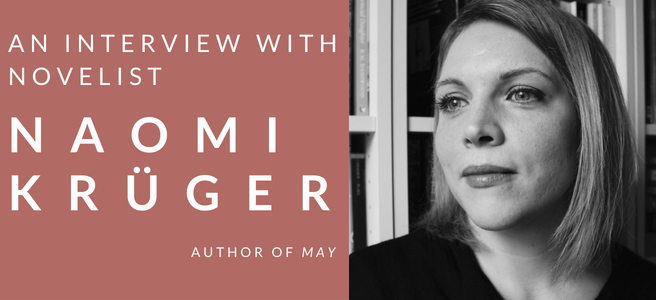
An interview with novelist Naomi Krüger

Interview novelist Naomi Kruger

Naomi Krüger MayNaomi Krüger’s debut novel, May, provides a sensitive and moving insight into the life of the title character. We see May in glimpses through the eyes of her loved ones, and from her own perspective: from the past to her present in a care home, where she now struggles to maintain her identity and memory as she wrestles with the effects of dementia.

What moved Naomi to write such a novel, and how did she go about it? In this interview, Seren’s Rosie Johns asks Naomi all about the creation of May.


What do you think it is about fiction that makes it a good form in which to address subjects such as dementia? 

Dementia is something that inspires a lot of fear and is often represented in the media in reductive and sensationalist ways. What I think fiction can do is give nuance to these kinds of representations. It can allow us to imagine what it might be like to live with a disease that affects memory, identity and perception. It can remind us that someone with dementia is more than a diagnosis. It can complicate the stereotype. But in some ways dementia resists narrative representations because the very things we need to write and read a story (the ability to make connections between past and present, the ability to anticipate what comes next) are disrupted. So it’s a complex thing to try to narrate in first person.


In May, there are several different narratives of which May’s story –despite being the thing to connect them all – is only a part. What influenced your decision to depict this story in such a way? 

I wanted May to be part of a community of voices. In some ways this was a practical choice because it would be hard to sustain a whole novel in such a fragmented consciousness. But I also wanted to show that May’s identity is inter-subjective. She has dementia but she is also part of a family and a community. She is influenced by her past experiences and her current environment in the care home. As I began writing the other narratives, interesting parallels emerged. Many of the other characters feel lost or alone. They forget things, lie or fail to speak. They are not as different from May as you might imagine at first. There are opportunities for connection and although the characters don’t always take these, I wanted readers to sense these spaces, to see May through the eyes of other people and build up a complex picture of someone who struggles to speak fro herself but still has things to communicate.


Given the delicate nature of the subject matter and the abstract style in which you approached it, did you find narrating May’s perspective difficult? Were there any other characters whose narratives were particularly easy or difficult to write? 

Capturing May’s perspective was a shifting experiment. At times it felt like a giant imaginative leap. Although she is a fictional character I did feel a sense of responsibility to research the effects of dementia and spend time with people who live with the disease to get a sense of the reality. But of course this varies from person to person and diagnosis to diagnosis. Ultimately it is an approximation of something often beyond language that has to feel as ‘real’ as possible. Afsana was another character that I felt a real responsibility to. I didn’t find her difficult to imagine or write, but because I was taking a cultural leap I spent a lot of time researching and trying to make sure the details were right.


Another character we get very close to throughout the novel is May’s grandson, Alex. He finds his grandmother’s deterioration particularly hard to deal with, especially when her memory of him fades. What would your advice be to those who find themselves in a similar position to Alex?

I think it can be very scary and upsetting to feel unseen and unknown by a person who has  previously been a big part of your life and identity. This can hit particularly hard for young people who are still in the process of finding their place in the world. I am very fond of Alex as a character. Although the book is not autobiographical his experience is very loosely inspired by my own reaction to my grandfather’s Parkinson’s related dementia. He lived with my family for my whole life and died when I was sixteen. When he began to get confused and hallucinate I didn’t deal with it very well. I went from daily contact to avoiding him as much as possible. When he was transferred to a home I didn’t visit him as much as I could have. I didn’t know what to say. My advice to my younger self would be to go anyway, to meet him wherever he is. To listen, to communicate through music or photographs or touch, to feel the fear and still go.


Finally, if you could recommend one book that readers of May will also love, what would it be?

I’m going to cheat and say three!

Moon Tiger by Penelope Lively: A book that plays with memory, hope and regret in really interesting and beautiful ways.

The Turning by Tim Winton: A collection of interconnected short stories set on the Australian coast. I love the way the characters re-emerge, trespass and become more and more complex with each story.

Olive Kitteridge by Elizabeth Strout: Another collection of stories, but this time focused on one main protagonist. I love how the book builds layers of relationships often through the mundane and domestic details, the moments that build and accumulate.


May is available from the Seren website: £8.99

Join our free Book Club for 20% off every book you buy from us.


Posted on

Short Story of the Month | ‘The Visit’, Jaki McCarrick

The Visit Jaki McCarrick Short Story of the Month

May’s Short Story of the Month is ‘The Visit’ by Jaki McCarrick, an award-winning writer of plays, poetry and fiction.

the scatteringMcCarrick won the 2010 Papatango New Writing Prize for her play, Leopoldville, and her play Belfast Girls, developed at the National Theatre London, was shortlisted for the Susan Smith Blackburn Prize and the 2014 BBC Tony Doyle Award. The Scattering, from which ‘The Visit’ is taken, was shortlisted for the Edge Hill Prize.

‘The Visit’ takes place against the backdrop of Bill Clinton’s visit to the border town of Dundalk in Ireland – a visit that was very much a part of the Peace Process. 


The Visit

This is an extract. Read the full short story for free on the Seren website.

It had been a day of weather: snow and wind, sunshine and rain.
Water dripped from the overhanging hedges in the drive and
the path was thick with pine needles. Brendan made a mental
note to sweep them up once Pat had gone. He stopped before
the gates and pulled his trousers up by their creases to check
his shoes and thought that maybe he should’ve worn his boots.
He walked on. Pat would make him forget. Pat could make you
forget all kinds of silly woes. He glanced over at Coogan’s and
noticed the stars and stripes flag, still and wet on the pole.
After McCaughey’s he looked over at Joy Callan’s neat line of
laundry crowning her raised side lawn: a small satin-rimmed
blanket, black stockings, two blue ballroom gowns, a pair of
orange nylon pillowcases. As he approached her house he saw
her in the yard, bright and chic in pink slacks and a tight white
jumper. She was raking up leaves. He watched her part the
dresses then yank the wet leaves into a pile. It made him smile;
she might have hung the gowns out after she’d raked, but Joy
always seemed to do things differently from others. And anyway,
he was glad, because she made the task so mesmerising. He
recalled how after her husband had gone she had kept body and
soul together by moonlighting, rather originally he thought, as
a mushroom picker in Clones. Otherwise, as a relief teacher
she had taught both his children in the Friary, though she had
not been popular. He waved and wondered would she be at
the Square tomorrow. He made a mental note to call in one
of these evenings with the picture of Sean’s wedding in the
paper.
Walking on, his thoughts returned to Pat. He looked forward
to seeing him. There would be much talk of the ‘great
adventures’ as Brendan called them, the London times, the days
of the Black Lion where he had been manager for nearly a
decade and where Pat had been its most notorious barfly. He
was proud to think he’d organised some of London’s most
celebrated lock-ins, booked musicians from Dublin and Doolin
and Donegal, and had the likes of David Bailey and Donovan
in attendance. Soon he and Pat would be reminiscing about
those times, about the dog races at Hackney and White City,
the times they’d played poker in Holland Park with Jack Doyle.
He walked up the cobbled lane towards the station. He could
see clearly on the cold day the sprawl of the town towards the
hills. The trees by the church were draped in ropes of white
lights, and a flurry of flags hung from Carroll’s Apartments. He
was amazed to think that here, in this small dot on the face of
the globe, he and Pat would stand together tomorrow evening
and see the President of America.
The big station clock said ten to three. He had a few minutes
yet to gather his thoughts, stare over at the glass wall of the
brewery. He sat outside on the iron seat. The gulls hovered
above him, filling the air with their cries. The sweet wort’s more
pungent today, he thought, as his gaze fixed on the huge copper
kettle glistening through the glass. It had been his first job in
the brewery to wash the kettle out once the sweet wort had been
siphoned off. He would then prepare it for the following
morning’s shipment of hops and grain. He had spent the best
part of five years inside that copper drum, up to his ankles in
the remnants of fresh hops, proteins and sticky clumps of
caramelised sugar. It had given him time to think; to put into
perspective all that had happened in ’74.
There was a rumble on the tracks. He turned and saw the
sleek green body of the Enterprise stack up like a metallic snake
along platform two. He walked over and watched from the
ticket office. The doors of the carriages swung open. Women
with pull-up trolleys, young men in dishevelled suits, Mrs Little
and her daughter, Edel. As the crowds dispersed he saw a ghost,
the tall, hulking frame of Pat Coleman standing stock-still on
the busy platform. The springy hair was all white, the once firm
chest now visibly lax. Brendan watched his friend remove a
cigarette from behind his ear, ask a girl for a light, then take
three or four concentrated puffs before flicking the stub behind
him onto the tracks. Pat’s short-sleeved shirt seemed frowsy
and unironed; the thick brown arms with their blue tattoos
recalled to Brendan Pat’s nickname on the sites: Popeye. Popeye
Pat had had the strength of ten men, and once, in a drunken
rage, Brendan had seen him flatten as many.
He followed Pat’s gaze. Up to the pale, elusive sky of the
North; out to the striking sweep of the white-capped hills, the
green spire of the Protestant church peeping up against them.
He began to feel unfamiliar pangs of pride for the town, as if
through Pat’s languorous impression, he, too, was glimpsing
it for the first time. The town was his wife’s town, and he had
always found it hard to appreciate its people with their
wariness, their industrious, practical approach to things. His
wife had been right; he had put up a resistance. She had
accused him often of hiding away in the brewery kettle like a
genie. But the friendships he had formed here had been
without the closeness of his London bonds. The men he knew
from the town were nothing like that famous man on platform
two.

Continue reading ‘The Visit’ for free here.


Posted on

Short Story of the Month | ‘Beginning Again’, Candy Neubert

Short Story Beginning Again Candy Neubert

Our Short Story of the Month for March is ‘Beginning Again’ by Candy Neubert.

Cornish Short Stories

The story will shortly be published in Cornish Short Stories: A Collection of Contemporary Cornish Writing (The History Press).

Candy Neubert lives in Cornwall but maintains strong ties with South Africa where she lived from 1990–1996. She has received numerous literary awards, including the Bridport Prize. She is the author of Foreign Bodies (Seren, 2009) and Big Low Tide (Seren, 2012).


Beginning Again

This is an extract. Read the full short story for free on our website.


She was coming straight up the beach towards him.
Through half-closed eyes, his head propped up against his rucksack, he watched her come. In silhouette at first, the kind of shape you just knew wasn’t English, couldn’t be English, but you couldn’t say why. Hair plastered back slick and wet off her face.
She came right up and stood over him, flicking water over his hot skin. Hey, he laughed. She lifted her towel, shaking it out like a sheet over a bed, lying down with a grunt.
He felt the cool coming from her, saw tiny droplets drying on her neck—Sonya, his mate, his life’s woman.
“Mm … now I’m hungry,” she said, not opening her eyes. He was, too. He sat up slowly, sun dizzy, and reached into the rucksack. Here it was, the container she always filled to the brim—he raised a corner of the lid and out came the smell of food, olives and onion and … just then he woke up, as the small figure of the boy crossed his line of vision, still quite far off, heading his way.

        The path went straight up from Porthcurno and he took it two steps at a time. Not really steps but boulders and cliff straight up from the car park, just the way to get going on a cool morning. They’d soon be warm and the mist would clear; it was only a sea mist. He positively sprang all the way, pretty fit for a business man, an office chap.

        When the path levelled out, he waited for Daniel. It was an inviting path, gorse on either side, beaten earth sprinkled with rabbit droppings, gulls laughing overhead. But he kept still and waited patiently. He was so effing patient. But Daniel wasn’t in sight.

        Finally.

        If shoulders could talk.

        If shoulders could talk, the rucksack on Daniel’s back would shrivel up and die. As if towels were heavy. Bulky, yes, but not heavy. He should try the picnic, if he wanted heavy.

        Also, Fuller had the surfboard, which was fair enough; his arms were longer. But Daniel was young and strong. They did sports training at school, didn’t they?

        The boy climbed the last bit and came to a halt five yards away, his eyes fixed on his shoes.

        Patience, mind. Fuller held his tongue and set off again. A fresh scent came from the pink flowers in the grass under the gorse, while the mist ripped back off the cliffs before his eyes—what luck, when it might have come in thick and spoiled everything.

        They did sports training and next year Mandarin, of all things. He asked Daniel about it yesterday, about the new school. The boy made a face, sticking his tongue over his front teeth. They’re all tossers, he said. He’d wanted to go to a school in Devon where they taught tractor driving.

        But they were going to have a day today, a great day. They were here, damn it. The sun was coming out and everything was sorted.

        A kestrel rose and hung in the air, over to the right. Fuller put his fingers in his mouth and whistled, and the boy raised his head.

        ‘What?’ he yelled.

        ‘Kestrel!’

        ‘Uh.’

        Now, five hundred yards ahead, a gate—it had to be the right place, the path veering off towards the cliff edge, dipping at the end, there! He stood, breathing hard. Sheer drop on one side and at his feet, far down, two perfect golden discs of sand divided by a bar of pale green water, just like the photo in the brochure. He’d found it. His chest was big and warm and happy. Daniel came up behind him.

        ‘There it is—great, eh? Looks like the Caribbean. And the sun’s out. Got all my cards in one shoe, boy.’

        ‘What?’

        ‘Y’know—got everything I want, all in one place.’

        ‘Whatever.’

        He was twelve.

        ‘Go careful now. Very careful. Watch it.’

        They did have to be careful; it was a real rabbit path, hard on the knees. Fuller couldn’t be sure that this sluggish figure was truly his son; maybe he’d dart ahead the way he always had. He put out a warning arm. Sheer drop. Careful.

        The body board was a nuisance. Glancing at the sand below, he saw people down there already. Damn. Not to worry, live and let live, hey.

        ‘I’ll let the board drop,’ he called. Please let it not break, he said to himself as it slithered from his hand, pivoted on one edge and shot out of sight. Fuller turned around to take the last slope of rock backwards.

        ‘Turn around,’ he called up.

        The boy would figure it out. Let him find out for himself, let him learn from something a bit tough.

        All the nooks and crannies and shady spots were taken. Fuller walked the whole beach and back to where the boy had stopped, his bag dumped on the sand. Every cleft and shadow already occupied. A middle-aged couple were sauntering from one of these nooks, and something about them had the boy transfixed. Fuller looked. Not a stitch. Starkers. Perfect mahogany tans all over, their buttocks going concave as they walked, the brown flesh in shallow folds. The man had a hat on.

        ‘Well, what is the world coming to?’

        ‘Where are we going?’ asked Daniel.

        ‘Here’s as good as anywhere, I guess.’

        Fuller began to unpack the stuff. He was sure he’d brought everything: shorts, food, sun lotion, you name it, he’d got it. He flipped a ball in the boy’s direction, and it rolled a way off.

        ‘Bring your water bottle?’

        Daniel looked at him.

        ‘You didn’t, did you? You forgot, didn’t you? Didn’t I say: bring your water bottle?’

        ‘Well I didn’t, did I?’

        ‘We’ll be short. Good job I brought mine, but we’ll be short.’

        ‘What you doing?’

        ‘Getting the towels out.’

        ‘That’s my bag.’

        ‘I’m getting the towels out of your bag, okay? Please Daniel, may I get the towels out?’

        No reply. The boy sat down, yanked his cap further over his eyes, and looked at the sea. Fuller pulled his own shirt off and wrapped a towel tight around his waist. Still warm and happy; that sea was calling.

        ‘Coming?’

        He and his son, racing down the sand.

        ‘Coming?’

Continue reading ‘Beginning Again’ for free here.